



Abstract
Through a review of Richard Rorty’s philosophical work and critiques of original planning documents from the Urban Renewal era, this paper makes three points. First, a pragmatist epistemological approach offers a better foundation for planning than the current communicative paradigm. Second, updating planning’s Enlightenment roots with Rorty’s view of moral progress as a process of “redescription” can help reduce the anxiety planners feel in putting forward bold visions. Last, Rorty’s concept of the liberal ironist provides an interesting model for planners that sees equal value in the contributions made by both the Jane Jacobs’s and Robert Moses’s of the field.
Keywords
Introduction
Contemporary city planning faces what seems like a paralyzing tension. On one hand, we long for the return of the romantic side of the enlightenment tradition from which our field was born—which provided the rational and moral basis to “make no little plans” and provide “the good” to the broadest possible spectrum of humanity. Witness several accounts in the field which claim that planning needs to regain its “visionary capacity” (Campanella 2011) or “reclaim progress” (S. Campbell 2006). On the other hand, we are acutely aware of the damage done by planners in the name of the good. Nowhere was this damage more glaring than during the Urban Renewal era of the mid-twentieth century, as the implosion of the Pruitt Igoe public housing complex, and Jane Jacobs’s scathing critiques still burn in our collective imagination as reminders of social disasters of displacement, top–down authoritarianism, and unforeseen environmental damage. Planning has also endured theoretical critiques from Marxists and poststructuralist thinkers who argue that planning, as a profession, is simply a tool for the dominant and powerful interests to exert their will or assert their dominant ideologies over the spatial domain of their cities (Allmendinger and Gunder 2005; Sandercock 1998; Yiftachel 1998).
As a result, the field has turned to an emphasis on process; attempting to tread lightly on normative proposals and instead facilitate a communicative exchange among stakeholders which is both “rational” and “nonauthoritative.” Yet, as critics have pointed out, there is no guarantee that plans generated by communicative processes will not be equally unjust or destructive (Fainstein 2010; Flyvbjerg 2001). As planning has the unique modus operandi of needing to “do something at the end of the day,” there is a need to reflect on this tension, and find—if not a solution—a way to operate in the world that balances this tension. In this paper, I argue that the neopragmatist work of Richard Rorty offers a palliative framework to the field and should hold a more prominent role in the canon.
Although several planning theorists discuss pragmatism as a philosophical basis for planning (Forester 1993, 2013; Friedmann 1987), only a few have covered Rorty’s work directly (Healey 2009; Hoch 1984, 2006, 2016). As a result, traditional planning theory pedagogy remains dominated by communicative theory and/or critical theory. Drawing on archival material from plans and speeches made during the Urban Renewal era, I make three distinct points to advance the argument that neopragmatism should gain greater prominence in the planning theory literature. First, I argue that a pragmatist epistemological approach—that truth is made rather than found—is both consistent with a critique of the rational planning model and offers a better model for planning practice than the current Habermasian-influenced paradigm of communicative rationality. Second, on the normative side, updating planning’s Enlightenment roots with Rorty’s antiessentialist, postmodern view of moral progress as a process of “redescription” will help reduce the anxiety planners feel in putting forward bold visions for the future. Last, Rorty’s concept of the liberal ironist provides an interesting role model for planners that sees equal value in the contributions made by both the Jane Jacobs’s and Robert Moses’s of the field.
Replacing “Knowledge” with “Social Hope”: A Pragmatist Epistemology for Planning
In Rorty’s opening autobiographical essay to Philosophy and Social Hope titled “Trotsky and the Wild Orchids,” he documents his ultimately failed intellectual quest to “hold reality and justice in a single vision” (Rorty 1999a, 7). By holding reality and justice in the same hand, Rorty is referring to a philosophy that provides both epistemological foundations and a mechanism to make universal moral judgments. If anything, the legacy of Richard Rorty’s career has served to tell us that philosophy cannot serve these two purposes simultaneously. For planning, the traditional rational planning model (RPM) served both 1 of these purposes and it was the dominant paradigm in planning practice through much of the twentieth century and in particular during the peak of the Urban Renewal era (1949–1974). On an epistemological level, the RPM provided a way of knowing and making plans that was based on the Enlightenment’s scientific tradition. Under this model, knowledge is produced through scientific inquiry, the ultimate function of which is to uncover objective truths about the physical and social world. Thus, the RPM takes as given an epistemological assumption that the objects of a planning process—people, neighborhoods, environments—have an essential true essence that can—with accurate tools—be observed and controlled through the application of human reason. This section begins with a Rortian critique of this traditional enlightenment view of knowledge and then presents examples of the RPM’s epistemological hubris based on documents from the Urban Renewal era.
Rorty neatly summarizes his view of a pragmatist theory of truth as “that of replacing the Greek and Kantian dualisms between permanent structure and transitory content with the distinction between the past and the future” (Rorty 1999b, 31). Thus, for pragmatists there is no single objective truth out there in the world waiting to be discovered. Instead, knowledge about the world is made through a human process that is structured by social factors which are constantly evolving. Specifically, Rorty argues that we drop the correspondence theory of truth that states that a given statement is true if it accurately mirrors or represents reality. This approach to truth is at the heart of Enlightenment epistemology and assumes that every object of study has a real essence that is universal and appears the same to all observers in all contexts. Just as the prisoners in Plato’s cave could only see the shadows of real figures moving along the wall, social scientists—in this view—can only measure appearances of real objects. What determines whether one piece of knowledge is true and another false is the degree to which they come closer to approximating this underlying essence.
Rorty (1979) devotes the majority of his first and most influential book, Philosophy and the Mirror of Nature, to critiquing the correspondence theory of truth. The pragmatist version of knowledge denies this appearance-reality distinction. Rather than a given statement or argument being true in the sense of exactly mirroring an objective reality, or essential nature, “truth” for pragmatists is simply statements or beliefs that can be justified. This is what Dewey referred to as “warranted assertability.” In this sense, what is true is necessarily dependent on the particular context within which statements are asserted and is therefore never fixed or universal. As Rorty writes, the only criteria we have for applying the word “true” is justification, and justification is always relative to an audience. So it is also relative to that audience’s delights—the purposes that such an audience wants served and the situation in which it finds itself. (Rorty 1998, 4)
For pragmatists then, the question of what statements are true and what constitutes useful knowledge for action is not an absolute. First, when Rorty (and Dewey before him) says that true statements are those that can be justified to a given audience, this does not mean any random group. Here the context refers to the set of actors engaged in trying to solve a problem. Second, we can understand the pragmatist definition of truth as running along a continuum from statements which are difficult to justify (e.g., 2 + 2 = 5) to those that are well justified and accepted by a large share of actors in a given context (e.g., the earth revolves around the sun). However, what is critical here is that history matters, in that particular statements can move from being unjustifiable or blasphemous—as was once the case for Galileo’s astrology—to “hard facts” that appear second nature in the current context. To clarify, saying that history matters simply means that what counts as a true statement is contingent upon previous debates and controversies that were “solved” through a pragmatic process.
Rorty goes on to argue that what the classical pragmatists were doing was “replacing the task of justifying past custom and tradition by reference to unchanging structure with the task of replacing an unsatisfactory present with a more satisfactory future, thus replacing certainty with hope” (Rorty 1998, 32). Since the common denominator of all planning activities is a future orientation (see Lake 2016), Rorty’s suggestion that knowledge be replaced by social hope is particularly useful.
If we take the view that all knowledge is contextual and open to future revision, how then can we form a basis for collective action and solve the contemporary urban challenges that plague us? Unlike other postmodernists, Rorty goes the furthest in explaining that even though what we call “true” is simply what helps us solve problems in a given context, we are not paralyzed to act. As he explains, For the pragmatist . . . “knowledge” is, like “truth,” simply a compliment paid to beliefs which we think so well justified that, for the moment, further justification is not needed. An inquiry into the nature of knowledge can, on his view, only be a sociohistorical account of how various people have tried to reach agreement on what to believe. (Rorty 1991b, 24)
The pragmatist version of truth as inherently contingent has been criticized for being relativistic, and in the realm of questions relevant to social science, irresponsible, for lacking the foundation to condemn certain practices as universally wrong, or unjust, or simply untrue. But the pragmatist notion of truth as prudently justified beliefs is quite similar to Habermas’s and is similarly informed by the linguistic turn in philosophy. Specifically, truth is arrived at through a process of intersubjectivity—or by justifying one’s beliefs to others through dialog. Rorty writes, For pragmatists, the desire for objectivity is not the desire to escape the limitations of one’s community, but simply the desire for as much intersubjective agreement as possible, the desire to extend the reference of “us” as far as we can. Insofar as pragmatists make a distinction between knowledge and opinion, it is simply the distinction between topics on which such agreement is relatively easy to get and topics on which agreement is relatively hard to get. (Rorty 1991a, 23)
In addition, Rorty responds to the charge of relativism with a definition of inquiry that still ascribes a significant role for scientists. He argues, even if there is no such thing as “the intrinsic nature of reality,” there are still causal pressures. These pressures will be described in different ways at different times and for different purposes, but they are pressures none the less. (Rorty 1991a, 33)
Thus, the use of knowledge in planning processes can be understood not as an attempt to “represent” reality but to elucidate the relationships between our environment and the social and physical outcomes that matter to us. It is here that one can draw a line that distinguishes the pragmatist view of knowledge from the classical Enlightenment view. Later, the goals of human progress are inextricably linked to both scientific discovery and the revelation of universal truths. For pragmatists, knowledge is simply a tool that helps society make decisions that can potentially aid in furthering human progress. In the pragmatists’ contingent understanding, knowledge helps builds the vocabulary necessary to describe human progress.
Thus, the production of knowledge for the pragmatist-influenced planner is less about providing technical certainty and more about helping to construct a better future. As argued above, for Rorty this amounts to “replacing knowledge with social hope”; a phrase that I would argue is highly consistent with the planning profession’s original historical focus on improving basic living conditions in the early industrial cities of Western Europe and the United States. The spatial knowledge that John Snow produced to document the spread of cholera in London in 1854 was produced with the hope of ameliorating human suffering. Similarly, the (moral) arguments made by housing reformers in New York City about the need for light and air in tenement buildings was based on knowledge—including the visual knowledge produced by Jacob Riis—that was essentially hopeful. This particular kind of knowledge was hopeful in that it described causal relations in a manner which implied direct policy changes, and ultimately led to a change in design practices and zoning law. These new planning tools institutionalized the provision of light and air as basic human needs that should be served. I argue that this pragmatist view of knowledge can help exorcize the current paralysis in the field, and help motivate the work of planners. As Rorty encourages, to say that one should replace knowledge by hope is to say . . . that one should stop worrying about whether what one believes is well grounded and start worrying about whether one has been imaginative enough to think up interesting alternatives to one’s present beliefs. (Rorty 1998, 34)
The Misuse of Knowledge: The Case of Urban Renewal
The work of John Snow and Jacob Riis described above are illustrations of how we can understand knowledge as “social hope.” However, it is important to realize that the purposes they were put to are relatively narrow
2
and concretely focused on reducing some aspect of human suffering. This is contrasted with the overarching epistemological approach of the RPM, which presupposes an instrumental logic and assumes that planners can know all they need to know to make “rational” plans. In addition, this empirical tradition—inherited from the Enlightenment—seeks to organize knowledge under broad theoretical frameworks which are then used to make generalizable claims. It is this tendency to generalize that gets large-scale planning into trouble. Nowhere was this more evident than during the zenith of the Urban Renewal era. Although Urban Renewal has been widely criticized and described as one of the planning profession’s most glaring failures (Caro 1974; Hall 1982; Scott 1998), it is nonetheless illustrative to return some original archival sources from the era to understand the specific ways knowledge was misused. In a speech titled “The Slum, the City, and the Citizen” made to the Chamber of Commerce in Saint Louis in February of 1954, the Administrator of the Housing and Home Finance Agency, Albert M. Cole, explained the motivation for expanded urban renewal authority and funding under the recently passed 1954 Housing Act as follows: The President has recommended a new broad-scale attack on those problems arising from the continued obsolescence and decay that has been going on in our cities. This is not just another program for another problem. This is a comprehensive plan of attack on all the factors that have already destroyed such a vast number of our homes and neighborhoods, factors that breed blight, and that are blanketing ever larger areas of our cities with slums.
3
(Emphasis added)
Later, he quotes directly from a subcommittee report of housing experts and planners who argue that the absolute necessity for lifting our sights from piecemeal thrusts at occasional slum pockets, to a broadscale integrated campaign that stretches across the whole spread of urban blight from the earliest symptoms to the last stages of decay . . . We must develop a broader, bolder and better balanced program for slum prevention and clearance than we have so far evolved. The tight relationship between cause and effect in slums must be held in tight focus, and we must insist in dealing with both if we are to get rid of either.
4
Collectively, these passages denote a high level of confidence in the understanding of “all the factors” that have led to urban problems and that planners have the ability to fully articulate and address the “cause and effect” process or slum development. In proposing a “broad” and “bold” program for the entire country, the Urban Renewal planners were implicitly imposing the generalized theory of neighborhood development to a wide variety of contexts, regardless of local variation. Finally, in following the logic of the ecologically influenced Chicago school, planners made the mistake of addressing their efforts to a nonexistent object—neighborhoods—which they imbue with not only with agency but what Rorty (in his critique of realists) would call a real essence. Explicit in the language used here to justify the expansion in depth and scope of urban renewal is the idea that its object (neighborhoods) can be infected by a disease called blight in much the same way that John Snow’s patients could be infected with cholera. Also implicit here is the idea that, through rational study and knowledge production, the real essence of a neighborhood can be understood and its condition accurately diagnosed.
Rorty’s suggestion that we replace knowledge with social hope, in this context, means that we make plans and proposed solutions for the future while also avoiding the temptation to connect our plans with larger metanarratives and/or grand theoretical schema. He does not suggest that knowledge is not important, or that facts are not real. He is simply suggesting that we be humbler about who can contribute facts, and that we focus their utility in a narrower sense of employing them to convince our fellow citizens to pursue some particular social hope, rather than thinking of facts as proving the existence of some larger theory. Although many theorists have criticized the epistemological basis of the RPM (see Flyvbjerg 2001; Friedmann 1987; Lindblom 1959; Sandercock 1998), the Rortian critiques presented here are both powerful, in that they highlight the overreach and hubris of certain large-scale plans, but are also hopeful, as they suggest a new way of thinking about planning research and the production of knowledge in support of certain narrow attempts to reduce human suffering. It is important to note that I am not claiming that Rorty’s ideas form a new epistemological foundation for planning. The work of classical pragmatists and Rorty himself is highly skeptical of foundations. Rather, I offer these ideas as a better model or metaphor for planning practice that the traditional RPM.
The Contingency of Justice and a Pragmatist Account of Progress as “Redescription”
The vocabulary of justice is necessarily public and shared, a medium for argumentative exchange. (Rorty 1989)
As planning’s large-scale failures have been criticized, the profession seems to have also abandoned the moral or normative hopes of the Enlightenment; namely, universal human rights and individual freedom. With the turn toward communicative planning and its emphasis on the process rather than substance of plans, some in the field lament that planning has lost its normative authority (Campanella 2011; Fainstein 2010).
5
Although many of the communicative theorists were influenced by pragmatist thinkers (Forester 1993; Healey 1993; Innes and Booher 1999), the emphasis of communicative rationality has focused more on epistemological critiques of the RPM and an attempt to improve the planning process rather than offering a framework for justice per se. Without the Enlightenment basis of universal human rights, where else can we look for a bedrock normative position from which to base our justification of certain plans or practices as being “just” or promoting “social justice”? Some planning theorists have even argued that by ceding the normative high ground held during the Urban Renewal period, planning has been co-opted as a mere tool for capitalist interests. H. Campbell, Tait, and Watkins (2013) argue that the confidence of the immediate postwar years in the capacity of public policy to affect positive change has dissipated. In its place is a neoliberal discourse, which disparages the effectiveness of public intervention and celebrates the efficiency and even morality of markets. (H. Campbell, Tait, and Watkins, 2013, 45)
Purcell (2009) and other critics of the communicative model similarly lament the move toward a procedural turn in planning and the need to reassert a stronger normative stance to articulate a “right to the city.” I argue that Rorty’s ideas can again serve as a guide for action and can provide a framework for planners to reassert a normative vision, yet without mooring such visions to a bedrock foundation. In particular, I argue in this section that his neopragmatist definition of “progress” as an open-ended, evolutionary process of “redescription” rather than a linear march through history toward a prespecified goal is particularly useful for planning. Accepting Rorty’s definition of progress would essentially free planners from having to be tied to a single, specific normative foundation (as was the case under the RPM).
Rorty extends the pragmatist position on epistemology to the question of social progress toward a more just society. If we adopt a Rortian view of progress, how then should we define progress in planning? I argue that progress is about solving problems and as Rorty points out, seeking to solve new problems that the planners of previous decades or centuries either ignored, created, or simply did not have the vocabulary to describe. Thus, it serves the neopragmatist version of progress when planners and urban thinkers describe the ways in which the status quo/business as usual practice results in unexpected consequences, or potentially disastrous impacts on resources or other goals that we collectively value. In this sense, the “problems” that planners attempt to solve are those that are socially produced and which planners themselves helped to describe in the first place. Or as Rorty writes, it helps to think of progress in the way in which Thomas Kuhn used to think of it: as the ability to solve not only the problems our ancestors solved, but also some new problems. On this account, Newton made progress over Aristotle, and Einstein over Newton, but neither come closer to the truth, or to the intrinsic character of reality, than any others. (Rorty 1998, 7)
This process of problem defining and solving extends to questions of social justice and moral progress as well. He offers the following example: the Athenian polis made moral and political progress over the Persian monarchy, the slavehood-abolishing nation-states of nineteenth-century Europe over the Athenian polis, and the social democracies of modern times progress over their proletariat-immiserating nineteenth-century predecessors. But none of these societies was closer to the Demand of Morality. (Rorty 1998, 7)
Take Rorty’s example of Athenian democracy making progress over the Persian monarchy. This can only be termed progress in that certain fundamental tensions or contradictions of the old system were resolved when the elite leaders of an ancient city-state found it more useful to make collective decisions through a deliberative process rather than following the dictates of a king. However, in articulating the solution that democracy provided, Athenian democrats lauded the moral goals of equality and rights. At the time, they did not even conceive of extending theses moral ends to the vast slave population in the Polis. It was only later that others—including Hume, Locke, Wollstonecraft and Douglas—pointed out the inconsistency between the goals of a democratic society and the treatment of slaves. It was through the process of problem describing—or in this case pointing out the hypocrisy of slavery in a so-called democracy—that moral progress occurs. For Rorty, this process amounts to redescribing rather than adhering to a predestined universal moral code. Thus, pragmatists can withstand the charge of moral relativism and clearly argue that slavery and other abhorrent practices is unjust. Yet this statement is made in an antiessentialist manner because we view the issue as being solved through the pragmatic heavy lifting of previous debates rather than a matter of finally accepting the revelation of a universal moral Truth.
From a normative or moral perspective, Rorty argues that progress is defined as the perpetual expansion of solidarity, or what he calls “we-intensions.” We-intensions are expressions of who belongs within our own moral communities. I interpret this as roughly equivalent to the constituencies for which planners plan (e.g., Chicagoans, North Carolinians, Americans). Interestingly, Rorty does not extend solidarity to the entire human race all at once. As ever the antiessentialist, he takes a decidedly ethnocentric view of solidarity. Ethnocentric is defined here not as implying that one race or worldview is superior to another, but rather as a recognition that solidarity, and thus definitions of justice or the “just city” are necessarily built-up within particular, historically contingent cultures. He uses an ethnocentric approach as a caution against any claims of universality—or that any one person or culture can provide a complete definition of justice which is applicable universally, everywhere and in every culture or context.
6
Specifically, he writes, The right way to take the slogan “We have obligations to human beings simply as such” is as a means of reminding ourselves to keep trying to expand our sense of “us” as far as we can. That slogan urges us to extrapolate further in the direct sense by certain events in the past—the inclusion among “us” of the family in the next cave, then of the tribe across the river, then of the tribal confederation beyond the mountains, then of the unbelievers beyond the seas (and perhaps last of all, of the menials who, all this time, have been doing our dirty work). This is a process which we should try to keep going. We should stay on the lookout for marginalized people—people whom we still instinctively think of as “they” rather than “us.” We should try to notice our similarities with them. The right way to construe the slogan is as urging us to create a more expansive sense of solidarity than we presently have. (Rorty 1989, 196)
For Rorty (1989), words like progress or social change are fundamentally about problem solving and resolving tensions between two or more deeply held beliefs or values. In Contingency, Irony, and Solidarity, he describes human beings as having “webs of beliefs and desires” which make up one’s “final vocabulary” through which they base their actions. Over time, some deeply held beliefs or desires may come into conflict with one another, or be put under pressure due to changes in the broader community. He argues that the resolution of such tensions is achieved, not by dropping the beliefs that are wrong or universally unjust, but by the creation of new vocabularies which resolve the tensions. Or, in other words, the redescription of social phenomena in new ways.
Rortian-oriented planners can also answer the charge of “how can you not say that practice X (e.g., slavery, racism, sexism) is always unjust” by suggesting that the pragmatist view of moral progress is actually more hopeful than any blanket universalist claim in that it is inherently an unfinished project. It is unfinished in that it allows for the continual expansion of solidarity to additional groups or people. In Rorty’s view of progress, we can accept the fact that our currently held beliefs—even some of our most deeply treasured—and the practices that stem from them, are open to future redescription and potential abandonment. In essence, the neopragmatist version of progress recognizes the fragility and contingency of any given society’s most deeply held norms and institutions. It recognizes that contemporary western liberal democracies—just as the Athenians before us—are capable of moral fallibility when viewed in hindsight.
Ultimately, I argue that Rorty’s neopragmatist approach to progress is particularly useful for planning thought; especially in its current condition. In particular, Rorty cautions us to think of progress not in a linear fashion, as in progress toward something universal. We should not attempt to talk about progress toward a single conceptually graspable vision of the “good city.” Instead, progress is an evolutionary process in which the normative foundations of our plans are subjected to constant redescription as new tensions are resolved and new problems framed. However, just as biological evolution is not understood as a linear process—with species morphing into an idealized platonic form—social progress, for Rorty, is an equally open-ended and contingent endeavor. When we say that progress is contingent and open-ended it is important to note that this version of progress does not necessarily mean that the future will always be more progressive or egalitarian per se. The process of redescription, being a social and dialogical process, is inherently open to the influence of power. Thus, Steven Lukes’s (1974) discussion of agenda setting power is a point well-taken here and is a caution to recognize that what gets redescribed and how it gets redescribed can be influenced by those who hold greater power. The key take away for planners is that rather than simply being facilitators of redecription for the sake of the powerful, they themselves can offer normative visions.
Finally, planners would also benefit from Rorty’s approach to questions of social justice or moral progress. For Rorty, the term justice is also open to constant redescription, and moral progress occurs by expanding solidarity, or to use a planner’s term “who has standing” in a cost benefit analysis. To summarize his view, Rorty argues that rather than seeking a model of thought or paradigm which can define justice or progress once and for all in a universal or essential sense, we should learn to operate in the face of contingency. In the following section, I describe how planners can take this neopragmatist conception of progress as a replacement for the Enlightenment’s foundationalism and continue to offer normative visions of a better future.
Planning’s Dialectical Moral Basis
What universals might we currently embrace as meaningful ideals upon which to let our imaginations roam as we go to work as insurgent architects of our future? (Harvey 2000, 248)
How do we regain the will to plan and solve the world’s most vexing problems? Can planners continue to offer bold, visionary ideas about how to reshape our shared physical and socioeconomic spaces, if the normative goals that underlie these ideas are merely “contingent” or subject to future “redescription”? Is it the case that we need “universals”—as the quote from David Harvey above suggests—in order “to let our imaginations roam?” To some extent, relying on a statement as universally true or good lends us a certain amount of fortitude or standing from which to base our specific plans or arguments for change. However, the neopragmatist framework rejects precisely this notion of universal moral claims and instead highlights the contingency of our notions of justice and “the common good.” Rorty argues, however, that recognizing the contingency of our beliefs should not lead us to paralysis. He lauds the words Joseph Shumpeter wrote, “to realize the relative validity of one’s convections and yet stand for them unflinchingly, is what distinguishes civilized man from a barbarian” (Rorty 1989, 46). However, within any given planning process, how is the process of normative authority left open to “redescription”? Where is the safety valve? As I argue in this section, the safety valve of redescription, comes not from the planning process itself, but from across the broader field of planning and planning thought, and even from critics from outside the field. It is through the continual back and forth between Harvey’s utopian “insurgent architects of the future” and the critics of these visions, that the field as a whole can amend the normative goals of planning schemes over time so that we prevent injustices from happening or extend rights to new constituencies that were previously ignored. The role of critique and redescription is the critical aspect of this “dialectical” process of planning’s normative evolution. 7 In this section, I use Rorty’s presentation of the “liberal ironist” as a metaphorical reference for the kind of critique that moves the field of planning forward. I again use an example of a highly criticized case from the Urban Renewal era to demonstrate this dialectical process.
The Liberal Ironist and the Value of Critique
Rorty (1989) develops the character of the liberal ironist in Contingency, Irony, and Solidarity. By liberal Rorty means someone who, in their discussions of public policy or plan making, is simply content to argue that society should avoid “human cruelty.” This is not liberal in the sense used by neoliberal theorists or libertarian thinkers. He simply means liberal in the sense of respecting the dignity of each human being and not being overly proscriptive or appealing to a universal definition of what makes an idealized human life. By ironist, Rorty means someone who is constantly questioning the core assumptions of their own beliefs and those of others in their community. Rorty argues that an ironists’ primary activity (beyond their own private questioning) is a critical redescription of the vocabulary others use to describe their own personal justifications for their private and public lives. Nonironists may have social hopes, which when turned into proposals for action, or more generally, plans, are literal descriptions of what should be done in the name of other people. He suggests that the closest thing that ironists (as inspired by thinkers like Nietchze, Foucault, and Derrida) can do to serve the public is to use redescription to expose the human cruelty done by others. 8 In the field of planning, this takes the form of highlighting the unintended effects of plans.
Rorty describes the back-and-forth process of change that results from such critical redescription as a process of playing the old off against the new. In particular, social criticism should not try to encapsulate all possible social needs and should not be universal or context-independent. He writes that the task of social theory [in an ideal society] is what Rawls calls “attaining reflective equilibrium” between our old moral principles and our reactions to new developments, our sense of the desirability or undesirability of various recently disclosed possibilities. Out of this attempt there will come initiatives to reform old institutions, or to replace them with new ones. The question of the intrinsic validity of the principles would not arise . . . So there would be continual social criticism, but no radical social theory, if “radical” means appealing to something beyond inherited principles and reactions to new developments. (Rorty 1998)
Rorty continues by arguing that such a society can escape the charge of relativism, or the charge of accepting institutions that perpetuate cruelty or injustice, by building in the function of criticism and debate. And that such criticism is the only way that unjust or cruel institutions or practices can change. In particular, he cites novels, films, journalists, and other forms of cultural criticism as the key drivers of such change rather than a new metanarrative or grand theory of social justice that finally gets things “right.” These are the products that ironists produce to alter existing vocabularies of justice. For example, he writes, Only detailed descriptions of pain and humiliation—descriptions that brought home to the powerless the contrast between their lives and the lives of others (thus inciting revolution) and brought the same contrast home to the privileged (thus inciting reform). (Rorty 1989)
Thus, there is a role for planners who uphold existing norms and try to implement plans based on them, a role I will term constructionist. Likewise, however, there is also a role for the planner who is ever critical of the plans offered by the constructionist.
This is precisely the function that critics of urban renewal played for planning. By pointing out how planners ignored the perspectives of whole neighborhoods or groups of citizens critics like Jacobs (1961), Gans (1962), Anderson (1964), Hartman (2002), and others exposed the hubris of the RPM under urban renewal. Voices from outside of planning and public policy offered critiques that similarly ironized the key justifications for urban renewal schemes. The historian Arnold Hirsch (1998) documents the social ills and racial exclusion that resulted from the process of letting local city councils implement the citing of the large-scale public housing funded under the urban renewal period. Similarly, the psychologist Mindy Fullilove (2016), in her book Root Shock, documents the long-term impact that urban renewal’s displacement and relocation had on the social psychology of African American communities in Pittsburgh.
How Ironism Works: Critiquing a Failed Urban Renewal Plan
Let us look at one case of urban renewal that, in hindsight, seems an egregious example of top–down overreach on the part of a planning profession which was self-possessed enough to think it had all the relevant “scientific facts” at its disposal and the tools (e.g., eminent domain) to make the needed changes. Although rather small in scale compared with more high profiles, examples of urban renewal, Chicago’s Central Englewood Urban Renewal Plan (IL-47), drafted during the early 1960s and fully implemented by 1969, epitomizes the failures of urban renewal. The plan called for the redevelopment of a then-thriving retail center at 63rd and Halsted streets on Chicago’s South Side into a suburban-style mall complete with a covered pedestrian mall and acres of newly landscaped surface parking lots (see Figure 1). A critical aspect of the plan was the creation of new arterial roads encircling the shopping center to allow for more “efficient” traffic flows that allowed shoppers from outside the immediate neighborhood of Englewood to better access the site by car. The effect of such a plan—no doubt evident to both the professional planners who titled it the “perimeter plan” (see Figure 2) and advocates such as the Englewood Businessmen’s Association and the Chicago City Bank and Trust—was to wall off the shopping center from a neighborhood in racial and economic transition. To accomplish this “modernization,” the plan called for the demolition of 311 structures (out of which only 119 were deemed “blighted”) containing six hundred families, 76 percent of whom were nonwhite.

Map of blighted properties and properties with blighting influences proposed for demolition in the central Englewood project area, 1963.
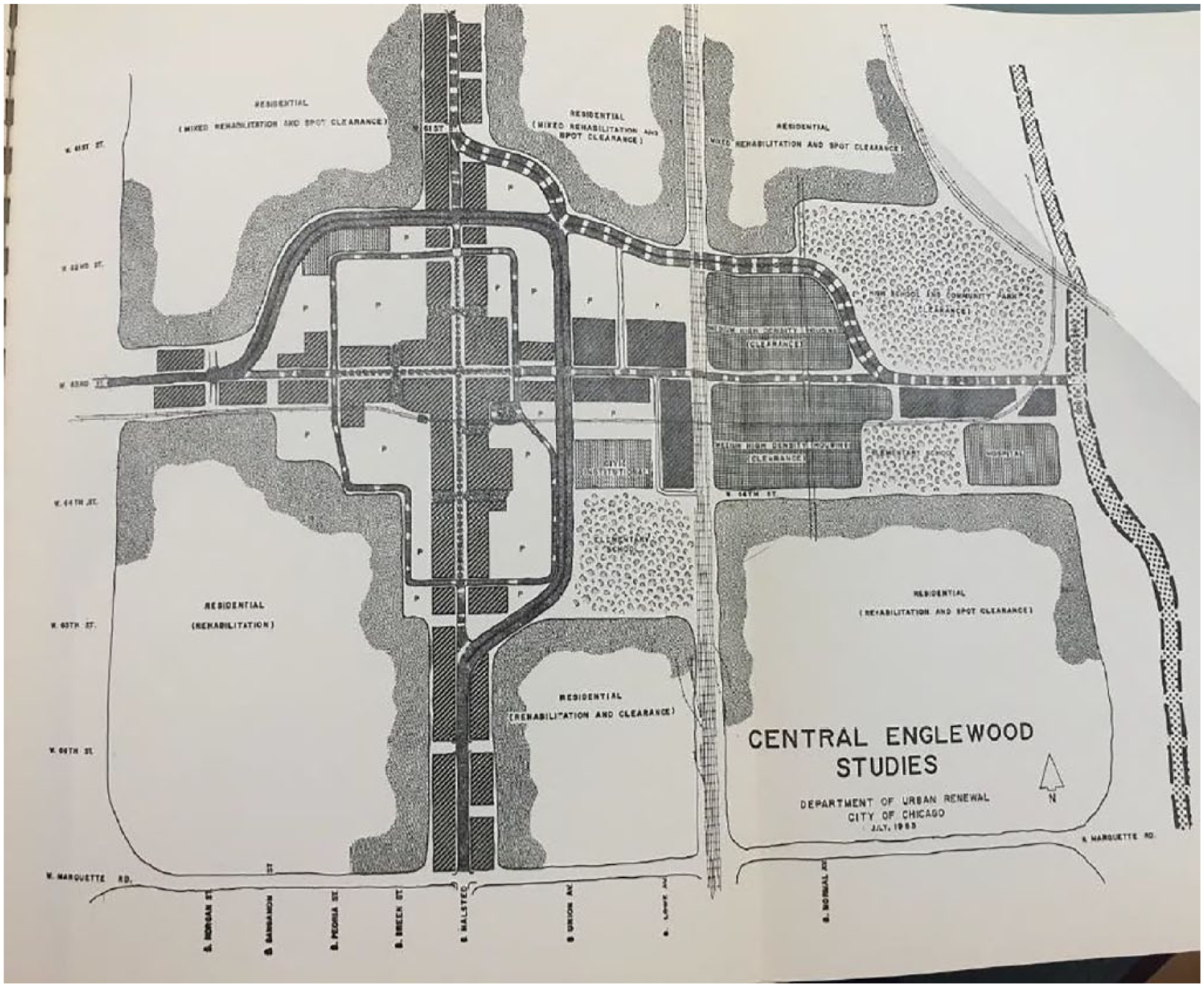
Conceptual “perimeter plan” for the central Englewood urban renewal project (IL-47).
Among those displaced were several dozen African American homeowners living in housing that was not substandard and who had just managed to purchase a home in Englewood despite the structural and institutional barriers set up against them at the time in Chicago’s racially changing neighborhoods (Hirsch 1998; Satter 2009). The plan was highly criticized at the time for its top–down implementation, secrecy, and disparate racial impacts. For example, two community organizations—the Green Street Association and the Citizens’ Housing Committee—sued the Chicago Department of Urban Renewal in 1964 to obtain copies of proposed plans for demolition and relocation which the City refused to make public. This dispute gained wider attention when high profile civil rights activists, including Albert Raby of the Coordinating Council of Community Organizations (CCCO), supported the lawsuit and connected the displacement under the Central Englewood plan to broader issues of unfair housing and civil rights. In a letter to the U.S. Department of Housing and Urban Development (HUD) Secretary Robert Weaver opposing the project Mr. Raby wrote, Chicago urban renewal severely affects Negro and other minority families—eighty-five per cent (85%) of families displaced by urban renewal clearance from 1948 through 1962 were non-white. This displacement frequently is accompanied by violations of the National Housing Act and the requirements of the Urban Renewal Administration, e.g., community participation in planning, availability of other housing to non-whites, and relocation standards. Relocation into neighborhoods with overcrowded, segregated and inferior schools is common.
9
These critiques did not ultimately stop or substantially change the final plan, yet they did become a part of a broader political movement that ultimately challenged the practice of displacement and highlighted unfair housing practices in the city. Although the pedestrian mall was officially dedicated in 1969, the economic trend planners predicted for the neighborhood and the City were grossly inaccurate and most businesses closed by the mid-1980s, prompting the City to remove all the suburban-style infrastructure (at further public cost) in 1985.
How do we judge the justness of this case? On one hand, we can say that planners should have known better or that they were simply cruel to ignore the obvious injustice involved in tearing down the homes of African American families who had struggled against long odds to become homeowners amid the racial maelstrom that was in Chicago in the 1960s. On the other hand, these claims, while “true” under the vocabulary of contemporary planning thought, seem to assume a preexisting moral yardstick by which we should judge all plans. This is precisely the kind of universalist logic that Rorty’s pragmatism cautions us against. To understand why, and to understand why his pragmatist viewpoint is actually more helpful and hopeful, we need to consider the role of ironists in changing the vocabulary of planning itself.
The case of Central Englewood in the 1960s could not be viewed as a complete failure if it were not for the work of urban renewal critics who challenged the project from a variety of perspectives be it direct—as Al Raby did during the 1960s—epistemological—can planners ever really have complete information or fully comprehend the complexity of the problem at hand (Lee 1973)—or procedural—were the interests of the less powerful fully taken into account (Davidoff 1965). These are the writers and thinkers who I am calling—for the purposes of this analogy—ironists. Their critiques, collectively, have given us a new vocabulary from which to judge urban renewal and, under this new vocabulary, the Central Englewood case is an obvious failure and morally reprehensible. The critiques of the ironists in planning give us the “new vocabulary” with which to call plans unjust.
Thus, Rorty’s language gives us a way to understand changes in dominant planning models, or “best practices” not as a process of winnowing down to the “true” best or even “optimal” practice. In particular, I argue that the use of Rorty’s pragmatist ideas offers a more insightful synthesis of proposal and critique than other planning paradigms. Instead, the progression of ideal models and their critiques is a process of continually changing vocabulary. Although many words in the profession’s vocabulary are relatively stable and mundane (e.g., floor area ratio, traffic count, density), the meaning and social content of other words has changed radically in the last fifty years (e.g., blight, development, rights to the city). It is through the work of critical ironists that our collective vocabulary changes and that our understanding of justice is redescribed.
From Critical Ironism to Utopian Social Hopes
Although the previous example illustrates the essential role of “ironists” in the field of planning thought, they cannot work alone. Jane Jacobs needed a Robert Moses; not simply as a foil to respond to but as an intellectual and moral nemesis against whose ideas and practice she wove her critiques and generated a wealth of “new vocabulary” for the field. This then implies a strong role for those in the planning profession whose gifts lie not in critical irony, but in enthusiastic optimism and visionary utopian proposals. Rorty himself is very limited in his specific normative recommendations and says little useful for urban planning per se, beyond “avoid being cruel.” What guidance he does offer for those who seek to offer normative propositions in their plans for the “just city” is twofold. First, be bold in your proposals, but focus on well circumscribed, even banal aspects of human suffering that could be avoided through planning. Second, do not think that the role of utopian thinking is to actually achieve the finished product.
On the first point, I argue that in a Rortian-oriented planning paradigm, one needs to continue to offer normatively explicit plans based on a clearly articulated set of goals for human development, but without attempting to link these goals to a grand “metanarrative” about the way all human beings should live, or a universal theory of behavior. He develops his cautious approach to development in an essay published after the fall of the Berlin Wall titled “The End of Leninism: Vaclav Havel and Social Hope.” Here he not only describes and lauds the “social hopes” of various grand metanaratives throughout history—especially socialism—but also recognizes the potential harm caused by the creation of all-encompassing societies based on these ideas (e.g., The Stalinist Soviet state). Pointing to leaders like Havel, a noncommunist reformer who took power after the first free election in Czechoslovakia, he rejects the need to link all of our proposals to a single ideology and focuses instead on the relatively banal tasks of reducing cruelty and extending solidarity to an ever larger circle of people. He writes, A lot of fantasies can stand on their own without being twined around some large conceptually graspable object . . . They are concrete fantasies about a future in which everybody can get work from which they derive some satisfaction and for which they are decently paid, and in which they are safe from violence and from humiliation. We intellectuals have, since Plato, supplemented these small concrete, local, banal fantasies with a larger, blurrier, more sophisticated fantasies. (Rorty 1998, 232)
In this light, the gross errors and inequities propagated by the planning profession were not committed because the impulse to intervene and help ameliorate conditions in cities was wrong or misguided. Instead, the mistakes were made when planners attempted to link their “fantasies” to larger metanarratives about the fundamental nature of cities or neighborhoods. The case of Urban Renewal as described above illustrates this precisely. The impulse to intervene in cities and ameliorate overcrowded conditions and deteriorating housing was based on a legitimate social hope aimed at reducing human suffering. Yet the implementation and the ends-means justifications—as they became tied to a larger metanarrative—went awry.
Rorty’s second point—that we need utopianism to have progress—underscores the dialectical role of ironism. If ironism is the antithesis, then utopianism is the instinct in planning that offers new theses. Yet, as Rorty cautions, the process never ends in a final synthesis.
He writes, A historicist and nominalist culture of the sort I envisage would settle instead for narratives which connect the present with the past, on the one hand, and with utopian futures, on the other. More important, it would regard the realization of utopias, and the envisaging of still further utopias, as an endless process—an endless, proliferating realization of Freedom, rather than a convergence toward an already existing Truth. (Rorty 1989, xvi)
Thus, planning needs this dialectic between its optimistic, pragmatically focused members and its critical ironists. A healthy balance keeps at bay both harmful grandiose schemes and paralysis. This is something that David Harvey recognizes as well. In his essay titled “The Right to the City,” Harvey (2003) writes about just this dual role for utopian thinkers and their critics in shaping a definition of justice over time.
In practice, we suspect Thrasymachus was right: justice is simply whatever the ruling class wants it to be. Yet we cannot do without utopian plans and ideals of justice. They are indispensable for motivation and for action. Outrage at injustice and alternative ideas have long animated the quest for social change. We cannot cynically dismiss either. (Harvey 2003, 940)
In principle, anyone can offer a utopian vision for a better future or a just city, opening themselves and their plans up for future “redescription” and critique. Likewise, anyone can critique plans and highlight the unintended consequences and concealed injustices. Yet, it is important to acknowledge that power imbalances abound. This acknowledgment is critical on the ground as those with more resources are better able to proselytize their own visions and those with privileged voices are more likely to have their critiques heard. Yet, this recognition does not detract from the overall argument that it is through the back-and-forth dialectical process that “progress” occurs.
Conclusion
As we look back at planning’s greatest failures—epitomized by the Urban Renewal period—one could conclude that advocating for new large-scale Federal interventions to improve conditions in our cities and regions would be unwise. Given all the criticism of past injustices, the general public might well be justified in ignoring planners most innovative or bold solutions. In this essay, I have argued that the neopragmatist philosophy of Richard Rorty offers planning theorists and practitioners a set of tools to respond to this mistrust. First, I argued that a pragmatist epistemological approach offers a better way to critique the RPM which is also largely consistent with the current communicative paradigm. Second, unlike the communicative model, Rorty’s pragmatism also provides space for normative propositions under a definition of moral progress that is antiessentialist and based on redescription rather than adherence to a single universal vision. Third, Rorty’s concept of the liberal ironist, illustrates a way to think about the planning field as a whole—as evolving in a dialectical manner—that allows space for both utopian dreamers and postmodern critics.
Finally, some may suggest that through my criticisms of both the RPM and the communicative planning paradigms, I am arguing against the goals of the Enlightenment itself. These goals such as enhanced freedom, individual liberty, and the promotion of the common good can still remain bedrock features of planning. On the contrary, in following a Rortian path in planning theory, we can begin to do what he suggests at the end of his essay “Justice as a Larger Loyalty” (Rorty 2007), which is to “peel apart Enlightenment liberalism from Enlightenment rationalism” (Rorty 2007, 443). What this amounts to is keeping the goals of the Enlightenment while getting rid of the epistemological baggage which required linking our plans to grand metanarratives or fully specified scientific models. Ultimately, I argue that Rorty’s work deserves a more central position in planning theory pedagogy.
Footnotes
Acknowledgements
The author would like to thank Andrew Whittemore, Nichola Lowe, Emil Malizia, Noreen MacDonald, Nikhil Kaza, Eric Lester, and Ashley Tindall for their critical comments, feedback, and discussion about the central ideas in this paper. The author would also like to thank the three anonymous reviewers for excellent suggestions and comments; the conference participants and discussants at the Joint AESOP/ACSP Conference, July 15 to 19, 2013, in Dublin, Ireland; and Andrew Guinn, Tony Sease, and the doctoral students in PLAN 891 seminar on social justice and the city. All opinions and arguments are the authors alone.
Declaration of Conflicting Interests
The author(s) declared no potential conflicts of interest with respect to the research, authorship, and/or publication of this article.
Funding
The author(s) received no financial support for the research, authorship, and/or publication of this article.