




Abstract
Using observed single-family house sales in the inner-ring suburbs of Chicago from 2010 through 2017, this paper uses a multilevel mixed-effects model with crossed random effects to estimate the effect that millennium mansions—new, large single-family houses—have on the sales prices of nearby single-family houses. Controlling for property, sale timing, and surrounding neighborhood socioeconomic characteristics, the study finds that mansionization is associated with an increase in the sales prices of neighboring houses. Long-term residents of a neighborhood undergoing mansionization should not fear a decrease in their house values; however, decreases in neighborhood affordability may result in exclusionary displacement.
Introduction
Single-family houses dominate the American housing stock. The United States experienced a boom in the construction of single-family housing in the post–World War II period, but more than 18 percent of the single-family housing stock in the country today has been built since 2000 (U.S. Census Bureau 2017a). The largest of these new houses, termed millennium mansions (McAlester 2015)—also known by the pejorative moniker McMansions—often stand in sharp physical contrast to older single-family houses built in the pre- and postwar eras. 1 In the 1950s, the average single-family house was a two-bedroom, one-bath single-story residence with less than 1,000 square feet of living area (National Association of Home Builders 2000). The square footage of newly constructed single-family houses has increased steadily over time. In 2014, more than half of the new single-family houses completed annually in the United States were larger than 2,400 square feet, and more than 10 percent exceeded 4,000 square feet (U.S. Census Bureau 2017b). In some cases, houses are built on newly subdivided, previously undeveloped land on the fringe of metropolitan areas, but new single-family houses are also built in established urban and inner-ring suburban neighborhoods. When a millennium mansion is built in an existing inner-ring suburban neighborhood, the contrast between it and the neighboring original houses is often acute, sparking the consternation of neighborhood residents.
Millennium mansions are criticized for their negative physical impact on adjacent properties and on overall neighborhood character, their large ecological footprint, and the inconveniences they cause during construction. Antimansionization advocates in favor of increased regulation of millennium mansions argue these points, and they often also contend that new houses lower the values of adjacent properties. For example, the advocacy group No More McMansions in Los Angeles (2017) states explicitly on its website, McMansions loom over their neighbors. They take their air and light and privacy, and they hurt their property value. Mansionization spoils the scale and character of established neighborhoods. And it prices more and more families out of the market.
This is one example of the commonly held belief that new, large single-family houses built in older, more modest neighborhoods have a negative effect on the property values of original houses. The idea that millennium mansions reduce the property values of their neighbors may be attributable to the evaluation of original houses relative to adjacent millennium mansions—by virtue of a direct visual comparison with a newer, larger house, original houses may seem less desirable. Or the belief may stem from a perception that millennium mansions, because they are so physically different from the other houses in older neighborhoods, diminish the collective aesthetic character of the neighborhood and, therefore, reduce the neighborhood’s desirability overall.
The ideas that the McMansions hurt neighboring property values and simultaneously price families out of the market are at odds. If millennium mansions cause the prices of neighboring houses to decrease, they might actually increase the affordability of the original housing in the neighborhood overall. Conversely, if the construction of millennium mansions raises the prices of neighboring houses, it could contribute to neighborhood-wide decreases in affordability and potentially the exclusionary displacement of long-term neighborhood residents. Previous scholarly research on this topic yields mixed findings. There are many reasons for long-term residents to dislike millennium mansions in their neighborhood, but it is not evident that the fear of declining house values is justified. This paper addresses the overarching question: what effect do millennium mansions have on the values of adjacent single-family houses?
This study contributes empirical evidence to the discussion of the impact that millennium mansions have on their suburban neighborhoods. The impact they have on the experience and visual assessment of nearby houses is of particular interest. This study is specifically constructed to tease out the effects of millennium mansions located within the “viewshed” of a house—on the same street and within 100 meters (328 feet)—on the values of single-family houses. Controlling for individual property, sale timing, and surrounding neighborhood socioeconomic and school district characteristics, this study examines the effects that the construction of millennium mansions has on the sales prices of nearby single-family houses. The paper then discusses the implications of these findings for inner-ring suburban neighborhoods.
Background
In her survey of American house styles, McAlester (2015, 707) situates single-family housing built since the mid-1990s within the architectural history of American houses, describing the identifying features of millennium mansions as, Complex high-pitched roof, with lower cross gables or hips; tall entry features, one and one-half to two stories high and often arched; dormers; multiple wall-cladding materials, may be applied to a single surface like wallpaper; differing window sizes and shapes, sometimes arched; commonly asymmetrical and with tall vertical appearance.
These millennium mansions are a much-maligned form of contemporary housing. Journalistic articles such as “Help, a McMansion is going up next door” and “Your neighbor’s building a ‘McMansion’: What McNow?” respond to and fuel a disdain for millennium mansions and the belief that new large houses will lower the values of nearby properties (Brashich 2016; Morell 2008). Neighborhood groups espoused this specific claim in the recent fight over antimansionization legislation in Los Angeles (No More McMansions in Los Angeles 2017). Although it makes sense intuitively, the fear is largely empirically unsubstantiated. Previous empirical studies of the effect of surrounding house size on house sales prices offer conflicting findings.
The term mansionization implies a metamorphosis of the built environment. Millennium mansions may be built in new suburban subdivisions on previously undeveloped land; however, in pre- and postwar, inner-ring suburban neighborhoods, millennium mansions are often built through infill redevelopment—an original single-family house is demolished, and a new, much larger and more expensive single-family house is built in its place (Charles 2017; Pinnegar, Freestone, and Randolph 2010; Randolph and Freestone 2012; Wiesel, Pinnegar, and Freestone 2013). The mansionization of a neighborhood occurs incrementally over time and is spatially clustered (Charles 2017). Within a suburban neighborhood of older single-family houses, the first millennium mansions often create a jarring physical juxtaposition. As increasing numbers of millennium mansions take the place of original houses, the suburban neighborhood is physically transformed, creating pressure on remaining houses to be redeveloped. Once this begins to occur, houses may then be sold primarily for the value of the land they are built upon. The physical change in neighborhoods through mansionization may then be accompanied by an economic and social transformation.
The idea that a larger house built nearby might decrease the desirability of a smaller adjacent house has its roots in the theory of conspicuous consumption and the positional nature of housing. Conspicuously consumed goods are those whose purchase is motivated by the public display of wealth and status (Veblen 1899). Hirsch (1976) identifies these as positional goods. Previous empirical studies find housing to be moderately positional (Alpizar, Carlsson, and Johansson-Stenman 2005; Charles 2018; Solnick and Hemenway 2005); thus, the value of housing is measured not only by its inherent qualities—size, finishes, materials, and so on—but also by those qualities relative to its neighbors (i.e., reference group). Frank (2007) writes that given the choice between a 4,000-square-foot house in a neighborhood of 6,000-square-foot houses and a 3,000-square-foot house in a neighborhood of 2,000-square-foot houses, most people would choose the 3,000-square-foot house, even though the absolute consumption is less. Given this rationale, relatively smaller houses within the immediate neighborhood of millennium mansions should sell for a discount, and millennium mansions, which would then convey greater relative status, should sell for a premium.
Haurin (1988) argues that atypicality—the degree to which a house deviates from the standard appearance of the neighborhood—affects sales prices of houses within a neighborhood. Houses that differ in easily observable ways from their neighbors sell for less because atypical houses take longer to sell, and owners may have to discount the price of such houses to sell within a similar time period to a typical house. Similarly, Turnbull, Dombrow, and Sirmans (2006) empirically find that larger houses in the neighborhood (defined as a one-half-mile radius) of smaller houses sell at a discount compared with houses in homogeneous neighborhoods. However, they also find that atypically small houses compared with their neighborhoods sell at a premium, but that the premium dissipates as the disparity increases. This rationale contradicts the conspicuous consumption argument; millennium mansions within the immediate neighborhood of smaller houses should sell for a discount, and relatively smaller houses within the neighborhood of millennium mansions should sell at a premium.
Leguizamon’s (2010) findings from her empirical study of the effect of the average house size of several different reference groups on house prices contrast to the findings of Turnbull, Dombrow, and Sirmans (2006). She finds that houses that are larger than their eight nearest neighbors and houses with a smaller difference between them and the average of the largest of the eight nearest neighbors sell at a premium. She attributes this finding to the idea of conspicuous consumption, which she terms the envy effect: homeowners derive value from having a home that is relatively large with respect to its neighbors. Leguizamon (2010) observes the opposite effect with respect to more distant houses, in which case an increase in average house size of those that are more distant (i.e., the ninth through sixteenth neighbors) is associated with an increase in sales price. Leguizamon and Ross (2012) find that households value relative size, but absolute size dominates.
Zahirovich-Herbert and Gibler (2014) tested the effect of new, atypically large housing located one-quarter, one-half, and one mile away from existing housing. They find that concentrations of larger-than-average houses have a positive, albeit small, effect on existing house prices, particularly when the new large houses are located within one-quarter mile. This effect is particularly evident for relatively low-priced houses. They find that similar-sized houses constructed nearby exert a downward force on existing house prices because they directly compete with the existing houses. When larger new houses are constructed, however, the appeal of being located near the new, “better” housing raises prices. They find that the spillover effects of new construction change with increasing distance from the existing house: the positive effect of new large house construction decreases at one-half mile.
Previous studies on this topic define a neighborhood as the area within a radial distance surrounding the subject house, irrespective of the road network or housing density. Thus neighboring houses in these studies may in fact be next door, but they may also be located on an adjacent street or on the other side of a physical barrier (e.g., an arterial road or a river). When using a neighborhood boundary of a one-quarter-, one-half- or one-mile radius, the new larger houses may be located at such a great distance from the subject house that its actual effect on the appraisal of the subject house may be negligible. This technique for establishing neighborhood boundaries does not take into consideration the physical form of the neighborhoods or focus on neighboring houses that may have the greatest effect on the actual evaluation and visual assessment of a subject house, that is, houses within view of the subject house.
Previous studies measure the effect of the average size of houses within a neighborhood on the sales prices of other nearby single-family housing, regardless of vintage. This study is unique in that it specifically focuses on the effect of mansionization—the construction of single-family houses built in or after 2000 and over 2,500 square feet—on adjacent original housing. Mansionization is an ongoing process in many cities and inner-ring suburban areas. As new millennium mansions are proposed in existing neighborhoods, residents are often compelled to engage in a policy discussion of the negative effects and potential regulation of them. This empirical study contributes evidence to this debate.
Data and Method
This study uses a multilevel mixed-effects model with crossed random effects to estimate the effect that millennium mansions have on the sales prices of nearby houses. The study area—sixty-five municipalities in suburban Chicago—was chosen because of its established high rates of mansionization. 2 Data on all single-family houses sold between January 1, 2010, and December 31, 2017, located in the study area were obtained from CoreLogic, a company that compiles and maintains property data. The dataset was reduced to only “arm’s length” single-family residential property sale transactions that took place during the seven-year period. 3 If a property was sold more than once during the period, only the most recent sale was used. Transactions for less than $100,000 and duplicate contemporaneous transactions for the same property were discarded. 4 The sales transaction data were then matched by Property Index Number to 2017 property characteristic data maintained by the Cook County Assessor’s Office, also obtained from CoreLogic. The resultant database of single-family residential properties (N = 53,990) was then matched spatially to census tracts and high school districts and then associated with census data and school quality data, respectively. The road network driving distances to downtown Chicago (the intersection of State and Madison streets) and to O’Hare airport were also determined for each subject property. 5
Previous studies have defined neighboring houses (reference group) as being located within a certain straight-line distance of a subject house, or have used statistical methods to determine the optimal number of nearest neighbors (e.g., Leguizamon 2010). These methods may include in the reference group neighboring houses that are physically near, as measured by a straight-line distance, but that are not most influential to the visual and experiential appraisal of a subject house. Using these criteria, neighboring houses may be located on other streets or on the other side of geographic barriers. This study more precisely establishes the reference group that has the greatest effect on the visual assessment of a subject house. The reference group of interest includes only houses within the “viewshed” of the subject house, defined in this study as single-family houses that are located on the same street and within 100 m of the subject house. The 100-m threshold is well established in the urban design literature as the “social field of vision,” the point at which one can distinguish movement and detail (Gehl 2010, 34). This metric is used as maximum viewing distance for stadiums, auditoriums, and civic spaces, and is seen in the configuration of St. Peter’s Square in Rome, Italy; the Place des Vosges in Paris, France; and the Mughal Gardens of the Taj Mahal in Agra, Uttar Pradesh, India, among others (Sussman and Hollander 2015). The method used in this paper is arguably a rough approximation of the zone of visual influence—road geometry, trees, and other obstacles may obstruct the viewshed from the subject houses; however, this method aptly identifies the most proximal residential context within which visual evaluations of a subject house are made.
Houses were classified as millennium mansions if they were built in 2000 or later (but prior to the sale year of the subject property) and have a floor area of more than 2,500 square feet. McAlester (2015) and journalistic mentions of McMansions note the emergence of millennium mansions as a distinct single-family house form/style during the 1990s. Studies of mansionization note an acceleration of millennium mansion construction in the early 2000s (Charles 2017). The size threshold used in this study is intended to identify houses that reflect the substantial increase in size of millennium mansions compared with housing built earlier. The threshold of 2,500 square feet is approximately one standard deviation greater than the average square footage of houses built before 2000 and is confirmed in the literature as a reasonable lower bound of the size of a typical millennium mansion.
The Cook County Assessor’s Office data were matched with each property sold to determine the property characteristics of the hundred nearest properties to each subject property, measured by a direct line distance. Of those hundred nearest neighbors, the properties located within the viewshed of each subject house, that is, on the same street and within 100 m, were identified. All subject houses with at least five other houses within their viewsheds were then identified as having zero or exactly one, two, three, four, or five or more millennium mansion neighbors, and a categorical variable was created. Whether or not each subject house had zero or exactly one or two millennium mansions located directly adjacent (i.e., next door) to it was also determined, and a categorical variable was created. The percentage of millennium mansions among houses within each subject house’s viewshed and the percentage of millennium mansions among the hundred nearest neighbors (limited to within one-eighth of a mile) were calculated. Figure 1 presents a diagram of an example subject house, the houses within its viewshed, and its 100 nearest neighbors. Figure 2 presents a photograph of the house and its directly adjacent (next-door) neighboring houses. In this example, four of the houses within its viewshed (21%), one next-door neighbor, and 21 percent of the hundred nearest neighbors are millennium mansions.
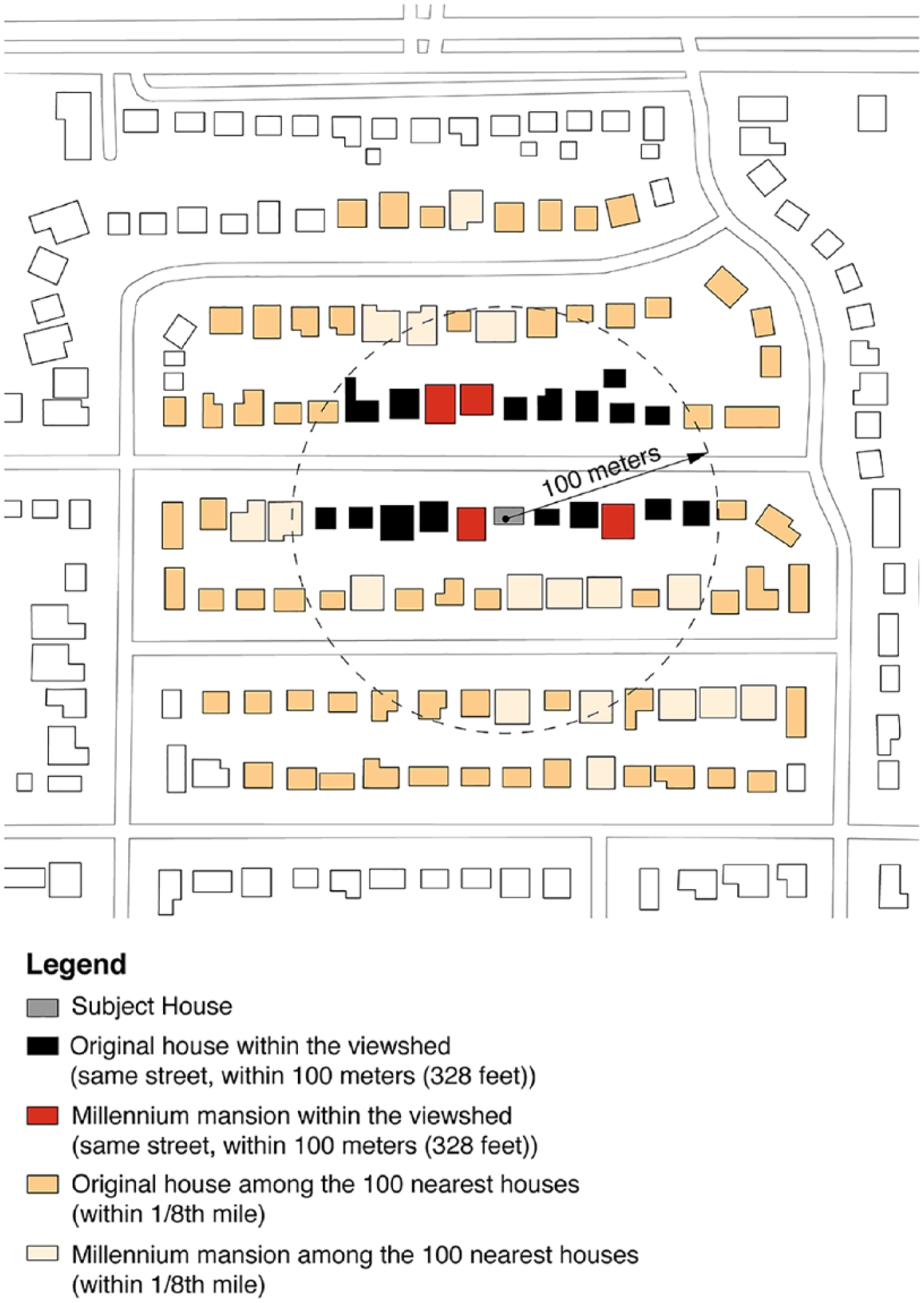
Diagram of an original single-family house relative to its surrounding houses.
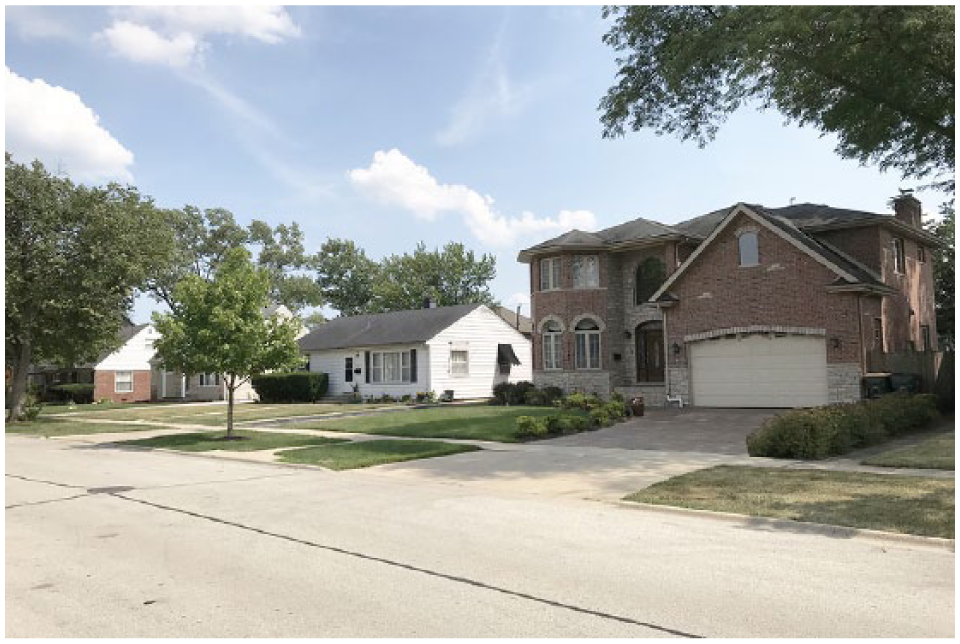
Photograph of a subject house built before 1970 (white, center) and its directly adjacent (next-door) neighbors, an original house (left) and a millennium mansion (right).
This study uses hedonic analysis to determine the association between the number of millennium mansions within a house’s viewshed and its sales price. Hedonic house price models are based on the theory that the price of any given house represents the price of a bundle of attributes, which are revealed in a market transaction (i.e., a property sale). The estimated parameters of hedonic house price models signify the relative contribution of each included characteristic. In this study, the sales price is specified as a vector of property characteristics, H; a vector of sale timing variables indicating the year and season in which the house was sold, F; a vector of socioeconomic and school district characteristics in the census tract and school district within which each house is located, N; and a vector of neighborhood property characteristics—the variables of interest—including the percentage of millennium mansions among the hundred nearest neighbors and within the viewshed of each subject house and two categorical variables measuring the number of millennium mansions within the viewshed of and directly adjacent to each subject house, M.
Multilevel mixed-effects hedonic models address a common challenge in housing market research—the individual property as the unit of analysis with data measured at the property level and at one or more geographic levels (e.g., census tract level, school district level). A multilevel mixed-effects model accounts for the correlation of observations within geographic levels/clusters. McMillan and Chakraborty (2016), Chasco and Le Gallo (2013), and Pfeiffer and Molina (2013) are but a few of the recent housing studies that use this type of model. In this study, the dependent variable (i.e., log of the house sales price) is measured at the individual house level, and the data are clustered by census tract (neighborhood socioeconomic data) and high school district levels (school quality data). Thus, a multilevel mixed-effects model with crossed random effects was used to control for factors associated with census tracts and high school districts that may affect the house sales price. The data were analyzed using the mixed package in Stata 14.2. Census tracts and high school district were specified as random factors to control for their intraclass correlation. 6 The log-linear model specification is used in this study; therefore, the estimated coefficient of the categorical variables that measure the number of millennium mansions within each subject house’s viewshed and the number of millennium mansions located immediately adjacent (next door) to each subject house can be interpreted as the percentage change in the dependent variable (i.e., house price) compared with houses with zero millennium mansions located in the viewshed or next door, respectively.
The association of nearby millennium mansions with house prices may differ depending on the era of construction of the subject houses (i.e., pre- and postwar houses vs. other millennium mansions). For that reason, the full dataset was divided into all houses built before 1970 (N = 42,634) and millennium mansions—houses built in 2000 or after and with a floor area of more than 2,500 square feet (N = 3,407). While the selection of a cut-off year is arguably arbitrary, 1970 is used to allow for at least a thirty-year age difference between original houses and millennium mansions, which is done to better test the effect of substantially newer houses on original house sales prices. The separate millennium mansion grouping captures only the effect of new, large house construction on other millennium mansions. Table 1 presents the descriptive statistics for the property, sale timing, neighborhood and school district, and neighboring property characteristics.
Descriptive Statistics.

More than three-quarters of the 42,634 original houses sold between 2010 and 2017 did not have any millennium mansions among the houses within their viewshed. Of the 22.6 percent of original houses that had one or more millennium mansion neighbors, the average percentage of millennium mansion neighbors is 14.0 percent. Millennium mansions, on the other hand, are more often surrounded by other millennium mansions; 75.1 percent of millennium mansions sold between 2010 and 2017 had at least one other millennium mansion within the viewshed. Approximately 8.0 percent of all millennium mansions constructed are entirely surrounded by other millennium mansions within their viewshed. This may reflect millennium mansions not built as infill in pre- or postwar suburban neighborhoods but as part of an entire neighborhood of millennium mansions on previously undeveloped land. On average, 23.1 percent of the viewshed of millennium mansions is other millennium mansions. Histograms of the percentage of millennium mansions within the viewsheds of original houses and other millennium mansions are presented in Figure 3.
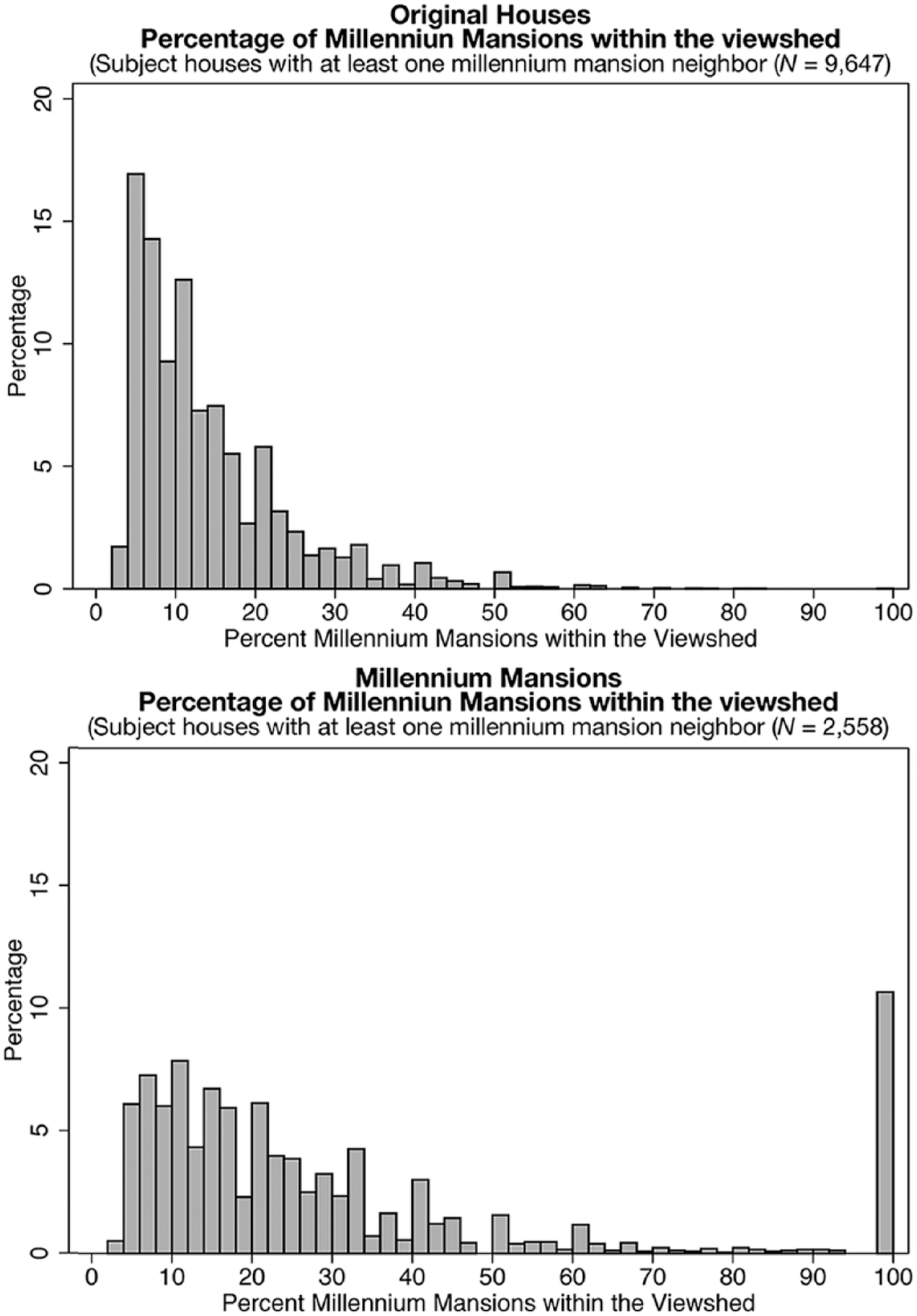
Histograms of the percentage of millennium mansions within the viewshed (i.e., located on the same street and within 100 m) of original houses (top) and other millennium mansions (bottom).
The house and property characteristics, H, include several standard physical features. These features were included to control for differences among the subject houses. The full list of house and property characteristics is included in Table 1. Also included are whether the sale was a foreclosure sale and whether the property was purchased with a mortgage. The travel distances to the Chicago Loop and O’Hare airport were included to capture locational advantages of each property. Sale timing characteristics, F, are included to capture variations in sales price due to the year in which each property was sold as well as the season. Socioeconomic and school district characteristics, N, include the median house value in the census tract of each subject house as well as the percentage of people in professional and management occupations, non-Hispanic black residents, Hispanic residents, and Asian residents obtained from the 2008–2012 American Community Survey and the 2010 decennial U.S. Census. Last, a measurement of school district quality—average ACT score—for the high school district in which each house is located was obtained from the Illinois State Board of Education (2018).
The final category, neighborhood property characteristics (M), includes the variables of interest. The percentage of millennium mansions in the overall vicinity of each subject house (i.e., the hundred nearest neighbors within one-eighth mile of each subject house) and the percentage of millennium mansions within the viewshed are included. A categorical variable that indicates whether each subject house has exactly zero, one, two, three, four, or five or more millennium mansions in its viewshed as well as a categorical variable measuring whether each subject house has exactly zero, one, or two millennium mansions directly adjacent (next door) are also included.
The property, neighborhood, school district, and neighboring property characteristics vary considerably between original single-family houses built before 1970 and millennium mansions. The two groups are physically quite different—the average floor areas of original houses and millennium mansions are 1,650 square feet and 3,783 square feet, respectively. As expected, the average original house floor area and parcel size are smaller, and the sales price is lower, on average, than that of millennium mansions. The original houses also have fewer bathrooms and fireplaces than millennium mansions, and fewer properties have central air conditioning, a finished basement, or an attached garage, and are two stories or more. A higher percentage of original houses are constructed of masonry, have asphalt shingle roofs, and are split-level than the millennium mansions. A higher percentage of millennium mansions was purchased in a foreclosure sale, and a lower percentage was purchased with a mortgage compared with original houses. Original houses are located closer to the Chicago Loop than millennium mansions. The median house values within the census tracts of millennium mansions are higher on average than those of original houses. The census tracts of millennium mansions have a higher percentage of non-Hispanic white residents and lower percentages of non-Hispanic black, Hispanic, and Asian residents than the census tracts of original houses. Last, the average ACT score is higher on average in school districts of millennium mansions than those of original houses. Millennium mansions have higher rates of having exactly one, two, three, four, and five or more millennium mansions within their viewsheds and of having one or two millennium mansions as next-door neighbors. Descriptive statistics are presented in Table 1.
Results of the Hedonic Price Models
The results of the hedonic price models are presented in Table 2 for the group of original houses and in Table 3 for the group of millennium mansions. For both groups, all three models include property characteristics, sale timing variables, and neighborhood and school district characteristics as controlling variables. The models also include the percentage of millennium mansions among the hundred nearest neighbors of each subject house as a controlling variable. And each of the three models includes the census tract and school district as random effects. The first model includes the percentage of millennium mansions located within the viewshed of each subject house. The second model includes the categorical variable measuring the number of millennium mansions within the viewshed of each subject house. The third model includes the categorical variable that measures the number of immediately adjacent (next door) millennium mansions to each subject house. The pseudo R2 values for the three models using the original house data are each 0.80; the pseudo R2 values for the three models using the millennium mansion data are each 0.77.
Mixed-Effects Multilevel Regression Estimates (Original Houses Built before 1970, N = 42,634).

Note: Coeff. = coefficient; Sig. = statistical significance.
Mixed-Effects Multilevel Regression Estimates (Millennium Mansions Built in 2000 or after and over 2,500 square feet, N = 3,407).

Note: Coeff. = coefficient; Sig. = statistical significance.
Turning first to the group of original houses (built before 1970), results of the regressions indicate that a 10 percent increase in the percentage of millennium mansions within a house’s viewshed is associated with a 1.2 percent increase in the sales price (p < .01). Results also indicate that exactly one millennium mansion within the viewshed of an original house is associated with a 1.3 percent increase in the sales price (p < .01) of an original house compared with other original houses with no millennium mansion neighbors, controlling for property and neighborhood characteristics. The effect of nearby millennium mansions on the sales prices of original houses increases as the number of millennium mansions in the subject houses’ viewsheds increases. The presence of two millennium mansions is associated with a 2.5 percent higher sales price (p < .01), and the presence of three millennium mansions is associated with a 3.0 percent higher sales price (p < .01) than those of original houses with no millennium mansions within their viewshed. Exactly four and five or more millennium mansion neighbors are associated with 4.4 and 8.1 percent higher sales prices (p < .01), respectively. One millennium mansion located directly adjacent (next door) to an original house is associated with a 1.4 percent higher sales price (p < .05) than original houses with no millennium mansions next door. When both of an original house’s next-door neighbors are millennium mansions, the associated sales price is 6.1 percent higher (p < .01) than that of original houses with no millennium mansions next door. The random effects of both census tract and school district were both statistically significant (p < .01), indicating the correlation of observations within the geographic clusters. Table 2 presents the complete regression results for the original houses group.
A similar pattern emerges for the sales prices of millennium mansions sold between 2010 and 2017. A 10 percent increase in the percentage of millennium mansions within another millennium mansion’s viewshed is associated with a 1.3 percent increase in the sales price (p < .01) of that house, controlling for property and neighborhood characteristics. The results for the presence of exactly one other millennium mansion within the viewshed are not statistically significant; however, the presence of exactly two millennium mansions within the viewshed of another millennium mansion is associated with a 4.1 percent higher sales price (p < .10) than that of millennium mansions with no other millennium mansions nearby, ceteris paribus. Exactly three, four, and five or more millennium mansions within the viewshed of another millennium mansion are associated with increases in sales prices of 5.8 percent (p < .05), 6.6 percent (p < .05), and 9.1 percent (p < .01), respectively. Millennium mansions also benefit from having other millennium mansions located immediately adjacent (next door) to them. One millennium mansion next door is associated with a 5.3 percent higher sales price (p < .01) than that of millennium mansions with no other millennium mansions next door; two millennium mansions next door are associated with a 9.0 percent higher sales price (p < .01) than that of millennium mansions with no other millennium mansions next door. The random effects of both census tract and school district were both statistically significant (p < .01), indicating the correlation of observations within the geographic clusters. Table 3 presents the regression results for the millennium mansions group.
Concluding Discussion
Owners of older single-family houses should not be afraid that if millennium mansions are built in their neighborhood, they will hurt their property values. Much the opposite. This study finds that the presence of millennium mansions within the viewshed of an older, original suburban house (built before 1970) is associated with an increase in the sales price of that house, holding constant the characteristics of the house, its neighborhood, and its school district. In fact, the construction of exactly one millennium mansion within the viewshed of an original house is associated with a sales price premium of 1.3 percent, compared with original houses with no millennium mansions nearby. The premium increases to 8.1 percent when five or more millennium mansions are located within the viewshed of an original house.
Millennium mansions themselves benefit from having other millennium mansions as their neighbors, providing insight into the observed spatial clustering of mansionization. Millennium mansions exert a similar positive influence on the sales prices of other millennium mansions within their viewshed as they do for original houses. The presence of exactly two other neighboring millennium mansions is associated with a sales price 4.1 percent higher than one with no other millennium mansion neighbors. This premium increases to 9.1 percent for those with five or more other millennium mansions in their viewshed. A millennium mansion that is one of the first of its kind in the neighborhood would be expected to garner a sales price less than it would if it had two, three, four, or five or more other millennium mansions as neighbors. Thus, by constructing a millennium mansion in a pre- or postwar neighborhood where others had already been built, the owners of that house may realize a higher sales price than that of an identical house in a neighborhood in which there were no other millennium mansions.
Millennium mansions, by virtue of their relative size compared with neighboring older, original houses, serve as signifiers of the wealth and status of their owners. The findings of this study, however, do not support the theory of conspicuous consumption in terms of house prices. Millennium mansions are no doubt consumed conspicuously, but the increased status that they embody is not reflected in a sales price premium. In fact, the most conspicuous millennium mansion—one surrounded by older, smaller original houses—sells for a discount compared with one surrounded by other millennium mansions, ceteris paribus. Similarly, any purported decrease in status that comes from a millennium mansion being situated next door to an original house does not result in a decrease in the sales price of the original house. On the contrary, these findings suggest that the sales prices of original houses increase when millennium mansions are constructed nearby. It does not necessarily speak to the evaluation of the house itself, however, because the property may become more valuable as land for redevelopment and not for the older house built upon it.
Contrary to the theory of atypicality, this study finds that older and smaller original houses do not sell at a discount when millennium mansions are built within their viewshed. As the atypicality of the original house increases, that is, the number of millennium mansions in its viewshed increases from exactly one to five or more, the sales price premium increases. Older, inner-ring suburban neighborhoods are often completely built out, meaning that there is very little undeveloped land on which to construct new single-family housing. In this particular context, the construction of millennium mansions is often achieved through redevelopment in which the millennium mansions replace original houses. When a cluster of millennium mansions appears in a neighborhood of original older houses, it puts financial pressure on the remaining original houses to be redeveloped as millennium mansions. Thus, this finding is not a repudiation of the atypicality theory, in that the sales price of atypically old and small original houses is not reflective of the house itself but of the value of the land for redevelopment. As the spatial cluster of millennium mansions increases, so does the pressure on original houses for redevelopment. This cross-sectional study of the effects of mansionization on house sales prices is unable to discern the temporal dimensions of the effect. Future research is needed to better understand how the sales price premium in a neighborhood undergoing mansionization changes over time.
Mansionization may portend a unique suburban form of gentrification. This study finds that mansionization is associated with neighborhood-wide house price increases, which may make neighborhoods unaffordable to people who might otherwise have been able to afford to live there. Exclusionary displacement occurs when the cost of housing in a neighborhood increases so that households similar in socioeconomic status to the ones that originally settled in the neighborhood are prohibited from moving in (Marcuse 1985). Some of the municipalities included in this study are highly affluent; the majority are middle- and upper-middle-class areas that are highly desirable for their proximity to employment and commercial centers and to public transportation as well as for their high-quality schools. As mansionization raises the prices of the original single-family houses in the neighborhood, suburbs that may have been affordable to low- and middle-income households are no longer so, and households may be pushed to suburbs that lack the amenities they desire.
The potential for suburban gentrification in a form previously observed in urban areas is muted since many suburban residents own their homes. Residents who rent their homes may be subject to rent increases that result in their indirect displacement. Owners of older and smaller original houses, on the other hand, may reap financial rewards from nearby mansionization if they sell their house. But long-term residents who would like to continue living in the neighborhood do not benefit financially in the short term. Long-term homeowners are in one sense immune from gentrification-based increases in the cost of housing, in that their mortgage payments are based on the amount paid to purchase (or refinance) the house and do not increase with the real-estate market as rents may. However, increasing property values may result in increased property tax assessments and, therefore, higher property tax bills. Increasing property tax liability may make continuing to own the house financially difficult and result in the indirect displacement of suburban single-family homeowners.
This study does not support the assertion that mansionization negatively affects neighboring property sales prices; however, it does provide evidence that mansionization may price families out of the market, as claimed by No More McMansions in Los Angeles and other antimansionization advocacy groups. Municipalities have at their disposal policy tools to affect the physical form of mansionization in their jurisdictions. Zoning regulations, such as floor-area ratio, daylight plane, setback, and building height requirements, may be deployed to control the overall size of millennium mansions. While not directly addressing their effect on neighborhood house prices, controls on the size of millennium mansions may at the same time limit their impact on neighborhood affordability. The physical impacts of millennium mansions on their nearest neighbors—increased traffic during construction, shadows cast and views obstructed, and diminution of the original neighborhood aesthetic character—often draw vocal criticism from neighbors. But since homeowners may benefit from mansionization through increases in their house values, as the findings of this study demonstrate, the neighborhood-wide decreases in housing affordability and exclusionary displacement often are not among individual homeowners’ primary criticisms. Moreover, local municipalities also benefit from increases in their residential tax base. Suburban policy makers may be reluctant to restrict their constituents’ ability to profit from the redevelopment of their property and may not be overly concerned with housing affordability. Thus, they may be averse to enacting zoning regulations that limit the size of new single-family houses. It may fall then to regional planners and advocacy groups to address the effects of mansionization on housing affordability.
Footnotes
Acknowledgements
The author would like to thank the three anonymous reviewers for their helpful comments.
Declaration of Conflicting Interests
The author(s) declared no potential conflicts of interest with respect to the research, authorship, and/or publication of this article.
Funding
The authors disclosed receipt of the following financial support for the research, authorship, and/or publication of this article: This research project was supported by the Institute for the Social Sciences, Cornell University [Small Grants Program].
