



Abstract
This article presents a new theoretical approach for assessing the implementation process of transit-oriented development (TOD). Through a conceptual framework, based on the notion of the urban project as an instrument of public policy, it highlights two distinct processes at work in the implementation of every TOD project: territorialization and differentiation. The first suggests that there are necessarily discrepancies between metropolitan planning strategies and the very local nature of the TOD projects. The second suggests that implementing a TOD project is an incremental process rooted in local policy conditions that must be factored in at every phase of the implementation process.
Introduction
This article aims to present a new conceptual framework about transit-oriented development (TOD) articulated through our research. It proposes to define TOD as an urban project bringing together different actors to produce an integrated urban development. As such, this conceptual framework draws the attention on the TOD implementation conditions at the local scale. Focusing on the processual dimensions underlying the project, it allows us to in-depth analyze the coordination problem at play, the solutions chosen by actors involved to solve it, and then its effects on the local urbanism
A genealogy of urban planning policies implemented in major North-American cities over the last twenty-five years reveals a similar trajectory of the spatial planning models that underlie new so-called “sustainable” neighborhoods (Joss, Cowley, and Tomozeiu 2013). Inspired by the doctrines of New Urbanism and Smart Growth, this movement has most notably resulted in the TOD model (Calthorpe 1993). Developed in the United States, this model was widely adopted throughout Canada (Filion and Kramer 2012; Grant 2009). However, very few studies to date have closely examined the conditions of the TOD implementation process in the North-American context. Our ongoing research is therefore fills this gap by evaluating the implementation of TOD projects in the Montreal metropolitan area. In this context, our research aims to answer two questions: How do local agents in charge of TOD projects manage to achieve urban planning transportation coordination while balancing the objectives of the TOD project with local urban planning challenges? How are the TOD projects carried out and what effect do they have on urbanism? The main objective is not to measure how TOD affects mobility practices or spatial development on a regional scale, but rather to analyze the changes in local urban planning practice brought about by the adoption of the TOD principle. First, TOD is defined as a coordination strategy involving the fields of urban transportation and urban planning. Second, it is conceptualized as a local project.
The coordination sought-after in the TOD can be defined as a wicked problem for local public action. Hence, in an effort to understand how the actors involved resolve such issues at the local level, the urban project can be understood as a new instrument of public action. This project-oriented approach to collective urban action reveals the congruence and incrementalism underlying collective decision-making processes. It also highlights two distinct processes at work in TOD implementation: territorialization and differentiation. The first suggests that there are necessarily discrepancies between metropolitan planning strategies and the local and pragmatic nature of any given TOD project. The second suggests that beyond the specificities of metropolitan governance and spatial planning mechanisms, implementing a TOD project is an incremental process firmly rooted in local conditions (actors, resources, tools) that must be factored in at every phase of the overall TOD implementation process.
This article is divided into five parts. The first presents the turn toward sustainable development in Canadian spatial planning—a trend that focuses on promoting the TOD model. The second part details our methods. The third part analyzes scientific knowledge on the implementation of TOD and emphasizes areas that have been overlooked by research—how the process of TOD implementation actually unfolds and the effect this has on urban planning. The fourth part reports on TOD implementation in the Montreal region. And, finally, the fifth part presents the new theoretical framework.
The Critical Turn Toward Sustainable Urban Planning: (Re)introducing Coordination Principles without Providing Proper Toolkits for Cooperation
The critical turn toward sustainability has had a profound effect on the strategies of metropolitan public actors. The vision underlying most regional spatial planning is largely based on the necessary integration of urban and transport planning (a long-standing issue), which has been embodied in new urban design models (such as the TOD model). At the same time, despite these strategic changes in planning, very few recommendations have been made with regard to the collective action methods and instruments to implement these models and promote coordination between two distinct fields.
Integration of Urban Planning and Transportation Planning: Updating an Old Issue with New Spatial Models
The spatial planning strategies of countless Canadian cities began making the shift to sustainable development as early as the 1990s (Filion 2003; Grant 2002). Toronto and Vancouver, however, proved to be the true frontrunners in this respect, introducing these concepts back in the 1970s (Filion 2003; Grant and Bohdanow 2008). At the other end of the spectrum, Montreal has only jumped on the bandwagon in more recent years (Roy-Baillargeon 2015). Through the adoption of the principles of Smart Growth and New Urbanism, public discourse is changing and evolving, as are theories on urban development and strategic planning content to implement (Grant 2006; Ouellet 2006). Planners have increasingly adhered to these principles due largely to intense criticism of the urban models that prevailed in previous decades (Filion 2003). Now at the heart of the political agendas of every major city, these principles are being implemented on an operational level, through the programming of new urban projects at the local level.
In this context, these projects are inspired by models of multiple variants that go by different names: TOD, complete community, urban village, eco-district and so on (Grant 2009; Ouellet 2006). Despite their different appellations, these models share a common objective (Fischler 2003)—projects based on these models focus primarily on ensuring a better integration of urban planning and transit transportation, particularly rail or buses modes. However, this objective of coordination dates back to the 1950s in certain Canadian cities (Filion and McSpurren 2007). Despite this, operationalizing such coordination remains a major challenge to this day. The latter has essentially been analyzed from the perspective of how urban transportation is governed at the metropolitan level and how institutional coordination processes have evolved at the regional level (Matkin and Frederickson 2009; Pemberton 2000). However, these particular approaches are not sufficient to help us understand what needs to be done at the local level in order to implement TOD projects. As such, sustainable urban planning makes local actors responsible for integrating urban planning and transportation without always having the proper tools to go along with this objective.
TOD: A Normative Urban Model Looking for a Modus Operandi
TOD project presents a standard design (diversity, density, and design) and anticipates specific effects, but it is complex to implement (Cervero and Kockleman 1997). Faced with this complexity, the model fails to provide a clear method for overcoming these planning and implementation issues.
In the same way as the Smart Growth movement, the TOD model codified by Calthorpe grants priority to the connection between public transportation networks and urban development, both at the local level and the metropolitan level (Calthorpe 1993). Inspired also by New Urbanism (Fischler 2003; Grant 2002), it proposes a spatially deterministic model with an organic relationship between urban forms and social relationships. Spatial innovations introduced through TOD must generate new virtuous social practices (in terms of residential trajectories and daily mobility). Furthermore, the TOD model is expected to have an impact at multiple levels. At the metropolitan level, as TOD projects may support a regional polycentric development, they are supposed to provide an alternative to urban sprawl and automobile dependency (Carlton 2007; Cervero 2007; Feldman, Lewis, and Schiff 2002). At the local level, they provide a strategy for redeveloping and revitalizing living environments through the introduction of new livable and affordable neighborhoods (Cervero, Ferrell, and Murphy 2002; Jacobson and Forsyth 2008).
The targeted objectives of TOD projects can prove difficult to obtain the anticipated results (Boarnet and Crane 1998). The challenge is essentially twofold. First, such projects rest upon the fundamental principle of urban and transportation planning coordination (Hull 2011). This implies a multilevel and multi-sectoral system of actors. The leadership of TOD planning can vary according to context and can be assumed either by public transit authorities or by the spatial planning authority at the regional level, or even by the federal authority at the upper level (Dumbaugh 2004). At the local level, detailed TOD programming and the framework of implementation is assumed and led mainly by local municipalities (Dittmar and Ohland 2004) but nonetheless involves a variety of actors: public actors (transit authority, the municipality, and, occasionally, the regional spatial planning authority as well as upper level government representatives), private actors (mainly developers), and, in certain instances, the local population (Belzer and Autler 2002; Dittmar and Ohland 2004).
The coordination of these actors and the conciliation of their interests and resources for the duration of the project from planning to implementation stages go against the traditional division of political work (Cervero, Ferrell, and Murphy 2002; Legacy, Curtis, and Sturup 2012) based on a silo-type organization of skills and interventions as well as resources and interests (at the different levels). Second, such projects are implemented in areas that have specific needs and face specific challenges. TOD must contribute to local development; however, planning rests on specific conditions (local real estate market, developers’ strategies, social needs, etc.) that can be very difficult for public actors to manage (Boarnet and Compin 1999; Renne and Newman 2002). In reality, the designers of TOD models have rarely linked their proposed urban designs to any sort of implementation method for programming and implementation processes. Consequently, ensuring the transition from regional planning objectives to local implementation remains a key issue.
Given that TOD implementation is grounded in local urban projects led by municipalities, it falls upon municipal actors to manage the integration of urban and transportation planning and the realization of the ensuing projects. Municipalities rely on their ability (or lack thereof) to create the right conditions and effective methods for planning and implementing a given project (Cournoyer-Gendron 2017; Roy-Baillargeon 2015). Although they have the ability to plan detailed TOD projects and ensure the appropriate zoning by-laws required for the latter’s implementation, this still proves insufficient for creating a shared work environment and the proper coordination process. Municipalities face diverse challenges and constraints that require specific instruments.
In this context, some regional governments and certain municipalities have developed new instruments aimed at ensuring better implementation of TOD projects at the local level (Maulat, Paulhiac Scherrer, and Scherrer 2018). Although the nature of these instruments varies, it clearly reveals that coordination is a key issue and that certain changes have been made with regard to urban collective action. The municipal actors in charge actually design the institutional frameworks for cooperation to ensure that all stakeholders are, first and foremost, in agreement and share a long-term vision and, second, are committed to implementation—these are key factors for TOD success at the local level. Thus, our concern is to open the black box of TOD implementation.
Approach and Method
The theoretical framework at the core of this article has been synthesized using a four-step iterative process involving theoretical considerations on urban collective action, on the one hand, and empirical observations, on the other.
First, our previous research focused on the making of urban policies in the European and Canadian contexts (Paulhiac et al. 2012; Paulhiac and Kaufmann 2006). It stressed that urban policies are largely negotiated and territorialized to the extent that they depend on specific local conditions. As a result, they are partly dependent on the urban actors involved, the local issues to be resolved, and the resources and instruments mobilized in this specific context. One study in particular focused on the context of the sustainable turn in spatial planning at the metropolitan level, in France and Canada (Combe et al. 2012). The conceptual approach defined sustainable urban development as the product of a (local) process and negotiation rather than a (predefined) norm (Theys 2000). In this perspective, the analysis of public policy decision-making processes highlights the substantial choices of urban action. A focus was put on the role of public participation in the planning process. The results underlined the effectively differentiated nature of the sustainable spatial planning on two dimensions: decision-making processes and strategic content. Thus, decision-making is mainly shaped by the instruments mobilized by the regional actors to define the strategic content of the action and the means of their implementation (e.g., diagnostic instruments and citizen participation). The way these instruments are used depends on issues to solve (e.g., urbanism-transport coordination) and necessary and available resources (e.g., financial, knowledge). But it also depends on institutional and legal frame (e.g., obligation to revise a plan or to conduct a public consultation exercise), actor-specific routines (e.g., choosing to systematically involve specific actors in decision-making), and arbitrations between stakeholders (e.g., the choice of a coercive or incentive solution). As a result, each policy is the product of a specific process. This procedural differentiation has consequences on the policy content. For example, certain instruments allow greater consideration of local issues or the integration of new expertise, at least in the programming step, even sometimes in the implementation step. Consequently, a substantial differentiation is then played out.
Second, this approach was tested at the local level in the case of the implementation of a TOD project. As such, we contributed to an exploratory case study of one of the first TOD projects implemented in the Montreal area between 1997 and 2000. This case study focused on stakeholders and processes underlying different stages of the project. It analyzed the public policy instruments chosen for managing coordination issues and their effects on local urbanism. The results allowed us to discuss the nature of the instruments and their effects and also the role of congruence and incrementalism in decision-making processes. Finally, these processes at play as well as some uncertainty about the expected effects of these processes suggested that the concept of urban project be used to define this specific TOD project (Dushina, Paulhiac Scherrer, and Scherrer 2015, 2017). The content of the project, the distribution of responsibilities, and resources are carried out by successive adjustments throughout the project. The actors meet the needs of land-use planning as they are identified. Thus, the initial development concept is modified while respecting the overall logic of the project and a shared initial intention. This decision-making process avoids blockages, due to potentially conflicting needs or interests. It also reveals the importance of the territorial context in which they take place. This incrementalism and the indeterminacy of results are key characteristics of the urban project (Pinson 2004). This led to the third step.
Based on these previous results, we conducted a review of the academic literature in order to position our own conceptual approach and its potential contribution to Canadian urban studies on TOD. This is the first time that such a critical review has outlined the scope of the current existing knowledge about TOD implementation and highlighted the lack of focus on the processes underlying TOD implementation and how they affect urbanism.
Consequently, as a fourth step, we led a comparative Canadian study on diverse TOD projects in several metropolitan regions, as the model became dominant in spatial planning (Roy-Baillargeon 2015). The conceptual framework was based on three key concepts: public policy instruments, territorialization, and differentiation. We focus on the Montreal area where the first regional spatial plan was adopted by the Montreal Metropolitan Community (MMC) in 2012. This particular plan promoted polycentric organization at the metropolitan level, rooted in the original TOD model. In all, 155 potential TOD areas have been identified with a view to handling future population growth. These areas are located around the stations of transit networks (bus, subway, commuter train). The objective is to build dense and mixed-function districts within a radius of about 800 m around these stations. For each area, housing density targets have been set according to the types of networks and locations. As such, an extensive range of local experiences can now be used for assessing the TOD implementation process.
Among 17 new TOD projects in progress since 2012, five were studied in depth. The main data sources were drawn from face-to-face and semistructured interviews of TOD project stakeholders (public actors from local, regional, and provincial levels; private actors such as developers and consulting firms) and from documentary sources (local newspapers, plan, and policy documents). During the interviews, the actors were asked about the nature of their involvement, their understanding of the different issues at play, the negotiations underway and agreements that needed to be concluded at the different stages of the project, the impact of these negotiations on urbanism choices, and the effects of the processes on their own positions and practices. 1 The results have confirmed the relevance of the approach based on the urban project concept. Consequently, as a result of these four steps, we have synthesized a new conceptual framework.
TOD Implementation in Canadian Cities: An Emerging Field of Knowledge
Studies of North-American urban planning have focused mainly on the content of TOD (ingredients) and the effects of the projects (output) without examining the methods to be used for implementing such projects. This trend has, however, recently been reversed in light of a situation that has quickly become something of a paradox (Grant 2002). Although TOD has been planned for in many Canadian cities, it has rarely been concretely implemented and has proven only partly successful (Grant 2002) or difficult to consolidate (Filion 2009). The model has required some adjustments depending on the local contexts in which they were applied (Cournoyer-Gendron 2017; Lan Xu 2017; Maulat, Paulhiac Scherrer, and Scherrer 2018). As is the case in other national contexts (Cervero, Ferrell, and Murphy 2002; Curtis, Renne, and Bertolini 2009), the different projects carried out in Canada appear diverse, even disparate (Filion and Kramer 2012). Out of this context was born an academic interest for developing a better understanding of the conditions required for carrying out these projects and their impact on the success or failure of TOD.
Understanding the Implementation of TOD: Meta- and Meso-Analysis
With the TOD model flourishing, and given the issues related to its implementation, comparative approaches are being developed in an effort to identify key factors of TOD success or failure in Canada (see Table 1). Various scales of analysis are used: international comparison of different metropolitan contexts, including Canadian cases (Tan, Bertolini, and Janssen-Jansen 2014; Thomas and Bertolini 2014, 2017) and comparison of specific projects in different Canadian cities (Brewer and Grant 2015; Grant 2009) or within the same city (Lan Xu 2017; Maulat, Paulhiac Scherrer, and Scherrer 2018). The objectives and scope differ. Thus, meta-analyses define general conditions that foster the implementation of TOD regardless of local contingencies (Thomas and Bertolini 2014, 2017), whereas meso-analyses define categories of factors that can potentially affect certain projects in a variety of specific contexts, at the regional (Tan, Bertolini, and Janssen-Jansen 2014) or local level (Grant 2009; Maulat, Paulhiac Scherrer, and Scherrer 2018). Finally, several of these approaches provide solutions designed to help create the right conditions for implementing TOD—some of which are more directly related to decision making (Tan, Bertolini, and Janssen-Jansen 2014; Thomas and Bertolini 2014, 2017). Therefore, by drawing a large scope of various multi-scaled factors, these studies reveal the various conditions of TOD implementation and its success or failure.
Comparative Studies of TOD in Canada.

Note: TOD = transit-oriented development.
Understanding the Conditions of TOD Implementation: The Central Role of Politics and Institutions
TOD projects are carried out both at the center of major cities and in fast-growing outlying suburban areas, dynamic employment hubs, or historic village centers (Grant and Bohdanow 2008; Lan Xu 2017). However, the picture of the success and failure of these projects is a mixed one (Grant and Bohdanow 2008). Regional spatial planning focused on TOD appears insufficient to guarantee that projects are successfully carried out at the local level. In this case, the difficulty to translate the upper objectives (from the regional level) into projects and policies at the local level can reveal a kind of “integrity gaps” between “objectives and efforts” (Lee and Perl 2003). In addition, results achieved at the local level do not always generate the same outcome at the regional level. In fact, TOD implementation can prove to be rather ineffective at dealing with urban sprawl or at changing daily mobility practices at the metropolitan level (Filion 2003; Grant 2002). Filion and McSpurren (2007) point out that TOD projects that are poorly coordinated in terms of time and space have little impact on changing development and travel patterns at the regional level. In addition, they point out that the conditions required for success depend on more than the regional institutional framework or context as we point it below.
The conditions required for success strongly depend on the local and regional contexts of TOD implementation characterized by a great deal of resistance and constraints (Filion 2003; Filion and McSpurren 2007; Grant 2002, 2009). The success or failure depends on multiple factors whose respective roles in project implementation are difficult to identify. Grant provides a typology of institutional, political, economic, and sociocultural constraints encountered by planners (Grant 2009, 2015). A distinction has also been made between barriers encountered during projects of a formal nature (related to institutions and the legal frameworks of urban actions) and those of an informal nature (related to lifestyle, experiences, or the opinions of stakeholders). In fact, meso-analyses place tremendous focus on the accumulation of different barriers and on the role that contexts (legal, strategic, financial) play during project implementation (Tan, Bertolini, and Janssen-Jansen 2014). Meta-analyses, for their part, essentially highlight the importance of the political and institutional contexts in which the projects are carried out (Thomas and Bertolini 2014, 2017).
An increasing number of studies have focused on the institutional (public action sectorialization, resources available, and decision-making processes) and political (role of elected officials, consistency of policies, and instruments used) factors influencing the implementation of TOD. First, at the regional level, two key obstacles have been identified. To begin, certain development plans based on TOD present content that is rather undetailed and fails to prioritize interventions (Roy-Baillargeon 2015), making them difficult to implement (Filion and Kramer 2012). Furthermore, the historical divide between urban planning and transportation policies and the lack of mechanisms for ensuring effective intersectoral coordination are considerable obstacles to achieving TOD (Filion and McSpurren 2007; Tan, Bertolini, and Janssen-Jansen 2014; Thomas and Bertolini 2017). Second, at the municipal level, TOD projects are more difficult to carry out if municipal authorities do not explicitly show their support for the project or if they are not attentive to other policies that might conflict with the objectives of said project (Grant 2009, 2015). Local governance that fosters a connection between the various actors involved and the development of collaborative processes also are key factors in successfully implementing TOD (Maulat, Paulhiac Scherrer, and Scherrer 2018; Tan, Bertolini, and Janssen-Jansen 2014; Thomas and Bertolini 2014; Van Lierop, Kees, and El-Geneidy 2017).
In addition, resources and funding (public and private) allocated to project planning play a role. Real estate management, financing of public transportation, equipment and local services, and quality public spaces in new neighborhoods also affect the success of projects and the extent to which set objectives are met (Grant 2009). Real estate market conditions are also critical to ensuring the viability of such projects. Depending on the area where projects are implemented, and the local fluctuation of the real estate market, supply may not always meet demand, especially in suburban areas (Feldman, Lewis, and Schiff 2012; Grant 2009). Finally, social and cultural conditions can play a significant role. Local opinions that run counter to the project (e.g., nimbyism attitude against density) are factors that can disrupt, and even completely prevent TOD implementation, or at the very least scale down the project’s initial objectives (Filion 2003; Filion and McSpurren 2007; Grant 2009; Tan, Bertolini, and Janssen-Jansen 2014).
In this new and enlightening field of knowledge, some studies insist on the key role that local conditions play in successful TOD implementation. In the United States, Boarnet and Compin (1999) paved the way by drawing particular attention to the intrinsically local nature of TOD projects and to the important role that certain actors and local conditions play in the implementation of such projects These realities served as the undercurrent of a whole new stream of research in Canada (Dushina, Paulhiac Scherrer, and Scherrer 2015; Maulat, Paulhiac Scherrer, and Scherrer 2018; Tan, Bertolini, and Janssen-Jansen 2014). Overall, it emphasizes the diversity of local contexts in which TOD projects are implemented as well as the wide range of obstacles and barriers faced by the stakeholders involved (Belzer and Autler 2002; Feldman, Lewis, and Schiff 2012; Hess and Lombardi 2004; Thomas and Bertolini 2014, 2017).
In this perspective, few studies opt to focus on the internal dynamics of TOD projects and their effect on urban planning. In fact, research on TOD implementation has rarely examined the connection between how the project is carried out (the actors and the processes involved) at different stages (from planning to implementation) and local urban planning (professional practice and urbanism). In an effort to compensate for this, the Montreal study focuses on the specific trajectory and collective action that results in TOD planning, paying particular attention to many factors involved and their mutual interdependence: interaction between the different stakeholders (from conflicts to learning), establishing areas of agreement (adjusting interests and challenges related to the changing position of actors), and evolving project content and urban development choices.
TOD Implementation in the Montreal Region: From Fragmented to Collective Action
A summary presentation of the public actors involved in spatial and transportation planning in the Montreal region highlights the complexity of shared responsibilities. In the way that public action is organized, authority is so fragmented (among different tiers and fields) that it ultimately results in the production of numerous sectoral plans and raises the issue of coordination. In the field of spatial planning, the conformity principle stipulates that any document produced at one tier must not contradict the orientations or planning produced at the upper tier. This ensures a kind of inter-tier coherence. The field of transportation, for its part, is still relatively fragmented (Table 2).
Public Action in Transportation and Land-Use Fields (1993–2017).
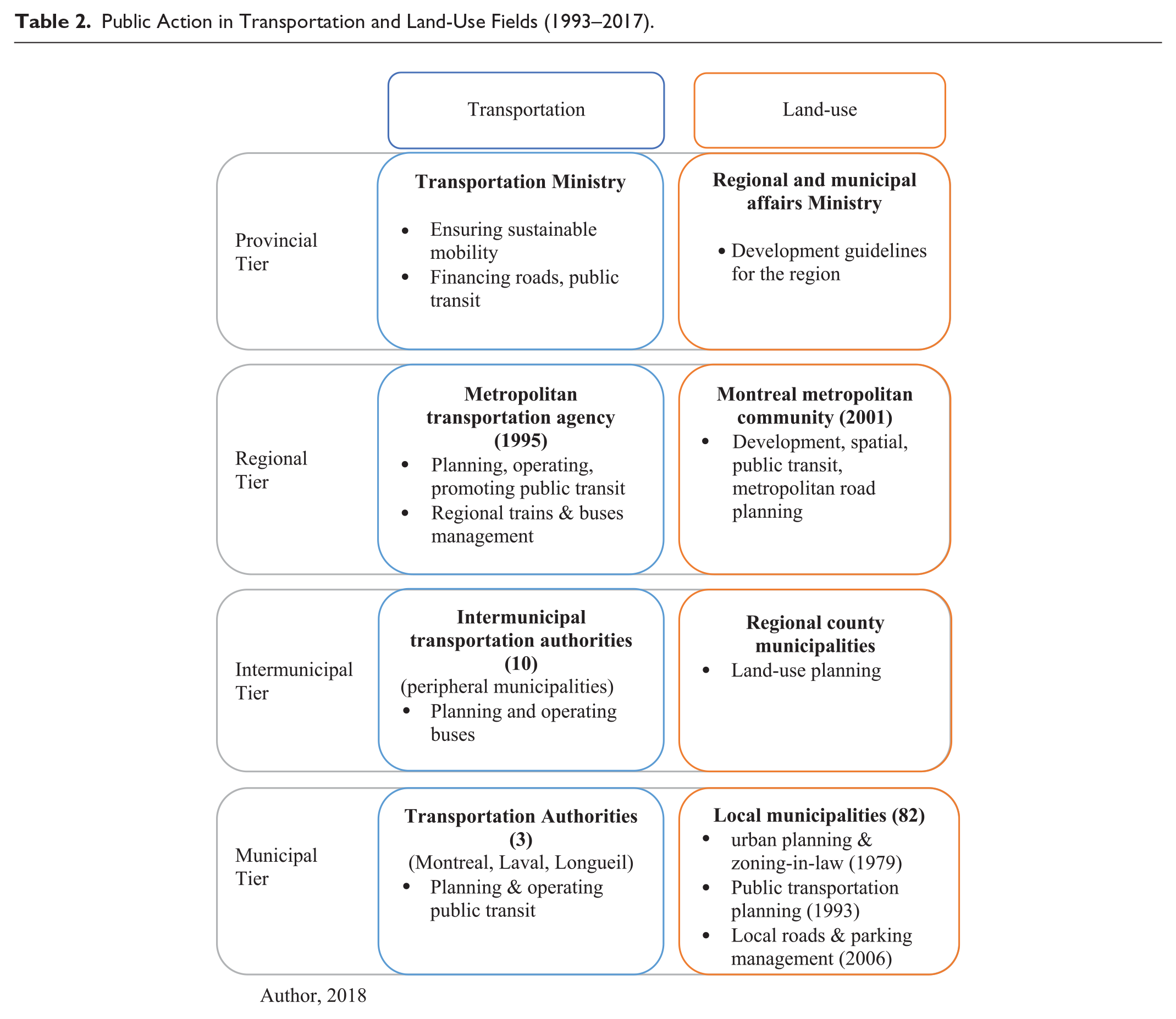
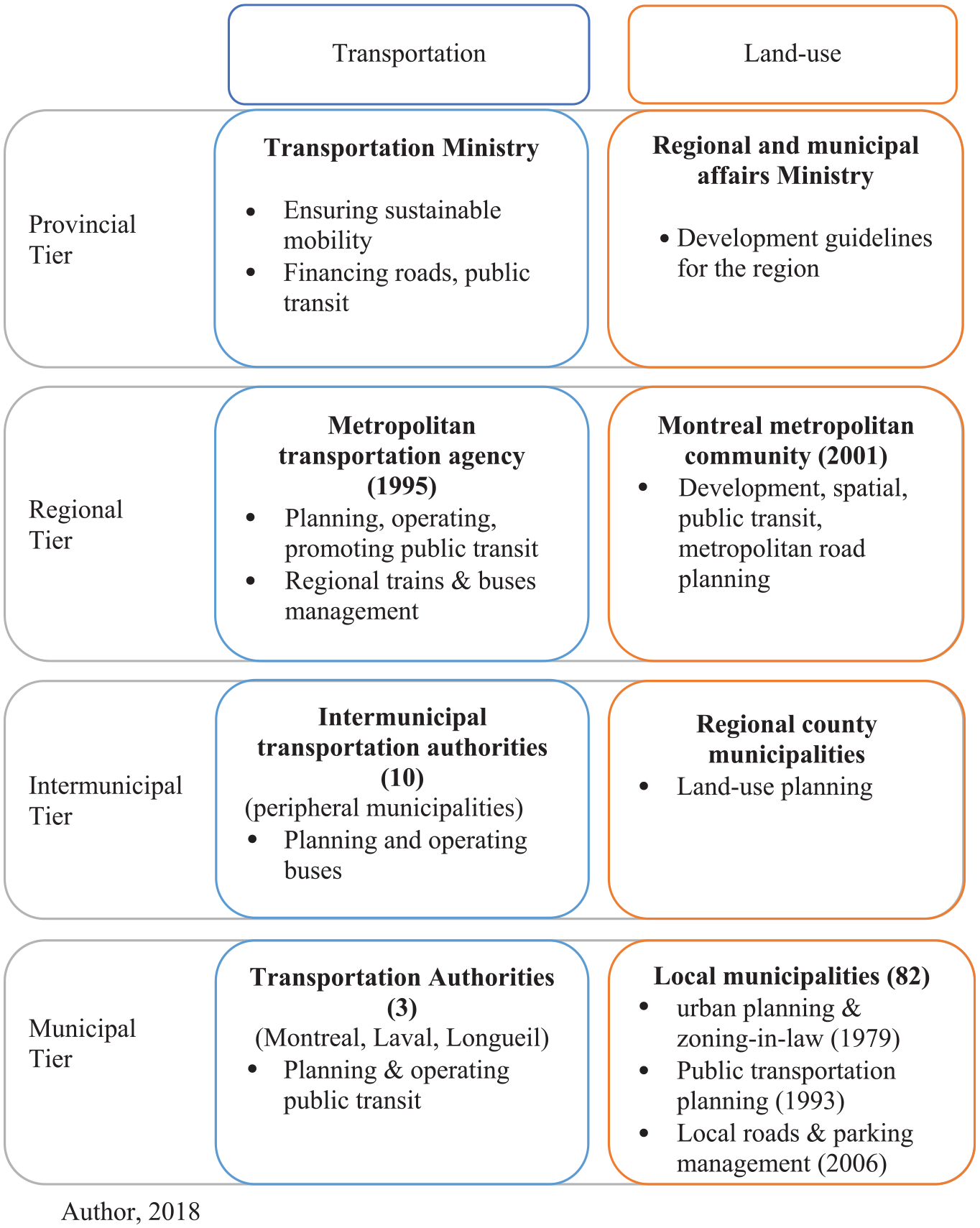
Over the last twenty years, certain institutional reforms have been introduced to improve governance in both of the above-mentioned fields. They have fostered the emergence of new levels of decision-making, both in land-use and transportation planning—the Metropolitan Transportation Agency (MTA) for public transit, in 1993, and the MMC for regional development, in 2001. In fact, these additional institutions were assigned the same responsibility with regard to the development of public transit. Mechanisms of horizontal coordination had to be created in order to ensure coherence among the plans, budgets, and decisions of these two institutions. But what does this specific context mean for TOD implementation? The issue is not only a matter of reconciling different professional cultures and learning to work together, within the same strategic and temporal framework, but also of reconciling interests that are sometimes contradictory or at different spatial and temporal scales, as Belzer and Autler (2002) and Cervero, Ferrell, and Murphy (2002) point out in other contexts.
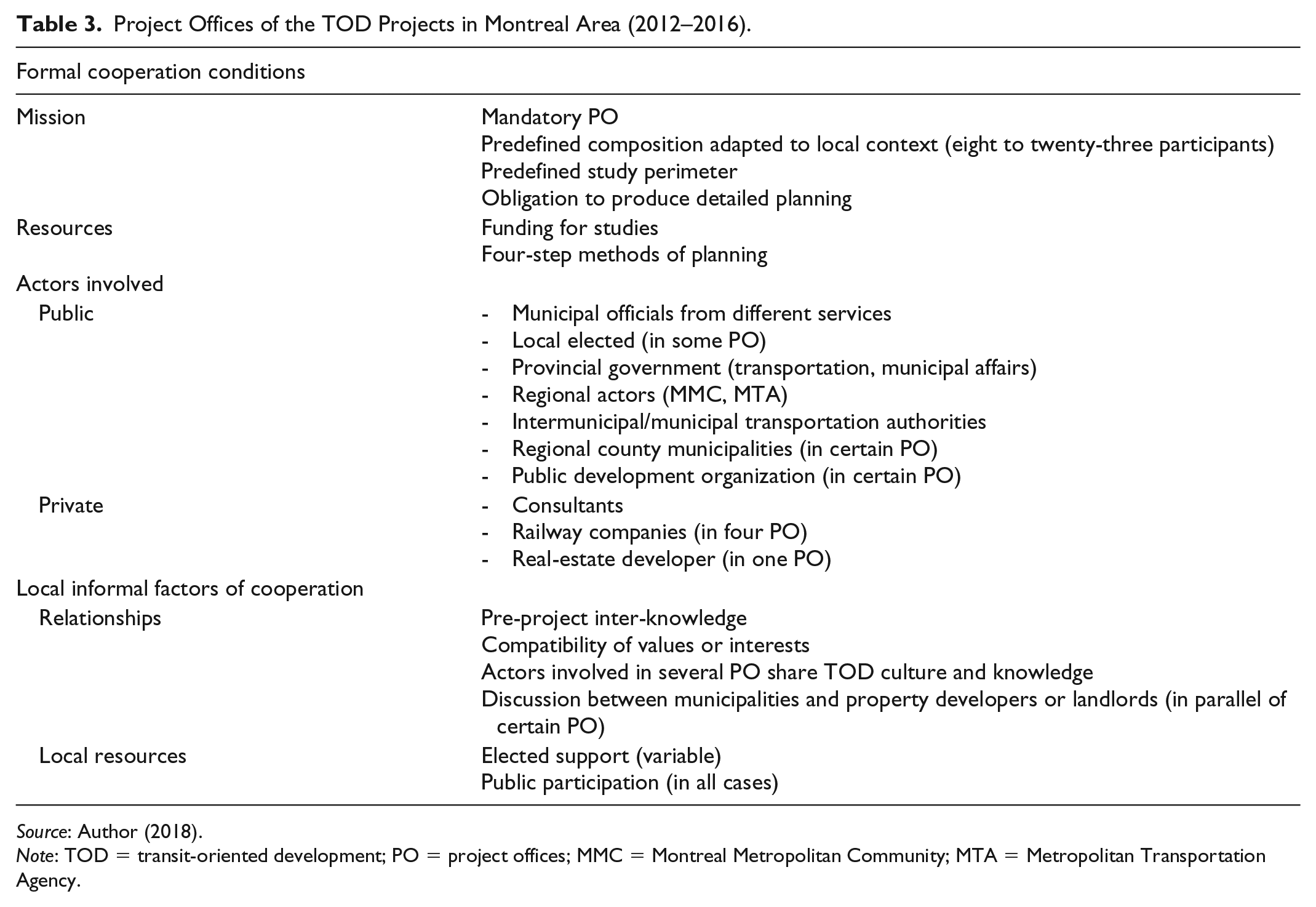
Given this, since 2012, the MMC has developed several instruments in order to ensure that municipalities can implement TOD and promote coordination between different fields of action (Maulat, Paulhiac Scherrer, and Scherrer 2018)—these include local Project Offices (PO), dedicated specifically to TOD implementation. POs are mandatory for TOD implementation in order to “mobilize stakeholders and potential investors; . . . to propose assembly solutions . . . ; anticipate and minimize risks and increase the chances of success” (Communauté métropolitaine de Montréal [CMM] 2018). Municipalities are responsible for the coordination, operation, and follow-up of the POs. They require the presence of the concerned stakeholders and also have to adopt a detailed standard four-step method for TOD planning in relatively short time (Maulat, Paulhiac Scherrer, and Scherrer 2018). This detailed planning has to be adopted by the municipality’s council and must include “a functional program that specifies the development phases, number of residential units, floor areas . . . , public spaces and the network of traffic . . . ; an estimate of the costs . . . the anticipated municipal tax benefits . . .” (Maulat, Scherrer, and Florence 2018). To support these POs, the MMC has funded the studies required for the plans.
Despite some difficulties (variable resistance of actors, difficulty in matching interests, priorities, or temporalities), POs have had positive effects both on decision-making processes and on project content (Maulat, Paulhiac Scherrer, and Scherrer 2018). First, they have clearly favored cooperation between actors while providing the necessary flexibility municipalities need to adapt such instruments and methods to local challenges. Second, discussions surrounding detailed planning have allowed actors to share a common TOD culture as well as collectively negotiate and adjust coordination strategies to local territories. These adjustments concern different project dimensions including density thresholds (sometimes renegotiated upward; their integration into the site), transitions between neighborhoods, soft mobility, car traffic in the neighborhood and green spaces. Although they highlighted the main forms of resistance or divergence that remained among actors, POs also revealed certain more informal factors that play a role in these processes, as we mentioned in Table 3. These results were consistent with the explanatory case study on the first TOD project in the Montreal region (Dushina, Paulhiac Scherrer, and Scherrer 2015, 2017; Maulat, Paulhiac Scherrer, and Scherrer 2018). As such, they have allowed us to build a new conceptual framework with which to analyze TOD implementation.
Project Offices of the TOD Projects in Montreal Area (2012–2016).
Source: Author (2018).
Note: TOD = transit-oriented development; PO = project offices; MMC = Montreal Metropolitan Community; MTA = Metropolitan Transportation Agency.
A New Conceptual Framework for Assessing TOD: An Urban Project–Oriented Approach
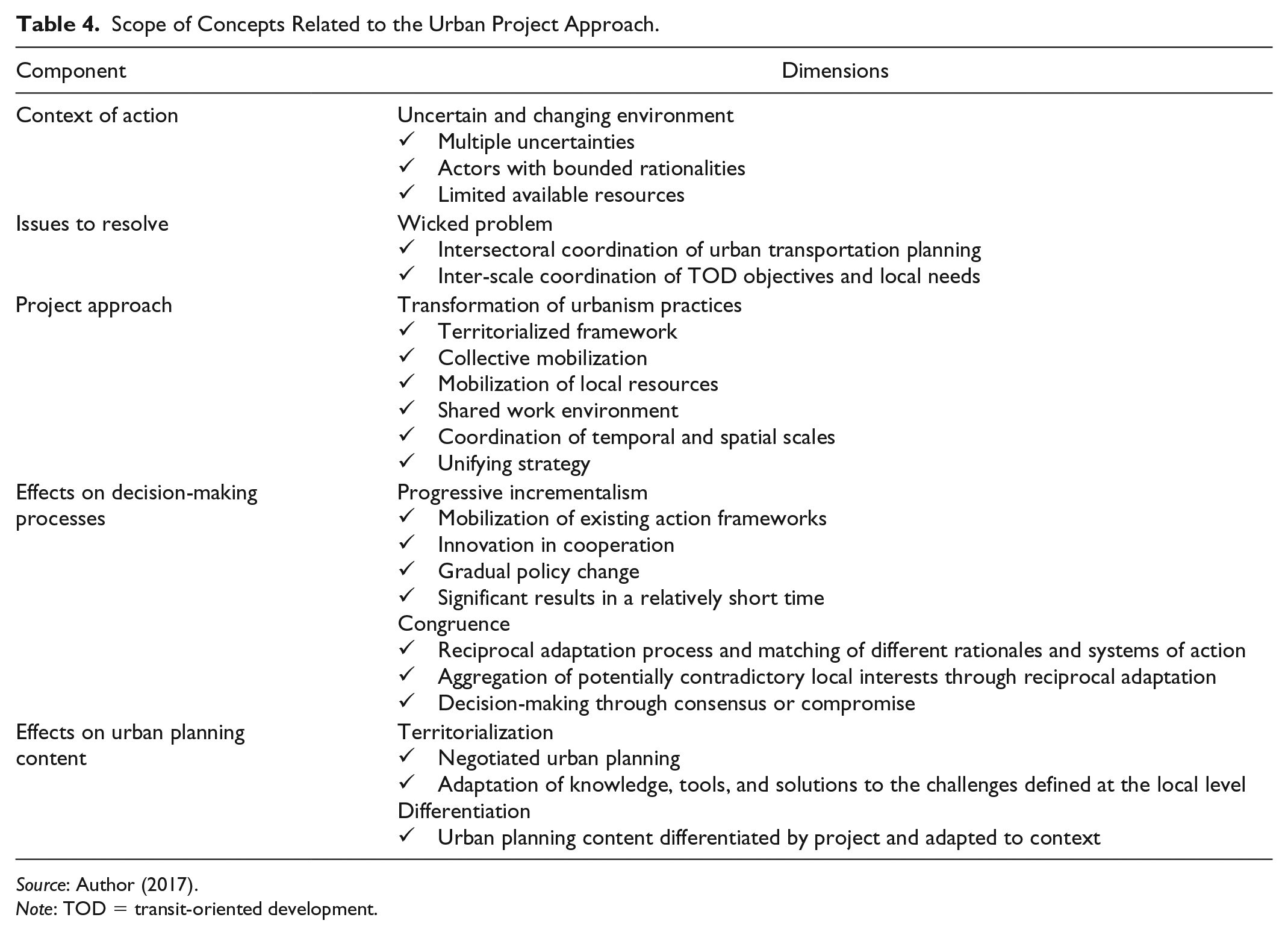
TOD projects are studied through the concept of “urban project.” First, the notion refers to a new unstable environment in which the collective action has a limited rationality and resources to act. Second, it refers to the new modalities of urbanism production. In such a specific environment, the “urban project” is defined as an urban planning framework that fosters the collective mobilization of various actors around a unifying strategy over a relatively long period of time (Arab 2018; Pinson 2004). As such, it is considered a contemporary urban action instrument focused on resolving issues specific to the territory to which it is applied. This dual approach (urban project and public policy instrument) enables a change in how urban planning projects in Canada, specifically TOD projects, are viewed (see Table 4).
Scope of Concepts Related to the Urban Project Approach.
Source: Author (2017).
Note: TOD = transit-oriented development.
Considered urban projects, TOD projects are defined as multi-actor frameworks in which processes and methods play a critical role in understanding the urban planning choices that are made and how different inherent issues are reconciled. As an instrument of public action, TOD aims to resolve complex development issues. To achieve this, the processes applied focus on joint production of shared knowledge (of the challenges to be met, the resources and opportunities to be seized, the constraints and obstacles to be eliminated) and the operational solutions that must be applied. The urban planning that is implemented is the result of collective negotiated action. Hence, the TOD urban project aims to produce not a priori sustainable development, but rather “urban planning that is flexible and negotiated, open and varied” (Ascher 2012, 98).
TOD Defined as an Urban Project and an Instrument of Public Policy
The different components of the urban project concept take into consideration changes that made to urban planning approaches (Arab 2018; Pinson 2004) in a societal environment that has become increasingly complex to manage. According to Pinson (2004), the urban project essentially refers to a city’s forms of action and production, both collective and voluntary. These depend largely on the local contexts as well as on the environment (social, economic, political, etc.) in which the action takes place. Such environments are characterized by uncertainties of various kinds (temporal, social, political, etc.) and involved actors are forced to make decisions despite bounded rationality and equally limited resources (Ascher 2012; Pinson 2004). Consequently, the concept focuses on the city’s pragmatic production processes, which allow for decision-making and the development of operational strategies despite uncertainties and complex challenges. The urban project is far more than a simple urban composition or design. It is, first and foremost, a set of processes negotiated with a view to debating and reformulating the issues and challenges that must be resolved as well as defining options and solutions that can be brought to the table (Arab 2018).
The urban project outlines negotiated urban planning procedures focused on the renewal of knowledge-based tools; decision processes and production methods integrating a diversity of actors/stakeholders; and the articulation of the spatial and temporal scales of challenges and solutions. According to Pinson (2004), these components allow the urban project to be considered as a new instrument of public policy (Lascoumes and Le Galès 2005; Lascoumes and Simard 2011). According to the instrument of public policy approach, an instrument is therefore not neutral or defined a priori. Mobilized by specific urban actors—which, in the case of TOD, is the municipality in charge of urban planning—this kind of urban project is first negotiated, adopted, and mobilized by a group of diverse actors (public actors from different levels and fields, private actors, and occasionally citizens) in order to meet specific challenges. Without a doubt, it also has its own effect on the network of actors involved as well as on the processes at work and, ultimately, the content of the project itself. Given this, every urban project stems from a collective construction, the effects of which are not predetermined. The project develops according to territories, interests, and the actors involved. Its impact (the solutions to challenges and their effects) is therefore contingent upon the environment in which the project is deployed. This allows for an innovative analysis of the challenges posed by TOD projects and how these are resolved as well as how they affect urban planning.
The Wicked Problem of TOD Coordination
The implementation of TOD forces municipalities to face a twofold challenge: that of the intersectoral coordination of spatial planning and transportation development actions and that of inter-scale alignment of objectives. This challenge can be considered as recurrent and persistent in the urban planning and design for many years now. As such, it shares some characteristics of a “wicked problem” (Rittel and Webber 1973). This notion defines problems faced by urban action that neither the rational planning nor an engineering and technical approach can solve. There is no obvious nor definitive way at the outset to solve such a problem. It concerns and affects multiple organizations and institutions. Despite, the latter have their own values and interests, the solution has to be collectively proposed, and, as such, it redefines the problem. In consequence, the solution depends on the specific context in which the project takes place (Conklin 2006; Rittel and Webber 1973). Similarly, the coordination at play in the TOD is rooted in singular context where issues are diverse and sometimes divergent. It implies stakeholders from diverse fields of action. And as such, it is the result of a complex collective decision-making process underlying different steps of the TOD project. A “wicked problem” is also inextricably linked to other complex problems. Concerning the TOD, one of them concerns the public sphere characterized by silo-type organization and multilevel governance. This frame has to be overcome with shared work environment. This complexity also refers to the interactions between the stakeholders. In the coordination process, the actors have to adjust their own logic and interests or negotiate to promote them. In this context, many questions arise (e.g., what expertise is collectively recognized and shared? What role is given to citizens in these processes?) In addition, despite the need of an agreement, some of stakeholders may appear as unforeseeable partners during the TOD implementation (e.g., private actors or local population).
Congruence and Progressive Incrementalism
Finding a solution to a wicked problem depends first and foremost on how well the actors involved understand the problem itself. However, understanding the problem is a complex exercise influenced by a multitude of factors that vary greatly by context. The solution therefore requires that changes be made to the methods used for urban collective action. Such changes can be rooted in two complementary processes at work in the urban project: incrementalism (Ascher 2012; Pinson 2004) and congruence (Offner 1993).
Where the dual coordination targeted by TOD is concerned, congruence aims to ensure reciprocal adaptation and consistency in diverse, if not contradictory, systems of action and logic related to transportation, urban planning, real estate development, and so on. At the same time, congruence cannot be achieved directly. Rather, it emerges through the process of progressive incrementalism. This process of creating change in public policy takes place gradually while producing a significant result in a relatively short period of time. In return, congruence and incrementalism have two consequences on the content of urban projects.
Hypothesis of TOD Territorialization and Differentiation
Problem solving through congruence and progressive incrementalism brings to light two characteristics of TOD urban projects that have been poorly documented to date: territorialization and differentiation. Territorialization stresses that projects are particularly connected to the local conditions (challenges to overcome, systems of involved actors, relationships between actors, and project production methods). These local conditions can be factored at each step of the project, from the programming to the development ones. They help us to understand the different types of brakes or levers, or even carriers of innovation (Maulat, Paulhiac Scherrer, and Scherrer 2018) all along the TOD implementation. As such, the planning of TOD is the result of negotiations among local and nonlocal actors (public, private, civil) originating from different fields of action. Involved in the same urban project, they are given the opportunity to change their points of view, redefine their understanding of problems to be solved, set priorities, and define their individual and collective strategies. Furthermore, the project is the result of opportunities and possibilities stemming from available urban planning tools (pre-existing and generally used) and the group of actors involved (resources, knowledge, power) as much as it is the result of the ability of these actors to innovate in order to understand, decide, and take action. This approach therefore makes it possible to identify the actors’ role during reformulation, abandonment, or arbitration. However, it emphasizes the collective aspect of decision-making through the mechanisms set up and its variations in time and space. Indeed, the configurations of actors (who is present) vary, depending on the different steps of one specific project, and between projects within even the same region. Thus, the points of disagreement or compromises reached and the roles of one body may differ from one project to another. This local rooting is essentially what distinguishes TOD projects from one another.
A differentiation between projects occurs both in terms of methods and processes used and in terms of urbanism (Maulat, Paulhiac Scherrer, and Scherrer 2018). Urban planning of TOD (and its effects) can therefore not be solely evaluated based on principles from the original reference model (the three Ds), nor can it be based on the regional objectives used for planning it and setting guidelines, nor can it be based on the institutional, social or market constraints that surround its implementation. Understanding urban planning choices requires an in-depth analysis of every stage of a given project: the collective construction of problems and challenges to overcome (their content and evolution throughout the project); problem-solving methods put forth by the system of actors/stakeholders involved (mobilized, existing or new processes and instruments); final urban planning choices (inter-scale and intersectoral conciliation of challenges) and their substantive (change in urban forms) and procedural (collective learning) effects.
Conclusion
Analyzing how local actors in charge of TOD projects deal with coordination issues has allowed us to highlight planning processes at work and the resulting urbanism. In order to build these new districts, local actors have to carry out complex decision-making and collaborative processes aimed at defining the specific scope of the dimensions to deal with and creating the conditions and opportunities for dealing with them. These processes rely on a dynamic system rooted in the political and social territory of the TOD project in question. The final goal is to ensure TOD implementation through a well-integrated urban project that is as best adapted to the context as possible. The resulting urbanism is a reflection of the conciliation (of issues, scales, interests) and dynamic system of action mobilized to make the project possible—and it highlights the key role that unique local issues play in the final plan and design.
The research also allows us to present a twofold conceptual framework. First, it refines approaches that address obstacles and levers to TOD implementation, particularly with regard to governance at the local level. The latter are regularly cited but generally under-documented, particularly in terms of procedural dimensions and the instruments it entails. As such, this approach has great potential for subsequent comparative analyses of other municipal cases in other parts of Canada. Such comparisons make it possible to question and assess the methodological and procedural choices of the actors in order to resolve coordination issues as well as measure how these choices affect local urbanism and the actors themselves. Comparisons can also be used to illustrate the processes of territorialization and differentiation.
Second, it offers potential for supporting the decisions of the public actors involved in these projects. On the one hand, the approach emphasizes the capacity of public actors for creating and promoting collective action. As such, congruence suggests that the trade-offs to be made for achieving TOD are specifically based on the ability of municipal actors to create the conditions for collective learning and decision-making among different actors. These necessary conditions can arise from inter-knowledge and willingness but mainly need formal cooperation structures dedicated to the project. On the other hand, TOD implementation does not rest upon linear and sequenced planning. As such, incrementalism suggests that this cooperation structure should be a framework both for coordination issues and also for adapting actions and interests to the territory targeted by the project. These adaptations can lead to an iterative decision-making process. Thus, this approach enables TOD actors to understand the collective nature of the action to be promoted and how it should develop over time and space in order to adapt to the local context.
Footnotes
Acknowledgements
First, I would like to thank the team working on the SSRCH project on TOD implementation in Canada. They provided insight and expertise that assisted the theoretical reflection at the core of this article. Second, I would like to extend my thanks to a number of people who have contributed their time and thoughts to this article. I am grateful to Franck Scherrer, Tood Reeser, and John Hamman for their insightful feedback on earlier versions of this manuscript. Many thanks are due to Annie Booth for her help for translating the paper. Finally, I would like to thank the anonymous reviewers and JPER editors for their excellent feedback.
Declaration of Conflicting Interests
The author(s) declared no potential conflicts of interest with respect to the research, authorship, and/or publication of this article.
Funding
The author(s) disclosed receipt of the following financial support for the research, authorship, and/or publication of this article: The author received a financial support for the research from the SSHRC (Social sciences and Humanities Research Council, Canada).
