



Abstract
Collaboration is used to address a range of complex problems, but there is less research on ongoing collaboration networks. We use interviews, document analysis, focus groups, and a survey to evaluate transportation networks in Oregon. Participants were positive about network operations, but the research highlighted how a centralized network limited goal sharing and multilevel functioning. Information procedures built group expertise and defined the network’s practical authority, despite a broader mandate. Representing diffuse interests was a challenge that requires further research. These findings highlight options for designing and improving collaboration networks relevant to a range of planning and management settings.
Introduction
Collaborative approaches to planning and management are becoming increasingly common in response to the complex, interjurisdictional issues facing society today. The need for collaboration has been triggered by more turbulent policy settings, greater competition for limited resources, intensification of adversarial interaction, and increasingly complex problems (Ansell and Gash 2008; Goldstein and Butler 2010; Gray 1989; Innes and Booher 2009).
There has been considerable attention in the literature on convening, building consensus, and reaching agreements through collaboration (Innes and Booher 2009). However, many of the problems that planners face on a daily basis involve a range of government and nongovernment participants engaged in ongoing collaborative decision-making. In this context, the challenge is how organizations work collaboratively to sustain information sharing, align decision-making, and resolve differences. As planning scholars have noted, this requires collaboration through formal and informal networks (Goldstein and Butler 2010; Innes and Booher 2009; Margerum 2011). Building on Emerson et al. (2012), we define collaboration networks as processes and structures of management that engage government and nongovernment stakeholders working across boundaries to carry out a collective public purpose. While some networks are defined as self-governed groups working on commonly identified goals, many are led by an organization seeking better integration of decision-making (Markovic 2017; Provan and Kenis 2008; Provan and Milward 2001; Thomas 2003).
In this article, we examine a multilevel network created by the Oregon Transportation Commission (OTC) to coordinate transportation and funding decision-making regionally and statewide. We evaluate the structure and process of ten different Area Commissions on Transportation (ACTs) and their relation to statewide decision-making. Overall, participants gave positive assessments of their primary functions, but were less positive about other roles. We suggest that the performance of this network relates to several structural and operational issues: shared goals, authority, information rules, and representation. Our findings highlight network limitations and options for improvement, and an experimental program demonstrates how this network could be adapted.
Collaborative Governance and the Role of Networks
Collaboration networks can include a wide range of multiparty arrangements for implementation and management (Alexander 1995; Ansell and Gash 2008; Deyle and Wiedenman 2014; Emerson, Nabatchi, and Balogh 2012; Margerum 2011). Some operate on a community level and depend on social networks or nonprofit entities (Agranoff 2007; Margerum 2011). Other networks operate at a policy level and involve fluid political ties and changing relationships (Abers and Keck 2013). However, many issues such as transportation planning in Oregon involve networks of organizations working to address cross-jurisdictional governance issues. Agranoff (2007) notes that these interorganizational networks tend to be more formalized with designated participants. They operate within the existing political and administrative framework, but address cross-cutting issues that benefit from collaboration (Agranoff 2007; Margerum 2011).
Networks have been studied in planning, but there is a more extensive literature in public administration and public policy. This literature is too extensive to fully review here, but frameworks defining structure, function, and operation help classify the networks we address in this study.
Some of the structural typologies of networks distinguish between centralized (organization centered) and decentralized (diffuse) (Arnouts, van der Zouwen, and Arts 2012; Cristofoli, Macciò, and Pedrazzi 2015; Provan and Milward 2001). Centralized networks such as Oregon’s ACTs depend on an organization or coordinator to facilitate its activities, while diffuse networks require more power sharing and coalitions of actors (Alexander 1995; Cristofoli, Macciò, and Pedrazzi 2015).
In terms of process, all networks require information sharing, joint commitment, and a willingness to change modes of working (Keast, Brown, and Mandell 2007; Koppenjan 2008; Mandell and Steelman 2003; McGuire 2006). Agranoff (2007) defines the process activities in terms of the type of information flow and its impact on joint action. Informational and development networks such as the ACTs in Oregon involve parties coming together to voluntarily exchange information, educate participants, and increase capacity.
Institutional analysis approaches have focused less on a typology of activities, but we use Ostrom’s institutional rules framework to analyze network functions (Imperial 2005; Ostrom 1990). This approach parses networks by the formal and informal authority granted to the network by its members, the rules and norms defining information exchange, and rules governing group decision-making (Huxham and Vangen 2005; Imperial 2005; Margerum 2011).
Evaluation Methods
The literature on evaluating collaborative networks emphasizes the importance of multiple perspectives to capture the range of less tangible factors and the importance of examining structure, process, and outcomes (Deyle and Wiedenman 2014; Innes and Booher 2009; Koppenjan 2008; Mandell and Keast 2008; Provan and Milward 2001) (see Table 1).
Assessment Framework.
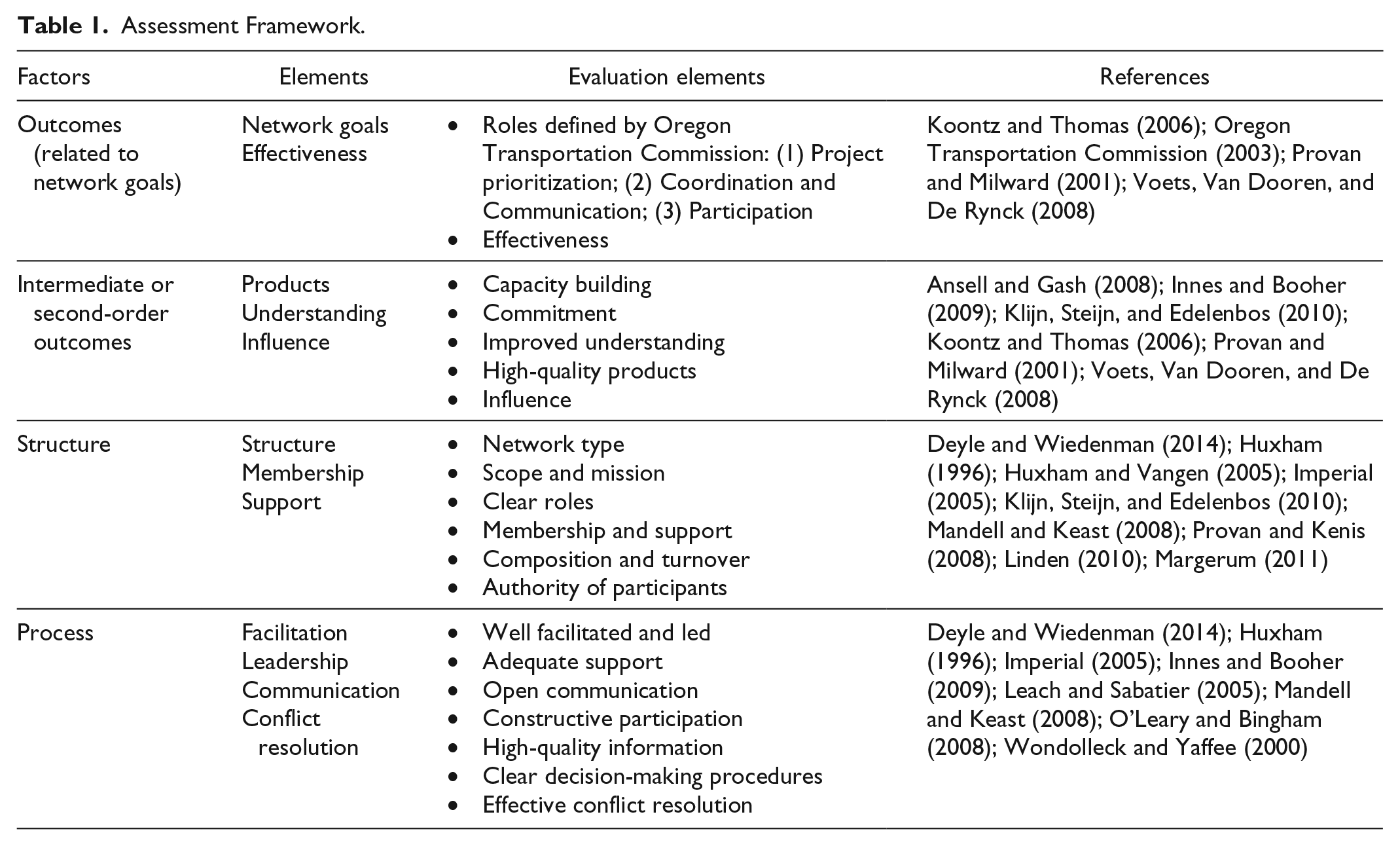
Evaluations of collaborative structure typically focus on the clarity of its scope, roles, and membership; types of information exchanged; and authority granted to collective decision-making (Emerson, Nabatchi, and Balogh 2012; Imperial 2005; Voets, Dooren, and Rynck 2008). Clarifying authority includes specifying the extent to which the collective decisions of the group are formally or informally binding on the participants (Huxham and Vangen 2005). Also important to this structure is its stability and the ability of participants to adequately represent their organizations (Deyle and Wiedenman 2014; Imperial 2005; Klijn, Steijn, and Edelenbos 2010).
Effective collaboration also requires skillful facilitation and leadership to help support communicative processes (Innes and Booher 2009; Leach and Sabatier 2005; O’Leary and Bingham 2008). This should include open communication, high-quality information, clear decision-making procedures, and processes for resolving conflicts (Deyle and Wiedenman 2014; Heikkila and Gerlak 2005; Imperial 2005; Innes and Booher 2009; Mandell and Keast 2008).
Finally, in assessing a collaborative network, it is important to examine the range of primary and intermediate outcomes (Innes and Booher 1999; Mandell and Keast 2008). One outcome is the satisfaction among participants with achieving network objectives such as communication and influence on decision-making (Deyle and Wiedenman 2014; Margerum and Born 2000; Taylor and Schweitzer 2005; Voets, Dooren, and Rynck 2008). Researchers also need to assess second-order outcomes, which include the less intangible results of a network, such as capacity building, commitment, and shared understanding (Ansell and Gash 2008; Deyle and Wiedenman 2014; Innes and Booher 2009; Provan and Milward 2001). Finally, networks can also be evaluated through the quality of products such as plans, decisions, and agreements (Deyle and Wiedenman 2014; Innes and Booher 1999, 2009; Margerum 2011).
Transportation Decision-Making and the Oregon Approach
The decision-making facing transportation agencies in the United States typifies the kind of complex interjurisdictional problems that collaborative networks are designed to address. States have limited funds, competing demands, and interlinkages between multiple transportation sectors and land use (Taylor and Schweitzer 2005). In the 1990s, federal transportation legislation shifted its emphasis away from highway-centered planning dominated by state transportation agencies to a more collaborative and multimodal approach. Federal regulations also require states to prepare plans and transportation improvement plans (State TIP) that list projects approved for funding (Cullingworth and Caves 2009).
The demands for more collaboration around this decision-making led several states to create regional structures. The state of Washington has created regional transportation planning organizations (RTPOs). Iowa created regional planning affiliations (RPAs) and California established regional transportation planning associations (RTPAs). In Oregon, the state Transportation Commission created ACTs to help allocate and prioritize state transportation investment and improve communication and coordination at the regional level (Brody et al. 2009).
Oregon’s ACTs are advisory bodies to the OTC and are composed of government and nongovernment stakeholders. They have no legal, regulatory, policy, or administrative authority. Their mission is to “provide a forum for the discussion and coordination of current and future transportation issues and to make recommendations to the OTC” (OTC 2003; Brody et al. 2009).
The policy creating ACTs identified nine activities that can be grouped into three areas: (1) regional communication and coordination, (2) providing a process for stakeholder and public input, and (3) helping to prioritize transportation funding. This third role relates to decisions about priorities for investment through the Statewide Transportation Improvement Program (STIP; OTC 2003). The policy also identified optional activities related to planning, project input, and state and regional policies.
The OTC created ten ACTs to cover the state, but allowed different structures in metropolitan Portland and Lane County (Eugene-Springfield). The OTC defined the geographic boundaries, membership, authority, and Oregon Department of Transportation (ODOT) staff roles. They required each ACT to develop agreements specifying roles, process, and structure. The OTC gave ACTs considerable leeway in their decision-making processes (OTC 2003).
As in other states, federal procedures require Oregon’s Metropolitan Planning Organizations (MPOs) to prepare metropolitan TIPs and expenditures within regions must be consistent with MPO plans and TIPs. The OTC Act structure did not usurp the role of MPOs, but specified a coordination role for ACTs containing an MPO (OTC 2003).
Evaluating Oregon’s ACTs
In terms of the network typologies described above, ACTs are an example of a centralized network connected to ODOT. Because the OTC retains its authority to make prioritization decisions, the network can be classified as informational or developmental rather than a joint action network (Agranoff 2007). We used the network assessment factors summarized in Table 1 to describe and evaluate the network. We approached this using a mixed-methods approach involving interviews, content analysis, a survey, and focus groups. Our goal was to assess the performance of the network to identify potential improvements for Oregon’s ACTs and identify the lessons this offers for network effectiveness in general.
The assessment of outcomes focused on the roles defined by the OTC and overall effectiveness in relation to individual ACTs and the statewide network. The research team conducted forty-eight in-person interviews with individuals representing a cross section of interests, including elected officials, transportation committee members, local government staff, and staff from ODOT. The open-ended interviews focused on the effectiveness of ACTs in achieving their objectives and the effectiveness of their structure and process.
The team also conducted a detailed review of web sites, documents, meeting minutes, and reports to summarize the structure and function of all 10 of Oregon’s ACTs, all Oregon MPOs, and the regional entities in Portland and Eugene-Springfield. This review included a content analysis of all ACT meeting minutes to analyze operating procedures and the topics addressed at each meeting over a two-year period. The team selected a cross section of three ACTs and led semi-structured focus groups involving eight to ten ACT members at each site. These ACTs were chosen because they represented a range of geographic, political, economic, and administrative settings found in Oregon. The focus group discussions examined ACT performance, structure, and operations.
The interviews and focus groups were used to help develop an on-line survey of 351 ODOT, ACT, and MPO officials, and other individuals familiar with the role of ACTs. The survey followed a Dillman (2007) methodology and used a combination of Likert scale, categorical, and open-ended questions. We asked respondents to evaluate ACTs against the roles identified by the OTC. We also asked them to assess ACT effectiveness, functioning, structure, operation, and their influence on a range of organizations (see Tables 2–4). Finally, we asked open-ended questions about ACT scope, coordination, strengths, and weaknesses.
ACT Structure and Process.
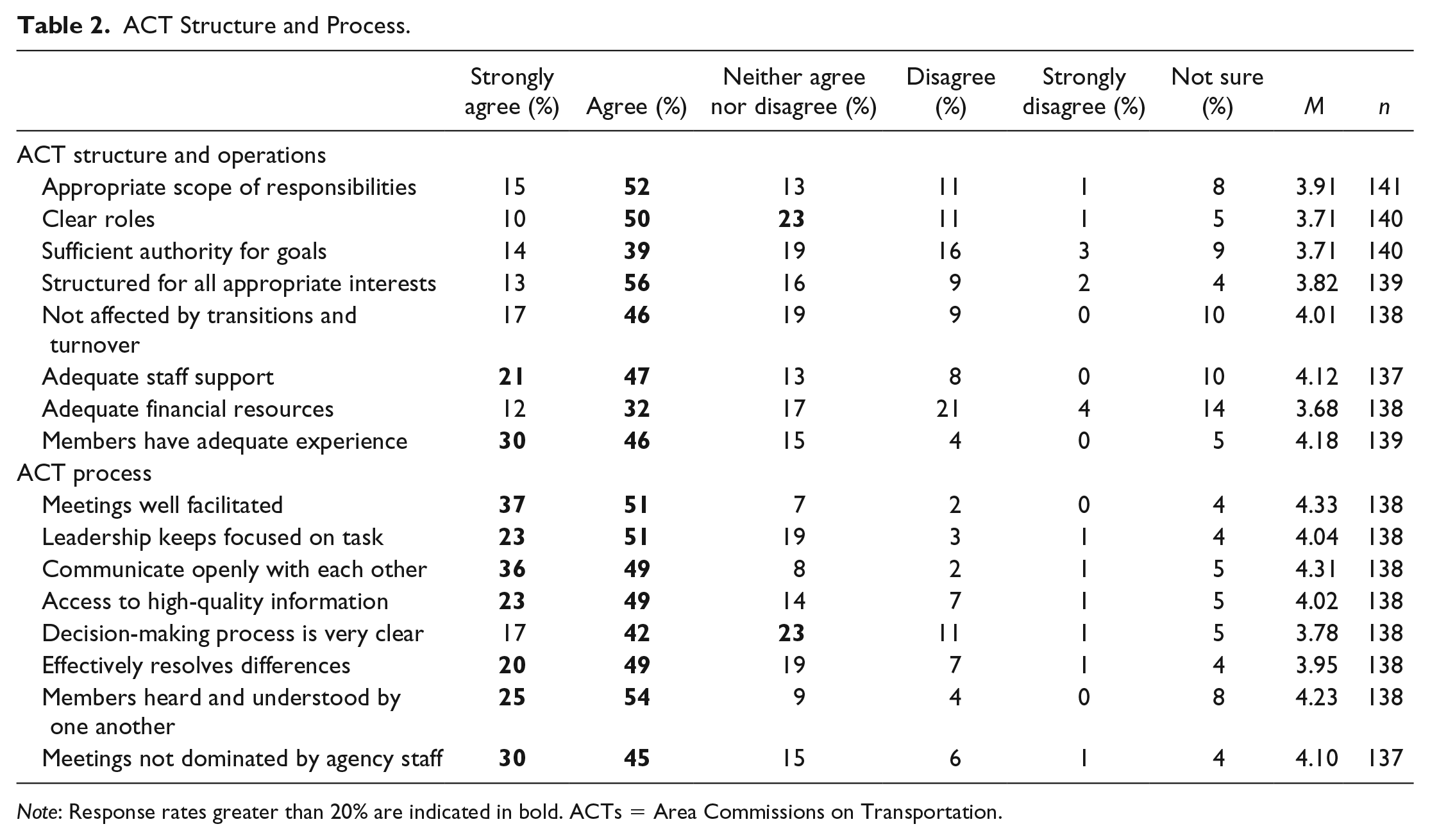
Note: Response rates greater than 20% are indicated in bold. ACTs = Area Commissions on Transportation.
ACT Interim Outcomes.
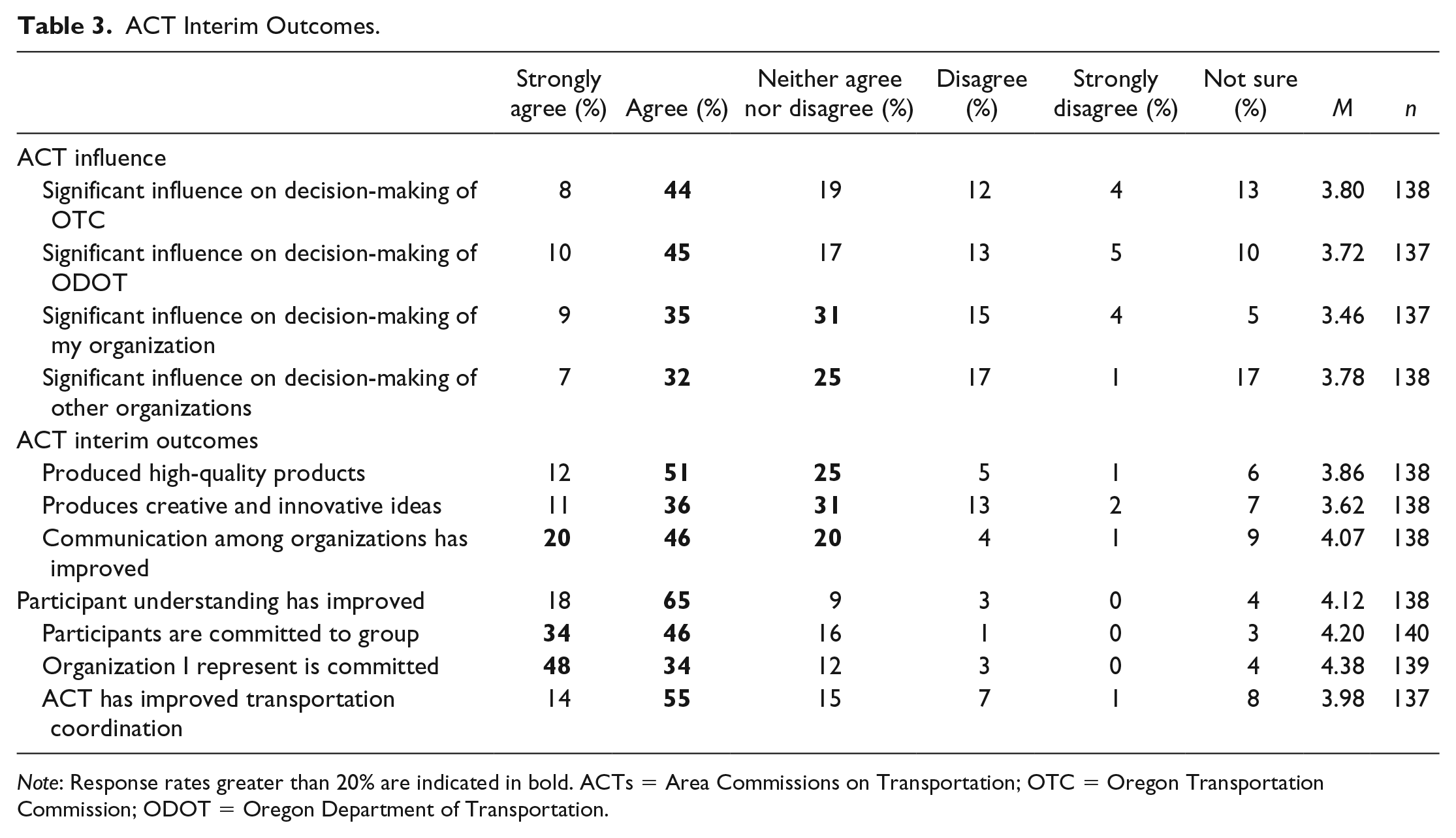
Note: Response rates greater than 20% are indicated in bold. ACTs = Area Commissions on Transportation; OTC = Oregon Transportation Commission; ODOT = Oregon Department of Transportation.
ACT Outcomes.
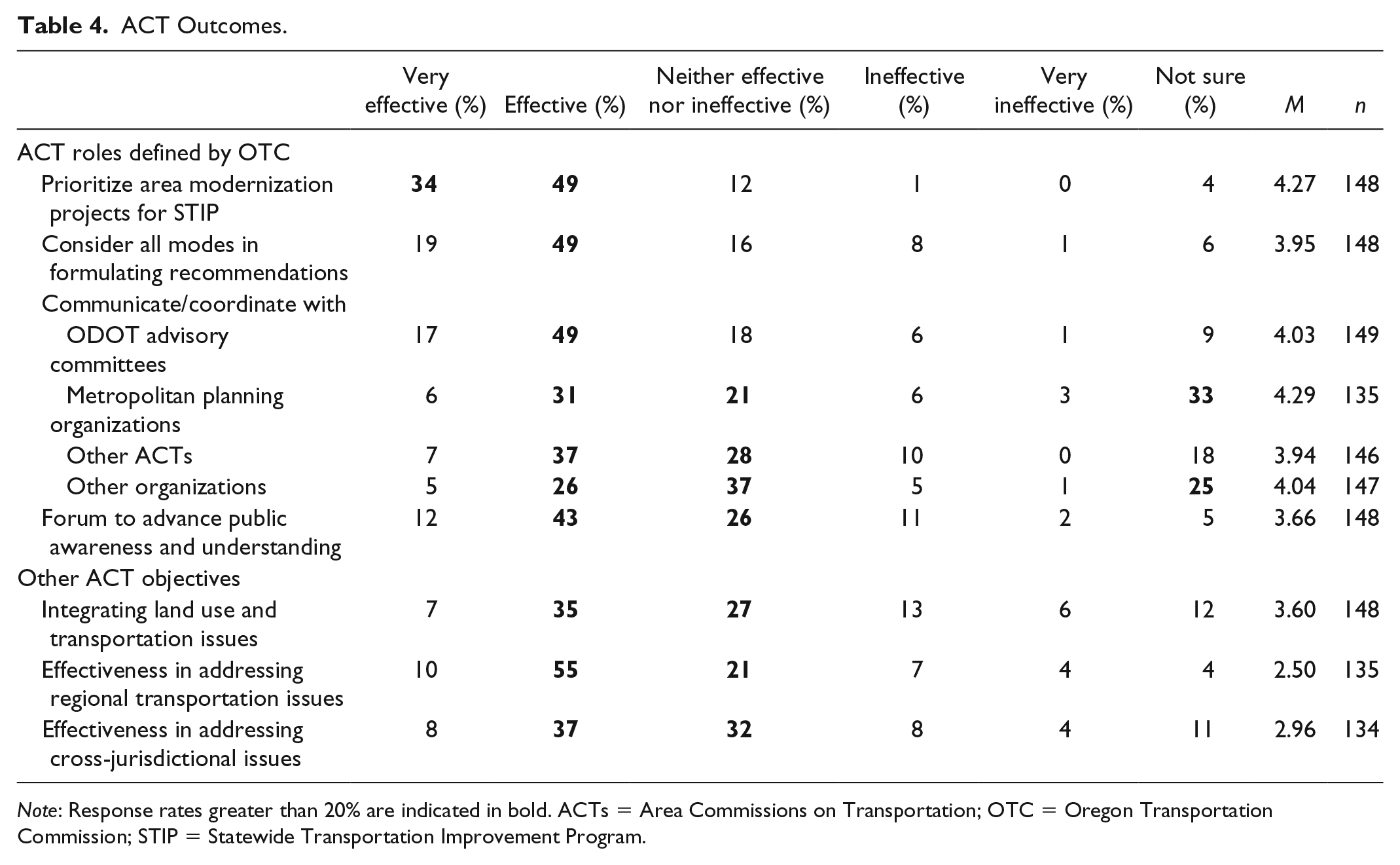
Note: Response rates greater than 20% are indicated in bold. ACTs = Area Commissions on Transportation; OTC = Oregon Transportation Commission; STIP = Statewide Transportation Improvement Program.
A total of 178 individuals responded (51%) to the online survey, but some respondents did not complete all questions. Almost a third (32%) of all the survey respondents represent city government, another quarter (23%) were affiliated with state government, 14 percent were affiliated with county governments, 9 percent represented the private sector, and 4 percent represented MPOs. A total of fifteen respondents worked for ODOT and three were affiliated with the OTC. All ten ACTs were represented in the survey, with sample sizes ranging from twelve to twenty-four.
Are ACTs Achieving Their Goals?
Each individual ACT operates as an independent forum, and they were allowed to develop their own rules, procedures, and special areas of focus. The ACTs are also part of a multilevel collaboration network that provides input into statewide priorities and policies. In this section, we review ACT performance and summarize findings about their structure, process, and outcomes.
Relative Performance of ACTs
To assess the performance of ACTs, we considered both network goals and intermediate outcomes (see Table 1). We collected 178 surveys from individuals involved in ten different ACTs, but when we compared the mean responses grouped by each ACT, we found few significant differences between them. This is due the variability of the responses and the relatively small numbers of responses associated with each ACT (n = 12–24).
The one exception was the Cascades West ACT. An analysis of variance revealed higher scores for four variables (authority, resources, communication, and influence on the OTC) that were significantly different from one or more ACTs. Our analysis of surveys and interviews did not reveal obvious reasons for the higher evaluations, but several respondents noted “excellent leadership” and we speculate that geography may be another explanation. The Cascades West ACT is one of the smaller ACTs and encompasses the state capital of Salem where ACT members may have more opportunities to interact with state agencies and the OTC. Due to the lack of significant differences between ACTs, we focus on the overall performance of the statewide ACT network.
Network Structure
To assess network structure, we assessed issues such as roles, scope, support, and authority (see Table 1). Survey respondents were positive about many aspects of the ACT structure (see Table 2), but three factors revealed more dissatisfaction. Respondents evaluated the financial resources lower than other variables. However, interviews and written comments suggested that respondents were focused on the availability of resources for transportation generally rather than resources to support ACT operation.
There were also lower evaluations of the ACT scope and its authority, and the written comments and interviews revealed confusion about their authority. The OTC and ODOT use the ACT network to set funding priorities. ACTs were established as advisory bodies, but some participants appeared to believe that ACTs were empowered with decision-making authority—or believed that should be given that authority. For example, when asked about weaknesses, one respondent noted a “lack of authority,” and another stated “Not really sure what our role is. Advisory, suggestions, concurrence?” Interviewees noted that this came to light during statewide prioritization of projects. ODOT is organized into regional districts and there are several ACTs in each ODOT district. ACT recommendations are assembled and prioritized at both the district level and the state level. Therefore, while some ACT participants assumed that a project rated as a high priority by the ACT would receive funding, this was not always the case as the projects were amalgamated and ranked at the district and statewide level.
When asked about representation, almost 70 percent of respondents indicated that the appropriate interests were involved (n = 139). The OTC gave ACTs considerable flexibility to choose participants, allowing each one to tailor their structure to their regional circumstances. This flexibility has helped engender strong support for the ACT structure, but some of the representation approaches created complications that are discussed below.
In terms of resources and staffing, it was clear from interviews and surveys that ODOT provided consistent and substantial support for the ACTs. They have operated for over ten years, and ACT participants were very complimentary of ODOT staff in their survey responses and comments (see Table 2).
Network Process
To evaluate process, we considered factors such as facilitation, communication, participation, and decision-making (see Table 1). Facilitation, leadership, and clear membership roles all garnered very positive evaluations from participants (see Table 2). Respondents agreed that ACTs are well facilitated, have open communication, and participants felt heard and understood by one another. They gave ACTs positive evaluations for having clear decision-making processes and resolving conflicts effectively. For example, one ACT created an “equity resolution” and another agreed to “take turns” on large project proposals to help resolve funding conflicts. Among ACT strengths, respondents commonly cited their “collaborative approaches,” “hard work to build consensus,” and “willingness to compromise the needs of one jurisdiction for the welfare of another.” ACTs also received high marks from participants for clarity and flexibility. Respondents were less positive about the innovation of ACTs, with only 49 percent giving this a favorable assessment (see Table 2). Comments on this often related to the limited focus and role of ACTs relative to “other decision-making processes for the rest of the [transportation] system.”
There were higher levels of dissatisfaction with decision-making authority. As noted above, some participants were confused about ACT decisions relative to regional and state priority setting. Several ACTs also experienced difficulty representing the large number of local governments in their region, which is discussed in more detail below.
Interim Outcomes
In evaluating collaborative groups, factors such as influence, products, commitment, and improvements in communication, understanding, and coordination are all important interim outcomes for assessing effectiveness (see Table 1). Overall, respondents were very positive about communication and understanding, as well as commitment to the group (see Table 3). ACT respondents gave moderately positive ratings to the innovativeness of ACT products, which the interviewees attributed to the constraints of the project prioritization process and the limited opportunities to consider more wide-ranging concerns.
Network effectiveness is also evaluated by its defined roles of prioritizing transportation investment, regional coordination, and participation (OTC 2003). A primary ACT responsibility is to make recommendations on funding allocations for the STIP. Over 80 percent of respondents indicated that the ACT role in prioritization was effective or very effective and only 1 percent gave this role a negative evaluation (see Table 4). For seven ACTs, STIP prioritization was on the agenda for 75 to 100 percent of their meetings, while two ACTs covered this topic at 50 percent of their meetings and one ACT at 44 percent of their meetings. In interviews and focus groups, participants noted that this role also consumed the vast majority of their time and many interviewees indicated that ACTs were too focused on this role. A few interviewees with long involvement in transportation planning indicated that ACT funding allocations were a significant improvement compared to the pre-ACT approaches. The respondents were less positive about their advisory role in terms of ACT influence on the OTC and ODOT.
ACTs were also charged with coordinating regional transportation issues. Sixty-nine percent of respondents agreed that ACTs had improved transportation coordination (n = 137), but the assessment of coordination with some organizations was mixed. Although all ACTs with an MPO had an MPO representative at 100 percent of their meetings, over 20 percent were neutral on their coordination effectiveness. For most ACTs, there has been limited information exchange or joint projects with MPOs, except for project prioritization discussions. Improved communication and coordination between ACTs and MPOs was also one of the most commonly cited needs.
The third broad role of ACTs is to create a forum for public and stakeholder involvement in prioritizing transportation investment. The interviews and surveys indicated that this was the lowest rated of the defined roles (see Table 2). The committees ranged between 17 and 24 voting members, with the most representatives coming from cities, counties, ODOT, transit districts, and ports. Most ACTs also involve nonvoting members, including state agency staff, representatives from neighboring ACTs, legislators, local officials, and representatives from other states. Many ACT participants cited elected officials as the primary avenue for public input, and we found that only 15 percent of the meetings over a two-year period involved any public comment. A typical response noted by one respondent was that the “general public is clueless about the jobs that ACTs perform.”
Discussion and Implications
As a complex, multilevel network charged with the difficult task of prioritizing limited transportation funding, participants gave ACTs a positive evaluation. However, other aspects of their defined role were clearly weaker and there was dissatisfaction with their influence on state level decision-making. This reveals several broader lessons and implications for collaboration networks.
The Shared Goal Weakness of Centralized Networks
The literature on collaborative networks emphasizes the importance of shared goals and interdependence created by participants who recognize they can accomplish activities collectively that they could not do on their own (Emerson, Nabatchi, and Balogh 2012; Innes and Booher 2009; Margerum 2011). Markovic (2017) suggests that networks will be more effective when they are integrated through a central core agency, but our findings highlight that this integration was limited.
While ACTs were created to serve a broad regional coordination role, they were defined by the authority shared by the OTC. The review of meeting agendas and feedback from participants all emphasized that the majority of activities centered on prioritizing ODOT transportation funding (Table 2). Participants were committed to ACTs because they had the opportunity to influence these important decisions, but they were not committed to the broader goal of collaborative transportation governance in their region.
Broader communication and coordination roles received far less attention and lower assessments of effectiveness even though our interviews and open-ended survey responses highlighted this as a need. Many participants did not envision ACTs as the means to achieve broader integration, because they viewed ACTs as a “creature of the OTC.” This broader role would require commitments from other agencies and participants to the collective mission of ACTs (Keast, Brown, and Mandell 2007; Provan and Kenis 2008). Therefore, we conclude that a broader coordination mandate is destined to underperform in a centralized network such as the ACTs, unless there is a broader (and probably more formal) joint decision-making role defined by the participating organizations.
Multilevel Networks Can Complicate Authority
Network authority is defined by the shared goals and scope, but it is also defined by the joint actions performed by the group (Emerson, Nabatchi, and Balogh 2012; Huxham and Vangen 2000; Keast, Brown, and Mandell 2007; Voets, Dooren, and Rynck 2008). This authority may be specified through formal agreement or emerge as informal norms, but it is defined by the issues offered to the group for consent and the extent to which the authority of group is binding on participants (Huxham and Vangen 2000; Voets, Van Dooren, and De Rynck 2008).
ACTs experienced confusion about their authority relative to ODOT and the OTC. Participants gave high marks to the prioritization role, but a much lower evaluation of ACT influence. ACTs were allocated authority by the OTC to make prioritization recommendations, but as part of a multilevel network, these recommendations had to be amalgamated at the regional and state level. The OTC was effectively offering ACTs the authority to recommend priorities on project funding. Some ACT members perceived their prioritizations to be final and did not fully understand how their recommendations were merged in each ODOT region and across the state. The literature distinguishes this shared influence as distinct from shared authority or joint decision-making (Emerson, Nabatchi, and Balogh 2012; Huxham and Vangen 2005). As Koontz et al. (2004) point out, government decision makes often retain control, but they can share power by integrating the input of stakeholders and operating as participants rather than dominant players.
The concerns about the amalgamation of ACT decisions at the regional basis led one regional ODOT manager to share additional authority. The Region 2 manager conducted “All Area” meetings that consisted of representatives from three ACTs and Lane County. All of the representatives then discussed these priorities at the meeting in an effort to reach consensus on Region 2 priorities. This multilevel structure is comparable to Goldstein and Butler’s (2010) analysis of the multilevel fire learning network, but with some key differences.
The all area meetings decreased some of the confusion about how ACT decisions were resolved within an ODOT region and highlighted the competition for projects. Consis-tent with Goldstein and Butler’s (2010) findings about sharing innovation, ACT found that sharing information with other ACTs helped participants understand how state prioritization and improved ACT-level processes. Implemented statewide, this approach could help reduce some of the dissatisfaction about decision-making and improve prioritization. Interviewees and survey respondents recommended a statewide meeting of ACTs to further improve OTC-ACT communication and cross-ACT information exchange.
However, unlike the fire learning networks studied by Goldstein and Butler (2010), ACT participants noted that the Region 2 process was “competitive rather than collaborative” because there was a fixed amount of limited resources. In other words, the primary issue being resolved was the distribution of a fixed sum of funding, which is well established in the literature as creating fewer opportunities for collaborative decision-making (Carpenter and Kennedy 1988; Hanemann and Dyckman 2009; O’Leary and Bingham 2007; Susskind and Cruikshank 1987).
Information Rules Can Define the Scope of Work
The literature on collaboration and networks emphasizes the importance of a deliberative process using high-quality information, open communication, and an exchange of creative and innovative ideas (Ansell and Gash 2008; Beierle 2002; Deyle and Wiedenman 2014). An institutional analysis perspective analyzes this interaction in terms of defined rules for information exchange (Imperial 2005; Ostrom 2005). In a network these protocols define the timing, extent, and procedures for exchanging information, whether it be through committee processes, referral procedures, or shared databases (Emerson, Nabatchi, and Balogh 2012; Imperial 2005; Klijn, Steijn, and Edelenbos 2010; Ostrom 2005). These types of procedures are described as “the ground rules for behavior and interaction in the network” (Klijn, Steijn, and Edelenbos 2010, 1070).
We found that in defining the interaction of the group, these protocols for information exchange had a significant effect on the scope of network activities because they defined clear procedures and built expertise among participants. In both surveys and interviews, participants were far more positive about transportation project prioritization than other coordination roles.
The OTC and ODOT gave the ACTs information at specific points in time and requested specific outputs in the form of project prioritization recommendations. There was little confusion about information procedures and the prioritization activities were the single most dominant agenda item. Furthermore, participants indicated that the regular timelines and focus on these activities built up an expertise within the group.
This approach created a fairly narrow set of decisions even though ACTs had broad flexibility in their scope. Many other activities relating to the roles of OTC and ODOT were not fulfilled by the ACTs, because there were no specified information procedures and these roles became effectively squeezed out. As one participant noted, “our decisions are only about [project] prioritization.” Interviewees noted that information on topics such as ODOT policy were not shared regularly or systematically, and participants noted that they did not feel they knew enough about these other issues to fully participate. Similarly, one of the common weaknesses cited by survey respondents was a lack of understanding of the bigger picture, such as state policy, neighboring ACT issues, and regional corridors.
From a network analysis standpoint, this suggests that explicit rules defining information exchange and decision points are just as important as the quality of interaction and the scope of network authority. These rules ensure more stable interaction (Imperial 2005), and they improve the ability of participants to interact. Participants build up experience with a subject matter and they are able to anticipate the topics and issues that will arise. These norms and rules also affect the scope of collaborative action (Emerson, Nabatchi, and Balogh 2012; Imperial 2005), even if the formal scope is much broader. The list of nine primary activities defined by the OTC for the ACTs were the things it would have liked for them to do. The rules that defined information exchange and communication defined what the ACTs actually did.
Representation Challenges
One of the commonly accepted tenants of collaborative decision-making is the need to select stakeholders that are broadly representative and have sufficient authority in their organization (Deyle and Wiedenman 2014; Gray 1989; Linden 2010; Ysa, Sierra, and Esteve 2014). Our research revealed that ACTs included the appropriate parties, but ACTs were limited by the time of elected officials and regional representation was challenging. While representation challenges are often noted in the literature, we suggest that these challenges may limit the effectiveness of a collaboration network.
First, many of the key participants on the ACTs are elected officials, which provides important high level participation. However, when asked about expanding the roles of ACTs, both staff and elected officials listed “lack of time” for elected officials as the chief limiting factor. ACTs cover large, multicounty areas that require significant travel time for participants, particularly elected officials who also attend numerous local meetings and events. When asked whether there were other primary activities or roles in which ACTS should be engaged, only 22 percent said “yes” and interviewees noted, “ACTs have a full agenda, and that adding issues would strain ACT members [and staff].” Put succinctly, when asked about expanding ACT activities, one elected official responded, “I think we do plenty.”
Second, the ability of individuals to represent a region presents challenges. Representatives are asked to assemble a regional perspective or make judgments about a position that their organization or entity may not have addressed (Margerum 2011). There may also not be consensus on the issues being discussed, which places the burden for a representative to negotiate at the table and negotiate among the set of constituencies the individual is representing (Colosi 1983; Huxham et al. 2000).
This two-table problem can be challenging for those representing organized interests and even more complex when there is no formal group. For example, some elected officials appointed to an MPO were asked to represent the MPO perspective. However, survey comments and focus group discussions highlighted that elected officials tended to rely more on personal judgment or represent their own jurisdiction’s perspective rather than presenting the MPO perspective. In another example, the high number of local governments in urbanized regions led ACTs to created representation arrangements. Some of these ACTs grouped representation into subregions; others created representatives for transportation corridors; several ACTs relied on counties to represent the perspectives of several smaller towns and cities within their jurisdiction. In all of these arrangements, participants cited dissatisfaction and difficulties. Representatives had difficulty presenting the perspective of these organizations, particularly since there was no organized forum for consulting with them. This remains an under-addressed topic in the literature. Even researchers who raise this difficulty (Laws 1999) do not offer clear strategies beyond suggestions for how the representative can work to gather perspectives from various constituencies.
Opportunities to Adapt a Centralized Network
The findings about ACT structure, authority, and information rules might lead to the conclusion that these shortcomings are insurmountable. However, within the ACT structure, there was one experimental program that was widely lauded for generating shared goals, joint collaboration, and innovation. In response to requests for transportation funding for a broader set of objectives, the OTC created the ConnectOregon program. This program provided new funding through a competitive, joint funding proposal process.
This program had several key features that distinguished it from its other primary activities. ODOT created a clear timeline and information procedures that allowed each ACT to initiate proposals or create a forum for discussing proposals. The scope of funding provided a much more open set of criteria that encouraged multiple objectives (transportation and economic development) and offered new opportunities for collaboration with public and private sector organizations. This contrasted with project prioritization, which is confined to a limited set of transportation projects and a relatively limited set of evaluation criteria. The program also allowed the ACTs to serve as a forum for new participants to come together to propose projects that met common goals and induced joint commitment of funding or action. ConnectOregon funded port upgrades, bike share programs, scenic railroad improvements, and freight rail infrastructure. The program also induced two ACTs to develop a “super ACT” proposal. ConnectOregon offered new funding that had not been available previously for projects that were often difficult to fund, allowed more creative proposals, and induced more joint action.
The results of the ConnectOregon program suggest that even within an organization-centered network, there may be opportunities to create programs and procedures that allow for stronger goal commitment and more creative forms of interaction. For the OTC, this also offers clues to how they could create new opportunities for ACTs. Many participants called for more transportation and land use coordination. A ConnectOregon type of program delivered with the state land use agency could be a pathway to address this growing need.
Conclusion
Our analysis highlights several important findings about a centralized network that is relevant to other collaborative planning and management settings. First, a network centered around an organization is more likely to lack shared goals. This limitation is not commonly highlighted in the literature, but clarifying this with participants can avoid confusion. This also suggests broader coordination goals like those envisioned for the ACT network will require higher level commitment to joint decision-making from the participating organizations.
Second, multilevel networks like ACTs have the potential to create confusion about the authority related to regional and statewide decision-making. Increased information sharing among ACTs may have reduced some of this confusion, but when constrained by a distributive allocation decision, the opportunities for true collaboration will be limited. This highlights not only the need for clear expectations, but also the settings in which the objectives of collaboration networks will be constrained.
Third, these cases demonstrated that the rules specifying information exchange can be just as important in defining its focus as those specifying scope and authority. The information rules not only define the actual agenda of the network, but they also build the expertise and knowledge among the participants.
Fourth, the cases highlighted the complications of regional representation, particularly when using elected officials as participants. While the issue of representation is often noted in the literature, there has been little systematic research on the effectiveness of different strategies.
Finally, the cases demonstrate that even an organization-centered network dominated by one primary function can generate more innovative activities. More open-ended funding programs induced new sets of participants to work collaboratively around commonly shared goals, which participants lauded as an important innovation.
In conclusion, networks will continue to play an important role in planning and policy decision-making, and many networks will be organized around a central organization. Understanding the options for structuring and operating these networks will help agencies make more informed choices. Systematic analysis of these networks can help shed more light on the factors that influence their effectiveness and provide more detailed issues of challenges such as stakeholder representation.
Footnotes
Acknowledgements
We are grateful to the external reviewers for their helpful comments. The authors acknowledge the work of Susan Brody and Gail McEwen, who co-authored a report with us on Oregon’s Area Commissions on Transportation for the Oregon Department of Transportation. We would also like to thank the master’s student team that participated in this project, helping to gather data, conduct surveys, and run focus groups: Project Manager: Matt Peterson; Team members: Ethan Erickson, Suzannah Hamlin, Casey Kleinhenz, Omar Ortiz, and Titus Tomlinson.
Declaration of Conflicting Interests
The author(s) declared no potential conflicts of interest with respect to the research, authorship, and/or publication of this article.
Funding
The author(s) disclosed the following financial support for the research, authorship, and/or publication of this article: This paper was based on data collected as part of a larger study on Oregon’s Area Commissions on Transporation, which was funded by the Oregon Department of Transportation Research Unit and U.S. Federal Highway Administration.
