



Abstract
Today’s immigrant rights movements bring attention to jails—some cities’ largest public safety expenditures—as primary sites for deportation operations. This article examines how these movements push for sanctuary while challenging jails’ political and economic place in cities. With qualitative and archival data from a case study in Santa Ana, California, this research finds that by ending U.S. Immigration and Customs Enforcement (ICE) contracts, exposing the economic and political interests invested in jails, and pushing for jail reuse alternatives, sanctuary planning threatens public investment in police and security infrastructure. Challenges to these movements include jurisdictional fragmentation with diverse approaches to detention.
Introduction
Today’s movements for immigrant rights have increased attention on jails’ political and economic place in cities. In addition to establishing physical sanctuary and rapid response networks, and halting deportations, a critical component for immigrant rights organizers remains fighting for local and state policies to limit law enforcement and U.S. Immigration and Customs Enforcement (ICE) collaborations—termed “poli-migra” or “pol-ICE” by activists—including jail deportation programs. Immigration and Nationality Act Section (INA) 287(g) agreements with city and county jails to “deputize” local officers and fulfill countless ICE detainer requests have been an instrumental enforcement strategy to implement attrition (Parrado 2012). 1 While local policy makers are compelled to make decisions regarding collaborations with ICE, many jails serve as primary sites for ICE deportation operations (Henrichson, Rinaldi, and Delaney 2015).
Having grown significantly in the last thirty years, jails are part of many cities’ physical, economic, and political landscapes (Henrichson, Rinaldi, and Delaney 2015; U.S. Department of Justice, Bureau of Statistics 1983; Wagner and Sawyer 2018; Zeng 2018). In 2016, 217 per one hundred thousand U.S. residents were incarcerated in jails (Zeng 2018). While state or federal prisons typically hold people with year-plus sentences, jails represent short-term confinement for persons arrested but not convicted of any crime (Henrichson, Rinaldi, and Delaney 2015; Kyckelhahn 2013; Pretrial Detention Reform Workgroup Judicial Branch of California 2017). Operating under local government agencies’, county governments’, or independently elected sheriffs’ authority, jails can be one of cities’ largest investments. This significant safety expenditure draws from the same budget supporting other public services (Simpson 2015). In fact, the U.S. Department of Justice approximated that local jurisdictions spent $22.2 billion ($26.4 billion including community corrections) on jails in 2011 (Henrichson, Rinaldi, and Delaney 2015; Kychelhahn 2013).
This research analyzes how the contemporary sanctuary movement disrupts jails’ place in cities. Through an examination of the struggle for sanctuary and immigrant rights in Santa Ana, California, that targeted the city jail, it contributes to our understanding of spatial (in)justice and how the contemporary movement for sanctuary re-envisions safety as a city’s core function. The following section situates spatial injustice within literatures on the carceral city and new military urbanism to increase insight into jails’ political and economic place in cities. I also use sanctuary as an historical and conceptual term to examine the movements’ influence on planning processes. The findings demonstrate the push for sanctuary to be an historic local enactment around immigrant rights also threatening the foundation of the jail-ICE apparatus in Santa Ana. The conclusion highlights immigrant communities’ active role in the fight for spatial justice.
Spatial Injustice, Security, and Urban Infrastructure
To begin, Marcuse (2009, 3) posits two cardinal forms of spatial injustice, “involuntary confinement of a group to a limited space” and “allocation of resources unequally over space.” Examining jails as both forms of spatial injustice, this research uses literature on the carceral city and new military urbanism to delineate cities as strategic battlegrounds where urban infrastructure—in this case, jails’ building and financing—is linked to contemporary political, economic, and social violence under the guise of increased security. Three themes underline this framework’s logic connecting physical infrastructure to injustice.
The first is blending criminalization with everyday life through “a collection of surveillant nodes” and security techno-apparatuses targeting cities and civilians (Graham 2010; Soja 1995). New urbanist military elements infuse the immigration enforcement apparatus, impacting people’s everyday mobility through localized relations of social control (Coleman 2007; Stuesse and Coleman 2014). Immigrant detention and deportation are threats experienced in the most “intimate recesses of immigrant life” and amount to “migrant incapacitation” and forced or disciplined mobility at the everyday level (Coleman and Kocher 2011, 235). Immigrant detention represents forced or disciplined mobility for not only detainees but communities of color generally (Martin and Mitchelson 2009). The physical environment becomes imbued with spatial practices and ideological meaning wherein a blurry boundary between “carceral” and “non-carceral” exists, and security and divisions trump movement and access (Davis 1990; Gill et al. 2018; Moran 2013, 2015; Moran, Turner, and Schliehe 2018).
The second theme is dehumanizing the “other” to discipline the “criminal” (Martin and Mitchelson 2009) and legitimize the separation between “us” and “them” (Wacquant 2009a, 2009b). For immigrants of color, the “other” is the sociopolitical and racialized category of “illegal” inseparable from a history of exploitation and criminalization (Abrego 2013; De Genova 2002; Ngai 2014). 2 The term “illegal” and the connection between criminal and immigration processes have legitimized withholding basic noncitizen civil rights, like due process and prohibiting detention without charges (Ridgley 2008). Meanwhile, individuals facing immigration removal are not entitled to a lawyer (Eagly and Shafer 2015). Detention and imprisonment are part of punishing “foreign” or “enemy bodies” through isolation and marginalization (Martin and Mitchelson 2009). Transferring detainees to different cities, for example, is a spatial practice further penalizing migrants and their families, preventing them from forming or maintaining relationships (Gill 2009). Dehumanizing immigrants allows shifting away from moral responsibilities to offer asylum and support toward criminalizing and removal (Gómez Cervantes, Menjívar, and Staples 2017).
The third theme concerns security investment relative to urban neoliberal regimes. Marcuse (2013) explains how investment and disinvestment are not mutually exclusive, but mutually reinforcing. For instance, cities divest from public services while increasing investment in police and security measures. With the social-welfare treatment of poverty replaced by a post-Keynesian state, imprisonment and criminalization become ways to address poverty, unemployment, and retrenchment of public services (Aviram 2015; Gilmore 2007; Peck and Theodore 2008; Wacquant 2001). The idea of crime and corresponding need for increased security can also claim “surplus in the realm of defense” when violence is waged against communities of color, from genocidal wars against native communities to colonial expansion (Gilmore 1999). Crises of neoliberal modes and mass incarceration of the working poor have prompted politicians to consider alternatives to jails and prisons, but only when incarceration’s profitability is in doubt (Aviram 2015).
Conceptualizing Sanctuary
In the early 1980s through mid-1990s, the sanctuary movement was largely shaped by refugees and communities of faith (Freeland 2010; Gonzalez O’Brien, Collingwood, and El-Khatib 2017). Across the United States, communities organized to support refugees fleeing U.S.-funded violence in Central America and to oppose U.S. foreign and immigration policy locally (Cunningham 2013; Mancina 2013; Perla and Coutin 2013). Some of those communities like Takoma Park, Maryland, passed sanctuary city ordinances in 1985 and again in 2007 (Ridgley 2008; Walker and Leitner 2011).
Conceptualizing sanctuary surfaces a reconfiguration of citizenship at the local scale with important limitations. Today, sanctuary cities are part of a national response to immigrants’ criminalization and aggressive immigration enforcement policies that have expanded the categories of immigrants subject to detention, deportation, or family separation (Rosenbloom 2018). Municipal policies affirming immigrants’ rights to public services regardless of legal status challenge notions of the state and nation as citizenship sites (Holston 2009; McDonald 2012; Miraftab 2016; Nyers and Rygiel 2012). Yet, the sanctuary framework is not purely emancipatory. Sanctuary can be a “suspended state,” normalizing migrants’ temporary, incomplete citizenship status and subjecting them to different kinds of discipline and uncertainty (Bagelman 2016). Critiques also probe how effective sanctuary is when it does not guard against a more systemic exclusionary regime and other forms of violence beyond deportations (Muñiz-Pagan 2018). Social movement organizations further question how sanctuary can exist for immigrants while Black communities and other people of color are continuously harassed and killed (Mijente 2017).
Conceptualizing sanctuary also surfaces “variegated landscapes” or “patchworks” of local immigration policies and enforcement conflicting at various scales (Coleman 2007; Walker and Leitner 2011). As federal immigration policy pushes “the border inward,” particularly since 9/11, proximate jurisdictions can assume different responses to immigration (Coleman 2007). For example, one can declare itself a sanctuary while the other maintains a 287g agreement with ICE (Coleman 2007; Varsanyi 2008a, 2008b; Walker and Leitner 2011b). Gradations of sanctuary actions also exist. Some cities or police departments forbid law enforcement from making immigration inquiries. Others publicly affirm immigrants’ rights or reject ICE’s detaining nonviolent offenders (Gonzalez O’Brien, Collingwood, and El-Khatib 2017). Meanwhile, local organizations’ networks and alliances represent state- and national-scale political and strategic forces on progressive and conservative sides (Cordero-Guzmán et al. 2008).
Methods and Context
Santa Ana, California, is an exemplary case study for examining how the sanctuary movement challenges jails’ economic and political integration in a largely immigrant city. The population of Santa Ana, Orange County’s second largest city, is about 324,528; 46.6 percent are immigrant and 77 percent identify as Hispanic or Latino (U.S. Census Bureau 2013–2017; American Community Survey 5-Year Estimates). Approximately 19.5 percent of the population lives below the poverty line, and 21 percent of those identified as Hispanic live below the poverty level (U.S. Census Bureau 2013–2017 American Community Survey 5-Year Estimates). Santa Ana’s Sanctuary Ordinance has stronger requirements than most such actions. It prohibits using city resources for immigration enforcement, protects sensitive information, prevents biased-based policing, and directs law-enforcement officials to exercise discretion in citing and releasing individuals. Furthermore, the ordinance calls for more city-employee training and establishes a community task force to advise the city council on ordinance-related policies. In addition, the ordinance disallowed exceptions in using city resources for immigration enforcement in criminal defendants’ cases. Finally, Santa Ana stands apart from most sanctuary struggles in its demand to repurpose the jail.
Calculating the jail’s financial costs is the first step toward broadly analyzing jails’ political and economic integration into urban landscapes. To estimate jail costs, I analyzed budget revenues, expenditures (discretionary, flexible, and unrestricted dollars), and deficit and other liabilities. I included Santa Ana budgets from 2014 to 2018, when community groups began organizing around the jail. I documented fifteen years of general city funds invested in it.
Capturing the city’s political investments and decision-making processes required participant observation at city council and city-hosted public meetings. Data included city minutes and staff reports regarding the jail and sanctuary from 1994 to 2017 and transcriptions of forty city council meetings from 2014 to 2018 involving any discussion of either one. Finally, a discussion with fourteen community members involved in the jail reuse process and four in-depth interviews with sanctuary activists provided additional data. Public documents, transcriptions, field notes, and interviews were coded and analyzed for emerging themes. I identified lead organizations and activists through their membership in ICE Out and Not One More campaigns as well as local response networks.
Acknowledging challenges in determining total costs associated with a local correctional facility is necessary. Other government agencies share jail costs (i.e., employee benefits, health care, education programs, administration) not reflected in jail budgets. The Santa Ana Jail budget included operations but not actual facility costs, making it hard to trace the jail’s building utilities/maintenance costs apart from those of the overall police facility. All these costs were combined in a Police Department Building and Facility budget of $3.4 million (City of Santa Ana 2018). Under this arrangement, the city merged police department and jail expenses, but separated jail operation expenses.
Budget data does not readily reveal that experiences of incarceration significantly impact certain communities both inside and outside of prison and jail. The jail-ICE apparatus in Santa Ana is a complex network of physical spaces, political institutions, and financial relationships that shape everyday experiences for immigrants through checkpoints, raids, notifications, detainer requests, and arrests at everyday places like bus stops, immigration appointments, and court hearings. 3 In 2017, ICE recorded 1,211 total arrests in Orange County (Avila, Escobosa Helzer, and Lai 2019; Transactional Records Access Clearinghouse [TRAC] 2018). This research’s important shortcoming is its not incorporating the extent of financial and social costs to individuals, families, and communities when so many people are behind jail walls and so many families are separated.
ICE and the Santa Ana Jail
The Santa Ana Jail is a Type II jail which functions as a local detention facility for persons pending arraignment, during trial, and upon a sentence of commitment (Board of State and Community Corrections 2014). Located in Santa Ana’s core civic center and surrounded by the business district, the governmental center, and several Latino neighborhoods, the 168,400-ft2 holding facility with a partial basement and two mezzanines is attached to the Santa Ana Police Department Administrative offices, a 236,300-ft2 four-story building. According to the City of Santa Ana Request for Council Action (2017), the jail has 512 beds.
To open the jail, in 1994, the city borrowed $107.4 million in bonds with a thirty-year repayment term to assist with construction costs for the combined jail/police facilities. Council members refinanced debt portions in 2004 and 2014 at lower interest rates. According to city staff update on May 17, 2016, “in addition the 16.6 million cost of operating the facility” there remained a jail facility debt balance of $24.3 million with a $3 million annual payment through 2024. Santa Ana assesses a utility tax to help cover the bond payments. 4
During the twenty years between 1996 and 2016, the city became increasingly dependent on immigrant detainees to financially sustain the jail. In 1996, the year before the jail opened, Santa Ana entered into its first agreement with the United States Immigration and Naturalization Service (INS) to house ten people at its detention facility. 5 Figure 1 captures overlapping events at the local, state, and federal levels. In 2006, ICE entered into an intergovernmental service agreement with the city to house up to two hundred detainees in the jail at a per-diem rate of $82, later raised to $105. Not until 2008 through Secure Communities, did ICE and the Department of Homeland Security (DHS) have a streamlined way of contacting jails including Santa Ana’s. Secure Communities added the Automated Biometric Identification System, increasing the ability to identify matches in DHS’s database. In 2012, the Santa Ana Jail had the nation’s first dedicated module for transgender people detained by ICE and adopted the Transgender Care and Classification Committee (TCCC) program in 2015. Finally, in 2016, according to a city manager’s report ICE detainees were 58 percent of the jail population (City of Santa Ana Staff Report 2016).

Timeline of events related to immigration policy at the city (Santa Ana), state, and federal levels.
The Santa Ana Jail forms part of an intricate network of jails and prisons also serving as detention centers. Nearby are the Central Men’s and Central Women’s Jails which are both run by the Orange County Sheriff’s Department (OCSD) since 1968. Each facility houses people who have been sentenced as well as those subject to pretrial maximum-security. The Central Men’s Jail holds 1,433 people and the Central Women’s Jail 380 people in prison (Orange County Sheriff’s Department n.d.). Local felony arrestees are transferred to the County Jail and held there at no cost to Santa Ana. The Santa Ana Jail has a 900-ft tunnel linking the Holding Facility with the Orange County Intake and Release Center enabling ready transfer of people between the two. For years, ICE has contracted with OCSD to jail up to 958 civilian immigrant detainees awaiting deportation or immigration court hearings at Irvine’s James A. Musick and Santa Ana’s Theo Lacy facilities 6 (Becerra 2019).
ICE, which can transfer detainees between facilities for various reasons, is supposed to notify detainees shortly before transfer and their attorneys shortly after, but has no responsibility to inform families. In 2012, ICE’s (2012) transfer policy established “new prioritized transfer determinations that are meant to minimize, to the extent possible, detainee transfers outside the area of responsibility (AOR) and to provide cost savings to the agency.” The AOR, the geographic AOR under the authority of a Field Office Director (FOD), covering Santa Ana includes the entire Los Angeles Metropolitan area (Los Angeles, Orange, Riverside, San Bernardino Counties) and Central Coast (Ventura, Santa Barbara, and San Luis Obispo Counties) (ICE 2018). The Adelanto ICE Processing Center in San Bernardino County, California’s largest detention center, is within the established AOR. During this research, ten facilities in California, not counting the Santa Ana Jail, housed immigration detainees. 7
Targeting the City Jail
Community efforts targeting the jail initiated in 2012 when a coalition of community-based organizations successfully passed a Sunshine Ordinance requiring the city to develop a strategic plan to prioritize public spending. This process surfaced the jail’s mismanagement and recurring political and economic decisions to invest over half of general city funds in the police and fire departments as exhibited in Figure 2. Figure 3 shows the police budget, 13 to 15 percent of which is for the jail. Two years later, in 2014, community organizations ensured the strategic plan would have to “[m]odify the Santa Ana jail business model” (City of Santa Ana 2014).
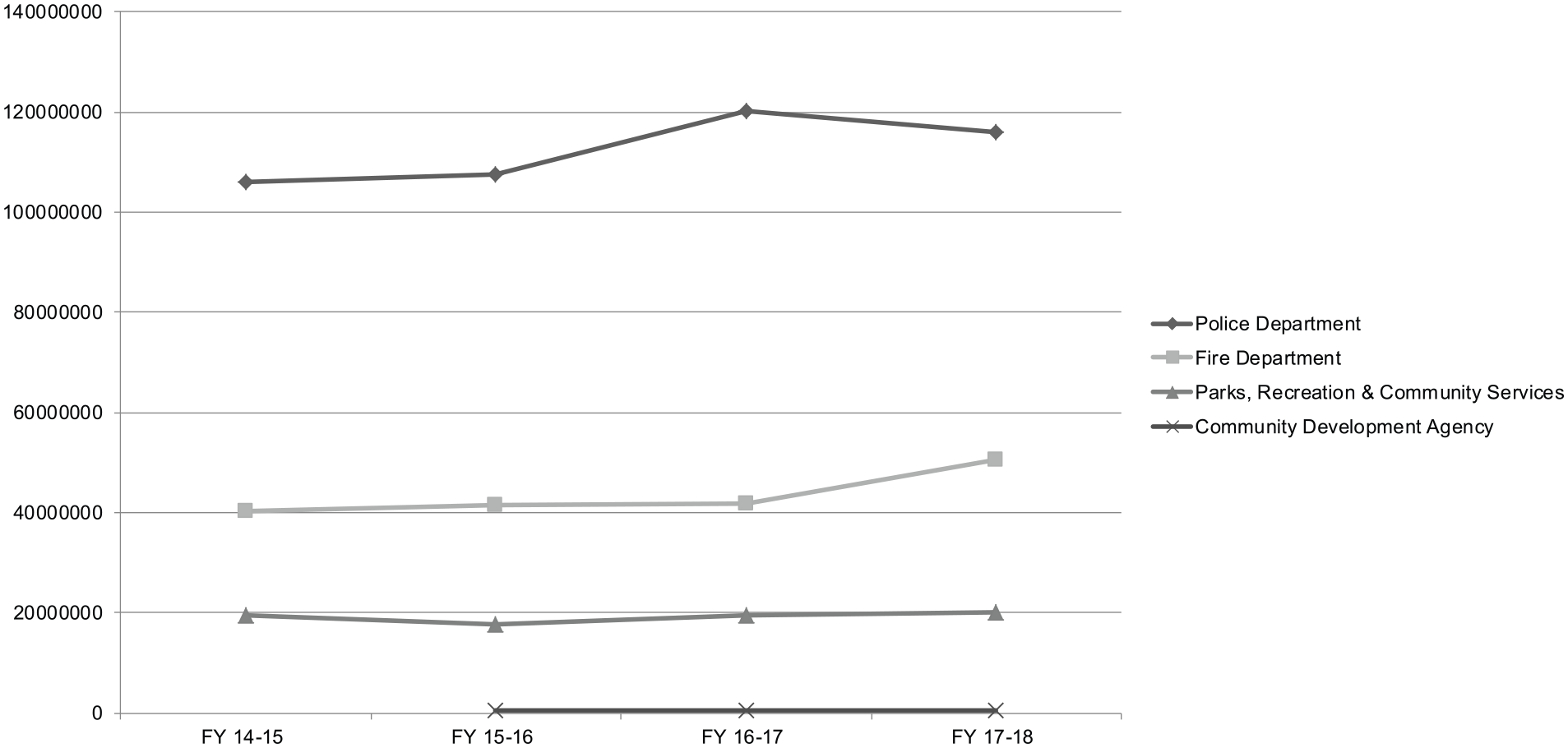
City of Santa Ana General Fund Allocations 2014–2017 demonstrating high funding for police.

Police budget and police service debt (the latter not included in total police budget).
In early 2016, two years after the publication of the strategic plan, the city proposed increasing the number of detainees to address the jail debt. According to the city staff, who had been working for over a year on a TCCC recommendation, the city’s goal was to “take into consideration the transgender population preferences as it relates to the placement within the facility” and fill vacant beds to “be in better position to repay our debt.” The city manager stated, “This facility raises the bar even higher, [provides] protections especially for the most vulnerable. We have the opportunity to make it even better.” The city jail debt strategy depended on increasing lesbian, gay, bisexual, transgender, and queer/questioning (LGBTQ) detainees from seventy to 128 and ICE detainees from two hundred to three hundred maximum.
Meanwhile, community activists formed the “OC Immigrant Rights Working Group” with community organizations which had successfully passed the Sunshine Ordinance and immigrant rights organizations—many led by undocumented and unafraid dreamers—such as RAIZ/Resilience Orange County and the Orange County Immigrant Youth United. The group advocated for Sanctuary City, to end the city’s contract with ICE, and LGBTQ organizers from La Familia organized a hunger strike specifically focused on the detention of transgender immigrants. In May 2016, community efforts finally pushed city council to “slowly disengage [from] the contract” with ICE but not until 2020. Advocates also won a small investment of $50,000 for a jail reuse study. By the end of the year, on December 20, 2016, community organizations had pushed the Santa Ana City Council to unanimously approve the Sanctuary Ordinance and authorize staff to release a request for qualifications (RFQ) for a jail reuse study.
As a result, in February of 2017, federal immigration authorities decided to end their contract to house detainees at the Santa Ana Jail. ICE spokeswoman, Virginia Kice, noted that “recent actions by the city to drastically curtail the number of beds available at the city’s jail to house immigration detainees meant the existing detention contract was no longer viable or cost effective” (Kwong 2017a, n.p). The jail now had one contract with the U.S. Marshals Service for 111 detainees and another with the Federal Bureau of Prisons for fourteen detainees (Kwong 2017b). According to city staff, ending the ICE contract represented a monthly loss of $340,000. The drastic impact on the jail operations budget is visible in Figure 4. Consequently, city staff and council members made a political shift away from union interests by proposing to reduce jail staff from 116 to eighty-three full-time employees instead of refusing to layoff any jail employees.

Jail operation costs and revenues reflecting the decrease in staff personnel, costs, and revenue decline when U.S. Immigration and Customs Enforcement (ICE) withdraws from contract, but the increase from the Marshal contract.
Locked in the Jail Business
The city’s planning process demonstrates a political and financial inability to break away from investing in the security apparatus. Data analysis illustrates the continued negative investment in and challenges of transforming a concrete-and-steel structure and the political and economic relationships that sustain it.
Technical and Structural Priorities
Initially, the city hosted twelve community-stakeholder meetings to develop the RFQ for the jail reuse study where immigrant rights advocates fought to include a conditions assessment of the people being held in the jail. However, after ICE canceled its contract, city staff and council removed the jail conditions assessment because of the urgent financial situation to fill the financial gap and the possibility of no longer operating a jail at all. Staff suggested the city council could request a conditions assessment separately.
The city received only two proposals. One was collaborative, involving Torti Gallas + Partners, Builders of Hope, Community Initiatives for Visiting Immigrants in Confinement (CIVIC), and Californians United for a Responsible Budget (CURB). This group included an international planning, architecture, and urban design practice and nonprofit organizations with experience assessing immigration detention conditions, conducting reuse assessments on public and private buildings, running alternatives to detention programs, and generating cost-effective options to incarceration strategies. Some of the organizations were currently monitoring jails, including Santa Ana’s. The other bid was from Vanir Construction Management, Inc. According to its promotional material, Vanir (2018) has experience in “managing more than 270 justice projects” including jails, prisons, courthouses, and emergency operations as well as other public facilities. City staff explained the number of bids in relation to the planning requirements: Why only two firms? Part of the reason is there’s not a lot of companies that do jail reuse studies. It’s a very niche market, so with the recommendations that the group, the planning group put together, we did require some prior expertise in this area to ensure that whoever the selected vendor would be able to understand the complexity of jails, and the specific building codes, and requirements that go with operating the jail.
The city’s process prioritized the jail’s physical structure, codes, and planning requirements. Ironically, understanding jail operations became the main qualification.
The city manager’s office and Santa Ana and Anaheim jail administrators rated the proposals. City staff explained that even though the collaborative proposal did not meet the RFQ’s minimum qualifications staff still scored both proposals. Vanir’s outscored the collaborative one (Vanir 425/500; Torti Gallas et al. 142/500). On April 2017, the city executed a one-year agreement with Vanir for $103,155, plus a $21,845 contingency, for a total not to exceed $125,000.
Good for One Thing
The study’s first part comprehensively assessed the structure’s potential for reuse or continued use while the second part proposed alternative uses for the jail. Vanir evaluated different facility areas—administrative, central control, housing, kitchen, and laundry. Key structural issues were the building’s age and deteriorating plumbing. In addition, the jail was deficient in space per person—350 ft2, when four hundred was the standard and five hundred was the more current design. The medical/mental health services area was nearly 6.5 ft2 lower than those in other comparable California detention facilities (Vanir 2018). The study’s second part garnered input from city staff, three community meetings (two open to anyone), and city council meetings. City council members, for example, offered their experiences visiting converted hotels, data centers, and art spaces that used to be jails.
Proposed jail reuse options gathered by Vanir included “criminal justice detention” and “out of the box” options. Vanir provided reuse categories, allowing city staff and council members to develop distinct scenarios: (1) a Type II Jail Facility or expanded rehabilitative services (e.g., transitional community reentry treatment programs), (2) general commercial office use including an office complex, (3) other institutional use like homeless shelter housing with supportive services space, and (4) commercial use such as a data center. Vanir’s and city staff’s assessment criteria by which the city council could rank options included the estimated financial investment, yearly operational costs, potential yearly revenue, community benefit, in addition to the implementation schedule and required building/systems modifications.
Responses from staff and city council members after the release of the study reflected their difficulty seeing beyond an “obsolete structure” or one made for a particular purpose. One council member emphasized the space’s physicality: “It’s concrete and steel. Any kind of reuse, it’s going to have to be . . . any reuse has to be secure.” Another council member noted the public needed to “Understand that we are limited in terms of how the jail was built” when considering alternatives. A third council member stated, “I’m supportive of the jail uses as it is. It’s served us well . . . we also know that the debt goes away in a few years and so it will be cost effective.” None addressed conditions for the people being held in the jail itself.
Filling in the ICE Gap
Filling in the financial gap left by ICE was a “short-term problem” with a “long-term solution” that required reinvesting in the jail according to the city. In August 2017, the city voted to renew a two-year contract with the U.S. Marshals, increasing those jailed by about 171 to make up the shortfall by reinvesting in incarceration. In addition, city staff recommended allocating funds for plumbing and a van for jail transportation operations.
According to both the city staff and council, this continued investment would “slow down” the reuse process and buy them time. One city staff member stated, “This is really a temporary contract . . . It is not a long-term fix for the jail, but it does give us some breathing room while we move forward with the reuse study.” City council comments focused on “offsetting losses,” “relief,” “making the hole smaller,” and “thoughtful time to contemplate what our options are.” For city council and staff, fulfilling a long-term goal of developing alternatives and transforming the jail’s use involved investing in the jail itself.
Sanctuary Planning
Sanctuary planning in Santa Ana represents a focus on Marcuse’s two cardinal forms of spatial injustice by challenging the confinement of immigrants and the continued allocation of resources into the security apparatus. Immigrant rights organizations challenged the underlining logic of the carceral city and new military urbanism by exposing the investment in security infrastructure and the political and economic interests contained within the jail’s physical structure while also fighting for the reallocation of resources in the city.
Challenging Immigrant Detention
Targeting the jail required re-envisioning safety as a core city function that prioritized the humanity of those deemed “criminal” over public profits. The city’s own narrative shifted from a need for efficacy toward a more human treatment of individuals being detained. Originally, the jail had been a response to inefficiency and crime, according to the current mayor, a city council member when it opened: The intent was that we would get our officers out of the county jail . . . The county jail was full. We would send officers over there to arraign potential inmates and they would be there all day. You would lose them. The waiting lines were so long. The process was so long and the cost of that, because now we wouldn’t have officers on the streets . . . and homicides and everything was out of control.
The city’s original safety narrative concerned police efficiency and control but the city’s current TCCC proposal increased the number of detainees to balance the jail budget while also considering “protections for the most vulnerable” while in custody.
Immigrant rights advocates worked on rejecting this narrative and the TCCC proposal and rather pushed to phase out the ICE contract altogether. Organizers had moved away from previous immigration reform that “left others behind” and employed frameworks combined with disparate criminalization practices to focus only on “deserving immigrants.” One advocate raised the conditions in the jail and restated the following during a city council meeting: I’m here to uplift the case of Cristina Lopez, who is a 35-year-old trans woman from Peru, who has been detained in your city jail for two years now, who has been diagnosed with hepatitis C inside detention and, up to this day, has had no medical treatment for her condition. For us it is unacceptable.
Activists’ new narrative responded to the city’s proposal by simultaneously elevating experiences of jailed transgender women and exposing the profiting from immigrant detention. From reports on observational tours, the jail was not complying with established detention standards (American Bar Association Commission on Immigration 2007; American Bar Association Delegation 2004). Another activist publicly stated the following: It is shameful and it’s outrageous that this city would consider increasing your budget on the suffering, pain, and torture of trans women inside detention centers, so we will continue to organize to hold all of you accountable to stand with the community.
Advocacy lifted the humanity of those individuals within the jail while focusing on the city balancing the budget on the backs of the immigrant community.
Even the Sanctuary Ordinance was not enough for advocates. When Santa Ana City Council unanimously approved the Sanctuary Ordinance in 2016, public comments were largely focused on holding the city accountable for considering increasing the budget via detention despite “the city’s stance” in protecting the immigrant community. Referring to the Sanctuary Ordinance as the “right path,” “the beginning of something stronger,” nonetheless, activists also observed it fell “short of the level of commitment” needed to “protect the immigrant community” and that the city contradictorily continued detention in its jail.
Jail Reuse and the Reallocation of Funds
With the end of the ICE-jail contract, the movement for sanctuary in Santa Ana shifted its efforts toward challenging the whole security apparatus. An LGBTQ organizer at a council meeting stated, [Free] the most criminalized, trans women that are doing sex work out there, all criminalized people, those held in your cages. Shut down the detention center! Shut down your prisons! Shut down your borders! Let us live!
Activists then advocated for discontinuing the jail business altogether and repurposing the building. As part of this advocacy, the organizations that lost the BID to Vanir, published a report in February 2018 (Fialho 2018). The report proposed reuse options including shared office workspaces, several urban farm possibilities, artist studios, and an alcohol distillery. It highly recommended the option of a community-based reentry center, combining cognitive-behavioral treatments with programming and a community garden.
Changing the jail’s use would significantly weaken the public infrastructure invested in broader systems of criminalization and incarceration while allowing for reinvestment in community benefits, like youth programming and legal representation for immigrants facing deportation. Immigrant rights advocates argued for “an increase in returns” by investing in community benefits, as this organizer’s remarks demonstrate: The jail was created in the 90s with the narrative that there was a rise in crime, and that’s where we invested a lot of our money, when we should have invested in our youth at that time . . . This jail carries no public or community benefit. The residents and taxpayers of Santa Ana are paying for that . . . We are burning and mismanaging taxpayer dollars. As we move forward, we urge you to prioritize community-based reuse options, ones that will have a public benefit, something taxpayers deserve.
A first step in this direction was the city’s vote in July 2017 to set aside $65,000 dedicated to providing publicly funded representation to people facing deportation. The city also received grant funding for $100,000 to join the SAFE Cities Network for universal representation, or providing legal defense for undocumented residents. The city passed these initiatives that exemplified investing to keep people out of jail as extensions of Sanctuary Ordinance.
The promise and challenge were to expand sanctuary to other spaces, like housing or neighborhoods, according to one activist interviewed: When you include the issues of affordable housing or home ownership, one cannot ignore the highly concentrated level of immigrants in certain neighborhoods who are over-policed more than others. And if you live in an over-policed neighborhood, more enforcement means higher arrests and more arrests mean contact with ICE at the county jails.
Sanctuary meant stopping deportations and “making sure the person has somewhere to live” and “their children feel safe at their schools in their neighborhoods.” Sanctuary for the immigrant community now included a critique of not only immigrant detention but also a critique of public profiting from detention and incarceration and a search for alternative uses for the physical building and a reallocation of public monies.
Sanctuary’s Variegated Landscape
Sanctuary planning exposed the political actors and immigration policies at various scales. Although the Sanctuary Ordinance was largely a local decision, the city council publically responded to federal threats against sanctuary cities issuing from Donald Trump’s electoral campaign during this time. Council Benavides referenced local jurisdictions’ powers to adopt sanctuary legislation: The City of Santa Ana has the authority to adopt the Sanctuary Ordinance. This ordinance is a legitimate constitutional exercise of the city’s authority to regulate for the health, safety, and welfare of its residents. Under the 10th Amendment, local public welfare is a matter for state and local concern and not a matter of federal government.
Santa Ana’s city council defended the local authority to regulate issues of safety and responding if challenged.
The sanctuary movement surfaced important political and economic fragmentation at the local level as well. Targeting Santa Ana’s jail helped expose and challenge the extent of the police union’s powerful political and economic forces in the city. Ending the ICE contract and losing detainees had forced the previous city council to cut the jail’s biggest financial costs, those step fixed costs associated with personnel, as exhibited in Figure 4. In addition, sanctuary advocates publicly criticized not just the general budget but the fact that two-thirds of raises and pensions went to Police Department employees, despite current and former police employees amounting to fewer than a third in the city’s pension plan. Despite the initial political union on city council, after Trump’s election, some council members who voted for sanctuary lost their seats. Newly elected Jose Solorio, a democratic politician supported by the police union who activists called “Latino Trump,” proposed reviving ICE’s contract.
In addition to citing the local political and financial consequences of losing the ICE contract, Council Member Jose Solorio used the varying conditions in detention centers to defend having ICE in the Santa Ana Jail: Folks are going to be transferred instead to places like Adelanto . . . If you think the conditions in our facility or other public facilities are bad, they’re much worse in private jails.
The variegated landscape allowed for immigrants’ placements in jails farther away or in neighboring counties while advocates organized for their release. Distance would further complicate finding support for detained individuals. Sanctuary planning required a scalar analysis of political strategies and support mechanisms that also considered the network of jails and detention centers in various cities and regions.
Although passed at this time, the role of Trump’s election in shaping grassroots tactics to close or keep the jail open should not be overstated. The regional and national networks and alliances on either side began forming decades earlier during Barack Obama’s administration. At regional and national scales, immigrant rights networks generally forge significant political alliances. For instance, national organizations, present at various city council meetings, provided research, analysis, and legal and campaign support around the jail. Other regional anti-immigrant alliances aligned with support for jails as reflected in one speaker’s statement at a public meeting: My only son was murdered in 2002 by an illegal alien who was previously deported. Don’t break the laws and you won’t end up in jail. I support Santa Ana jails.
Those noting the “criminality,” “illegality,” and “unwillingness of immigrants to assimilate” also organized regionally to show up locally.
Conclusion
Jails are important sites in a complicated landscape that immigrants and advocates must navigate at various scales. However, sanctuary planning represents how immigrant are more than negotiating and coping with new military urbanism and the carceral city; immigrant organizers, many of whom are “undocumented and unafraid” (Nicholls 2013), are shaping community-police relations and city budget allocations and challenging economic models built on immigrants’ detention, deportation, and incarceration. Immigrant led movements are “reinventing” (á la Davis 2000) practical, economic, and political urban planning alternatives, including opting out of the jail business and transforming the physical environment. Most notably, sanctuary planning shifts the question from how to make jails feel less like punishment (Moran, Turner and Schliehe 2018) or locational decisions about where to place jails to what spatial justice alternatives can look like and where. Spatial justice is not simply about spatial remedies, but changing social, political, and economic conditions impacting space and vice versa (Marcuse 2009).
Meanwhile, sanctuary cities are heterogeneous in their policies and city governments make different political commitments to local, regional, and national actors (Graber and Marquez 2016). Sanctuary planning is a consideration of the politics working at various scales while prioritizing human costs. Just as the federal government needs local facilities to implement its deportation goals, “justice is not achievable at the urban level without support from other levels” (Fainstein 2009, 21). Scaling up sanctuary raises important challenges. At the national scale, cities and states decide to align with either sanctuary politics or the federal policy on immigration and can represent opposition to federal immigration policy by granting immigrants rights. California faces a federal lawsuit filed by the Justice Department against three state laws in 2017: SB54, the California Values Act; AB 450, the Immigrant Worker Protection Act; and AB 103, a detention statute.
Finally, recognizing planners’ active role in both reproducing carceral cities and developing alternatives is important. Planners have been complicit in planning jails and prisons, with the profession, at best, remaining silent (Simpson 2015; Stein 2015). Planners instead can help develop new ways to assess the human costs of jails and prisons for residents who foot most of the expenses and deal with the consequences of decreasing public benefits and services. Finding potential reuses for such large properties is an ongoing planning challenge. Some intermediary steps include downsizing, filling the financial gap, and developing reuse proposals. Sanctuary planning considers the broad implications of stemming people’s flow into and releasing them from jail or detention and reinvesting in people’s humanity over more politically feasible options.
Footnotes
Acknowledgements
I would like to acknowledge the organizers and leaders of the various organizations working in Santa Ana and thank them for everything they continue to teach me. This research builds on the great work done by those organizers and organizations working to advance racial justice. Also, thank you to the Journal of Planning Education and Research (JPER) Editors and three anonymous reviewers, whose feedback greatly improved this article.
Declaration of Conflicting Interests
The author(s) declared no potential conflicts of interest with respect to the research, authorship, and/or publication of this article.
Funding
The author(s) received no financial support for the research, authorship, and/or publication of this article.
