




Abstract

Academic journals help define fields by inviting some contributions and excluding others. Generalist journals like JPER play this role for urban planning. Yet, as an applied field of research and practice, the boundaries of planning are porous and frequently shift to accommodate emerging societal needs. How can we realistically set boundaries? Perhaps we should instead ask what is planning’s attractive core, rather than seeking to locate its edges.
The question of what counts as planning scholarship has been our central editorial concern over the years from 2016 to 2020. Here we explore the shifting boundaries of planning research as it has played out in our editorial decisions during this period. We see implications for research, practice, and pedagogy.
In a generalist journal such as JPER, articles need to speak beyond their specialty to those with other interests, but how broad do those conversations need to be? The empirical answer for the 2016–2020 period has several dimensions.
Nationalities
Every scholarly community originates somewhere, and ours is based in North America. It draws on English common law traditions, American colonial experiences, and settlements built in vast continental landscapes, following market principles. If planning in North America is our core, then the data show that we are beginning to attract scholars from other locations to this community. Figure 1 shows the number of accepted and rejected manuscripts by author’s country of origin from 2016 to 2020. Four important insights emerge:
JPER remains a North American journal, with more accepted manuscripts and fewer rejections for U.S. and Canadian authors.
Other Anglophone countries also fare well, as do Israel and the Netherlands, whose scholars arguably share similarities with North Americans.
There is great interest in JPER in China, India, and Iran, but to date only China-based authors have successfully published articles.
Authors from fifty-eight countries from Algeria to Zambia have submitted manuscripts to JPER during the past five years, most with low success rates.
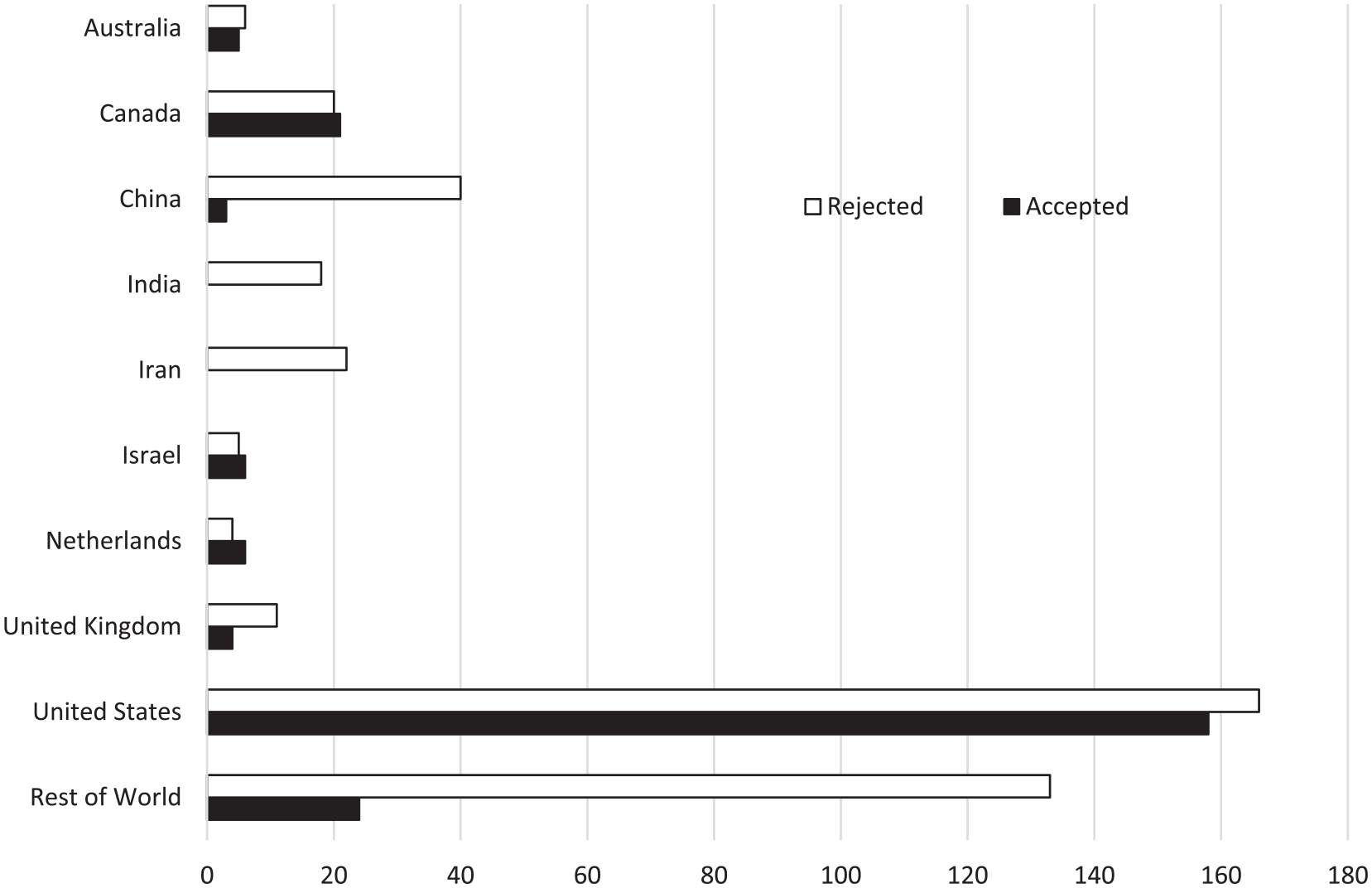
Accepted and rejected JPER manuscripts by country (2016–2020).
Topics
Articles published in JPER are contributions to an evolving scholarly conversation. Because interesting conversations rarely stand still, the topics that authors write about change from time to time. One way to measure the topics of greatest interest is to count how frequently certain words appear in the titles of manuscripts. See Table 1 for a list of the top 10 most frequently appearing words in titles of accepted and rejected manuscripts during our editorship, from 2016 to 2020. Accepted paper title word frequencies show that the JPER conversation has focused in recent years on housing, community, development, environment, role(s), learning, transit, neighborhood, evidence, and built features.
Ten Most Frequent Words Appearing in Titles of Accepted and Rejected JPER Manuscripts (2016–2020).
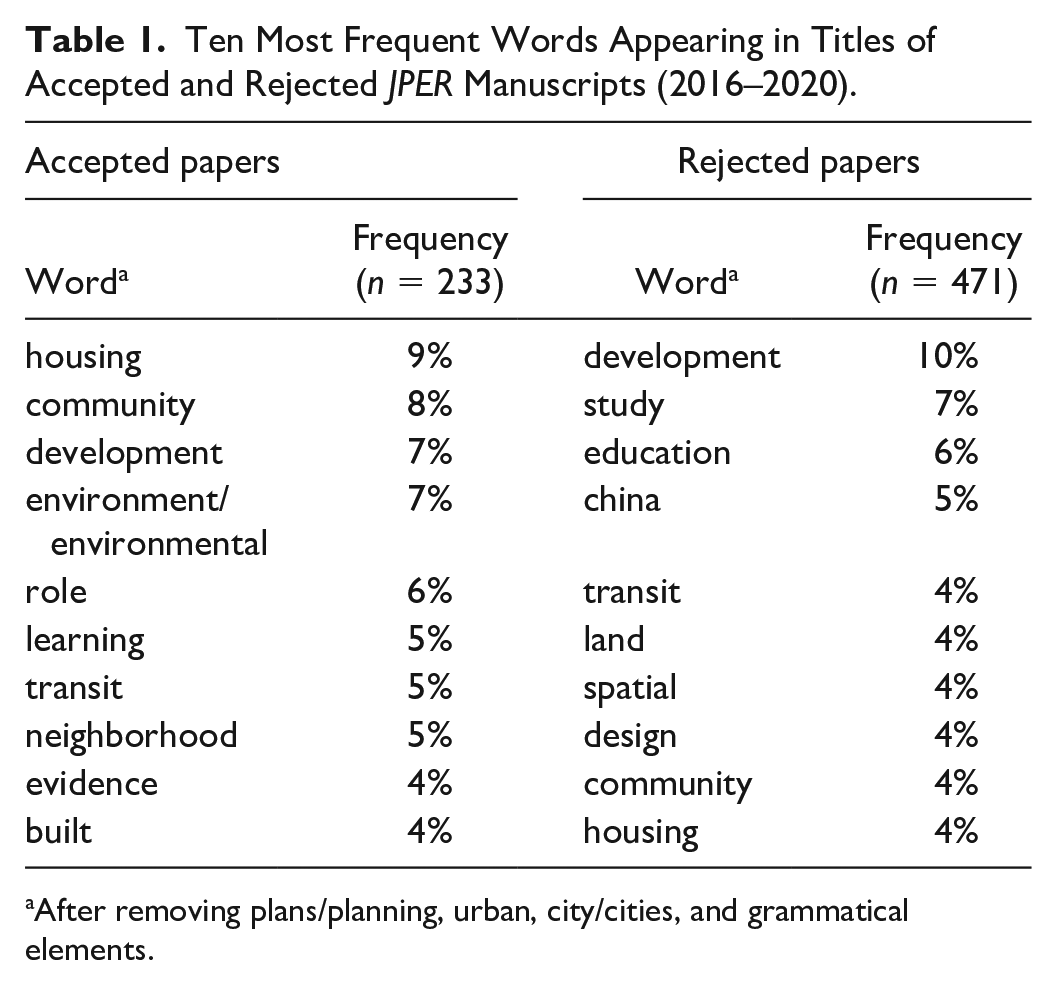
After removing plans/planning, urban, city/cities, and grammatical elements.
Words appearing frequently in the titles of rejected papers show a different pattern in Table 1. Some popular words are the same and simply reflect that not all submissions on hot topics get accepted: development, transit, community, and housing. The word frequencies for land, design, and spatial(-ity) suggest that the current JPER conversation is less focused on such issues. The prominence of the word education likely reflects the relatively large numbers of unsuccessful submissions on pedagogy, and the word China likely reflects the lower acceptance rates experienced by Asian authors.
Universities
Scholars at certain universities have recently contributed more intensively to JPER, as shown in Figure 2. All but three of the U.S. universities shown are ranked among the top 25 urban planning graduate programs (Planetizen, Inc. 2019), and all of these programs are accredited by the (U.S.) Planning Accreditation Board or the Professional Standards Board (PSB) of Canada (Planning Accreditation Board 2020; PSB 2020). Thus, these scholars and their programs are very much at the center of the planning academy in North America.

Universitiesa with more than two accepted JPER manuscripts during 2016–2020.
The list of universities with the largest number of rejected manuscripts includes multiple institutions in Africa and the Middle East.
Influential Papers
The five most cited papers published during 2016–2020 include
Pedestrians, Autonomous Vehicles, and Cities (Adam Millard-Ball);
Guidance on Conducting a Systematic Literature Review (Yu Xiao, Maria Watson);
New Insights into Rental Housing Markets across the United States: Web Scraping and Analyzing Craigslist Rental Listings (Geoff Boeing, Paul Waddell);
Exploring the Association between Urban Form and Air Quality in China (Man Yuan, Yan Song, Yaping Huang, Shijian Hong, Liejia Huang);
Evaluation Theory and Practice: Comparing Program Evaluation and Evaluation in Planning (Dave Guyadeen, Mark Seasons).
These articles span the breadth of JPER’s scope, from research to education, and from substantive topics in housing, transportation, and environment, to procedural issues.
Breaching Boundaries
We are unhappy that an author’s nation of residence and university seem to be important determinants of successful publication. On that basis, we have undertaken two relevant initiatives. First, we started translating abstracts of newly published papers in February 2018 in order to make this scholarship more accessible. We have completed translation of abstracts into Spanish and Chinese for 126 research papers since then. Students who performed these translations included Maia Delacalle, Stephania Gonzalez-Mena, Manning Qiao, Haoyun Wang, Sicheng Wang, and Sishen Wang. We thank them for their careful work. Second, we convened an annual JPER Summer Writing Workshop for Early Scholars where postdoctoral researchers polish manuscripts and learn successful publishing strategies. Increasingly, these include emerging international scholars. We thank Michael Greenberg, Robert Lake, Jane Miller, Kathe Newman, Karen O’Neill, and Frank Popper for serving as faculty facilitators during these workshops. There remains much more to do on these fronts.
Planning’s Attractive Core
We conclude that it is more important to attract scholars than to defend boundaries. For the most part, our scholarly community is instinctively welcoming and nurturing. Most of us want to learn new things and borrow useful ideas from other fields. The connections to practice keep us grounded in the lived, current experiences of regular people. Over time, as new concerns, methods, and theories emerge, it is important that JPER encourage scholars to explore them.
The bigger concern probably should not be to exclude less-central scholarship from our community, but rather to limit the extent to which other disciplines encroach on our core. For example, one could argue that we have ceded much of the smart cities space to computer scientists and engineers, to the detriment of cities. The list of most cited articles above shows that we have much to offer in exactly this space (and probably that non-planners are reading it). Yet, when we seek reviewers of such articles, we often hear that “this isn’t planning.” It is!
This is the final issue edited by our team at Rutgers, and we thank you for being such good authors, reviewers, and readers. The new editorial team, based at Texas A&M University, is already in place and doing a great job.