



Abstract
“Free-choice” learners are people who learn outside of a formal learning environment. The video platform YouTube is a popular place for free-choice learners to educate themselves. The author of this article produced a YouTube channel with fifty-one videos on city planning topics to determine how many free-choice learners could be taught on the platform. Millions of viewers, most with no prior formal educational experience with city planning, watched the videos over a two-and-a-half year pilot study. YouTube can be a powerful tool for education beyond the classroom, but the platform’s recommendation algorithm poses challenges to reaching all demographic groups.
Introduction
Education is a critical part of the act of city planning. Planning education can take the form of an accredited university program, or a practitioner discussing the basics of zoning at a community meeting. Planners can, in turn, learn from the wisdom and expertise of an engaged community. There is another type of learning scenario that does not receive as much direct attention from planners: educators and practitioners teaching “free-choice” learners. These learners do not have goals or agendas within the institutional structure of school or a defined planning process, but instead are engaged in lifelong continuing education on topics that interest them. They read books, magazine articles, and newspaper articles; watch educational television programs; and visit museums and science centers. Increasingly, free-choice learners are turning to YouTube, the world’s largest online video platform, to consume educational content. YouTube is the second-most visited social network on the Internet, behind only Facebook, and the largest learning platform in the world. YouTube states it has one billion users from over 100 countries (“YouTube for Press” N.d.). Users upload more than 500 hours of videos every minute (Loke Hale 2019). Free-choice learners can find videos teaching everything from archeology to zoology, and popular educational videos can reach audiences in the millions. This access to information and knowledge over the Internet is even more valuable during the COVID-19 pandemic, as schools, universities, and museums are closed or operating in a limited capacity.
Despite the large number of YouTube users and educational videos, there are relatively few videos and channels (the term used for accounts that publish videos) about city planning. This is a potential missed opportunity, as YouTube can provide basic education on planning topics to large numbers of people. Those free-choice learners who watch a city planning YouTube video may get involved in future planning processes and vote in elections and referenda. They may become community and neighborhood leaders and become the next generation of planning commission or city council members. They may be inspired to pursue a career in city planning.
This observation about the low number of channels focusing on city planning education prompts the following research questions:
To gain insight into these questions, I used a novel methodological approach. I produced a YouTube channel that regularly publishes five- to fifteen-minute educational videos on city planning topics, such as transportation, land use, and urban design. The channel differs from many university, research center, and local government YouTube channels that publish videos infrequently and tend to be more informative and promotional than educational. This pilot project began in January 2017, and at the time of publication is still ongoing, although this article will examine data through August 2019. The performance of the channel and the fifty-one videos published in the study period is measured in video views and channel subscribers.
Relevant data, including demographic data about viewers, are provided by YouTube’s robust suite of statistics. These data are supplemented by a viewer survey of 716 respondents that asked them additional questions about their YouTube viewing habits and interest in city planning. The results show that 11.8 million people watched city planning videos over the thirty-two-month study period. The viewers, for the most part, were not practitioners, planning students, or otherwise involved in a planning process. This is an encouraging result that demonstrates the promise of publishing videos as a means of educating the general public. The analytics and survey results show some potential downsides of relying on YouTube to reach free-choice learners, however. YouTube’s algorithm acts as a gatekeeper and does not recommend videos to all demographic groups equally. Content creators (YouTube’s term for video publishers) cannot choose their audience, but instead must rely on YouTube to do it for them. YouTube also does not widely recommend videos they deem incompatible with their advertising program.
This article begins by defining the concept of free-choice learning. This is contrasted with the ways planning practitioners and academics use media to communicate to the general public. The article continues by describing the unique method of starting a YouTube channel and publishing videos for over two-and-a-half years. Detailed viewer analytics and the results of a viewer survey provide information about the size of the audience and their demographics. The article concludes with a discussion about the lessons learned and next steps for educating free-choice learners about city planning.
Background and Literature Review
Free-Choice Learning and YouTube
This research is at the confluence of several areas of literature, both within the planning discipline and without. The concept of free-choice learning is primarily documented outside of the field. The concept of learning by the general public has been studied for decades under many labels, including “self-teaching” (Tough 1967), andragogy (Knowles 1980), and free-choice learning (Falk 2005). Free-choice learning, broadly speaking, is learning that is done outside of formal learning environments. Free-choice learning differs from the formal/informal learning construct by the addition of choice. The learner is in control and making a choice to learn and choose the learning option that best fits their needs (Falk 2005, 273). Free-choice learning is not a passive activity, but one where the learner seeks the knowledge in an informal environment.
Why do people engage in free-choice learning? They do so for several reasons, including fulfilling their intellectual and personal curiosity, satisfying a sense of identity, and better understanding the world in which they live (Falk 2005). There can be extremely practical reasons for free-choice learning. One may be planning a trip and wish to learn the best way to reach a destination. Research via an online map tool is considered free-choice learning. Free-choice learning can also be undirected. A museum visitor may wish to learn more about art, but not have any specific questions. Instead, they attend the museum to learn about the collections and exhibitions available on that given day. Free-choice learning is truly a lifelong endeavor, children outside of school can engage in it, as can a senior (Falk, Donovan, and Woods 2001).
YouTube may be an ideal channel for the diffusion of planning-related information (Rogers 2003). Rogers (2003, 19) describes diffusion as “a social process that involves interpersonal communication relationships.” While mass media can diffuse knowledge to free-choice learners, social media is better suited for the task. YouTube allows viewers to leave comments and even create videos of their own. This process can take a concept or idea and amplify it. While this exchange between a YouTube video producer and a commenter is one-to-one, the exchange is visible to all, making YouTube a cosmopolite channel, similar to mass media.
YouTube may be the most prominent example of free-choice learning via social media due to the volume of educational content found on the platform. Hours and hours of educational videos are published on YouTube every day, and there have been studies done on the effectiveness and challenges of using the platform as a teaching tool. Studies have confirmed a fundamental point: people use YouTube to learn. Researchers found that one third of a sample of Singaporean Internet users viewed science videos during the previous week. The study concluded that this was a form of free-choice learning (Rosenthal 2018). A study of anatomy students found that 78 percent augmented their classroom learning with YouTube videos on the topic (D. S. Barry et al. 2016).
Starting a YouTube channel has been shown to be an effective way of educating the general public. A study of a medical education channel found a substantial audience after a year producing videos on the platform (Tackett et al. 2018). Education on YouTube can be an effective means of reaching many people, but it can be challenging to evaluate educational outcomes on the platform, due in part to low response rates to surveys. In addition, viewers often do not watch the entire video, making it difficult to know how much of the content they consumed and retained (Harrison et al. 2016).
Communication in the Planning Field
The previous section provided a background into the motivations of free-choice learners and the way YouTube can provide them with the knowledge they seek. How does city planning fit into the education of free-choice learners? Planners often have experience with formal planning education, often in a university setting. There is a robust set of literature about how city planning instructors can more effectively teach students in a university setting (J. Barry et al. 2019; Kennedy and Tilly 2019; and Alizadeh, Tomerini, and Colbran 2017, to name a few recent examples from this journal). Instructors have used social media to improve learning outcomes. One professor has his students use the social network Twitter to tweet questions during lecture (Evans-Cowley 2018).
There is an ongoing discussion about how planning scholars reach beyond the classroom and exert influence in the public sphere. These efforts are usually meant to broaden the impact of the scholars’ teaching and research. Planning scholars can become “public scholars” by publishing in mainstream media and on social media platforms (Siemiatycki 2012). Flyvbjerg (2012) concludes that mass media can be an effective way of increasing the impact of scholarly work on practice, and social media have made it even easier to make an impact. This article’s research is intended to test another potential channel for planning scholars to become public scholars.
A thread of scholarship discusses engaging and educating the general public about city planning through social media, although they are framed through the lens of an active planning process (Evans-Cowley and Griffin 2012; Schweitzer and Stephenson 2016; Throgmorton 2003). Social media has the potential to elevate community members to the highest rungs of Arnstein’s ladder and become co-equal creators of plans and public spaces (Apostol, Antoniadis, and Banerjee 2013).
Planning scholars have thought deeply about how planning communication can foster shared meaning and incite action. This communication, increasingly, does not have to come from a major institution, but it can be spread online (Castells 2009). Online spaces can be a form of “informal” or “weak” public space, as theorized by Habermas. This informal, non-institutional realm is at the grassroots level and can be a “context for discovery” (Flynn 2004; Habermas 1996). This discovery period can result in the formation of online interest groups that can organize to stop new developments or planning processes (Evans-Cowley 2010). These developments have made practitioners rethink their approach to planning in the face of organized opposition (Trapenberg Frick 2016).
Collectively, this literature points to a large free-choice learning population on YouTube and a planning field that has strongly considered the ways planning knowledge can be used and disseminated in planning processes and grassroots social movements. This suggests that a YouTube channel about city planning could potentially reach a large audience and inspire viewers to action in their communities.
Method
Developing a Channel
At the outset of this study, there were very few YouTube channels dedicated to the topic of city planning. There are many city planning videos on YouTube posted by universities, research centers, and local governments. These videos are typically not posted on a regular schedule, with topics selected to build a large audience on the platform. Some channels, not specifically focused on city planning, have produced videos on the topic. For example, the channel “The B1M” focuses on construction projects around the globe. They will sometimes touch on urban issues (“The B1M—YouTube” N.d.). Similarly, some general knowledge channels will produce a one-off video on a topic such as induced demand (“How Highways Wrecked American Cities” 2016). A study of existing videos about city planning from a variety of sources could have yielded some data, but publishing one’s own videos on YouTube gives the creator access to a suite of statistical tools for deeper demographic analysis. I decided to create a new city planning YouTube channel, produce and publish videos, and gather data on the audience.
There is no one “right way” to start a YouTube channel and produce videos for the platform. I relied on YouTube’s Help section, now called YouTube Creator Academy, to learn the basics of how to start and grow a channel. There were a few key takeaways from YouTube’s recommendations:
Channels should have a clear and consistent branding, and the branding should match the tone and content of the channel (“Lesson: Brand Your Channel” N.d.).
Creators should upload videos on a regular schedule if possible. The more frequent, the better.
Videos should have a consistent format (“Lesson: Keep Your Channel Fresh with Uploads and Playlists” N.d.).
Creators should interact with their audience to build a following. This includes turning comments on for videos and replying to commenters (“Grow Your Community” N.d.).
With this basic advice, I set forth to develop a YouTube channel and produce videos about city planning. Following the advice in point one above, I chose a name (“City Beautiful [http://www.youtube.com/citybeautiful]”), created a logo, and tried to use the same colors and fonts throughout the videos. I set a goal of publishing one video per month, but more if possible, to achieve the recommendation of posting frequently. I left comments on and answered follow-up comments to videos as often as I could.
Producing Videos
YouTube videos vary in quality. YouTube is popular, in part, because it is easy for anyone to upload a video and have the potential for it to reach a large audience. One only needs a camera found on a mobile phone and an Internet connection to produce and disseminate a video. At the same time, major network television shows upload clips and episodes to YouTube, produced with big budgets and experienced professionals. Amateur YouTube creators aiming to grow an audience will typically fall somewhere in the middle of these two extremes. I wanted to portray myself as an accessible expert on city planning topics and have production values to match. As a one-person operation, I had to learn video production skills, such as filming, lighting, and audio engineering, as well as post-production tasks such as editing and animation. I had to learn how to write compelling, concise scripts and how to present on camera. Nobody can be an expert at all of those things at once right away, and early videos did not have the same production values as the ones two years later. That said, the quality of the videos on the channel were similar to other amateur educational channels on the platform. There is a valid concern that this study would measure viewers’ reaction to the quality of the videos as opposed to their interest in city planning. If a video is not engaging, nobody will want to watch it, regardless of interest. The results indicate that this was not the case, or at least not enough of a factor to stop a sizable audience from watching anyway.
City planning is a broad field, and there are a great many topics about which to write a script. My areas of expertise include land use, transportation, and urban design, so I favored those topics when deciding which videos to make. I knew I wanted to appeal to a general audience, so I often framed videos around questions I thought people might ask themselves. My first video was “Why do so many U.S. cities have gridded streets? [https://www.youtube.com/watch?v=KUDVP6aRS1Y].” Once I wrote a script, I would develop graphics and animations, as well as film myself, either on “set” (in my home) or on location out in the city. You can see screen captures from one example video, “The Reason Our Streets Switched to Cul-De-Sacs [https://www.youtube.com/watch?v=d9vDcfH03gs]” in Figure 1. The amount of time required to produce a video declined as the pilot continued, but the time investment remains substantial. Initially, I required about forty hours spread over one month to produce a video. A video now takes twenty hours to produce.
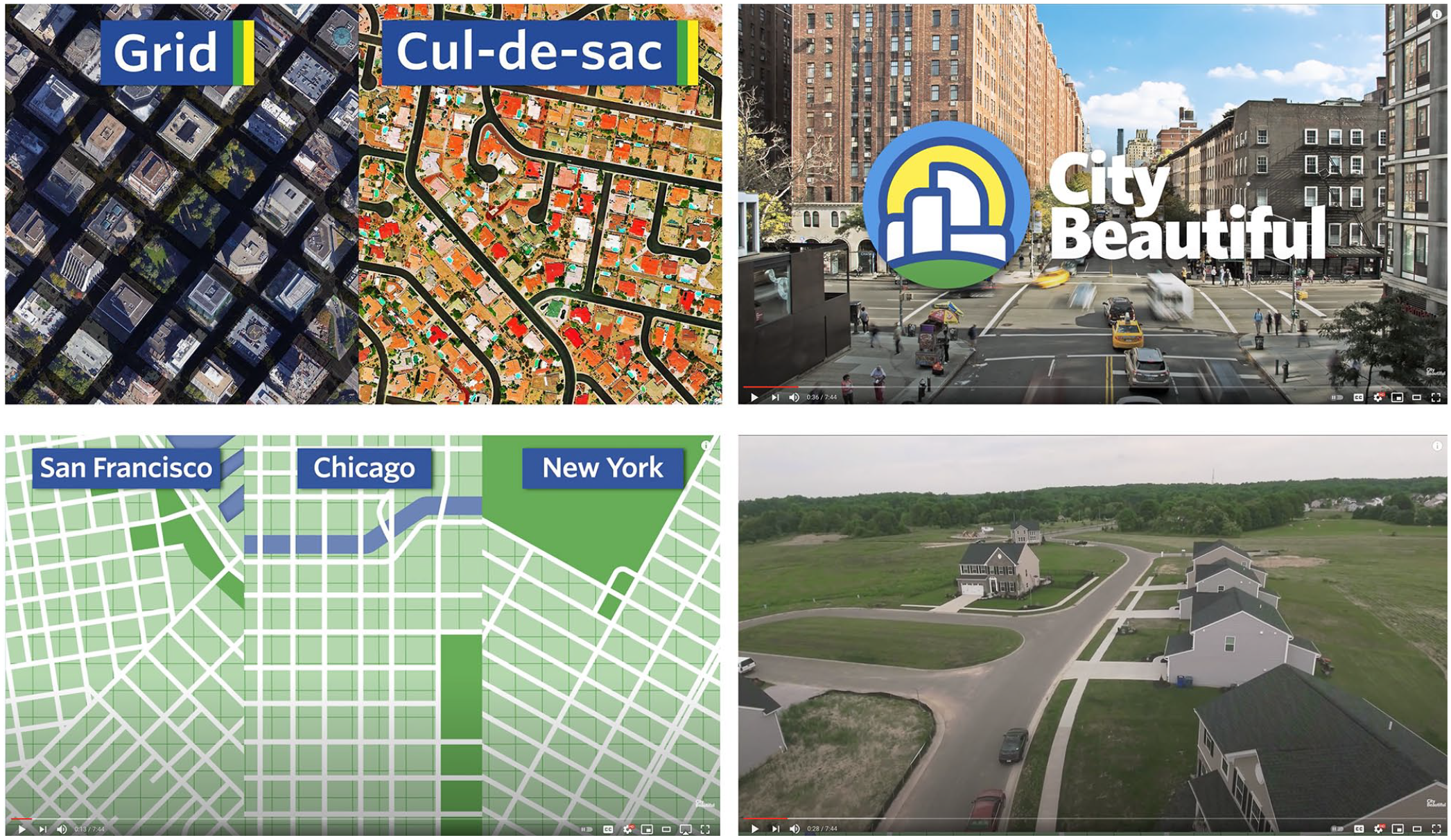
Screenshots from a representative video showing graphics and branding used. Top left: Video thumbnail. Top right: Branding element that appears in the video. Bottom left: Example graphic designed by the video’s producer. Bottom right: Example of the kind of images and stock footage used in a video.
Measuring the Audience
This study measures the number of free-choice learners on YouTube that could be taught about city planning. YouTube offers an extensive suite of viewer statistics called YouTube Studio. The statistics it provides includes video views, minutes of watch time, percentage of video viewed, where viewers found the video, and number of viewers who subscribed to the channel. YouTube Studio also captures a few pieces of demographic information: gender, location (country), and age.
While YouTube Studio provides many useful statistics for measuring the overall effectiveness of reaching an audience on YouTube, as well as who the free-choice learners are, there is still more to know. This study includes the results of a brief viewer survey that asks additional questions about their YouTube viewing habits, where they learn about city planning, and how involved they are in local planning processes. Taken together, YouTube Studio and the viewer survey offer a detailed look at how many free-choice learners watched the videos and who, exactly, they are.
Results
YouTube by the Numbers: Channel Statistics
I published a total of fifty-one videos on the “City Beautiful” YouTube channel between December 29, 2016, and September 5, 2019. I published videos on average about one every three weeks, although I published videos less frequently in the first year and more frequently at the end of the study. This difference is because I became faster at producing the videos and aimed to meet YouTube’s best practices about video publishing frequency. Videos on the channel received a total of 11,832,140 views and 64,896,129 minutes of watch time. A net total of 146,369 YouTube viewers subscribed to the channel.
These numbers can be difficult to understand without some context. The social media statistics aggregator SocialBlade places City Beautiful as the 21,936th most popular channel in the United States, and the 4,888th most popular education channel (“City Beautiful’s YouTube Stats [Summary Profile]” N.d.]. There are 31.4 million YouTube channels, so City Beautiful has achieved a level of success most channels do not, although nothing close to the success of others with tens of millions of subscribers.
Figure 2 shows the growth in views and subscribers from the beginning to the end of the study period. Videos received very few views in the first nine months. By the end of August 2017, the nine videos on the channel were viewed 11,673 times in total. By comparison, the number of views in just one month two years later, August 2019, was over 100 times greater, at 1,259,939. There is no clear reason why views began to substantially increase on videos at around September and October 2017. I can only speculate that something triggered the YouTube algorithm to begin showing my videos to viewers more widely than before. This applied to previously published videos as well as new videos. My very first video had only 1,181 views by September 2017, but now has 351,563 as of September 2019.

Cumulative views and subscribers for the duration of the study period.
Subscriber totals are a common way to measure the audience size for a YouTube channel. Subscribers click “subscribe” on a video page or channel homepage and see videos on their “Subscriber” page when new videos are published. Subscribers represent the core audience for a channel; they found the channel and want to stay updated. Subscribers, while loyal, represent a small portion of overall viewers. Only 13.8 percent of video views came from subscribers. The growth in subscribers in Figure 2 looks remarkably similar to the growth in views. This suggests that there is a certain proportion of viewers that become subscribers, regardless of video. View growth and subscriber growth go hand in hand.
Comments are one way YouTube channels measure engagement, or how connected the audience is to a video topic or the channel generally. A total of 44,394 comments were left on videos during the study period. Creators can have an influence on the number of comments on a video by choosing a provocative topic, taking a provocative stance, and asking for comments specifically. For example, the video titled “Let’s Make Mass Transit Free* [https://www.youtube.com/watch?v=ccxVYborUcU]” received one comment for every 133 views. It received comments on both sides of the argument, including “Preach on the free transit!” and “taxes taxes taxes. That’s something I want more of.” In contrast, a benign video titled “Disney World’s Private Government [https://www.youtube.com/watch?v=aeWOc-cjfY0],” about the Reedy Creek Improvement District and special districts more generally, generated only one comment for every 1,104 views.
Who Are the Free-Choice Learners?
YouTube provides several demographic statistics for creators, including gender, age, and geography (country). This information comes from data collected by Google, the owner of YouTube. The most notable result is this: about 94 percent of viewers were male. More viewers were in the twenty-five- to thirty-four-year-old age group than any other, followed by eighteen- to twenty-four-year-olds. Few minors and seniors watched City Beautiful videos. Just over half of viewers watched in the United States, while several English-speaking countries (Canada, the United Kingdom, and Australia) followed, contributing 7, 6, and 3 percent of total views. The large international audience is notable considering many videos have a U.S.-centric perspective.
YouTube statistics can also be used to gauge the success individual videos had within the YouTube audience of free-choice learners. This can provide some insights about how to reach them effectively. The most viewed video during the pilot was “An Urban Planner Plays SimCity 2000 [https://www.youtube.com/watch?v=LUQaCoxybW8].” In this half-hour video, viewers watch me play the computer game SimCity 2000. As I played, I discussed city planning concepts relevant to what was happening in the game. To date, the video has received over 1.6 million views and 8,900 viewers subscribed after watching. A similar video, “An urban planner reviews Minecraft cities [https://www.youtube.com/watch?v=y_RibZPy72g],” also found a large audience (562,000 views).
Other videos did not work so well. For every video reaching hundreds of thousands of viewers, there were videos that did not find an audience. It is more difficult to dissect why these videos did not do as well as others. I did notice that certain topics that had more political or scientific controversy surrounding them seemed to perform worse than average, such as a video discussing climate change [https://www.youtube.com/watch?v=8o4-hhs9bc4] and a video on racial segregation in school districts [https://www.youtube.com/watch?v=s6EXykhBnBk]. It is unclear if these videos did not attract viewers because of their content, because the algorithm determined they may be controversial, or because the videos were of lower quality than the rest.
Results from the Viewer Survey
Viewers responded to a survey posted as a link in a “pinned” (top) comment on two videos. From August 23 to 29, it appeared on the video “How Eminent Domain Destroys Neighborhoods [https://www.youtube.com/watch?v=w0cCF2pG13U]” (Video 1), and it appeared on the video “An Intro to Urban Wastewater Systems [https://www.youtube.com/watch?v=-HkRkCXPjzw]” from August 29 to September 12 (Video 2). A total of 955 viewers began the survey. After consenting to participate in the study, 135 respondents were screened out by a question asking them if they were under eighteen, as only respondents eighteen and older could participate in the survey. A further 109 participants dropped out at this point, likely viewers under the age of eighteen who guessed they could not participate. Thus, the true number of respondents for this survey is 716.
The survey asked respondents if they were subscribers to the channel. Nearly 79 percent identified themselves as subscribers (563 respondents). The respondent subscriber proportion is substantially larger than the viewer subscriber proportion. Only 45 percent of Video 1’s viewers and 21 percent of Video 2’s viewers were subscribed during the survey window. This is perhaps unsurprising, as the biggest “fans” of the channel would be more inclined to take the survey.
The gender breakdown of respondents closely mirrored that of the YouTube statistics, with 91.4 percent male, 6.3 percent female, and 2.3 percent another gender. Unlike the YouTube statistics, however, the eighteen to twenty-four age group was the largest, constituting nearly half the responses. The twenty-five to thirty-four age group was the second largest, with 36 percent of responses. The survey’s country statistic mirrored the YouTube statistic, with approximately half of responses answering from the United States. The overall composition of the study group is similar to the viewing audience, although somewhat younger and more likely to be a channel subscriber.
The survey asked respondents about their other experiences with city planning and planning education. One question asked them to choose a description of themselves in relation to city planning and the video (see Figure 3). Respondents could choose more than one answer. The most popular answer, with 57 percent of the responses, was “I want to know more about how city planning shapes my community.” The second most popular response was “I just watched the video, I don’t have any specific interest in city planning” (15%). Only seven respondents chose “I am a city planner”; nine chose “I am on a local board, commission, or council”; and thirty-seven chose “I am involved in a local planning process” (n = 1,037). Respondents chose “I study city planning in college or university” or “I am considering city planning as a career” a total of 163 times. These results point to an audience that is mostly outside the traditional professional and academic worlds.
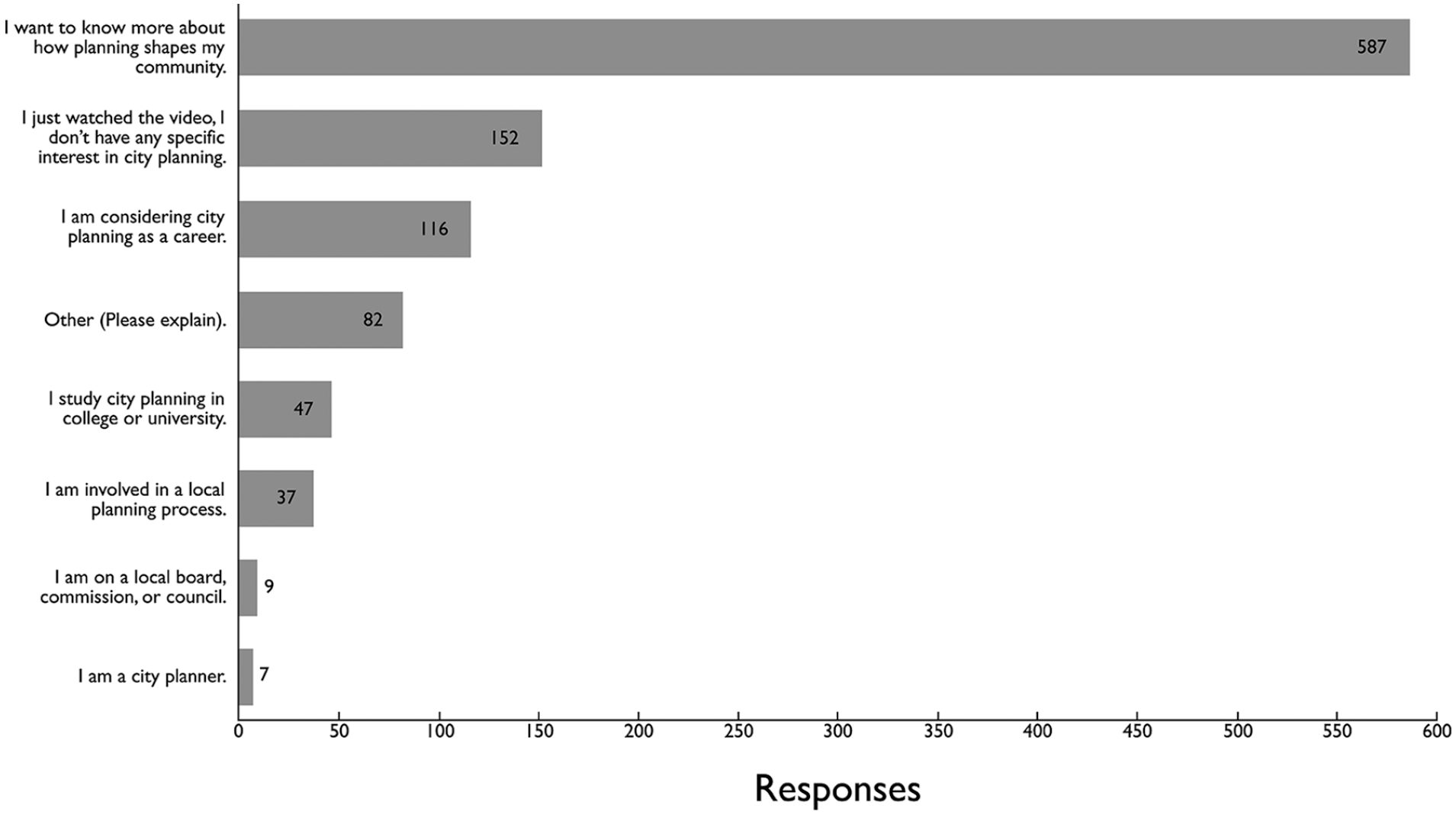
How respondents described their interest and experience with city planning.
Another question aimed to understand how connected respondents were to local planning processes and discussions in their community. The results indicate that the majority (65%, n = 817) had “not attended a city planning meeting.” For those who did attend a meeting, city council was the most popular option and fifty-seven respondents reported attending a workshop as a part of a planning process.
The survey then asked respondents to identify the ways they have learned about city planning (see Figure 4). Again, respondents could choose more than one answer. The most popular response, by far, was “Other YouTube videos.” “Magazine articles,” “Local news,” and “Books” came next. Respondents chose “Primary or secondary school” the least often. If respondents did not see an answer they preferred, they could choose “Somewhere else” and specify in a text box. The 134 respondents who did this overwhelmingly mentioned city simulation video games such as SimCity and Cities: Skylines.
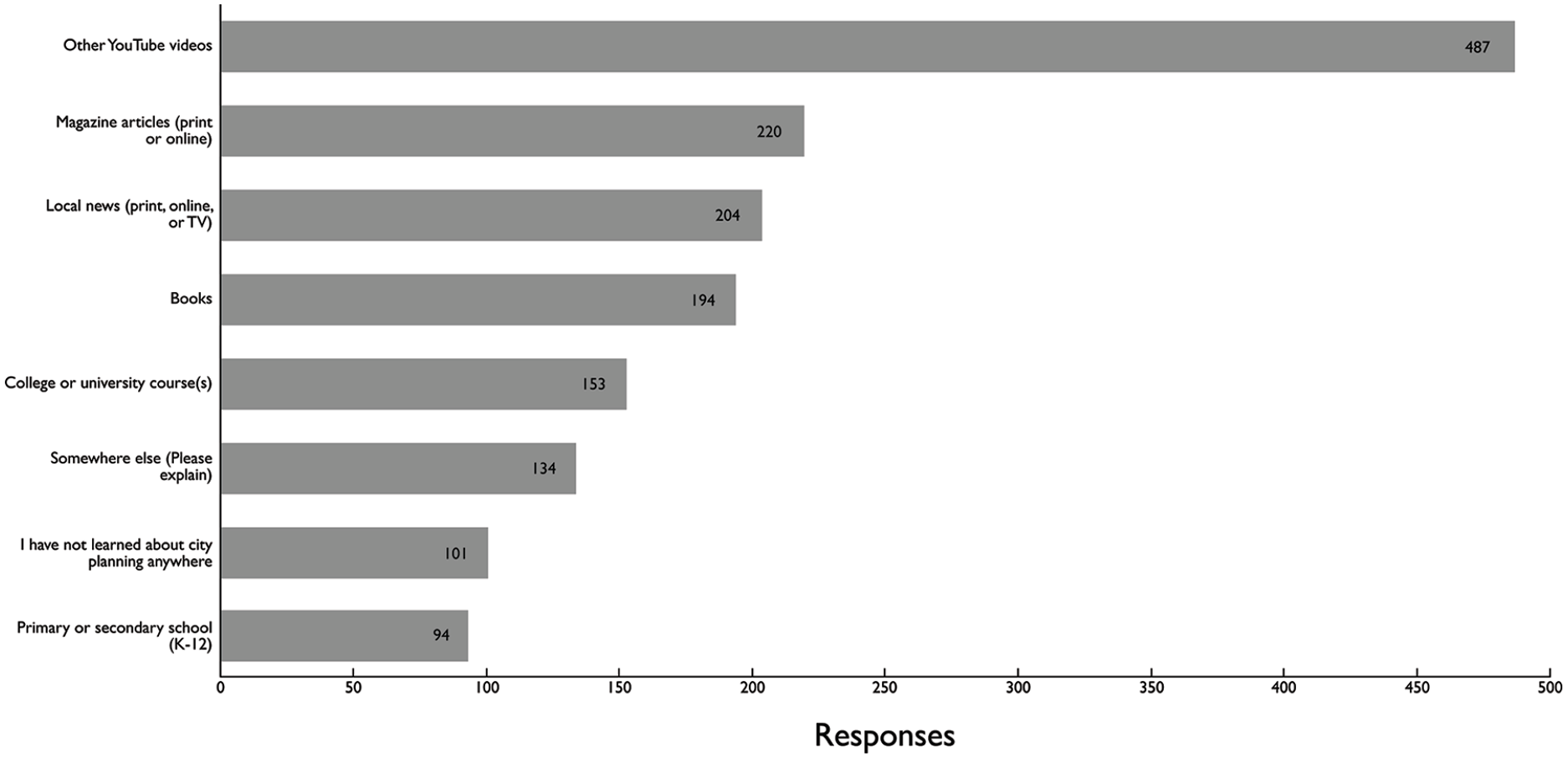
The ways respondents learn about city planning.
An additional set of questions sought to understand how the respondents used YouTube, for educational purposes or otherwise. Seventy-one percent of respondents watch YouTube every day of the week, and only 2 percent of respondents watch it three days per week or fewer. Respondents most commonly watch for about an hour each day, but over 26 percent watch three or more hours per day. They also watched other educational YouTube channels (96%). When asked which channels they watched, the results show an eclectic mix of science, media studies, general interest, geography, philosophy, and math.
Discussion
The research questions proposed in this study are straightforward.
As the YouTube statistics show, videos on the channel were viewed nearly twelve million times. YouTube does not track unique viewers, so there is no definite answer as to the total number of people who watched a video on the channel. It is likely that millions of unique viewers watched at least one video. This pilot project has demonstrated that there is strong interest in city planning content among YouTube viewers and that the platform makes it possible for a single person to reach a large audience.
This large audience primarily consists of free-choice learners. The viewer survey confirmed that most viewers are not planners or planning students, but instead people interested in the video topic or city planning generally. They have not attended planning meetings or workshops in their communities. Their primary source for city planning knowledge is other YouTube videos.
Reaching these free-choice learners can have a larger impact on the planning profession and our cities. Nearly 73 percent of survey respondents said that watching a City Beautiful video made them more interested in learning more about city planning. Over 11 percent said that they were considering city planning as a career. YouTube, with its young audience, could be a particularly useful way of encouraging the next generation to study city planning at the university level and pursue a career in the field.
The Role of the YouTube Algorithm
This pilot study demonstrates that there is a significant audience on YouTube interested in watching videos about city planning, but this discussion would not be complete without a discussion of the YouTube algorithm. The algorithm is the colloquial term for the neural network Google has developed to recommend relevant videos to users on their homepages and alongside videos they watch (Covington, Adams, and Sargin 2016). YouTube uses this neural network to encourage users to stay on YouTube and watch more videos, and subsequently, more advertisements. Advertising is YouTube’s primary source of revenue, and the company does not let the algorithm recommend videos without ensuring the videos are “advertiser-friendly.” YouTube states that adult content; inappropriate language; firearms-, tobacco-, and drug-related content; and hate speech are considered inappropriate for advertising, and subsequently may not get recommended as often by the YouTube algorithm (“Advertiser-Friendly Content Guidelines” 2019). Notably, YouTube’s algorithm cannot easily detect misinformation or misleading content and has only recently begun trying to control the spread of conspiracy theories through algorithmic recommendations (Jee 2020). YouTube’s algorithm acts as a gatekeeper separating creators from viewers, giving creators little control over who sees the content and how many people see it. If a creator would like a large number of people to see videos they produce, it is wise to keep the content within the bounds of the guidelines. The algorithm does not always make equitable choices about what is “advertiser-friendly.” It labels videos about lesbian, gay, bisexual, and transgender (LGBT) issues as “adult content.” That content is not recommended by the algorithm as much as it would otherwise (Romano 2019).
Throughout the pilot, I have had one video deemed not friendly for advertisers. It was a video about the planning process of rebuilding Ground Zero after the September 11 terrorist attacks [https://www.youtube.com/watch?v=-WWd_nGaP5Q]. The video did not mention terrorism yet failed to reach a large number of viewers due to the algorithm’s unwillingness to recommend anything related to 9/11. When the algorithm chooses to suppress videos in this way, it can influence the decisions of creators. They may avoid sensitive topics if they hope to reach a large audience. City planning often engages with topics like race, LGBT issues, and crime. Yet videos on these topics may reach a far smaller audience than something the algorithm deems advertiser-friendly. This makes it more difficult for a channel that focuses on these issues to grow and reach an audience.
Videos YouTube deems advertiser-friendly may be shown to a wider audience. But creators do not get to choose their audience. This can lead to outcomes like the one for City Beautiful, where the audience is 94 percent male. YouTube’s algorithm determined that men are more likely to click on a City Beautiful video than women when they are recommended, and now the algorithm barely recommends them to women at all. Women who search for a city planning educational video are just as likely as men to find a City Beautiful video, but recommendations are the primary way viewers discover videos. City planning is a topic valuable to everyone regardless of gender, and the inability to reach women on YouTube is a serious hindrance to its effectiveness as a method for teaching free-choice learners. Forty-three percent of U.S. city planners are women, which suggests that city planning educational content is broadly interesting to women as well as men (“APA Planners Salary Survey” 2018). And according to Google, more than 50 percent of Google’s audience is female (“Think with Google” 2016). Given the lack of control creators have over the algorithm, there is no obvious recourse here, except to hope that this changes as the algorithm evolves.
Limitations and Areas for Future Research
This pilot project is just that, a first step in what could be a series of research projects aimed at understanding how best to educate the general public on city planning topics. This is a topic that may become even more important as more people are learning online due to the COVID-19 pandemic. This trend may continue after the virus is contained. This research has certain limitations that could be overcome by continuing to do this work. One limitation is somewhat obvious: we do not know how effective the YouTube videos were in educating the viewers. Did the videos attract an audience because they were entertaining, but did not make a viewer think very hard? One could imagine two types of studies, one of free-choice learners and another of university students viewing the videos as a supplement to other course materials. This research could help improve the overall impact these videos have on the learner’s knowledge of planning issues. Another study could ask participants of planning processes if they had consumed any free-choice learning materials on city planning to understand how that effects their knowledge base and biases. This study also is limited by platform and voice. Is YouTube truly the best social media platform to educate people, or simply the most popular? And how much did the results rely on the personality and skill set of the video’s producers? Other research could focus on different forms of publishing on social media, such as podcasts and Twitter posts. Are they more effective at reaching large numbers of free-choice learners? Future research could also gather data from other city planning–focused YouTube channels that have emerged since this pilot project began to determine what effect presentation style has on growing an audience and pedagogical effectiveness.
Final Thoughts
The large numbers of views and subscribers amassed in this pilot study suggest that there is a significant amount of the general public that wants to learn more about city planning. The fifty-one videos posted to the City Beautiful channel do not begin to address all of the topics and issues in the field. In the two-and-a-half years since the pilot began, other channels and videos have also added content to the platform, but there is still room for new perspectives and voices. There are significant barriers for any aspiring YouTube creator, however, and they cannot be ignored. Women may have a more difficult time starting a channel, and videos on sensitive issues may not reach a large audience. Building an audience according to YouTube’s recommendations requires a significant time investment over a sustained period, but educating a large number of viewers on the platform is possible.
Footnotes
Acknowledgements
The author sincerely thanks the three anonymous reviewers for the input that made this manuscript better.
Declaration of Conflicting Interests
The author(s) declared no potential conflicts of interest with respect to the research, authorship, and/or publication of this article.
Funding
The author(s) received no financial support for the research, authorship, and/or publication of this article.
