



Abstract
This paper examines equity’s incorporation into Climate Action Plans (CAPs), an increasingly important part of the urban sustainability planning landscape. We conduct a content analysis of 170 California CAPs and compare the plans’ treatment of equity to city characteristics such as size and income inequality. We find that equity language correlates with an increased presence of more systemic policy interventions, such as dense and/or affordable housing, in CAPs. However, the majority of CAPs “miss the housing for the trees,” with green policy agendas, such as trees and open space, remaining more dominant. We also find little association between local inequalities and how CAPs incorporate equity goals.
Introduction
Climate change and social inequality are two defining crises of our time. While both of these problems are global in scope, attempted solutions are frequently urban in scale: planners and policymakers increasingly place their hope in cities as places where more just and sustainable ways of living can be envisioned and incubated (Angelo and Wachsmuth 2020), while city governments are under increasing pressure to incorporate equity into urban sustainability, resilience, and climate policy.
Plans and planning are one mechanism through which cities strive to convert these broad aspirations into concrete goals and policies. While climate and equity concerns may serve as the backdrop for wide-ranging comprehensive planning efforts, one type of plan—the Climate Action Plan (CAP)—emerged in the 1990s as a vehicle for cities to develop emission reduction targets and actions, from energy efficient streetlights to affordable housing, to achieve them. CAPs have become an increasingly important part of the climate planning landscape over the past two decades as international treaty efforts have stalled and municipal leadership on climate change has grown (Ninomiya and Burch 2019).
CAPs have traditionally had a sole focus on greenhouse gas reductions, but as climate action planning has matured, there have been increasing calls for social equity to become a central focus of urban climate planning (Adams 2018; Schrock, Bassett, and Green 2015). Perhaps in response to early critiques, CAPs increasingly include equity language (Angelo, MacFarlane, and Sirigotis 2020). Large, progressive cities such as New York, San Diego, and Seattle have made high-profile commitments to equitable climate action. How equity is handled in urban climate planning is a crucial question for the future not only because poor and racialized urban residents are disproportionately vulnerable to climate change-related weather events such as heat waves and storm surges, but also because mitigation and adaptation efforts have the potential to either entrench and deepen existing socio-spatial inequalities in cities, or help remedy them (Anguelovski et al. 2016).
Yet in spite of its growing importance, equity remains an amorphous goal. It is not obvious how commitments to equity should be translated into concrete policy items and agendas in the context of city-scaled planning efforts, especially outside of large cities. Two major empirical questions remain. First, how are broad equity goals being transformed into specific policies in CAPs? In the realm of emission reductions, planners can draw from established calculators and best practice guides, but with equity, a wide variety of ideas exist regarding what equity-oriented climate planning might look like (e.g., Reckien et al. 2017; Schrock, Bassett, and Green 2015), what it means to address equity in the context of municipal climate action (Agyeman, Bullard, and Evans 2002; Wachsmuth, Cohen, and Angelo 2016), and the relationship of equitable climate planning to equity-oriented planning theory and practice more generally (Reece 2018; Solis 2020). Second, what relationship do CAPs’ embrace of an equity agenda have to actual inequities in a given location? While certain best practices have emerged in the high-profile plans published in large cities, it is not clear if this trend generalizes across a broader range of urban environments.
This paper examines the implications of the “equity turn” in climate planning through the lens of 170 CAPs in California, a revealing context to study because the state’s aggressive environmental legislation has meant that an unusual number and diversity of cities have adopted CAPs. We ask if and how the inclusion of equity language has affected plans’ content—in terms of the mitigation strategies they recommend—and examine the relationship between cities’ socioeconomic characteristics and the policies that are formulated to meet equity objectives. Our findings are based on an inductive content analysis of the plans and a quantitative examination of the relationship between equity language, the presence and strength of various mitigation policies, and city characteristics such as size and income inequality.
We identified two distinct ways that plans incorporate equity language and policies. Green plans disproportionately favor policies such as open space, street trees, and recycling, while gray plans emphasize policies such as public transit, jobs, and especially affordable and high-density housing (see Wachsmuth and Angelo 2018). An orientation toward trees and other aesthetically “green” policies is common in CAPs regardless of their attention to equity, while the inclusion of housing and other “gray,” systemic interventions in the built environment is highly correlated with the presence of equity language. We also found that variation in plans was explained by politics, not need—that is, the inclusion of equity language and the strength of mitigation policies correlated with voting patterns, but not the inequities of a given city.
Our findings suggest that while equity language may have increased the presence of affordable housing and other policies not traditionally included in CAPs, many CAPs are “missing the housing for the trees”: equity language is being added to plans without substantively changing their content or addressing local needs. These patterns suggest that planners working to improve CAPs’ treatment of social equity should address equity through plan content and not just language, design policy interventions responsive to local inequities, and look beyond aesthetically green strategies such as trees and open space toward systemic, gray interventions in housing, transit, and employment that also have significant emissions reduction impacts.
Equity in Urban Sustainability and Climate Planning
Though a tripartite understanding of sustainability as consisting of economy, ecology, and equity has its roots in the 1980s and has been commonplace since the early 2000s (Purvis, Mao, and Robinson 2019), incorporating social equity goals into sustainability planning practice has remained a challenge. Agyeman (2008: 11) identified an “equity deficit” in much sustainability planning and policy; more generally, equity, economic, and ecological goals have often been conflated (Ikeme 2003) or seen as “conflicting urgencies” (Campbell 2013) in urban sustainability planning (see also Agyeman, Bullard, and Evans 2002; Giddings, Hopwood, and O’Brien 2002). Compounding the problem of equity’s absence has been a perennial question among planners of how to transform equity goals into policy. “Equity,” like “sustainability” (Wachsmuth and Angelo 2018: 1052), is commonly critiqued as an amorphous concept or empty signifier, and it has not always been clear how aspirations of equitable sustainable development should translate into planning practice (Berke 2016; Moore 2016). Campbell (1996) famously articulated these tensions in his “planners’ triangle,” which placed sustainability at the center of the triad of economy, ecology, and equity, but even he recently acknowledged that justice and equity remained a “black box” in early formulations (Campbell 2016: 392). A 2010 study of CAPs in large cities found that equity was the “short leg” of the “sustainability stool” (Pearsall and Pierce 2010: 569), while another argued that “though the term ‘equity’ is often invoked . . . there is no clear consensus on what equity actually means in this context” (Finn and McCormick 2011: 400).
Questions regarding what equity could or should mean in practice have persisted as climate action planning by cities has matured, and as equity-blind climate planning has been found to at best, reproduce, and at worst, exacerbate, existing inequalities. Climate-related investments in energy efficiency, green infrastructure, and public transit are made in unequal landscapes shaped by long histories of spatial, social, and economic injustice. As environmental justice advocates argued that the marginalization of poor communities of color left them disproportionately exposed to polluting facilities and other environmental bads, climate justice advocates now argue that past injustices leave the same communities disproportionately vulnerable to contemporary climate impacts (as well as other environmental impacts such as Covid-19) (Klinenberg, Araos, and Koslov 2020; Ranganathan and Bratman 2021). These patterns have been found to be compounded by climate planning efforts that do not actively take inequality into account. The construction of dense, energy-efficient housing and walkable neighborhoods can lead to climate or green gentrification that physically displaces or culturally alienates poorer, long-time residents (Checker 2011; Gould and Lewis 2016). Post-disaster redevelopment oriented toward economic growth may not meet the needs of low-income communities (DuPuis and Greenberg 2019), while adaptation planning may actively protect the needs of elites (Anguelovski et al. 2016). Such outcomes also undermine ecological goals, as residential displacement leads to longer commute times and increased emissions (Chapple 2014; Mössner and Miller 2015), and the consumption patterns of affluent “climate-friendly” neighborhoods have larger carbon footprints (Rice et al. 2020).
Recent high-profile sustainability plans have clearly foregrounded equity in discursive terms, perhaps in response to such outcomes. While in 2011 CAPs in the United States’s three largest cities—New York City, Chicago, and Los Angeles—“largely fail[ed] to . . . adequately address issues of equitable economic development and environmental justice” (Finn and McCormick 2011: 397), New York and Los Angeles made equity a cornerstone of a second generation of sustainability plans. New York City’s 2007 PlaNYC (promising a “Greener, Greater New York”), was updated in 2015 to #OneNYC (now “New York City’s plan to become the most resilient, equitable, and sustainable city in the world”), while Los Angeles’s 2007 Green LA action plan was replaced by a 2015 Climate “pLAn” that emphasized social equity and environmental justice, its 2019 update carrying the subtitle “Environment, Economy, and Equity.” Recent best practice guides, such as Bloomberg Philanthropies’ 2019 “Climate Action Playbook Brief,” also underscore the importance of “equitable climate action.” The American Planning Association’s (2020) Climate Change Policy Guide includes a chapter on “interwoven equity” that calls for the integration of equity considerations into all forms of climate action (p. 29). Scholars have observed an increase in concerns for equity in sustainability planning as well (Hess and McKane 2021; Loh and Kim 2021).
However, how abstract commitments to equity are transformed into concrete policies in climate plans remains uncertain. Do most plans, for example, take climate equity to mean justice—that is, assigning responsibility for emissions or redressing systemic and historical forms of racial or economic inequalities? Do they foreground resiliency—developing infrastructure to improve vulnerable communities’ ability to manage weather impacts? Or does procedural equity—extending involvement in planning processes—dominate? As examples from New York and Los Angeles above suggest, the word “equity” often appears as a rhetorical device—a “headline” or part of general framing language. At times, equity concerns appear to translate into an emphasis on citizen participation in planning processes, a procedural strategy common in other policy spheres and non-climate-oriented urban planning (Baiocchi and Ganuza 2016; Pitt and Bassett 2014). Los Angeles’s 2019 pLAn includes a cross-cutting chapter on environmental justice that designates specific milestones related to each of its main sections as “equity initiatives.”
Recent scholarship suggests that equity’s inclusion has been quixotic and uneven even in well-funded, well-coordinated sustainability, resilience, and climate planning efforts, and scholarly frameworks for understanding how commitments to equity are being translated into policy proliferate. Schrock, Bassett, and Green (2015) use Bullard’s (1994) distinction between procedural, geographic, and social equity and find that social equity (equity across race, ethnicity, and class) dominates. Reckien et al. (2017) borrow from McDermott and Schreckenberg (2009) to distinguish between outcome-based, process-oriented and context-related equity but emphasize the significance of poverty and gender across types. Meerow, Pajouhesh, and Miller’s (2019) recent study of equity in resilience planning in ten members of the Rockefeller Foundation’s 100 Resilient Cities program (since dissolved) developed a typology of procedural, recognitional, and distributional equity, and found wide variation in attention to equity even among this relatively narrow group. Others have turned to case study approaches to examine the incorporation of equity in practice and as influenced by local politics and social movements (Benner and Pastor 2011, 2015; Frick et al. 2015; Zapata and Bates 2015).
Yet, basic descriptive questions remain about if and how cities are transforming equity commitments into climate policies, or if or how such efforts match local needs, especially outside of large cities (Lamb et al. 2019). As Castán Broto and Westman (2020: 2) argue in a recent review article, climate governance and scholarship is marked by both an ongoing concern with questions of justice and equity, and an absence of “a consistent and comparative body of research that addresses the everyday realities of climate action.”
Studying Equity in CAPs
Our analysis aims to develop a more systematic picture of the treatment of equity across local governments based on 170 California CAPs, 149 of which are city plans, and 21 of which are county plans. While many cities have produced CAPs, state environmental legislation in California has put unique pressure on cities to adopt CAPs, making them one of the most widespread climate planning tools in the state (Bedsworth and Hanak 2013; Hui, Smith, and Kimmel 2019; Kwon, Jang, and Feiock 2014). 1 The number and diversity of California cities that have adopted CAPs make this sample especially useful for examining how factors such as city size, needs, and political preferences may affect the translation of equity goals into policy, and for considering the consequences of rhetorical commitments to equity in the national landscape of climate planning.
Large cities with progressive voters and good environmental amenities are disproportionately likely to have adopted a CAP, and in this regard California is similar to other parts of the United States (cf. for example, Krause 2011; Wang 2013). Some cities and counties without CAPs have elected to plan for climate change via other policy instruments, such as General Plan chapters or sustainability plans, or have integrated climate change into sector-specific planning efforts such as in transportation. Others have largely ignored the issue of climate change altogether. However, the 170 CAPs in our sample account for nearly one third of the local governments in California, providing insights into climate and equity planning across places that have conducted such planning with varying levels of commitment, enthusiasm, and capacities. Restricting our sample to a single state, meanwhile, allows us to hold constant factors such as state-level housing and planning mandates.
We identified relevant documents by using the Governor’s Office of Planning and Research’s (OPR) 2016 list of California jurisdictions addressing climate change. We considered only the plans classified by OPR as CAPs, and excluded sustainability plans, energy action plans, and greenhouse gas emission inventories. While the genesis of plans varies between cities—some were written by staff, some by consultants, and a few by community organizations—all were described by OPR as in progress or already adopted by a city council or equivalent body. 2
For each city and county, we draw demographic, social, and political characteristics from the Regional Opportunity Index (ROI) and city- and county-level election results. 3 The ROI emphasizes equity and provides a consistent way to combine multiple indicators derived from the U.S. census, state agencies, and other sources. We focus on two ROI indicators: People, a composite measure of education, housing, transportation, health, and civic engagement opportunities; and Housing Cost Burden, which indicates the percentage of households paying less than 30 percent of income for housing. 4 From the election data, we use the proportion of voters opposed to Proposition 23, a 2010 ballot measure that would have effectively repealed California’s AB32 climate legislation.
Because our objective was to learn how planners were transforming commitments to equity into concrete policies in a context in which many possible approaches exist, we began with an inductive coding process. 5 We coded the plans for the presence and strength of (i) equity language, and (ii) mitigation policies that were framed in equity terms by at least one city. Equity language (i) was defined as any acknowledgment of, or stated desire to ameliorate, historical or present inequalities between groups. We coded for the appearance of the word equity or related terms such as “justice,” or “inequality,” as well as mentions of vulnerable populations, low-income or underrepresented communities, minorities, seniors, youth, homeless, geographic and racial disparities, people with disabilities, disadvantaged groups, communities of color, non-English-speaking communities, awareness of gentrification and displacement, environmental justice, and so on. Often, such statements appeared in introductory or framing text. For example, the city of Elk Grove. 2013 CAP begins a section on “Climate Change Impacts” by noting: “Social equity issues related to the unequal distribution of resources and increased costs to address community-wide health risks will need to be addressed proactively to reduce the potential for financial strain on local governments” (2013: 2–5).
We then identified a subset of mitigation policies (ii) as equity-related by using the “3 Es” of economy, ecology, and equity as a heuristic. We identified nine policies (recycling and waste, open space and trees, participation, transit, health, density and infill, affordable housing, food, and jobs) that at least one plan explicitly linked to “equity” or justified in terms of broadly social outcomes, such as safety, longevity, or quality of life, rather than exclusively economic or ecological ones. For example, San Diego’s CAP’s discussion of green jobs not only emphasizes economic growth and emissions reductions, but also the benefits to under-served communities. See Table 1 for this and additional examples. Rather than framing language, these policies were generally part of substantive chapters. Once we identified a set of mitigation policies that were at least in some cases described in equity terms, such as green jobs, we coded all of the plans for the presence of these policies whether or not equity language was also present, and whether or not a specific plan described that policy in terms of equity-related outcomes.
Examples of How CAPs Linked Policies to Equity.

Note: Hess and McKane (2021) provide further examples of specific policies that link mitigation with equity goals, such as “Affordable housing near transit stops” and “energy efficient appliances in public or low-income housing.” Our inductively identified policies largely match their list. CAP = Climate Action Plan; GHG = greenhouse gas.
Then, trained research assistants assigned cities a score of zero to three for the strength of their plan’s engagement with (i) equity language and (ii) each of the nine mitigation policies identified, using the rating scale in Table 2. Plans that scored a one mentioned such policies in passing or articulated their importance in general terms but lacked specific local strategies. Plans that scored a two generally took the form of “encouragement” of private initiatives or public-private partnerships, rather than robust public commitments or funding (e.g., car-sharing programs but not investments in public transit). This coding scheme is similar in principle to those that assign scores based on whether a plan policy is absent, suggested, or required (Berke and Conroy 2000), or absent, considered but not thoroughly, or fully considered (Tang et al. 2010). 6
Coding Guide and Sample Scores.

Note: Each CAP was coded for the presence of (i) equity language and (ii) nine mitigation policies identified as being potentially equity-related. Each mention was then assigned a score from one to three, as the examples for equity language and one mitigation policy (Density & Infill) illustrate. CAP = Climate Action Plan.
To understand what effect an orientation toward equity might have had on plan content, we then used multiple regression and principal components analysis (PCA) to explore which policies were most tightly linked to the presence of equity language. PCA transforms a set of variables into a set of new variables, which are uncorrelated with each other (Wheelwright et al. 2020) and is well suited to uncovering latent factors that underlie a dataset. We also sought correlations between plan content and cities’ existing inequalities as well as general characteristics such as population size and voting patterns. We complemented the quantitative analysis with insights gained from more intensive reviews of particular plans that were illuminating outliers in our dataset and those that were representative of more general patterns.
While we believe that CAPs, as artifacts of decision-making processes, are meaningful reflections of changing municipal priorities as well as points of political negotiation and policy innovation (Millard-Ball 2021), our methods have several limitations. First, they do not provide an account of how the CAPs were produced, or of the rationales behind the inclusion of equity language or policies. Second, we are unable to demonstrate CAPs’ relationship to inequalities in a given location beyond the ROI data, such as other forms of injustice that different data might reveal. Third, we did not track the implementation of policies in the CAPs we analyzed, which is important because previous studies have questioned CAPs’ implementation (Wheeler 2008) and impacts (Millard-Ball 2012, 2013).
Equity Inclusion, City Characteristics, and Green and Gray Mitigation Strategies
Urban sustainability planning has been shown to be marked by two distinct environmental strategies, that of green and gray. Engineers distinguish between “green infrastructure” such as marshland and rain gardens and “gray infrastructure” such as concrete seawalls (Casal-Campos et al. 2015), while geographers have identified a distinction between aesthetically oriented “green” policies, such as tree planting and parks, and systemic and/or technologically oriented “gray” policies such as public transit or solar power (Wachsmuth and Angelo 2018). The green/gray distinction is often used to differentiate between low- versus high-tech interventions, and greater recognizability of green mitigation strategies as related to ecological goals. We found that green and gray policies in CAPs also have very different relationships to equity. As we discuss below, our analysis revealed a strong orientation toward trees and other green policies in CAPs, regardless of their attention to equity, while the inclusion of housing and other gray policies was highly correlated with the presence of equity language.
Plans Prefer Green Policies
We begin by discussing the extent to which local governments have considered the nine mitigation policies we identified as potentially equity-related in their CAPs. Figure 1 shows the distribution of scores on each category, along with the mean score.

Distribution of scores on (i) equity language, and (ii) the nine mitigation policies.
Overall, CAPs were more likely to include green policies such as trees, and those policies tended to also be better-developed (i.e., to receive higher scores on our zero to three scale) than gray mitigation strategies. Two green policies were included in CAPs most frequently and in the most robust manner. Recycling & Waste was included in the vast majority of plans and received the highest mean score of 2.3, with 44 percent of plans receiving the highest rating of three. Open Space & Trees was almost as frequently included and received the second-highest mean score of 2.1. By contrast, two gray policies, Density & Infill and Affordable Housing, were included both much less frequently and much less robustly, with mean scores of .9 and .8. Though Participation and Transit were frequently present and also scored highly, the strong divergence between tree-oriented green policies and housing-related gray policies remained a consistent and striking pattern throughout our analysis.
Equity is also shown in Figure 1. As described above, equity here refers to the appearance of the word itself, or any stated desire to reduce disparities in outcomes, rather than to specific policies. In spite of the growing interest in the concept, most plans in our sample give scant attention to equity, with 39 percent of plans scoring a zero, and just 5 percent scoring the maximum three. The phrases most commonly coded for equity recognized vulnerable populations, low-income residents, or health inequalities, as well as racial and geographic inequities. For example, San Mateo. 2015 (pop. 105,000, just south of San Francisco) CAP states, “elderly, young, and sensitive populations most likely to be impacted by climate change are also those that often lack sufficient resources to adapt” (2015: 7). Surprisingly, racial inequality was not widely discussed in the plans. Even among those that scored highest (three) in terms of equity, only 11 percent explicitly mentioned racial inequalities, and even fewer addressed issues of historical racial injustice.
Equity Correlates with Gray Policies
In order to better characterize the content of equity-oriented CAPs, we then examined whether the presence and strength of equity language correlated with CAPs’ incorporation of different policies (Figure 2). At one extreme, Affordable Housing had the strongest correlation, indicating that plans that emphasize equity also emphasize affordable housing. In fact, all seventeen cities in our sample that received scores of 2.5 or higher on Affordable Housing also mentioned equity. At the other extreme, there was almost no correlation between equity and Recycling & Waste. Most solutions, including Open Space & Trees, have a moderate correlation with equity.
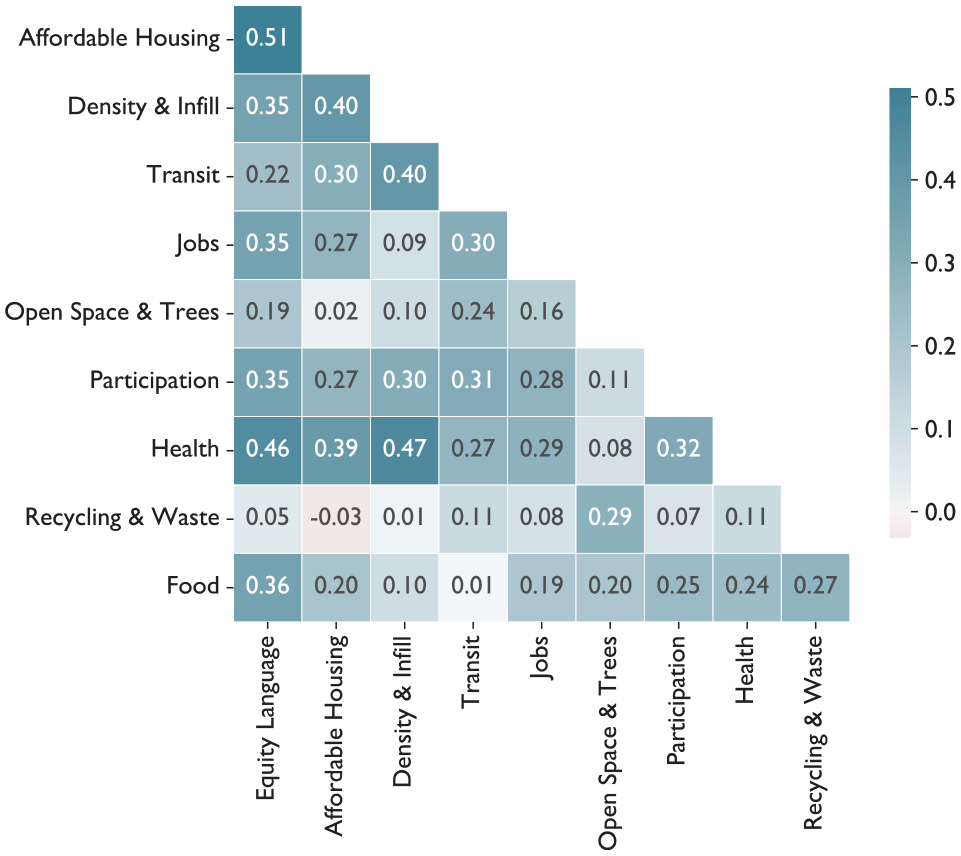
Correlations between plan policies.
Having identified these basic patterns, we then used principal components analysis (PCA) as another way to characterize the contents of CAPs and explore the relationship between equity language and policy choices. Two PCA-identified latent variables, which we call Ambition and Greenness, help differentiate cities based on the overall ambition of their climate policies, and their relative emphasis on aesthetically green strategies such as trees versus gray interventions such as housing. A city with more Ambition is characterized by higher scores on some or all of the underlying policies, while a city with more Greenness puts a greater emphasis on green rather than gray policies, while holding Ambition constant.
The PCA confirmed a divergence between local governments that pursue more systemic gray mitigation measures, especially infill and affordable housing, and those that emphasize the green policies such as trees and recycling that have traditionally been included in CAPs. Local governments with a positive score on Greenness disproportionately favored Open Space & Trees, Recycling & Waste, and Food (the policies with the highest positive coefficients in Table 3). Local governments with a negative Greenness score favored affordable and high-density housing and infill (the policies with the largest negative coefficients). While both types of policies are intended to have emissions-reduction impacts, these two types of plans and policies have very different relationships to equity, as the raw correlation coefficients in Figure 2 indicate.
Principal Components of Climate Solutions.

Note: We focus on the first two components—Ambition and Greenness—due to their higher eigenvalues and because they are readily interpretable (components 3 and 4 are also reported in the table). Both Ambition and Greenness are defined based on the scores for each policy, multiplied by the weights shown in the table.
The relationship between Ambition and Greenness for all the local governments in our dataset is shown in Figure 3. The x axis shows the green versus gray continuum (Greenness), while the y axis shows the level of ambition. By construction, the two components are uncorrelated. Several outliers are evident and labeled on the plot. The geography and demographics of these cities varies widely. The progressive Bay Area cities of Berkeley and Oakland have the most ambitious plans, while at the other extreme are Hillsborough, a wealthy suburb of San Francisco, and Reedley, an agricultural city near Fresno. Oakdale (a Central Valley city outside of Modesto), San Diego County, 7 and Paso Robles (a Central Coast city of wineries and olive groves) prioritize gray policies, given their overall level of ambition, whereas Hughson (another Central Valley city near Modesto), Mill Valley (a city in Marin County, just north of San Francisco), and Butte County (in the Central Valley north of Sacramento) prioritize green policies such as trees, recycling and food, again, controlling for their overall level of ambition.

Relationship between Ambition and Greenness.
Politics, not Need, Shapes a Local Government’s Choice of Policies
Finally, we examined whether CAPs’ inclusion of particular policies was related to known patterns of inequality in particular cities and counties by considering the relationship between plan content and local socio-economic and political characteristics. Our regressions included variables that aim to measure equity needs (drawn from the ROI, discussed above), and local support for climate change policy as measured by opposition to Proposition 23 in 2010, a voter initiative that would have effectively repealed the state’s landmark climate law (Millard-Ball and Press 2019). We also controlled for population, given that large local governments may have more capacity to implement climate mitigation measures, for year of adoption (as a series of binary variables), and whether the jurisdiction is a city or a county. Our regressions do not have a causal interpretation, given that we do not adopt an experimental or quasi-experimental strategy. Rather, they aimed to uncover the characteristics of local governments that are associated with different policy choices.
Table 4 shows the regression results. Unsurprisingly, the Ambition of a CAP is strongly correlated with the share of those voting “No” on Proposition 23 (i.e., those who are pro-climate mitigation), and also with population size. The ROI variables, which measure local inequalities, however, have no substantive or statistically significant effect on CAP content. 8 More notably, the Proposition 23 variable is also the strongest predictor of whether a local government pursues green or gray approaches. More voters opposed to Prop. 23’s climate policy rollback implies a more aesthetically green approach, but the ROI measures of housing needs have a minimal impact. The R2 of all the models is relatively low, potentially indicating the importance of factors that are not captured in the model (e.g., perhaps related to the manner in which a plan was developed and the structure of local climate policy coalitions).
Regressions (OLS) Showing How the Choice of Solutions Varies with Political Preferences and Need.

Note: Robust standard errors in parentheses. OLS = Ordinary least squares; ROI = Regional Opportunity Index.
p < .1. **p < .05. ***p < .01.
The “No on Prop. 23” variable also explains more of the variance in the inclusion of various policies (Columns 3–6). Equity, Affordable Housing, and Recycling & Waste are positively associated with the share of “No” voters, but not with the measures of the need for housing and other equity-oriented policies. In other words, more progressive cities rather than needier ones are more likely to have ambitious plans that prioritize housing. Open Space & Trees is not explained by any of the variables, indicating that local governments of all socio-economic and political types pursue this mitigation strategy. To the extent that climate policy can be bipartisan, it comes in the form of trees.
Trees, Housing, and Ambition in Practice: Patterns of Equity Inclusion
The quantitative analysis identified clear patterns in the ways equity concerns are being incorporated in CAPs. While equity language is highly correlated with the presence of affordable housing, more CAPs have adopted equity language while maintaining a more traditional orientation toward green policies. Here, we offer a closer look at a sample of cities and plans that highlight several possible configurations of Greenness and Ambition. Rather than discrete, non-overlapping categories, these examples are intended as aids to understanding and include both representative types and explanatorily useful outliers. While the cities are labeled in Figure 3 and differences in Greenness and Ambition are visible there, other patterns were identified through a close reading of plan content rather than solely from the quantitative analysis.
For a classic CAP, consider Mill Valley, a small, affluent municipality with a population of 15,000, located just north of San Francisco. Mill Valley’s CAP has high Greenness and mid-level Ambition (Figure 3). It includes neither equity language nor housing policy, but focuses on reducing waste, improving energy efficiency, conserving water, and encouraging bike sharing; it was one of the seventy cities in our sample that scored high on recycling and waste but low in other areas. The CAP was adopted in 2013 as part of the city’s 2040 General Plan and includes a twenty-year tree planting agenda which, it estimates, will reduce emissions by 28.3 MTCO2-e by 2040. With this CAP as an imagined baseline, we now profile several variations of these patterns as they appear in practice: (1) the minority of balanced, high ambition plans; (2) more commonly, plans that incorporate equity language while maintaining a focus on green policies; (3) by citing state or federal policies without adjusting for local context; (4) the few CAPs that adopt gray policies but not equity language; and (5) the voluntary measures characteristic of middling- to low-ambition plans.
Progressive Early Adopters: Balanced, High-Ambition Plans
While there has been a shift in CAP content toward equity language and gray policies, such plans remain the minority. In fact, the progressive Bay Area city of Berkeley (pop. 150,000) was one of only five plans that ranked highly on Affordable Housing, Equity, and Recycling & Waste; the only CAP in our sample to score the maximum three on all three of these measures; and one of the few plans to couple high Ambition with a balance of green and gray policies (Figure 3). Berkeley’s 2009 plan outlines goals for energy-efficient buildings, sustainable mobility, local food, disaster preparedness, and strategies to ensure that “the social and economic benefits of the climate protection effort are shared across the community” (p. ES2). It argues that goals for emissions reductions and energy efficiency can be leveraged to address social inequities by improving transportation access, employment possibilities, and quality of life (p. ES1), and that open space and community gardens are a key part of neighborhood sustainability. It was produced with significant community input, and includes recommendations for developing affordable housing in housing-rich areas and zoning for TOD. However, rather than this balanced, high-ambition pattern becoming more common as CAPs turned to equity, Berkeley’s CAP has remained an outlier.
More Common: New Equity Label, Old Green Content
Instead, equity has been more commonly incorporated as a new label applied to old CAP content, with its focus on direct sources of emissions reductions and quality of life improvements such as open space and trees. The city of Corona’s (pop. 150,000, located about forty-five miles southeast of Los Angeles) 2012 CAP retained this green content even as it incorporated equity language as an overarching concern. Corona’s CAP is in the middle of the pack in terms of both Greenness and Ambition (Figure 3). The plan’s introductory language suggests a definition of sustainability in terms of the three Es: The City of Corona is committed to providing a more livable, equitable and economically vibrant community through the reduction of greenhouse gas (GHG) emissions . . . Corona’s community of residents, neighbors, workers, and visitors strive together to balance ecological, economic, and social needs to ensure a clean, healthy and safe environment for all current members of society and for generations to come. (p. vi)
The CAP positions itself as “consistent with and complementary to” federal government actions and the “global community through the Kyoto Protocol” (pp. 1–3). However, in spite of this broad framing of its goals, the CAP itself remains focused on GHG emissions, and includes few policies related to either economic growth or equity. It directs readers to the city’s General Plan for more comprehensive planning agendas and focuses on achieving reductions through water conservation, recycling, building retrofits, vehicle efficiency, car sharing, neighborhood electric vehicles, bicycle master plans, tree planting, and cool roofs and paving.
Also Common: State or (Inter)national Policies not Tailored to Local Context
Corona’s CAP is typical both in acknowledging equity as a crucial aspect of sustainability without significantly changing the plan’s policies, and in engaging equity concerns through the language and priorities of international best practices and state policy, rather than describing specific local inequities. We found that even when plan content does change with the addition of equity—that is, even among gray or housing-oriented CAPs—recommended policies often take this form, usually citing state mandates or echoing consultants’ boilerplate. (See Sirigotis et al. [2022] for a more detailed discussion of the role of such state mandates and boilerplate text.) This pattern is visible in the lower scores that housing policies received overall. While Recycling & Waste and Open Space & Trees received many high scores (about one-third were scored as “3” on our zero to three scale), policies such as Affordable Housing and Density & Infill not only occurred less frequently but also generally received lower scores (e.g., fewer than ten plans scored “3” in either of these areas; see Figure 1).
The mid-sized city of San Marcos (pop. 87,000), in San Diego County, produced such a CAP in 2013. Its CAP received a score of 2 on Affordable Housing and 2.5 on Density & Infill. For affordable housing, the plan cites two statewide programs: Caltrans’s Community-Based Transportation Planning Grant Program, which is used “to seed planning activities that encourage livable communities,” including increasing affordable housing, and the state’s Infill Infrastructure Program, which assists in the construction of infrastructure that supports higher-density affordable housing. The San Marcos CAP also highlights a section of the city’s General Plan that encourages infill and redevelopment activities. Thus, while the CAP contains considerable language to promote affordable housing and infill, none of its provisions go beyond existing state and local policies—suggesting that the inclusion of equity concerns in this CAP have not resulted in new local mitigation strategies that were not already being pursued for other reasons.
A Minority of Gray Plans: Housing Policy Absent Equity Language
Of course, the presence of the word “equity” or related vocabulary is not the only possible sign of shifting CAP concerns. While the majority of gray CAPs also included equity language, some included affordable housing policies even in the absence of the word equity. With California’s affordable housing crisis and the fact that commuting for work is one of the largest emissions sources, it is perhaps not surprising that a subset of CAPs, which have traditionally focused on more direct GHG mitigation strategies, aim to address climate change in this manner.
Nine CAPs that did not receive high scores for the inclusion of equity language received high scores for the inclusion of affordable housing as a mitigation policy. One of those was Sonoma County (pop. 495,000), a coastal county north of San Francisco that contains a number of small cities and which is best known as Northern California’s wine region. Sonoma County’s CAP has one mention of equity, in the context of food access, and a fairly robust affordable housing section explicitly tied to transit. The most common rationales for affordable housing in such plans were reducing vehicle miles traveled and promoting smart growth. In other words, these CAPs present affordable housing as a policy to reduce emissions, with the social justice benefits almost an afterthought.
Some plans also cited affordable housing programs that were part of their cities’ General Plans, a pattern that also speaks to the influence of state policy. In California, state housing law requires regional planning bodies to conduct a regional housing needs assessment every five years, resulting in frequently updated housing elements of General Plans. While this has been found to result in a “rift” between housing policy and environmental policy in General Plans (Brinkley and Stahmer 2021), it may also be the case that more recently updated housing policies that reflect emissions-related concerns would subsequently be included in CAPs.
Voluntary Measures: Middling- to Low-Ambition Plans
A number of plans included some consideration of housing, trees, and equity, but were relatively limited in their overall ambition, as per the PCA analysis. Plans of middling ambition tended to be of two kinds. Some, like Corona, cited state, national, and/or international policies, or relied on already-published regional or general plans but did not develop specific local initiatives (Type 3 above). A second type relied on voluntary programs to achieve sustainability goals.
Palm Springs, a small, progressive, affluent city in the Coachella Valley of Southern California, offers such a CAP (Figure 3). Its 2013 CAP contains policies related to both housing and trees, and some mention of equity, but only a handful of the CAP’s seventy-eight proposed measures include enforceable ordinances. Most rely on “promotion,” “voluntary participation,” “recognition,” “incentives,” or “education/awareness.” The CAP’s affordable housing strategy, for example, is to “promote the construction of energy-efficient affordable housing with private-sector partners” (p. 9). Palm Springs’s CAP also has high Greenness relative to both its Ambition and housing content. While this is especially surprising given the city’s desert climate, it was also a common pattern. Green policies tended to comprise a larger focus of lower-ambition plans. Thus, inclusion of equity language or affordable housing in a plan is not in itself a guarantee of robust public commitment.
Notably, two of the lowest ambition plans in our sample were from two very different places, politically and socioeconomically: the affluent Bay Area town of Hillsborough, and the small, agricultural city of Reedley in Fresno County (Figure 3). Reflecting these differences, Hillsborough’s 2010 plan appends a copy of the U.S. Conference of Mayors Climate Protection Agreement signed by the city’s mayor, and motivates the plan by underscoring its benefits for property owners, while Reedley’s includes a discussion of the debate around whether climate change is an anthropogenic or natural phenomenon. Yet both are quite short in comparison to other CAPs, and their content is not as different as one might expect. Hillsborough’s CAP focuses on residential energy efficiency, community education and engagement, recycling and composting programs, and sustainable purchasing. Reedley’s plan outlines a mix of already completed and planned energy efficiency improvements, including tree planting, green purchasing, and requiring that new residential and commercial developments “self-certify” that they meet emissions reduction requirements.
Missing the Housing for the Trees
Overall, these patterns suggest that the new equity discourse surrounding urban sustainability planning has likely not led to significant changes in policy, at least as is reflected in CAPs. While the presence of gray policies has increased with the presence of equity language, equity is still most commonly incorporated in CAPs in a relatively low-ambition and/or green way. One tangible way that plans can move beyond equity rhetoric to policy is through gray policies such as housing. But we find that even the plans with the most robust gray policies still tend to devote less space to housing than trees, and have housing plans that are less well-developed, less responsive to local needs, and do less to extend beyond existing commitments than those for trees, open space, or recycling.
The fact that housing is a new area for CAPs may help explain why housing policies are relatively less developed when included in plans. The longer-standing association of aesthetic “greenness” with “good” and sustainable outcomes may also contribute to the outsize presence of trees and open space in CAPs and the real or perceived popularity of such policies, while gray policies such as affordable housing or green jobs remain less obviously legible as related to environmental goals (Angelo 2019; Wachsmuth and Angelo 2018).
Outside of CAPs, housing affordability and the associated problem of homelessness have emerged as a major policy concern in California. The construction of affordable, energy efficient residential units along transit corridors is seen as a central component of equitable and sustained economic growth in the state (Benner and Pastor 2015). The national trends of stagnating wages and rapidly rising housing costs have also made housing policy a national issue (Hermann 2018; Mazzara 2019), while it is becoming increasingly clear that climate-friendly housing (new, energy-efficient construction, and walkable neighborhoods near public transit) can unwittingly become unaffordable to the majority absent explicit protections. As a result, there is a growing national awareness that “housing policy is climate policy” (Weiner and Kammen 2019; see also Kallerman and Weinberg 2016; Next 10 2020). So, while equity-oriented climate policy agendas can certainly manifest in other gray forms, such as investments in public transit or green jobs programs (see, for example, Schrock et al. 2015), it is not surprising that a minority of California CAPs seem to be taking up the challenge of sustainable development at the urban scale through housing, and one might expect housing to assume an increasingly central role in U.S. climate planning. In cities like Portland and New York, for example, recent equity-oriented climate planning has specifically addressed affordable housing (Pattison and Kawall 2018).
Despite the broader policy discourse recognizing the housing-climate link, however, the majority of California CAPs are still “missing the housing for the trees.” Neither housing nor equity appear in plans in places where these interventions are most needed and, when they are included, tend not to be well-developed. If California’s CAPs offer indications about how local jurisdictions of a variety of sizes and political orientations will engage in climate planning, 9 our findings suggest that, at least in some cases, such conditions appear to produce bare-minimum incorporation of required language and policies. No doubt this at least partly reflects the conditions under which climate action planning occurs in small and mid-sized cities: under duress, in response to unfunded mandates, and often with limited local resources, expertise, or political will, regardless of cities’ socioeconomic composition. The increasing use of consultants may also contribute to these patterns. California cities have become much more likely to outsource CAP development to consultants in recent years (Angelo, MacFarlane, and Sirigotis 2020), and while consultants’ templates may more often include generic housing-related language, they generally do not conduct local needs assessments before formulating specific policies (Sirigotis et al. 2022).
Two additional factors that may contribute to these patterns warrant further analysis: funding and politics. Housing is both a more expensive and more politically contentious policy area than trees, as the bipartisan nature of CAPs’ inclusion of trees and open space reflects. In California, state funding and mandates have prioritized planning rather than implementation. This may have de facto encouraged green policies, such as tree planting, that tend to be less expensive and easier to implement, even in cases where housing- or transit-oriented gray policies that focus more on spatial patterns of development may have a greater impact on local social and ecological problems. In terms of politics, like any plan, CAPs are political documents: they make implicit and explicit tradeoffs between different policy and public expenditure priorities. Nevertheless, in the CAPs that we examined, climate planning is generally approached as a technical rather than a political problem—which is to say that the political tensions that animate decisions regarding climate planning are often left unstated. This may contribute to plans’ avoidance of legally enforceable policy recommendations, those that create permanent changes to the built environment, or those that redistribute resources to address local inequities. Viewed this way, it is not surprising that cities, in response to a mandate to plan, might be reluctant to open themselves up to contentious debates regarding inclusionary zoning requirements, density, or reallocating road right of ways, let alone revenue-raising measures such as carbon taxes or congestion pricing, when street trees and community composting and recycling programs are, by contrast, both popular and politically safe.
Conclusion: CAPs at a Crossroads?
While concerns for justice and equity are on the rise in urban climate planning and related scholarship, the effects of these efforts have so far been poorly understood. It is not clear what equity means when it is invoked rhetorically, nor what the implications of such invocations are on policy, especially outside of large cities. In response, we analyzed equity’s inclusion in local government CAPs in California, and found that equity language does correlate with the increasing presence of gray policies, such as housing, in CAPs. In this sense, it could be argued that the “equity deficit” in urban sustainability planning is being addressed to some degree as equity language and housing policies are being incorporated into more CAPs. However, we found that equity-oriented CAPs more often “missed the housing for the trees,” by focusing on aesthetically green, quality of life-oriented solutions such as trees and open space, while policies such as housing or transit that might impact emissions while better addressing local inequalities appeared less often and were less well-developed. And so, while the equity turn in urban climate planning is not all talk, we conclude that it is not likely to accomplish its goals in its current state of being focused primarily on trees while being unresponsive to local needs.
Our analysis also found that the presence of equity language indicates little about how effectively equity goals are transformed into policy. Even as equity concerns are appearing more frequently in CAPs, these are rarely integrated in a robust manner. That is, the word often appears, but funding and/or specific policy prescriptions do not often accompany it. And, importantly, equity is not being prioritized where it is needed the most, but where it is driven by local politics—in relatively larger, more progressive cities. CAPs’ status as symbolic documents makes the low overall ambition of the CAPs we studied somewhat surprising. If decision makers are not bound by plan implementation, why not reach higher in terms of rhetoric and aspirations, at least in cities where residents and policymakers see climate change as a pressing issue? Instead, CAPs frequently restated targets laid out in regional or general plans without venturing more unusual types of policy recommendations, such as land trusts or cooperatives, that might change local patterns of wealth and land use more dramatically. Indeed, even in the most ambitious plans, topics like racial justice were notable by their absence.
In principle, the equity turn in urban climate planning presents a clear opportunity for planners, policymakers, and local advocates to foreground the ecological implications of social inequality (such as longer commutes or energy inefficiency in sub-par housing), and, conversely, to emphasize the ecological benefits of social equity. As an addition to current urban sustainability best practices, 10 we suggest that planners and policymakers can create climate plans that reflect these commitments by having an eye to housing as well as trees, and by assessing local needs prior to planning. While green amenities such as street trees and open space are beneficial to urban residents and often unequally distributed, gray, systemic policies relating to the built environment have the potential to address specific local challenges relating to housing, transportation, and employment, and have significant environmental benefits.
However, our analysis suggests that CAPs may have reached a crossroads. As a broader agenda for CAPs weakens the distinction between them and other local government plans, local governments face a choice: treat CAPs as technical documents primarily concerned with politically neutral emissions-reduction strategies, or grow in ambition by recalibrating toward local needs and explicitly taking up the political challenges that shape investments in infrastructure, affordable housing, and public transit. The latter path suggests that such concerns are best integrated into general plans or sustainability plans rather than through CAPs as stand-alone documents. Regardless of the format of the plans, however, the latter option requires climate action planning to be treated as a climate justice issue: it must address both climate and equity.
Footnotes
Acknowledgements
The authors thank Chris Benner, Miriam Greenberg, Katharyne Mitchell, and Veronica Terriquez for their support of this research, and two anonymous reviewers for their helpful comments on an earlier version of this article.
Declaration of Conflicting Interests
The author(s) declared no potential conflicts of interest with respect to the research, authorship, and/or publication of this article.
Funding
The author(s) disclosed receipt of the following financial support for the research, authorship, and/or publication of this article: This research was supported by the American Sociological Association’s Fund for the Advancement of the Discipline and by the Committee on Research and the Institute for Social Transformation at the University of California, Santa Cruz.
