



Abstract
The challenges metropolitan regions, cities and towns, neighborhoods, and villages face require community development skills that address complex community problems, engage multiple publics, and pursue collective strategies. However, there is no consensus about how community development should be taught due to its various understandings, theories, and approaches. The article presents the results of a community development educator survey and illustrates a diversity of responses to educational delivery among forty-eight respondents representing twenty-seven community development programs in the United States. We compare the perspectives of respondents who teach in planning programs with other community development educators to discuss commonalities and differences.
Introduction
Contemporary community development is comprised of different philosophies and theories, disciplines, and fields. Despite this diversity, there are two predominant schools that have influenced its education, training, and practice in the United States—one that began with early urban reform movements and a second concerned with improving rural life, both beginning at the turn of the late-nineteenth century. The more visible school, and one most familiar to planning, focuses on the conditions of the urban poor with origins in the Progressive Era characterized by Settlement Houses and the larger tenement house reform movement (Vidal and Keating 2004; Von Hoffman 2012). This “urban” school of community development parallels the rise of planning and the creation of federal policies and programs from the mid-20th century onward aimed at ameliorating the effects of poverty, especially within low-income neighborhoods. The Housing Act of 1949, Model Cities, the Housing and Community Development Act of 1974, the Low Income Housing Tax Credit, HOPE VI, and the Promise Neighborhoods program are some of the more prominent policies and programs that come to mind. Also included in this story of urban community development are pilot and demonstration projects funded by philanthropic organizations, which led to a robust industry of community development corporations, intermediaries, and financial institutions (Lowe 2004; Vidal 1997; Von Hoffman 2012).
Part of this evolution and as a response to negative consequences of top-down urban policies and ineffectiveness of government has been a focus on advocacy and equity planning (Angotti 2007; Davidoff 1965; Krumholz 1982; Zapata and Bates 2015). This bottom-up approach has ties to different traditions within community development that includes the ground-breaking work of Saul Alinsky, who, beginning in the late 1930s, applied union organizing methods to support immigrant neighborhoods in their efforts to gain a political foothold in Chicago. A focus on citizen involvement gained a foothold in the profession given the ascendency of advocacy planning. As pioneered by Paul Davidoff (1965), advocacy planning made explicit the political role of planners in advocating for group interests and the development of plural plans presented to the public for discussion and debate. Noteworthy was Davidoff’s (1965, 337) call for a liberal arts undergraduate education to provide “an opportunity for holistic understanding of both urban conditions and techniques for analyzing and solving urban problems.” Building on Davidoff’s early work was a generation of planners committed to equity planning out of an ethical concern about the exploitative nature of the urban development process as well as the inability of formal polities to adequately address community problems, especially for those that had few, if any, choices (Fainstein and Fainstein 1982; Krumholz 1982). Norman Krumholz (1982, 173), an early pioneer of equity planning, noted that one of the biggest impacts of this approach was its positive influence in city planning curricula at various universities throughout the United States. Empowerment planning later carried the equity torch by expanding citizen involvement outside of formal public decision-making spheres through more radical means (Kennedy 1996; Reardon 1998). This included introducing community organizing into planning as well as newer methods of engagement such as popular education and participatory action research centered on a transformational goal of enhancing a community’s capacity to plan for themselves (Bengle and Sorensen 2017; Fine and Torre 2004). A related area was the work of faith-based institutions whose mission was to advance social justice through community development and engagement (Lowe and Shipp 2014). Collectively, efforts toward equity and empowerment that emphasize direct participation, especially among marginalized populations, represent the radical tradition of planning (Friedmann 1987; Grabow and Heskin 1973). More recently, a number of scholars have identified insurgent forms of planning and design outside of formal processes, professional roles, and sanctioned citizen participation. A focus on community-driven placemaking, grassroots action, novel forms of community engagement, a challenge to dominant institutions and problematizing universal conceptions of the public characterize much of this work (Hou and Rios 2003; Miraftab 2009; Rios 2009; Sandoval 2018).
Parallel to the urban school of community development is a second thread that grew out of self-help activities of late-nineteenth-century rural life. Less familiar to planning, the “rural” school of community development has ties to the U.S. Department of Agriculture, land-grant institutions, and educational associations (Phifer 1990). Much of this history has been told through the lens of rural sociology with an emphasis on quality of life and well-being of communities outside metropolitan regions comprised of small cities, towns, and villages (Summers 1986). As part of the early 20th-century Country Life Movement to improve the living conditions of rural residents, the focus was on preserving a rural way of life while responding to persistent problems in these communities. The 1908 Commission on Country Life gave legitimacy to the movement and brought national attention to rural concerns (Summers 1986). One of the lasting legacies was the creation of the Cooperative Extension Service through the Smith–Lever Act of 1914, which continues to be a major influence in rural community development practice today. Shortly after the passage of the Smith–Lever Act, educational associations such as the National University Education Association (NUEA) drew attention to the importance of “community service” as early as 1915. The term “community development” appeared in the NUEA’s 1924 proceedings and the following year called for “university-sponsored community development workers” (Phifer 1990, 21). However, not all community development taught in the academy was practice-oriented as there already existed a focus on community organization in social work and rural sociology as well as the initial training of extension workers (Cary 1980). While a number of community-based studies informed early training in community development, it was not until the 1950s when one of the first community development programs was established at the University of Missouri in response to “requests for assistance from rural communities to address issues of out-migration, economic stagnation, and reduction in essential services” (Phifer 1990, 22). However, an emphasis on locality development remained influenced by development studies that initially centered on modernization, that is, the application of science and technology, then supplanted by a focus on human development (Bhattacharyya 2004). In addition, the relationship between community developers and communities was characterized as “client-centered intervention” and the privileging of individual citizen needs over radical reform (Summers 1986, 363).
By the late 1980s, a directory of community development education and training listed fifty-two programs in the U.S. and Canada institutions of higher education (Robertson 1987). Today, there are several member organizations that provide support to community development education and research. Among these include the International Association for Community Development (IACD) founded in 1953, the Community Development Society (CDS) founded in 1969, and more recently, the National Association of Community Development Extension Professionals formerly established in 2007. As of January 2021, IACD’s (n.d.) webpage defined community development as “a practice-based profession and an academic discipline concerned with the organisation, education and empowerment of people within their communities . . . ” Community development has wide appeal as planning, urban and rural studies, public administration, global/cultural studies, and sociology are among the most prominent disciplines that claim community development as a field of practice. This diversity is reflected in the curricula of 107 identified programs that have a community development degree, major, minor, concentration, or certificate. However, scholars have made the case for greater theoretical coherence so that community development might be recognized as a distinct area of professional practice and scholarly inquiry that is universal in scope with its own purpose and methodologies (Bhattacharyya 2004; Blakely 1980). Bhattacharyya (2004, 10) theorizes the purpose of community development as “the promotion of solidarity and agency” with a definition of community as solidarity and development as agency. Short of arriving at consensus, however, community development continues to remain a multi-disciplinary field that lacks a common theoretical and professional orientation (Christenson and Robinson 1980). By comparison, the field of planning has greater coherency as a professional discipline, that is, professional accreditation of educational programs and professional certification, despite drawing from a range of theories and approaches.
This brief sketch describes the evolution of community development practice in the United States that has influenced the way community development is taught in institutions of higher education. However, this is not to suggest a bifurcation of the community development field as there is considerable overlap in philosophical, epistemological, and pedagogical influences as well as common issues that face both urban and rural communities. Moreover, the utility of an urban–rural distinction is limited when accounting for suburban communities, especially first-ring suburbs, as well as peri-urban geographies, that experience similar social and economic problems as their urban and rural counterparts (Archer, Sandul, and Solomonson 2015; Rios 2014). Related, transnational migration and the changing demographic landscape in the United States problematize historical distinctions between racial and ethnic identity, community, and place (Miraftab 2016; Rios and Vazquez 2012; Sandoval 2013). In response to the unevenness of metropolitan development (Gordon 2008; Gotham 2002), there are increasing examples of novel community development strategies transcending local geographic boundaries that are regional and transregional in scale (Benner and Pastor 2012; Shibley, Schneekloth, and Hovey 2006).
The growing interdependencies between urban, suburban, peri-urban, and rural communities as well as the diversification of these geographies when combined with uneven metropolitan development suggest that there is much to be gained from greater integration between different schools of community development. However, tensions remain about community development’s proper place in the academy as well as a critique of community development as an inchoate field. This is due, in part, to disparate definitions, theories, and methods; the practice orientation of the field; and political tensions between working “in, for, or against the state” (Bhattacharyya 2004; Blakely 1980; Fletcher 1988; Miraftab 2009; Sandercock 1998; Wolf-Powers 2008). For community development scholars and educators, some key questions moving forward include the following: Where is there convergence in defining community development? What type of skills are needed to advance community development practice? How do theory and practice inform training and education?
This article responds to these questions and focuses on community development education in higher education as a starting point. Our aim is to put different schools of community development in dialogue with one another to advance understanding of educational delivery to students as future practitioners. This is especially important at a time when there is a need to adequately respond to the persistence of racial and social injustices in the United States foregrounded by a growing divide between mostly white rural areas and the concentration of non-white populations in urban areas as twelve of the top fifteen largest cities now consist of majority–minority populations. We posit that community development educators can learn a great deal from their counterparts in different programs that alternatively emphasize the aforementioned distinctions, community over development, and vice versa, along with a variety of educational delivery methods. Related, there is a need to identify with community partners the types of skills required for future practitioners and build these skills through pedagogical experimentation, innovation, and dissemination.
It is within this context that an examination of community development education in the United States was undertaken by a multi-year initiative between community development educators from University of Kentucky; University of California, Davis; and University of Detroit Mercy. This article provides a summary and descriptive analysis of one portion of the initiative: a community development educator survey given its salience to planning pedagogy. The survey aimed to answer the following question: What foundational knowledge and skills are being taught in U.S.-based community development programs? Respondents claimed expertise from diverse disciplines with terminal degrees in planning, sociology, community development, geography, economics, and psychology, among others. In addition, a number of respondents taught in planning programs. Therefore, we compare these perspectives with a larger group that taught in stand-alone community development programs. The results of the survey have implications for the type of education and training that will be needed in the future. A focus on community-driven responses to address increasingly complex problems and issues, growing attention to interdisciplinary and transdisciplinary approaches, and the need to build a knowledge base that draws from different fields and employs different methods are some considerations. We argue that by integrating the best of different traditions, community development will be well positioned to serve this purpose. However, it will require engagement outside of historical practices and disciplinary norms.
Community Development and Planning Education
A review of literature provides corroborating evidence that philosophies, epistemologies, and contexts vary widely among community development education programs (Hustedde and Calvin 2003; Matarrita-Cascante and Brennan 2012). Moreover, curricula and pedagogical practices have not been compared, contrasted, or debated in any systematic way (Gruidl and Hustedde 2015). The lack of attention to community development education is compounded by its multi-disciplinary nature that alternatively focuses on economic, physical, and human processes to pursue community development interests (Matarrita-Cascante and Brennan 2012). The unit of study and intervention also vary based on different types of communities, that is, place, practice, identity, and interest, that is the foci of community development.
Discussions of community development have alternatively focused on community-based and equitable approaches to planning on one hand (Brand 2015; Rosen, O’Neill, and Hutson 2018; Sarmiento and Duarte 2015; Zapata and Bates 2017), or real estate, economic development, and housing policy on the other (Anacker and Niedt 2019; Cabrera and Najarian 2013; Kane and Weber 2016; Morales 2009; Mueller et al. 2011). While not mutually exclusive, the two sides of community development’s representation in planning reflects often divergent understandings and approaches to the field that typically emphasize either “community” or “development” in community development practice. This division is not a recent phenomenon as some scholars have pointed out the differences between development and community control, and the tensions therein (DeFilippis, Stromberg, and Williams 2018; Stoecker 1997). Some critics have argued that professionalization of the community development sector has been met with mixed results as a focus on local economic development and the production of housing moved community development practice away from a focus on empowerment and capacity-building, especially with respect to issues of community organizing, and social and environmental justice (Shiffman and Motley 1990; Stoecker 1997). For example, Shiffman and Motley (1990) argued the need for “comprehensive and integrative planning for community development” that goes beyond a focus of housing production to address persistent issues such as poverty requiring longer term strategies inclusive of community residents as well as the ability to create vertical linkages to influence public policy. Some examples of a community emphasis include institutional analyses of comprehensive community initiatives that reflect the historical role that philanthropic organizations play in community capacity-building (Glickman and Servon 2003; Rosen, O’Neill, and Hutson 2018), while others draw attention to equity-based planning that leads to different and often uneven outcomes (Brand 2015; Sandoval 2018; Zapata and Bates 2017). Topics that emphasize development vary from assessments of housing policies and economic development tools (Anacker and Niedt 2019; Baxamusa 2008; Mueller et al. 2011) to the economic and social benefits accrued from different approaches to development (Jamme et al. 2019; Kane and Weber 2016; Lung-Amam, Pendall, and Knaap 2019; Nasar 2003).
Studies on community development in higher education have focused on the experiences of faculty (Derounian 2018; Wood 2017), the outcome of student learning experiences (Harris and Denise 1989; Sarwono 1975), the integration of community development approaches into disciplinary fields (Gilbert et al. 2015; Hufford et al. 2009), community engagement (Sandu 2015), and the impact of programs in regional and local geographies (Ylikoski and Kivela 2017). Related, universities play an increasing role in regional and local development that emphasizes place-based community development approaches (Ehlenz 2019; Perry and Wiewell 2015). For example, Perry and Wiewell’s (2015) edited volume, The University as Urban Developer: Case Studies and Analysis, explores how universities use real estate development as vital aspect of the community development process from a transactional perspective, which necessarily involves university administration and finance, community relations, and politics.
Despite these various studies, there has been little attention to community development curricula holistically. Rather, within planning there has been considerable discussion about curricula, especially around what constitutes core knowledge (Friedmann 1996), differences between disciplinary and practitioner orientations (Myers and Banerjee 2007), and the variation among planning programs (Edwards and Bates 2011). A search within the Journal of Planning Education and Research reveals a number of themes centered on the benefits of service-learning (Greenstein et al. 2015; Hammer 2004; Levkoe, Friendly, and Daniere 2018; Martin and Beatley 1993; Roakes and Norris-Tirrell 2000). Other scholars place more emphasis on learning through community engagement and the role of planning education in participatory planning, community development, and the challenges therein (Kennedy and Tilly 2019; Norton et al. 2018). At the programmatic scale, a number of interventions focus on how new planning curricula can support community development goals and collective capacity-building within communities (Ashley and Vos 2015; Botchwey and Umemoto 2018; van Horen, Leaf, and Pinnawala 2004). Despite differences in focus, the aforementioned equally emphasize the challenges that service-learning and community engagement present when it comes to existing institutional and professional norms, as well as systematically evaluating the impact of these activities. However, the emphasis is on planning curricula, not community development. When the latter is referenced, it is in the context of benefits accrued rather than explicit curricula or pedagogical goals. In sum, there has been little focus on the multi-disciplinary convergence of complimentary fields when it comes to curricula. Therefore, the remainder of the article focuses on examining the perspectives of community development educators across the United States in comparison with educators who teach community development within planning programs.
Methods: Data Collection and Analysis
For the purposes of the study, “faculty” refers to part- and full-time instructors teaching courses in a community development program. 1 “Program” refers to a structured or semi-structured path of higher education offered through a college or university that results in the completion of a bachelor’s degree, master’s degree, certificate, minor, or concentration. A faculty survey was administered to all individuals identified by contact person(s) in a previous programmatic survey. In all, 107 programs comprised the original population of the study inclusive of community development bachelor and master degrees, certificate programs, as well as minors and concentrations. Of these programs, nineteen did not have contact information available for staff or faculty members affiliated with the program, and/or did not respond to online inquiries submitted through the program “contact” forms when available. An initial programmatic questionnaire was sent to the remaining eighty-eight programs. Forty-five programs responded to the questionnaire, providing a 51 percent response rate. The questionnaire asked the contact person(s) to list up to five individuals who teach core community development courses in their respective program for the purpose of the faculty survey. The faculty survey was subsequently administered as an online questionnaire developed to gather information from community development educators regarding pedagogy and educational practices. A descriptive cross-sectional design was used for the faculty survey and an electronic survey was developed using the Qualtrics platform. A total of 117 faculty names were provided as part of the initial program questionnaire.
There were a total of twenty-five questions on the survey, with fifteen closed-ended questions and ten open-ended questions. The face and content validity of the faculty survey were established by community development faculty members and an evaluation specialist, who reviewed the questionnaire for appropriateness of content and structure of questions for the intended purpose (Ary et al. 2006). Reliability of the questionnaire was established from a pilot survey that was tested with a comparable group of seventeen faculty members selected from the project team’s respective universities who were not included in the final survey to avoid a contaminated sample. The pilot survey results indicated consistency of answers and did not suggest any major changes to the survey. All the potential study participants received a survey invitation via email followed by multiple reminders (Dillman, Smyth, and Cristian 2014). At the end of the fifth follow-up, fifty-two people responded to an initial response rate of 44 percent. On careful examination of the fifty-two responses, four were found to be incomplete and were removed from the final analyses, resulting in a usable sample of forty-eight and a final response rate of 41 percent. Of the total forty-eight surveys completed, eleven respondents (23%) were affiliated with planning programs. It is important to note that community development is most often identified as a minor, concentration, or certificate within planning programs. This is similar to other disciplinary degree programs, such as sociology, offering community development as a minor, concentration, or certificate and different from academic programs offering an undergraduate or graduate degree solely focused on community development. To handle low response rate, which amounts to nonresponse error, early to late respondents were compared (Dooley and Lindner 2003). Early (two follow-ups) and late respondents (three or more follow-ups) were compared on six variables from the survey. There were no statistically significant differences at .05 level of significance on five of the six variables.
A Comparison of Community Development Education in the United States
The following section provides an overview of educational perspectives among educators who teach in planning programs compared with those who teach in community development. Faculty in planning programs teach community development less often than faculty from other programs. For example, 36 percent of respondents from planning programs teach a community development course more than once each year as compared with 54 percent of respondents from other programs. However, in both cases, the majority of respondents teach graduate-level courses, with planning faculty teaching graduate courses more than their counterparts in other programs; 49 percent of faculty from these latter programs also teach undergraduate courses, compared with 18 percent from planning programs.
Educator Backgrounds
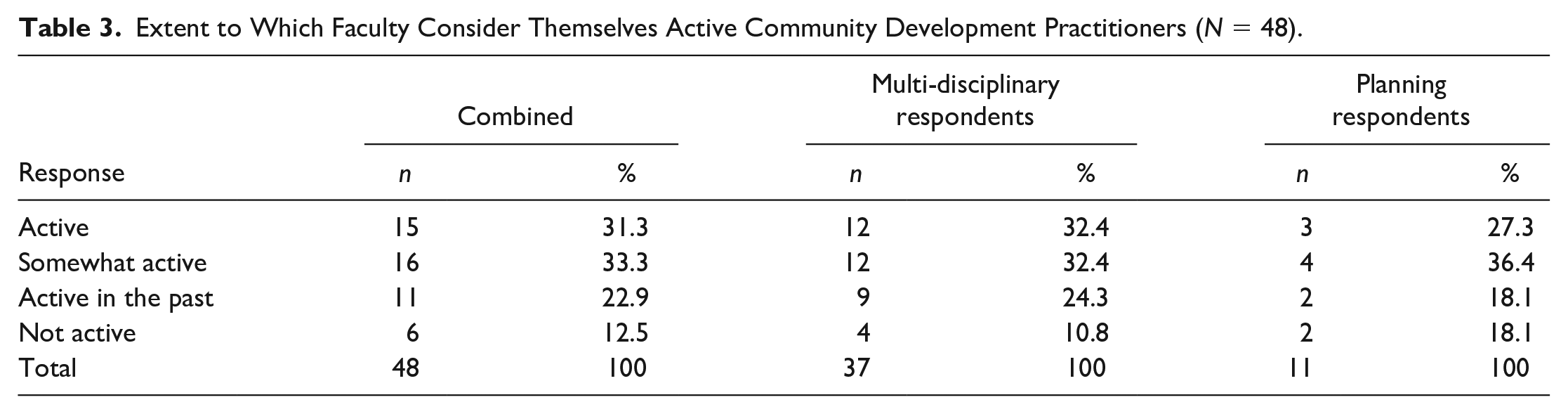
Survey participants were asked to provide demographic data (Table 1), disciplinary backgrounds (Table 2), and community development practitioner information (Table 3). The survey respondents were predominantly male (65.2%) and the majority self-identified as white (67.3%), followed by Hispanic/Latinx (11.5%). The age of respondents primarily fell between fifty-five and sixty-four years old (41% of all respondents), followed by thirty-five to forty-four years old (19.6%). The disciplinary backgrounds of respondents varied and reflects the diversity that can be found within the field of community development (Table 4). All but seven of the forty-eight respondents have a terminal PhD or EdD, with close to a third (27.8%) of all respondents holding doctoral degrees in planning, followed by sociology (13.9%). Only two of the respondents who teach in planning programs do not have a terminal degree in planning. Although not represented in Table 2, it is worth noting that almost a quarter (24.5%) of all respondents also have a master’s degree in planning.
Demographic Breakdown of Respondents.
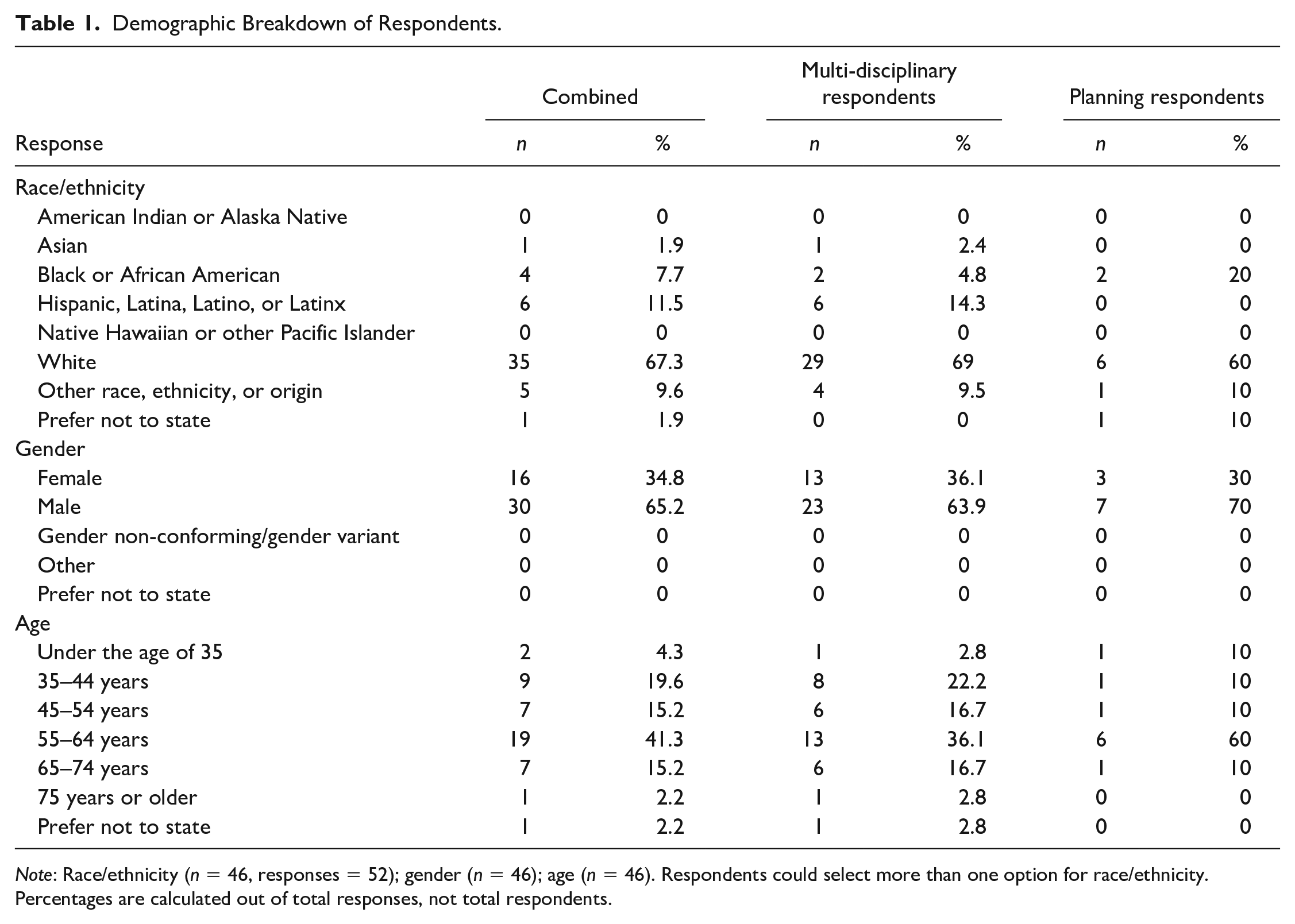
Note: Race/ethnicity (n = 46, responses = 52); gender (n = 46); age (n = 46). Respondents could select more than one option for race/ethnicity. Percentages are calculated out of total responses, not total respondents.
Terminal Degree of Respondents by Discipline.

Note: n = 43. Two respondents did not specify the discipline of their terminal degree and were therefore removed from the sample.
Extent to Which Faculty Consider Themselves Active Community Development Practitioners (N = 48).
Percentage of Professional Time Spent on Community Development Practice.
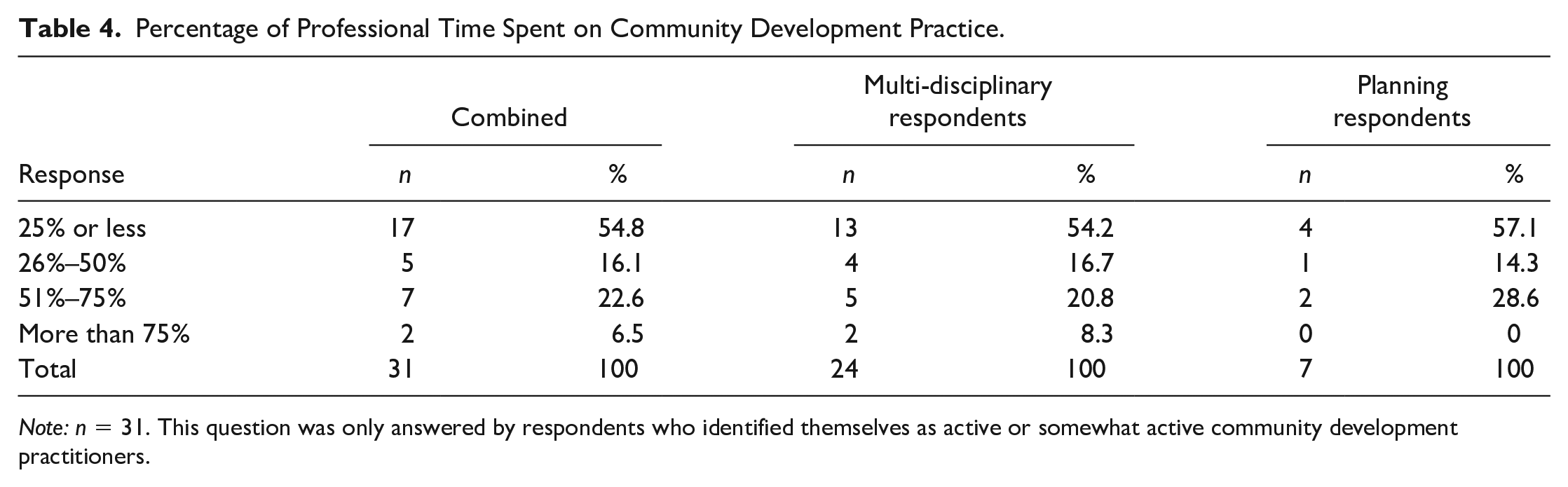
Note: n = 31. This question was only answered by respondents who identified themselves as active or somewhat active community development practitioners.
With respect to community development practice, there was a relatively even breakdown among respondents who considered themselves active (31.3%), somewhat active (33.3%), and previously active practitioners (22.9%). Only 12.5 percent did not consider themselves active. Of the active or somewhat active practitioners, a majority of overall respondents dedicated 25 percent or less of their professional time to community development practice (Table 4). This is true for all respondents.
Definitions and Concepts of Community Development
Survey participants were asked if they employ a definition of community development when teaching. Thirty-five respondents (73%) provided a definition of community development used when teaching their courses. Four themes associated with a definition remained consistent across all programs: social justice, community resources and capital, collective action, and community empowerment. Social justice was the most prominent response for planning educators and community resources and capital was the most prominent response for other educators. Some of these themes warrant elaboration as there were multiple concepts associated with a specific theme. For example, social justice encompassed diversity and inclusion, equality, equity, freedom, human rights, justice, poverty reduction, social change, and solidarity. Multiple concepts were also identified under the theme of community resources and capital, with economic development emerging as the dominant category followed by various forms of capital, that is, social, human, built, natural, and financial.
Among the responses captured, multiple individuals referenced the definition of community development as adopted by the IACD, CDS, and National Association of Community Development Extension Professionals, previously mentioned. Some definitions were broad, offering descriptions such as “Community development is placed-based and people-centered,” “Locality oriented social action aimed at improving quality of life,” and “Empowering residents to take control of the trajectory and nature of change that directly impacts their neighborhoods.” Others were more extensive, including one that reads Community development is both a goal and a practice. As a goal, it refers to the empowerment of communities to represent, voice, and effectively shape decisions being made that impact the community. It is the effective practice of democracy. As a practice, community development refers to actions that are shaped by the conscious and intentional inclusion of diverse voices, the analysis of process as well as results, and the commitment to life-long learning through community engagement.
It was apparent that many respondents offered definitions that aim to capture the broad nature of community development. However, it is important to understand how the respondents’ unique perspectives and professional backgrounds influence word choice and framing. For example, the distinction between “equity” and “equality” suggests different ideas about access, inclusion, and fair treatment when it comes to addressing disparities. Similarly, “social change” and “social justice” each imply varying degrees of systemic change, including the tactics and actors involved in implementing these strategies. These nuances are valuable to capture, especially considering the implications of different concepts and the etymology of these terms.
Forty-six individuals (96%) identified concepts that are consistently covered in their community development coursework. A total of ten overarching themes emerged from the responses across all programs, including social justice, community resources and capital, collective action, community empowerment, community characteristics, social structures and systems, methods, professional skills, community development, and frameworks and theory. These themes were reflected in all of the other respondents. The following four themes remained consistent across all respondents: social justice, community resources and capital, collective action, and community empowerment. However, replies from planning program respondents did not reflect concepts related to the other six themes: community characteristics, social structures and systems, methods, professional skills, community development, and frameworks and theories. Based on the top three overarching themes that emerged across all types of programs, that is, social justice, community resources and capital, and collective action, planning program respondents reflected a similar distribution as compared with the rest of respondents. Social justice was the most prominent response for planning program respondents and community resources and capital was the most prominent response for the other respondents—closely mirroring the themes from definitions of community development.
Survey respondents were also asked to choose among the types of communities as the learning foci (Table 5). Four choices were provided: communities of place (a common geographic location), communities of practice (common areas of work or profession), communities of identity (common populations such as age, gender, income, and race/ethnicity), and communities of interest (common pursuit, passion, or activity). Respondents could select more than one answer. The most common type of community that all respondents focus on in their coursework is community of place (96% of responses). This is followed by community of identity (67% of responses) and community of practice (56% of responses). The second most common type of community for planning program respondents is practice, whereas the second most common type of community for the other respondents is identity.
Community Types Commonly Covered in Community Development Coursework.
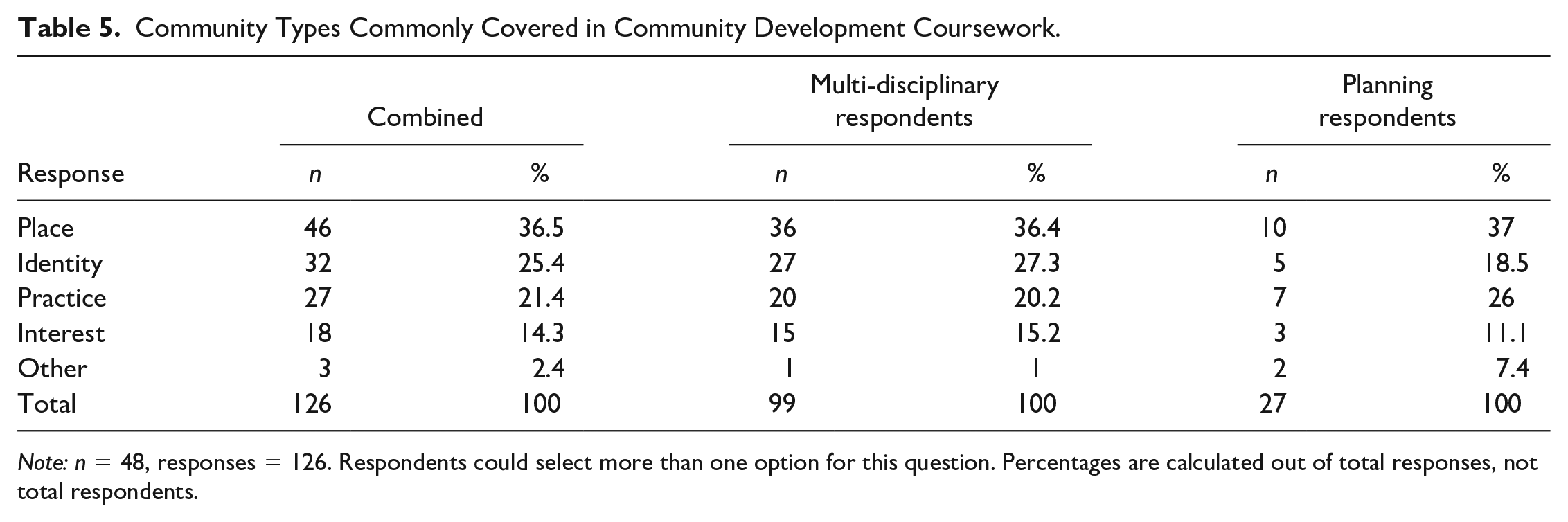
Note: n = 48, responses = 126. Respondents could select more than one option for this question. Percentages are calculated out of total responses, not total respondents.
Instructional Methods and Practices
Survey respondents were also asked about methods used to teach community development theory and practice. Respondents could select more than one answer to these questions. Overall, respondents identified classroom discussion, course readings, community engagement, classroom lecture, and project-based learning as best methods to teach community development theory (Table 6). In order of importance, respondents from planning programs identified course reading, classroom discussion, and classroom lectures as the best methods, whereas respondents from the other programs consider classroom discussion, course reading, and community engagement as the best methods to teach theory. 2 This might suggest that educators outside of planning programs value community engagement as an effective way for students to learn and test community development theory. To teach community development practice, respondents chose community engagement, project-based, group projects, classroom discussion, course readings, and internships as the best methods (Table 7). Respondents from planning programs identified project-based learning, community engagement, and group projects as the best methods to teach practice. Respondents from the other programs identified community engagement and project-based learning as the best methods. However, when asked “How often do you link community development theory and practice in your teaching?,” more than 70 percent of all respondents stated that they always do so.
Methods Used to Teach Community Development Theory.
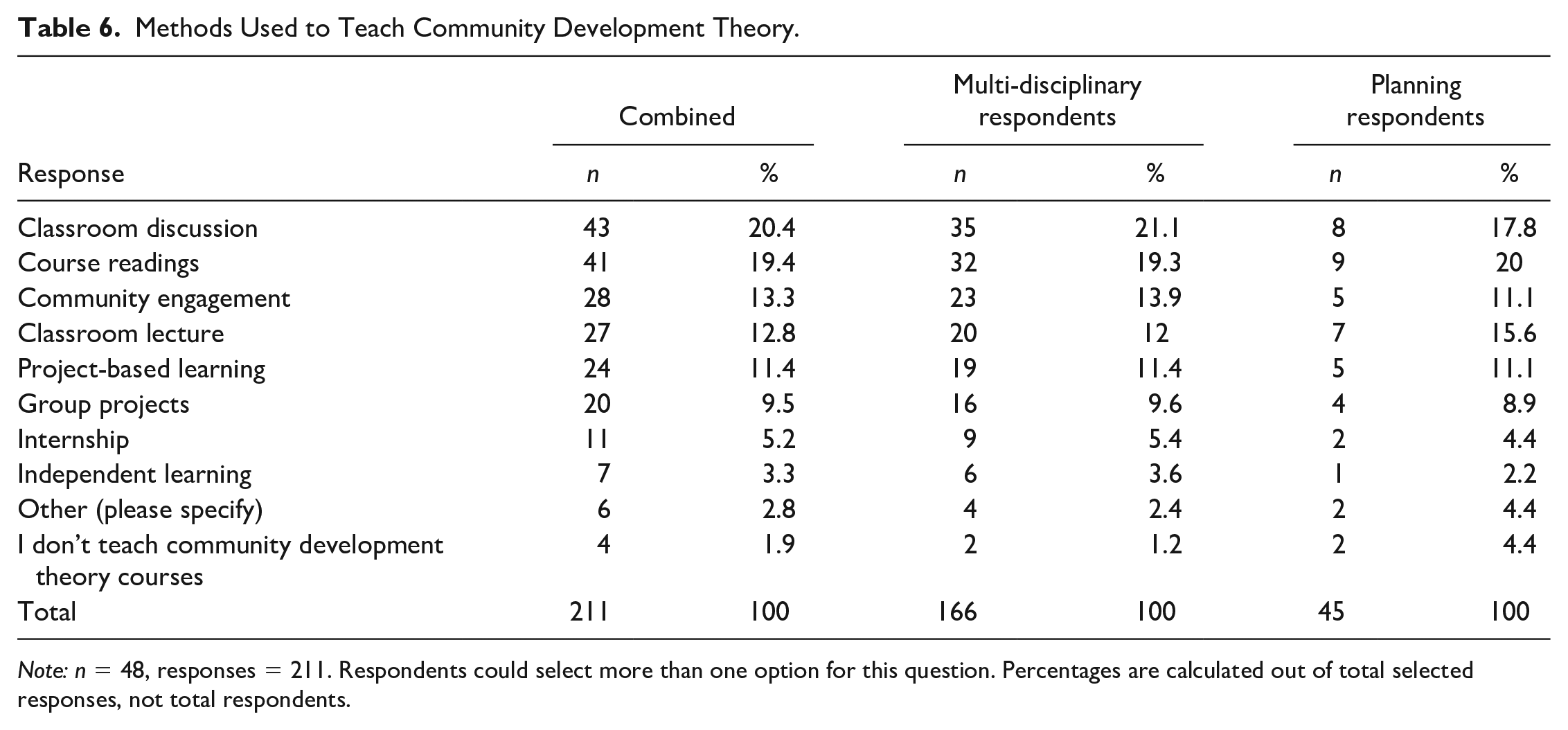
Note: n = 48, responses = 211. Respondents could select more than one option for this question. Percentages are calculated out of total selected responses, not total respondents.
Methods Used to Teach Community Development Practice.
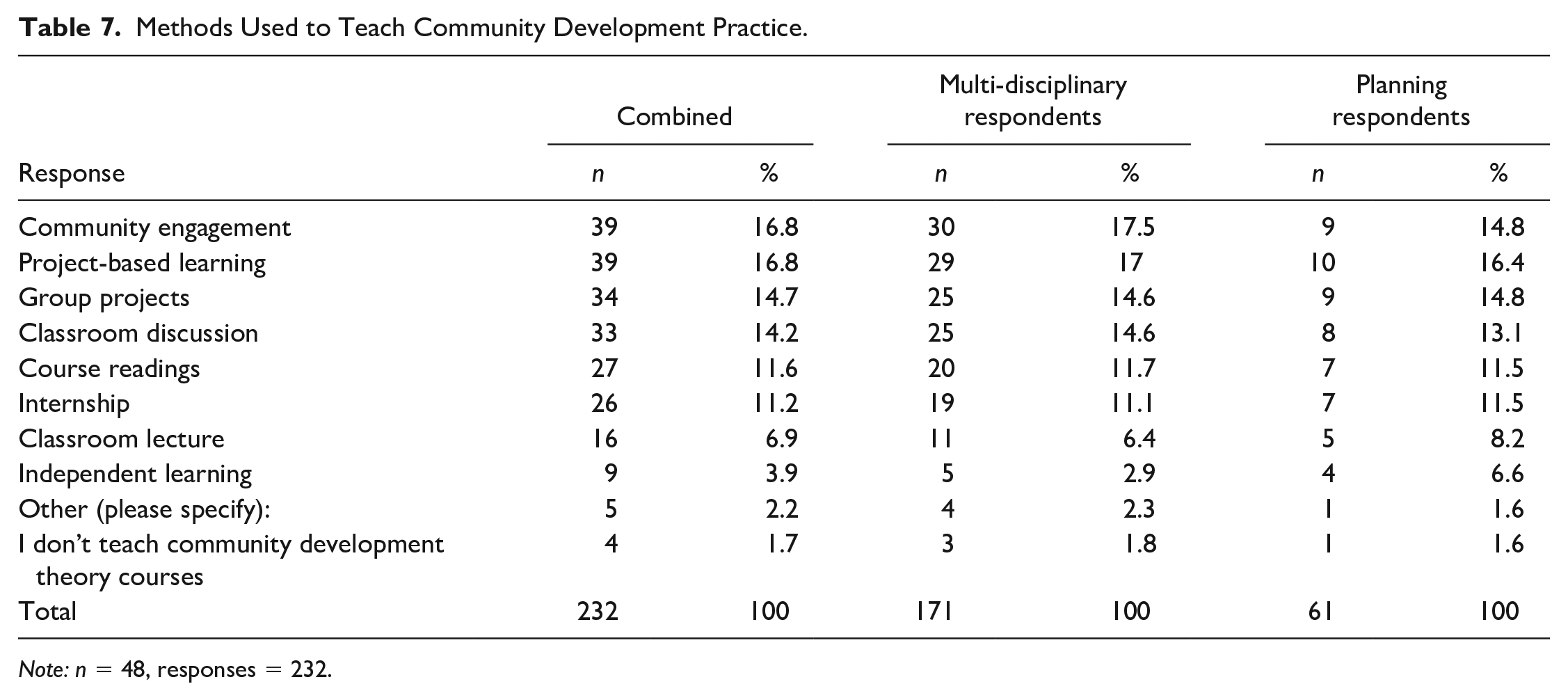
Note: n = 48, responses = 232.
Community engagement is one area where there were slight differences between respondents. While the overwhelming majority of the forty-eight respondents (94%) “always” or “sometimes” include a community engagement component in coursework, 64 percent of planning program faculty responded “sometimes” as compared with faculty from other programs that “always” include community engagement (51%). Forty-four out of the forty-eight respondents described how they engage community through their courses. Eleven themes (in alphabetical order) were identified as types of engagement with communities: attending community events, case studies, community assessment, community-based projects, collect information from community, guest speakers, internships, partnerships with community organizations, service-learning, site visits, and teach community engagement. The most identified type of community engagement is community projects that take the form of a group project, where students either conduct a study or propose strategies for a specific community. The second most popular category of community engagement practices was to collect information from a community. Responses alluding explicitly to data collection methods were classified into this category and included interviews, focus groups, organizational analyses, collect information, demographic profiles, field analysis through participation, participant observation, and surveys. The third most frequent category was to invite guest speakers. Responses here were consistent in that faculty members would invite community members, practitioners, and community leaders either to conferences or to class, or to participate in active conversations.
Respondents were asked to identify teaching practices they consider to be creative or innovative. Forty of the forty-eight respondents answered this question and teaching practices fell under one of three overarching themes: pedagogical approaches, methods of research and analysis, and forms of community engagement. All respondents reflect these themes with no major differences between respondents who teach in different types of programs. Two prominent sub-themes emerged under pedagogical approaches, including experiential learning and project-based learning. Experiential learning included responses related to the connection of theory and practice, service-learning, and internships, among others. Project-based learning included responses related to group projects, idea development and conceptual modeling, and project presentations. Three sub-themes emerged under methods of research and analysis, including community analysis, applied research projects, and site/field visits. Under forms of community engagement, the dominant sub-theme was community partnerships. Practices within this category reflected some form of collaboration or partnership with community development practitioners, community groups, and/or residents.
Expectations of Student Learning Outcomes
Survey participants were asked to select the top learning outcomes from a pre-selected list they expect students to achieve through their coursework. All provided a response to this question. Overall, respondents identified critical thinking (20%), community engagement (20%), complex problem solving (10%), participation methods (10%), and evaluation (10%) as the top student learning outcomes (Table 8). However, responses between planning program respondents and others vary, thus illustrating differences in expected outcomes. Individuals from planning programs overwhelmingly identified critical thinking as the top student learning outcome, followed closely by complex problem solving. A smaller proportion of planning respondents also identified community engagement and cross-cultural understanding as top learning outcomes. The other respondents largely identified community engagement as the top student learning outcome, followed closely by critical thinking. A smaller proportion of these respondents also identified participation methods and evaluation as top learning outcomes.
Top Student Learning Outcomes.
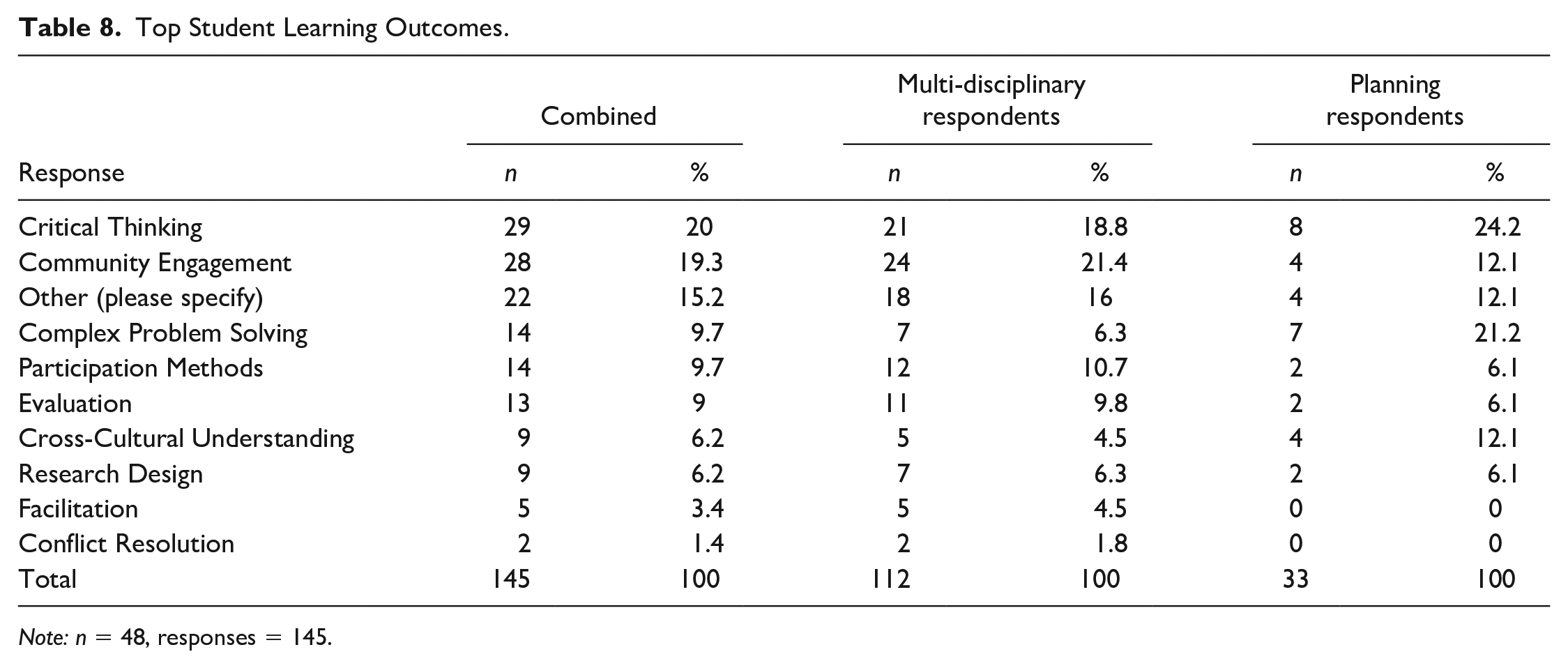
Note: n = 48, responses = 145.
Challenges, Opportunities, and the Future of Community Development Education
All but one of the respondents identified top challenges in community development education. Of these responses, four main themes emerged: methods, resources, community engagement, and ethics. Methods reflect challenges related to the understandings and approaches to teaching community development. Four sub-themes were identified in the methods category: balancing classroom instruction with fieldwork, defining the field of community development, producing evidence of effectiveness, and teaching the complexities of community development. Resources represented a variety of challenges related to institutional support. The most frequent response within this broad category was identified as limited funding for community development fieldwork and community engagement. Other responses primarily included the perception of limited job market opportunities combined with the challenge of communicating the broad application of community development across professional contexts and related fields. Other common responses alluded to the limited visibility of community development and a perceived lack of interest in the field among students and faculty. Within the broad category of community engagement, responses were classified between several sub-themes: integrating community engagement within coursework, politics and cooperation (referring to dynamics between government and private entities, communities, and within the university), and providing meaningful outcomes for communities. Ethics encompasses challenges related to core principles and morals underpinning teaching in community development. Within this category, three sub-themes were identified: changing conditions in communities (such as gentrification, automatization of jobs, global economy, climate change, economic challenges, digital divide, mechanization, flight of capital), community development values not practiced, and teaching thoughtful judgment and practice.
Answers provided by respondents were represented in all of the four themes of methods, resources, community engagement, and ethics. However, respondents who do not teach in planning programs identified resources and methods as top challenges more frequently than planning program respondents. With respect to the themes of ethics and community engagement, there were certain challenges that were identified more significantly for planning program respondents than for other program respondents. These primarily include community development values not being practiced, teaching thoughtful judgment and practice, and politics and cooperation.
Looking toward the future, respondents were asked to identify new directions for community development education. Thirty-eight out of forty-eight respondents (79%) identified promising new directions under the following five broad categories: changing context of the field, community engagement, teaching methods, emerging approaches, and resources. It is worth noting that a number of the categories were also identified as challenges to the field of community development education, namely, community engagement and resources. Responses regarding the future of community development education were equally represented under these five categories. One of the most frequent themes identified as promising new directions is the changing context of the field, which includes the emergence of new topics and problems as objects of study. New topics arising from a changing context that were identified included community-based models, for example, co-ops, land trusts, increasing focus on racism, environmental justice, activism and leadership, health and wellness, regeneration of industrial cities, social justice, transportation alternatives, urban food systems, and faith-based organizations. Community engagement was identified as a promising area for the future, which centered on establishing closer partnerships and collaborations with community members. Teaching methods represented a number of different methods and approaches to teaching. “Social learning,” “online CDE for practitioners,” “using tech to see the world of CD,” “active learning methods,” “teaching technologies that could help deliver more CD courses in real time at a distance,” “storytelling,” “art and placemaking,” “mediation training,” “project based approach,” and “democratization of information” were mentioned as examples. Main themes under emerging approaches applicable to community development education included interdisciplinary and intersectional approaches, as well as legitimacy of community development as a community of practice. Last, many respondents saw both financial and non-financial resources as an area that will benefit community development in the future. Some examples include a growing number of organizations that support community engagement efforts and resulting impacts, as well as new standards for community development practice that could guide the direction of community development programs. However, there were some differences between respondents. Teaching methods was the most prominent response for planning program respondents, and community engagement was most prominently identified by the other respondents. However, it was difficult to discern the differences between the two as a number of respondents viewed community engagement as a teaching method. Planning respondents also identified the legitimacy of community development as a community of practice more frequently than the other educators, suggesting that the community development field is gaining legitimacy as a growing focus within planning. By contrast, the other respondents see community engagement and interdisciplinary approaches as vital to the future of community development given the growing complexities found in local settings, that is, “wicked problems.”
Conclusion: Implications for Community Development Education
This article summarized the results of a community development educator survey as part of a multi-university collaborative study that aimed to answer the following question: What foundational knowledge and skills are being taught in U.S.-based community development programs? As evidenced from the survey responses, it is clear that there is diversity in methods and approaches to educational delivery. This is substantiated by the variety of education backgrounds of educators from community development programs that offer undergraduate and graduate degrees as well planning programs leading to a certificate, minor, of concentration. This has implications for how diverse disciplines and fields shape respective programs, specific theories and approaches, as well as teaching methods and student learning experiences. Despite this, similar patterns did exist across all survey respondents. Not surprising, there is convergence around community engagement as a core curricular element. However, there may be philosophical differences about the role of community engagement as it is unclear how respondents view its purpose—either as a method to teach community development practice, a student learning outcome, or both, as well as the various ways community engagement manifests in student learning environments. For some, this may include a view of community engagement as a transactional method to gather important feedback as part of public decision-making, whereas others may view community engagement as a transformational process vital to community capacity-building toward collective action outside of formal polities. Differences between educators may also be due to the fact that community engagement in planning programs is often not required or part of core curricula. In addition, integrating community engagement into curricula often requires faculty to devote extra time to facilitate student learning experiences, which is unevenly rewarded when it comes to merit, promotion, and tenure (O’Meara, Eatman, and Peterson 2015). Recognition of the time and labor required by faculty that facilitate community engagement, and the partnerships these activities represent, is an important consideration for planning programs exploring further integration of community engagement into curricula. By comparison, this may prove less difficult for educators in community development programs as it is often a normative expectation tied to research. Regardless, a greater emphasis on community engagement in planning programs is worth exploring, in general and not only as part of community development specializations or certificates, as community engagement is increasingly identified as an important skill in facilitating complex collaborations that involve multiple constituents and university programs (Bridger and Alter 2010).
Results from the survey also reveal several implications for teaching methods. Educators from planning programs responded with a preference for course readings, discussion, and lectures, while other respondents emphasized more group activity and community engagement. This may be due to the fact that planning programs view community development as a pedagogical supplement to core curricula, and educators do not integrate experiential learning into curricula given these activities often require a significant time investment (similar to community engagement) compared with traditional forms of educational delivery. Furthermore, the way in which planning educators engage students may echo how educators also engage communities. However, the value that project-based learning and community engagement offers to students should be an important consideration for all community development educators. The import to these forms of experiential learning is the development of skills associated with life-long learning that put a premium on self-awareness, reflective thinking, and ethical responsibility, among other experiential learning benefits (Roakes and Norris-Tirrell 2000). Furthermore, a report commissioned by the Association of American Colleges & Universities indicates that many employers view these and related skills, that is, ability to apply knowledge in real-world settings, ethical decision-making, critical thinking, creative problem solving, collaborative teamwork, and communication, as vital to the future workforce (Hart Research Associates 2015). These types of learning experiences are also valuable to a younger generation of students who put a premium on transferable skills that can be used upon graduation. Attracting this new generation of students may help bolster student enrollment in community development and planning programs, alike.
In addition, greater attention to student success and equitable outcomes also warrants consideration. Not surprising, there are different priorities among survey respondents for student learning outcomes: critical thinking, community engagement, complex problem solving, participation methods, and evaluation were the top choices among a list of other potential outcomes. When these combined responses are disaggregated, educators who do not teach in planning programs emphasized a combination of community engagement and critical thinking as the two top learning outcomes compared with planning educators who identified critical thinking and complex problem solving. It is worth noting that complex problem solving was not considered an important student learning outcome for educators outside of planning programs, while community engagement is less important among planning respondents. Despite these different priorities, a focus on student outcomes is paramount when considering some of the challenges faced by first-generation, low-income, and students of color. For example, a 2015 survey of more than 30,000 U.S. college graduates concluded that students who were emotionally supported during college and had participated in experiential learning were more likely to have a high level of well-being (Gallup-Purdue Index 2015). In addition, among racial-ethnic minorities and first-generation students, a sense of belonging predicts better persistence, engagement, and mental health (Gopalan and Brady 2019), and some studies show that opportunities are expanded for underrepresented students who participate in community-engaged research and learning experiences (Harden, Buch, and Ahlgrim-Delzell 2017). Immersing white students in diverse community settings through engagement activities may also add to their cultural intelligence, awareness, and empathy when prior life experiences have not afforded such opportunities. When exposed to these experiences, students can apply what they are learning, broaden their career choices, and serve communities in meaningful ways. However, more work remains to increase the racial and ethnic diversity of educators toward creating a greater sense of belong among students of color. In addition, there is growing consensus that community-engaged learning experiences cross boundaries of the university and community divide, center on reciprocal relations, enable the co-production of knowledge, and bolster community–university partnerships (Ashley and Vos 2015; Bose, Horrigan, and Doble 2014; Levkoe, Friendly, and Daniere 2018). Most of community development education already engages in such activities and are well positioned to contribute to this growing movement in higher education.
What is needed now is for community development educators and, by extension, the diverse programs they are affiliated with, to collaboratively produce and disseminate knowledge to improve educational practices in ways that are responsive to the many societal problems we now face. 3 In doing so, the field of community development education can do its part to provide a vital foundation for students and ensure professionals are well-prepared for the unforeseen challenges our communities will face in the future.
Footnotes
Acknowledgements
We would to thank the rest of our team involved in this collaboration effort. In particular, Ceara O’Leary from the University of Detroit Mercy; Cristina Chiarella and Wei Qing Xu from the University of California, Davis; Kristina Hains, Ron Hustedde, and Janela Salazar from the University of Kentucky; John Gruidl from Western Illinois University; and Neil Knobloch from Purdue University. We would also like to acknowledge all of the individuals who participated in the Community Development Education Symposium and Summit in Detroit, Michigan.
Declaration of Conflicting Interests
The author(s) declared no potential conflicts of interest with respect to the research, authorship, and/or publication of this article.
Funding
The author(s) disclosed receipt of the following financial support for the research, authorship, and/or publication of this article: This research was supported by a USDA NIFA Higher Education Challenge Grant (2017-70003-2638).
