



Abstract
This article analyses a fieldtrip studio course in Indonesia, reflecting on its value and benefits for urban planning. The original contribution of the article is twofold. First, we show how the course contributes to the development of the skills and knowledge required by planning graduates. Second, in relation to the course’s learning activities, we reflect on the significance and challenges involved in building partnerships between academia and industry from the perspective of the key partners involved in the course.
Introduction
International collaborations and partnerships in education have become more common due to the widespread use of mobile technology and reduced travel costs. Our planet has become a “global village” and there is a crucial need to prepare young urban planners to have not only global perspectives but also skills to work in a specific local context. This article analyzes an annual fieldtrip studio course delivered in Indonesia that started in 2015. The course examines development problems in urban and rural settings. Our reflection focuses on the “urban planning component” of the course, in particular the benefits of this course for the academic partners (students and lecturers) and civil society (non-governmental organizations and local communities).
This paper makes two novel contributions to the literature. First, we show how our course contributes to the development of the skills and knowledge required by urban planning graduates, who are expected to become “global changers,” and how it prepares well-rounded practitioners. Second, in relation to the learning activities, we reflect on the significance and challenges in establishing partnerships between academic and industry partners. In this reflection, we forefront not only the academic value of fieldtrip studio courses but also their value for communities and local civil society organizations. While other practitioners and researchers have discussed the value of planning studios (Allen, Lambert, and Yap 2017; Jones 2019; Winkler 2013), their focus has been mainly on the academic value of these courses, assessing teaching and learning objectives, rather than the experiences of diverse communities (Winkler 2013). Incorporating the voices of communities and local organizations is even more important when working with communities in the Global South, as these communities have previously been considered mainly as passive agents in such collaborations. We also reflect on the challenges we have faced and the strategies we have developed to overcome some of these challenges.
This article is organized into six sections, including this “Introduction.” First, we discuss the role of planning as a discipline and practice. Second, we examine the process of planning practice and planning learning, and the skills and competences students are expected to acquire. Third, we analyze our international course, providing an overview and examination of the pedagogy of the course and how the skills and competences for planning students are developed through this course. Fourth, we discuss the collaborative approach to designing and implementing the course, and identify its strengths and challenges. We conclude by reflecting on the value of work-integrated learning (WIL) activities such as our international fieldtrip studio course for planning education, reinforcing the need to integrate theory and practice to create planners who are “global changers” at the local level.
The Planning Discipline and Practice
Urban planning is an intervention to improve urban areas and provide residents with high-quality living environments. This is a conscious and collective intervention to improve the form of urban areas and requires the interplay of several actors, including those from the public and private sectors, civil society organizations, international institutions, and residents (UN-Habitat 2009). These interventions are made to benefit “the many” and not “the few” in society (Healey 2010). Power relations permeate all planning processes, with situations where the government might use its power to impose policies and decisions on other stakeholders, or situations where power is more equally distributed allowing communities and other stakeholders to influence and create planning processes through their own actions. Planning is thus “[a] contested field of action” (Miraftab 2018, 279). City development involves a complex “circuit of power” where power is dynamic, capillary, and decentered (Pieterse 2008, 5). While planning sets the direction for improving the built environment, this is a difficult task in the Global South where financial and professional resources are scarce and where there is a “conflict of rationalities” (V. Watson 2009) between plan-making and the formal organization of the city, with top-down approaches, and the organic, fluid, and informal practices of the majority of city residents who strive to survive every day.
Since the 1960s, and as a criticism of the “rational modernist approach” to planning, the practice of planning has emphasized the “communicative turn” (Healey 1997), and the need to include all stakeholders in decision-making processes to improve quality of life in cities. Reality is socially constructed (Healey 1997; Sandercock 1998) and special attention is given to the inclusion of minority groups and those with a history of being wrongly considered as “invisible,” “voiceless,” and “powerless” (Friedmann 1992; Ife 2016; Satterthwaite and Mitlin 2014). Planning is a process that brings people together, to discuss their interests and deal with conflictual viewpoints and opposing interests, aiming for consensus and collaborations (Healey 1997; Innes and Booher 1999). Following a “post-colonial turn” in planning, different voices and contributions have begun to be valued, and an emphasis on the specificities of Global South planning has developed in the last two decades. Southern Planning highlights the contribution of informal processes of city-making and the need to break with the models imposed by “the North” to better respond to the realities of “the South” (Robinson 2002; V. Watson 2009).
The “communicative turn” has led to planning education and practice (mainly since the 1990s, but with some notable earlier contributions) considering group process skills, including facilitation, negotiation, engagement, and the use of participatory tools, as essential in the formation of new planning professionals (Arnstein 1969; Healey 1997; Sandercock 1998; UN-Habitat 2009). At the same time, the “neutrality” of planning has been challenged (Forester 1989; Sandercock 1998), with many considering planning not only a political exercise but also an activity that addresses social justice values, including the public good, equity, inclusion, and diversity. The communicative approach was criticized for its belief in the “equilibrium among competing interests,” without addressing issues of conflict, imposition, and oppressive power (Miraftab 2018, 277) and neglecting the role of dissensus and conflict as also common elements in the planning process (Minnery 2007). The idea of “value-free” planning has been questioned (Thompson and Maginn 2012), with an explicit reference to “the moral responsibility of the planner to tackle social inequality and injustice” (Thompson and Maginn 2012, 22). The meaning of inclusion has also been challenged in relation to participatory processes that reproduce the status quo through only “invited spaces of action” (spaces that are legitimized by governments and other powerful stakeholders), incorporating differences rather than challenging power (Miraftab 2018).
Planning is a context-specific discipline and it is necessary to understand the local realities (needs, requirements, interests, and influencing factors) for projects to be successful. Awareness of cultural differences is an expected aim in planning processes (Sandercock 1998; Thompson and Maginn 2012). The idea of “one size fits all” where “best practices” can be applied to different contexts is highly contested as it does not respond to locally situated needs and practices (United Nations Development Programme 2019; V. Watson 2009). Simultaneously, power tensions and imbalances need to be made explicit and acknowledged as an inherent aspect of the planning practice (Minnery 2007; Miraftab 2018; Pieterse 2008; V. Watson 2009). The contribution of marginalized groups through the creation of “invented spaces of action” (spaces that serve to confront authorities and challenge the status quo) where these groups can improve their spatial and material realities through their own actions has become more widely accepted in the Global South and North (Holston 1998; Miraftab 2018; Roitman 2019b).
Processes of coproduction of knowledge are essential to the planning process within the collaborative approach. Coproduction occurs through the integration of diverse viewpoints and interdisciplinary perspectives (V. Watson 2014), while considering the multiplicity of knowledges (Sandercock 1998). Meaningful information is created through social interactions (Ozawa and Seltzer 1999). While diversity and representation are critical issues, the opportunities to create change through their own actions, particularly for marginalized communities, becomes more important than the simple idea of inclusion (Miraftab 2018).
In addition to addressing issues of diversity, representation, and inclusion at the local level, planners need simultaneously to pay attention to the global debate. We live in a globalized world and there is an increasing need to implement the idea of “think globally, act locally.” 1 Understanding processes according to global challenges such as poverty, climate change and environmental injustice, and income and wealth inequality, but acting locally is crucial as planning has an important role in protecting the equity and sustainability of this planet. Historically, planning education has followed general theoretical concepts, discussed within specific locations or contexts (UN-Habitat 2009). Planners need to provide local, alternative, and innovative ideas for a better future. Planning education ought to ensure the formation and development of “global changers” and “reflective planners,” who are those who can provide practical local solutions within broader global perspectives (Frank and Silver 2018). To this aim, planning education institutions need to work collaborative to leverage the role of planning in the global society. The case of several regional and global planning education networks such as the Association of African Planning Schools (AAPS), Asian Planning Schools Association (APSA), Association of European Schools of Planning (AESOP), Australia and New Zealand Association of Planning Schools (ANZAPS), and Global Planning Education Association Network (GPEAN) shows that academic institutions can work together to develop a common understanding of the global issues and threats we face and how we can collaborate together to provide solutions.
Bridging Learning and Practice
Planning is a practical discipline that is informed by theory. There is a constant dialogue between theory and practice, with theory providing the foundations for critical analysis and planning education (Ozawa and Seltzer 1999). Highly skilled graduates are expected to combine theory and practice to address problems in cities, the built environment, and the impact of development on people’s lives (Odendaal and Watson 2018; UN-Habitat 2009).
Learning is also context-dependent and happens in specific settings that shape outcomes. Then, “how can learning produce actionable knowledge that can impact upon urban planning, without claiming to be universal?” (Allen, Lambert, and Yap 2017, 355). How can planning students working on context-specific problems become “global changers”? We argue this is done through the development of an array of skills, including the understanding of how to manage diversity and cross-cultural awareness. We provide details on this by using our course as a case study. Before that, we discuss the employability skills required by the planning industry as a framework to assess our course.
Currently, planning education emphasizes the need to develop employability skills, to engage in experiential learning, and incorporate WIL. WIL is “an umbrella term for a range of approaches and strategies that integrate theory with the practice of work within a purposefully designed curriculum” (Patrick et al. 2008, iv). WIL aims to enhance students “work-readiness” upon graduation, preparing students according to industry requirements. There is a broad range of learning activities that contribute to WIL, including industry placements, industry projects, work simulations, field experiences, and entrepreneurships.
Universities now emphasize the need for WIL components in all degrees, with an expectation that programs contribute to the development of up-to-date employability skills and the ability to understand real-life problems. Most universities place the development of employability skills at the core of their student strategies and strategic plans. Planning programs are usually accredited by professional associations that provide advice on the skills required by industry. We used these professional requirements to assess the competences developed by students in our studio course. Table 1 elaborates on the core curriculum employability skills as defined by the Professional Planning Association in Australia (Planning Institute of Australia [PIA]). These competences refer to skills to be able to manage the planning process at the local level, but with a reference to the global debates and theories in urban and environmental planning and design. Graduates are expected to know how to work with diverse stakeholders, and include conflict resolution, problem-solving and ethical choices, as well as more specific skills about types of planning and frameworks guiding planning practice. Graduates should have the necessary skills to be able to collect and analyze qualitative and quantitative data and monitor and evaluate projects and processes.
Core Curriculum Competences in Planning.

Source: Adapted from Planning Institute of Australia (2019).
Note: Twenty-nine performance indicators are listed by Planning Institute of Australia (2019, 13–16). This table presents a selection of the indicators most relevant to this article.
Planning students are also expected to develop more general capabilities that constitute the core of tertiary education skills, such as critical analysis and synthesis, development of arguments based on theoretical underpinnings, and capacity to express clearly and effectively, both in oral and written formats. The list of competences in Table 2 includes these general competences such as critical thinking, being able to develop arguments and locate and use credible information. Awareness of the different needs of diverse social groups and in particular minorities is required, as well as being able to operate in culturally diverse contexts. These are critical skills developed in our course, as explained in later sections.
General Capabilities and Competences in Planning.

Source: Planning Institute of Australia (2019, 12).
Successful professionals need to be able to work in their local environments as well as in broader contexts and become “global changers.” The Strategic Plan 2018 to 2021 for The University of Queensland (UQ 2018b) in Australia states that graduates need to be able to develop the necessary skills to solve current and future global challenges. Therefore, UQ (2018a) promotes external engagement with key stakeholders, as outlined in its Engagement Strategy. Universitas Gadjah Mada (UGM) in Indonesia is one of the international “core partners” of UQ (2018a). This partnership, and the already established relationships among planning staff from UQ and UGM, were the drivers underpinning the creation of our international fieldtrip course in Indonesia, as explained in the next section.
Pedagogy of the Course
Fieldtrip studio courses are a type of WIL. These types of courses see lecturers as facilitators of the student learning process. They provide a more informal environment and more flexibility in teaching and learning new skills and knowledge than traditional university classes. Our course consists of an international fieldtrip and adopts a studio approach. It combines three models of learning: a “humanist model”; an “activity model”; and a “situated learning model.” The “humanist model” implies a natural desire of humans to learn, where “the learner is driven by their wish to improve their understanding and abilities” (Cunningham et al. 2007, 9). Students are at the center of the learning process in this model. The “activity model” and “situated learning model” are “practice-centred” and use participatory approaches driven by specific tasks (Cunningham et al. 2007; Higgins, Aitken-Rose, and Dixon 2009). Students learn from the work completed by communities and other stakeholders in a particular context, forming “communities of practice” (Wenger 1998). The learning process encompasses competences outlined in the planning curriculum (Tables 1 and 2) and simultaneously develops personal values.
Studio course pedagogy has a long history in planning education (Higgins, Aitken-Rose, and Dixon 2009; Long 2012) and is a type of experiential learning. Studio courses are designed around problem-based learning or real-life case studies. Students are usually organized in small teams (Jones 2019), with collaboration and emphasis on process being key aspects of the learning experience (Higgins, Aitken-Rose, and Dixon 2009). A final student presentation to lecturers and other stakeholders is usually a key form of assessment. The learning objectives and outcomes of studio courses can vary from physical planning and plan-making analysis to policy-based reviews, with most courses including “real-world problems,” “exposure to the complexity of real life,” “synthesis,” “learning by doing,” “reflection-in-action,” and field experience (Higgins, Aitken-Rose, and Dixon 2009; Jones 2019; Long 2012). These skills and features can be summarized as “the five Cs”: creativity, criticality, contemplation, collaboration, and citizenship (Higgins, Aitken-Rose, and Dixon 2009). The latter refers to a sense of promoting public interest, professional values, and engaging with communities, which are critical aspects of the planning discipline (refer to section “The Planning Discipline and Practice”).
Our course aims to demonstrate that students can “create change” through real-life interventions. Such approaches are a type of “service learning” (Winkler 2013). In line with the communicative planning approach as well as principles from Southern Planning that emphasize bottom-up approaches and promote the use of diverse local knowledges, the course also promotes the vision of planners as engaged actors and not experts. Students from the Global North are challenged by the idea of seeing themselves not as experts but as planning professionals who must work with the local communities and not for the local communities. They need to be open to learning from the communities. The direct work with local communities provides students with new personal and professional experiences, an appreciation of how communities organize themselves and a better understanding of the type of planning actions initiated by grassroots organizations. Students also reflect on different types of knowledge (Sandercock 1998). They also realize that several theories from the North do not work in the South and consequently students are challenged to see “from the South” (V. Watson 2009).
The course is called “International Field Course: Understanding development complexities.” It started in 2015 and has been conducted annually since then, with the exception of 2020 and 2021 as a consequence of travel restrictions due to the COVID-19 pandemic. There is a wide variety of students in the course. Students at UQ come from several countries, while those at UGM are mainly nationals. The course is offered to undergraduate and postgraduate students from the fields of urban planning, environmental management, geography, development, anthropology, political science, and social sciences at UQ and only undergraduate students from urban planning at UGM. The ratio of undergraduate and postgraduate students from UQ has varied through the years (Table 3). The course is a Level 3 course available to students in the third and fourth years of the Bachelor of Regional and Town Planning, Social Science, Environmental Management, and Science (Geography) and second year of several master’s degrees including planning, environmental management, and development practice at UQ and third year of the Bachelor of Urban and Regional Planning at UGM. It is a two-unit course. There are no explicit prerequisites (as students come from diverse programs) but there are recommended courses to be completed prior to this course. These recommended courses include sustainable development, community planning, planning theory, Global South planning, and research methods.
Student Characteristics, by Year and University.
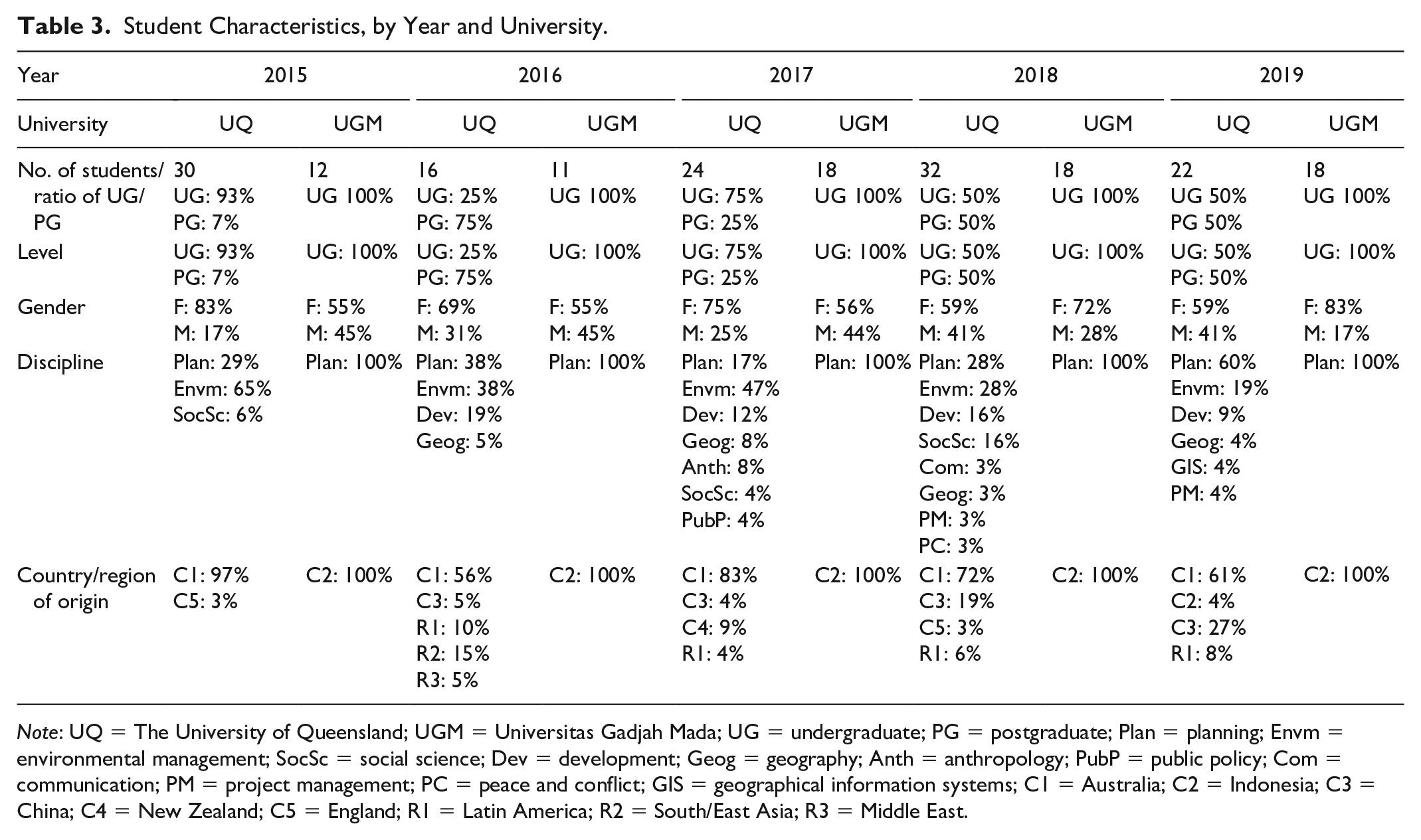
Note: UQ = The University of Queensland; UGM = Universitas Gadjah Mada; UG = undergraduate; PG = postgraduate; Plan = planning; Envm = environmental management; SocSc = social science; Dev = development; Geog = geography; Anth = anthropology; PubP = public policy; Com = communication; PM = project management; PC = peace and conflict; GIS = geographical information systems; C1 = Australia; C2 = Indonesia; C3 = China; C4 = New Zealand; C5 = England; R1 = Latin America; R2 = South/East Asia; R3 = Middle East.
There have been two experienced lecturers (one from the planning program at UQ and one from UGM) responsible for the urban component of the course and one experienced lecturer from UQ responsible for the rural component. These three experienced lecturers have worked together to organize the activities for all students (both urban and rural groups). The lecturers working on the urban topics (and coauthors of this article) have facilitated the course every year since 2015. Two lecturers from UQ have conducted the activities for the rural groups in the course. These lecturers have participated in alternate years. In 2019, a lecturer from UGM also supported some of the activities of the rural groups. In addition, each year, the course has received support from two local teaching assistants (one for the urban groups and one for the rural groups). These assistants, who come from UGM, are planning graduates who have previously completed the course. These assistants have changed over the years, some performing the role for two years. The urban and rural groups are also supported by six staff members from two local non-government organizations (NGOs) that are also partners in the course, and by local community members. The four authors of this article have been involved in the delivery of the course every year since 2015, representing the two universities, one local NGO called Arkom Indonesia Foundation (hereafter Arkom), and one local community-based organization (CBO) called Association Kalijawi (Paguyaban Kalijawi, hereafter Kalijawi).
Each year, the course is completed by sixteen to thirty-two students from UQ and eleven to eighteen from UGM. Table 3 shows the student number distribution from UQ and UGM according to undergraduate/postgraduate enrollment, gender, discipline, and country/region of origin. Some students from UGM come from Yogyakarta, while others are from different parts of the country and may be unfamiliar with the city or the local language. There are also students from UGM who come from rural areas.
The course involves two main “stages”: (1) prefieldtrip activities in each respective country and (2) a two-week fieldtrip in Indonesia. The prefieldtrip activities are designed to match the different needs and learning requirements of students at UQ and UGM. For students from UQ, who travel to a foreign country, these activities include lectures on urban planning and development on Indonesia, comprising a discussion of planning in the Global South and the Sustainable Development Goals (SDGs), research methods, including discussions on participatory data collection tools, and cultural awareness to enable students to conduct fieldtrip activities in a foreign country. Students also receive information about local culture, history, and basic information about the case study areas and problems. Students from UGM familiarize themselves with the case study locations and related development planning problems, relevant literature, and research methods. All students receive basic information about the problem to be analyzed and the case study area in Stage 1. Students from UGM are encouraged to visit the case study areas with their group members before the arrival of UQ students. Although all UGM students live in the city where the case studies are conducted, they are usually unfamiliar with the specific case study areas and they prefer to visit these areas prior to the arrival of students from UQ.
The fieldtrip in Indonesia is conducted over two weeks. Students from the two universities are divided into three “urban groups” and three “rural groups.” Each group has students with diverse backgrounds and interests. The activities for the “urban groups” are linked to urban planning, whereas the “rural groups” focus on environmental management. The study areas (case studies) vary among the groups as do some of the industry partners who work with the two broad groups. There is a core group of industry partners (Arkom Indonesia and Lingkar -two local NGOs-, Habitat for Humanity Yogyakarta, Warga Berdaya, Yogyakarta provincial government, Yogyakata and Sleman local governments, Kalijawi, communities in Sukunan and Kampung Code, and the local communities of each year’s case study locations) that have been involved since the start of the course. There are some activities (lectures and field visits) that are conducted for both groups. This article focuses on the activities related to urban planning (“urban groups”). As shown in Table 3, students from UGM are all undergraduate planning students, whereas students from UQ span several disciplines at both undergraduate and postgraduate levels. Students elect to participate in an urban or rural group. The two main disciplines for UQ students are planning and environmental management. Planning students tend to prefer the “urban groups,” whereas environmental management students tend to select the “rural groups.” The urban and rural groups are expected to be equitable in relation to undergraduate and postgraduate students, discipline, gender, and country of origin. Every year, there have been three urban subgroups and three rural subgroups. Since 2018, each subgroup has comprised three students from UGM and an equal distribution of UQ students (based on their number in each year). Having multidisciplinary groups means that students contribute different skills and knowledge to the teamwork. Some students might have better drawing or spatial skills, while others might be better at facilitating a focus group, discussions with the community, or conducting interviews. Students divide their tasks within the group and learn from each other. Some basic knowledge on data collection is provided as part of the course before the fieldtrip and in one of the first activities during the fieldtrip.
Each group is given a case study location and works on a particular problem defined by the local community. For the urban groups, this includes issues about housing, land tenure, water, and sanitation and waste management. During data collection, the problems are refined in consultation with the local communities. The analyzed problems have included deficient access to sanitation, insecure land tenure, flooding, and lack of waste management. While there are problems that might be repeated from previous years, such as insecure land tenure, the analysis is always different as the case study locations change every year. Study areas are selected according to the needs of local communities and the interests and needs of Arkom and Kalijawi. For example, Arkom might need to collect data from a particular neighborhood or Kalijawi might want to strengthen the grassroots activities in a particular settlement. At the end of the fieldtrip, each group gives a presentation to provide an in-depth analysis of the planning problem and recommendations on how to address this problem. All course partners attend these presentations. Prior to 2019, the presentations were held at UGM, whereas in 2019, they were delivered in one of the “urban” case study locations. This enhanced the integration of students with the local communities. It further promoted a stronger idea of a horizontal contribution to knowledge, breaking the stereotype of the venues and environment where knowledge is produced and disseminated. It also provided the opportunity for students and other partners in the course to visit one of the case study sites.
In addition to the work that each group conducts in their case study area, there are activities developed for the full group of students (urban and rural groups) that include lectures from local researchers, NGO staff, and activists; field visits; and cultural experiences, such as learning about local music and visiting heritage buildings and temples.
The course encourages a horizontal and bottom-up learning approach where students learn from communities and collaborate with them, instead of being “outsiders” and “extractive researchers,” or simple “consultants” (Winkler 2013). Students meet with local communities to understand the development challenges they face and collect primary data through focus group discussions, community mapping, interviews, surveys, observations, and transect walks. 2 The course emphasizes the need to work with local knowledge since “the community knows best” about their own problems (Ife 2016, 127). Students combine local knowledge with technical knowledge, relying on the local knowledge to understand the development challenge they work on. Students also work in multidisciplinary teams, as students from UQ come from diverse disciplines (Table 3). There is also a mix of undergraduate students (from both universities) and postgraduate students (from UQ). Students value this diversity in teams as each individual contributes particular knowledge, skills, and experience to the coproduction of knowledge.
A unique aspect of the course is the collaboration with a wide variety of stakeholders, and in particular with local communities, who had never been invited to participate in this type of collaboration before. Arkom (local NGO) and Kalikawi (local CBO) have been partners in the course since its inception, contribute to the design of the course activities every year, and act as gatekeepers providing entry to local urban communities. In collaboration with the local communities from several informal settlements in Yogyakarta, these two partners decide on the case study selection each year. The various partners have a range of responsibilities (Table 4) and the activities have different timeframes. In addition to these core partners, the course also has other contributors, including several local and provincial government agencies, who present their work to students, local activists, and other NGOs. This large variety of stakeholders provides students with a comprehensive understanding of the challenges faced by local communities. Each stakeholder addresses these challenges from different viewpoints, thus providing different and complementary information and different types of knowledge. The interaction with diverse stakeholders highlights the complexity of planning processes.
Main Activities of the “Urban” Component and Responsibilities of Each Partner.
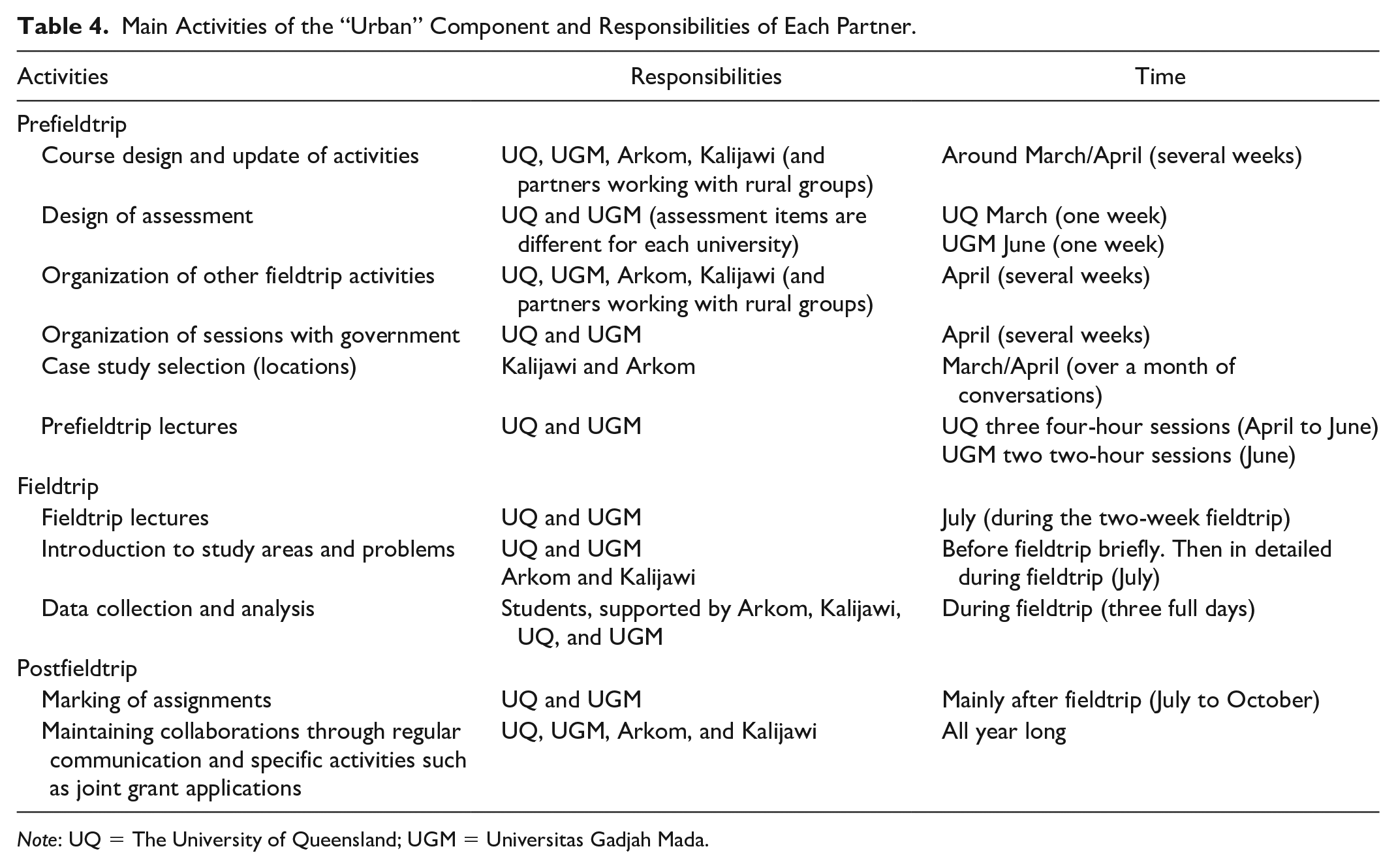
Note: UQ = The University of Queensland; UGM = Universitas Gadjah Mada.
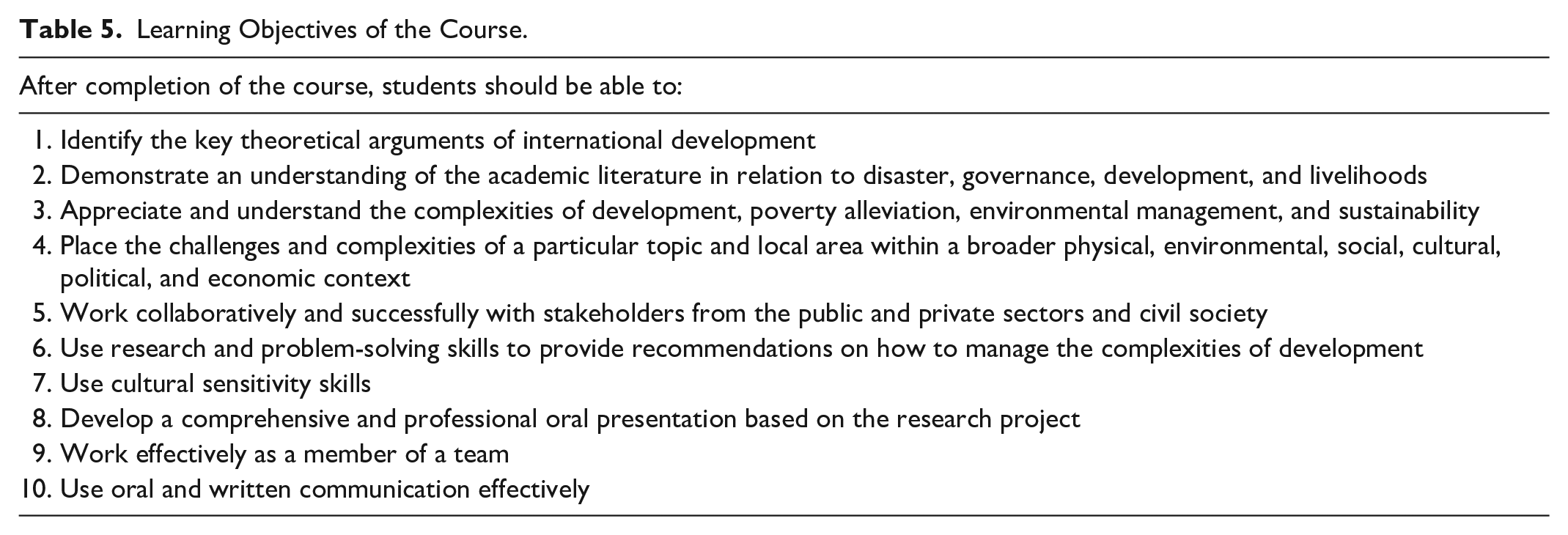
The learning outcomes of the course (Table 5) combine theory and practice and address several core competences for planning graduates (Tables 1 and 2). There is a strong emphasis on experiential learning through learning by doing, collaboration, and dialogue in what is known as “transactive planning” (Friedmann 1987; Sandercock 1998), which is a process of social learning, based on dialogue that incorporates experiential and formal knowledge (Friedmann 1987). With regard to discipline knowledge, the course includes discussion of critical concepts from planning, environmental management, and international development, such as poverty, development, informal settlements, housing policies and decentralization, slum-upgrading processes, governance, social action, disaster management, Sustainable Development Goals (SDGs), approaches to research, gender, positionality, and engagement.
Learning Objectives of the Course.
The course has three assessment items, which constitute the basis for the main activities conducted in the course. First, students at UQ work individually on a literature review as part of the prefieldtrip activities. They select one of the 2030 Agenda for Sustainable Development’s (United Nations 2015) SDGs and discuss how it applies in the context of Indonesia. This activity enables students to critically reflect on data and develop knowledge about planning and development challenges in Indonesia. Students at UGM work on the review of a journal article. The course reading list is similar for UQ and UGM students.
The second assignment is a group activity that requires students to analyze a problem in the field. It includes a final presentation at the end of the fieldtrip. This activity is the most important task undertaken during the fieldtrip. It provides firsthand understanding of development challenges in Indonesia and experiential learning about planning practice. Learning is practice-based, participatory, and follows a “situated learning model” with contextual knowledge and goals. Knowledge is cocreated by the group of students, in consultation with other stakeholders (especially local communities). Students need to understand the complexity of the problem, based on the perspectives of a diverse range of stakeholders and they are required to provide recommendations on how to improve the situation. However, the focus of the analysis is on “problem-setting” rather than “problem-solving” (Sandercock 1998; Schön 1983). The activities required for this group work include primary data collection through interviews, focus groups, surveys, and meetings with stakeholders; site visits; group meetings for data analysis and discussions; preparation and delivery of an in-country presentation; writing a short document outlining the key findings; and sharing it with stakeholders.
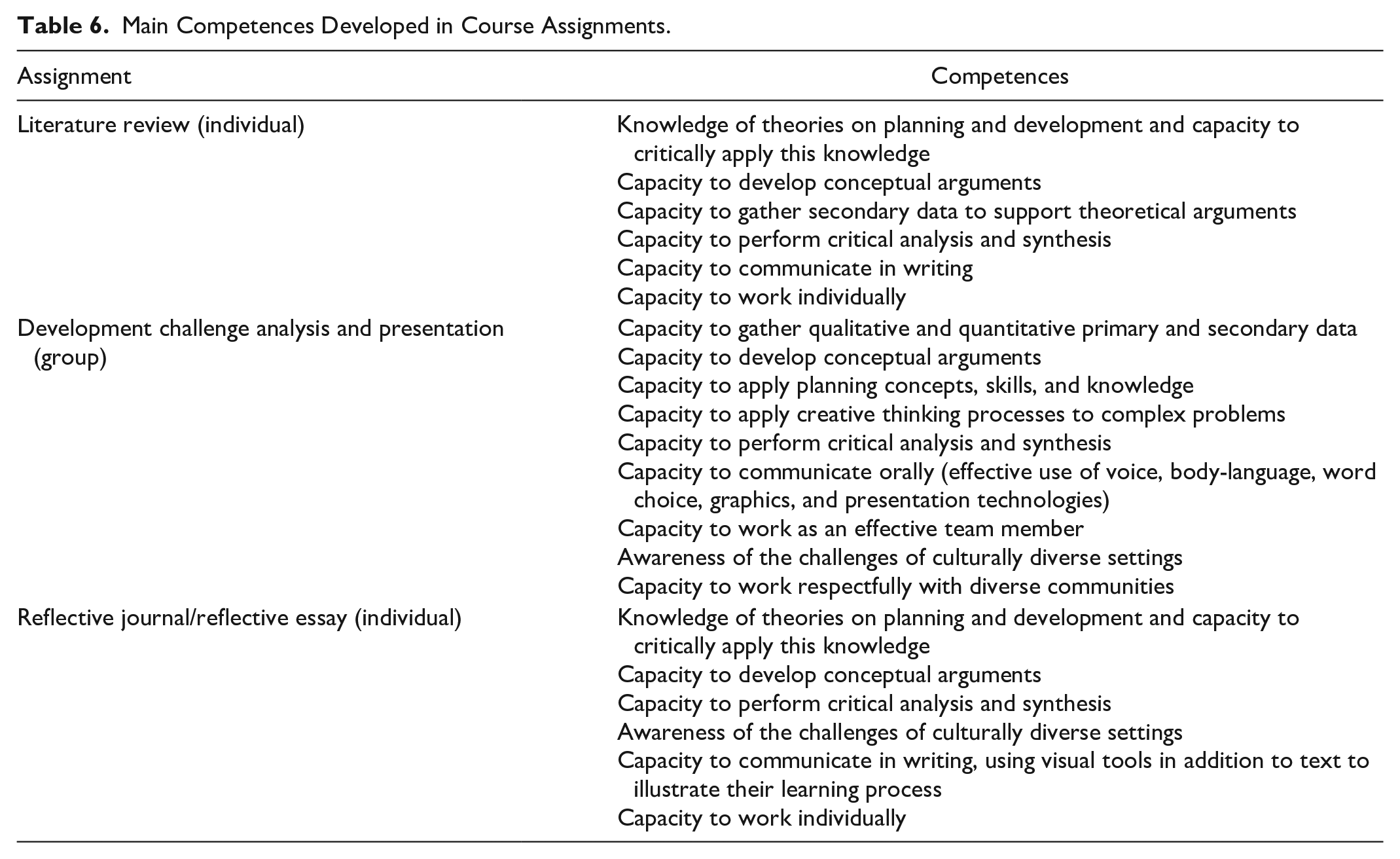
The third assessment item is a reflective journal for UGM students and a reflective essay for UGM students. The journal consists of ten entries or short reflective pieces for undergraduate students and eleven entries for postgraduate students. The first and last journal entries are completed before and after the fieldtrip, whereas the remaining entries correspond to activities during the fieldtrip. These activities are site visits and opportunities for engagement with local residents and communities (e.g., visits to an ecovillage called Sukunan [Iswanto, Rahmani, and Roitman 2018], upgraded settlements, and cultural sites). In these reflections, students discuss how the course has provided opportunities to develop new skills and knowledge, for example, through learning how local communities deal with flooding or waste management, or conducting community mapping. Students from UQ also reflect on the similarities and differences between planning problems and solutions in Australia and Indonesia. Students need to situate their reflections within the literature relating to the course. This assignment follows a “humanist” approach where learning is centered on self-inquiry and discovery (Cunningham et al. 2007; Long 2012). Students reflect on their learning process, in relation to new knowledge and skills, teamwork, their own “positionality,” and the management of power relations with other stakeholders. Students learn to become “reflective practitioners” (Schön 1983). This assessment item assumes that learning molds students’ identities in the context of communities of practice (Wenger 1998). A range of competences are developed in each assessment item (Table 6), reflecting the competences outlined previously (Tables 1 and 2).
Main Competences Developed in Course Assignments.
Initially (in 2015, first year of running the course), students at UGM did not obtain program credits for completing this course. Consequently, the assignments were designed according to the rules and requirements at UQ. Students from UGM only had the group presentation as the main assignment. Later in 2017, there were changes in the recognition of elective courses at UGM and the course became a formal elective course for planning students at UGM. When this happened, course staff from UQ and UGM discussed the assignments and adapted them according to the requirements for students at both universities. For example, in the final presentations, groups must present their work in English and Bahasa Indonesia. Students from UGM are encouraged to present in English to continue developing their language skills. UGM incorporated the literature review assignment and the reflective essay. The course is graded. At UQ, students receive grades (1–7) 3 and the grading system is the same for undergraduate and postgraduate students. They need to have at least a 4 (<50%) to complete the course. There has been only one student who did not complete the course as they did not submit the final assignment. There are not observed differences in terms of the performance of undergraduate and postgraduate students. The inclusion of a more diverse set of students in relation to country of origin in recent years (Table 3) did not reveal significant differences in student performance. At UGM, the course is graded from A to E. Students need to get at least 45 (out of 100), which is a C to pass the course. 4
For UQ students, the assignments are the same for undergraduate and postgraduate students; however, since the learning objectives are more complex for postgraduate students, there are higher expectations in their assessment. For the literature review, postgraduate students must write a longer piece and they must include a good number of academic references and a higher level of critical analysis than undergraduate students. This assignment is weighted 20 percent of the total course mark for postgraduates and 15 percent for undergraduates. In the case of the reflective journal, postgraduate students are required to write an additional reflection which is an overall critical reflection on the course, including suggestions for improvement. There is an expectation for students to engage with pedagogical discussions in this additional reflection. The reflective journals are weighted 45 percent for postgraduate students and 50 percent for undergraduates.
In this course, learning is developed individually as each student analyzes and reads critically and develops conceptual arguments, as well as collectively through the interactions with peers and other stakeholders, mainly community members. Based on the idea that knowing is a matter of “active engagement in the world” (Wenger 1998, 4), knowledge is coproduced through different activities and methods including (1) formal lectures in Australia and Indonesia; (2) the use of academic literature, government reports, and data collected and produced by Arkom and local communities; (3) presentations to students from Arkom and Kalijawi members and other organizations; (4) interviews and focus group discussions with local communities; (5) presentations from local government officers; (6) site visits and field observations; and (7) informal conversations among students and with community members. Students acquire new skills and knowledge through the six forms of knowing identified by Sandercock (1998): through dialogue, from experience, through gaining local knowledge, through learning to read symbolic, nonverbal evidence, and through contemplation and action planning. Dialogue (Healey 1997), listening (Forester 1989), and reflection (Schön 1983) become the most critical methods in the course. They are also critical tools to maintain partnerships (see next section).
Students learn about the everyday practices of local residents. The visits to their neighborhoods and homes and the sharing of local food prepared by the local communities (funded by the course) help to establish trust and rapport between students and local communities. This rapport is part of “being there” (Goebel 2021). The interaction of students from two different universities and several different countries is another critical aspect in the course. It provides a rich cultural experience, where learning is not only about development planning but also learning about other students’ cultures, using other types of knowledges and practices, and using all senses to appreciate new food and tastes, new smells, new music, rhythms and sounds, and new images and visual experiences. The practice of learning involves talking, listening, seeing, contemplating, and sharing (Sandercock 1998). One important discovery for some students is that despite the cultural differences that might exist between students from UQ and UGM (despite UQ students being a diverse group), they also share similar interests (music, dance, travel, and food). However, each cohort of students has been different. Some groups have showed more interest than others in learning from the other students. Some students form friendship relationships that are maintained after the course. Some students have also changed career pathways after completing this course, deepening their knowledge and skills on development planning and community development. For students at UGM, the course provides an opportunity to improve their language skills in English, and learn about study abroad programs and scholarships.
As part of the “quality control” of the university, students from UQ are requested to complete voluntary course evaluations, which are deidentified and anonymous. This course has received excellent scores over the five years that it has been conducted (4.88 in 2015, 4.75 in 2016, 4.85 in 2017, 4.83 in 2018, and 5 in 2019, maximum score of 5). 5 While there are limitations related to assessing the worth or value of the course based on student evaluations (Feistauer and Richter 2017), the feedback shows students’ appreciation for experiential learning, in a safe environment. In these evaluations, students can also provide suggestions for improvement. One of the main suggestions in the first years was to extend the stay in Indonesia, which has been done progressively as explained earlier. Another suggestion was to include a “free day.” This was done in 2019. Students used that day to do some sightseeing or shopping. There were also other suggestions for example to replace a visit to a particular place or make it longer, or suggestions about having more time for teamwork and a workshop on research methods. All this was incorporated in the program of activities in 2019 when the course was extended to 14 days.
Student evaluations of this course include comments such as the following: . . . this course [gave] me a broader understanding of planning complexities outside Australia. The opportunity to be put in an entirely new environment, as well as the opportunity to work with students from a foreign university, was a highlight as it outlined the importance of developing good relations in order to make research and further progress for the areas we visited possible. (undergraduate student 2019) . . . the collaboration with UGM was one of the best parts, the students gave additional understanding that we couldn’t have got from readings alone. Also, the collaboration with the NGOs was great to give us more of an understanding of some of the agencies involved in development and the community participation. (undergraduate student 2018) . . . the course also required self-directed work as well as peer-to-peer teaching. These were some of the best aspects of the course with regards to learning. (postgraduate student 2018) I am so thankful for the experience in learning about the complexities of development in an academic setting before being thrown completely in the deep end if I work in a similar field. Also great doing the literature review before hand and having an understanding of the theory before experiencing the reality. (undergraduate student 2017) The fact that we got to go to the field and learn first-hand by collecting qualitative primary data made learning in this course very interesting . . . (undergraduate student 2017) Every day was packed with meaningful interactions with communities, NGOs and government officials, which replicated a real-life international development working situation as closely as possible. (postgraduate student 2016) It was such an amazing opportunity to actually consult with real communities who have real issues . . . to have real world experience and learn practical skills is rare and I believe more courses should be designed like this. (postgraduate student 2016)
Students from UGM also have also reported on positive outcomes of the course in their reflective essays: This is a very special programme because I can learn about planning as well as practising my English. (undergraduate student 2019) I am very happy and feel lucky to get the opportunity to join this course. I got many new lessons and experiences that I’ve never had before. I believe these lessons will be very useful, especially for my future career. (undergraduate student 2019)
The course has won two teaching and learning awards. We received the International Award 2019 Curriculum Innovation Award from the Lincoln Institute of Land Policy (United States) and the Association of Collegiate Schools of Planning (United States), and the UQ Faculty of Science Award 2019 in the category of “Partnership and Collaboration” in recognition of the significance of the course’s partnerships and engagement.
Despite all these advantages and gains for planning education, fieldtrip studio courses are resource intensive in terms of preparation, organization, and delivery (Higgins, Aitken-Rose, and Dixon 2009). They do not allow for large numbers of students and therefore they do not provide high financial viability. Under the current financial constraints of universities, and a culture of seeing universities as “profit-making” rather than service providers, these aspects are serious threats to the continuity of courses such as ours, in particular international courses that demand high financial support for airfares and accommodation. The COVID-19 pandemic and travel restrictions also have had a negative impact on these courses. Involvement in studio courses is demanding for teaching staff and other partners and can affect research productivity and family commitments. It can also be seen as “unsafe territory” involving high risk and uncertainty: Leaving the safe, controlled classroom environment for more experimental and unpredictable territory inevitably involves an element of risk that some staff might prefer to avoid, particularly within a culture that is increasingly risk averse. The very value that studios offer in terms of emulating the uncertainty and ambiguity of real life practice can be off-putting to staff. (Higgins, Aitken-Rose, and Dixon 2009, 13)
In addition to tuition fees, international fieldtrip courses require students to pay for airfares, accommodation, food, and other activities. In some cases, these costs can be covered by scholarships. In our course, some students benefited from government funding that supported international student mobility. These are highly competitive annual grants, which require additional time and effort for the staff members to attract. Unfortunately, not all students are eligible to access this funding, which creates inequalities among the students.
These risks imply that the teaching staff involved in this type of course need to have a strong conviction about the value of the learning experience that is provided. Part of this conviction is about the “service” to communities and the real contribution of partnerships. Industry partners also need to evaluate the benefits they might receive, in a context of limited resources, including time and financial constraints. The next section discusses the aims, benefits, and challenges of building this partnership.
Building Teaching Partnerships
The idea of designing a studio course arose in 2014 as a result of three situations. First, UQ was interested in expanding its engagement and collaboration in South East Asia, and in particular with academic partners, including UGM, which is one of the most prestigious universities in Indonesia. Second, members of the planning program from UGM, including the UGM author, had visited UQ and its planning program in 2013, with the intention of fostering teaching and research collaborations. Third, the author from UQ had started a research project on housing policies in Yogyakarta in 2014 and developed relationships with the four main organizations that were later to become involved in the course. Kalijawi was set up in 2013 in Yogyakarta, with technical support from Arkom (Roitman 2019a). Kalijawi has expanded and continues to have the support of Arkom. In early 2015, the two lecturers from UQ involved in the course traveled to Indonesia for a week to organize activities and meet with all the course partners to finalize the preparation of the course. The journey from 2013 to 2015 when the course was delivered for the first time and the later regular engagement among all the partners during these six years have required building trust and respect. This includes not just formal/professional relationships among all the partners from Australia and Indonesia, but also collegial and friendship relationships that can foster solid collaborations.
Studio courses in planning benefit from engagement with communities and industry partners who can provide the “real-life” component to the course activities and can serve to develop employability skills. These partnerships greatly enhance teaching activities and outcomes. However, it is unclear as to whether these courses bring benefits to the nonacademic partners. Some studio courses have reported feelings of frustration and disappointment from communities with regard to their involvement or benefits (Winkler 2013).
The four organizations that became involved in the development of the “urban component” of the course did so for various reasons. The two academic organizations (UQ and UGM) aimed to provide students with skills relevant to the planning practice and to contribute to their development as “global changers.” The two civil society organizations (Arkom and Kalijawi) were mainly concerned with sharing their work and the challenges faced by communities and aimed to find collaborative solutions. They saw benefits in expanding their working relationships with universities, both local and international. Arkom was interested in getting involved in a colearning process with communities and academic institutions. Kalijawi saw this opportunity as a vehicle to improve the quality of organizational knowledge and enhance collaboration with other partners, in addition to becoming more visible as a stakeholder in relation to their contribution to improving their neighborhoods (Roitman 2019a).
Over these years, the success of the course and its continuity have brought several benefits to the partners. The first and most obvious benefit has been the opportunity to strengthen collaborations with international and domestic partners, and in doing so, learn from each other. Students and lecturers have learned from communities and practitioners and vice versa. A second benefit for the academic organizations has been the opportunity to provide “real” case studies that develop employability skills and implement urban planning activities that can contribute to the public good by providing data, maps, and other research outputs to communities. Connected to this is a third benefit for Kalijawi and Arkom that receive new data and the students’ critical analysis of this data and the problems analyzed in the case studies. This information can be used for future projects, and the organizations gain experience relating to how urban planning challenges are analyzed within conceptual disciplinary frameworks. A fourth benefit for Kalijawi and Arkom is that through their involvement in the course and the resulting data, in addition to other activities they do, they can implement an advocacy process with the local and provincial governments. Advocacy brings visibility to grassroots organizations (Roitman 2019a, 2019b). A fifth benefit for the community members is that through sharing their experiences, they have further developed their communication skills, even in English. Because of their involvement in this course, some community leaders have also been invited as guest lectures in other courses at UGM. Finally, a benefit that is shared by the four organizations is the expansion of cultural awareness and social capital based on intense exchanges through everyday activities (sharing food, music, anecdotes, and personal experiences).
Planning as a situated practice allows for the local aspects of communities to be brought to light, enabling community members to showcase and share their everyday life with people who might be familiar or unfamiliar with this. It allows for bridging from local change to global action. For example, the local communities and case studies analyzed are located on a riverbank. Students can see the river as part of the whole natural ecosystem in a more “global” view, or as part of the contribution to the lives of local communities. Another important learning element is a visit to local communities living near Mt Merapi, an active volcano. Students are exposed to views about the environmental vulnerability of these communities, but at the same time, they learn why local communities have decided to remain in the area, despite their high vulnerability, and come to understand how a volcanic eruption is not viewed as a threat, but rather as a blessing from nature. Local knowledge versus technical and global knowledge is discussed in this case study.
Due to the importance of global-local connections, over the last seven years, the government in Australia has emphasized the importance of student mobility to promote cultural awareness and create “global changers” through a mobility program for undergraduate students (UQ 2018b). This course has received government funding to support students from Australia to travel to Indonesia as part of the course since 2015. This article demonstrates that all partners, including local communities, experience benefits from this collaborative course, an outcome that has not always been found in other studio courses (Winkler 2013). However, it is important to emphasize that obtaining more visible benefits for the local communities remains one of the main challenges, as explained later.
The course partners also had to address some challenges relating to learning to work together. These challenges incorporated managing a diverse set of expectations from all partners and individuals, which is a challenge reported in the literature (Winkler 2013). They also included dealing with time management and communication problems, influenced by cultural and institutional differences. Flexibility and adaptability became essential skills as many activities did not follow the initial plan, although they did take place in an appropriate way. We have all learned to be more flexible and understandable with other working logics and practices. Flexibility requires patience. These two skills are very important for planning students to develop as the planning discipline deals with some level of uncertainty and surprise (Winkler 2013). In several instances, there were misunderstandings due to the differences between the working logics of civil society organizations and academic institutions. There were also different guidelines and procedures between organizations and between countries. These challenges created an additional layer of complexity and required regular dialogue, understanding, patience, and trust to create collective work. Trust and transparency are key factors when establishing long-term partnerships (Winkler 2013).
Language was also a challenge. Most students and lecturers from UQ did not speak the local language in Indonesia and therefore relied on students from UGM and Arkom staff to act as interpreters when working with local communities. These informal interpreters were essential to progress the learning activities. Despite this obstacle, with the help of UGM students, students from UQ were always able to effectively engage in conversations with local communities and able to collect primary data. Before starting the fieldwork activities, we would explain to students that language was a critical and challenging issue. To mitigate the problem, local students were asked to provide translations in as much detail as possible, whereas students who did not speak the language were asked to be patient and understand there would be times when they would feel not fully integrated. As part of the discussion on dominant paradigms in planning, this local context, where English was not the dominant language, was a new learning experience for some students from UQ. This challenges the “political implications” associated with language use (E. E. Watson 2004). To start building rapport, UQ students learn a few basic words in the local language, which is always received very positively by local residents.
Students from UQ also experienced a “cultural shock,” something that is commonly experienced by researchers unfamiliar with the local context (McLennan, Storey, and Leslie 2014). For some students, it was the first time that they had visited Indonesia, while for those who had visited previously, it had been primarily as tourists. Students were confronted with a lack of understanding of the local language and local rules. The new learnings expanded their awareness of cultural diversity and challenged the idea of “dominant” languages.
Over the five years that the course has been conducted, the relationship among partners has strengthened and there is a clearer understanding of the overall aim of the course. There have been some changes introduced as part of the course learnings and student feedback. For example, the fieldtrip has been extended (from seven to fourteen days), the number of students from UGM was expanded from eleven to eighteen, and these students now obtain formal recognition for this course as part of their degree. The course was delivered over seven days in 2015 and 2016, ten days in 2017 and 2018, and fourteen days in 2019. The extension of the duration of the fieldtrip allowed us to include one session to discuss data collection methods at the start of the activities; half a day for all students (urban and rural groups) to visit to an informal settlement to enable all students to become familiar with “urban problems”; half a day was devoted to more teamwork; and a free day was added for students to either rest or conduct a tourist activity in the city, such as going to the city center to explore local markets and other attractions. The assignments have not been changed for UQ students, but since 2017 in addition to the group presentation, each group must submit a two-page “policy brief” written in English and Bahasa Indonesia to be shared with all the stakeholders and course partners. 6 For UGM students, as previously explained, the assignments were increased from one to three when the course was recognized as a formal elective course in their degree. Based on the learning experience for students and lecturers at UGM, the planning program at UGM is now conducting similar shared teaching activities with universities in the Netherlands.
As a result of this course, Kalijawi has received more exposure locally and internationally and has been able to expand their working relationships, including with the local government and UGM. The work of Kalijawi has been featured in three academic publications (including Roitman 2019a, 2019b) and five conference presentations by the academic partners. We continue to work on joint publications, such as this article. We also submitted two grants applications together, which unfortunately were unsuccessful.
However, there are still changes that are required in moving forward and improving the course outcomes for all partners. We have already developed some strategies to attend to these challenges. The main challenge is how to increase the direct benefits of the course to the local communities that are involved. Local communities feel that addressing Challenges 3, 4, and 5 (see below) could help to address this first (and most important) challenge. The second challenge concerns expectations about advocacy or community services as these activities imply different types of engagement for academic and nonacademic organizations. Regular conversations between academics from UQ and UGM and Arkom and Kalijawi members are conducted to clarify this. We make sure that while the academic benefits continue through positive experiences for students and making visible the work of Kalijawi through joint academic publications and conference presentations, there is also advocacy to facilitate relationships between Arkom and Kalijawi and other stakeholders, in particular the local government. Due to COVID-19, the course did not take place in 2020 and 2021. During this time, the lecturers involved in the course and the members from Arkom and Kalijawi have been in contact through several ways. For those based in Yogyakarta, they have been in contact through social media and occasional in person visits. With the partners overseas, the relationship has continued to be fostered through informal conversations through social media and email and more formally through the cowriting of two publications (including this article) and a joint PhD supervision between lecturers from UQ and UGM.
A third challenge relates to the duration of the contact between the local communities and students. In this sense, Kalijawi members believe that it would be beneficial for the students to remain in contact with them and collaborate on a more regular basis (at least those from UGM who live in Yogyakarta). Recently there have been conversations between Kalijawi and UGM about how to facilitate students to work with communities more regularly that could provide more direct benefits to local communities. Some of these collaborations already exist, but they need to be strengthened. For example, there is currently a project on urban farming in Yogyakarta, where students from UGM and Kalijawi members are working together. This initiative started in 2020; students and lecturers from UGM helped the local communities to develop these activities to improve food security during the COVID-19 pandemic.
A fourth challenge is a perceived view from local communities about students being more interested in building relationships between the two student groups (UQ and UGM) rather than with members of the local communities. Perhaps more regular and sustained work linking the UGM students with local communities, as proposed by Kalijawi, would also contribute to strengthening social relationships between students and local communities. This is a proposed change for the near future. A final challenge has to do with how to help the local communities to support their livelihoods, for example, through giving marketing advice to sell their products (traditional medicine, snacks, handcrafts). Sometimes local communities have requested that the students provide specific marketing advice, such as the type of packaging to sell cassava chips made by the local community. In this situation, we have tried to put the communities in contact with specialists who can provide advice on this as it is outside the scope of the course learning objectives. However, conversations about how to facilitate this technical support have been developed, including facilitating contacts with other local stakeholders, who might be able to contribute.
Conclusion
This article has assessed the contribution of WIL activities to planning education through the analysis of an international fieldtrip studio course in Indonesia. Studio courses offer planning students the opportunity to discuss real-life problems and to interact with stakeholders as well as to integrate theory and practice. Our course gives students an appreciation of the complexity of planning processes. It also encourages students to develop capabilities required by industry such as teamwork and collaboration, respecting and valuing individual contributions, having the capacity to gather primary and secondary data and to be creative and innovative in understanding and explaining complex situations. Students also put in practice knowledge and skills acquired in other courses, such as planning theory, GIS skills, data collection, and analysis methods.
In addition to the academic outcomes of the course, our international studio course reinforces the significance of planning as an activity contributing to the public good and fostering social justice values. It also contributes to developing planners who are “global changers,” while working at the local level. This requires students to become familiar with how the context shapes the realities of residents. Understanding culture, local practices, and the local planning systems, including regulatory frameworks and resources, constitutes core aspects of the education of planners who are able to work and adapt to different realities, shaped by local conditions, local problems, and local expectations. This understanding of the specificity of the local context is within an appreciation of the “big picture” and the global principles that influence cities and their residents’ lives and how to apply critical thinking regarding the transferability of concepts from the Global North to the South. Dialogue and sharing with others (colleagues, lecturers, community members, or government staff) enrich the understanding of the complexity of these local contexts. These group activities are complemented by individual processes of self-reflection and processing of sensorial experiences while learning. Students are exposed to the importance of local knowledge and the use of a variety of knowledges. Students work with communities, and not for the communities. They are not experts or consultants but active learners. In this respect, a challenge remains to build more solid relationships between the local communities and local students from UGM that can be sustained over time, providing long-term benefit to the local communities.
The analysis of our course pedagogy and students’ outcomes shows that the experiential learning provided by courses like this one is difficult to replicate in the classroom. Despite financial and time constraints involved in the preparation of these types of courses, they should ideally be a core component of planning education (Jones 2019). The design of successful courses requires developing strong relationships with all stakeholders involved in the learning process. In this article, we have demonstrated how we, as core partners in the course, have had, at times, different views on the course and how to approach learning activities as well as different expectations based on the aims of our own organizations. Collaboration and common understanding among partners require, as in urban planning processes, time, respect, dialogue, trust, listening, shared goals, and being open to regular monitoring and assessment of the process. We have also elaborated on the challenges we have faced in building solid partnerships over these seven years and how we have overcome some of these challenges while there are still issues we need to continue to improve. While it is not possible to provide “recipes” on how to replicate this type of learning activity in the field, these learning processes and design of “hands-on” courses required commitment to a regular and sustained learning process from all involved stakeholders and a need to remain open and flexible to change to accommodate diversity and cross-cultural awareness. Overall, it is a process of enjoying learning from others in formal and informal activities realizing the most significant aspect of learning which is the mutual respect, sharing, and enrichment of personal and academic experiences.
Through the reflection on this learning experience, we have highlighted that planning education requires collaboration, constant change, and adaptation. WIL activities, as exemplified by our course, bring awareness of diversity and complexity and prepare students to work in a more global and interconnected world, while being mindful of local culture, needs, and practices.
Footnotes
Acknowledgements
We would like to thank all the people who have contributed to the course. This includes colleagues from The University of Queensland (UQ), Universitas Gadjah Mada (UGM), Arkom, Kalijawi, Lingkar, Habitat for Humanity (Yogyakarta), Warga Berdaya, Sukunan, Kampung Code, local communities from kampung located by Gajah Wong and Winongo rivers in Yogyakarta, Yogyakarta provincial government, Yogyakarta city government, and Sleman government. In particular, we would like to thank all the UQ and UGM students who have participated in this course, and our colleagues Associate Professor Karen McNamara and Associate Professor Ron Johnstone who have been instrumental in conducting the ‘rural component’ of the course. We are grateful for the funding the course has received from UQ, UGM and the Australian Government.Special thanks to the course teaching assistants: Sita Rahmani, Shandy Situmorang, Fadhila Nur Latifah Sani, and Basanda Etavita. Finally, thanks to Associate Professor Ann Peterson for her comments on previous drafts and edition, and the four anonymous reviewers.
Declaration of Conflicting Interests
The author(s) declared no potential conflicts of interest with respect to the research, authorship, and/or publication of this article.
Funding
The author(s) disclosed receipt of the following financial support for the research, authorship, and/or publication of this article: UQ students have received funding from the New Colombo Program (DFAT - Department of Foreign Affairs and Trade, Australian Government), Endeavour Mobility Grants (Australian Government), and Short Term Global Experiences Initiative (UQ Student Employability). The course has also received funding from the School of Earth and Environmental Sciences at UQ, and the Planning Program at UGM.
