



Abstract
This study investigates the instrumental role of translated environmental news in informing public opinions on environmental issues among Chinese-speaking communities. Its contribution to methodology is exploring the automatic corpus annotation tools, that is, semantic analysis system. Its contribution to theory is identifying and distinguishing among three recurrent sub-news-types of translated environmental news published on BBC China, that is, governance; international relations and environmental science. Discourse features attributed to these subtypes of environmental news underscore BBC China’s reporting styles and strategies and largely explain its wide appeal and credibility among the target audiences.
The BBC China is one of the few Western digital news outlets that have a wide accessibility and sustained impact on changing public opinions in China. It practices a mixed news sourcing and reporting system that results in wide appeal and credibility in China. With a specific news service focus on Chinese-speaking communities, BBC China selects and serves news materials from a variety of sources in original Chinese or other languages. The appeal of BBC China to a very mixed Chinese-speaking audience, especially those residing inside of China, stems from its perceived independent and balanced view on contentious issues such as those related to the China’s social and economic development and resulting environmental impacts. For years, the British news outlet provides an important news source for those with limited access to original English news, particularly to readers who can read only in Chinese, despite the increased English literacy among young generations. More importantly, it serves as a powerful tool to promote a well-sourced set of ideas to inform a large and growing Chinese-speaking audience.
BBC China fills a gap in environmental reporting in a country that faces numerous environmental problems. 1 BBC China also illustrates the growing importance of the design and delivery of localized digital news in the target languages, with a view to better engaging distinct audiences in the development and exchange of social values and ideas across languages and cultures. A growing body of research focuses on environmental news, particularly cross-national studies that explore the nexus between environmental news discourse and explanatory social/cultural factors. 2 The current study advances this growing research trend by focusing on a particular type of trans-national environmental news, that is, the purposeful translation and redesign of environmental news for cultural and language-specific audiences with BBC China as an example.
The highlight of translation of news underpins the growing importance attached to localized digital media amid the latest waves of globalization and cross-lingual communication. 3 Translation represents a particular type of discourse and language variety, which differs from original writing. By definition, it involves two languages and sociocultural systems, known as the source language and target language. 4 The complexity of translation lies in the development of strategies to facilitate the interaction between distinct language and cultural systems. 5 The study of discourse patterns in translation helps identify communication strategies in specialized translation genres such as economics, finance, business, news materials and so on. Following this line of translation research, this study explores dimensions of translated environmental news with data collected from BBC China.
Not surprisingly, a considerable amount of news published on BBC China is selected from that originally published on BBC UK. However, variations in terms of language styles, framing techniques and visibility level of specific news content between the two reporting systems exist. As a result, the popularity of BBC China and its sustained impact on Chinese-speaking audiences cannot be explained solely by its implicit connection with BBC UK. This is because, despite the influence and value of original English news, a literal translation and less focused reporting approach would necessarily receive criticism from the large Chinese-speaking audience with a very complex ethic, cultural, ideological and age structure.
This study explores intriguing issues through the development of new analytical instruments and provides a useful and innovative focal point for global environmental news analysis:
What are the translation and editorial strategies developed by BBC China to inform its language-specific audiences over complex issues such as climate change?
Are there any consistent patterns regarding the framing and reporting of environmental events with impact in different areas of social life?
The analysis draws on methodologies widely used in translation studies, environmental media and corpus linguistics.
Research Methodologies
Three Types of Translated Environmental News
The first stage in the study of translated environmental news on BBC China is collecting relevant data from the news website. BBC China represents a hybrid news reporting system that incorporates news collected from a variety of sources, including translated and adapted news originally published on the parent website BBC UK; news collected from other national news outlets such as Nikkei News (Japan); The Australian; CNN (the United States); Le Monde (France), Moscow Times (Russia) and major Chinese news outlets like China Daily and People’s Daily. The automatic retrieval of translated environmental news on climate change benefited from the parallel reporting system of BBC China. By inputting key search words such as global warming, climate change with a space followed by the Chinese character YI (which means translation), a number of news entries came up. The automatically returned news entries were then screened manually based on degree of relevance to this study. News entries that discussed marginally the input key words were excluded to streamline the analysis.
More weight was given to news entries that dealt specifically with the social impact and implications of environmental issues. Discussions on unobtrusive issue-areas such as climate change and global warming were deliberately included in the news search alongside investigative reporting on environmental deterioration that prevails in Chinese environmental news. 6 The inclusion of news reporting on climate change aims to explore how foreign news outlets such as BBC China foster an increased social awareness and scientific attitude among the Chinese audience toward environmental phenomena such as global climate change, given that in-depth discussions about scientific and policy perspectives on environmental changes in Chinese news media are largely still developing. 7 The data retrieval and filtering process produced a relatively small yet representative list of environmental news articles published on BBC China in the five-year period 2009 to 2014.
The total number of news articles—exclusively translated and abridged news and directly related to environmental issues—was 87 with each article ranging between 400 and 2,000 character words. News stories were transcribed into text files and labeled individually. Based on thematic topics covered, this material were classified into three recurrent categories, which are (1) environmental governance; (2) international relations and (3) environmental science. These three topics and highlighted environmental news categories exhibit consistent patterns in the translated news database and they reflect the growing concerns around environmental issues in the Chinese news media. 8
The first type of environmental news, governance, deals with social impacts of environmental issues at a national level. 9 It is not limited to the management and handling of environmental problems by Chinese governments (at all levels) but extends to include reporting on national policies, legislation and high-profile events of environmental protection in other parts of the world, especially in the United States, the United Kingdom, Russia, India and Japan. The distinctly wide breadth of reporting on environmental governance at the national level enables audiences to develop their critical understanding and evaluation of the effectiveness and deficiencies of national environmental policies in the global context. 10
The second type of environmental news is that with international dimension. In the transcription and classification of translated BBC China news, it became clear that environmental issues were often framed within a highly dynamic international setting. Environmental issues provide an important focus of debate among countries in terms of responsibility attribution and distribution of resources to combat environmental deterioration. This international environmental news, an integral part of BBC China’s journalism, prepares a globally minded Chinese-speaking audience, especially young generations, to look at environmental issues beyond national borders.
The news in the environmental science category dealt with the latest scientific breakthroughs, advances made with new energies on an industrial scale and impacts of extreme weather conditions on national economies and people’s daily lives. If the first two types of environmental news are seen as frames in the social domain, environmental science news is essentially a natural frame that engages the public in the scientific and scholarly debates of global climate change. This type of environmental news receives less attention in national news reporting inside of China, as the majority of the general public accepts, to varying degrees, climate change as natural results of environmental deterioration that come at the cost of the country’s economic development.
Automatic Sentiment Analysis and Corpus Data Processing
The sentiment analysis tool used in this study was developed by the Centre for Computer Corpus Research on Language of the University of Lancaster, United Kingdom. It is known as USAS. USAS has a multitier structure that covers 21 major discourse fields and domains organized alphabetically. Within each field, subdivisions are provided based on the sentiment (especially subjective and evaluative) properties of terms and expressions classified in each major domain. The Chinese version of USAS (CH-USAS) draws upon the English taxonomy of sentiment analysis. It was used to annotate translated environmental news from BBC China.
The advantages of using sentiment analysis tools such as USAS, available in many languages, are multiple. First, it is a useful experiment with computational corpus annotation, which has proved valid and productive with different languages, from those using the Latin alphabet to character-based Asian languages. This helps to overcome technical and linguistic difficulties involved in cross-lingual and cross-cultural analysis. USAS represents a higher level language processing system, as computer analytical systems such as part-of-speech tagging and syntactic parsing are often language-dependent, especially with noncognate or typologically distinct languages. The deployment of an annotation tool that is valid across languages enables the development of theoretical and hypothetical models in different contexts to fill in a critical gap in cross-national environmental news analysis.
Second, the use of corpus annotation tools like USAS is instrumental in processing large-scale databases to extract important quantitative information. The statistical processing of news media data is a prerequisite to conceptualizing and developing theoretical constructs such as meta-frames and measure scales for empirical news media studies. With a small set of news events, the result obtained or the conclusion drawn are necessarily circumscribed and insufficient to yield insights into the relation such as co-variation, changing dependence relationship between social and cultural factors, moderating and mediating variables and the framing and editorial strategies devised for environmental reporting purposes.
After collecting translations of environmental news from BBC China’s website, the raw news data were first entered into the automatic tagging system of CH-USAS. Next, they underwent a thorough manual screening to retain tagging items that were relevant for this study. Before the statistical analysis, it is important to elaborate on the purpose of the quantitative analysis that follows the collection of translated news data. Two main types of statistics are particularly relevant to the current study, that is, pattern detection and feature discrimination for classification purposes. Again, this study’s first aim was to identify BBC China’s reporting strategies through a quantitative analysis of recurrent textual patterns in translated environmental news. Recurrent textual patterns discovered help to study how the selection and translation of environmental news enables BBC China to inform and mobilize its targeted Chinese-speaking audiences about environmental issues and the social ramifications of climate change events.
Again, this study’s second aim was to highlight textual features that effectively discriminate different types of environmental news. This involves identifying a small set of textual features drawing upon the result of sentiment analysis to explain differences among the three subgenres of translated environmental news in the current study, that is, governance, international relation and environmental science, as well as intra-genre variations. USAS has 21 major discourse fields and 232 category labels. Although such a comprehensive annotation system increases the depth and scope of linguistic and sentiment analysis, it poses difficulties for detecting textual features characteristic of each subtype of environmental news.
To achieve the first objective, exploratory factor analysis (EFA) was applied to the multidimensional annotated data. EFA is a widely used statistical technique that configures the underlying patterns of a large set of observed variables by classifying the original variables into a reduced set of variables known as principal components, factors, conceptual dimensions or measurement scales. Through the statistical classification and grouping of textual features such as different semantic discourse features such as nouns, adjectives and verbs indicating people’s attitudes, opinions and subjective evaluation of environmental events, EFA can extract consistent textual patterns in the three environmental news categories, which are then called principal components or dimensions characterizing and underscoring the reporting, presentation and/or style of each category. This statistical method has been explored widely in stylistics and empirical translation studies and, in short, it provides an efficient analytical tool to convert subjective evaluation to objective empirical data analysis in language and textual studies. 11
In the statistical extraction and identification of main textual dimensions that can be used to define news genres, relevance of certain textual features (known as original observable variables because they can be counted when reading news, for example, use of semantic linguistic devices such as evaluative language expressing one’s feelings and judgment) to a statistically extracted textual dimension is indicated by component loadings of textual features on that particular dimension. Classified variables are either closely or loosely related to the newly constructed dimensions as indicated by their varying component loadings. If a variable (textual feature) is strongly related to the principal dimension (i.e., particular aspect of the reporting style), then it will have a large loading score on that dimension in the EFA result. That is, a large positive loading indicates a strong correlation between the observed variable and the principal dimension, and a moderate positive loading implies the limited contribution of the variable to the hosting factor. (Component loading scores may also have negative values and the interpretation is slightly different. A large negative loading suggests that an increase of value of the observed variable will cause a proportional decrease in the value of the dependent variable. In other words, if a variable or textual feature, for example, the use of words such as “good” or “bad” has a large negative loading score on a principal dimension, it suggests that that particular textual feature is very unlikely to appear in the news subgenre under study.)
In the current study, if some linguistic features were negatively related to a conceptual scale built by EFA, an increase of frequency of these linguistic features was linked with the decrease in the frequency of subgenres that were highly related to that particular conceptual dimension. By eliminating observed variables with low loadings on the conceptual dimensions and low item-total correlation scores within each dimension, EFA can effectively extract textual features from a large number of original observed variables to predict the dependent variable’s behavior. The small set of textual features retained is then used to discriminate and classify underspecified environmental news, which, again, is this study’s second objective.
Confirmatory statistics Discriminate Analysis (DA) was used to assess the validity and efficiency of EFA-built conceptual scales or analytical models. DA is used to test and verify whether the new principal dimensions (or aspects of reporting styles of environmental news subgenre) extracted are reliable. This is done through testing new analytical models with newly collected news data. If new models can be used to classify unknown environmental news sources and decide whether unknown news sources fit into any of the three environmental news subgenres highlighted, it means that the EFA analysis is robust and reliable; otherwise, further enhancement will be needed to improve the current EFA analysis of the differences between environmental news subgenres. This set of research approaches and methodologies, that is, the development and verification of corpus-data-driven news classification models, has been widely explored in corpus linguistics and empirical translation studies amid the growing research paradigm known as digital humanities.
Findings of the Corpus Analysis of Translational Environmental News Data
Exploring Intra-Genre Differences
Exploratory statistical techniques such as EFA are particularly useful in the absence of well-developed theoretical frameworks to inform empirical analyses like this study. Based on the completed semantic analysis, an EFA was run on the collected news data. Table 1 shows the variable and factor correlation scores between the observed variables and the conceptual scales constructed. A large positive score is a sign of the variable as an acceptable measurement of the scale, indicating a strong correlation between the variable and the conceptual scale constructed. A large negative score provides information regarding the distribution or variation in the dependent variable as a result of variation in the observed variable. The efficiency of the model is enhanced by removing variables with ambiguous or small loadings on both dimensions, that is, A15, E3, S4.3.2, S3.1, S6, S7.3, S8 and Z4.
Variables/Factor Correlation

Note. USAS = semantic analysis system.
After the iterative selection process, a streamlined analytical model emerged. This encompassed only four semantic analysis categories, that is, A1.2 (General/abstract terms relating to appropriateness, suitability, aptness), A1.6 (General/abstract terms denoting [level of] practicality/abstraction), A5.2 (Evaluation: true/false) and E4.2 (Level of contentment). Table 2 shows the internal structure of the two dimensional model built by EFA. The first dimension is substantiated by A1.6 and E4.2, but the second dimension includes A1.2 and A5.2. This highly streamlined bi-dimensional EFA model means that the large number of translated environmental news articles collected in this study can be effectively classified and distinguished by using this model. In other words, based on the distribution of variables, that is, the eight semantic categories of words (A15, E3, S4.3.2, S3.1, S6, S7.3, S8 and Z4) in the news article, one can separate different environmental news and suggest suitable news subgenre to label news articles as belonging to governance, international relations or environmental science. This statistical approach can significantly reduce the subjectivity in many existing studies of environment news and the news media.
Correlations between Variables and Factors after Varimax Rotation

Note. USAS = semantic analysis system.
Table 3 shows the result of DA in which the four sentiment analysis categories in Table 2 were used to predict the group membership of 50 randomly selected articles from the translated environmental news data set. Figures on the diagonal are cases that have been rightly predicated by the DA model (20 for subgenre 1, 8 for subgenre 2 and 7 for subgenre 3) and their percentage of total, which includes both correctly and incorrectly classified cases are presented in the last column (percent correct). As can be seen in Table 3, the DA model rightly predicated almost 90 percent of the total cases of subgenre 2 (international relations and environment); the success rate remains at a high level of 80 percent with the discrimination of subgenre 1 (environment and governance) and the lowest success rate was just above two fifths (44 percent) with the identification of subgenre 3 (environmental science). As a result, the overall accuracy of membership attribution of the DA model constructed is 71.1 percent.
Confusion Matrix of Discriminant Analysis

The breakdown of the accuracy rates shows the DA model’s efficiency with the classification of subgenre 1 and subgenre 2 and its limitation with the isolation of subgenre 3 from the rest of the news texts. This suggests that BBC China tends to deploy consistent translation strategies with the reporting of issues revolving two sets of themes. These are (1) relation between (in)effective governance and environmental deterioration, for example, air pollution in China and mismanagement of nuclear plants in Japan, and (2) the problematization and prioritization of climate change and other environmental issues on agendas of international gatherings and organizations as well as part of national policies for and approaches to internationalization. The low accuracy rate with the membership attribution of subgenre 3, that is, environmental science indicates the DA model constructed does not help much with the study of translated news on environmental science.
Exploring Intra-Genre Differences in Communication Strategies and Language Styles
This section examines textual patterns underlie these three subtypes of translated environmental news to identify reporting strategies developed by BBC China to frame specific types of environmental change issues. Findings in 3.1 enable the alignment and evaluation of strength of correlation between individual news articles within each of three subtypes of translated environmental news with the highlighted sentiment analysis categories in Table 2.
Similar to EFA, the size of factor loadings indicates the relation between the observed variable and the conceptual scale constructed. A large positive score suggests that news items tend to exhibit textual features (sentiment analysis categories in this case) that have large positive loadings on that particular dimension. By contrast, a large negative score implies that news articles lack certain textual features or tend to exhibit reversed attributes of sentiment analysis categories which have large loadings on a given dimension. The loadings of news items on both dimensions lead to the discovery of the internal complexity or stratification of factor scores within each subgenre of translated environmental news.
News items belonging to each subgenre were resorted based on their computed factor scores on Dimension 1 (Table 4; only a fraction of the sorting result is provided here, completed data sets are available upon request). This facilitated the isolation of news items with negative loadings from those with positive loadings on Dimension 1. The interpretation of the results leads to important findings regarding distinct framing strategies used in three types of environmental news on BBC China. Four levels of the controlled use of evaluative and judgmental language are found in the three subgenres of environmental news reporting on BBC China:
Decrease (large negative loadings, above −1.0)
Neutralization (small negative or positive loadings, with the range of −0.4 and 0.4)
Moderation (medium positive loadings: controlled use of evaluative language, between 0.4-1.0)
Increase (large positive loadings, above 1.0)
Prior and Posterior Classification and Factor Scores (DA)
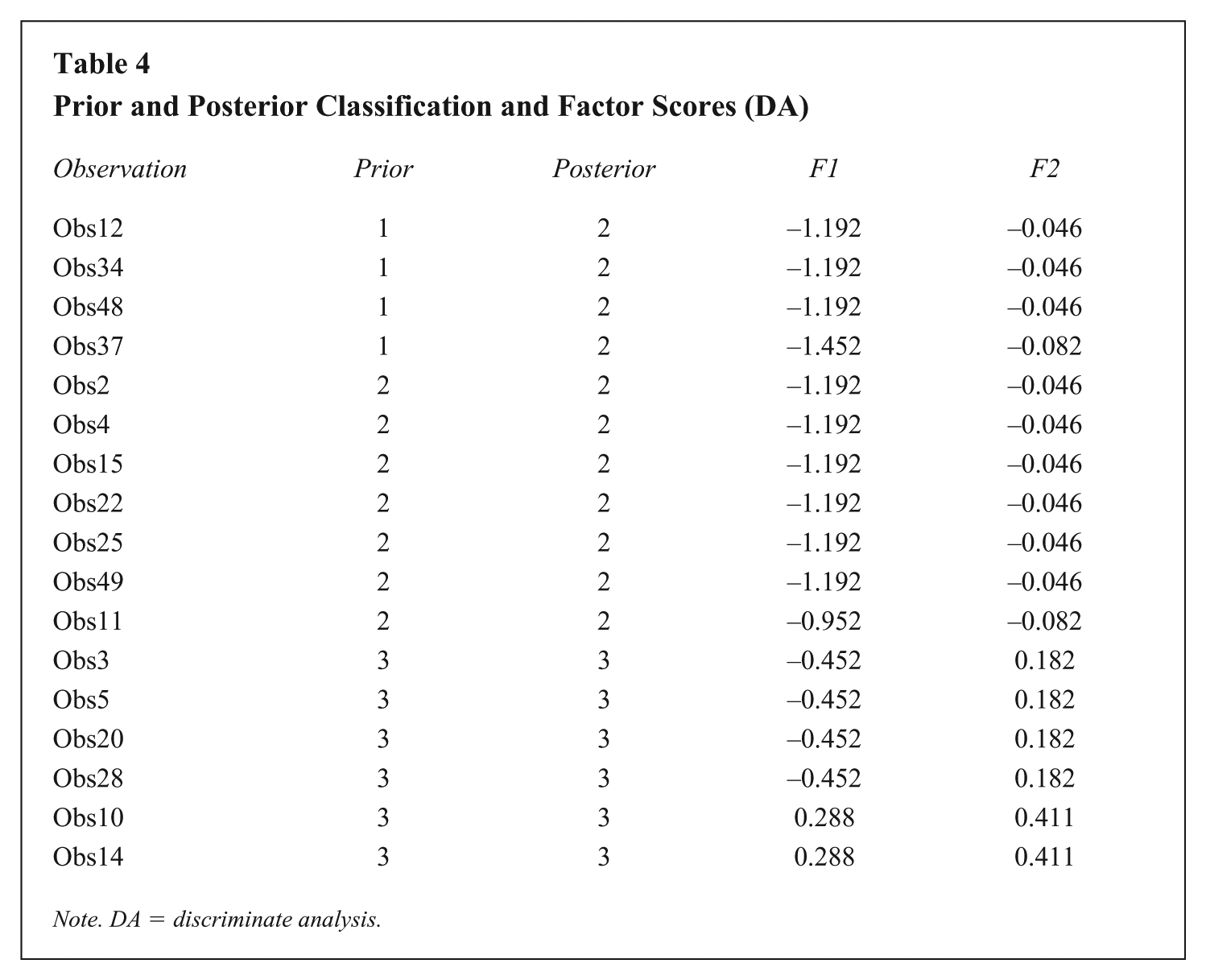
Note. DA = discriminate analysis.
Subgenre 1 (Governance and Environment)
Neutralized or moderate use of abstract terms relating to appropriateness, suitability
Neutralized or moderate use of evaluative language expressing false or true
Competing reporting style regarding the increased or decreased use of evaluative language describing contentment and abstraction/practicality
Subgenre 2 (International Relations and Environment)
Decreased use of evaluative language describing contentment
Decreased use of evaluative language describing abstraction and practicality
Neutralized use of abstract terms relating to appropriateness, suitability
Neutralized use of evaluative language expressing false or true
Subgenre 3 (Environmental Science)
Neutralized or moderate use of abstract terms relating to appropriateness, suitability
Neutralized or moderate use of evaluative language expressing false or true
Competing reporting style regarding the increased or decreased use of evaluative language describing contentment and abstraction/practicality
Discussion of Corpus Findings
The corpus analysis revealed more homogeneity within the subgenre of international relations and environment, while competing styles of reporting existed for the subgenres of governance efficiency and environmental science. The focus of debates and controversies in both cases was on the increased or decreased use of evaluative language describing contentment such as aggrieved, chuffed, content, disappointed, frustrated, humor, browned off, fed up, had enough of and expressions conveying abstraction and practicality such as abstraction, hypothetical, metaphysics, notionally, practicalities, theorize or in theory. The tendency of purposely increasing evaluative language of contentment stands in contrast with other evaluative languages such as abstract terms relating to appropriateness, suitability and evaluative language expressing false or true, which have been consistently neutralized or reduced across the three subgenres of environmental reporting.
The increased use of evaluative language expressing contentment in translated environmental news, despite the close relation between the source and the target texts, could be due to various external factors including an effort made on the part of the translator and editor to re-conceptualize environmental issues and events so that they appear to have a more tangible impact on the readers’ daily lives. Subjectivity in Chinese news tends to increase when journalists reflect upon a reported event. It seems that Hsieh’s finding on induced subjectivity in the reworking of reported news in Chinese journalism also holds in the current study. 12 The result of the corpus analysis shows that Chinese translators and editors, while working on the source English-language texts, tended to modify the original texts for a culturally distinct audience. Translating original news materials represents a further process in the framing, adaptation and circulation of global environmental news to culturally diversified local audiences.
EN1: Title: Air pollution in China killing 4,000 people every day: Nearly everyone in China breathes worse air than the dirtiest air found in the US.
CH1: 报告:中国空气污染每天导致4000人死亡
(English translation: Report: Air pollution in China causes 4000 deaths every day)
This example above illustrates the content modification occurred in the translation and adaptation of original English environmental news. In the original English title, the subheading (“nearly everyone in China breathes worse air than the dirtiest air found in the US”) that compares the air quality in China and in the United States was deliberately omitted in the Chinese translation provided.
EN2: Air pollution is killing about 4,000 people in China a day, accounting for 1 in 6 premature deaths in the world’s most populous country, a new study finds. (August 13, 2015, The Independent; www.independent.co.uk/news/world/asia/air-pollution-in-china-killing-4000-people-every-day-10455409.html)
CH2: Chinese translation and adaptation: 一项研究报告显示,中国的空气污染平均每天会导致4000人死亡,占中国总死亡人数的17%. (August 13, 2015, BBC China; www.bbc.com/zhongwen/simp/china/2015/08/150813_china_pollution_report)
Translation: A research report shows that air pollution in China may cause 4000 deaths every day, representing 17% of the total deaths in China.
This is another typical example that illustrates the content variation and modification occurred in the translation process. First, while the original English news uses the present tense “is killing,” the Chinese translation has deliberately introduced the modal verb “may cause,” which significantly weakened the causal relationship between air pollution and the severe consequences and threats to public health. Second, in the original English news, the proportion of deaths caused by air pollution was one out six premature deaths in China every year, highlighting the impact of environment on healthy Chinese populations. However, this fact was altered to “17% of the total deaths in China every year” in the Chinese translation, which would mislead the audience in the reading and understanding the original English research report, because “total deaths” include both healthy populations and people living with disabling conditions caused by other external and/or internal factors.
Another important finding emerged from the corpus analysis is the inconsistent reporting style of governance and environmental science regarding the presence of evaluative language expressing abstraction and practicality. An increased level of abstraction in the reporting of environmental issues, particularly unobtrusive issues such as climate change, requires specialized knowledge and a higher level of literacy from the audience.
The coexistence of abstract and more concrete reporting styles seems to suggest that BBC China attempts to attract and appeal to readers with different educational backgrounds and political stances. A “balanced” account between abstraction and narration of issues that are seen as sensitive and controversial in China, such as the efficiency or lack of efficiency of governing bodies and authorities in dealing with environmental changes, will necessarily add to the credibility, impartiality and depth of critical analysis to the news outlet.
Important consistent textual patterns also emerged from the cross-genre analysis of translated environmental news. First, in all three subgenres of translated environmental news, the use of abstract terms relating to appropriateness, suitability and evaluative language expressing false or true is neutralized (within the range of −0.4 and 0.4 in terms of factor scores) or maintained at a positive yet controlled level (within the range of 0.4 and 1.0).
Second, a distinctive feature of the subgenre of international relations and environment is the decreased use of evaluative language describing contentment, abstraction and practicality. The avoidance of judgmental language that evaluates the suitability and authenticity of elements of relevant news events, again, reflects the tradition of neutrality and objectivity of English-language journalism.
The mixed corpus findings suggest a tendency to modify and adapt original news materials in source languages for culturally distinct audiences. BBC China exemplifies localized digital news media and news outlets that have been born out of the latest waves of globalization. The subgenres identified and their associated reporting strategies reveal the dynamics of environmental news when the original news has been translated, adapted for specific cultural and language communities. The finding shows that as a developing specialized translation genre of important cross-cultural impact, the production of translated environmental news involves a variety of factors, particularly the cultural and linguistic sensitivity of the intended target audiences.
Footnotes
Editors’ Note
This article was accepted for publication under the editorship of Sandra H. Utt and Elinor Kelley Grusin.