




Abstract
This study focuses on midsize newspaper coverage of the New York Times v. Sullivan case that strengthened press freedom. A content analysis of articles from 29 Northern, 25 Southern and six multistate major metropolitan newspapers identified differences in article frequency and placement related to source and coverage type. The hierarchy of influences model explains perceived regional bias. Midsize newspapers relied on wire news articles more often, with Northern papers publishing more editorials, including multiple editorials and original coverage.
Keywords
This study investigates Northern and Southern midsize newspapers through a content analysis of coverage of New York Times v. Sullivan, a 1960s case that originated from events pitting North against South. 1 This landmark decision involved a Southern police commissioner (Sullivan) who sued the North-based Times for libel over a full-page advertisement and won at trial. The Supreme Court precedent redefined the First Amendment with respect to press freedom, reversing a state decision that would have limited commentary on conduct of politicians. The Court’s reversal on appeal switched the burden of proof from the defendant to the plaintiff in libel cases about public officials, a legal standard that significantly affected all political coverage that followed. The decision was also the first time the Supreme Court had extended First Amendment protection to advertising. Self-interest in press freedom was not the only issue, however, because the case was directly tied to civil rights activism. 2
Both Northern and Southern newspaper editors and publishers made decisions concerning coverage of the proceedings that attracted the attention of news media, activists and readers alike. Space allocation and article placement are considered as purposive decisions, while analyzing content to determine whether editors provided detailed and unbiased accounts.
This study proposes the hierarchical influences model is one way of rationalizing the differences in newspaper coverage that might otherwise be attributed to regional bias on the part of those with editorial control. 3 Midsize newspaper editors act as managers when delegating tasks to reporters and selecting news. They prioritize based on geography, with local and community news inclusion addressing readership needs. Less importance and value is often placed on reporting news of national affairs that does not “hit as close to home.” These proclivities reflect their regional inclinations toward news, while likening them to information service providers as opposed to gatekeepers.
Literature Review
Regionalism has been the focus of studies in a variety of academic disciplines, including history, anthropology, political science, geography and sociology. 4 This study explores correlations between regional behavioral differences and editorial decision-making, perceivable as cultural attitudes in social, political and economic contexts. The supposition is that regionalism influences editorial differences between Northern and Southern newspapers.
Fico and Drager utilized a sample similar to the current study (15 midsize newspapers) but with different focus (local conflict stories) when exploring the fairness and balance of news media coverage. 5 Findings suggested that local conflict coverage was “generally balanced,” news having been fairly presented with minor discrepancies found in terms of space allotment and prominence.
This article investigates coverage of two news events that can be construed as “victories” for Alabama, what Southern readers might appreciate learning about more. The libel decision went against a prominent North-based newspaper (New York Times) that was often critical of discriminatory practices such as segregation, particularly in schools in Southern states. Two other news events might be viewed as a triumph for a Northern newspaper while manifesting powers of the federal government (through the Supreme Court decision that reversed a decision favoring a Southern commissioner, Sullivan) overturning Southern court decisions.
This suggests that many Southerners viewed the federal intervention in the same negative way they viewed the Northern news media. One common functional belief is that gratifications are the foundation for newspaper consumption. Such gratification would be not as well served by negative news coverage, content that is contrary to or opposed to the regional well-being of the community.
Media Differences: What Separates the South
One valid rationale for examining differences in Southern newspapers is the fact that several columns entitled, “What Separates the South” or something similar in spirit, appeared in Southern newspapers regularly into the early 1960s. 6 Southern newspapers had discernible differences that also made them a more attractive topic for researchers, such as very few being nationally distributed and what this study contends is a regionally definable orientation. Southern newspapers often chose discriminatory headlines and used language in stories that suggested that blacks were not “men,” but rather degraded to be something less. 7
Clendinen notes that news columns of Southern papers “weren’t very curious or deep or original in the late 1940s and 1950s.” 8 Readers actively followed sports and politics, but news coverage in general exemplified the Southern culture and could be viewed as “self-defensive and maintaining.” 9 The lack of depth in content could be rationalized as the habit of Southern editors not to examine (or criticize) the Southern traditions in their news pages. Literate whites were inclined to reach for their newspapers’ editorial pages, where they found content that reflected the local, state and Southern perspective and used this news media to guide them on what to think about things.
The Typical Southern Daily in the 1960s: Pro-White Bias
The South was absorbed in mythology, history and politics, and can be described as “a region that loved anecdote, rhetoric, and personal flourish,” with the focus of most editorial pages written to honor such traditions. 10 These pages gave editors “an authority unequaled before or since” as they became a forum for reflecting on the issue of race and unrest during the Civil Rights movement. One Southerner, a businessman who insisted on anonymity, noted the well-founded tendency of editors who took it upon themselves to “play God,” oftentimes “killing important printable news for that reason.” 11 While not particularly pleased with this notion, his opinion was that important exceptions make such practices necessary. Such principles are applicable to news involving racial relations, where this anonymous source asserts that an argument can be made that such suppression is good for the community. 12
New York Times v. Sullivan: Four Newsworthy Events
Event A was the Sullivan trial decision from an Alabama district court, rendered November 4, 1960. Event B was the Alabama Supreme Court decision, where Southern state justices denied the Times appeal by affirming the original decision on August 30, 1962. Event C was the U.S. Supreme Court acceptance of Sullivan writ of certiorari, the decision to review constitutionality of the state decision, announced on January 8, 1963. Event D was the U.S. Supreme Court decision finding for the New York Times, a federal ruling that overturned the Alabama verdict on March 9, 1964.
Research Questions and Hypotheses
The following hypotheses are premised on the supposition the South reported Sullivan differently for regional reasons, 13 beyond the inclination to cover local news:
The rationale for H1 and H2 hinges on the Southern propensity to remain separate, a proclivity this study asserts as having been created from a sense of regional “communityship,” an inherent influence on both Southern editors and readers.
Method
The methodological approach relies on critical social theory in combination with the assumption that regionalism might influence newspaper editors to construct research tools to examine content differences. The sample timeline was identified as the day of each newsworthy legal event (Events A, B, C and D), while including articles published the following eight days. 14
Sample
This study investigated coverage within 54 Northern and Southern midsize newspapers with circulations between 20,000 and 100,000 (Table 1). 15 Northern newspapers were limited to states among the original colonies above the Mason-Dixon line. These included Pennsylvania (7), New York (6), Connecticut (5), New Jersey (5), Massachusetts (4), New Hampshire (1) and Delaware (1). 16 The Southern sample was collected from Alabama (5), Mississippi (5), Tennessee (5), Georgia (4), South Carolina (4), North Carolina (1) and Arkansas (1). Southern newspapers were limited to Southern states as defined by sociologist Howard W. Odum located within or bordering the Bible Belt. 17
Sample Midsize Newspapers (54 Total), by Region
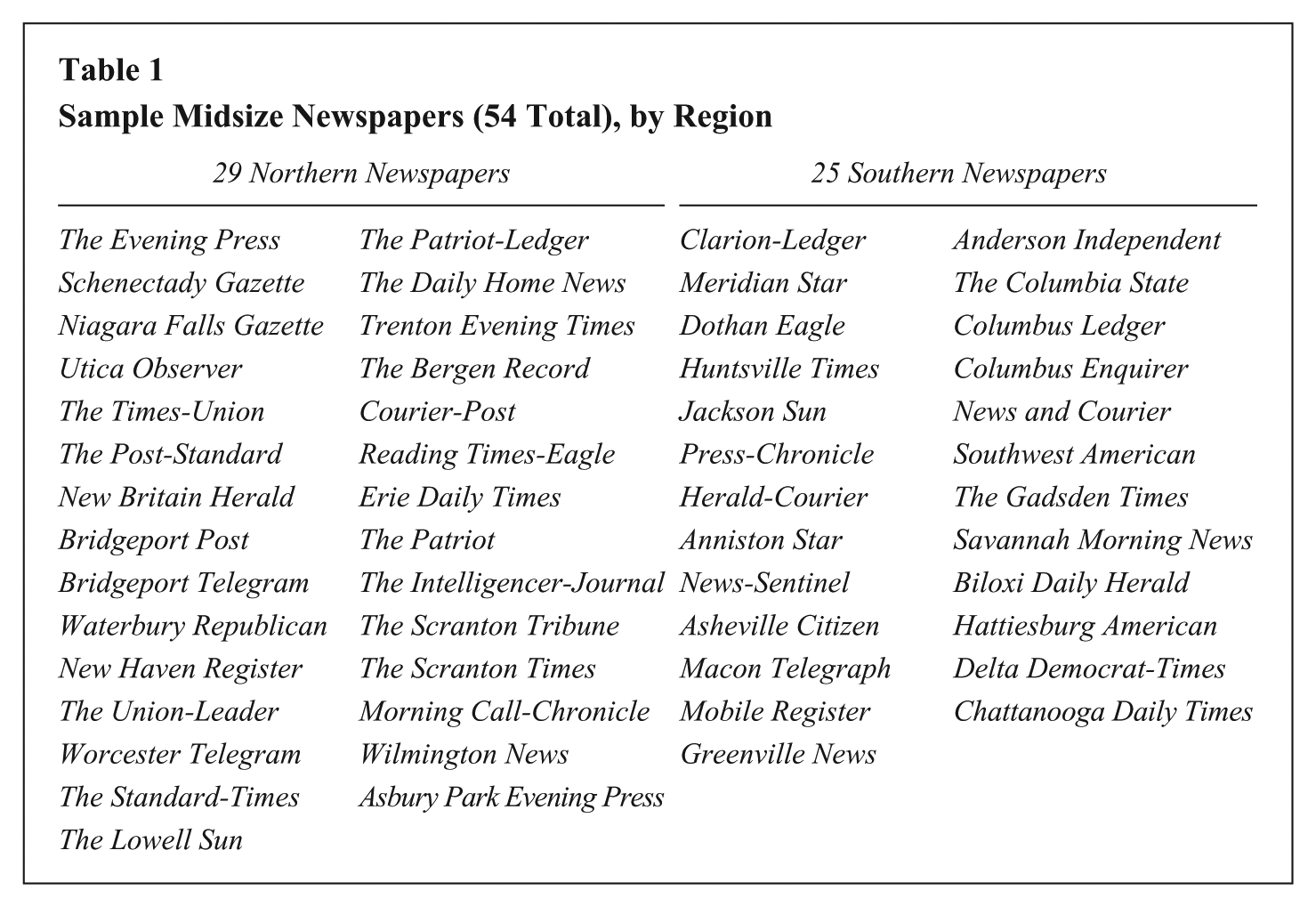
For operational definition purposes in this study, a “national” is a major metropolitan multistate (MMM) newspaper with 100,000 or higher circulation. What distinguishes MMM papers from the midsize newspapers included in this study is section organization. These larger newspapers devote a large tiled subsection in front to national news—thus a higher likelihood to cover a Supreme Court case there, and perhaps have editorials nearby (both in the newspaper’s first section). The study methodology is a content analysis to detect possible editorial bias in decision making. The MMM “nationals” serve a varied readership (not just in one state) and provided a sample group for testing the null hypothesis, whether the findings for midsize newspapers indicate regionalism influences the editorial content per se. Coverage of the New York Times v. Sullivan case amounted to 258 articles, which included those from six newspapers operationalized here as national: the New York Times, Washington Post, Chicago Tribune, Atlanta Constitution, Montgomery Advertiser and Philadelphia Inquirer.
Coding procedures
The content focus was coverage during the New York Times v. Sullivan case. 18 This content included the full text of any and all articles, editorials or news briefs. Content was sorted for differences in handling based on article focus (Sullivan case), article type (news, editorial, brief), article size (column inches), article placement (page number, above or below fold) and source of origin (internal, external).
Article selection
Dual coding found 258 articles having a Sullivan focus. 19 Reportage of the original trial (Event A, 56 articles, 21.7 percent) and Supreme Court decision (Event D, 144 articles, 55.8 percent) dominated the sample, with newspapers devoting 15 articles to the Alabama Supreme Court state appeal (Event B) and 43 articles toward the Court’s acceptance for review (Event C).
Data analysis
The methodology focused on how Northern and Southern press handle news, through assessing differences while also tracking wire service usage. The unit of analysis was the article in all instances, with the creation of five coded clusters, Regional news (Events A&B, Events C&D), Newspaper size (National, Midsize), Midsize only (Northern, Southern), Article type (News, Editorial) and Source (External, Internal), effectuated by combining data from coding schedules into bivariate sets. The different characteristics of articles (i.e., article type, article source) were compared for pattern differences using the Regional, Newspaper and Midsize clusters as the independent variable(s). The analysis cross-tabulated one bivariate to either variable in a second cluster set to determine regional patterns in editorial handling.
Findings
The examination of regional differences involved both article frequencies (coverage count by article) and newspaper frequencies (coverage count by newspaper); these findings reflect either the number of articles or newspapers found, respectively.
Article and Newspaper Frequencies
RQ1: National versus midsize newspapers
Addressing article frequencies, of the 55 articles from MMM national newspapers, 34 were identified as an internally generated news or editorial, 21 articles originating from an outside source. Of 203 articles from midsize newspapers, 35 were internal and 168 were external in origin. The numbers indicate differences related to article source of origin, that midsizes used more externally generated articles (82.8 percent as opposed to 38.2 percent for MMM nationals), with the inverse true for internally generated articles (61.8 percent for nationals, 17.2 percent for midsizes). 20
Article source as significant
Table 2 indexes by specific source of origin, revealing basic differences between MMM national versus midsize newspapers. Midsize newspapers were found to utilize wire services (Associated Press and United Press International) more than the MMM nationals relied on these external sources. MMM nationals, on the contrary, used local staff to create internally generated Sullivan articles (14 total), while no such coverage was found in midsizes. Internal source usage was dominant within the MMM nationals, manifested more so where editorials were involved. 21
Article Source: Midsize and National Newspapers
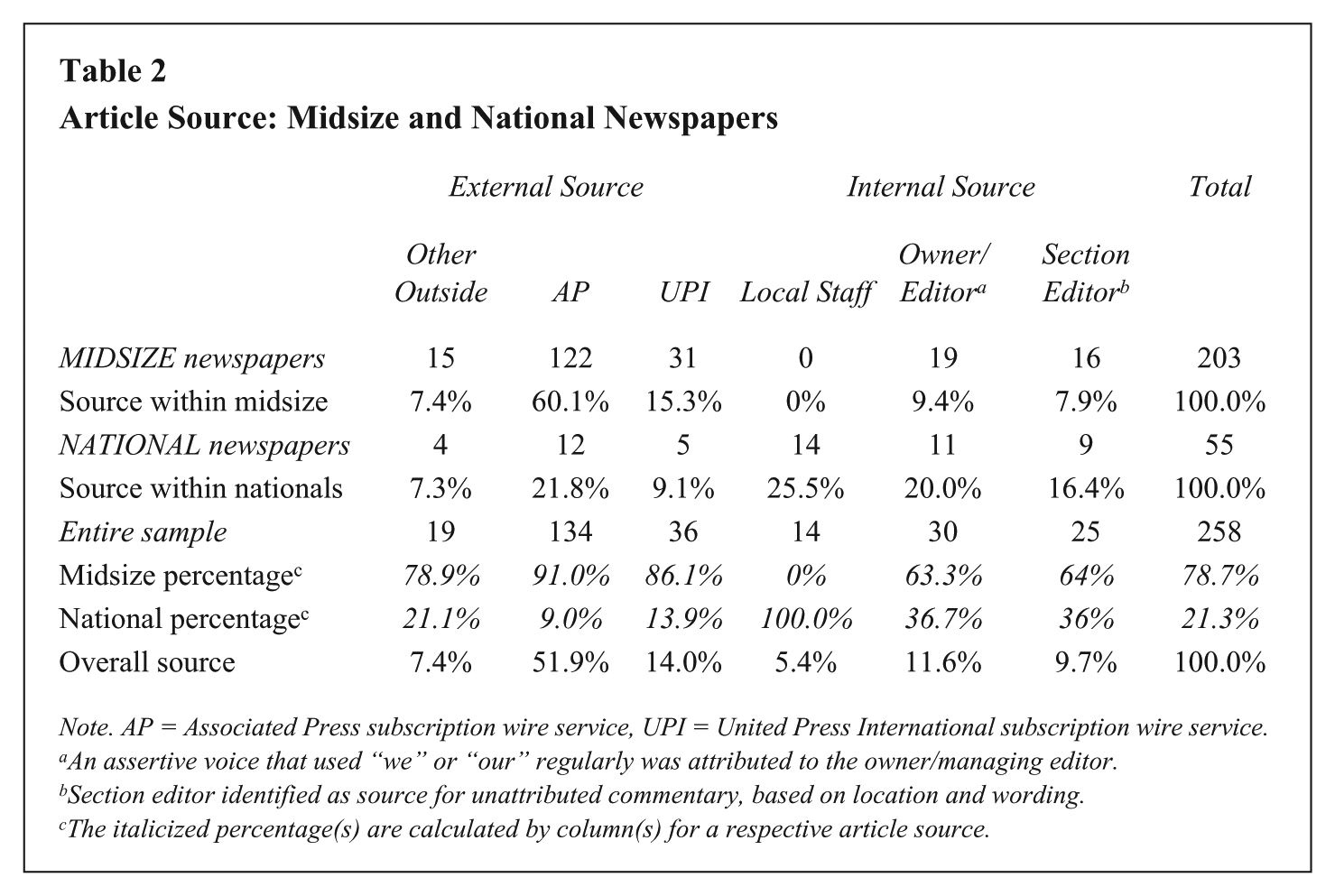
Note. AP = Associated Press subscription wire service, UPI = United Press International subscription wire service.
An assertive voice that used “we” or “our” regularly was attributed to the owner/managing editor.
Section editor identified as source for unattributed commentary, based on location and wording.
The italicized percentage(s) are calculated by column(s) for a respective article source.
Wire service article usage
Wire article usage is documented in Table 3, with frequencies in the three right columns. Utilization of two editorial features about the Supreme Court decision written by renowned AP analyst James Marlow was at the heart of newspaper source differences. Seventeen AP Marlow analyses were published in midsize newspapers, while no MMM national newspapers utilized this external source. Midsize newspaper use of wire service articles, generally speaking, was proportionally greater than MMM national usage; one deviation from this was noted when two MMM national newspapers reported on the state appeal decision that few other papers covered.
Article Frequency: Wire Article Multiple Usage(s)
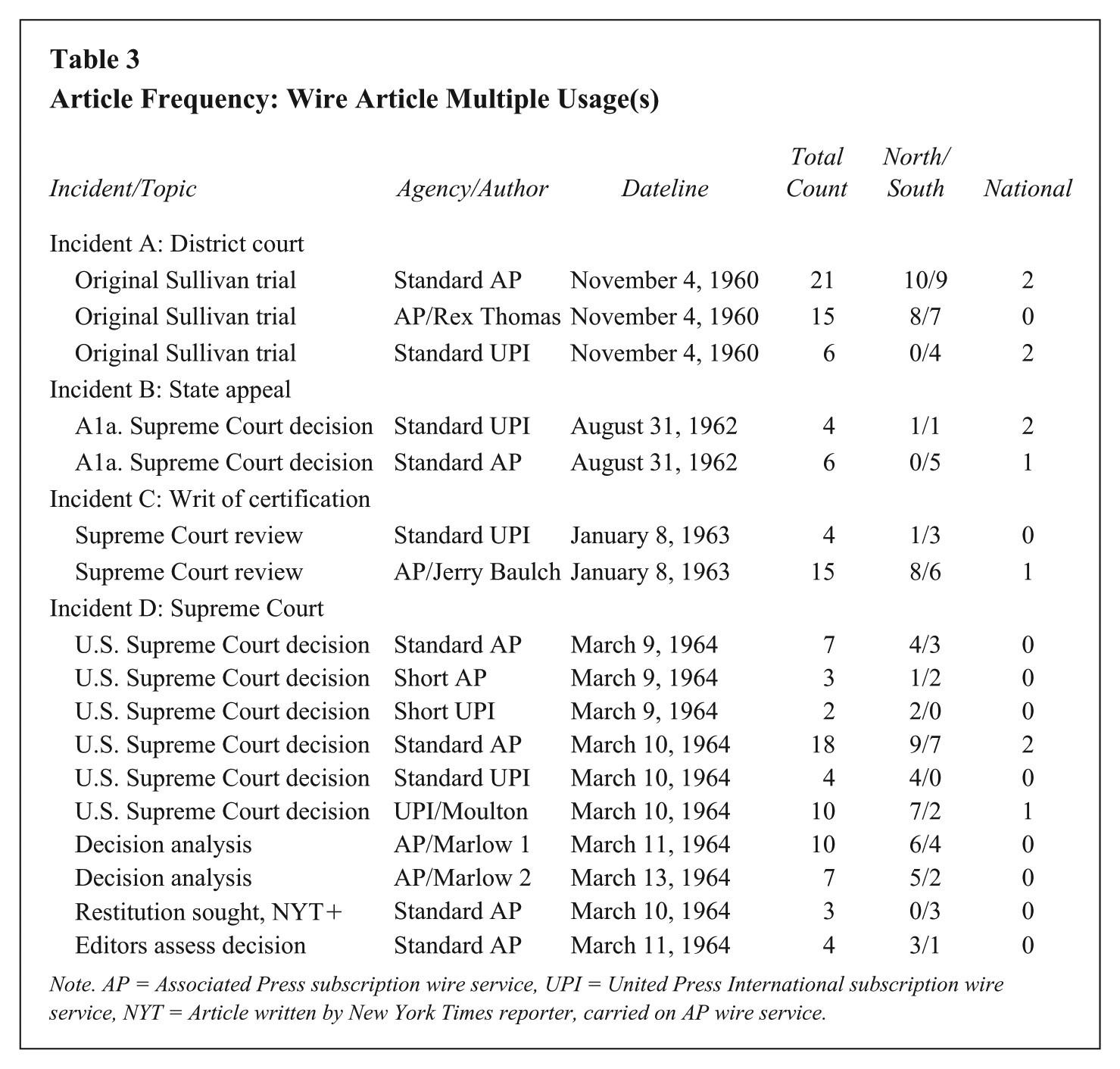
Note. AP = Associated Press subscription wire service, UPI = United Press International subscription wire service, NYT = Article written by New York Times reporter, carried on AP wire service.
Significance of article topic(s)
The article frequencies in Table 4 revealed MMM nationals reported the final decision (Event D) 2.5 times more often than the midsize newspapers did. 22 Article sorting by topic includes reference to source context and publication type (midsize vs. national). Wire news articles covering reversal favoring press freedom (Event D) were utilized by 50 percent of the MMM national newspapers, while only six percent of midsizes covered these efforts. The three other MMM national newspapers published internally generated reversal articles. 23
Significant Article Frequency Differences: Midsize versus National
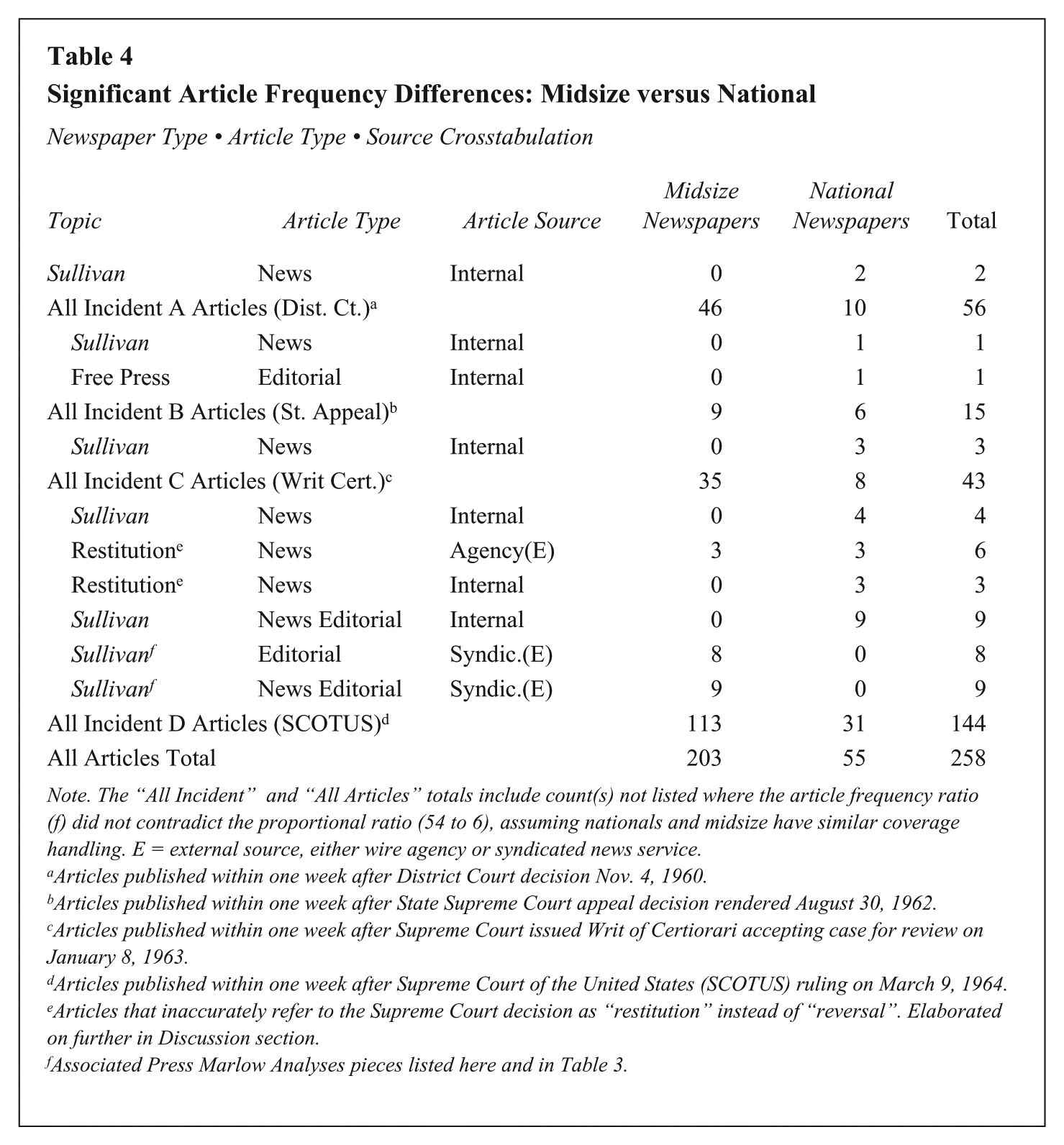
Note. The “All Incident” and “All Articles” totals include count(s) not listed where the article frequency ratio (f) did not contradict the proportional ratio (54 to 6), assuming nationals and midsize have similar coverage handling. E = external source, either wire agency or syndicated news service.
Articles published within one week after District Court decision Nov. 4, 1960.
Articles published within one week after State Supreme Court appeal decision rendered August 30, 1962.
Articles published within one week after Supreme Court issued Writ of Certiorari accepting case for review on January 8, 1963.
Articles published within one week after Supreme Court of the United States (SCOTUS) ruling on March 9, 1964.
Articles that inaccurately refer to the Supreme Court decision as “restitution” instead of “reversal”. Elaborated on further in Discussion section.
Associated Press Marlow Analyses pieces listed here and in Table 3.
Table 4 differences were noted in other internally sourced Event D news and editorial coverage not matched by midsizes, where MMM nationals published with four and nine, respectively. This “originality” trend, internally generated articles from nationals only, also was found in Alabama trial coverage (Event A). Event B numbers (Alabama appeal) also reflected more coverage in MMM national newspapers, averaging one article per newspaper, as opposed to one in every six of the midsize newspapers. 24 Differences were noted in Marlow analysis usage (last two rows, Table 4 Event D editorials), with eight Marlow pieces framed as an editorial by midsize newspapers, while nine handled it as a news editorial feature (placement within news pages).
RQ2: Differences within publication types
Disparities existed among four of the six national newspapers, in terms of space allotment. The multipage news articles that the Washington Post, New York Times and Chicago Tribune devoted to the U.S. Supreme Court ruling (Event D) set them apart from all study newspapers, providing the most comprehensive Sullivan coverage. The Montgomery Advertiser was the only MMM national newspaper not to publish any editorials on the Supreme Court decision after Event D, providing the least comprehensive coverage in terms of frequency and space. 25 The other two MMM national newspapers, the Atlanta Constitution and Philadelphia Inquirer, devoted a “moderate” amount of coverage by comparison.
Nationals: Content differences
Both the Times and Post devoted several pages to the full-text court opinion, while the Tribune also provided additional Sullivan features in special sections. The promptness of editorial response by these three MMM national newspapers, publishing original commentary the next day (March 10, 1964), also set them apart. Southern editors 26 promoted the Deep South region through Confederate flag depictions within pages or by applauding “what separates the South” in regular (repeating) columns. These regional differences in the Montgomery Advertiser and Atlanta Constitution were noted in editorial columns. Both of these MMM national newspapers carried a regular feature column entitled “Off the Bench,” which was particularly relevant to this study in that it was written by Southern judge Walter B. Jones, who oversaw the Sullivan trial. 27 In addition, Constitution editor Eugene Patterson chose to become personally involved, writing one of the two April 11 editorials. The headline message, “An End to Intimidation,” was further emphasized in a second editorial entitled, “Intimidation of Press Dealt a Blow,” one not attributed to Patterson. 28
Midsize newspapers: Coverage differences
The majority of coverage involved Events A and D, with little difference(s) in space allotment (size). Addressing newspaper frequencies, midsize newspapers were found to devote editorial coverage devoted exclusively to Event D, the Supreme Court final decision, electing not to publish feature commentary on the other three incidents. 29 Concerning coverage type, Southern midsize papers printed news stories concerning Event A more often (84 percent as opposed to 58.6 percent) than their Northern counterparts, while Northern midsizes more often provided news (86.2 percent as opposed to 68 percent) and editorial feature coverage (75.9 percent as opposed to 36 percent) of Event D than Southern newspapers. These differences among midsizes support H1 with respect to Event D (Northern newspapers devoting more coverage of Supreme Court) if considering newspaper frequency as equitable to space allotment, in that Southern newspapers covered it less often. Support is also found for H2 (Southern devoting more coverage of Alabama courts) to a lesser extent.
Individual differences: Minimal coverage by midsizes
Five midsize newspapers included in the study sample (Table 1) were not counted among the newspaper frequencies, as four did not report on any Sullivan incident, while a fifth paper covered Event D with only a news brief. The latter coverage was found in the Anniston Star, with three other Southern papers (Jackson Sun, Bristol Herald-Courier and Meridian Star), among the four without reportage of the final decision. 30 This equated to four of 25 Southern newspapers (16 percent) not devoting detailed coverage to Sullivan, while only one Northern paper, the Scranton Times (3.4 percent), did not acknowledge the ruling. 31
Four other instances of disparate representation, minimal coverage with only one Sullivan article, were found in the Bristol Herald-Courier, Meridian Star, Reading Times-Eagle and Erie Daily Times. The first two Southern newspapers reported solely on Event A, while the latter two Northern newspapers covered only Event D. 32 Again these findings reflected a regionally correlated coverage trend for Events A (more Southern) and D (more Northern) that selectively supports H2 and H1, respectively.
Northern versus Southern Newspapers
Continuing this investigation limited to articles from midsize newspapers, the analyses highlighted what might be perceived as regionally correlated differences.
RQ3: Northern versus Southern midsize newspapers
Beyond disparities between Southern and Northern newspapers in their propensity to report on Sullivan, article frequencies in Table 5 show a higher occurrence (1.35 times more often) of Northern coverage of Events C or D than their Southern counterparts, while the article size range numbers showed little differentiation between Northern and Southern newspapers; a chi-square test verified space allotment was not a significant regional variant within midsize newspapers. 33
Article Size: Midsizes by News Origin

The study results indicate no significance in editorial handling with respect to article size among midsize newspapers from the North and South.
Regional significance in article placement
Editorial decisions concerning article placement fell into four categories for coding purposes: (1) most prominent (defined as first page, above the fold), (2) prominent (operationalized as placement on bottom first page or Page 2 or 3), (3) average/semiburied (defined as not included on first three pages of news story), (4) not covered. A larger percentage of articles from Southern newspapers (29 percent) had a most prominent placement when reporting on Sullivan in the Supreme Court (Events C and D), when compared against their Northern counterparts (11 percent), a fact that contradicts H1 on the surface. This coverage included a greater frequency with prominent placement among Northern newspapers, however, enough to support H1.
Not surprisingly, Alabama court decision news was more prominently placed in Southern newspapers. The editorial decision(s) concerning placement, if considered separate from any inclusion decision(s) (newsworthiness), affirmed both H1 and H2 with respect to a regional differences in handling as reflected by article placement, accordingly. Chi-square tests confirmed a correlation of significance linking article placement difference to regionalism when compared with midsize newspapers; for Events A and B clustered news about Alabama courts, p = .016, for Events C and D news about the Supreme Court, p = .015; both p < .05. 34
RQ4: Northern versus Southern midsize newspapers
Turning to RQ4, which considers local newsworthiness as an editorial handling influence, article inclusion findings highlight coverage differences among midsize newspapers. Article frequencies (inclusion count) indicated a regional significance (p = .027; p < .05) between Northern and Southern newspapers listed in Table 1. Northern newspapers more often covered news about the Supreme Court (79 percent), while Southern newspapers were more likely to cover the Alabama courts (66 percent). This infers the Times-Sullivan ruling was perceived as more important by Northern midsize newspapers that devoted more article coverage, including more editorials. The frequency differences supported H1 in that Southern midsizes covered the Sullivan case in the Supreme Court less often than Northern midsizes. 35 A similar reaffirmation for H2 was reflected in results finding half again more Southern articles during Events A or B than their Northern counterpart(s). 36
Regional article type correlation
Concerning story framing, whether as a news feature or within the editorial section, the article frequencies over all four incidents underscore a regional correlation to article type. Southern newspapers were much more likely (84 percent vs. 59 percent) to provide news coverage of the original trial in Alabama. Investigating beyond inclusion, more editorials with lengthier commentary were discovered in Northern newspapers reporting the Times-Sullivan ruling. Northern newspapers published editorials of the Supreme Court decision 76 percent of time, as opposed to 36 percent from Southern papers.
Northern editors provided more commentary with Sullivan coverage, 43 editorials with 64 news articles, than their Southern counterparts, which published only 24 editorials along with 70 news articles. The Southern propensity to devote three-quarters of their coverage to news articles, while publishing editorials half as often as Northern papers did, confirmed a correlation of significance (chi-square p = .028, p < .05) between article type and midsize publication type. 37
Discussion
Article frequencies confirmed differences between MMM national and midsize newspapers, the midsize newspapers’ propensity to report on Sullivan less often and with less extensive coverage than MMM national newspapers. Simply stated, the MMM national newspapers produced more original articles while relying on wire articles less than their midsize counterparts, particularly when providing editorial commentary on the significance of the Times v. Sullivan ruling.
Perception of Regionalism
Article size was found not regionally related to news and editorial articles, when indexed by publication type(s), across the entire study sample. The analysis found no relationship between article size and publication type, as distinguished by region (Northern vs. Southern), among the midsize newspapers. 38
The results displayed differences between midsize newspapers, however, in article placement, defined by location and prominence within a newspaper, as correlated to publication region (Northern vs. Southern). The cross-tabulation of midsizes by news origin indicated Northern newspapers devoted more prominent placements to articles covering the final decision. The converse, that Southern newspapers devoted more prominent coverage to the original Alabama trial proceedings, was confirmed as well to a lesser degree of significance. 39
This alone was not significant, however, as regional coverage disparity might be indicative of the newsworthiness of events, particularly to the MMM national newspapers. A cross-tabulation of midsize publications established a regional correlation between Northern and Southern newspapers. Northern newspapers more often covered Sullivan with both news and editorials, while Southern newspapers provided slightly more news articles than Northern newspapers, while editorializing much less frequently. This finding is key to the assertion that the hierarchy of influences model might better rationalize (as opposed to regional bias) the differences between midsize newspapers, as the Southern ones relied more on the wire services. This is a difference in routine practices, which will be elaborated on in the “Conclusion” section.
Two MMM national newspapers sampled were in close proximity to the original trial location. Editorial columns in the Atlanta Constitution were strategically framed, assertively worded and promoted the South through a column written by the owner/publisher, while remaining propress freedom in its headlines. 40 The Montgomery Advertiser, on the contrary, devoted the least attention and was the only national not editorializing on the Times v. Sullivan ruling. The Advertiser’s less comprehensive coverage, coupled with its lack of opinion analysis interpreting its impact, represents one instance of “editorial omission.” 41 Again, this finding is relevant to the assertion that the hierarchy of influences model, and in particular the use/reliance on news services when covering Supreme Court proceedings, might better rationalize what transpired with respect to editorial decision making.
My contention here is that the editors’ decisions to omit editorial commentary was influenced by their reliance on wire services when reporting news. While regionalism might be perceived as a distinguishing influence noted through article inclusion and frequency differences within the midsize sample, it could just as easily be attributed to the greater reliance on wire services by Southern newspapers when reporting outside their region. Newspaper frequencies support the contention that either regionalism or perhaps resources appeared to make publications selective in informing their readership about Sullivan. Differences found included a higher Northern frequency (96.6 percent to 76 percent) during Event D that favored a Northern entity (the Times). This was contrasted with Event A, when the news topic was the original Alabama trial and findings were the inverse, with Northern midsize newspapers covering this less often (58.6 percent) than Southern newspapers did (84 percent). The appearance of editorial selectivity through article frequencies tabulated by regional origin reflected a comparable number of news and editorial articles covered Sullivan final decision (Event D), as opposed to sparser coverage of the Alabama trial proceedings.
Wire Service Use
The midsize newspaper tendency to rely on news agency sources was observed consistently throughout all Events. Documented in Table 2 are appropriation differences that distinguished internal versus external sourcing. This study revealed differences in handling, extensive utilization of external sources by midsize newspapers confirmed as wire service usage in Table 3. 42 This reliance was more pronounced in U.S. Supreme Court reportage, with internally sourced stories nonexistent among midsize newspapers. 43 Of the 65 wire service articles used by midsize newspapers, 41 (63 percent) were in Northern newspapers. Conversely, 26 of the 45 wire services articles (58 percent) reporting the Alabama decisions were from Southern newspapers.
The MMM national newspapers published more internally sourced news stories and editorials, while midsize newspapers used wire service (externally sourced) articles often framed as feature columns (i.e., AP Marlow analyses) instead. Larger staffs and access to more economic resources through larger circulation numbers and advertising revenues, those characteristics that typified the national newspapers, were rationalized to explain such editorial handling differences. When considering options for such coverage, results suggest Northern newspapers utilized the AP Marlow analyses for different reason(s), more so to emphasize the import of Sullivan and oftentimes with multiple-editorial coverage. Southern newspapers, on the contrary, relied on it more to impart the relevance of the decision as a stand-alone editorial. A second problematic routine of three Southern newspapers was the use of an AP wire story entitled “Restitution Sought, New York Times” (Table 4); the story was inspired by an original article published by the New York Times that used restitution to describe their own feelings toward the reversal of a decision that was unjustly decided against them. As restitution implies compensation and no funds were ever exchanged (the original decision was appealed), this terminology was incorrectly used—the Supreme Court decision was a reversal.
Conclusion
The Times v. Sullivan ruling represented an event that tested the objectivity and responsibility of regional editors as gatekeepers of public information. With respect to assessment of news media bias, an argument can be made that the selective perceptions of editors concerning newsworthiness resulted in the regionalism effect noted through editors differently handling the Sullivan case. The most significant findings were revealed through chi-square tests, findings indicating space (article size) was not related, while confirming a correlation with respect to article placement, the prominence devoted to coverage, and article frequency. A larger percentage of Northern newspapers covered the Supreme Court decision. Southern newspapers, on the contrary, distinguished themselves from Northern newspapers by reporting more often on the Alabama trial proceedings (Events A and B).
A more compelling argument can be made for the hierarchy of influences model, however, which treats media content as the dependent variable with five levels of influence (social system, social institutions, media organizations, routine practices and individuals) as potential independent variables. Shoemaker and Reese stipulate that influences at one level can interact with those at another, as was apparently the case in this study. 44 News media organizations (midsize newspapers and wire services), routine practices (frequent utilization of wire service when reporting national news and the Supreme Court) and individuals (the editors or reporters who edited wire service articles) interacted in a manner that more readily explains many differences in how news was handled among midsize newspapers.
The findings showed that the Northern newspapers that relied less on wire services were far more likely to include original editorials. Overall, the reliance on wire services decreased the likelihood of including either an editorial or the AP editorial feature (Marlow) when covering the Supreme Court decision. Two proclivities might be perceived from this study, with respect to the use of wire service articles by midsize newspapers with smaller staffs when covering legal issues and the Supreme Court: first, that newspapers relying on wire services are far less likely to possibly overlook consequence(s) of the decision that might affect their local constituents—but at the same time not recognize those possibly worthy of an editorial; and second, newspaper editors and reporters need to be more careful with legal terminology, while being knowledgeable about legal issues and phrases, to avoid publishing (possibly) misleading information about court decisions.
Footnotes
Editors’ Note
This article was accepted for publication under the editorship of Sandra H. Utt and Elinor Kelley Grusin.