



Abstract
An online survey of newspaper journalists (N = 1,063) shows engagement is a mediator between social media instructions in newsrooms and perceptions or attitude toward social media. The more journalists are engaged with Twitter, the more they believe social media is accountable and social media is less threatening to journalists, journalism and their news organizations. However, social media accountability is not significantly associated with social media as threats.
Keywords
The popularity of social media is leading to the popularity of citizen publication, fragmentation of audiences and the birth of “prosumers” and “prod usage.” 1 Audiences are framed as “active recipients.” 2 “Being an audience is now a much more active and interactive experience.” 3 They are collaborators, co-producers and generators; 4 curators and perhaps even re-mixers. 5 For example, during the Arab Spring in 2011, alternative voices from social media made up 50 percent of the 3,291 Tweet mentions of journalist Andy Carvin’s sources in Egypt. 6
In the digital age, audiences consuming news anytime, anywhere and through any device is driving a news organization’s digital transformation to a mobile-first strategy. Mobile phones shape young people’s news consumption, especially on social media. 7 To adapt to this trend, journalists have to perform beyond journalism in their daily routines. 8 The percentage of journalists “using social network sites on a daily basis during the newsgathering process has increased from 4% in 2008 to 24% in 2013.” 9 Journalists use social media to seek new audiences, engage with sources, verify information, 10 promote their own coverage 11 and even demand the accountability of their news. 12 Social media making content more hybrid are creating a power shift in news production. 13 Mutually responsive patterns of social exchange were found between journalists and audiences. 14
Social media provide a framework for news organizations to build on, gear toward, connect to and thrive on their own websites, 15 and are regarded as a tool for engaging audiences in a quick and cost-effective way. 16 For example, Facebook live was found to be an effective tool to reach broader audience in major news organizations. 17 Although no consensus exists on how to define and measure engagement, it is considered related to participation, connectedness and involvement. 18 Through condensed descriptions of activities filled on Facebook and Twitter, observers are able to tune into events physically removed from them. 19 Utilizing web analytics, newsrooms can monitor audiences’ engagement by number of clicks, amount of viewing time and number of shares. 20
Within the social media and engagement scholarship domain, the study seeks to understand how social media instructions in newsrooms affect engagement and journalists’ perception of, or attitude toward, social media. Utilizing a quantitative online survey, the study aims to interpret social media and engagement in a structural way through a SEM test.
Literature Review
In light of studies on digital transition in newsrooms and this study’s purpose, concepts of social media, engagement and accountability and threat were explored.
Social Media
Social media become an important channel for news media to promote news stories. Journalists largely use social media to report the news and share to news websites. 21 A 2012 survey on local television stations’ use of social media in the United States found 85 percent (N = 102) of the surveyed news managers at network affiliate television stations (ABC, CBS, NBC and Fox) indicated that they regularly post links to their news stories on Facebook, and nearly as many using Twitter for the same purpose. 22
Social media greatly facilitate user participation in the news production process. The “global,” “open,” “transparent,” “non-hierarchical,” “interactive” and “real time” social media are changing audience behavior and workplace expectation. 23 “Network communication, particularly social media, enables people to be more than simply members of an audience.” 24 In fact, the Internet and, in particular, Web 2.0 have “heightened the activeness of audiences.” 25 The essence of social media is “peer-production and participatory activities in which production is dependent upon consumption.” 26 News craft is blended into peoples’ personal lives, plus it is a principal component in the connections between people’s personal information spheres and those of others nearby and far away. 27 News in the digital age has become a social-engaging, social-driven activity, and is niche community out of proximity, especially online. 28
Social media are a valuable source, functional instruments for the networking of journalists and popular channels for interactions between journalists and audiences, which is the basis of audience engagement.
Engagement
A consequence of “interactivity” and “participation” in the social media age, engagement connects interactivity and social media to produce User Generated Content (UGC), and creates a new engagement business model.
Social media facilitate engagement. Features such as being able to easily access online activities, online forums and real time statistics make engagement more efficient. 29 From the audiences’ perspective, engagement is an emotional connection between audiences and journalists. 30 Goode defines engagement operationally as blogging, reposting, commenting, recommending, rating, tagging and the like. 31 Through engagement, namely, “a complex and layered mix of representation,” “interpretation (and re-interpretation),” “translation” and “remediation,” after traversing a range of sites and varying media platforms, the news and audience commentary, discourse and information, is reshaped. 32 A typical form of engagement—UGC—is labeled by the Advertising Research Foundation as “an indicator or proxy of engagement; a form of engagement; or a result of engagement.” 33
Audiences are emotionally charged when engaging with the community. 34 Digital networked media are utilizing social media’s participatory features to expand the capabilities and options of audience members to produce, disseminate and comment on journalism content, as well as to get directly in contact with newsrooms. 35 The public’s display of emotion through Facebook or Twitter infiltrated into the texture of political expressions in mainstream discourses subsequent to social movements worldwide. 36 Lewis and Usher categorized audiences as passive recipients, commodities and active participants based on different degrees of engagement. 37
Engagement is fulfilling dual roles of journalism—social force and business entity. The value of engagement (citizen participation) to journalists is potentially one that holds both public and economic value 38 —balances news media’s function in making profits and serving the public.
Accountability and Threats
Accountability in journalism is normally evaluated by the journalistic ethical standard and democratic values. It gets involved with the government, the public, the journalists and news organizations. Harro-Loit stated journalists’ view of accountability represented by pressure groups: “professional community oriented, market pressure, sources, and power holders.” 39 The aim of accountability in journalism is to engage the public in a discussion on a public forum 40 and the speaker that demands accountability. 41 Hughes held that accountability in journalism involves enhancing civic participation and government accountability to citizens—representation of citizens and government accountability to the public. 42
Wahl-Jorgensen stated journalism culture shapes and circumscribes the prominence of accountability it enables. 43 In this sense, accountability is context specific and governed by journalism practice. Note Alvin Gouldner’s criterion of accountability: “To be ‘accountable’ means that one can be constrained to reveal what one has done and why one has done it; thus, the action and the reason for it are open to critique by strangers who have few inhibitions about demanding justification and reasonable grounds.” 44
When engaging audience through social media becomes part of the daily routines of newsrooms, “not only the physical landscape of newsgathering places but also the resulting journalistic products, relationships, routines and culture” were transformed. 45 The accountability of journalism changed accordingly. Accountability is a commitment by journalists to engage others, both journalists and the public, in an open and public discussion of press practices and performance. 46 In this study, accountability was categorized into three dimensions: accountability as a professional practice, accountability to audiences, and accountability to an organizational role.
Despite benefits, the potential threats of social media to the quality and reputation of journalism are obvious. Foreman announced the threat warning, “social media networks can threaten the integrity of the editorial process.” 47 Reuters tell its journalists, “We want to encourage you to use social media approaches in your journalism but also need to make sure that you are fully aware of the risks—especially those that threaten our hard-earned reputation for independence and freedom from bias.” 48
In light of the literature reviews on social media and engagement, the following hypotheses were proposed:
Method
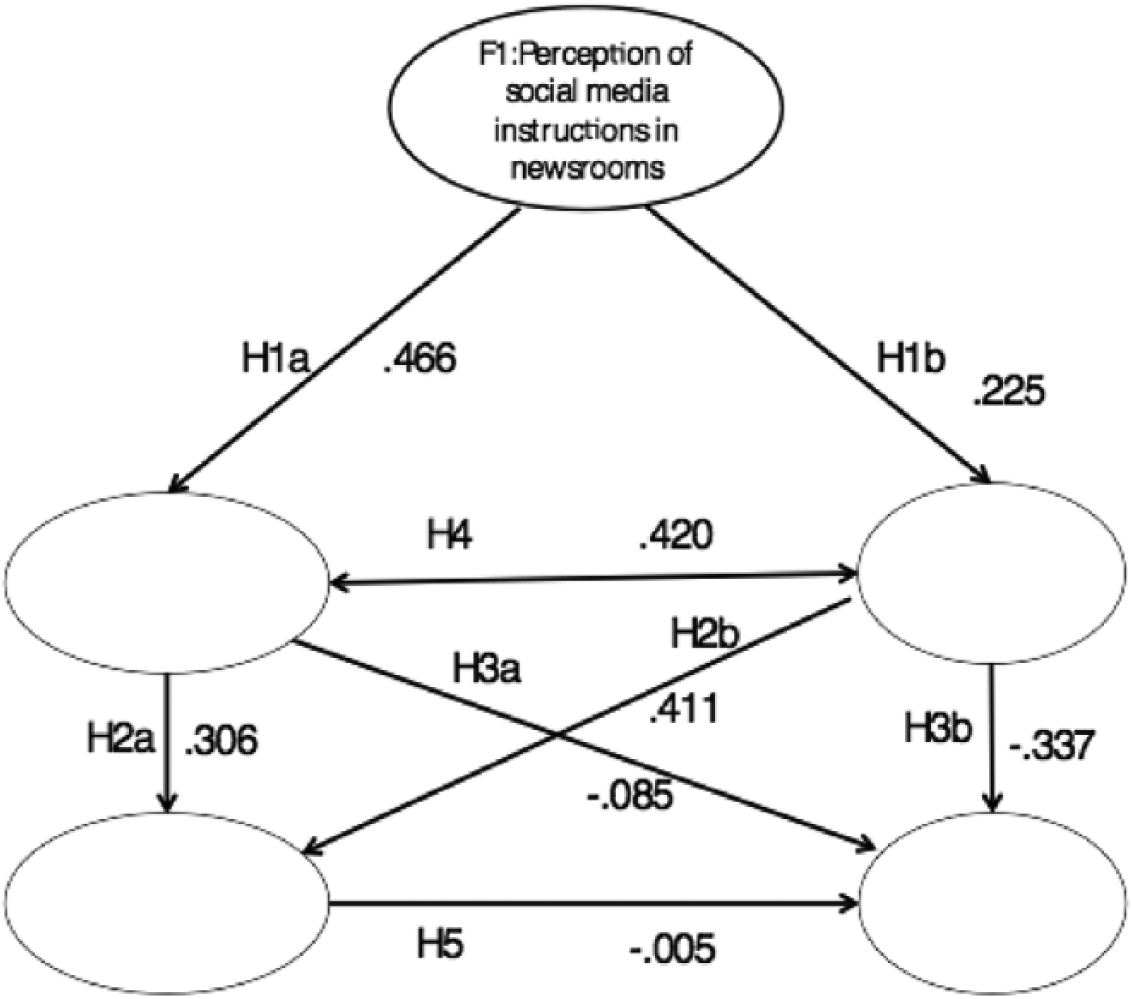
To test the hypotheses, a cross-sectional, self-administered online survey was conducted to examine the influence of social media instructions and use on the perception of social media in newsrooms. A survey design provides a quantitative description of trends, attitudes or opinions of a population by studying a sample of that population. 49 The purposes of the online survey were (1) to examine the perception of social media instructions in newsrooms and (2) to examine the social media engagement status, including engagement on Facebook or Twitter, and perceptions of social media engagement on social media accountability and social media as threats. A structural equation model (SEM) was constructed to test the relationships among social media instructions in newsrooms, Facebook engagement, Twitter engagement, social media accountability and perception of social media as threats.
Data Collection
Data were collected from March 18 to April 30, 2016. Subjects were randomly selected from the Cisionpoint list, a web-based software and services platform to monitor news coverage and analyze results.
An online questionnaire was created on Qualtrix. The questionnaire was developed based on Indiana University’s American Journalist in the Digital Age questionnaire and the Worlds Journalism Study 50 questionnaire. Five-point Likert-type scales were developed to ask the subjects about social media instructions, engagement and the perceptions of social media in newsrooms.
A clustered sampling strategy was utilized. First, the United States was divided into four regions: West, Midwest, South and Northeast. Then eight states were randomly selected from each of the four regions, so 17,885 newspaper employees across the country from 32 states constitute the sample. Staff members from non-news/editorial departments were screened out. A total of 1,529 interviewees completed the survey, for an overall response rate of 8.54 percent. Thus, 1,063 cases with effective answers to all variables in the SEM model were included in the final sample.
In the final sample, 578 (54.4 percent) were men and 485 (45.6 percent) were women. The average age in the sample was 47.81 years old (SD = 13.50), which is close to the median age of 50. The youngest was 22 (0.2 percent), and the oldest was 84 (0.1 percent). Of all 1,063 respondents in the final sample, 466 (43.8 percent) were editors and 597 (56.2 percent) were reporters.
Measurement
The survey contained 24 questions (71 items) that were written with multiple choices or employed five-point Likert-type response scales.
To determine how many factors to retain from the 65 items with scales, a parallel analysis was conducted in SPSS. Comparing eigenvalues between random data matrices and this study’s data, and using the eigenvalues that correspond to the desired percentile (95 percent) of the distribution of random data eigenvalues, components were retained as long as the eigenvalue from this study’s data was greater than the eigenvalue from random data. In the end, the analysis shows eight factors are needed to explain the relationships among the variables.
In the next step, an exploratory factor analysis with eight fixed latent factors was conducted and a varimax rotation method was selected to determine the indicators of each latent factor. Factors failed to load at least three indicators needed to construct a latent factor and were therefore excluded, leaving a total of five factors extracted from the data: (1) social media instructions (F1, indicators include what social media instructions are provided, whether who use social media effectively are called on to coach others and how useful social media training events are in newsrooms), Cronbach’s alpha = .723; (2) Facebook engagement (F2, indicators are how often posting on Facebook, whether Facebook allows journalists to have better communication and page views of their stories), Cronbach’s alpha = .737; (3) Twitter engagement (F3, indicators include whether Twitter is important to the quality of journalism, has increased sources and how often get responses from Tweets), Cronbach’s alpha = .749; (4) social media accountability (F4, indicators include whether social media make journalists more accountable to the public and their news organizations), Cronbach’s alpha = .799; (5) perception of social media as threats (F5, indicators include whether social media are undermining journalism and whether UGC threatens the integrity of a news organization), Cronbach’s alpha = .737.
Data Analysis
A SEM measurement model was constructed with the five latent factors of 32 indicators. A two-step structural equation modeling analytical process with maximum likelihood estimation was utilized to test the model fit. To evaluate the fitness of the measurement and structural equation model, Schreiber et al.’s reporting index, including the root mean square of approximation (RMSEA), the comparative index (CFI) and the Tucker–Lewis index (TLI), were adopted. 51 RMSEA is recognized as “one of the most informative criteria in covariance structure modeling.” 52 It comes with a closeness of fit test, referred to as the PCLOSE value. An RMSEA value of .06 or smaller 53 and values close to .95 for CFI 54 and TLI 55 indicate a good fit.
The measurement model was trimmed until the goodness of fit indices. 56
Discussion
The study here sought to understand how engaging with social media influences journalists’ perception of accountability of social media, and social media as threats.
Findings in this study show perception of social media instructions at the organizational level has a direct effect on journalists’ social media engagement, which is in line with both Kiousis, Shoemaker and Vos’s contextual effect on journalists’ philosophy in news selection and the way they interact with audiences in daily routines, 57 and Shoemaker and Reese’s 58 journalism as an “acquired professionalism” where news organizations exert a control mechanism.
Social media instructions have no direct effect on journalists’ attitude toward social media in newsrooms. The effect is mediated by social media (Facebook and Twitter) engagement. The finding is in line with Newhagen, Cordes and Levy’s study showing that interactivity is a psychological state and evaluated by individuals’ sense of coping with the system. 59 However, Facebook engagement does not have a significant effect on journalists’ perception of social media as threats. But Twitter does. The more journalists engage with Twitter, the less they believe social media are threats. Facebook and Twitter also play different roles in journalists’ daily routines. Journalists’ interaction with Twitter affects their perception of Twitter as an important tool in doing good journalism. However, that is not the case with Facebook.
Social media engagement was found to be a significant predictor of social media accountability. The more journalists engage with Facebook and Twitter, the more responses and page views they acquire from Facebook and Twitter; the more journalists believe social media is accountable, the more they believe the journalism they produce is accountable—engaging audience participation and adds value—to their news organization. Hermida’s study on Twitter’s value in the case of the 2011 Janpan earthquake as well as Haiti disaster verified the accountability of social media in news alerts. 60 The findings showed feedback or responses from audiences motivate journalists to engage with social media, which is conforming to the previous discovery that “feedback” is regarded as the key signal of interactivity. 61
Social media accountability and perception of social media as threats are negatively associated with each other, although the association was not significant. That means, journalists may look on social media as accountable but also undermining. Maybe that is because accountability and threats—undermining accuracy and integrity of journalists—are not polarized concepts. Further studies need to accurately define the indicators of accountability—what the journalists are responsible for and to whom—to find out the association between the two factors.
Conclusion
A structural equation model was built based on a survey of 1,063 journalists from newspapers across the United States. The analyses show that the more journalists perceive the instructions on social media in their newsrooms as clear and helpful, the more journalists engage with social media and the more they believe social media is accountable to the public and the less they believe social media are threats to good journalism. The study is not without limitations. The measurement is relied on a self-report form, which limits the generalizability of the findings.
Footnotes
Editors’ Note
This article was accepted for publication under the editorship of Sandra H. Utt and Elinor Kelley Grusin.