



Abstract
This study explores how British and American newspapers covered the 2015 terrorist attack on Charlie Hebdo. British newspapers prioritize free speech and the protection of marginalized groups compared with American ones, but both countries differentiate Muslims from radical terrorists. Attention to news media coverage of the attack is positively related to public approval of publishing the cartoons, supporting press freedom. Implications for free speech debate over Charlie Hebdo are discussed.
On January 7, 2015, two French orphan brothers, Saïd and Chérif Kouachi, forced their way into the meeting room of the French satirical magazine Charlie Hebdo in Paris, killing 12 people in the name of Al Qaeda. Over a 2-day period, two additional attacks involving the assassination of a policewoman and a hostage-taking in a kosher supermarket resulted in five more victims. These 3 days of terror were commonly known as the “Charlie Hebdo attacks” (Castelli Gattinara, 2017; Mayer & Tiberj, 2016). Charlie Hebdo had a long-established record of satirical provocative cartoons and gained notoriety in 2006 for its portrayal of a sobbing Muhammad, under the headline “Muhammad overwhelmed by fundamentalists” (Taub, 2015). In 2014, one of the magazine’s most controversial covers depicted an ISIS (Islamic State of Iraq and Syria) insurgent beheading Muhammad. In the front cover, Muhammad says, “I am the prophet, asshole,” to which the ISIS militant exclaims, “Shut up, infidel” (Taub, 2015).
Because the shooting was claimed as an act of revenge against the publication of provocative cartoons portraying the Prophet Mohammed, a wave of international protests and rallies both against and in support of Charlie Hebdo broke out (Mayer & Tiberj, 2016), which further triggered debates on contentious issues such as free speech, secularism, and immigration. While massive protests against the magazine were held across much of the Muslim world (Sreberny, 2016), 44 global leaders joined millions of people in the Paris march calling for peace and an end to violent extremism (Lichfield, 2015).
The global media community also quickly showed solidarity with Charlie Hebdo’s determination to keep publishing. For instance, the French daily newspaper Libération hosted surviving staff members; Google and the British daily newspaper, The Guardian, contributed funds toward remaining Charlie Hebdo employees producing the “Survivors’ Issue” of January 14 (Parkinson, 2015). Condensed by the hashtag #JeSuisCharlie (I am Charlie), the intensified emotional responses further amplify the social, political, and cultural implications of this event in a hybrid media environment (Sumiala, Valaskivi, Tikka, & Huhtamäki, 2018). What distinguishes this event from earlier terrorist attacks is “the symbolic value that Charlie Hebdo represents—the right to freedom of speech and the upholding of secular democracy” (Andre & Esposite, 2016, p. 1).
Using content analysis, we examine how American and British newspapers presented the Charlie Hebdo attack. We also analyze survey data from the Pew Research Center (2015) about free expression and religious tolerance to test whether individuals who paid more attention to news coverage of the attack supported Charlie Hebdo’s decision to publish the cartoons. This analysis not only goes beyond the previous research on terrorism coverage that focused largely on individual countries (e.g., Morin, 2016), but also contributes to an increasing number of comparative studies (e.g., Boyle & Mower, 2018; Papacharissi & de Fatima Oliveira, 2008). Moreover, the two governments are allies in containing and degrading the threat that ISIS poses to global security; therefore, it is important to investigate how newspapers in two leading military powers approach the issue of terrorism. Findings suggest American and British newspapers have both similarities (e.g., differentiation between Muslims and Muslim terrorists) and differences (e.g., a free speech frame, protection of marginalized groups frame) in their coverage of a terrorist attack that occurs in a foreign country, which reveals that news framing of terror attacks can vary in an international context (Gerhards & Schäfer, 2014; Somerville, 2017; Yarchi, Wolfsfeld, Sheafer, & Shenhav, 2013).
Framing Terrorism: Differences Between British and American Newspapers
Frames adopted by newspapers to cover terrorism may serve as a technique to discover causes, make moral evaluations, and provide remedies to the terror attacks (Papacharissi & de Fatima Oliveira, 2008). Framing theory discusses “frames of references” in storytelling. The essence of framing is selection and salience, which means certain concepts, elements, images, or facts are emphasized and prioritized over others, thereby making one particular interpretation of events more prominent than others (Entman, 1993). News frames include references to external news events or historical incidents, assumptions and suggestions, scope and solutions to the problems discussed, and manifestation of sociocultural cues (Entman, 1993; Fahmy, 2010; Iyengar, 1991; Powell, 2011). Frames are used to describe and shape certain events within the broader contexts to help people interpret foreign events (Gamson & Modigliani, 1989), because the less personal experience or contact people have with a foreign issue, the greater is their dependency on media messages (Demers, Craff, Choi, & Pessin, 1989). Audiences depend on news media to understand foreign affairs and therefore become susceptible to media framing.
Oscar Wilde (1904) sarcastically said, “We [the British] have really everything in common with America nowadays, except, of course, language.” Although having many commonalities in cultures, the two countries differ in press systems, government subsidy of the press, and Muslim ethnic minority issues. An apparent reason for different approaches by British and American newspapers toward Middle Eastern conflicts is Britain’s population has a larger percentage of Muslims, around 5%, compared with less than 1% in the United States (Mohamed, 2016). Thirteen Muslim members serve in the United Kingdom’s parliament, compared with only two members of the U.S. Congress. In addition, Britain and the United States differ in integrating Muslim communities. American Muslims are more affluent, educated, and culturally integrated than Muslims in Western Europe, which have had significant social issues with poverty and integration (Ahmed, 2018; Nowrasteh, 2016). As mass media cater to their news audience, British news media consider Muslims as part of their own population more than outsiders to their country.
Newspapers in the two countries significantly differ in their framing of recent military conflicts. During the Second Gulf War, British newspapers focused more on the loss of civilian life, destruction, and Iraqi government artifacts, whereas the U.S. ones highlighted military activities and the peace-building efforts (Fahmy & Kim, 2008). Similarly, when framing terrorism between 2006 and 2007, American newspapers undertook a military-oriented approach by discussing successes and failures of military goals, military death tolls, civilian causalities, and government policy in relation to military actions, whereas the British ones employed diplomatic evaluations of terrorist attacks (Papacharissi & de Fatima Oliveira, 2008). British and American newspapers differed in the way they discussed implications of different terrorist attacks in Europe from 2001 to 2004 (Ruigrok & Van Atteveldt, 2007). An analysis of news framing of Middle East’s terrorist attacks in the U.S. and U.K. newspapers found the former engaged in predominantly episodic frames, whereas the latter employed thematic frames (Papacharissi & de Fatima Oliveira, 2008). Studies suggest that framing of terrorism and conflicts in the two countries are different and closely related to the involvement of their respective military force and population to those events.
In light of these differences, previous research (e.g., Semetko, Blumler, Gurevitch, Weaver, & Barkin, 2013) suggests operative distinctions between the American and British press systems are originated from different orientations toward producing news. The American press adopts a pragmatic orientation, whereas the British press features a sacerdotal orientation (Semetko et al., 2013). A sacerdotal approach considers political statements and activities as inherently important and should be reported in news stories (Esser, 2008). However, pragmatic news culture insists political materials are likely to be used to a lesser degree and should find their way into reporters’ stories (Esser, 2008). The aforementioned studies indicate that journalists from countries with a strong public media and a history of government-supported press (e.g., Britain) tend to emphasize the press helping to maintain harmony in society, often by standing up with minorities and critiquing dominant powers. By contrast, countries with a strong commercial press (e.g., United States) tend to advocate objective reporting without serious regard for societal consequences (Hanitzsch, 2007; Hanitzsch et al., 2011). Journalists with a greater distance from power holders are usually very skeptical of statements made by officials, whereas journalists with close proximity to politicians are more loyal to their interests and more receptive to their assertions (Esser, 2008; Hanitzsch, 2007). Concepts such as proximity and power distance, market orientation, objectivism, and idealism can be used to analyze media from different countries (Hanitzsch, 2007).
Journalistic Differentiation Between Muslims and Muslim Terrorists
News media depictions of Muslims are often associated with terror acts (Ahmed & Matthes, 2016; Satti, 2015), without distinguishing by nationality, ethnicity, or general branch of Islam (Sheikh, Price, & Oshagan, 1995). However, a commanding body of recent scholarly literature shows differentiation exists in news coverage of terrorism (Gerhards & Schäfer, 2014; Sides & Gross, 2013; Stephan, Renfro, Esses, Stephan, & Martin, 2005), and plays a vital role in affecting individuals’ perception of terrorist threats (Woods, 2011). For instance, when portraying perpetrators, Gerhards and Schäfer (2014) found Al Jazeera not only explicitly differentiated perpetrators from Muslims in general but also highlighted how many Muslims condemned terrorist attacks. With terrorism coverage, journalistic differentiation aims to explicitly identify the differences “between Islamist terrorism or terrorist acts committed by Muslim terrorists and Muslims or the general Muslim population living in Western countries at large” (von Sikorski, Schmuck, Matthes, & Binder, 2017, p. 830). Undifferentiated news about terrorism affects audiences’ fear reactions (von Sikorski et al., 2017). Importantly, people exposed to undifferentiated news about terrorists experienced fear of terrorism, affecting individuals’ evaluation of the general Muslim population in a negative way (von Sikorski et al., 2017).
Journalistic differentiation may help to prevent negative stereotypes toward Muslims (Sides & Gross, 2013; von Sikorski et al., 2017). The difference between news media representation of Muslim Americans and Muslims outside the United States leads to different evaluations of Muslims. Specifically, American Muslims are primarily presented as mostly peaceful, law-abiding citizens, whereas Muslims living in Pakistan and Egypt are typically featured as inherently violent, disloyal to the United States, and closely linked to suicide attacks, jihads, and global conflicts (Ibrahim, 2003). Evaluations of American Muslims are more favorable compared with attitudes toward Islam, Muslims in the Middle East (Nisbet, Ostman, & Shanahan, 2007; Traugott et al., 2002). In the wake of the 9/11 attacks, favorable depictions of Muslim American minority are manifested in news media, focusing on the backlash against Muslim Americans (Nacos & Torres-Reyna 2003, 2007; Weston, 2003). Prime-time TV dramas represent Arab and Muslim Americans with sympathy: “an attempt is made to rework the hegemonic racial configuration that marks Arabs and Muslims as fanatical terrorists who threaten U.S. national security” (Alsultany, 2008, p. 206).
Although Islamist terrorists have targeted Western countries, many Western political leaders attempt to distinguish Muslims who commit terror acts from the vast majority of peaceful Muslims. Following the shootings of Charlie Hedbo, French President Hollande said, “Radical Islam has nothing to do with Islam” (Willsher, 2015). French Prime Minister Manuel Valls stressed France was engaged in a war “against terrorism, against jihadism, against radical Islamism” (Hellyer, 2015). President Obama contended, “We are not at war with Islam. We are at war with people who have perverted Islam” (Hellyer, 2015). Similarly, 5 years ago, when two Islamist terrorists killed a British soldier in Woolwich (southeast London), former British Prime Minister Tony Blair asserted, “There is not a problem with Islam . . . there is not a problem with Muslims in general” (O’Brien, 2013).
After Charlie Hebdo: A Proliferation of Media Frames Take Shape
A dense field of meaning explorations and scholarly work take shape around the Charlie Hebdo event, and examine news media coverage (Bertelsen & Zagato, 2015; Freedman, 2017; Sreberny, 2016), framing mechanisms in relation to attacks (Castelli Gattinara, 2017; Mayer & Tiberj, 2016; Połońska-Kimunguyi & Gillespie, 2016; Walter, Demetriades, Kelly, & Gillig, 2016), the tension between freedom of expression and respect for religion (Grantham & Miller, 2017; Juss, 2015; Kim, 2016; Rudi, 2015; Simon, 2017), diverse French factions allying against Islamophobia (Mondon & Winter, 2017), public discourse over attacks (Felicetti & Castelli Gatiinara, 2018; Wessler, Rinke, & Löb, 2016; Zagato, 2015), hybrid media dynamics of the response (Sumiala et al., 2018), Twitter hashtags #JeSuisCharlie (Salovaara, 2015) and #JeNeSuisPasCharlie (Dawes, 2015, 2017), and antiracist thought and activism in response to attacks (Lentin, 2017).
Proliferation of these news frames addresses different aspects of the Charlie Hebdo attack from its motivations, to its impact, to public reactions. However, these interpretative frames are politically defined and mutually resonate with each other (Klug, 2016), because political elites must secure a dominant narrative (e.g., free speech frame) to avoid further events in the chain. It is this free speech frame that will be most successful to protect the disciplinary power of the state (Saeed, 2015). The attack on a newspaper presented a particularly powerful political frame—an assault on freedom of expression, a foundational freedom embodied, not only by Charlie Hebdo, but also by the French Republic itself, which was also deemed under attack (Titley, 2017). Freedom of expression is a common frame in news media’s coverage of international terror events (De & Buitrago, 2013; Douthat, 2015; Penketh & Branigan, 2015). For instance, De Buitrago (2013) finds freedom of expression is a prevailing frame in British newspapers to portray the attack on Danish cartoonist Kurt Westergaard. As freedom of expression remains central to functions of the press in a democracy, it is used as a perspective to look at events related to journalism. We expect that British newspapers will mirror this frame:
Unlike other European countries, British society has more room for culture differences and more tolerance toward Muslims (Kassaye, Ashur, & van Heelsum, 2016). When systematically assessing the portrayal of Muslims in British newspapers from 2001 to 2012, Bleich et al. (2015) found British newspaper headlines did not portray Muslims in a consistently negative manner. In contrast, their study indicated more positive than negative headlines about Muslims between 2001 and 2012 (Bleich et al., 2015). Given that initial research has provided preliminary evidence that story headlines may not treat Muslims as uniformly negative (Bleich et al., 2015), we test whether newspapers may adopt other frames such as the need to improve the integration of immigrants and the importance of differentiation among Muslims. The expectation is that British newspapers will prioritize the protection of marginalized Muslims more than American papers, which led us to the following hypothesis:
Although negative portrayals of Muslims are pervasive in both British and American mainstream media (Bowe, Fahmy, & Matthes, 2015; Bowe, Fahmy, & Wanta, 2013; Poole, 2002; Powell, 2011; Satti, 2015), recent scholarship suggests terrorism news coverage employs differentiated reporting to distinguish Muslim terrorists from Muslims in general (Gerhards & Schäfer, 2014; Sides & Gross, 2013; Stephan et al., 2005). Hence, we assume the following:
Whereas Charlie Hebdo’s “anti-Islamic” stance was considered as divisive and politically contentious (Cyran, 2013), the public holds in high esteem the cartoonists who were killed in the attack (Marlière, 2017). People attentive to news stories on Charlie Hebdo attack would support publication of the cartoons, as they would be sympathetic to the magazine. Therefore, we hypothesized the following:
Method
Using a multimethod approach, this study included a content analysis of news articles published in U.S. and U.K. newspapers, and a secondary analysis of survey data administered by the Pew Research Center about the Charlie Hebdo attack.
This study selected four American newspapers (the New York Times, USA Today, the Washington Post, and the Wall Street Journal) and four British newspapers (The Guardian, The Daily Telegraph, The Independent, and The Times) to collect news articles. These publications are among the top five largest newspapers in circulation from both countries. All eight newspapers delivered in-depth coverage of national and international news, making them roughly comparable on this dimension. Archived copies of the news stories were pulled up from LexisNexis database.
The content analysis included news stories published between January 7, 2015, and March 7, 2015. The 2-month period included the attack on Charlie Hebdo as well as the subsequent media reactions to Paris assaults, which allowed for ramifications of the incident to emerge. Using the keyword “Charlie Hebdo,” 302 news articles were selected. The analysis examines most news coverage of the eight newspapers, excluding editorials, op-eds, and letters to editor. After checking through the content of each story and sorting out unrelated items (e.g., a news article mentioned Charlie Hebdo attack but was related to entertainment), a total of 217 news stories were selected for the final analysis. The unit of analysis was each news article. Each topic and the substantive categories referred to
Freedom of speech. This topic has only one category and coded as “not present” (0) or “present” (1).
Portrayal of Muslims and Islam. This topic has four categories, such as negative portrayal of Muslim image, Muslims feeling marginalized, differentiating Muslims from terrorists, and Islam being compatible in secular society. In many cases, the four categories were simultaneously mentioned more than once in a news article, the coder counted those multiple mentions of the same category as only one mention in each news story, which can avoid unnecessarily inflating the number of total mentions.
Government action. This topic included two categories, namely, surveillance and collaboration. If government action as a topic is not applicable in news articles, each of two categories was coded as “not present” (0).
Emerging problems. This topic included three categories, namely, first postattack covers, solidarity with Charlie Hebdo, and anti-immigration movement.
These categories were generated based on the topics and frames in previous research on the Charlie Hebdo attack (e.g., Andre & Esposite, 2016; Titley, 2017; Wessler et al., 2016; Wolska-Zogata, 2015). Each of these categories was coded as “not present” (0) or “present” (1).
A training session for the two coders, who were graduate students, was conducted before the formal coding process. Each coder was provided with a list of detailed instructions on how to code these general topics in terms of different categories. Discrepancy between coders was then discussed and solved. A random subsample (N = 22 or 10%) of the sample was calculated for intercoder reliability using Cohen’s kappa. Each category used in this analysis has achieved levels of agreement from .831 to 1.000 with an average of .899 (see the appendix).
Analysis of Pew Survey Data on Charlie Hebdo Attack
Pew Research Center conducted a national survey about public support of Charlie Hebdo’s decision to publish cartoons that depict the Prophet Muhammad, and the survey was conducted between January 22 and January 25, 2015, 2 weeks after the attack in Paris. The survey used a probability sampling procedure and was based on 1,003 adults residing in the United States (501 respondents were interviewed on a landline telephone, and 502 were interviewed on a cell phone). Interviewers at Princeton Data Source, under the direction of Princeton Survey Research Associates International, conducted the survey. The margin of sampling error was ±3.6 percentage points at a 95% confidence interval.
The dependent variable taken from the national survey was the most important question: “Do you think the publication depicting Prophet Muhammad by Charlie Hebdo was okay or not okay?” (0 = don’t know, 1 = not okay, 2 = okay; M = 1.68, SD = 0.467). The independent variable was worded using the following questions: “Do you follow each news story about Charlie Hebdo attack very closely?” (4 = very closely to 1 = not at all closely; M = 2.68, SD = 1.13), and “How much have you read news or heard about the attack in Paris on the satirical magazine Charlie Hebdo?” (3 = a lot, 2 = a little, 1 = nothing at all; M = 2.31, SD = 0.779). The two questions were significantly correlated (Pearson r = .528) and were summed to form a measure of “paid attention to media coverage” of the Charlie Hebdo attack on a 1 to 7 scale ranging from extremely higher attention to extremely lower attention (M = 5.17, SD = 1.618, Cronbach’s α = .66). The sample had an average age of 54.31 years (SD = 19.77 years), and was 52.3% female. In terms of political ideology, the sample was identified as moderate on a 1 to 5 scale ranging from very conservative (1) to very liberal (5) (M = 3.17, SD = 1.63). Racially, the sample comprised 78.9% who identified as Caucasian, 10.1% as Black or African American, 3% as Asian, and 8% as another race. We also recoded the religion variable into one dummy control that captured whether the subjects identified as Muslim (0.5%) or another religion.
Results
Initial newspaper narratives of the attacks as an assault on free speech proved to be a prevalent news frame in both Britain and the United States. According to Table 1, freedom of speech (n = 73, 33.6%) was the most salient frame predominant in both American and British newspapers, followed by solidarity with Charlie Hebdo (n = 57, 26.3%), and differentiating Muslims from terrorists (n = 45, 20.7%).
Media Frames in News Coverage of Charlie Hebdo Attack
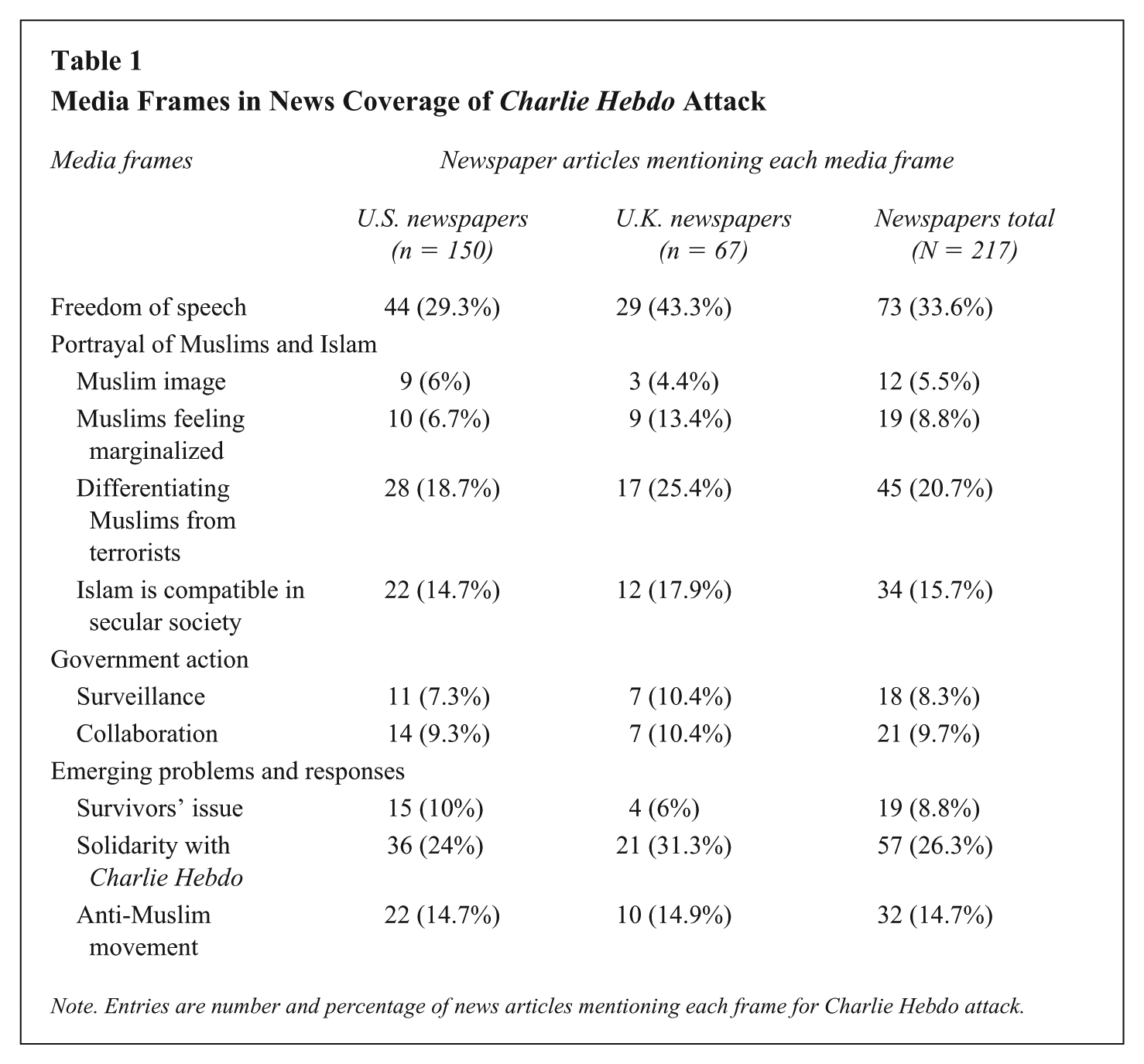
Note. Entries are number and percentage of news articles mentioning each frame for Charlie Hebdo attack.
To examine
Hierarchical Regression Predicting the Approval of Publishing Cartoons
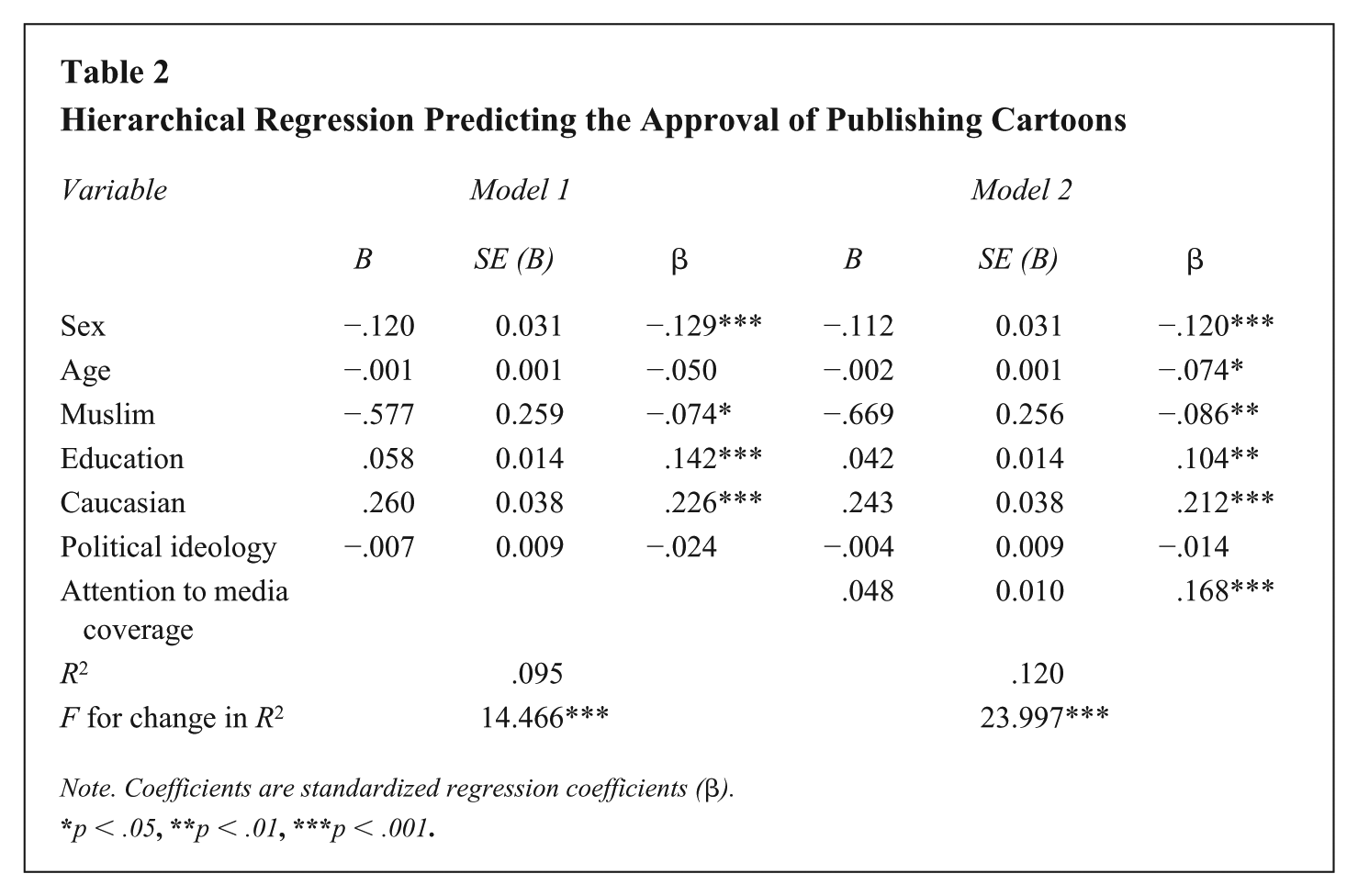
Note. Coefficients are standardized regression coefficients (β).
p < .05, **p < .01, ***p < .001.
Discussion and Conclusion
The findings reaffirm past reports of a regional difference between American and British newspapers in media representation of terrorism, and suggest that news media’s framing of terrorist attacks is grounded in political orientations of the host countries on terrorism. Whereas regional differences in news media framing of international terror events have been highlighted in previous studies (e.g., Gerhards & Schäfer, 2014; Papacharissi & de Fatima Oliveira, 2008), this study suggests states engaged in conflicts and international affairs attempt to promote their preferred news framing of events with Muslims. When covering the attack, American and British newspapers resonate with their governments’ involvement in combating terrorism and reflect governments’ attitude and policy toward Muslim populations in the respective countries. Information obtained from news media can influence how governments and certain publics respond to the terrorist attacks, especially in the case of foreign news with which the public has less knowledge and direct experience (Sheafer & Gabay, 2009).
In the aftermath of the Charlie Hebdo attack, tension arose between fundamental values pertaining to “freedom of speech” and “respect for religion” (Mondal, 2016). News media outlets particularly highlight the importance of guarding freedom of expression, not curtailing it, which not only pinpoint the news media’s role in upholding freedom of speech, but also raise the problem of prioritizing certain values and claims over the other. Our findings complement previous research on the Charlie Hebdo attack (Jenkins & Tandoc, 2017; Sreberny, 2016; Wessler et al., 2016), and illustrate that the free speech frame and the protection of marginalized Muslims frame are more prominent in British newspapers than American ones. Framing the Charlie Hebdo attack with a focus on freedom of expression, the editorial decision-making process (whether or not to republish images of Muhammad), and the plight of Muslims, provides a nuanced insight into the differences between U.K. and U.S. newspapers.
In contrast to French news media showing unconditional solidarity with the satirical magazine by republishing the controversial cartoons (Dawes, 2015), British and American news media have been varied in the way they have discussed the limits of free speech and responsibilities of the press. Especially, reproducing Mohammad cartoons is not only to bring out a news story, but, more important, it is symbolic of solidarity and principle (Boe & Hervik, 2011). In other words, republishing these satirical cartoons suggests the united efforts among news media organizations to demonstrate support for Charlie Hebdo. More important, it acts to preserve core principles to democracy—editorial independence and freedom of speech. However, none of the U.K. newspapers reprinted any caricatures of Muhammad, and the editor of the Independent hesitated to publish Muhammad cartoons because it is “too much of a risk” (Plunkett, 2015). In the United States, the Washington Post published the cartoons on its editorial page, whereas the Associated Press, along with mainstream U.S. networks such as ABC News, CNN, and Fox, did not distribute the Muhammad cartoons (Gollom, 2015). Whereas U.S. editors and news media organizations were being personally and institutionally hesitant to reproduce the cartoons, they subsequently published the January 14 “Tout Est Pardonné” (“All is forgiven”) cover as either an editorial or news item. Viewed in this way, the frames of “freedom of speech” and “respect for minorities” are openly and reflexively debated by the newspapers. Although press freedom within a liberal tradition is considered as autonomy from any political interventions (Lovett, 2014), the editorial judgment of whether or not to reprint the cartoons reflects a question about whether freedom of the press can be reconciled with other important values such as respect for religion. A deliberative perspective contends news organizations should reprint the Charlie Hebdo provocative cartoons perceived as offensive by Muslims only if this achieves purpose of public reflection and enlightenment (Wessler et al., 2016).
Although other pertinent narratives could be used to interpret and approach this attack, British and American newspapers privileged free speech in slightly different ways. U.K. news media coverage was less unanimous, being criticized of cowardice (Dawes, 2015), and American newspapers were also reserved, but reflective on the responsibilities of the press. There is a clear double standard in how freedom of speech was framed in the Charlie Hebdo attack, in particular, when the concepts of freedom of expression and freedom of the press are readily conflated, equating with the right of the press to publish whatever it wants without considering the consequences (Petley, 2012). The secondary data analysis adds further evidence that free speech is a salient frame prioritized by news media outlets and reveals that people who pay more attention to news media coverage of the Charlie Hebdo attack were more likely to approve of the magazine’s publishing of cartoons. This reveals the significance in how an event is framed and represented in mass media is reflected in the perceptions of the audiences (e.g., Hasebrink, 2006).
Furthermore, British newspapers were more likely to mention Muslims feeling marginalized in European society than the American ones. The results are not surprising as opinion surveys from 2015 show half of British Muslims say they face discrimination because of their faith in Islam and that Britain is becoming less tolerant; they feel prejudice against Islam, which makes it difficult being a Muslim in the United Kingdom (BBC, 2015). The British newspapers’ approach in presenting terrorism as a result of aliened Muslims has been a popular discourse in the country. It is argued that the United Kingdom’s multiculturalism policies have provided little space for citizens who possess multiple identities to belong as full-fledged members of society despite the willingness of the majority of Muslims to express a British identity (Jivraj & Simpson, 2015).
Taken together, by framing the Charlie Hebdo shooting as suffering for the cause of freedom of expression or as a result of alienation of Muslims, both American and British newspapers stressed the underlying causes and likely consequences of the event. More important, it provides an opportunity to reflect on the limits to the rights of the press, the information purpose of satire in the public interest, and the normative role of news media in democratic, secular, and multicultural contexts (Dawes, 2015; Titley, 2017).
Differentiation as a Media Frame
This research shows that differentiation of moderate versus radical Muslims has emerged as a frame in the Western news media in covering terrorist attacks. This study found that about 18% and 25% of the articles in the American and British newspapers, respectively, used the “different Muslims” frame. A negative view of Muslims was usually associated with a broader range of policy preferences such as support the War on Terror (Sides & Gross, 2013), support for subjecting Muslims to legal restrictions (Nisbet et al., 2007) or police scrutiny (Schildkraut, 2002). The implications of media’s efforts to differentiate Muslims from terrorist groups such as ISIS may help not only to describe and define general Muslims in terms of their characteristics, but also to combat bias or prejudice against the Muslim community, especially in the event of terrorism. The finding supports the perception that news media attempt to depict terrorists as deviants or extremist Muslims who are not mainstream.
The most substantial finding of the study, however, is not only identifying the differences between British and American newspapers in their approach to covering the 2015 Charlie Hebdo event, but also differentiating Muslims as a frame is adopted by both countries’ newspapers in depicting Muslims. The finding from Pew Research Survey further reflects the tension between religious and free speech rights and contributes to our understanding of how the public reacts or responds to this tension. As a result, individuals who pay high attention to news coverage of the attack are more likely to approve Charlie Hebdo publishing the cartoons. These findings contribute to a growing body of literature on media framing of Charlie Hebdo attack, and the study shows that news media in different countries might have developed different traditions on covering terrorist incidents. Whereas Powell (2011) finds American news media look for impacts of radical Islam among terrorists, this study shows that British news media, and possibly news media from the countries where Muslims are a significant minority, may attempt to treat Muslims more objectively when covering terrorism. More studies from other regions of the world are needed to build a framework on how international politics, role of Muslims, and cultural relevance to Islam play a role in news media’s coverage of terrorism.
Several limitations of this study should be acknowledged. First and foremost, this study is restricted to eight newspapers in the United States and the United Kingdom. Although the legacy news media still play an important role in affecting public interpretation of issues, emerging technology has dramatically altered the media environment’s landscape. It remains unknown whether the pattern of frames from newspapers will be consistent with other news media outlets such as television, social media, and web-based news sources. Future studies should continually identify consistent frames and unique frames in other news media. Second, given the use of secondary data that did not contain appropriate questions about changes in opinion about Muslims, further research is needed to determine the extent to which specific terrorism frames are employed and whether news media’s effort to differentiate Muslims from terrorist groups can change the audience’s stereotypes and attitudes.
Footnotes
Appendix
Codebook: Operational Definitions and Intercoder Reliability
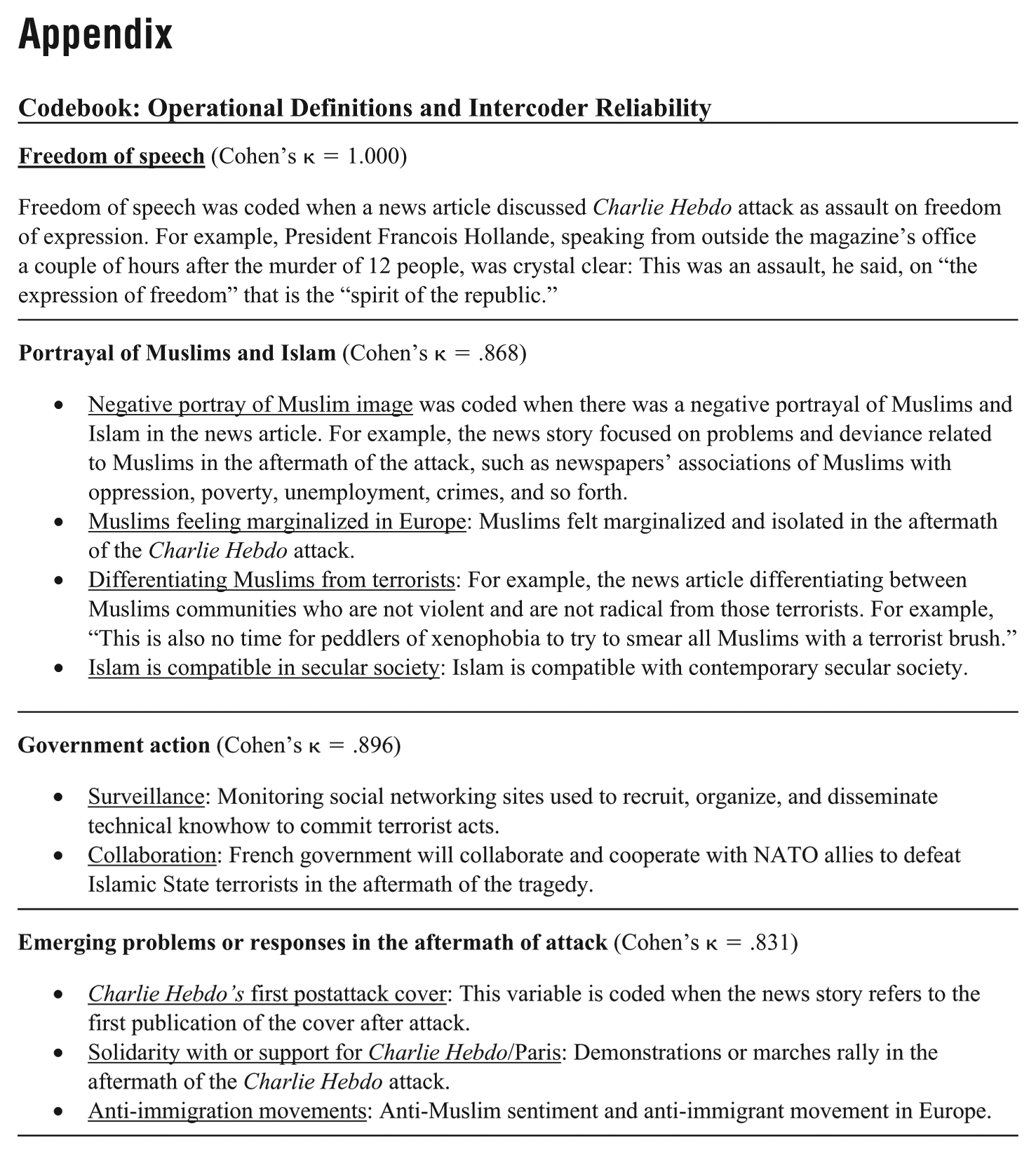
| Freedom of speech was coded when a news article discussed Charlie Hebdo attack as assault on freedom of expression. For example, President Francois Hollande, speaking from outside the magazine’s office a couple of hours after the murder of 12 people, was crystal clear: This was an assault, he said, on “the expression of freedom” that is the “spirit of the republic.” |
| • Negative portray of Muslim image was coded when there was a negative portrayal of Muslims and Islam in the news article. For example, the news story focused on problems and deviance related to Muslims in the aftermath of the attack, such as newspapers’ associations of Muslims with oppression, poverty, unemployment, crimes, and so forth. • Muslims feeling marginalized in Europe: Muslims felt marginalized and isolated in the aftermath of the Charlie Hebdo attack. • Differentiating Muslims from terrorists: For example, the news article differentiating between Muslims communities who are not violent and are not radical from those terrorists. For example, “This is also no time for peddlers of xenophobia to try to smear all Muslims with a terrorist brush.” • Islam is compatible in secular society: Islam is compatible with contemporary secular society. |
| • Surveillance: Monitoring social networking sites used to recruit, organize, and disseminate technical knowhow to commit terrorist acts. • Collaboration: French government will collaborate and cooperate with NATO allies to defeat Islamic State terrorists in the aftermath of the tragedy. |
| • Charlie Hebdo’s first postattack cover: This variable is coded when the news story refers to the first publication of the cover after attack. • Solidarity with or support for Charlie Hebdo/Paris: Demonstrations or marches rally in the aftermath of the Charlie Hebdo attack. • Anti-immigration movements: Anti-Muslim sentiment and anti-immigrant movement in Europe. |