




Abstract
Applying person perception theory, this research uses quantitative content analysis to analyze 1,183 newspaper photographs of the two leading candidates from the 2016 presidential election. Study findings show that there were statistically significant differences in the photographic presentations of Hillary Clinton and Donald Trump in the 2016 election, with Clinton pictured more favorably than Trump.
Even before the first vote was cast, the 2016 U.S. presidential election proved to be “unprecedented” for a multitude of reasons (Kurtzleben, 2016). Despite losing the popular vote to Hillary Clinton, Donald Trump became U.S. president with an Electoral College vote of 306 to 232 (270 electoral votes are needed to win). While visuals have held a “crucial” role in politics for quite some time, they were especially relevant in election 2016, as we are in a “moment in time in which we’re all using images to communicate” (Matiash, 2016, n.p.).
Scholars have demonstrated the value of visuals in political communication. As Schill (2012) concluded, “Images clearly play a foundational role in the political communication process” (p. 133). In research on campaign imagery, Moriarty and Popovich (1991) wrote, “Visuals are more than decoration; they perform important roles in communication such as conveying realism, credibility, and attitudes” (p. 372). As a specific and often-cited example, research on the 1992 presidential election found that one particular photo of George H. W. Bush that appeared on the front page of The New York Times—which depicted Bush as a wealthy, out-of-touch politician—contributed to Bush’s loss to Bill Clinton (Waterman et al., 1999).
Turning to the 2016 presidential election, Donald Trump frequently campaigned on a message of fear, attempting to convince voters that Hillary Clinton was “physically unwell” (Corasaniti, 2016, n.p.) and that she did not have the “strength or stamina” (Phillip & Gearan, 2016, n.p.) to protect the country. One campaign advertisement, for example, used ominous imagery of Clinton severely coughing, nearly collapsing, and slipping on stairs as visual evidence that she was “physically incapable of meeting the demands of the presidency” (Corasaniti, 2016, n.p.). While these images were also heavily used on conspiracy websites such as InfoWars, they were also used on the conservative media outlet Fox News and even on mainstream new outlets such as The Washington Post.
But despite the critical role of visuals in political communication, the study of visuals is often overlooked in mass communication scholarship (Griffin, 2001; Schill, 2012). Continuing the research tradition of analyzing candidate imagery within the theory of person perception, this research uses quantitative content analysis to build on the body of knowledge of political communication imagery to examine newspaper photographs of the two leading candidates in the 2016 presidential campaign.
Literature Review
Academic research has clearly demonstrated that visuals are more than just an aesthetic element. In addition to providing visual information, they can grab our attention and provoke emotion (Ewbank et al., 2009), help to set the agenda (Miller & Roberts, 2010), and influence how audiences understand news topics (Coleman & Banning, 2006). In fact, Pfau and colleagues (2006) conclude based on their research findings, “Compared to text alone, news photographs compel greater attention, are more credible, and are more memorable” (p. 152). As such, it is vital that research on political communication include analysis of visuals.
Person Perception Theory in Political Communication
Specifically considering images of political candidates, Waldman and Devitt (1998) argue that images may have “a substantial influence on opinions and attitudes toward candidates” (p. 304). Effects research has supported this statement. In reviewing extensive effects literature, Olivola and Todorov (2010) show that audiences make quick judgments about the personalities of political candidates based only on physical appearances, arguing that voters have a tendency to rely on the physical appearance of a candidate when making a voting decision. As a caveat of this line of research, scholars found that conservative voters in the United States prefer candidates who look stereotypically Republican (Olivola et al., 2012). At the same time, this effect did not hold for liberal voters regarding liberal candidates (Olivola et al., 2012).
Person perception theory—attributed to Schneider, Hastorf, and Ellsworth—considers imagery of political candidates in regard to behavior, context, and perspective, predicting that audiences “can and do” draw conclusions from photographs (Schneider et al., 1979, p. 17). Person perception theory suggests that audiences first consider the behavior of the person in the image. According to Moriarty and Garramone (1986), photographs capture “‘stop-action’ slices” of the candidate’s behavior through such items as facial expression and arm and torso positions (p. 729). Audiences interpret these behaviors as either positive or negative and this interpretation can then influence audience perception of the given candidate (Clore et al., 1975). According to previous research, audiences evaluate behavior (and the attributes of torso and arm positions and facial expression) more favorably when the torso is upright or tall, the arms are active through cheering or waving, and the face is cheerful or confident (Moriarty & Garramone, 1986).
Next, audiences consider the behavior within the given context; context typically includes activity, interaction, dress, and peers (Schneider et al., 1979). Dynamic activity (speaking and shaking hands) is evaluated more favorably, as are cheering crowds and attentive peers (Moriarty & Garramone, 1986; Moriarty & Popovich, 1991). A more favorable background includes flags, signs, or presidential icons, while more favorable dress is indicated by a pantsuit or suit and tie (German, 2010; Waldman & Devitt, 1998).
Photo perspective—including camera angle, photo size, and page position—is the final category (Moriarty & Garramone, 1986; Taylor & Fiske, 1975). The perspective category considers the observer’s viewpoint by considering such photographic attributes as lens distance to subject (proximal distance) and camera angle. A close-up shot is viewed as more favorable, as is a lower camera angle, which places the candidate in a position of authority to the audience (Moriarty & Garramone, 1986; Moriarty & Popovich, 1991). In addition, news media treatment of the photo contributes to the overall perspective of the photograph: larger photos and photos at the top of the page imply more importance (Adam et al., 2007) and are thus evaluated more favorably by audiences (Moriarty & Garramone, 1986).
Images of Presidential Candidates From the 1980s to 2016
Beginning with the landmark research from Moriarty and colleagues in the 1980s, previous scholarship shows significant differences in news media photographs of presidential candidates. In the 1984 election, Ronald Reagan was presented more favorably than Walter Mondale regarding context, body language, and facial expressions (Moriarty & Garramone, 1986). George H. W. Bush was depicted as “more cheerful and confident” than Michael Dukakis in the 1998 presidential election (Moriarty & Popovich, 1991, p. 379). Moving to the 1996 presidential election, Bill Clinton received slightly more favorable pictorial treatment than Bob Dole (Waldman & Devitt, 1998). In the 2000 election, George W. Bush received greater visual attention than did Al Gore, with pictorial coverage in The New York Times “dominated” by Bush (German, 2010, p. 51). Studying images of the 2012 presidential election between candidates Barack Obama and Mitt Romney (Dahmen, 2016) found significant differences in the photographic presentations of Obama and Romney, but in the aggregate, “the visuals were generally balanced” (p. 31).
The Value of Newspaper Photographs
Newspaper readership is declining (Anderson & Caumont, 2014), but total daily circulation is still in the tens of millions. There also are several other valid reasons to analyze newspaper photographs from the 2016 presidential election. Newspaper photographs often generate a stronger public reaction than the corresponding written stories (King & Lester, 2005). Photos on a newspaper front page represent prominent placement, generating a great deal of audience exposure (Utt & Pasternack, 2003). Waldman and Devitt (1998) suggest that a daily newspaper is a “good barometer” for the analysis of political reporting (p. 305). And as mentioned earlier, research on the 1992 presidential election found that one particular New York Times photo of Bush contributed to Bush’s loss to Clinton (Waterman et al., 1999). Most critical, this research continues a systematic approach to media scholarship, applying person perception theory to newspaper photos of presidential candidates (Dahmen, 2016).
Summary and Research Question
Given the noteworthy conclusions of previous scholarship in this area, the current research purports to build on academic and applied understanding of person perception theory, asking, “Applying person perception theory and the critical categories of behavior, context, and perspective, is there a difference in how newspapers photographically presented the two leading candidates, Hillary Clinton and Donald Trump, in the 2016 presidential election?”
Method
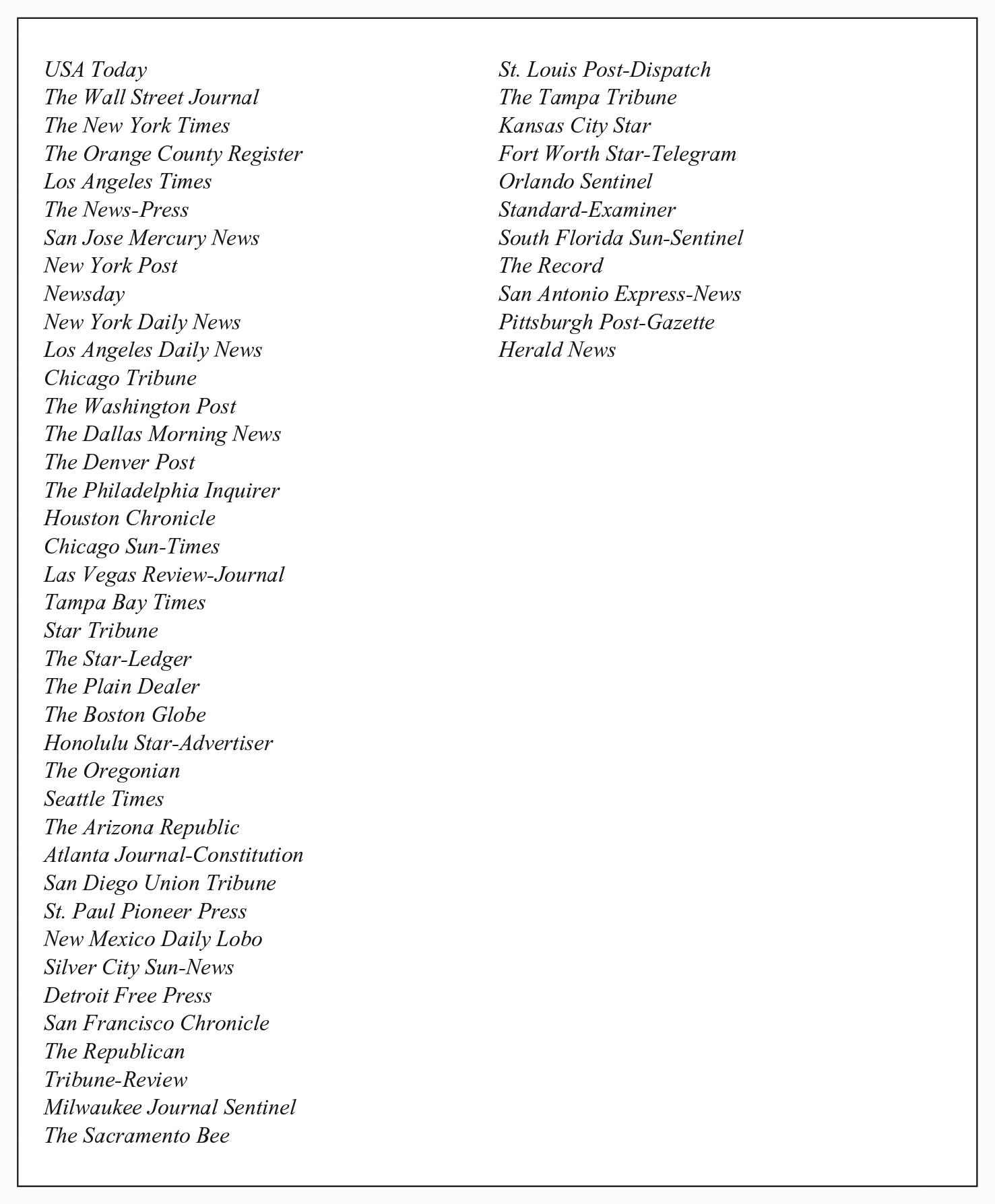
Data for this study were collected using a quantitative content analysis. The population under analysis was the front page of the top 50 highest daily circulation newspapers as listed by the 2015 Editor & Publisher DataBook (see Appendix). Newspapers not in English were not included. Again, previous research has shown that daily newspapers are valid sites of study of political reporting (Waldman & Devitt, 1998, p. 305). The newspaper sample was collected from the Newseum.com collection of newspaper front pages. Newseum.com displays jpg and pdf versions of newspaper front pages from around the world. Both jpg and pdf versions of the newspapers were collected from September 1, 2016, through November 8, 2016. This sampling timeframe began after the Democratic and Republican National Conventions and ran through the date of the presidential election. In addition, this time frame was selected as a valid sampling time frame based on previous studies of presidential elections in the United States (see, for example, Bichard, 2006). A graduate research assistant wrote a script to pull and archive all front pages for the analysis time period.
Front pages as a whole were examined for any photos related to the presidential election. For a photograph to be included in the sample, one or both of the two leading presidential candidates (Clinton or Trump) must have been included in the photo. The unit of analysis was an individual photograph. All photos of Clinton or Trump were coded; if both candidates appeared in the photo, the photo was coded twice, once for each candidate. Only individual photographs were included in the sample; montages, obviously edited photographs, informational graphics, and illustrations were not included. Methodological guidelines led to a sample of 1,183 photos: 541 (45.7%) photos of Clinton and 642 (54.3%) photos of Trump.
The design of the study followed best practices for quantitative content analysis as outlined by Krippendorff (2013). Specifically, it employed an a priori design, was externally coded, and used a reliability measurement that took chance agreement into account (Krippendorff, 2013). Data for the study were collected through quantitative coding as based on the theory of person perception. The coding protocol was developed based on previous studies applying person perception theory to the pictorial representation of presidential candidates. All photographs in the sample were coded for key variables related to the candidate’s behavior and photo context as well as the news perspective. For this study, the categories of behavior, context, and perspective were each coded based on distinct attributes. Table 1 summarizes the three coding categories with succinct operational definitions of each attribute. As was standard coding protocol for this line of research, each photo was given a score of +1 (more favorable), 0 (neutral), or −1 (less favorable) for each attribute. Each category was then summed and averaged by the number of attributes to create a composite score for the three categories of behavior, context, and perspective. Finally, a total score was created for each photo based on the summation of the categories of behavior, context, and perspective. A higher score represented a stronger, more dominant photo in terms of person perception theory. To analyze findings, mean scores were computed for each of the three analysis categories and for the total score. Mean scores were then compared using an independent samples t-test.
Coding Guidelines With Operational Definitions
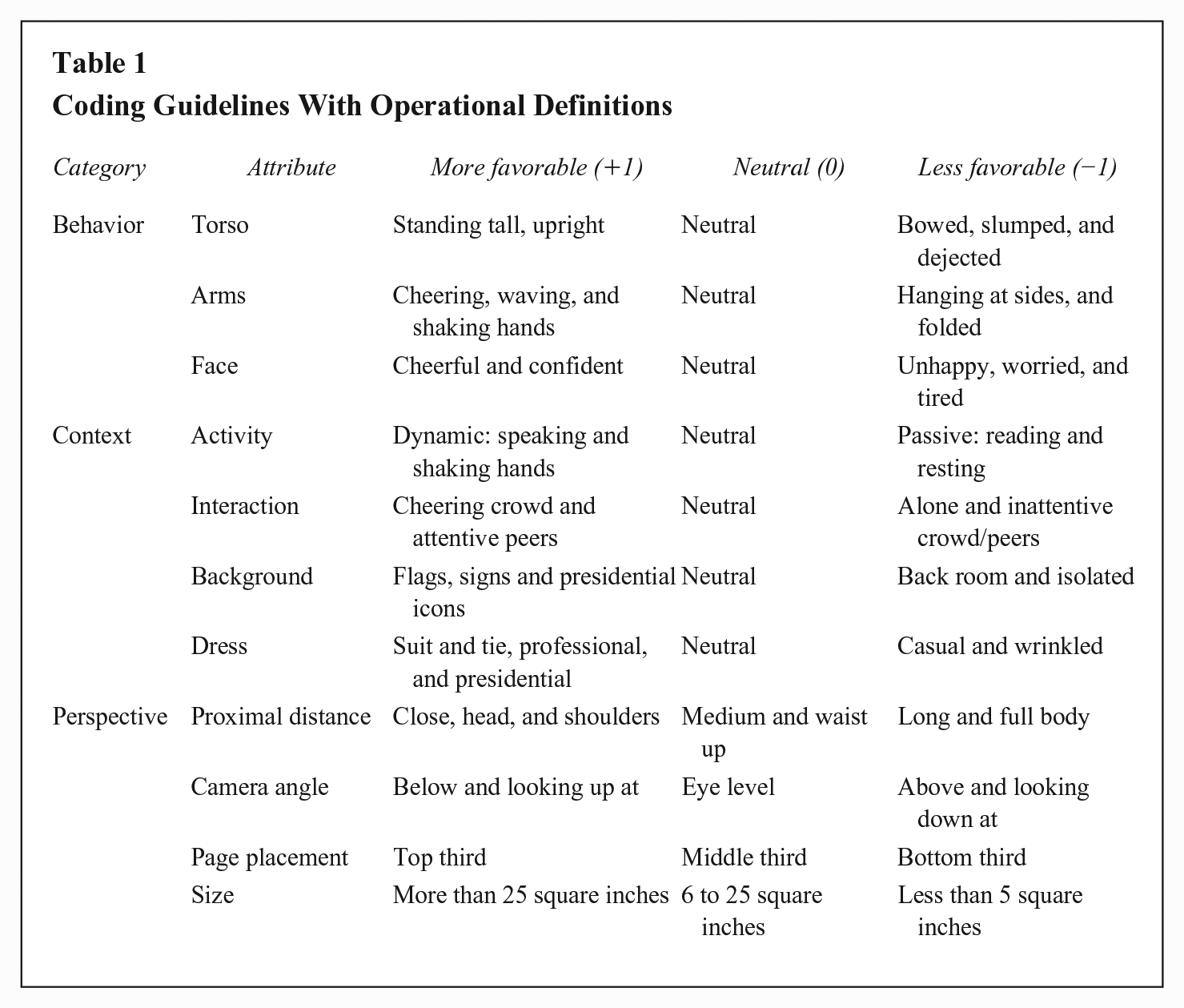
For coding purposes, two independent coders were hired and trained in multiple training sessions; front pages from July 2016 were used for coder training. For intercoder reliability purposes, both coders coded a randomly selected 10% of the sample. Using Scott’s Pi, a stringent measure of reliability that corrects for chance agreement, acceptable results ranged from a low of .655 to a perfect 1 (Riffe et al., 2005). Only one variable fell below the typically used acceptable range of .70 and above. Following the establishment of intercoder reliability, Coder 1 was assigned to code all even numbered dates (9/2, 9/4, 9/6, etc.), and coder 2 was assigned to code all odd numbered dates (9/1, 9/3, 9/5, etc.). The assignment of dates ensured that both coders were coding an unbiased and equal representation of the sample.
Findings and Discussion
The intention of this research was to build on the work of previous scholarship in the study of news media photographs of presidential candidates. Applying person perception theory and the associated categories of behavior, context, and perspective, the research analyzed 1,183 newspaper photographs asking the question, “Is there a difference in how newspapers photographically presented the two leading candidates, Hillary Clinton and Donald Trump, in the 2016 presidential election?”
Table 2 shows mean scores for each attribute as well as mean scores for the three analyzed categories (behavior, context, and perspective). Recalling that three attributes make up the category of behavior (torso, arms, and face), photos of candidates are evaluated more favorably if the torso is upright or tall, the arms are active, and the facial expression is cheerful or confident (Moriarty & Garramone, 1986). In looking at the attributes for the behavior category, significant differences were found. Clinton was presented with significantly more favorable behavior for the torso (t = 5.130, p < .001) and face (t = 7.158, p < .001) attributes. Clinton was also presented with more favorable behavior for the arms attribute, though the difference was not significant. Taken together, for the category of behavior, there was a significant difference between the photographic presentations of the two candidates; Clinton’s behavior was more positively pictured than was Trump’s behavior (t = 6.724, p < .001). Findings indicate that Clinton was more frequently pictured standing tall or upright and with a cheerful or confident facial expression (more favorable behavior), while Trump was more often pictured with his torso bowed, slumped, or dejected and an unhappy, worried, or tired facial expression (less-favorable behavior). The finding for facial expression is especially noteworthy as “expression is arguably the most critical part of a photo of a candidate, since the reader is naturally drawn to the photo’s central element and to the face of the familiar personage” (Waldman & Devitt, 1998, p. 309). And indeed, Trump’s facial expressions themselves—from the “alpha face,” to the “angry face,” to the “chin jut”—became a topic of news media coverage (Collett, 2017).
Mean Photo Scores by Attribute, Category, and Total for Each Presidential Candidate in Analyzed Newspapers (N = 1,183 Newspaper Photographs)
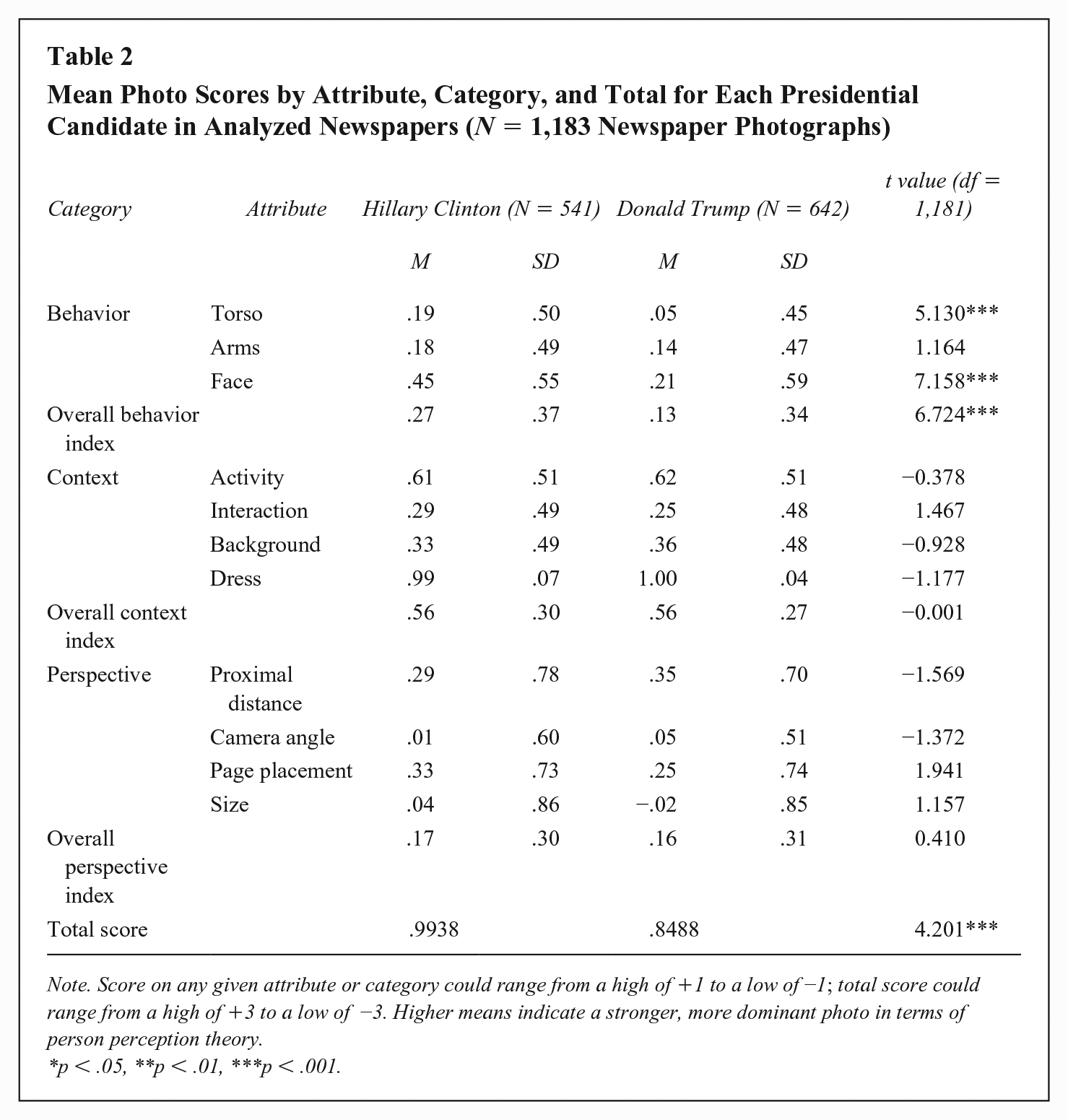
Note. Score on any given attribute or category could range from a high of +1 to a low of −1; total score could range from a high of +3 to a low of −3. Higher means indicate a stronger, more dominant photo in terms of person perception theory.
p < .05, **p < .01, ***p < .001.
Following evaluating a candidate’s behavior, person perception theory suggests that audiences then evaluate a candidate’s behavior within a certain context (Schneider et al., 1979). Again, the category of context includes activity, interaction, background, and dress. Dynamic activities are viewed as more favorable than passive activities, and interaction is evaluated more favorably when a candidate is with peers or with a cheering crowd as opposed to being alone. Favorable backgrounds include those with flags, signs, and other patriotic symbols, while dress is evaluated more favorably if the candidate is in professional dress. As seen in Table 2, there were no significant differences in individual attributes or for the category of context, indicating that both candidates were evenly presented in regard to context. Both candidates were often pictured speaking or shaking hands with the presence of a cheering crowd or attentive colleagues. In addition, both candidates consistently appeared in professional dress.
The findings on candidate dress are somewhat surprising, especially in consideration of previous studies in this area. In a study of the 2012 presidential election, Dahmen (2016) found that Obama was pictured more favorably in regard to dress than was Romney, concluding that the less favorable mean score for dress for Romney was likely strategic campaigning by Romney and his advisors. In the 2012 election, one of the goals of the Mitt Romney campaign was to re-define his image to forge a greater connection with the voters (West, 2011). As an example, Romney was often seen without a tie or with his shirtsleeves rolled up (Dahmen, 2016). Certainly, this is not a unique strategy. German’s (2010) research on the 2000 Bush/Gore election found that in an effort to break his “stiff and cold” image, Gore was often pictured in more casual dress; conversely, Bush was more often pictured in a suit and tie to “compensate for his perceived lack of political experience” (p. 56). Perhaps the same could be said for Trump: he frequently wore a suit and tie to compensate for his lack of political experience. However, in looking at Romney’s campaign, Romney dressed more casually in an attempt to connect with voters. Trump greatly appealed to the working class of Americans, even in a suit and tie (Cohn, 2016).
Moving to the final category of analysis, perspective considers the observer’s viewpoint in regard to four attributes: proximal distance, camera angle, page placement, and size. Again, a close-up shot and a lower camera angle are viewed as more favorable by audiences, as are larger photos and photos at the top of the page. The data showed no significant difference for the overall category of perspective or for the individual attributes (see Table 2). Effectively, there were no significant differences in the camera angle or differences in the distance between the candidate and the camera. Almost all photos were taken at a neutral camera angle at a relatively close distance (medium to close distance). Especially noteworthy, there were no significant differences in how newspapers used photos of the two candidates: almost all candidate photos were medium size and positioned toward the top of the newspaper front page. While Trump received more media coverage than did Clinton throughout the campaign (Patterson, 2016), the data indicate that despite the relative “novelty” of each of these candidates—Clinton, as the first female major party candidate and an experienced candidate with her own controversial political and personal history (Graham, 2016), and Trump, as a provocative candidate with no previous political experience who remained a controversial nominee for the Republican party (Hook et al., 2016)—newspapers could be said to have shown balanced photographic treatments in presentation of photos of the two candidates based on the fact that the data showed no significant difference in the category of perspective.
Finally, as seen in Table 2, there was a significant difference in the total mean scores for the photos of each presidential candidate. Considering the person perception categories together, Clinton was pictured significantly more favorably than Trump (t = 4.201, p < .001). Despite the fact that there were no significant differences in the categories of context and perspective, the difference in the category of behavior was large enough to reflect a significant difference in the total mean scores for the photos of the two presidential candidates.
Conclusion
Returning to the introduction of this study, history showed that one questionable action of George H. W. Bush—which was captured in a photo and prominently placed on the front page of The New York Times—contributed to his election loss to Bill Clinton (Waterman et al., 1999). The same cannot be said in the case of Donald Trump and the 2016 presidential election. Throughout the 2016 presidential campaign, Donald Trump’s questionable behavior (both current and past) was a frequent focal point of news media coverage and subsequent public discussion, most infamously his mocking of a reporter with a disability (Carmon, 2016), his criticism of the Muslim family of slain U.S. soldier (Haberman & Oppel, 2016), and his insults against women, specifically using women’s menstrual cycles as an insult (Yan, 2015) and his recorded lewd remarks in which he boasted about sexually assaulting women (Fahrenthold, 2016). But despite this behavior—which was captured by photojournalists and published repeatedly across the news media—Trump became president of the United States by an Electoral College vote of 306 to 232. In spite of losing the popular vote, Trump became the 45th president of the United States.
The premise of the current research was to build on the body of literature—continuing the research tradition of studying print news photos of presidential candidates—thus furthering a systematic approach to media scholarship. Taken as a whole, the data for this study found that there were distinct differences in newspaper photographic presentations of Hillary Clinton and Donald Trump in the 2016 election. Across all 1,183 photos analyzed, Trump was pictured significantly less favorably regarding the total photo scores. Specifically considering the category of behavior, Trump was pictured significantly less favorably than his opponent, Hillary Clinton. While a content analysis does not intend to prove effects—nor are the data collected from this method able to support conclusions about effects—the implication presented from the data in Table 2 is that audiences of the top 50 circulating newspapers in the United States were exposed to less-favorable photographic coverage of Donald Trump than to Hillary Clinton. And certainly, this echoes the findings of other research on election 2016 (Patterson, 2016). But in the end, the negative coverage of Trump—including unfavorable visuals—did not seem to sway his voting base (Tyson & Maniam, 2016).
As with all studies, this research was not without limitations. As the newseum.com archive includes only front pages, inside newspaper pages were not analyzed. Had inside pages been analyzed, the findings may have been different. But, again, based on research showing that the newspaper front page is a valid site for study of news media photographs, the current data set provides valuable insight (King & Lester, 2005; Utt & Pasternack, 2003). A second limitation of the study is the previously acknowledged decline of print readers. While the premise of the current research was to continue the trend of person perception research in print news, additional research must apply this theory to digital news sites, such as BuzzFeed and Huffington Post. The 2016 election ushered in a new era of candidates communicating directly with audiences (Sanders, 2016) without the news media as gatekeeper. As such, subsequent work in this area must consider candidate-controlled images posted via social media.
Returning to the findings of this study, a critical tenet of person perception theory is the ability of photographs to be used to strategically “mold voters’ perceptions” (German, 2010, p. 59). But, again, despite the more negative photographic coverage of Trump, the Republican candidate emerged victorious. So what do the person perception findings tell us in regard to visual communication and political communication via newspapers?
Study findings provide practical implications for the journalism and political communication industries, showing that despite the statistically significant differences in pictorial presentation of the two candidates in the analyzed newspapers, less-favorable images (and other research showing more negative coverage of Trump as a whole) did not translate to a loss for the more negatively presented candidate. In addition, and as other research has and will continue to demonstrate, there were a number of reasons that resulted in Trump’s victory, notably the support of working class, White voters (Cohn, 2016).
As previous scholars of political communication and person perception theory have shown, images can have an effect on audiences. As previous scholars have stated, while the differences are statistically significant, the visually subtle differences (such as torso upright or slumped) are potentially likely to go unnoticed by voters. But in this case, even if audiences acknowledged—and saw in newspaper photos—Trump’s negative behavior, it did not sway his base. And in fact, considering Trump’s facial expressions and the data showing that they were significantly more negative than Clinton’s facial expressions, some research actually suggests that Trump’s more expressive faces, even the sneers and scowls, actually appealed to voters (Noel, 2016). As such, this finding presents critical points for consideration regarding person perception theory. Given the increasing sophistication of political campaigning—such as Romney’s more casual dress and Trump’s reality TV persona—it appears that traditional “positive” depictions of candidates, such as professional dress and cheerful and confident facial expressions, may no longer be actually viewed as “positive” by audiences. As such, this indicates the need for an academic reconsideration of the tenets of person perception theory.
Footnotes
Appendix
Newspaper Sample: 50 Highest Daily Circulation Newspapers as Listed by the Editor & Publisher DataBook
|
USA Today
The Wall Street Journal The New York Times The Orange County Register Los Angeles Times The News-Press San Jose Mercury News New York Post Newsday New York Daily News Los Angeles Daily News Chicago Tribune The Washington Post The Dallas Morning News The Denver Post The Philadelphia Inquirer Houston Chronicle Chicago Sun-Times Las Vegas Review-Journal Tampa Bay Times Star Tribune The Star-Ledger The Plain Dealer The Boston Globe Honolulu Star-Advertiser The Oregonian Seattle Times The Arizona Republic Atlanta Journal-Constitution San Diego Union Tribune St. Paul Pioneer Press New Mexico Daily Lobo Silver City Sun-News Detroit Free Press San Francisco Chronicle The Republican Tribune-Review Milwaukee Journal Sentinel The Sacramento Bee |
St. Louis Post-Dispatch
The Tampa Tribune Kansas City Star Fort Worth Star-Telegram Orlando Sentinel Standard-Examiner South Florida Sun-Sentinel The Record San Antonio Express-News Pittsburgh Post-Gazette Herald News |
