



Abstract
Previous research suggested that news media coverage tone tends to become more negative for successful women in politics (but not for successful men) when compared with less successful and well-known women. This study tests this in 17 countries. Specifically, it examines relationships between greater parliamentary representation of women and the coverage tone in articles on women in that country through a computational analysis of millions of persons’ names in more than 1,000 newspapers. Growth in parliamentary representation of women is associated with more negative coverage, lending support for explanations that suggest reactionary responses to perceived breaching of gendered social hierarchies.
Negative coverage can be harmful for both individuals and organizations, whereas positive coverage can bring multiple desired consequences. This operates through a process that media scholars have named “second-level agenda setting”—the idea that news media tell us not only what to think about, but also how to think about it (McCombs et al., 1997). For example, movie actors and book authors, whose movies and books receive negative coverage and reviews in the news media, are more likely to suffer from reduced salaries, sales, royalties and income from commercial campaigns (Sorensen, 2007). Similarly, during political campaigns, the agenda setting and coverage patterns of various news media have been shown to influence the evaluations and voting patterns of news media consumers and potential voters (Golan & Wanta, 2001; Hyun & Moon, 2016; McCombs, 2004).
The effects of news media coverage patterns may be especially salient for marginalized social groups. Various studies have reported the harmful repercussions of negative news media attention for racial and ethnic minorities (Gilens, 1996, 1999; Sommers et al., 2006), for sexual minorities (Gross, 2001; Steiner et al., 1993) and for religious minorities (Poole, 2002; Powell, 2011). These groups are often presented as poor, lazy, criminal and threatening, contributing to public perceptions that foster inequalities in resource distribution and job opportunities, as well as a differential treatment by law enforcement agencies and judicial systems (Dixon, 2008; Oliver, 2003). News media coverage patterns may also affect gender social inequalities. For example, a long line of research has looked at the coverage of female political candidates in various countries, showing that they often receive less news media attention and that their coverage is not on par with their male counterparts. This differential coverage, in turn, often translates into fewer campaign donations and may negatively affect their ability to draw voters (Braden, 1996; Bystrom et al., 2001; Caul Kittilson & Fridkin, 2007; Heldman et al., 2005; Kahn, 1994).
This study examines how political representation of women affects newspapers’ coverage patterns in various countries. On one hand, greater political representation of women is associated with various positive social results, particularly for women and children, suggesting that it may contribute to more positive newspaper coverage of women (Bolzendahl & Brooks, 2007; Childs, 2002). On the other hand, women who reach higher professional and social positions (including politics) often suffer from significantly more negative news media coverage when compared with other women, whereas this is not the case for successful men (Heldman et al., 2005; Meeks, 2013). To further investigate the relationship between political representation and news media sentiment, this study analyzes computerized sentiment data for both men and women in more than 1,000 newspapers from 17 countries in which English is an official language.
Political Representation of Women and Its Consequences
In recent years, women have been gaining ground in parliamentary representation in most countries. Over the last two decades, the global average proportion of women in parliaments has doubled, increasing from 11.3% in 1995 to 22.6% in 2015 (Khan, 2017). One important reason for this growth is quota systems, currently in place in more than 120 countries, representing the efforts of most countries to increase the share of legislators who are women (Fallon et al., 2012; Kenworthy & Malami, 1999; Paxton, 1997). But how might greater political representations of women affect the way newspapers write about women?
First, one might examine the results of this growing political representation in other areas. Cross-national research has shown that improvements in parliamentary representation of women were associated with various social and political advances. A number of studies have shown that such increases led to greater investments in social policies and social welfare, leading to a decrease in poverty (Bolzendahl, 2009; Bolzendahl & Brooks, 2007; Brady, 2009). More specifically, increased representation of women has been shown to lead to greater passage of women-friendly policies and women’s and children’s rights bills (Celis, 2007; Chattopadhyay & Duflo, 2004; Childs, 2002; Childs & Krook, 2009; Kittilson, 2008; Meyer, 2003; Schwindt-Bayer, 2006).
Studies have also shown that greater political representation of women reduces the risk of violent international and domestic conflicts. Demeritt et al. (2015) argue that peace becomes more likely where women are better integrated into a state’s political and social institutions. Shair-Rosenfield and Wood (2017) have shown that a greater proportion of female representatives in a national legislature prolongs peace following a negotiated settlement, as it prioritizes social welfare spending over military spending and improves public perceptions of good governance and the credibility of political elites. Finally, cross-national research has demonstrated that greater political representation of women also has a positive effect on population health and in particular women’s and children’s health. Most notably, a host of studies have found a substantial relationship between greater female representation and reduced population mortality (Macmillan et al., 2018), infant mortality and child mortality (Boehmer & Williamson, 1996; Homan, 2017; Quamruzzaman & Lange, 2016; Swiss et al., 2012).
Because greater political representation of women is associated with results that are usually perceived to be positive, it stands to reason that newspaper coverage of women might also improve when representation grows. This might be due to the positive welfare and health consequences for children (whose health and happiness is frequently considered as the responsibility of mothers and female educators) and for women themselves. It may also be a result of journalists recognizing the positive consequences of more equal political representation and giving women in political positions due credit for these changes. Another reason to believe that greater political representation of women might improve their coverage tone is the possibility that journalists and editors are enamored with the novelty of women in politics and that at least some of them practice reverse discrimination. Reporters may wish to celebrate the achievements of successful women in politics, seeking to show that women can make it despite encountering multiple difficulties. Hence, journalistic reports might focus on success stories and on flattering and positive features, while disregarding or downplaying negative elements in successful women’s stories, personalities or behaviors.
While these are plausible suppositions, research on women in politics suggests that coverage patterns might in fact follow quite an opposite trend. This research has mostly looked at case studies of women who have reached senior political positions in various countries, arguing that their news media representation tends to be problematic. For example, research in New Zealand and in Australia has suggested that while men who appear commanding, competitive or resolute are commended for these traits, women who show similar traits are perceived to be breaching their gender roles and are thus portrayed in a negative light (van Acker, 2003). Similarly, research in Canada has shown that the coverage of female political leaders (but not of male politicians) focused disproportionately on combative displays and presented them as more confrontational than they actually were, while ignoring more low-key behaviors (Gidengil & Everitt, 2003).
However, even those women who try to avoid stereotypically “masculine” behaviors such as blatant competitiveness, ambition and combativeness do not fare much better in the news media. In fact, women who display stereotypically “feminine” traits, such as vulnerability and non-competitiveness, still fail to receive positive coverage, as these traits are perceived to be unsuitable for the political arena, conveying weakness and indecision (see also Henderson, 1999). Gender scholars have suggested that the main reason for this double bind is that successful women pose a significant challenge to the social status hierarchies by penetrating into traditional male bastions. Therefore, they are vilified and carefully scrutinized, and harshly criticized (Ridgeway, 2013; Rudman et al., 2012).
Following this logic, Fowler and Lawless (2009) have argued that when women run for office, they break gender stereotypes and norms about both women and politicians, and therefore receive negative news media attention. Coverage of women in politics tends to become more negative the more successful they are because this increases the unconventionality of their candidacy and puts their femininity under intense scrutiny (Meeks, 2012). Studies on news media coverage of women who attained particular visibility in American politics, such as Elizabeth Dole and Hillary Clinton, have suggested that negative stereotypes are most obvious and harmful in such cases (Heldman et al., 2005; Huddy & Terkildsen, 1993; Kahn, 1992, 1994; Ryan, 2013; Scharrer, 2002). Similarly, studies in New Zealand have suggested that when women reach top political positions their lives are heavily scrutinized by news media (more so than the lives of men are), and any hint of controversy is sensationalized (Comrie, 2006; McGregor, 1996; Trimble & Treiberg, 2010).
Although the studies reviewed above are instructive, none of them has systematically examined the effects of women’s political representation on news media coverage of women and none has adopted a cross-national analysis. Most of this research has relied on anecdotal case studies, examining only a small number of individuals (often only one or two) within a single country. Such research designs raise concerns about selection bias (in particular when focusing only on the most notable cases) and cross-cultural generalizability. It should be noted that conducting a cross-national analysis of news media’s gendered coverage patterns is particularly challenging given the difficulties in compiling large-scale and systematic cross-national data coming from a larger number of countries. However, new developments in computerized big-data collection and computational processing of natural language offer a unique opportunity to begin tackling these challenges. This study takes advantage of such large-scale data and systematic computerized sentiment analysis to explore the relationship between gendered political representation and news media coverage sentiment. More specifically, it examines whether news media coverage becomes better or worse when women enter political positions in greater numbers.
Method
Data
The primary data source for analyzing newspapers’ sentiment in this study is the Lydia text analysis system (Bautin et al., 2010; van de Rijt et al., 2013). Lydia provides time-stamped records of occurrences of persons’ names in the scanned and digital records of more than 2,000 newspapers, magazines and online news sources in 72 countries from 2004 to 2009. This period allowed a unique opportunity for researchers to access large-scale longitudinal data from the online editions of a large number of newspapers, before most of these newspapers placed their content behind paywall (Shor et al., 2019). For each name occurrence, Lydia provides the timestamp, newspaper’s name, newspaper’s country, sex and sentiment with which the name was mentioned (see Shor et al., 2015; Shor, van de Rijt, Ward, Asakar & Skiena, 2014; Shor, van de Rijt, Ward, Blank & Skiena, 2014). Lydia determines the sex of a named person through Anaphora Resolution (see Online Appendix 1 for a detailed explanation of the sex classification process and for a table indicating the validity of this process for a random sample of names).
This study examined a subsample of this database, containing more than 1,000 English-language newspapers from 17 countries in which English is an official language. The main reason for restricting the analyses to countries where English is a leading language is that the gender classifier used in this study is able to accurately classify the majority of the names in these countries. Conversely, in other countries (e.g., Russia, France and Germany), name classifiers were more often inaccurate and a large portion of the names was rendered ineligible for gender classification. For each of these 17 countries, the mean sentiment for all references to women was calculated for all newspapers published in the country in a given year, and did the same for men. Altogether, this process provided 102 country-years included in the final analyses.
Dependent Variable: Newspaper Sentiment
The Lydia system assigns scores indicating positive or negative sentiment to each distinct entity (name) in a text corpus, newspaper articles in this case (for more details, see Godbole et al., 2007; Shor et al., 2019). The system then computes an aggregate sentiment score, allowing us to determine the average sentiment score (ranging from −1 to +1) for women and for men in all the articles that appeared in a given newspaper during a given year. This measure was then recorded so that 0 represents entirely negative sentiment, 1 represents entirely positive sentiment and 0.50 represents neutral sentiment. We then tested the ability of this system to identify negative and positive events in the lives of several celebrities. We found that sudden shifts in sentiment indeed corresponded with these events, providing support for the validity of the sentiment measure (see also Shor, 2018).
Online Appendix 2 lists the most common adjectives associated with women and men. Adjectives used in conjunction with female and male names are rather similar, suggesting that gender differences in qualitative dimensions of coverage sentiment may be more modest than previously suggested. Nonetheless, various discrepancies are consistent with gender differences identified in prior work on gendered discourse, with “loving,” “wonderful,” “beautiful,” “beloved” and “safe” more often associated with women, whereas “guilty,” “offensive,” “responsible,” “fair” and “critical” are more typical for male subjects. Therefore, the analyses present distinct estimates for news media sentiment toward women and toward men, recognizing that these may reflect qualitatively different ways of reporting.
Independent Variables
Proportion of women in country’s parliament
The main variable of interest is the proportion of women in the country’s parliament in a given year. As discussed above, some reasons support the belief that a higher proportion will be associated with a more positive coverage tone for women. However, the results of empirical research on news media coverage of successful women in general and women in politics more specifically suggest that this might not be the case and that in fact women’s greater penetration into high-level political positions might come with the price of more negative news media coverage for women.
Proportion of women in newspapers
The Lydia system also allows calculating for each country-year the proportion of women out of all the names mentioned in the country’s newspapers in that year. When newspapers mention women more often, this might serve as a testimony for a more gender-egalitarian approach, which might also result in a higher likelihood for a more positive coverage tone for women.
Other measurements for women’s equality
The proportion of women in a country’s parliament might simply be one measurement of greater gender equality in that country. Analyses therefore control for other proxies for gender equality in the country, for which reliable cross-national data were available. These include women’s participation in the labor force, women’s life expectancy at birth and fertility rates. While the first two variables on this list tend to have a positive association with gender equality, the third is often associated with lower gender equality in the country. Greater gender equality is expected to have a positive association with the coverage of women in the country’s newspapers, both because it might affect this coverage and because it is likely affected by it. Finally, analyses control for two variables that are often found to be important in cross-national research—GDP per capita and country population (logged due to skewness). Table 1 presents descriptive information on all of these independent variables for the 17 countries included in the analysis.
Descriptive Statistics for the Independent Variables in the Analyses
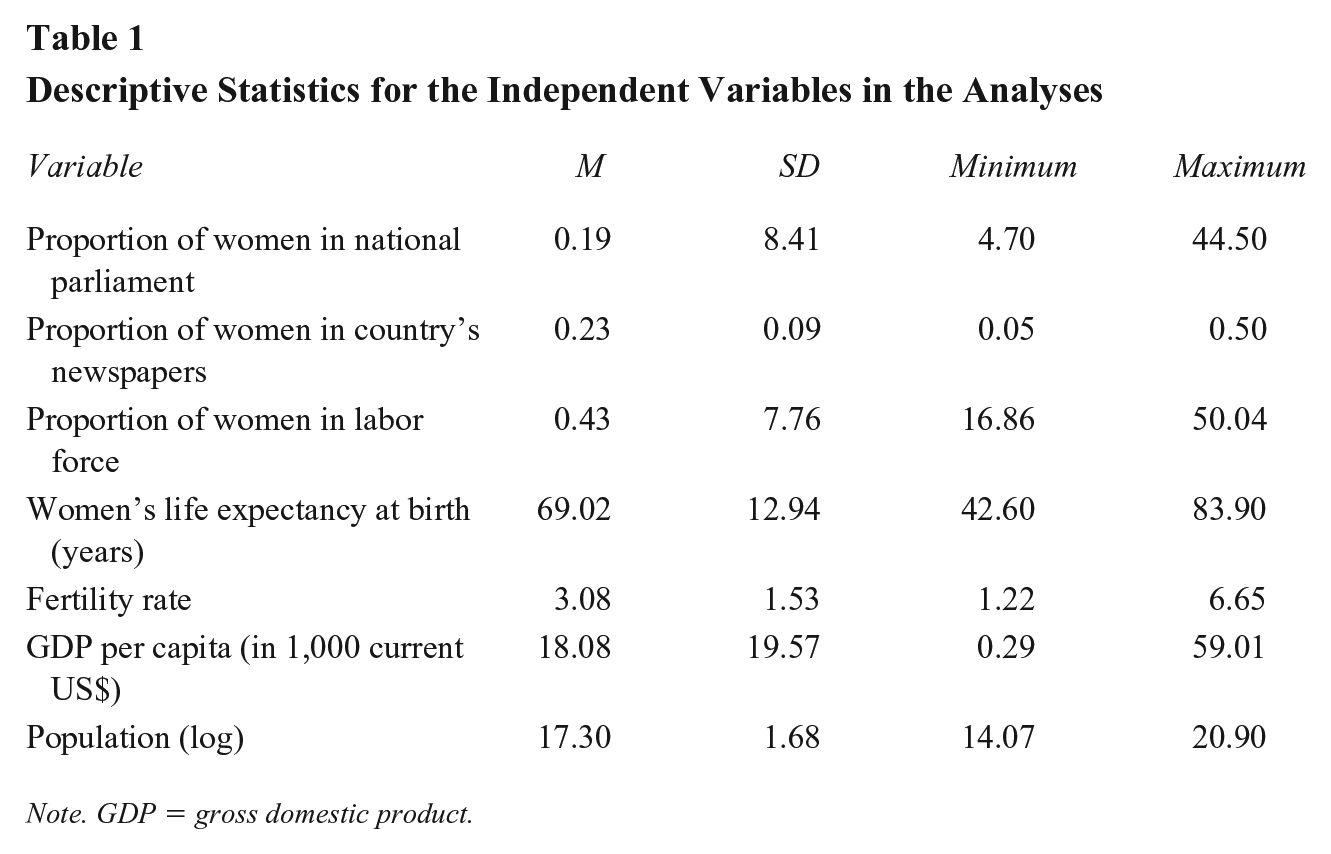
Note. GDP = gross domestic product.
Analytical Strategy
Results include both random and fixed effects cross-national panel analyses of the factors affecting a country’s newspapers’ sentiment toward women and men. The random effects models are important to assess, as some independent variables change relatively little over the 6 years of the study. However, these models tend to be less conservative and, in particular, they fail to adequately account for the potential problem of omitted variables. Therefore, country-level fixed effects models were also estimated, capturing how yearly changes within the country in each of the independent variables are associated with changes in coverage sentiment. Following standard practice, all models also control for time fixed effects (with years as dummy variables, as there is no reason to assume linearity).
Findings
Table 2 shows for each of the 17 countries in the analyses the proportion of women out of all names mentioned in its newspapers and the mean sentiment for both women and men in that country. Globally, women received 22.6% of coverage. The average sentiment for both women and men was overall positive, with the sentiment for women being somewhat more positive (0.183) than that for men (0.152). Examining individual countries in the analysis reveals that coverage volume did not always align with standard cross-national rankings of measures such as democracy or economic development. It is true that the countries ranked lowest in representation of women were Nigeria (only 8%), Zimbabwe, Pakistan and Ghana, all developing nations. Still, while some Western democracies (e.g., Canada, the United States and the United Kingdom) were ranked above average, others, such as Ireland, Australia and New Zealand were not, and the country where women had the highest share of all mentions (39%) was Kenya. Table 2 also shows that the overall advantage for women in coverage tone did not follow any clear pattern. Although women received a more positive coverage tone in most of the countries, there was no clear commonality for the countries where this was not the case (New Zealand, Singapore, Kenya and South Africa).
Descriptive Statistics for Coverage and Coverage Tone by Country

Table 3 presents the findings from the random and fixed effects panel analyses. Models 1 and 2 of the table show results for random and fixed effects for women, whereas Models 3 and 4 show the corresponding results for men. Confirming the study’s primary hypothesis, the proportion of women in a country’s national parliament is negatively associated with the coverage sentiment for women in the random effects models. That is, in countries that have a higher proportion of women serving in parliament, the overall coverage tone for women is more negative. Furthermore, these results remain significant in the fixed effects model (Model 2), showing that changes within countries’ parliaments are also important. As the share of women in a country’s parliament increases, their coverage tone becomes more negative. This variable was not significant for men, neither in the random effects (Model 3) nor in the fixed effects (Model 4) models, demonstrating that the effect is in fact unique to women and their coverage.
OLS Random and Fixed Effects Regression Panel Analyses of Factors Influencing Newspapers’ Sentiment Toward Women and Men in 17 Countries
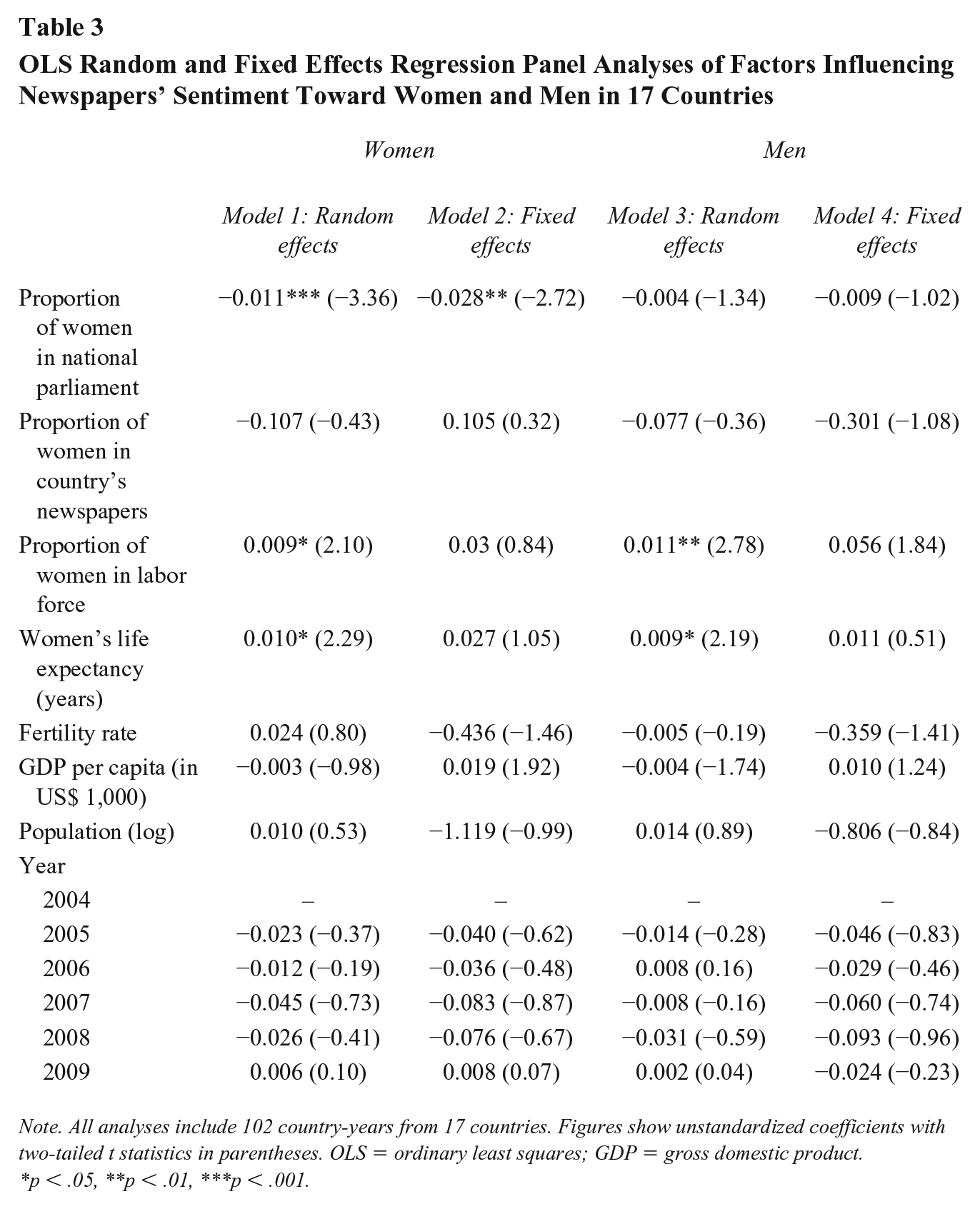
Note. All analyses include 102 country-years from 17 countries. Figures show unstandardized coefficients with two-tailed t statistics in parentheses. OLS = ordinary least squares; GDP = gross domestic product.
p < .05, **p < .01, ***p < .001.
Table 3 also presents results for the other predictors. Most of these did not have a significant effect on coverage tone for both women and men. The two exceptions are the proportion of women in the labor force and women’s life expectancy. As expected, both of these variables have a positive association with sentiment in the random effects model (Model 1). However, this effect was not limited to women, as the coverage tone associated with men was also more positive in countries where women had a higher share in the labor force and lived longer (Model 3). None of these effects were significant in the fixed effects models, but it should be noted that variability within countries for most predictors over the 6-year period of the study was relatively low.
Conclusion
This study examined the relationship between the parliamentary representation of women and news media coverage tone for both men and women. This was the first cross-national analysis to analyze this relationship, examining data on millions of female and male names appearing in more than 1,000 English-language newspapers in 17 countries.
Results showed that globally, women receive 22.6% of all the coverage, a figure that is in line with previous research findings on the percent of women in the news, both in North America and globally (Gallagher, 2010). Next, there was a significant relationship for women, but not for men, between parliamentary representation and news media sentiment. In countries with higher parliamentary representation of women, the coverage tone for women was more negative. In addition, when parliamentary representation of women increased within a country, this was accompanied by a more negative coverage tone for women in the newspapers of that country.
These findings demonstrate that despite the documented social benefits associated with greater representation of women (Bolzendahl, 2009; Bolzendahl & Brooks, 2007; Childs & Krook, 2009; Macmillan et al., 2018; Quamruzzaman & Lange, 2016; Shair-Rosenfield & Wood, 2017; Swiss et al., 2012), such greater representation in itself does not help women achieve more positive coverage. One possible reason for this is that the women who reach political success receive substantial news media coverage but this coverage is relatively negative. Such a negative relationship between fame and news media coverage sentiment for women has been previously suggested by case studies in various countries (Comrie, 2006; Gidengil & Everitt, 2003; Heldman et al., 2005; Trimble & Treiberg, 2010; van Acker, 2003). This study offers possible support for such a tendency. However, one must be careful not to conclude that this is necessarily indeed the case, as the data did not allow for a specific analysis of the news coverage for female politicians separately from the coverage for other women. It is therefore possible that the trends found here are in fact driven by the coverage of other women, rather than by the coverage of politicians, though it is unclear why this might be the case.
Assuming that the association is indeed, at least in part, the result of worse coverage for successful female politicians, one might wonder why this might be the case. That is, why might successful women in politics (and in other professions) receive more negative coverage despite their demonstrated success and the social benefits associated with it? While this study cannot offer a definitive answer to this question, gender scholars have previously noted that such success, in particular in fields traditionally dominated or even monopolized by men such as politics and business, is often perceived as threatening the gender hierarchies and the larger status quo, and therefore are treated with suspicion and hostility (Lamont & Fournier, 1992; Ridgeway, 2013; Rudman et al., 2012).
The results of this study may provide further support for these propositions and demonstrate another likely barrier for women’s success and for gender equality operating at the global level. Unfortunately, such a negative association between the rate of parliamentary representation and the tone of news media coverage may further contribute to the negative stereotyping of politically active women in both public and private domains. It may also have a negative effect on young women’s willingness to get involved in local and national politics, as they recognize the personal prices that they are likely to pay.
Supplemental Material
Supplemental_Appendices – Supplemental material for The price of greater representation: A cross-national analysis of parliamentary representation and media coverage sentiment for women
Supplemental material, Supplemental_Appendices for The price of greater representation: A cross-national analysis of parliamentary representation and media coverage sentiment for women by Eran Shor and Alex Miltsov in Newspaper Research Journal
Footnotes
Supplemental Material
Supplemental material for this article is available online.