




Abstract
The Federal Trade Commission (FTC) regulates advertising associated with dietary supplements, acting for consumers in cases of deception. This study examines the extent to which regional and national newspapers responded to 177 FTC press releases about deceptive claims associated with weight-loss supplements. Of 177 FTC press releases, 77 (43.5%) received at least some coverage in 212 newspaper reports; however, a relatively small number of releases accounted for the preponderance of coverage. Marked increases in news reports at certain points reflected FTC press releases involving multiple companies, new initiatives and the “superfood” acai berry.
Keywords
In the United States, the Federal Trade Commission (FTC) regulates advertising associated with dietary supplements, which now exceed $40 billion in annual sales (Eskin, 2019). More than one in two individuals uses at least one supplement (Dwyer & Coates, 2018), and that number appears relatively stable. To attract consumers, the industry spends more than $900 million per year on advertising (Kantar Media, 2018), and upward of 90,000 supplements are available for purchase (Manson & Bassuk, 2018). To gain a competitive advantage, companies sometimes exaggerate the effects of their products, promising stellar—and largely unsubstantiated—results (see Lellis, 2016). Deceptive claims lead the FTC to issue warnings and, if necessary, file complaints in U.S. district courts (Correia, 2004; Swindle, 2004). Like the Food and Drug Administration (FDA), the FTC publishes press releases about legal actions on its website, allowing journalists monitoring the site to convey that information to their own audiences. Whereas studies have examined news references to FDA press releases (Nucci et al., 2009; see also Woloshin et al., 2017), few have examined use of FTC communications.
This study examines the extent to which newspapers responded to 177 FTC press releases about weight-loss supplements across a 26-year period, April 1995 to May 2020. Research has shown deficits in consumer knowledge about supplement regulations (Dodge et al., 2011) as well as vulnerability to persuasive appeals, especially among younger audiences (Hobbs et al., 2006; see also, Mishra, 2017; Pomeranz et al., 2015). In some instances, such appeals involve potentially harmful behaviors (Ethan et al., 2016). By providing information about FTC actions, news articles stand to increase awareness of deceptive tactics (see Lim et al., 2020), provided articles do not misstate or exaggerate the contents of agency press releases (Rossmann et al., 2018).
Review of Literature
Regulation of the Supplement Industry
Under the Dietary Supplement Health and Education Act of 1994 (DSHEA), manufacturers do not have to demonstrate product safety and efficacy prior to marketing dietary supplements. While government agencies can inspect supplements after products enter the marketplace, premarket inspection generally does not occur (Avery et al., 2013; Vladeck, 2000). This absence of inspection has allowed bad actors to market products containing few, if any, active ingredients (Marcus & Grollman, 2012). The FDA has also identified more than 1,050 adulterated supplements (Food and Drug Administration, 2021; see also, Tucker et al., 2018), and investigators continue to discover products that contain actual drugs (Baume et al., 2006; Cohen et al., 2015; Li et al., 2020; Rocha et al., 2016). Athletes have failed drug tests because of tainted supplements (Maughan, 2005), and, in one case, more than 30 individuals suffered liver failure or acute hepatitis after using a “fat-burning” product (Park et al., 2013).
Deceptive claims in advertisements account for another set of industry problems. In Dietary Supplements: An Advertising Guide for Industry, the FTC explains that “Advertising for any product—including dietary supplements—must be truthful, not misleading, and substantial” (Federal Trade Commission, 2001, p. 1). That standard applies to print and broadcast advertisements, infomercials, catalogs and direct marketing materials. The FTC continued, “A deceptive ad is one that contains a misrepresentation or omission that is likely to mislead consumers acting reasonably under the circumstances to their detriment” (Federal Trade Commission, 2001, p. 3). The FTC does not regulate the volume of message content, only whether it is truthful and not misleading (Khatcheressian, 1999).
Regarding weight-loss products, in particular, the FTC (2014b) provides guidance for news organizations in its online publication Gut Check: A Reference Guide for Media on Spotting False Weight Loss Claims. As Correia (2004) explained, the guide applies to nonprescription diet products, which include over-the-counter drugs, dietary supplements, skin patches, creams and wraps. Gut Check itself warns news outlets to avoid publishing advertisements that contain any of the following claims (quoted verbatim):
Causes weight loss of two pounds or more a week for a month without dieting or exercise; causes substantial weight loss no matter what or how much the consumer eats; causes permanent weight loss even after the consumer stops using the product; blocks the absorption of fat or calories to enable consumers to lose substantial weight; safely enables consumers to lose more than three pounds per week for more than four weeks; causes substantial weight loss for all users; causes substantial weight loss by wearing a product on the body or rubbing it into the skin.
Those seven claims were part of a “Red Flag” media education campaign launched by the FTC in December 2003 (Federal Trade Commission, 2003). The FTC provided news outlets with information about false claims and encouraged them to review the seven items prior to accepting advertising for weight-loss products. Newspapers, like advertising agencies, product manufacturers and celebrity endorsers, are responsible for claims made in weight-loss advertisements (see Brison et al., 2020; Lellis, 2016; Pickett & Brison, 2019). Avery et al. (2013) observed some success with the Red Flag initiative, finding fewer false and potentially misleading statements; however, deception did remain, as Schein et al. (2020) recently found. Additional FTC initiatives have included “Operation Big Fat Lie,” in which law-enforcement agencies targeted six firms making false claims (Federal Trade Commission, 2004). The FTC also launched a 2014 initiative to address deceptive claims surrounding fad weight-loss products (Federal Trade Commission, 2014a). On that point, Roberts (2018) suggested that the FTC may become increasingly important if misinformation and inaccuracies continue to increase in the digital era.
News Processes
Fundamentally, the FTC is concerned with deception in advertising, and when it takes action against one or more companies, it announces those actions in press releases posted to its website. In the news media, gatekeepers decide whether information contained in press releases warrants inclusion in news reports. Shoemaker and her colleagues (2001) conceptualized gatekeeping as “the process by which the vast array of potential news messages are winnowed, shaped, and prodded into those few that are actually transmitted by the news media” (p. 233). Shoemaker and Reese (1996) had previously informed gatekeeping by proposing a five-tier model of influences on news media content, including the characteristics of individual journalists, news media routines, organizational imperatives, extramedia influences and cultural considerations. The influences they proposed help to establish a theoretical framework for the current study.
Individual characteristics of journalists include factors such as sex, race and education, while media routines include considerations such as news values, which have conventionally included conflict, impact, prominence, proximity, timeliness and unusualness (Parks, 2019). This study focuses on deception in advertising, as covered in FTC press releases. As a news value, conflict is inherently present, as is timeliness, given a relatively short lag between dates of press releases and subsequent dates of news reports. News values that stand to vary more than conflict and timeliness include proximity, prominence and impact. For proximity, one might expect newspapers in a certain region to report primarily on FTC cases in that region, with less emphasis on situations elsewhere. One also might anticipate more frequent reporting on cases involving celebrity endorsers (see Brison et al., 2020; Moorman, 2006; Pickett & Brison, 2019). As Blumell and Hellmueller (2019) pointed out, celebrity coverage has become an economic good for news organizations, especially in recent years, with many celebrities becoming “influencers” (and increasing their popularity) through social media. Finally, one might anticipate more coverage of FTC press releases when information stands to affect comparably large numbers of people or have significant consequences for individuals who use supplements (Parks, 2019).
At the third level of the Shoemaker and Reese (1996) model, organizational imperatives, news media outlets generally seek to maximize profit. Among extramedia influences, press releases serve the economic interests of news organizations by offering content at little or no cost. In fact, Gandy (1982) characterized press releases as information subsidies, reasoning that news organizations spend less money publishing press-release content than they do paying reporters to fill comparable space (see also, Griffin & Dunwoody, 1995; Turk, 1986). Research has shown that while increased economic constraints have led to increases in the use of press-release information, the practice is both limited and nuanced (Boumans, 2018; Curtin, 1999; Len-Rios et al., 2009). As an example, Anderson (2001) found that while companies influenced the press on what to cover, they did not appear to influence how coverage appeared in news media. Woloshin et al. (2017) studied the extent to which news media reported on two FDA drug safety communications, finding that although the first communication received significant coverage, the latter did not; the authors speculated that coverage fatigue may have impacted the results (see also, Gunn, 2019).
Additional studies have examined the influence of press releases on news about pandemics. In a study involving press releases and news coverage surrounding the A/H1N1 influenza pandemic, Rossmann et al. (2018) found that news reporting amplified risk by emphasizing conflict, drama and appeals to emotion. Also studying the A/H1N1 pandemic, Lee (2014) found that news releases focusing on preventive frames gained more press coverage, as did those that involved emotional appeals. In a study involving news coverage of the “obesity epidemic,” Saguy and Almeling (2008) found that press releases impacted how issues were framed. Apart from pandemic and epidemic news, Nucci et al. (2009) analyzed the influence of FDA press releases on television news coverage of a 2006 spinach recall, observing consistent use of press-release information.
Guided by gatekeeping theory, as informed by influences on media content, this study examines the extent to which newspapers reported on FTC press releases about weight-loss supplements. The study is guided by three research questions.
Research Questions
Method
Materials
Press releases
Using the search term “weight loss supplements,” the author in July and August 2020 gathered press releases published by the FTC [ftc.gov] between April 1995 and May 2020. The search generated 204 press releases, 177 of which met criteria for inclusion; that is, 177 releases pertained specifically to weight-loss supplements (not equipment) and identified actions taken against at least one company or one product. No press releases appeared prior to 1995, and therefore the study included weight-loss-supplement releases published after the DSHEA became law in 1994. In general, more than one press release pertained to each of 78 cases (i.e., ongoing situations involving the same entities) acted upon by the FTC; the Supplemental Appendix for this study includes detailed information concerning dates, cases, press releases and news reports.
News reports
News reports appearing between April 1995 and May 2020 came from two sources, Google News and Nexis Uni. Google News is a news aggregator, which, according to Haim et al. (2018), focuses almost entirely on the distribution of news: “As such, their underlying algorithms are geared toward news consumption rather than social interaction or the identification of search query patterns” (p. 331). Google News scans more than 50,000 news sources in some 30 languages and has reported 1 billion unique users per week (Filloux, 2013). Haim et al. (2018) found that while the search engine privileged some newspapers over others, the personal characteristics of users had little effect on searches. LexisNexis operates Nexis Uni, which is geared to university audiences and features more than 17,000 sources in news, business and law (LexisNexis, 2021). Nexis Uni does not feature as many smaller news operations as Google News does, but journalism scholars have routinely used Nexis in newspaper research. This study used both Google News and Nexis Uni to ensure that it included a complete sample of newspaper reports citing FTC press releases.
The author gathered newspaper reports systematically by entering the names of companies and the names of products along with the term FTC. If a resulting report appeared within 30 days of an FTC press release, then the author recorded the name of the news organization along with the press release it referenced. Because the study focused on both regional and national newspapers, it did not impose restrictions on newspapers included. It did follow existing research (Bleich et al., 2020; Hettinga et al., 2018) in classifying the following as national news organizations: the Los Angeles Times, the New York Times, USA Today, the Wall Street Journal and the Washington Post. Coverage in one or more of these outlets would suggest news of interest to national audiences, shedding light on impact. Regarding wire services, the study accounted for breadth of news coverage by including each news outlet in which a given report from the Associated Press (AP), Reuters or United Press International (UPI) appeared. In cases where no news outlets published a wire report, the study recorded the name of the wire service itself. This approach necessitated the use of descriptive statistics, as opposed to inferential, in that a single wire report sometimes appeared more than once, affecting independence among observations.
Operational Definitions
With conflict and timeliness assumed, this study examined the potential content influence of the news values proximity, prominence and impact. The study considered proximity present when one or more newspapers in states in which the FTC took action published reports citing information contained in FTC press releases. Prominence was measured by comparing percentages of celebrity endorsements mentioned in FTC press releases, as reported in newspapers, with celebrity endorsements in FTC materials not reported in newspapers. Similarly, following Parks (2019), the study operationalized impact by comparing the number of individuals affected by false advertising (i.e., the number of individuals scheduled to receive refund checks from the FTC), as well as specific monetary amounts, in press releases reported in newspapers and press releases not reported.
Operationally, the study also recorded the number of mentions an FTC press release generated in national newspapers, as such mentions would suggest news of interest to national audiences. Additional measures included the month, day and year in which a release appeared. The study operationalized newspaper presence of FTC press-release information based on names of companies and/or names of weight-loss supplements plus mentions of FTC actions. Again, news reports had to appear within 30 days of corresponding press releases.
Results
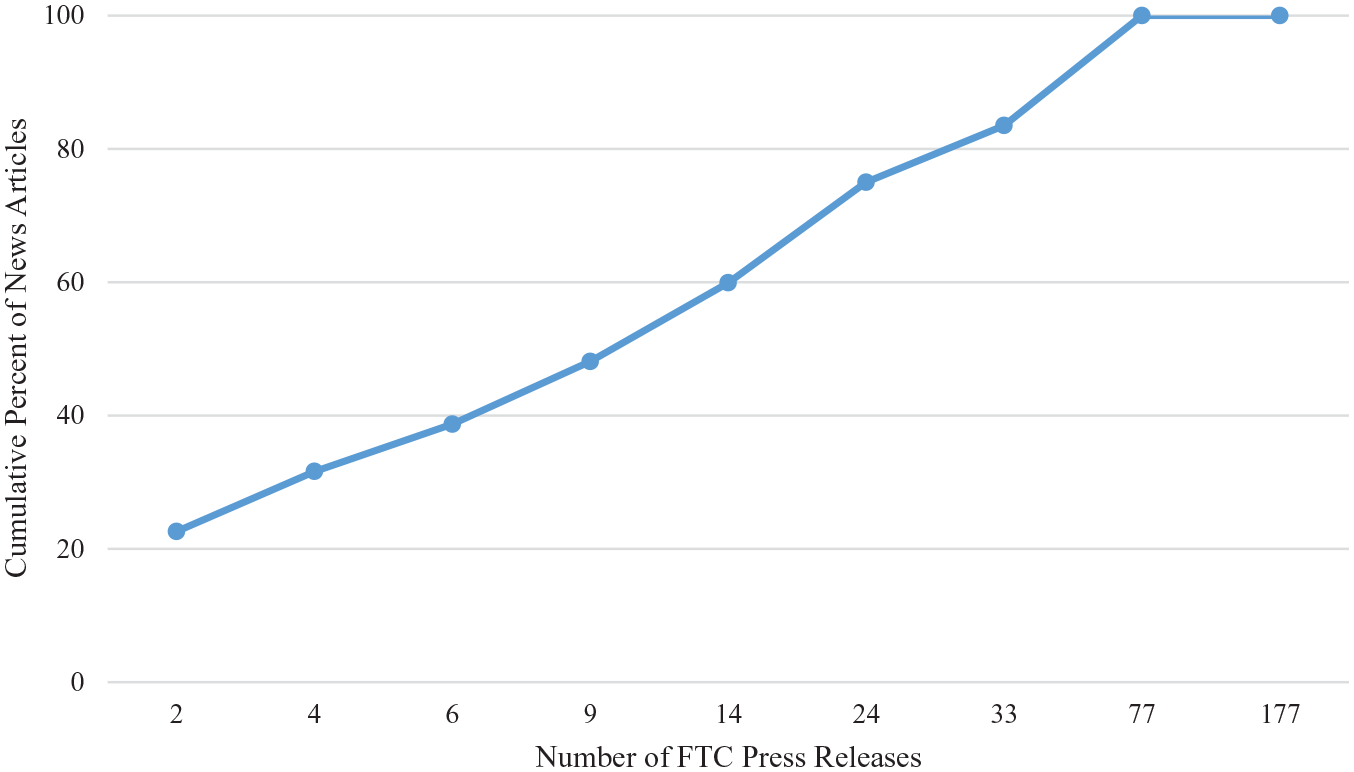
Cumulative Percentage of News Articles Based on Number of Press Releases
Proximity
Prominence
Prominence did not emerge as a strong news determinant, as celebrities appeared in just eight (10.4%) of 77 press releases acted upon by news agencies and eight (8%) of 100 press releases not covered in newspapers. When celebrities were present in news articles, coverage addressed two FTC matters, the first of which involved the acai berry as a “superfood.” Dr. Mehmet Oz had discussed its antioxidant properties on the Oprah Winfrey show in 2008, and internet marketers cited Oz and Winfrey as product endorsers. In fact, Oz and Winfrey did not provide endorsements of the acai berry, and both filed suit against more than 40 internet marketing companies. Second, former Major League Baseball player Steve Garvey appeared in three reports concerning a weight-loss formula, The Enforma System.
Impact
The study operationalized impact by comparing the number of individuals affected by false advertising (i.e., the number of individuals scheduled to receive refund checks from the FTC), as well as specific monetary amounts, in press releases reported in newspapers and press releases not reported. Among press releases receiving newspaper coverage, four (5.2%) of 77 specified a number of refund checks due consumers; these figures included 1,951, 3,483, 18,301 and 447,083, respectively. Monetary amounts were more frequent, appearing in 30 (39%) of 77 press releases cited in newspapers. A total of 27 cases mentioned settlements and fines ranging between $200,000 and $155 million (Median = $2 million). (The large variance in scores yielded a somewhat misleading mean of $12,507,037 [SD = $30,048,438]. As is common in such instances, the standard deviation exceeded the value of the mean.) Three suspended settlements included amounts of $6 million, $22.5 million and $359 million.
Among press releases not receiving newspaper coverage, 17 (17%) of 100 specified a number of refund checks due consumers; figures ranged from 1,596 to 442,898, with a median of 104,612. A total of 54 (54%) of 100 press releases indicated a specific amount of money, with 51 mentioning settlements and fines ranging between $35,000 and $30 million (Median = $1,900,000). (Again, a large variance in scores yielded a somewhat misleading mean of $4,194,630 [SD = $5,827,224]). Suspended settlements included amounts of $923,000, $2.1 million and $179 million.
Numbers of checks due consumers and amounts of FTC settlements and fines did not explain press coverage in the direction anticipated, as press releases not receiving coverage tended to contain more frequent indicators of individuals affected and amounts of FTC actions. Findings, thus, did not support those measures as drivers of news coverage. But the study also included additional indicators of impact as a news value. The analysis located a total of 212 newspaper reports referring to information in FTC press releases, and of that number, 52 (24.5%) appeared in national news outlets. From the standpoint of press releases, at least one national news report appeared in 33 (42.9%) of 77 instances in which an FTC press release gained media attention. Figure 2 shows (a) the number of FTC press releases, (b) the number of non-national newspaper articles and (c) the number of national newspaper articles that appeared in each year of the study. As shown in Figure 2, national newspapers clustered in select instances, with five national outlets responding to a January 7, 2014, press release. In four instances, three national outlets responded. Thus, five news releases accounted for 17 (32.7%) of 52 national news reports.
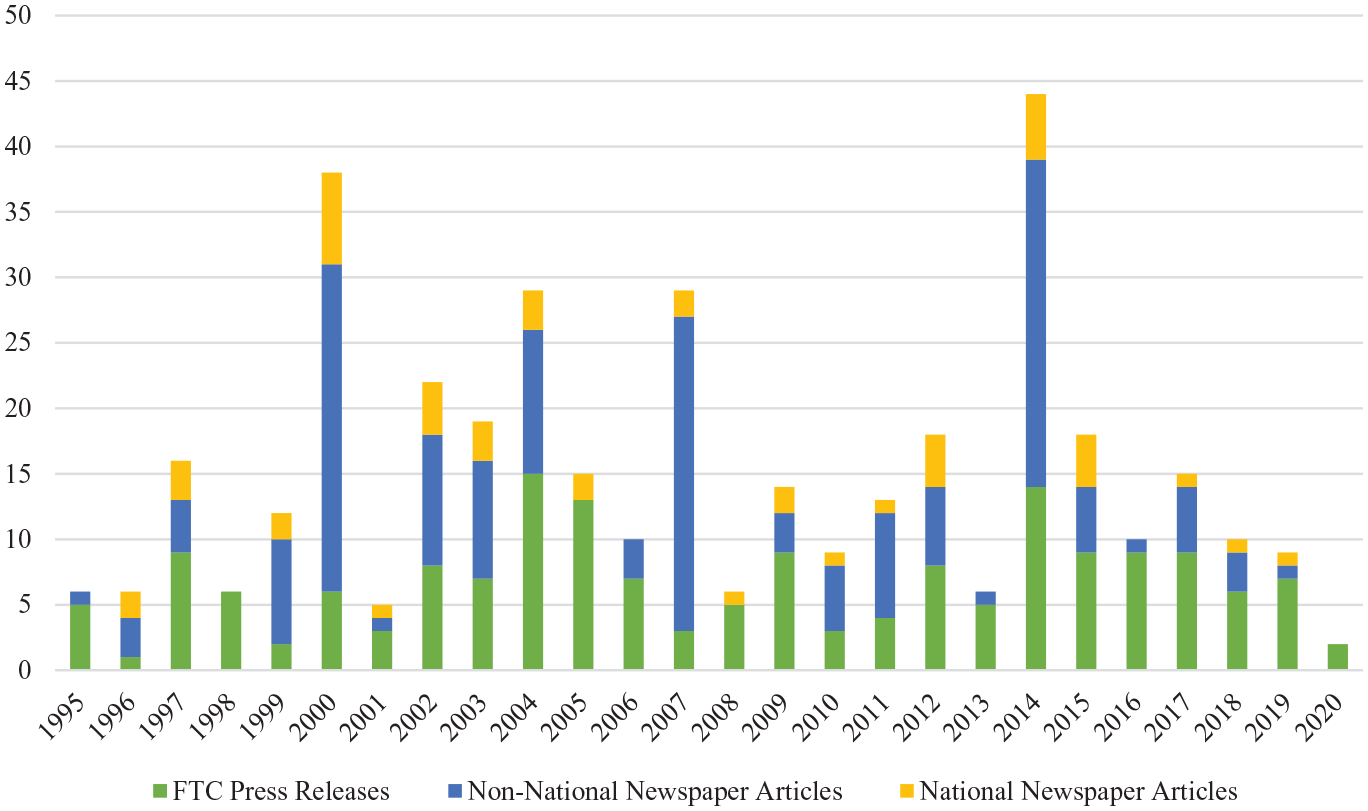
Yearly Counts of FTC Press Releases, Non-National Newspaper Articles and National Newspaper Articles
Examining Figure 2, 3 years stand out, the most recent in 2014. That year showed a marked increase in both press releases (N = 14), non-national (N = 25) and national newspaper reports (N = 5). In examining cases listed in the Supplemental Appendix, 22 (total) newspaper reports referred to a January 7, 2014, press release (Federal Trade Commission, 2014a). It announced, “Operation Failed Resolution,” an initiative designed to combat misleading claims in weight-loss-supplement advertising. The release discussed actions taken against four marketers of weight-loss products—Sensa, L’Occitane, HCG Science Direct and LeanSpa—and announced total consumer redress at $34 million. Increases in newspaper reports appeared to reflect the announcement of an FTC initiative, the involvement of multiple firms and, to a more limited extent, the amount of money collected toward consumer redress. Newspapers in the state in which the situation occurred, Connecticut, covered the story, as did five national newspapers.
Figure 2 also showed a comparably large number of newspaper articles in 2007. The FTC produced less than five press releases, but one of the releases, published in January (Federal Trade Commission, 2007), accounted for all 26 non-national and national news reports. The press release addressed actions taken against marketers of four weight-loss products: Xenadrine EFX, CortiSlim, TrimSpa and One-A-Day WeightSmart. Thus, like the January 7, 2014, press release (Federal Trade Commission, 2014a), the January 2007 release discussed actions involving four different entities. RTC Research and Development marketed Xenadrine EFX and agreed to pay between $8 and $12.8 million. A U.S. district court in California ordered seven marketers of CortiSlim to surrender assets worth approximately $12 million, with marketers of TrimSpa paying $1.5 million. A court in New Jersey ordered the Bayer Corporation to pay a $3.2 million civil penalty for violating an earlier FTC ruling.
Seven years earlier, FTC press releases resulted in 32 total newspaper reports. The FTC in 2000 announced actions against Modern Interactive Technology, Enforma Natural Products and the Garvey Management Group, Inc. First, an April 2000 press release stated that Enforma Natural Products would pay $10 million toward consumer redress for deceptive claims associated with “The Enforma System” and its two principle products, Fat Trapper and Exercise in a Bottle (Federal Trade Commission, 2000a). Thirty-minute infomercials for The Enforma System had featured former Major League Baseball player Steve Garvey. A second press release, in September 2000 (Federal Trade Commission, 2000b), announced additional charges against individuals associated with the infomercial, including Modern Interactive Technology and the Garvey Management Group. In this situation, the celebrity of Steve Garvey likely accounted for at least some of the regional newspaper coverage.
Discussion
This study found that 77 (43.5%) of 177 FTC weight-loss-supplement press releases received at least some coverage in 212 newspaper reports. Much of the recent research in this area has appeared in international contexts, and it is, therefore, difficult to discern whether FTC efforts were successful or unsuccessful. But some basic comparisons can be made. In a study involving the A/H1N1 influenza pandemic, Lee and Basnyat (2013) linked 55 (34.8%) of 158 press releases from the Singapore Ministry of Health to 57 published news stories. In a study involving Belgian news coverage of international aid issues, Van Leuven and Joye (2014) linked 61 (31.1%) of 196 press releases to coverage in 56 news reports. Using an automated approach to examine the influence of 4,455 press releases on Dutch newspaper and news agency content across a 10-year period, Boumans (2018) found that approximately one in 10 newspaper articles had been initiated by a press release.
In comparative terms, then, FTC materials appeared reasonably well-placed, but it should be noted that the majority of items (56.5%) did go unreported. In addition, a relatively small number of press releases accounted for the preponderance of newspaper reports. Figure 1 showed that two press releases accounted for 22.6% of newspaper articles, with nine accounting for 48.1% and 24 accounting for 75%. These findings appear consistent with studies showing that journalists tend to monitor content in other news outlets in deciding what to publish in their own newspapers (see Gans, 1979; Tuchman, 1978; for more recent discussion, see Carlson, 2017; Vos & Heinderyckz, 2015). Elite newspapers often define and legitimate news for other outlets, and, in this study, news outlets clustered around a limited number of FTC press releases. Wire services also contributed to this process by making specific content readily accessible to member newspapers.
Operationally, the study considered proximity present when one or more newspapers in states in which the FTC took action published reports citing information in FTC press releases. As a news value and determinant of coverage, proximity appeared more consequential than prominence and impact. As an example, one might consider newspaper coverage in Utah, where dietary supplements are a leading industry (Lipton, 2011). From 1998 to 2018, Utah politicians Orrin Hatch and Mitt Romney were ranked no. 1 and no. 2, respectively, in donations from the supplement industry (Brown, 2019). Hatch co-wrote the DSHEA legislation and championed the industry during his time in the U.S. Senate. Given such industry connections, the Deseret Morning News and Salt Lake Tribune could be expected to report on FTC press releases with implications for Utah, and they did so on multiple occasions. Florida did not have as much at stake as Utah, nicknamed the Silicon Valley of the supplement industry (Lipton, 2011), but newspapers there nevertheless provided consistent reporting on FTC supplement cases. Newspapers in other states appeared more sporadic in coverage, but they did provide reports.
The study measured prominence by comparing celebrity references in press releases covered by newspapers with celebrity references in press releases not covered. Quantitatively, this approach showed little support for prominence as a news determinant, as few differences emerged across press releases covered and not covered. As noted, much of the coverage involved the purported “superfood” acai berry, which had been discussed on the Oprah Winfrey show by celebrity doctor Mehmet Oz and featured in books by Dr. Nicholas Perricone, also a guest on the Winfrey program (Parker et al., 2019). As the Associated Press (2004) reported, an appearance on the program in November 2004 resulted in one Perricone book rapidly becoming the no. 1 bestseller on Amazon.com and another moving to no. 2. This would, in turn, have resulted in the books appearing on lists in daily and weekend newspapers, further increasing the popularity of the books and the acai berry itself. Some sellers perhaps sought to gain an edge by exaggerating the weight-loss capacities of the berry, resulting in FTC actions.
In addition to proximity and prominence, the study examined impact as a news value. It first compared the number of refund recipients indicated in press releases reported in newspapers with the number of recipients in press releases not covered, doing the same with monetary amounts. This approach to impact showed few differences between press releases reported and not reported, with press releases not reported containing more references to those receiving refunds. In terms of monetary amounts, median scores for the two groups were nearly even, with press releases covered in newspapers showing a median of $1.9 million and press releases not covered $2 million. Regarding national news coverage, the analysis located a total of 212 newspaper reports referring to information in FTC press releases, and of that number, 52 (24.5%) appeared in national news outlets. On their face, these figures indicate adequate representation, but the reporting clusters mentioned earlier temper the findings.
Regarding impact on their own industry, journalists may have paid extra attention to companies that created fake news sites and claimed that company products had been featured on national newscasts and in prominent national newspapers. As the FTC reported in one release (Federal Trade Commission, 2012), six companies used fake news sites to deceive purchasers of acai-berry supplements and additional weight-loss products: With titles such as “News 6 News Alerts,” “Health News Health Alerts,” or “Health 5 Beat Health News,” the sites often falsely represented that the reports they carried had been seen on major media outlets such as ABC, Fox News, CBS, CNN, USA Today, and Consumer Reports. Investigative-sounding headlines presented stories that purported to document a reporter’s first-hand experience with acai berry supplements—typically claiming to have lost 25 pounds in four weeks, according to the FTC complaints.
In addition to misleading information about news outlets, the weight-loss amount indicated they would not have met standards outlined in the FTC guidebook Gut Check (Federal Trade Commission, 2014b), as the amount would have been considered unsafe. In fact, FTC guidebooks and initiatives helped to explain newspaper coverage of FTC press releases, in general. For instance, Figure 2 showed that announcements of initiatives such as “Operation Failed Resolution” (Federal Trade Commission, 2014a) and the pursuit of multiple companies (Federal Trade Commission, 2000a, 2000b, 2007) corresponded to increases in coverage. In that respect, it appears that more than one factor explained newspaper coverage of FTC press releases, with coverage announcing new crackdowns or a series of companies targeted by the agency. Proximity added to those explanations.
Like most studies, this research has potential limitations. Although the study gathered news reports from two databases and sought to include as many reports as possible, certain news organizations may not have made content readily accessible. But overall, newspaper references to FTC press releases appeared both complete and evenly dispersed, especially among the national newspapers analyzed in the study. Researchers might replicate this study by extending it to the FDA, which acts on deceptive claims made on product labels and packaging and also monitors the legitimacy of products themselves. Like the FTC, the FDA maintains records of press releases about cases on which it acts, and its broader purview on dietary supplements might generate a larger and more diverse pool of regulatory actions. Moving forward, scholars also might replicate this study by examining deceptive claims surrounding Coronavirus “cures,” as the FTC website listed multiple cases in a relatively short period. It would be interesting to observe whether false claims made about products made available in a pandemic exceed those made across time regarding weight-loss supplements. Such research also might shed light on how news outlets reported on Coronavirus announcements relative to A/H1N1 communications along with press releases involving additional pandemics and epidemics.
Supplemental Material
sj-docx-1-nrj-10.1177_07395329211013994 – Supplemental material for Deception in weight-loss advertising: Newspaper use of press releases issued by the Federal Trade Commission
Supplemental material, sj-docx-1-nrj-10.1177_07395329211013994 for Deception in weight-loss advertising: Newspaper use of press releases issued by the Federal Trade Commission by Bryan E. Denham in Newspaper Research Journal
Footnotes

References
Supplementary Material
Please find the following supplemental material available below.
For Open Access articles published under a Creative Commons License, all supplemental material carries the same license as the article it is associated with.
For non-Open Access articles published, all supplemental material carries a non-exclusive license, and permission requests for re-use of supplemental material or any part of supplemental material shall be sent directly to the copyright owner as specified in the copyright notice associated with the article.
