



Abstract
This qualitative analysis examines the frequency and sentiment of immigration-related posts by media organizations and audience reactions on Facebook from the last term of Barack Obama’s presidency and the first term of Donald Trump’s presidency, January 2013–December 2020, under the lens of critical race and agenda building theories. Results indicate that news media have increased posting about this topic since 2013, the sentiment is statistically negative and audiences have elevated their participation over time.
The first debate of the 2016 presidential election, held on September 26, drew an estimated 84 million broadcast viewers, the most in recorded history for televised debates at that time (Stelter, 2016). Audiences also chose to participate in these debates via live streaming. More than 20 news outlets partnered with Facebook during that presidential election cycle to host live broadcasts, wherein audience members could interact in real time with coverage through varied forms of audience engagements, such as comments, shares and reactions (like, love, wow, haha, angry, sad) (Gold, 2016). A frequent topic in the 2016 debates, and subsequent news media coverage, was immigration. This was also a top issue for voters, along with the economy, health care, gun policy and foreign affairs (Pew Research Center, 2016). The United States–Mexico border and immigration policy became a high priority once Donald Trump was elected president and continued to be an ongoing media topic through the COVID-19 pandemic.
Access to information has evolved with the broad use of social media platforms by news and media organizations, utilizing Facebook, Twitter, TikTok and more to better engage audiences. Reporting news, delivering political commentary or creating satirical news-related content, as seen in late-night talk shows, often involves mixed-media approaches such as broadcast, print, social media, websites, apps and collaborations with digital aggregates that disseminate articles, such as Apple News. Topics of national concern are hyper-focused during presidential elections when candidates make policy plans (or at least claims) to align with their base of supporters and political commentary is covered by news and entertainment platforms.
The 2016 election was unique in not only the levels of access to candidate news but also misinformation on social media platforms. Facebook received scrutiny of its business practices for the volume of articles and information published to the site that were deemed clickbait, junk and false news stories prevalent throughout the site and designed to sway voters (Wang & Sebenius, 2019). To mitigate the risk of using these sites for this study, data were extrapolated from social media feeds of news platforms and media entertainment companies that had administrators located in the United States and were verified by Facebook, which entails a process of submitting business documents to the company. Including entertainment media that regularly does political commentary or satire provides a better view of how media may work in tandem to build influence for topics introduced by political figures. Entertainment media also include characterizations of people of color that might impact legislation and/or attitudes toward minority groups.
This study examines immigration-related mentions in Facebook posts by media organizations during the last term of President Barack Obama and the term of President Donald Trump (January 2013 to December 2020). Portrayals of immigration, including analyses of modifiers and the frequency of this topic or related stories by news media, have been researched. However, examining media posts on immigration centered around specific presidential terms and incorporating both emotion-based audience reactions and exploring critical race and agenda-building theories via multiple media has not been previously done. Research also has been conducted only on large, national, legacy news organizations, and attention has not been given to entertainment media that provide satirical or host-generated political commentary that may reinforce presence of various topics on Facebook pages of print and broadcast news.
Research also has explored the news framing of the 2016 presidential election, and agenda-building studies have focused on politicians’ use of press releases or social posts to influence news coverage in ways helpful to them. Trump consistently utilized Twitter for direct interaction with followers and, in part, to promote specific policies, before Twitter banned him for his tweets before and during a White supremacist insurrection at the U.S. Capitol on January 6, 2021 (Allyn & Keith, 2021); Trump was then impeached for a second time, for inciting the insurrection. Agenda-building research often overlooks the possible influence of audience participation through social media content, and the positioning of people of color during this process.
McCombs and Shaw (1972) proposed an agenda setting model about the 1968 presidential election and positioned news organizations as gatekeepers of information, often setting the agenda for what would be considered newsworthy information for the public. But audiences interact with news stories in limited ways and now easily and broadly via comments, shares and reactions on social media, suggesting a more participatory model where media (both news and entertainment here) is often influenced by audience behavior, so media and audiences work in tandem to influence attitudes, assumptions and policies impacting various groups. This is agenda building, originally a political science-grounded framework (Cobb & Elder, 1971).
The assumptions and attitudes derived from these actions that both influence policy and have an impact on specific groups, in this case immigrant populations who are predominantly people of color, are best ascribed to critical race theory. Developed by Derrick Bell, Alan Freeman and Richard Delgado, critical race theory holds that societal issues are rooted in cultural assumptions about people of color that may impact law, education, media and other structures that are utilized to uphold racial inequalities (Bell, 1995; Delgado & Stefancic, 1998). Crenshaw (1991) expanded this to include intersectionality, where a person’s multiple identities, such as a person of color and an immigrant, create a heightened experience of oppression. This study focuses on the intersectionality of being both an immigrant and a person of color.
Agenda-Building Uses
As agenda-building theory is predicated on a reciprocity between media and the public figures to influence policy and opinion, continuing scholarship on this relationship is nuanced. Berkowitz (1987), for example, showed close ties between routine-oriented news media and members of the public who might assist in some stories being covered with information from press releases or political candidates. In more recent years, journalists noticed social media audiences focusing on some newsworthy content and not others.
Audiences as actors in agenda setting is not studied as often as political press releases or social media posts. But Pérez-Díaz et al. (2020) tested agenda-building theory by gauging audience influence on news topics via comparing cover page digital stories to trending topics on Twitter. They found that topics trending more gained more lasting prominence on digital news sites and that hard news gained more participation from online audiences on the social platform. Abdenour (2016) found that investigative television journalists are using social media more often to gather news and story ideas from the public.
While Twitter is a consistent source of news and information, Americans continue to utilize Facebook as their primary news source. With over 2.5 billion active monthly users around the world and 186 million daily users in the United States alone, Facebook continues to evolve and adjust users’ news feeds to better reflect accurate information (“Facebook Q1 2019 Results,” 2019). Facebook offers multiple possible actions, from live video integrations with comment threads in real time to emotion-based icons such as “like,” “love,” “care,” “haha,” “sad,” “angry” and “wow.” Such emotion-based reactions allow for more in-depth understanding of audience attitudes, helpful for this research’s contextual analysis. The range from “like” to “angry” could be utilized similarly to a Likert-type scale.
Viewer participation on social media may have an influence on future content (Jacobson, 2013). Jacobson found that Rachel Maddow Show audience discussions on Facebook on particular topics were followed by shows on those topics. This prompts the question of whether show producers make content decisions based on Facebook and suggests audience members on social may influence agenda building.
Facebook aggregates both news and entertainment in an “All Media” list through its Crowdtangle platform that monitors posts and engagements across pages and open groups. In this study, entertainment media were included as: they are part of the list sourced, are within the scope of critical race theory in media and provide a broader view of audience participation with relevant news topics. Late-night series such as The Daily Show, Saturday Night Live and The Colbert Report include relevant discourse on politics, but their influences on audiences in conjunction with news outlets are rarely explored.
Kilgo et al. (2016), studying 400 native news stories on Facebook and Twitter, found that news associated with politics (government) was sensationalized like crime, but audiences were not more likely to engage sensationalized material (although that may have been due to the topics, not sensationalism). Kaur et al. (2019) found that certain Facebook users shared content as a form of “self-presentation,” and engaging based on reactions is a more passive activity requiring less cognitive processing than commenting or sharing.
In 2018, Facebook shifted its algorithm to feature more content on user feeds shared by friends or connections in part as an effort to help mitigate the spread of inaccurate news information (Mosseri, 2018); this had vast impact on what Facebook users saw.
While Bennett (2012) defines personalized politics as having a diverse ethos (allowing tolerance for different viewpoints), inclusive framing of social and participation through dense networks, Facebook’s algorithm change may put audiences into silos. News media have space to segment news content based on social media audience preferences, but the change may also narrow political viewpoints seen. Other variables during 2013 to 2020 have been the number of Facebook users, changes in levels of engagement and how news content written and edited for one platform (say, newspapers) is altered for another (say, Facebook).
Several social scientific methods could be used to analyze data extracted from Facebook posts about immigration. By using a contextual qualitative analysis to study Facebook posts from entertainment media and news organizations, some agenda-building-related conclusions can be drawn about the sentiment of posts as they relate to audience reactions; how levels of engagement shift over time; the participatory model of how political figures, media organizations and audiences build an agenda; and the possible impact to specific communities of color when examining how the positioning of posts on immigration reinforce racial assumptions.
Critical Race Theory (Immigration and Media)
Sentiment among Americans about the topic of immigration and the impact of legislation on Hispanic communities have been well researched. Immigration includes people from backgrounds worldwide, but much of the conversation is about the United States–Mexico border and includes a predominantly Hispanic/Latino focus. A 2015 Latino National Health and Immigration Survey showed signs of anxiety and depression during periods of heightened coverage of immigration policies with associated punitive laws that were common for legal immigrants, children of undocumented immigrants and Latino native-born U.S. citizens (Vargas et al., 2017). Sentiments studied stemmed from state and federal laws and funding that heavily increased deportations between 2005 and 2012, in part during the Obama administration. Obama was, on occasion, referred to as the “Deporter in Chief” during his term (Chishti et al., 2019). During Trump’s first 100 days in office, his administration issued several executive orders aimed at travel bans, border security and employment-based immigration (Cowger et al., 2021).
Although two thirds of Americans favor a path to citizenship for immigrants who are currently in America illegally, according to a Pew survey in late 2019, one cannot infer a positive sentiment to an increase in immigration overall (Daniller, 2019). The immigrant population in the United States steadily increased prior to the Great Depression and then declined through the 1970s before starting a sharp incline after 1980 (United States Census Bureau, n.d.). As most immigrants entering the United States at the United States–Mexico border are people of color, this nuance presents a form of intersectionality, which describes multiple layers of identities that coexist and make room for varied and often increased levels of oppression (Crenshaw, 1991). Immigrants who crossed at that border often may be described with terms such as “illegal” or “dangerous” and characterized as “stealing jobs.” These terms do not seem to be associated with immigrants from predominantly White countries. The complexity of stereotypes being imposed on someone who is both Hispanic and an immigrant adds to the frequency of negative sentiments and attitudes that impact daily life.
In The Media in Black and White, coverage of people of color is explored over time, from both news coverage and general mass media depictions (Dennis & Pease, 2020). Marable (2020) describes how studies show negative characterizations of Black people that are often openly expressed in White populations and that media depictions often portray harmful stereotypes. As critical race theory suggests, assumptions about people of color, in this instance tied to imagery, text and positioning in both news and media (film, television, ads, etc.), set the foundation for enacting institutionalized forms of White supremacy, most often seen in law and policy. Often siloed communities that were developed under redlining or gentrification practices also attribute to perception, as media become the primary interactions some groups have with people of different races or ethnicities.
Miller (2020) described the news media’s role in exacerbating prevalent stereotypes via the way stories about immigrants are framed, often confirming negative beliefs. This can come from upper management’s role in the process of news development or the lack of knowledge about immigration policy and law, the latter of which is doubly problematic when experts are used who are not properly vetted for their biases against immigrants. News media depictions of immigrants, as well as some news coverage, can run the gamut of views about “stealing jobs and welfare,” even though many immigrants are not eligible for most welfare programs, to the “model minority” idea, a viewpoint framing characteristics most associated with whiteness and power (assimilation, financial gains, minimal crime, etc.). The model minority concept alone is a testament to the overwhelmingly negative images associated with people of color, so that a select few are acclaimed for triumphing in a society formed by institutionalized racism.
U.S. immigration policy, specifically at the United States–Mexico border, was a widely circulated news topic during the 2016 presidential campaign. A Democracy Fund Voter Study Group survey indicated that immigration was a deciding factor in voter support for Donald Trump (YouGov, 2017). Among other topics, news media focused on Trump’s border security plans to build a wall and end DACA (Deferred Action for Childhood Arrivals). His specific immigration control policies weighed heavily with conservative voters, said the Center for Immigration Studies (Gimpel, 2017). Obama and Trump policies on immigration were vastly different and coincided with their respective Democratic and Republican parties. By focusing on their specific terms, this study has an opportunity to see whether or not audience attitudes, or sentiment, on immigration have shifted while the demographics of the social platform have remained consistent in terms of conservative and liberal ideologies. Although news reports indicate that some conservatives chose to leave Facebook, using the company’s advertising tool to perform an analysis showed that the estimated reach of Facebook users who would interact with conservative versus liberal political content was a difference of 2 million out of an estimated 70 million total users, not accounting for any overlap (36 million conservatives and 34 million liberals).
In 2008, the Governance Studies Program at the Brookings Institute, in partnership with the Norman Lear Center at the University of Southern California’s Annenberg School for Communication, released a joint report detailing the frequency of immigration-related content in news media over an extended time, an analysis of the stories featured and comparative frames of this topic alongside other domestic policy issues (Akdenizli et al., 2016). Immigration in news media surged in 2000 and then again in 2006 and 2007 when considering coverage during 1980–2007. Coverage increased in 2006 for CBS, The New York Times, the Associated Press and a selection of regional newspapers. Increases primarily coincide with moments of legislation and policies enacted around the same time periods. However, a hyper-focus on illegal immigration overshadowed news of how the government was enacting policies that would assist with legal migration.
Historical treatment of U.S. minority groups is a consideration that may influence how audiences engage with posts by news and entertainment media. Hurley et al. (2015) examined the influence of Black crime segments in television news to audience attitudes about public policy. In the study, participants watched news segments that solely focused on crime by White people, crime by Black people or no crime within the segment. They found that being a member of a minority group resulted in lower support for the police when viewing crime committed by Black people. White participants did not show a difference in support based on the ethnicity of those committing crime. This examination may take into account the complexity of race, identity and behavior when viewing certain content, which is an important element of critical race theory. If these viewer differences are a factor in how audiences of specific racial identity view content about minority groups, it may also have an impact on engagement of posts related to that topic. Kaufhold (2019) detailed mitigating perceptions of race and immigration based on news media consumption as both news consumption and racist events increased before and after Trump’s election. Based on more than 60,000 cases, newspaper use especially softened attitudes about race. Other determinants can impact a difference in news experience from print to digital, including algorithmic social feeds that produce content based on preference versus balancing coverage and digital-native news publishers that do not print or broadcast local or national editions.
While audience engagement on the Facebook pages of news and entertainment sites could potentially influence further coverage, it is their role in reinforcing or dismantling racial assumptions attached to eventual policy decisions that should be examined. Based on the entirety of the literature review, the research questions are as follows:
Method
Facebook post data for news and entertainment media was collected and sorted by frequency, date and reaction count with two distinct aims: (a) to attempt to show how the topic of immigration has evolved and been influenced by political figures, media and audiences within specific time periods and (b) to examine the sentiment of posts and any shifts in audience engagement and/or reactions that may attribute to ongoing assumptions about immigrants of color. Entertainment media were included here as they are labeled by Facebook under the umbrella of an “All Media” list and, again, they can work in tandem with news organizations to keep content circulating online that consumers comment on or repurpose even humorously. A sentiment analysis on posts was performed alongside emotion-based audience reactions and comments. This study focuses on U.S. media organizations with verified Facebook pages. Facebook has a process for verifying its pages (“How Do I Request a Verified Badge,” n.d.) that minimizes bogus pages. A subset of data was used to compare the number of immigration-related policies or events by the Trump administration to the overall frequency of media posts.
Using CrowdTangle.com, a website that owned by Facebook that aggregates its data, all posts from verified media organizations containing the word “immigration” from January 1, 2013, to December 31, 2020, were downloaded on February 21, 2020, and then re-downloaded on May 15, 2021, to test for discrepancies in the platform or data; data remained identical. Retrieved data includes Facebook posts, dates created, links to the original post, post-type and the numbers of shares, comments and reactions (Like, Love, Care, Haha, Wow, Sad, Angry) for each post. CrowdTangle curates “explore lists,” which are tailored aggregates of Facebook pages that may focus on events, such as “U.S. Politics,” or general topics such as news, sports, local and more (Phillips, n.d.). Again, this research used the “All Media” list, which included 9,683 Facebook pages as of May 15, 2021: traditional news organizations, independent news sites and entertainment (such as The Daily Show and The Colbert Report). Manually removing entertainment media for this many pages would have not only been a lengthy process but it would have also taken away from the platform’s own categorization of media entities that are used when algorithms display their posts on users’ news feeds, or home pages.
Data (including comments, shares and reactions) were sorted by month and year to better illustrate fluctuations over time. Posts were examined to ensure that they did contain immigration-related topics. (In some cases, only the post’s extension, such as a link to another article, included the immigration topic.) Facebook did not introduce emotion-based reactions beyond the “like” button until late 2016, and they were not widely used until mid-to-late 2017. So only comments, shares and likes were analyzed for 2013–2015. The full range of emotion-based reactions was examined for the 2016–2020 time period. Likes in the emotion-based reactions were segmented because the degree to which users chose to click “like” far outweighed other reactions, and it would skew data to include them with other reactions. Totals for comments, shares and reactions were used to create data visualizations in the form of graphs and charts (see the “Results” section). Emotion-based reactions were treated as a Likert-type scale for audience sentiment.
Using the open-source Jupyter Notebook and Python, an additional Vader sentiment analysis on each year’s posts was conducted to compare against audience reactions. Vader can detect the polarity of positive or negative sentiment of vocabulary, or lexicon, which, in turn, aids in the automatic contextualization and analysis of data (Hutto & Gilbert, 2014). Policies and events related to immigration were pulled from Ballotpedia, a non-partisan site that aggregates electoral and policy data. This was used to compare against the fluctuation of immigration-related posts both for the entirety of each term and for a narrow window of 1 month prior and after a few selected events.
Results
Executing the methodology described above, the total number of posts collected was 252,313 between January 2013 and December 2020. Figure 1 illustrates data that help to answer

Number of Immigration Topic Posts by Year
There were 21,301 immigration-related posts in 2016 (last full year of Obama’s presidency) and 56,966 in 2017 (first nearly 1 year of Trump’s presidency), a 167% increase. During Obama’s last term, 59,634 media posts were about immigration versus 192,679 posts during Trump’s term. This represents a 233% increase, not adjusting for changes in Facebook audience growth during that time. Trump, running for president in 2016, had a platform partly dedicated to immigration reform; he was elected in November. To better understand the correlation of policies with media coverage, which speaks to both agenda building and critical race theories, data were collected to overlap policy events with immigration-related posts by both administrations. Correlating these events does not indicate one caused the other, but it is noteworthy to understand that both presidents utilized news media to build influence for respective agendas and see changes in policies alongside frequencies of media posts. There were 74 events or policy changes related to immigration during this time (January 2013–December 2020); 24 during Obama’s administration and 50 under Trump. Figure 2 overlaps the yearly breakdown of the data above with immigration-related policies for each year provided by Ballotpedia (n.d.).
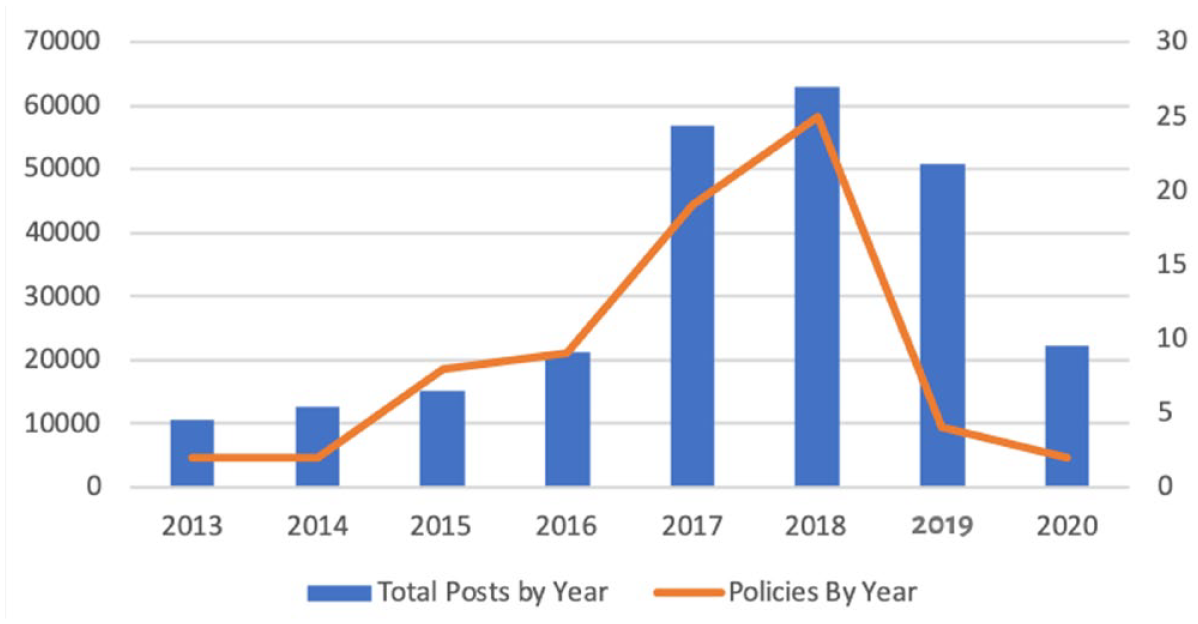
Total “Immigration” Posts and Policies/Events per Year
In 2013, there were five immigration-related events or policies, two in 2014, eight in 2015, nine in 2016, 19 in 2017, 25 in 2018, four in 2019, and two in 2020. The years 2017 and 2018 show the highest numbers of both policies/events and posts by media, which may be a mixture of ongoing policy effects or the consistent parade of them, especially during Trump’s first 2 years. Ballotpedia lists policy changes, such as DACA legislation during Obama’s term or the temporary ban on travelers from majority Muslim nations at the start of Trump’s term, and events, such as ongoing legal conflicts between presidential administrations and federal judges over immigration. The site does not distinguish between the two categories, and it lists policies/events for the Trump administration only up until mid-July 2020, which does not take into account many immigration/travel restrictions imposed during the COVID-19 pandemic. The Migration Policy Institute recorded more than 400 immigration-related policy changes and other events during the Trump presidency. However, the Institute did not produce a similar report for the Obama administration, so a comparative analysis with two separate sources would not have data consistency (Pierce & Bolter, 2021) or could be inaccurate.
Figure 3 shows the timeline of four policy events and the number of media posts that followed. “Before” and “after” designations indicate immigration posts that media shared before the event/policy was announced or took place and the shift, if any, in coverage afterward. Two policies/events were chosen from each term, and choices were based primarily on actions taken by the president and not ongoing legal challenges of immigration policies.
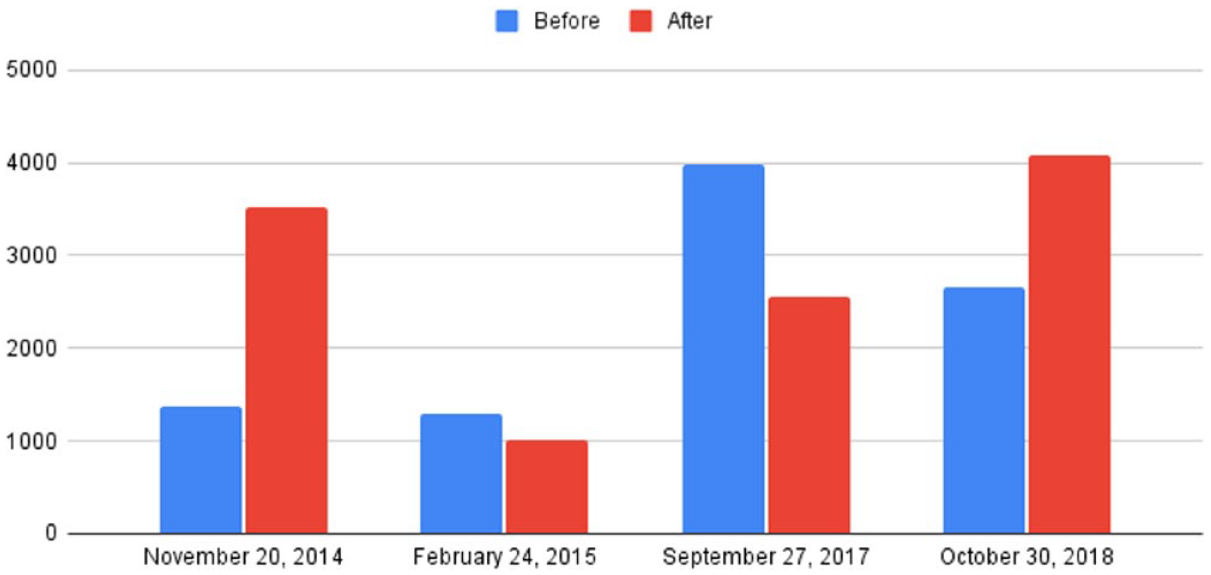
Number of “Immigration” Topic Posts Before and After Policy/Event
As shown in Figure 3, no clear pattern emerged of a rise in posts following immigration-related announcements; posts increased twice and decreased twice. Obama policy announcements include Immigration Accountability Executive Actions announcement, which included an expansion of DACA (Deferred Action for Childhood Arrivals) and DAPA (Deferred Action for Parents of Americans), on November 20, 2014, and an Obama op-ed published on February 24, 2015, responding to Judge Andrew Hanen’s ruling for a preliminary injunction to block DACA expansions and DAPA implementations. During Trump’s term, his order limiting refugees admitted to the United States to 45,000 occurred on September 27, 2017, and his statement about wanting to end birthright citizenship occurred on October 20, 2018. Each event includes a 1-month time span of coverage on immigration before and after each announcement that either shows an increase or decrease in coverage. Of course, the coverage amounts are affected by other news events at the time, the nature of each policy and other factors.
Specific policy changes vary in magnitude and popularity, but the timeline of posts, coupled with the engagement of audience reactions explained in the next section, may support the expansion of agenda-building theory to include the participatory factors of digital audiences influencing the number of posts dedicated to specific topics such as immigration. While news of policies may travel quickly throughout online communities, the impact of legislation and news material used for entertainment purposes may linger and create more content over time as opposed to the immediate effect directly after a policy is announced. Policy announcements also do not always indicate immediate enforcement, such as COVID-19 travel restrictions that were slightly delayed to allow Americans to return to the United States.
Engagement Breakdown
Engagement was also examined during January 2013 to December 2020. Figures 4, 5 and 6 are directly related to answering

Number of Comments and Shares on “Immigration” Topic Posts
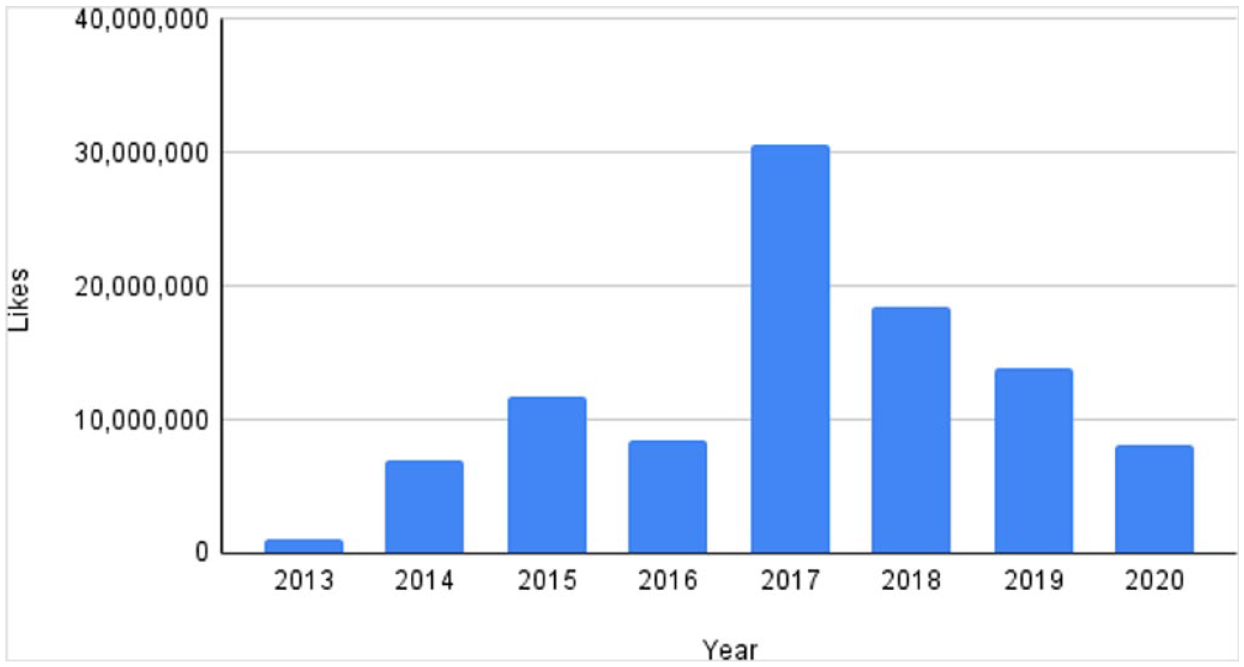
Number of Likes on “Immigration” Topic Posts by Year
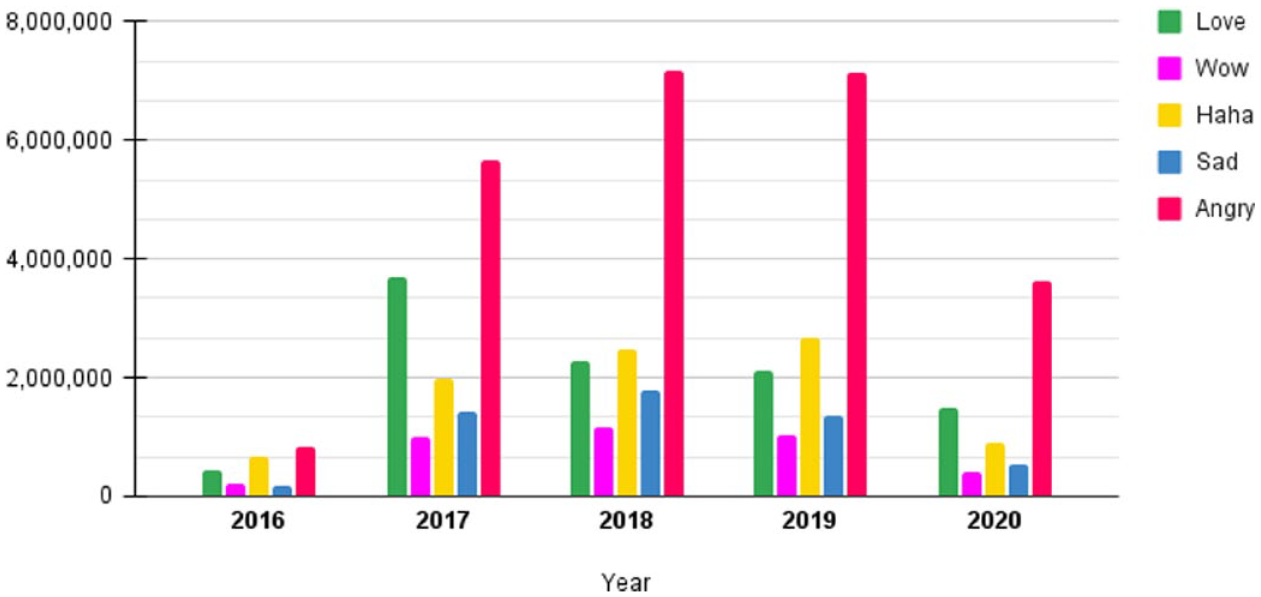
Reactions on “Immigration” Topic Posts by Year

Sentiment of “Immigration” Topic Posts by Year
From 2016 to 2017 (transition from Obama to Trump), the number of immigration-oriented comments and shares increased from 3,471,734 to 11,703,325 (237% increase) and from 3,755,274 to 10,283,294 (173% increase), respectively. Figure 5 shows the total number of likes by year of immigration posts by media. Samples of comments are included below to further describe audience sentiment in addition to the emotion-based reactions described in Figures 5 and 6.
A June 23, 2016, AJ+ video post said, “SCOTUS just blocked Pres. Obama’s executive order on immigration. It would have allowed millions of undocumented immigrants to remain in the country and work legally. Meet some of the kids affected by America’s broken immigration system.” Comments about it included: People are welcome but they must be legal!! Sorry but if I need money I can’t break the law and rob a bank because it’s illegal. Heck I can’t go to other counties and live without making it legal I had to go through hoops just to get a pass port to visit.—Patty Anderson I swear, it feels as though compassion has evaporated from the hearts of Americans. They don’t realise that the privilege they take for granted now was once stolen by them. It seems so hypocritical that now they point at everyone and declare people as illegals or wrong (or whatever!!). Makes you think that by and large they are nothing more than hillbillies who found money and cleaned up; but their views remained the same, backward and narrow.—Saleha Awan I hate to say it but if the family does not want to be separated if mother or father illegal, then they should all go back to parents country. Or just maybe actually make the effort to become a U.S. citizen.—Norma Harrington Meents (AJ+, 2016)
An August 12, 2020, Wall Street Journal post said, “Joe Biden and Kamala Harris share some goals and disagree on how to approach certain policy areas. Here’s where each stands on health care, taxes, immigration and trade, among other issues.” Comments about the post included “Nice to have a presidential candidate that can handle someone disagreeing with him. Adult of him.”—Bonnie Schafman Janowiak; “They can’t even agree on things not fit to run our Country.”—Donita Hill; and She says “There’s no vaccine for racism.” If she would stop trying to shove the race card down everybody’s throat everytime [sic] she opens her mouth, there would be no need for a vaccine. She is so racist. We all know Biden doesn’t have what it takes to be president and neither does Harris. They have some people fooled, but not the normal people. Vote Red all the way on November 3rd. Our nation depends on it.—Ginger Jolly (Wall Street Journal, 2020)
Comments and threaded replies ranged from stark opposition to agreement or sympathy with both media’s posts. However, many comments on the AJ+ video, which featured voices and video of undocumented immigrants, focused on immigration policy and comparisons to other legal actions. Comments on The Wall Street Journal post about specific policies related to many topics, including immigration, centered primarily on Biden and Harris themselves as opposed to the context of the article posted. Comments provide a deeper understanding of how people are interacting with these posts, but additional engagement factors, such as emotion-based reactions shown below, also are informative.
As shown in Figure 5, the number of audience “likes” on immigration-oriented posts increased steeply from 2016 to 2017, which began with Trump’s inauguration and then new immigration policies—most notably Executive Order 13769 (“Protecting the Nation From Foreign Terrorist Entry into the United States” (Trump, 2017). It was quickly labeled as a Muslim ban due to which countries were included and immediate enforcement that left people detained at airports. Likes and reactions were not broken down by month, so these reactions could stem from various policies enacted in 2017 and reactions to such policies by news and other media organizations. Because audiences tend to click “like” versus using other emotion-based icons (and keeping in mind Facebook implemented these additional reactions in late 2016), this study distributed other reactions (love, wow, haha, sad, angry) into a separate chart (see Figure 6).
Figure 6 shows the breakdown of emotion-based reactions audiences gave to immigration-oriented media posts. The distribution includes “love,” “wow,” “haha,” “sad” and “angry” reactions. The “care” reaction was introduced in 2020 because of the COVID-19 pandemic (Spangler, 2020). It was not popular enough in the timespan studied to add it to Figure 6. Viewing emotion reactions loosely as Likert-type scale-like and considering the crux of critical race theory applied to media being stereotypes associated with people of color that negatively impact treatment of, and policies associated with, those groups, this study can show that with the increase in immigration-related content, audiences primarily felt negative emotion-based reactions and decreased their positively correlated reactions as time went on. Audiences used more angry reactions during 2017–2020, but also a sharp increase in love reactions from 2016 to 2017, before dropping year over year. Widespread use of emotion-based reactions didn’t occur until early 2017; however, this range of sentiment gives a picture of how audiences felt about this topic’s coverage, albeit without adding modifiers to understand the context of posts each person was reacting to and adjustments for possible fake accounts. According to a New York Times report, as many as 35% of Facebook accounts are fake accounts that may comment, share and react to any number of posts (Nicas, 2019).
Related to agenda-building theory, sentiment about Trump’s terms to describe immigrants of color during integral policy discussions is well documented before and during his presidency. They range from references to “bad hombres” (referring to people from Mexico entering the Southern border) during his 2016 debates with Hillary Clinton to his more recent use of “China virus” instead of coronavirus or COVID-19, distinctly pointing to the origin of the virus (Wuhan, China) and an effort to build policies restricting trade, travel and more amid the pandemic (Gurdus, 2016; Reja, 2021). Trump’s policies impacting international students, who began reporting incidents of discrimination because of their Asian ethnicity, drew backlash from colleges and universities that had larger international student populations (Hartocollis & Jordan, 2020). Many attacks against Asian Americans in the United States have occurred throughout the pandemic. Would the media’s use of these terms, even though quoted directly from political figures, contribute to the sentiment of not only the posts but also the people of color being referenced? Were political agendas attempting to build up these references to create newsworthy headlines and negative sentiments about these groups?
To better describe the content and sentiment of posts, a sentiment analysis was conducted using Vader; sample posts appear below. Figure 7 shows the sentiment from a random sample of 10,000 posts per year for 2017–2020. Prior to 2017, posts still included messages but there was no extension of emotion-based reactions to compare post sentiment to reactions of audiences. Analysis shows that for years 2017 and 2019, the highest degree of posts were slightly positive in sentiment, whereas the opposite occurred for 2018 and 2020. In all cases, it appears that there is still a greater chance of negative sentiment over positive in post messages.
Sample posts from 2013 to 2020 are illustrative. A NowThisPolitics video post on June 30, 2019, said, “Children Are Being Forced to Represent Themselves in Immigration Courts. This Reenactment Shows What It Looks Like”; subtitle: “Children as young as toddlers are forced to represent themselves in immigration courts” (NowThis Politics, 2019). A Fox News link post on July 13, 2014, said, With all due respect Mr. President, you created this mess—now you fix it! You invited them in, now you solve it [. . .] Illegally entering the United States is not a right to citizenship. Don’t tell us we’re heartless because we believe in the rule of law, which is the foundation upon which our country was founded. In last night’s Opening Statement, Judge Jeanine Pirro blasted President Barack Obama for the illegal immigration crisis, accusing him of attempting to change the demographics and electorate of the U.S. Watch her entire Opening Statement: [link to statement]. (“With All Due Respect Mr. President . . .,” 2014)
A Vox post on December 9, 2015, said, “A few months ago, we’re supposed to hate Mexicans; now we’re supposed to hate Muslims. That kind of crap is not going to work in the United States of America.—Bernie Sanders” (Vox, 2015).
In some cases, media are not responsible for posts displayed on their social media; however, the build-up in frequency of content about immigration coupled with much of that being negative in sentiment and garnering negative reactions from audiences suggests a linkage between media depictions, sentiment about of people of color and resulting policies that may impact those groups.
Conclusion and Considerations
This study may tell us many things. News and entertainment media are presenting information related to immigration more frequently now than they have in the past. This shift happened about the same time as the 2016 presidential election. There is a possible overlap of immigration policy and the rise or fall in frequency of posts, but that does not indicate that policy necessarily caused the spike. Audiences apparently have changed the way they engage with this topic, choosing to comment and share more over recent years. This may also be due to increased users on social media platforms and the subsequent increase in receiving and sharing news and information on social media.
More specific to advancing agenda-building and critical race theories, this research has key takeaways. From a methodology standpoint and building on Kaur et al.’s (2019) use of quantifying shares, comments and emotion-based reactions to pair with sentiment analysis, this research employs a much broader scope by using news and entertainment media organizations that have more detached audiences than those researchers’ more controlled, diabetes-focused Facebook group data. As noted previously, Kaur et al. (2019) viewed the inclusion of additional user behavior data points (i.e., comments, shares and reactions) as a way to improve the accuracy of sentiment, such as the greater possibility of positive sentiment on posts with a greater number of shares. To go a step further, this research is utilizing these metrics, specifically emotion-based reactions, as a quantitative Likert-type scale-like measurement to better contextualize the sentiment of content. For newspaper and entertainment media organizations that have begun to gauge audience feedback through social reactions, as opposed to traditional surveys, this study can provide a baseline of the relationship between participation of digital audiences and agenda-building. Participatory agenda-building is an extension of Berkowitz’s (1987) example of public relations-driven news content to include audience interaction. As mentioned previously, Pérez-Díaz et al. (2020) and Abdenour’s (2016) research indicated that viewers’ social engagement with content not only kept topics prominent longer but the organic interpersonal interactions sometimes prompted future coverage. Data here may indicate shifts in coverage and social promotion decisions that rely not only on relationships with political figures but also audiences and their digital interaction behaviors.
Thus, study also sought to begin to understand how media engagement in policy-related topics under the lens of race theory has vast implications for people of color. Audiences reacted to content posted about Obama and Trump for many reasons, but data show that the more immigration was the topic of the post, it elicited similar levels of engagement, specifically emotion-based reactions. Agenda-building theory is not commonly studied through a critical race lens and therefore impacts of increased race-based policy coverage are studied via other theories and approaches. So how does social engagement between news and entertainment audiences affect the longevity of political-focused content and does that give weight to ongoing government policies? As the topic of immigration increased each year, so did policies that affected predominantly people of color at the United States–Mexico border. This study contributes to the ongoing expansion of critical race literature started by Bell, Delgado and Crenshaw, as noted above, to include its pairing with agenda-building and provide more nuanced examples of how the public engages with intersectional experiences by centering immigration (Bell, 1995; Crenshaw, 1991; Delgado & Stefancic, 1998).
The limitations of this study include the context in which the topic of immigration is presented, the lack of emotion-based reactions prior to Donald Trump’s term in office, the lack of a full sentiment analysis of all comments (because of the volume of posts) and findings that show correlations rather than causation. But by mapping some fluctuations in post frequencies to immigration policies and events that occurred at or around the same time, it was possible to see how often these stories are being posted after they are announced (both increases and decreases); shifts in comments, shares and reactions over time; and that posts’ sentiments were primarily negative. Exactly how and how much audience participation affects amount of coverage is still unknown, but clearly worth continuing to research.
Future research should examine modifiers to the term “immigration” and deeper study of correlations between policy changes, types and levels of posts and reactions, and especially characteristics of posters (Hurley et al., 2015). It was not possible with data pulled in this study to discover posters’ ethnicities, but a separate study could ask participants to read randomized posts and react based on the same mechanisms available on Facebook, that is, commenting, sharing or reacting through emoji-based icons after answering specific demographic questions. Applying critical race theory to media is an emerging scholarly agenda that may shift how we assess messaging aimed at communities of color. It also would be productive to study the roles of which individuals at media companies are responsible, and how (including roles of user engagement), for social media posts at the intersection of communities of color and government policy, and how such posts may reinforce assumptions that ultimately feed into structural race-based systems.
