




Abstract
Media representations of violence against transgender individuals have implications for public opinion, awareness and policy. A sample (N = 212) of U.S. mainstream news articles about 53 transgender 2018–2019 victims of homicide were studied by content analysis and qualitative methods. About 13% of articles referred to victims by their deadnames (no longer used birthnames), but about 18% of articles drew attention to the harms of misidentification. Deadnaming declined significantly from 2018 to 2019. About 30% of the full sample discussed violence against transgender individuals in social context. Police and transgender community advocates were sources in 80% and 50% of articles, respectively.
Transgender individuals, particularly transgender women of color, are disproportionately affected by violence (Waters et al., 2018). Reported homicides of transgender and gender-nonconforming individuals have been on the rise since 2013, with the National Coalition of Anti-Violence Programs reporting at least 26 homicides of transgender individuals in the United States in 2018 and at least 27 in 2019.
The way news media report on these crimes can legitimize or delegitimize the transgender community, thus contributing to the public’s understanding and acceptance of the community and the issues that affect its members (Billard, 2016). Media frames act as “prepackaged social constructions” (Gillespie et al., 2013, p. 225). Misgendering or misnaming victims, stereotyping and avoiding discussion of cultural and social factors that contribute to violence against gender-nonconforming individuals may further marginalize the community (Barker-Plummer, 2013).
Since the mid-2000s, the Associated Press (AP) Stylebook (Froke, 2018) has offered guidance on how to properly report on victims of violence who are members of the lesbian, gay, bisexual, transgender and queer (LBGTQ) community, with its most recent addition being a section on gender-neutral pronouns (pp. 121–122). Guidelines advise journalists to use the preferred pronoun of their subject. In cases when the subject is a victim of homicide, journalists should use the pronoun by which the victim lived publicly. Improper identification of victims in news media has decreased because these guidelines were introduced, but this decrease has lagged behind the changes to the AP Stylebook (Billard, 2016). Deadline pressures, dependence on police narratives and a lack of communication with LBGTQ advocates may present barriers to better reporting practices (Arune, 2006; Sacco, 1995).
This content analysis of mainstream news coverage examines gender identification, contextualization and sourcing used in the reporting of homicides of transgender individuals in 2018 and 2019. The AP Stylebook added expanded entries on cisgender, intersex, transgender and pronoun usage in the 2017 edition. Have journalists been putting these guidelines into practice? The years 2018 and 2019 were marked by increased news media attention on transgender rights—with the leaking of a proposed government policy that would establish a legal definition for Title IX purposes of “sex” as either male or female and a Trump administration policy barring openly transgender individuals from serving in the U.S. military. Were there incremental changes in journalistic practices regarding gender identification during this time period?
This analysis also sheds light on challenging situations when news media must make decisions based on conflicting information and inaccurate police reports. The findings offer insight on how journalists can do better when reporting on violence against marginalized groups, specifically the transgender community.
Literature Review
Violence, Transphobia and the LGBTQ Community
The assumption that gender is binary and fixed is widespread (Doan, 2006; Norton & Herek, 2013). The social expectation is that someone’s gender identity—the “deep-seated, internal sense of who they are as a gendered being”—aligns with one’s biological sex (Green & Maurer, 2015), but one’s gender may or may not correspond to one’s birth-assigned sex (Lagos, 2018). Transgender is an umbrella term describing individuals who have or express a gender identity that differs from their assumed gender based on sex categories assigned at birth (Jauk, 2013). One’s gender expression is the outward presentation of gender, which may or may not align with one’s gender identity. Gender expression may be dependent on whether someone feels safe and supported expressing their gender identity (Green & Maurer, 2015). One’s sexual orientation (the feelings of attraction toward others) is not linked to one’s gender identity.
Social attitudes toward LBGTQ individuals in the United States have shifted in previous decades to become more accepting (Flores, 2014; Reitz, 2017), and transgender individuals are being represented more on television and in film (Kenny, 2017). Despite progress made in entertainment media, gender-nonconforming and transgender individuals continue to experience discrimination and microaggressions (Austin & Goodman, 2017; Doan, 2006) and higher rates of violence and threats of violence due to stigma, fear and transphobia surrounding gender nonconformity (Clements-Nolle et al., 2006; Gordon & Meyer, 2007; Testa et al., 2012; Waters et al., 2018; Wyss, 2004). This vulnerability to violence stems from a number of contextual factors, including transphobia and/or homophobia of perpetrators, fear of reporting crimes to police and other barriers presented by gender identity that may make individuals more likely to become homeless, jobless, impoverished or forced into sex work (Choi et al., 2015; Crissman et al., 2017; Stotzer, 2008, 2009).
Gains in the entertainment media have been overshadowed by political setbacks in previous years, with the enactment of legislation that limits equal access to resources for LGBTQ individuals and eliminates nondiscrimination ordinances (Wang et al., 2016). One such type of legislation considered and proposed in numerous states is known as a “bathroom bill,” a law that restricts access to bathrooms based on sex assigned at birth. Anti-LGBTQ legislation further marginalizes and reduces the social status of the LBGTQ community (Oakley, 2017; Wang et al., 2016). Another policy illustrating discriminatory practices is the Trump Administration’s 2019 policy restricting transgender individuals from openly serving in the U.S. military.
The National Coalition of Anti-Violence Programs has compiled data on violence against LGBTQ individuals for the past two decades. Since 2013, the reported anti-LGBTQ homicides have increased, from 18 in 2013 to 52 in 2017 (Waters et al., 2018). Regarding transgender individuals specifically, there were 27 reported homicides in 2017, 26 in 2018 and 27 in 2019. The majority of the victims were transgender women of color (Waters et al., 2018). The U.S. Department of Justice’s report on hate crime statistics in 2017 mirrors this trend, showing an increase in hate crimes against transgender individuals since 2016 (United States Department of Justice [DOJ], Federal Bureau of Investigation, 2018). The U.S. government does not currently have a formal reporting system for capturing the true homicide rate of transgender individuals due to problems in calculating estimates of the transgender population, as well as challenges in reporting practices across law enforcement (Stotzer, 2017). Studies show, however, that nearly 31% of transgender individuals experience sexual violence compared with about 20.4% of cisgender individuals (Langenderfer-Magruder et al., 2016). The intersection of race and gender identity poses even greater risk for transgender women of color. In a 2013 study detailing the experiences of transgender women of color, participants reported experiencing both racist and transphobic events (Jefferson et al., 2013). Although not all of these events amounted to violence, violent acts can be motivated by gender and racial bias (Perry & Alvi, 2012). According to the Bureau of Justice’s 2018 National Crime Victimization survey, the homicide rate was 6 times greater for Blacks than for Whites, regardless of the gender. A 2017 study found that Black and Latina transgender women aged 15 to 34 years were more likely to be murdered than their cisgender counterparts (Dinno, 2017). Other than anecdotal evidence, crime data on the race of perpetrators who commit violence against transgender victims of color are not available, but the Federal Bureau of Investigation (FBI) hate crime statistics from 2018 indicate that nearly 54% of perpetrators of hate crimes were White and 23% were Black.
Violence and the threat of violence have serious implications for the health and wellness of the LGBTQ community (Clements-Nolle et al., 2006; Davidson et al., 1996; Testa et al., 2017). Transgender individuals exposed to physical and sexual violence are more likely to report a history of depression, suicide attempts and substance abuse (Nemoto et al., 2011; Testa et al., 2017). Advocates and civil rights organizations have characterized this violence as a “national epidemic” (Human Rights Campaign, 2018), but mainstream news media coverage of transgender violence, and transgender issues in general, is limited (Maza et al., 2015).
Transgender Individuals in the News Media
The relationship between public opinion and the media is reciprocal—news media inform cultural values, and cultural values inform the news media. News media play a critical role in the public’s understanding of events and issues (Entman, 2004). In particular, news media representations create an “interpretive framework” for social issues through framing devices, word usage and amount of coverage (Gillespie et al., 2013, p. 227). Framing devices are textual elements—choices a writer makes about what language, phrasing, quotes and other relevant information are included in a piece (De Vreese, 2005). Barker-Plummer (2013) characterizes narratives of gendered issues in the news as “critical discourse moments” (p. 710) because they impact public awareness, policy initiatives and solutions.
In entertainment media, gender-nonconforming individuals and issues have become more visible, with shows such as Transparent, Orange Is the New Black and The Fosters (Spencer, 2015). The 2018–2019, television season has seen more LGBTQ characters than ever before, with an increase in transgender characters specifically (GLAAD Media Institute, 2018). In addition, these characters are diverse and more representative of the LGBTQ community. Studies show that exposure to television and film portrayals of characters from marginalized groups can impact attitudes (Ayoub & Garretson, 2017; Cohen, 2001; Oliver et al., 2012; Slater et al., 2006). Specifically, acceptance of the LGBTQ community generally increases with increased exposure to LGBTQ characters (Gillig et al., 2018).
In the news media, however, representations of transgender individuals and their lived experiences have not been as visible (Maza et al., 2015). Studies have found that news media coverage of gendered violence in general contains framing devices, misrepresentations and other language that tend to stereotype, blame and further marginalize victims (Barker-Plummer, 2013; Billard, 2016; Gillespie et al., 2013).
Research in the area of news coverage and transgender violence has largely focused on high-profile hate crimes and victims, such as Gwen Araujo and Brandon Teena (Barker-Plummer, 2013; Chávez, 2010; Sloop, 2000; Willox, 2003). This study examines coverage of all 53 reported transgender victims of homicide in the years 2018 and 2019.
Delegitimizing Language in the News
Previous studies have pointed out how news media frames, language and word choice can serve a “legitimizing” or “delegitimizing” function for the transgender community (Billard, 2016). Misnaming, misgendering, misusing pronouns and using a victim’s deadname are widespread in news reports (Barker-Plummer, 2013; Capuzza, 2015; Sloop, 2000). Deadnaming is the act of referring to someone by their birthname, rather than their chosen name (Dunne et al., 2017). A case study of news coverage of the 2002 murder of Gwen Araujo, a gender-nonconforming teen, found many news media reports initially used the pronoun “he” to refer to Araujo, or she was called by her birth name, Edward (Barker-Plummer, 2013). Some news media reports avoid the use of pronouns altogether, put quotation marks around the victim’s preferred name, or use language to suggest that their preferred name is “artificial” (Arune, 2006; Billard, 2016). Unlike the customary practice of putting a person’s nickname in quotation marks, the same practice used with a transgender individual’s chosen name has been described in GLAAD’s 2020 media reference guide as derogatory, as it implies that the chosen name is invalid (
Mischaracterizations, stereotypes and victim-blaming of transgender individuals occur when news media reports equate transgenderism with dressing in drag or cross-dressing; use improper terminology, such as “transvestite”; or focus on irrelevant details, such as the sexual history, sexual organs or physical appearance of victims (Barker-Plummer, 2013; MacKenzie & Marcel, 2009; Meyerowitz, 1998; Sloop, 2000; Willox, 2003). News media language sometimes suggests that victims used some kind of “trickery” or deception regarding their gender that excuses perpetrators (Barker-Plummer, 2013; Schilt & Westbrook, 2009). This type of language focuses on characteristics of the victim rather than the act of the perpetrator, thus obscuring the perpetrator’s responsibility. Characterizing transgender individuals in relation to their physical characteristics and sexual behavior also “insults the dignity” of the subject and diminishes the source of one’s gender identity to one’s sex organs (Adams, 2015; Billard, 2016; Schilt & Westbrook, 2009, p. 179).
Acts of violence are often byproducts of larger social forces. When acts of gendered violence are portrayed as isolated events, the impact of social, economic and cultural factors is concealed or minimized. By referencing contextual factors (such as statistical evidence) and discussing institutional factors (such as systemic misogyny, transphobia, and other social, cultural and economic barriers that make transgender individuals more vulnerable to violence), news media highlight the problem of gendered violence as a shared problem that needs to be addressed with legislation and increased public awareness. Thematic framing involves embedding incidents, such as crimes, in a larger societal context (Iyengar, 1990; Post et al., 2009). Previous research finds that news media often characterize the root cause of gendered violence as an individual motivation, avoid thematic coverage and rely too heavily on police narratives (Berns, 2001; McManus & Dorfman, 2005; Richards et al., 2011). Referencing transgender hate crime statistics or quoting a transgender rights or victims’ advocate in a news report may help audiences understand that violence against transgender individuals (especially women of color) is a social problem, stemming from a combination of transphobia, racism, and discriminatory policies and practices (Berns, 2001).
Journalistic Practices: Sourcing and Gender Identification
News media practitioners take on significant responsibility when reporting on gendered violence, and crime in general. Ethical considerations (such as sensitivity to victims), journalistic values (such as accuracy, fairness and objectivity) and common practices (such as sourcing and the use of AP style) all govern how journalists report on crime (Chagnon, 2015; Lovell, 2001; Schudson, 2001; Tait, 2011).
Historically, news media have relied on “elite” sources, such as police and other public officials, to weave the narrative of a news story (Arune, 2006; Berkowitz, 2009; Sacco, 1995; Sherizen, 1978). Those seen as the most “credible”—those individuals with closer ties to social institutions— are at the top of the social hierarchy (Becker, 1967). The use of the police frame—marked by a reductive, “just-the-facts” approach—is common in crime reporting (McManus & Dorfman, 2005; Sacco, 1995). This approach is often characterized by the use of a “clinical tone” (C. A. Taylor & Sorenson, 2002) that lacks broader contextual information (e.g., about prevalence or “causes”), often portraying the crime as an isolated incident. Relying solely on police as sources can be especially problematic in cases of homicides of transgender individuals because police departments often use government identification when reporting victim names to news media (Billard, 2016; Waldron & Schwencke, 2018).
News media have a responsibility to foster democratic ideals and debate by providing pluralistic information—often requiring the inclusion of sources beyond the “elite" (Manning, 2001; Rosen, 1999). Particularly when it comes to coverage of gendered violence, journalists “produce and reproduce conceptions of gender diversity by relying on some sources but not others” (Capuzza, 2014, p. 116). The inclusion of LBGTQ advocates and citizen voices—such as family and friends of victims—can help shape discourses about gender identity and gendered violence.
Reporting on transgender violence comes with a special set of challenges and responsibilities involving identifying victims. The AP Stylebook contains guidelines on terminology, gender-neutral pronouns (they, them) and naming gender-nonconforming individuals. For example, journalists should avoid using the term “transgendered.” In 2017, the AP Stylebook (2018) updated its guidelines, instructing reporters to use the name and pronoun the person uses publicly and avoid describing a transgender individual as having been “born” a certain sex (pp. 121–122).
Police reporting of a victim’s “deadname,” or the name they were given at birth rather than their chosen name, is not uncommon. The practice of gender identification varies by department. A 2019 report from the National Center for Transgender Equality (2019) that examined the 25 largest police departments in the country found that 72% of departments had policies requiring officers to record the name and pronoun of subjects based on formal identification documents. Furthermore, 80% had policies that do not require the use of correct names and pronouns when communicating with a subject. A ProPublica investigation found that police misnamed or misgendered transgender victims of homicide in 74 out of 85 investigations since 2015 (Waldron & Schwencke, 2018). This not only devalues transgender victims and their community, but it may also hinder homicide investigations. Relationships between police departments and advocacy organizations have led to some positive changes in police policies (Fae, 2015). For example, the Milwaukee Police Department enacted a policy in 2018 that instructs officers to use the pronoun and name by which a person most closely identifies. Policy changes like this are done at a department level, as no state of federal legislation has been passed on gender identification standards in law enforcement.
Reporters must also make decisions about when and how to correct or call out other media outlets or police departments when misidentification occurs. In addition, decisions must be made about how to identify a victim when disagreement exists among friends, family and police. For example, one’s gender presentation may vary based on their environment—at home, on social media, with family, or with close friends. Furthermore, a victim’s gender expression—one’s appearance, dress and behavior—may not reflect their gender identity—one’s internal sense of who they are. Journalists may be unaware that they are misgendering an individual, or mistakes may not come to light until days or weeks after a story has been published. When reporters and editors are made aware of mistakes, corrections should be prompt and visible, according to journalistic guidelines published by the Human Rights Campaign (2019). Providing context, seeking out multiple sources and accurately identifying victims are steps journalists should take when reporting on any homicide—not just those involving a gender-nonconforming victim. Taking such care with every story helps avoid misgendering (Arune, 2006).
Advocacy organizations—such as GLAAD, the Human Rights Campaign and Transgender Law Center—can provide resources and valuable perspective, particularly when there is misunderstanding about a victim’s gender identity. Advocates can provide statistics, best practices, workshops, glossaries of terms and media kits. For example, GLAAD media institute’s 2020 curriculum includes a workshop on “Tools for reporting on the LGBTQ community.”
Journalistic practices related to sourcing, the inclusion of context and the identification of victims illustrate how news organizations represent and frame problems for the public. This study aimed not only to examine the extent of these practices in news coverage but also to compare 2018 and 2019 news coverage. Using several of Billard’s (2016) “legitimacy indicators” and other journalistic practices, the following research questions are examined:
Method
Sample
A content analysis of U.S. news articles (N = 212) covering the 53 transgender victims of homicide reported in 2018 and 2019 was conducted. These years were chosen for analysis because of a number of significant events impacting transgender rights and the media attention surrounding these events. In 2018, The New York Times reported that a leaked memo out of the Department of Health and Human Services sought to establish a legal definition for Title IX purposes of “sex” as either male or female and unchangeable once determined at birth—a policy that could have implications for legal protections of transgender individuals. In 2019, the Pentagon began implementing a Trump administration policy that prohibited transgender individuals who require or have undergone gender transition from serving in the military. The spotlight on transgender rights during the Trump Administration and increased reporting of transgender homicide statistics by advocacy groups provided a window of opportunity to collect a larger and more diverse sample of news content.
Articles were identified using LexisNexis and NewsBank databases and searching for all news items published by online and print mainstream news outlets—including broadcast outlets with online stories such as CNN—which covered the crimes and their victims. To find articles, the names of the 53 victims, including common misspellings of the names, were entered as search terms to locate articles. Every effort was made to find and include all relevant news items. The search was restricted to items published between January 1, 2018, and December 31, 2019, with 2018 articles collected in April 2019 and 2019 articles collected in February 2020. Duplicates and broadcast news transcripts were excluded. Press releases issued by LGBTQ advocate or interest groups were excluded from the analysis because the study’s goal was to capture ways in which journalists are framing gendered violence. LGBTQ-specific outlets were not included in the sample to capture representations of the issue most likely to be seen by the wider general public. Furthermore, mainstream news media have been accused of maintaining the “power structure of elite groups and institutions” (Van Dijk, 1995, p. 22); thus, mainstream coverage of gendered violence warrants a critical eye.
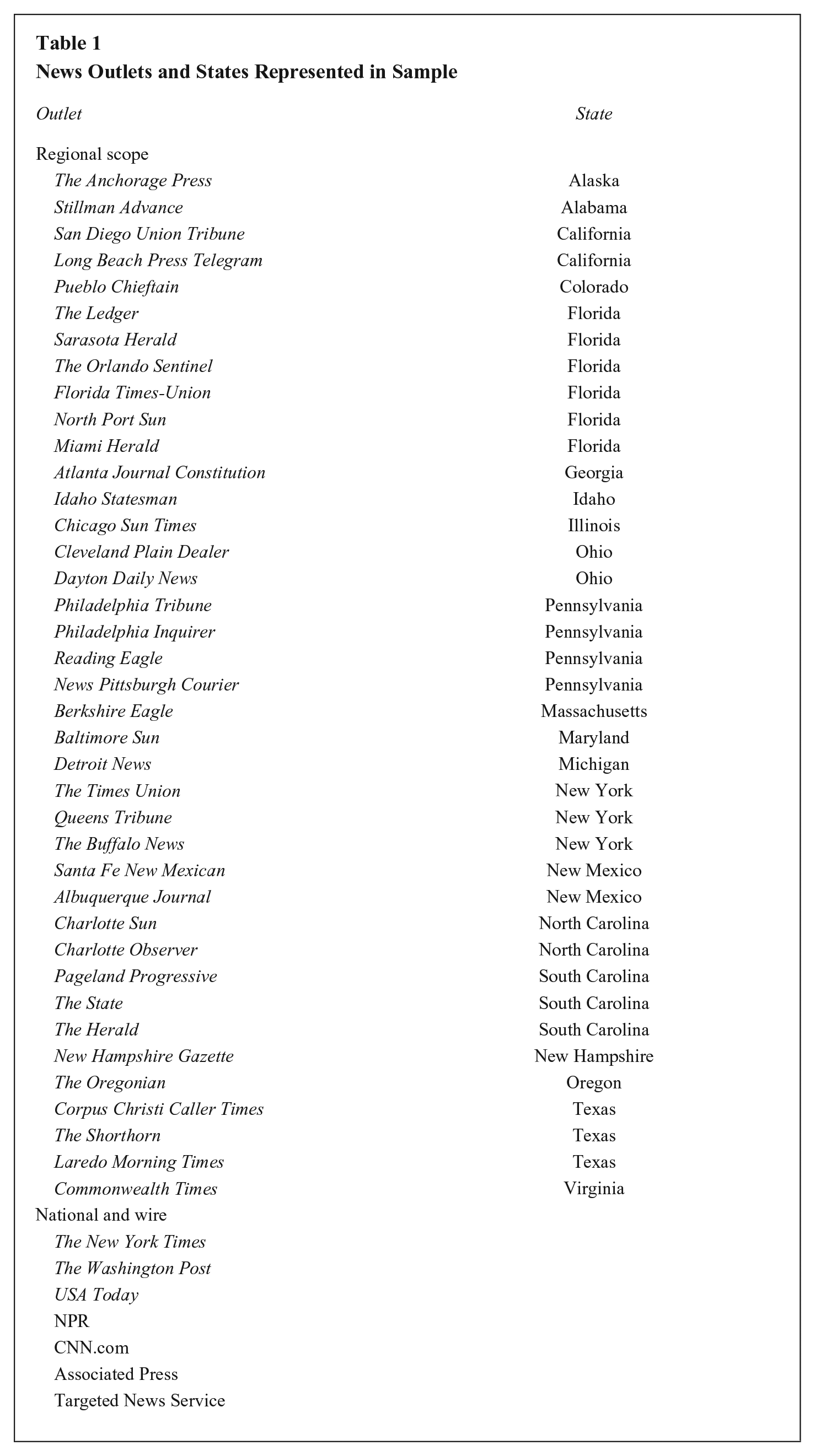
The sample contained items published by both print and online regional and national news outlets (e.g., Dayton Daily News, The New York Times, CNN.com) and news wire services (e.g., AP, Targeted News Service) spanning 20 states (see Table 1 for full list).
News Outlets and States Represented in Sample
Coding Categories and Reliability Analysis
A coding sheet was created with guidelines based on previous research on the framing of gendered violence in the news and news legitimacy indicators adapted from Billard (2016). Coding categories included the presence or absence of statistical context and societal factors (such as racism, transphobia, poverty and strained relationships with law enforcement) that contribute to transgender violence or make transgender individuals more vulnerable to violence. Misgendering and misnaming (and whether the misidentification came from the news outlet itself, police or another source) were accounted for, as well as the sources (police, family, friends, advocates, other public officials) cited in the news article. Instances of news media outlets explicitly drawing attention to police practices of reporting victims’ deadnames were also coded. The presence or absence of delegitimizing language, such as the irrelevant details about sexual history or a focus on the physical characteristics of the victim, was also coded.
As qualitative data help situate statistics in context (McCracken, 1988), several excerpts from news articles were pulled from the data to exemplify coding categories.
Article coding occurred in two phases. For the coding of the 2018 articles (n = 112), one coder was trained using 10 randomly selected news articles from the sample. The codebook was refined, and an additional 16 articles were double-coded by the primary researcher and the coder to establish reliability. The primary researcher coded the remaining 96 articles published in 2018. Krippendorff’s alpha was used to calculate intercoder reliability, with satisfactory reliability achieved with coefficients ranging from .71 to 1.0. Krippendorff’s alpha coefficients calculated for coding categories were as follows: identification of societal context within articles (.73); presence of statistical context (1.0); misnaming victim (1.0); appropriate pronoun use (.86); delegitimating language related to sexual history or physical characteristics (1.0); calling out misnaming (1.0); and the presence of source types, including police (.86), family of victim (.71), advocates (.84) and friends of victim (.85). In Phase 2, articles published in 2019 were coded using the same procedure with a different coder. Coder training was repeated, and 10% of the 2019 articles (n = 100) were double-coded with acceptable reliability coefficients achieved on identification of societal context within articles (.76); presence of statistical context (1.0); misnaming victim (1.0); appropriate pronoun use (.86); delegitimating language related to sexual history or physical characteristics (1.0); calling out misnaming (1.0); and the presence of source types, including police (1.0), family of victim (.83), advocates (.76) and friends of victim (.77).
Findings
R1 asked about misidentification of transgender victims. This question deserves a more nuanced approach because misidentification can come in several forms, through misnaming or using the incorrect pronoun. Misidentification can also come from various sources. At times, the journalist misnames the victim. In other instances, the journalist cites sources who misname victims. Overall, 28 articles (13.2%) contained a reference to the victim by their deadname—either by the journalist or by another source. Of those instances of deadnaming, 16 were by the journalist, 10 were cited or quoted by police, and two came from family members. Six articles, or 2.4% of the total sample, contained an improper pronoun, all from police.
Of the 12 articles that used the victim’s deadname as cited by police or family, nine of these included clarification or explanation behind the decision. An explanation for quoting others who refer to a victim by their deadname—whether it is done by police or family members—can add context to a homicide investigation and police practices. Journalistic transparency also helps explain the sometimes complex relationship dynamics between the victim and the transgender community, versus the relationship between the victim and family members. Journalists sometimes added valuable context when quoting family members who misgendered the victim, explaining that these family members either did not accept the victim’s gender identity or did not know that the victim identified as another gender. These explanations were common in articles covering the homicide of Londonn Moore. The following excerpt was taken from an article published in the Charlotte Sun: Some news organizations and lesbian, gay, bisexual and transgender (LGBT Q) advocacy groups have referred to Kinard as a transgender woman based on the victim’s Facebook page, which is set to female. However, Kinard’s family stated while they knew their son to be gay and wore his hair and makeup certain ways, he never presented himself as transgender to them or indicated he felt like a woman. (Charlotte Sun, September 15, 2018)
Similarly, in a North Port Sun article published on September 21, 2018, the victim’s father is quoted referring to Moore as Tyren, although the article also states that friends said he identified as female:
That was his name online. He never told us of it. It wasn’t something the family spoke about. But that wouldn’t matter—we love him,” Garry Kinard said. “(Londonn Moore is) not his birth name. Tyren Kinard—that’s who he was. That Londonn Moore was what he liked to be referred online. . . . He’s still Tyren Kinard to us.
When quoting a law enforcement officer who misgendered a victim, journalists sometimes explained that the police department’s policy mandated that victims are identified by their legal names or that police did not have accurate information about the victim’s identity at the time. For example, in an article published in the Sarasota Herald-Tribune about the homicide of transgender woman Londonn Moore, the author quotes police department spokesperson Josh Taylor: It is police policy to ask victims of crimes their gender identity, but in the case of a murder, Taylor said the department is relying on Kinard’s legal name and legal gender, which is male. He added that Kinard’s family members also identified the victim as a man. “We don’t have any information about how he identified. Based off of photos that we received and viewed on social media, I would say that calling Kinard trans is probably accurate, but of course, people can dress however they want and don’t specifically have to identify,” Taylor said. (Sarasota Herald-Tribune, September 14, 2018)
In another instance, the reporter explained that law enforcement initially reported the victim as a male, but the news outlet learned the victim identified as female. The following is an excerpt from a September 18, 2019, article in the Charlotte Observer on the death of Bubba Walker:
CMPD previously released a statement naming Walker as the person who died and used another first name as well as male pronouns to refer to Walker. The Charlotte Observer has learned that Walker’s gender identity was different than the sex listed on her birth certificate and driver’s license and that Walker had asked to be referred to with pronouns she and her.
Misnaming by the journalist was sometimes done with the use of phrases such as “previously known as” or “whose birth name is.” In four of the 12 cases of deadnaming by journalists, explanation was provided by the author for the decision. For example, in a December 21 article about the slaying of transgender woman Londonn Moore, the journalist refers to the victim throughout the article as Tyren Kinard. The author acknowledges the news outlet’s policy while explaining that family, friends and social media gave conflicting names: “The Sun’s standard is to discuss people by their chosen pronoun and gender, but is unable to establish a clear distinction in this instance” (Charlotte Sun, December 21, 2018).
When victims cannot speak for themselves, others must provide accounts of their life and death. R2 asked what types of sources were utilized in news coverage. Table 2 shows the frequency and percentages of source types in the full sample. Law enforcement and other public officials were cited more frequently—in about 80% of articles—reinforcing the journalistic norm of relying on police narratives. Advocates, however, were the second most common source used, with more than half of the articles citing an LBGTQ group or victim’s advocate. Friends and family of the victims were equally cited.
Frequency and Type of Sources (N = 212)
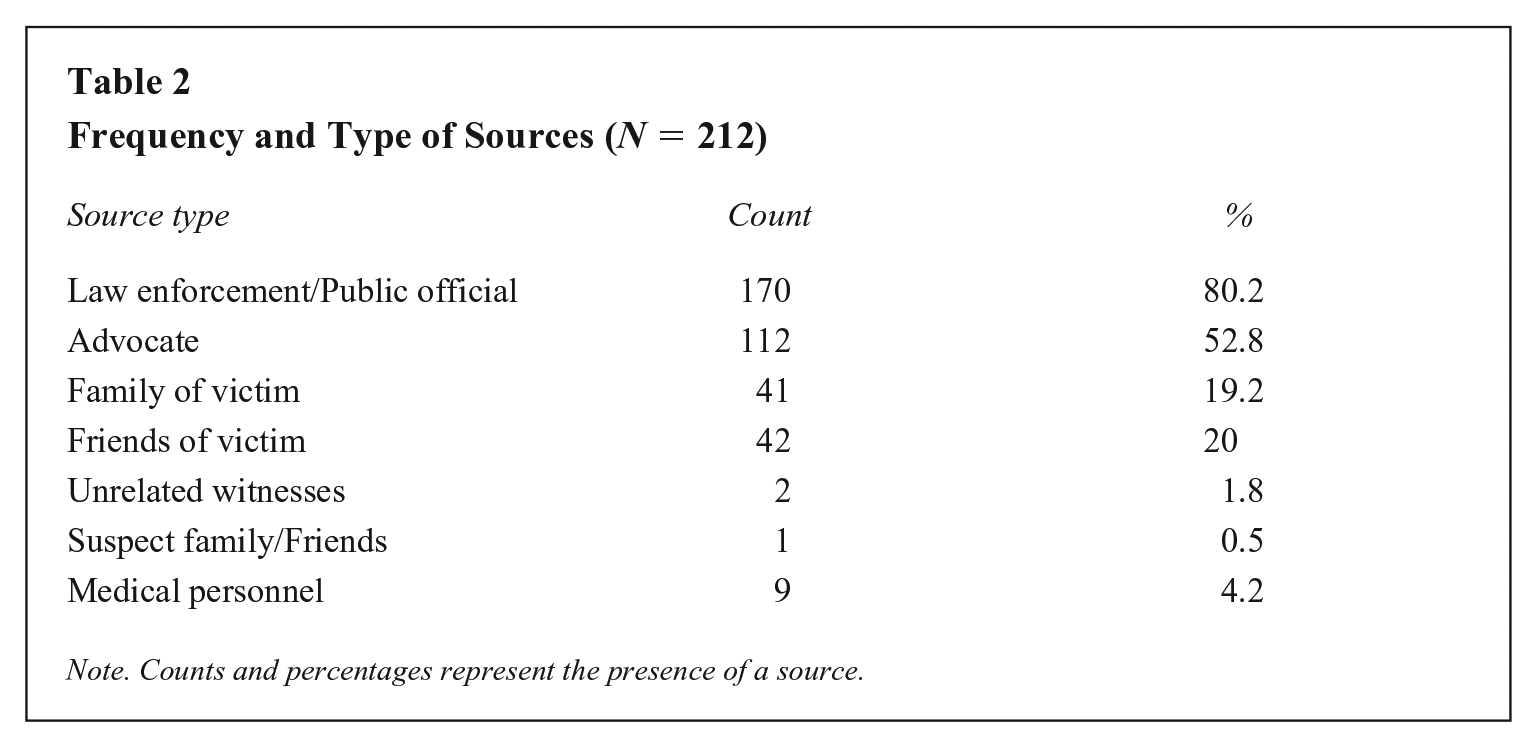
Note. Counts and percentages represent the presence of a source.
R3 asked the extent that news articles provided context. The inclusion of statistical context puts transgender violence into perspective. Similarly, when journalists include information about social, cultural and economic factors that contribute to gendered violence, these thematic framing devices portray the violence as a social issue rather than an isolated event. More than half (53.3%) of the articles included statistical context, generally related to the number of transgender victims of homicide or violence per year, or the increased likelihood that a transgender individual will be a victim of violence (see Table 3).
Frequency and Type of Context (N = 212)
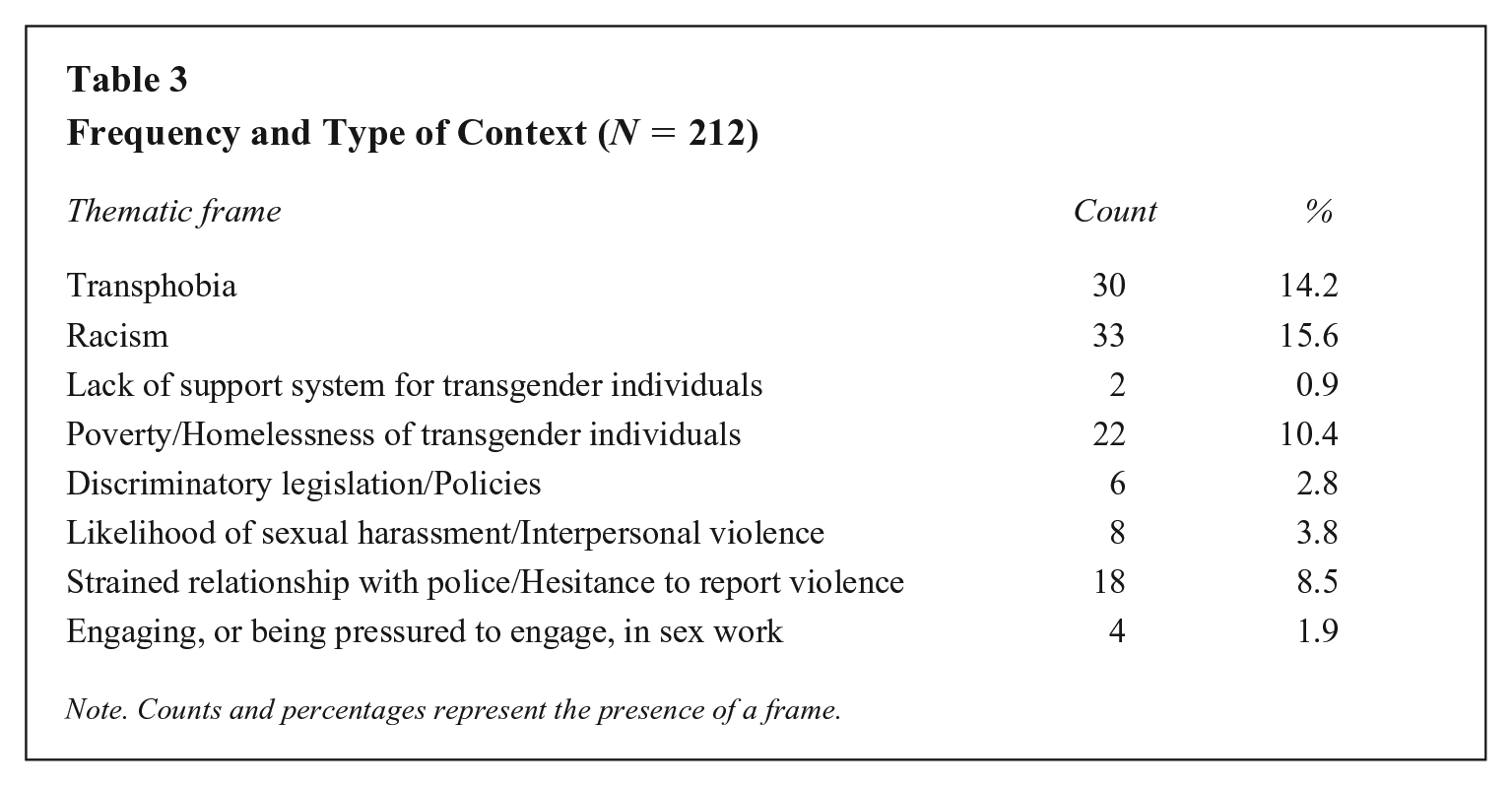
Note. Counts and percentages represent the presence of a frame.
Statistics highlight the magnitude of the problem, whereas thematic frames highlight the potential causes of the problem. The analysis found that 36 articles—30.2% of the sample—contained information about contributing factors, with transphobic attitudes and racism the most frequently referenced. More than 10% of articles discussed the prevalence of poverty and homelessness among transgender individuals, sometimes due to discriminatory employment and hiring practices, or because gender-nonconforming individuals are more likely to be kicked out or run away from their homes because of family rejection (Keuroghlian et al., 2014). Policies and legislation such as a wave of proposed “bathroom bills” or policies related to banning transgender individuals from the military were mentioned in about 3% of articles.
R4 asked to what extent the news coverage contained delegitimizing language. Twelve articles—nearly 6% of the sample—contained irrelevant details about the victim, communicated by the journalist or through a source. For example, many news articles covering the killing of Sasha Garden in Florida quoted the police describing the victim as a man “wearing a wig and dressed like a woman.” In another article, she was described by police as “wearing women’s clothing and makeup and that kind of stuff.” The mention of a victim’s previous arrest 3 years prior for prostitution without offering context and the labeling of a victim as a “transgender escort” illustrate other examples of victim-blaming using delegitimizing language.
R5 asked whether there were significant differences between 2018 and 2019 coverage. Chi-square tests of independence were conducted to make comparisons (see Table 4). For the first test comparing the use of deadnames, a chi-square analysis showed a significant difference between 2018 and 2019 articles. In 2018 articles, the use of deadnames was present in 20.5% of the content, whereas 2019 articles contained the use of the victim’s deadname in only 5% of the content, χ2(1, 212) = 0.809, p < .002, phi = −.229. When comparing the use of improper pronouns in 2018 and 2019 articles, chi-square results indicate no significant differences, χ2(1, 212) =1.191, p < .275. To compare the use of advocate sources, results of a chi-square test of independence found no significant differences in the frequency of advocate sources cited, χ2(1, 212) = 2.030, p = .154. A final chi-square test of independence was conducted to compare the percentage of articles in each year that called out police, news media or other sources who misidentified a victim. Results found no significant differences in this practice between 2018 and 2019 articles, χ2(1, 212) = 2.968, p < .227.
Percentages of Misgendering, Calling Out and Advocate Sources by Publication Year With Chi-Square Values (N = 212)
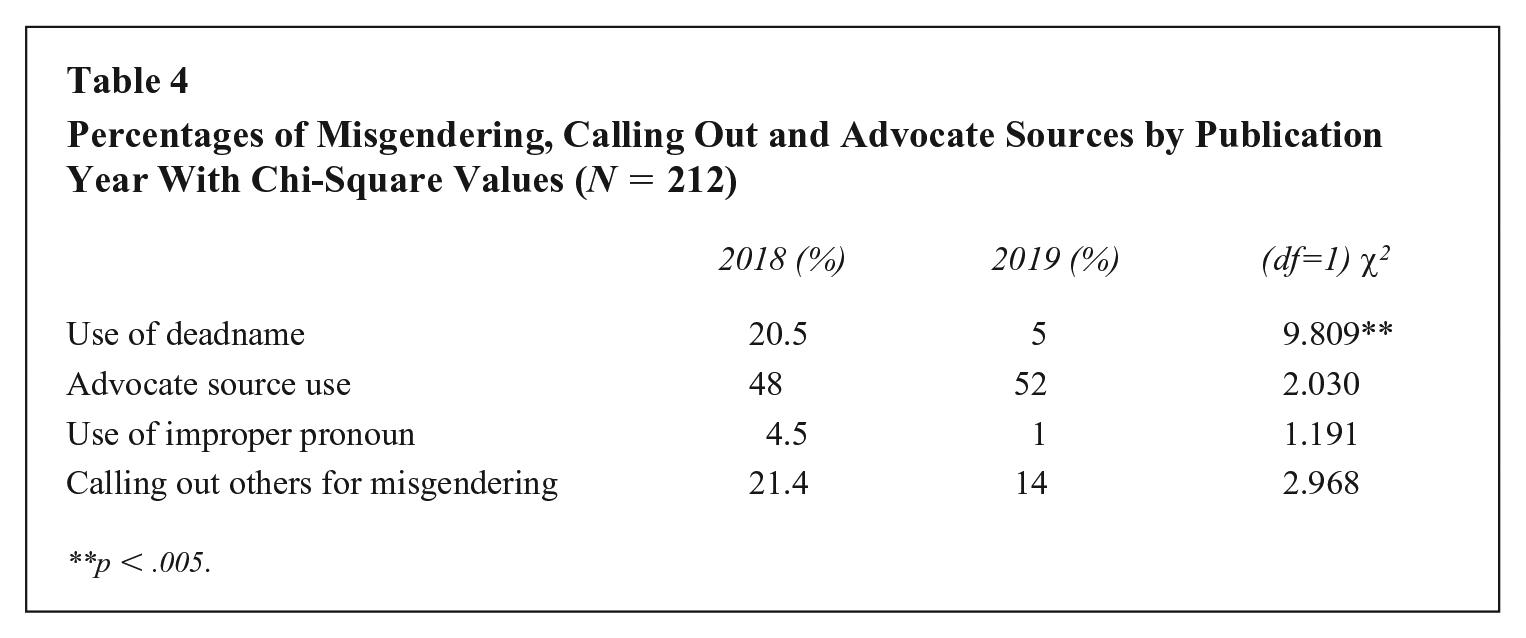
**p < .005.
Discussion and Conclusion
According to Billard (2016), there is “no right amount of delegitimizing” language in news coverage (p. 4209). Editorial decisions made by journalists regarding identification and language can have far-reaching implications. Misgendering and misnaming of transgender victims are still occurring in mainstream news outlets, as shown by the referencing of victims by their deadnames in a little over 13% of articles. Even when misidentification is committed by a cited source (such as a police officer) and not the author, if the journalist makes no effort to point out the discrepancy or add context, the public perceives what is cited as truth—the “official” version of events. Thus, the harm caused by the practice of deadnaming transgender victims may never come to light.
Journalists face challenges and responsibility when reporting on violence—particularly gendered violence—given the powerful role news media play in representing social problems, impacting public opinion, and exacerbating or mitigating stereotypes (Reese et al., 2001). Tight deadlines, confusion in the initial stages of homicide investigations and conflicting victim identification from multiple sources—these are all challenges news organizations grapple with when making editorial decisions about identifying victims. Being transparent with the audience and adding context when necessary are important when journalists are unsure of appropriate identification, particularly when victims cannot speak for themselves.
The study found that journalists are bringing the practice of misgendering to light. In 38 articles (18%), journalists explicitly addressed the problem of misidentification of transgender victims by police, pointing out the harm that can come from this practice, such as missed leads and tips and dishonor to the victims and their loved ones. Pointing out deadnaming by law enforcement makes audiences aware of this common practice. Journalists often quoted LGBTQ advocates to highlight the problem: Advocates say that not using the name and pronoun a person was known by can slow down an investigation during its most critical hours. People who knew the victim or who saw them in the hours before they were murdered might only have known them by their preferred name and gender. (ProPublica, August 12, 2018)
In another example from a June 3, 2019, CNN.com article, the reporter writes, “Unintentional or not, some advocates say this is one example that shows those in law enforcement need ongoing training to better serve people in the LGBTQ community.”
Learning from advocate organizations and adhering to AP guidelines, or supplementary style guides, can provide additional guidance. For example, the stylebook of the Association of LGBTQ Journalists instructs reporters to always cite sources when there are conflicting statements about gender identity and to explain the news outlet’s choices when using a particular name or pronoun when there is disagreement. When uncertainty persists, journalists should continue efforts to uncover the individual’s public identity, offering prompt corrections to previous publications when appropriate. Efforts can also be made to explain the barriers transgender individuals may face when it comes to legally changing their names and updating their gender markers.
Relationships with LGBTQ advocates can provide guidance on responsible reporting, but the burden cannot and should not always be put on advocacy organizations, which may be understaffed and have limited resources. Reporters can educate themselves about appropriate terminology so that they can approach news coverage with sensitivity and accuracy. For example, the difference between someone who cross-dresses (sometimes wearing clothes associated with a different sex) and someone who is transgender is an important distinction. Through investigation and interviews, journalists may learn the victim preferred to be described as genderqueer or genderfluid, in which case reporters should respect these labels. In some situations. The AP Stylebook does not set guidelines on gender identification in stone:
Language around gender is evolving. Newsrooms and organizations outside AP may need to make decisions, based on necessity and audience, on terms that differ from or are not covered by the AP’s specific recommendations.
Journalists should take initiative when gender-nonconforming individuals are covered in the news, reaching out to family, friends and social media before assigning names and pronouns to victims. This also means journalists should look beyond the police narrative.
Police sources are positioned as “gatekeepers” to crime news (Gillespie et al., 2013), but too much dependence on law enforcement information can lead to gaps in the narrative (Kurpius, 2002; Lacy & Matustik, 1984; Sacco, 1995). Law enforcement’s use of deadnames or improper gender may occur for a number of reasons—perhaps it is the department’s policy to use the government ID, perhaps the investigation is too early, gender identity is not apparent or police are receiving conflicting information about gender identity. While many police departments are changing their investigative protocols and media relations to be more LGBTQ-friendly, it is still incumbent on journalists to reach out to multiple sources and point out the reasons behind the misnaming of victims by law enforcement. Law enforcement officials are not journalists; they play a different social role. While law enforcement policy may be to report the name on a driver’s license, a journalist interprets and translates for the general audience. They dig deeper; they are watchdogs. Journalists follow a different set of protocols when it comes to identifying victims.
Advocates as sources have been called one of the most underutilized sources for crime coverage (Bullock & Cubert, 2002; Gillespie et al., 2013), as journalists fear they will be viewed as biased for including these sources. Sources with expertise on marginalized groups, however, can “contextualize” violence and correct misconceptions (Gillespie et al., 2013). Although no significant differences were found in the frequency of advocate sources used between 2018 and 2018 articles, when compared with a 2013 content analysis of domestic violence news coverage, advocates were cited nearly 5 times more in this study—48.2% compared with 8.5% measured in the 2013 study (Gillespie et al., 2013). This suggests that advocates are being consulted and used as sources more when news organizations cover violence targeting marginalized groups. Journalists wield substantial power as source gatekeepers, and including “non-elite” voices in news coverage contributes to the public’s understanding of gendered violence as a social problem and may help shatter gender identity stereotypes (Capuzza, 2014).
This study has limitations that should be noted. Although efforts were made to gather a comprehensive sample of U.S. news coverage on the 53 transgender victims of homicide reported in 2018 and 2019, some news coverage may have been omitted from the sample due to limitations of the databases used. This study compared consecutive years of coverage during a time period when controversial government policies highlighted transgender rights. With increased news media attention to transgender issues, and with the transgender community being represented more in entertainment media, language and word choice matters more than ever. The analysis found meaningful change in the practice of gender identification from 2018 to 2019, indicating positive incremental change in reporting practices.
That being said, AP style guidelines on gender identification continue to evolve, and it may take more time to see widespread improvement in news coverage. (In addition, not all local news organizations may be highly attentive to all changes in AP style from year to year, especially as a growing number of them have dropped their AP memberships.) A comparison of news coverage spanning several years may reveal more significant changes over longer periods of time. Future studies might compare today’s news coverage with coverage before 2011, when the AP Stylebook did not include clear guidelines on gender identification. Content analyses of news coverage of transgender individuals and news coverage of homicides of cisgender or male individuals could determine the differences in both quantity of coverage and framing. In-depth interviews with journalists and editors could shed light on the “how” and “why” behind the editorial decisions made when reporting on gendered violence.