



Abstract
This article examines how 22 Nebraska newspapers and a wire service covered nitrate contamination in Nebraska’s groundwater over nearly 4 years. We found coverage lacked depth and examined a few solutions although 88% of Nebraskans get drinking water from the ground. Reliance on fertilizer and irrigation for crop production leads to groundwater contamination, making this a concerning coverage gap as climate change impacts promise to make farming more challenging and increase environmental risks.
Keywords
In the last 40 years, nitrate contamination in Nebraska’s groundwater has been steadily increasing, primarily from leaching from fertilized, irrigated fields (Exner et al., 2014; Juntakut et al., 2019). Today, 82% of drinking water wells in an area of northeastern Nebraska are at risk of exceeding the federal nitrate drinking water safety threshold of 10 mg/L (Juntakut et al., 2020). While scholarly literature and scientific studies have drawn more attention to this issue and raised concerns about drinking water quality, newspaper coverage of nitrate contamination in Nebraska has focused on meeting coverage, features and few in-depth examinations.
Why does this matter? What is relevant to water in Nebraska is relevant to other states as well. The Ogallala Aquifer covers large portions of the middle of the country from Wyoming to Texas. In addition, Nebraska is one of the top corn and soybean producers in the country, meaning many states and countries source food and livestock from the state. Irrigated fields treated with commercial fertilizer are a major contributor to nitrates in the groundwater in Nebraska (Exner et al., 2014), which is troubling because 88% of the state’s residents get their drinking water from groundwater (Nebraska Department of Environment and Energy, 2021). Treating nitrates in the water puts a burden on small towns and increases individual water bills (Fargen Walsh, 2020). Drinking nitrates in water has been associated with increased cancer incidences under certain conditions (Ward et al., 2018) and neural tube defects (Croen et al., 2001). Nebraska also has the highest pediatric cancer rate in the Midwest (Siegel et al., 2018).
Nebraska is an ideal state to examine in that it shares similar geographic and agricultural production traits to its Midwest neighbors (Hatfield, 2012). In the United States, climate change effects such as increased rainfall variability will challenge crop yields and could further stress land and water resources and water quality (Basche et al., 2016; Troy et al., 2015). In addition, like other Midwest states, Nebraska has experienced troubling losses in local media. Given the increasing alarm surrounding contamination in drinking water and the state of journalism, this was an opportune time to study this issue.
In this study, we aim to contribute to our understanding of how and in what way resource-strapped journalists in an agricultural state cover an environmental issue that is tightly connected to agricultural and economic practices that also raise public health concerns. We were guided by agenda-setting theory to reveal coverage gaps and examine narrative elements of stories about nitrate contamination in the water. Most of the country’s journalists are situated on the coast (Shafer & Doherty, 2017), and although there is increasing attention to rural and small newspapers, much of journalism research is focused on larger newspapers (Ali et al., 2019; Reader, 2018) making Nebraska an ideal place to study and add more geographic diversity to local journalism studies. Most of the newspapers studied for this article had circulations under 10,000, and most were located in rural areas as defined by the federal government’s Health Resources and Services Administration (Rural Health Grants Eligibility Analyzer, n.d.) which uses Census and other data to determine an area’s ruralness. In this study, we are adding to the literature on local environmental reporting in the Midwest by outlining gaps in coverage in one agricultural state that can provide useful insight for science communicators, nonprofit news entrepreneurs, and journalists in similarly situated states.
Nebraska Media Landscape
As of 2020, there were eight counties in Nebraska without a newspaper and 43 counties with a single newspaper (Abernathy, 2020). Lee Enterprises, a national newspaper chain, currently owns many of the state’s daily newspapers. As of June 2022, Lee owned 19 of the 22 weeklies and dailies analyzed for this study (Lee Enterprises, n.d.; Nebraska Press Association, n.d.) and has continued to strip down staff in those newsrooms. There was evidence of this downsizing in Nebraska during data collection (“Omaha World-Herald Eliminates 23 Jobs,” 2018) and after (Omaha World-Herald Guild, 2022). This is also emblematic of challenges facing newspapers across the country including corporate consolidation, layoffs, lower salaries, less coverage, and downsizing (Abernathy, 2016; Miller, 2018). As data for this research was analyzed, two nonprofit news organizations have formed in Nebraska, demonstrating a need for more journalists to cover statewide issues as well as a recognition that legacy news organizations need help. Flatwater Free Press formed in the fall of 2021 (Wynn, 2021) to provide independent, investigative coverage of statewide issues. In 2022, the States Newsroom launched a government reporting bureau in Nebraska (Manning, 2022).
Of particular concern is coverage of statewide agribusiness and environmental issues given the amount of farming and ranching in the state and its importance for the economy and impact on natural resources. During data collection, there was no dedicated full-time statewide agricultural or environment reporter in Nebraska, which has led to coverage gaps. For example, in January 2021, the international newspaper The Guardian was the first newspaper to report on an unfolding environmental crisis in the tiny village of Mead, Nebraska, where an ethanol processing plant was being accused of contaminating the rural environment with the waste from the treated seed corn it was processing (Gillam, 2021). Residents had been complaining for years, but no real steps were taken until after Gillam’s story ran and media attention increased. The plant has since been shut down (Dunker, 2021). The state’s media consumers also benefit from Nebraska Public Media which operates a statewide public radio station and in 2022 added an investigative newsroom. In addition, the station belongs to Harvest Public Media, which produces radio stories on agriculture, environment and natural resources.
Agricultural, Science, and Environmental Journalism
While agricultural and science journalism often uses traditional news reporting practices and news hooks to engage audiences (Harcup & O’Neill, 2017), journalists may be more apt to identify scientific information that is easier to explain or understand. Agriculture often involves science and economic approaches to reporting. In a study of online comments about news media posts concerning agricultural and biological engineering, researchers found that news organizations created conversations around gene editing and manipulation as well as a mixture between antiscience and proscience stances (Walker & Malson, 2020). Often the conditions that accompany the news coverage of crisis and disasters (such as hurricanes, tornadoes, and the recent COVID-19 pandemic) are challenging environments for journalists, in that they may create physical and mental limitations (Houston et al., 2015; Perreault & Perreault, 2021).
Recommendations have been made by practitioners and journalism scholars concerning environmental journalism best practices (Friedman, 2015; Tandoc & Takahashi, 2014). As climate change and global warming became more recognizable in the 1990s and early 2000s, with the popularity of the documentary by former Vice President Al Gore, An Inconvenient Truth and blockbuster films like Erin Brocovich and Avatar, more people became aware of environmental concerns (Friedman, 2015). Many science journalism practices developed in magazines, which were dedicated to science reporting (Dunwoody, 2021). Researchers have found that climate change coverage is made more relevant when discussions of issues connected to climate are integrated into news coverage, rather than climate change being the central topic (Brüggemann & Engesser, 2017).
That said, journalists still struggle to understand science and cover scientific research, but there is a call in the profession for journalists to garner more engagement in scientific conversations around climate and environmental concerns rather than just print scientific studies (Dunwoody, 2021; Friedman et al., 1999). Increasingly, research has examined the value of covering science and environmental issues that inform the public at large, with science and environmental stories winning national and international awards. Journalistic research is increasingly investigating the more complex information around health, finances, and politics (Clatworthy & Jones, 2003; Hinnant et al., 2012; Jerit, 2009; H. M. Smith & Norton, 2013). Similarly, news stories on science or science-related topics often lead journalists to sources they have consulted in the past or those that are easy to access through libraries or other networks (Wallington et al., 2010; Wihbey, 2017).
The news media play a “significant” role in environmental policy debates, and therefore source diversity is important (H. M. Smith & Norton, 2013). In establishing seven categories of stakeholders that should be involved in the discussion of environmental topics including “citizens and community groups, environmental groups, scientists and scientific discourse, corporations and business lobbyists, anti-environmentalist groups, media and environmental journalists and public officials and regulators,” H. M. Smith and Norton (2013) defined the spaces in which journalists contribute to these debates.
Also, because journalists seek to cite experts in their reporting, science journalism might use people who have credentials, degrees, or are established as public intellectuals (Fishman, 1980). Therefore, journalists can use expert perspectives to open up conversations to a more general audience with limited scientific knowledge.
Local News Coverage Approaches
News values often dictate what stories journalists choose to cover or not cover (O’Neill & Harcup, 2009). News values like proximity, impact, conflict and timeliness are visible in most if not all news stories (Harcup & O’Neill, 2017). Primary topics of interest in local news have differed given the engagement, frequency of publishing, and news organization resources. The categories of coverage have been observed by scholars in local newspapers as well as on local television stations. Journalists often operate as facilitators of discourse around hard topics (Christians et al., 2010).
A study of several community-focused news stories found that often “crime, disaster/accident, and government/politics proved to be enduring news story topics,” which were not dependent on screen size or where people engaged with them (be that online or offline; Gant & Dimmick, 2000). Other areas of study regarding topical reporting in local journalism were business/economy, education, and environment/ecology news stories (Gant & Dimmick, 2000). While there are a few studies that address the intentions and approaches of local journalists, what is consistent is the connection they have to their communities as they chose to rally around issues pertinent to that community (Radcliffe, 2017). Local newspapers in particular play a significant role in informing voters (Druckman, 2005), and newspaper circulation per capita can influence whether someone will vote down-ballot (Chapp & Aehl, 2021).
Narratives can help journalists establish authority over a specific region or topic (Zelizer, 1990). Narratives can help communities cope in disaster and crisis, and journalists may choose certain narratives given the challenges of reporting on their own communities (Perreault, 2021). Narratives in local news can help local populations to connect to local issues. As reporters become more integrated into society, the ability to engage in certain parts of that society becomes more challenging (Johnson-Cartee, 2004). Trust is also stronger between publics and their news organizations when audiences consume location-based reporting (Sands, 2019), but as local news organizations began to cover more controversial social and political issues, people began to trust them less. In a study of automated journalism news stories, news stories with more complex narratives were more likely to hold the attention of readers than those with basic structures (Caswell & Dörr, 2018). So while local journalists may be more apt to cover local issues, they also may face pushback when locals see the story as too complex and lacking a storied approach.
Agenda Setting
Even with today’s fractured media ecosystem, which includes social media, digitally native startups, legacy media and nonprofit niche publications, agenda-setting theory remains a salient method for understanding the relationship between the public and the press. Journalists’ decisions to cover certain events or topics can influence public opinion (McCombs, 2005; Perreault & Ferrucci, 2020), and one of the primary ways to study agenda setting is through analysis of news coverage patterns (Wanta & Ghanem, 2006). Items on the agenda rise or fall and compete with each other (Dearing & Rogers, 1996, p. 3). Wanta and Ghanem’s (2006) meta-analysis of 90 agenda-setting studies affirmed support for the media’s “widespread” influence. Wanta and Ghanem (2006, p. 47) further posited that media influence applied more liberally to the “top agenda” not the entire agenda, using the environment as an example:
If an issue such as the environment generally receives little coverage from the media but suddenly gets substantial coverage, for whatever reason, media consumers would be likely to notice this change and may raise the environment higher on their issue agendas. (Wanta & Ghanem, 2006, pp. 47–48)
The converse would be true for topics placed at the bottom of the agenda (Wanta & Ghanem, 2006, p. 48) indicating that the more salience the media gives a topic, the stronger the effect.
The most common measure or dimension of media salience is attention, commonly represented in media studies as an analysis of the number of stories on a topic (Kiousis, 2004). The number of stories in a newspaper can define the salience (Tan & Weaver, 2009) and represent the newspaper’s agenda. The number of stories published comprised one of the attention measures of media salience Kiousis (2004) used when examining eight political topics covered in The New York Times coverage of the 2000 presidential election.
Newspapers set agendas at the state and local levels as well. The local newspaper can play both a transmitter role and a filtering role (Hess & Waller, 2020; Weaver & Elliott, 1985). In their content analysis of an Indiana city’s city council meetings, Weaver and Elliott (1985) found the local newspaper the Herald-Telephone filtered recreational and social news from the council, thus not all the major items discussed at meetings made it into the paper, suggesting a strong agenda-setting role. But they also found a more common transmitting role in topic coverage involving economics, meaning the newspaper was likely to reflect coverage of topics reported (Weaver & Elliott, 1985). Tan and Weaver (2009) found a positive relationship between the newspaper agenda and the policy agenda in 15 U.S. states from 1989 to 2006 when they studied the public, newspaper, and policy agendas in 18 states over 22 years.
With all this in mind, we pose these two questions:
Method
Researchers used the NewsBank database to search for Nebraska newspaper and wire service stories between January 1, 2017, and November 1, 2020. Researchers searched for the keywords: “water” and “nitrate” and “water” and “nitrates.” The analysis included stories from 22 daily and weekly newspapers in Nebraska in mostly rural areas. Of the 22 newspapers, 19 had circulations 10,000 or below. Lee Enterprises owned 19 of the 22 weekly and daily newspapers analyzed.
Characteristics of Selected Nebraska Newspapers, 2022
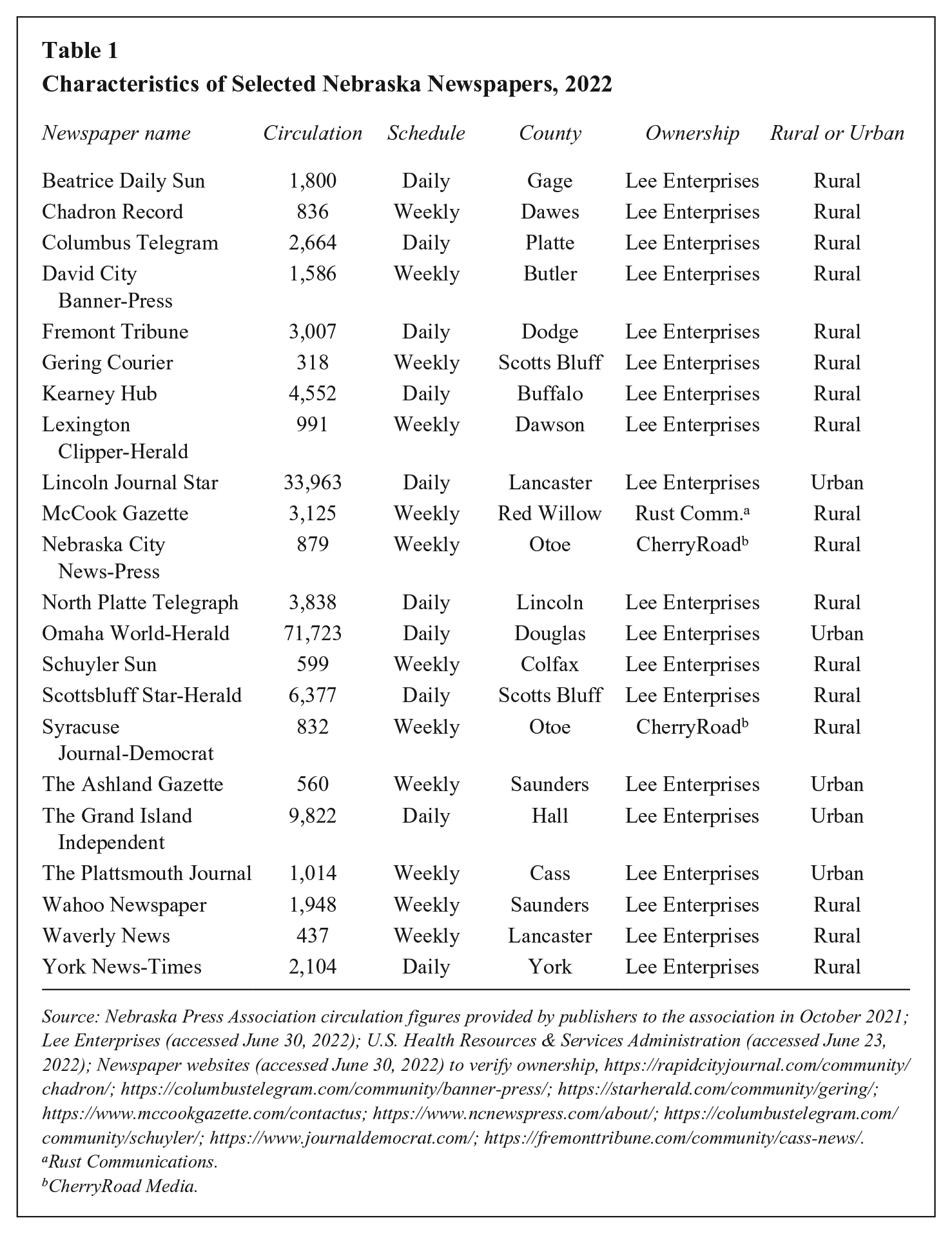
Source: Nebraska Press Association circulation figures provided by publishers to the association in October 2021; Lee Enterprises (accessed June 30, 2022); U.S. Health Resources & Services Administration (accessed June 23, 2022); Newspaper websites (accessed June 30, 2022) to verify ownership, https://rapidcityjournal.com/community/chadron/; https://columbustelegram.com/community/banner-press/; https://starherald.com/community/gering/; https://www.mccookgazette.com/contactus; https://www.ncnewspress.com/about/; https://columbustelegram.com/community/schuyler/; https://www.journaldemocrat.com/; https://fremonttribune.com/community/cass-news/.
Rust Communications.
CherryRoad Media.
Electronic databases storing news articles are commonly used for content analysis research, and they can make analysis easier (Ridout et al., 2012). Results are reliable (Weaver & Bimber, 2008). Weaver and Bimber (2008) noted there can be wire service blind spots, excluded corrections, articles printed in one newspaper and reprinted again in another in a truncated version, and issues with changes in contracts between newspapers and news databases, but those issues do not negate the effectiveness of electronic databases. Not every Nebraska daily newspaper was included in NewsBank. Electronic news database results may vary depending on the service used, but those variations were “minimal,” likely because newspapers do not vary the stories they submit to databases (Ridout et al., 2012).
There were 378 news stories displayed in the results for the above keywords and date parameters, but 227 were screened out because they were not local or they met other exclusion criteria. Exclusion criteria included: candidate biographies, articles written by an individual associated with a commercial entity such as the owner of an agrochemical company, articles that had the same byline, headline and/or story (duplicates), advertisements, event listings, stories republished from national or regional sources, stories that nitrate was referenced in a nonagricultural or nonfertilizer context, notifications of requests for proposals for projects, public meeting notices, letters to the editor, and guest columns from newspaper readers or community members. The remaining content analyzed included news stories, feature stories, editorials written by unnamed newspaper editors, extension articles, investigative stories, press releases, meetings and public service announcements. Stories and press releases written by nonjournalists such as extension educators or university sources were included in this analysis because news organizations turn to this type of content because it is cheap and requires little effort (Allern, 2002) as opposed to costlier and time-consuming investigative pieces.
Using a thematic narrative approach to code the news stories, researchers identified the types of stories, topics and approaches to topics involving water, nitrates, science and the environment. This detailed coding approach identifies specific “narrative elements” in that it seeks to find the sources, frames and types of newspaper stories written in these local Nebraska publications (Van Dijk, 1985, p. 39). Similarly, narrative framing has been used in many different ways to examine discourse and content in the social sciences (Herman & Lewis, 2012). Thematic approaches allow researchers of mass communication messaging to understand the decision-making processes and how those contribute to a larger discourse around a particular topic. Studies similar to this have been adopted by scholars in media studies, communication, and journalism fields to gain an understanding of the work of journalists as well as how the public perceives their work (Gamson, 1989; Gamson & Modigliani, 1989).
A thematic narrative analysis was used to organize and code the narratives and narrative elements in the stories (including the who, what, where, when, why and how; L. K. Smith, 2009) and the narrative elements such as subject, plot, and overall narrative (Foss, 1996). Narrative theory can assist in determining how journalists might draw attention to different issues or events based on the varied heroes, villains and plotlines (Foss, 1996; Perreault & Paul, 2018).
To ensure continuity in the data, 16 stories were coded separately by each of the researchers, discrepancies were discussed and coding categories were edited and adjusted. The researchers coded the remaining 135 stories separately and used separate spreadsheets with the same category or coding headings including author type, story type, newspaper name, sourcing, headlines, length and whether a story was about the topic of nitrates or merely had a mention. Quotes and rich descriptions were also noted, and researchers provided a summary sentence of each article.
Stories were determined to be about a topic or relevant (Kiousis, 2004), meaning the story was about the central topic of nitrates in the water, not just containing mere mentions. The stories that lacked relevance were considered in the thematic analysis because while they were not substantive, they did fulfill a public service duty to inform the public of community dangers and to educate people on environmental stewardship. The investigative or in-depth stories were thematically coded as such because of multiple layers of sources including a combination of farmers, scientists, concerned citizens, city officials or business representatives. Only stories with at least 500 words were considered as potential in-depth or investigative stories but only if those stories were about the topic or relevant (Kiousis, 2004), had source diversity (H. M. Smith & Norton, 2013), and also opened up the news for analysis and discussion (Figenschou, 2010). Agenda-setting theory was used because it demonstrates the influence news editors and reporters exert over content by telling audiences what to think about but not what to think (Matthes, 2005; McCombs & Shaw, 1972).
Findings
While Nebraska newspaper readers are getting access via their local papers to stories about nitrate contamination in the groundwater, the coverage often focuses on routine general news, meetings, and government activity or lacks relevance (Kiousis, 2004), in this case meaning the word nitrate is mentioned but not the central point of the story. These stories that lacked relevance did not fully explore the issue and its economic, agricultural and public health considerations. Over nearly a 4-year period, there were 151 stories that mentioned nitrate contamination in the groundwater—that’s about one every nine days.
The primary themes of nitrate water contamination in newspaper coverage involved covering topics that people already are invested in such as local meetings and visits to schools, rather than deeper, more scientific stories regarding nitrate contamination. In Nebraska, there are 23 locally elected Natural Resources District (NRD) boards that have levy power and can enact regulations that limit how much fertilizer farmers can apply and when they apply it. The boards are also tasked with groundwater monitoring and education.
In regard to RQ1, what are the primary topics covered in local stories about nitrate contamination in the water, the topics included the ways that nitrate contamination intersected with agriculture and by proxy, public health. Generally, these topics manifested in stories related to the agricultural impacts of nitrate contamination, fertilizer and irrigation regulations and impacts on farming. The agricultural impacts were implied—sometimes not mentioned—or intertwined with the discussion of regulations or nitrates in the groundwater.
For example, a February 18, 2020, York News-Times story written by Chrystal Houston, a public relations manager for the Upper Big Blue NRD, was about a fourth-generation farmer who saw success with conservation practices to reduce nitrates in the groundwater, which were above safe drinking water standards. Houston wrote,
One of the main goals of the project is to maintain the quality of the drinking water produced from the wellfield, as a healthy soil acts as a filtering system to the aquifer and decreases nitrogen leaching and contamination into the water supply. The purpose . . . is to improve the drinking water supply for York residents. . . .
A February 20, 2018, Grand Island Independent story about nitrate contamination focused on the unsafe drinking water levels for McCool Junction. “Upwardly-trending nitrate levels in the village’s water system is a drinking water threat,” reporter Steve Moseley wrote. The village faced an “imminent threat to the water supply,” he wrote, citing language in a grant application for money to drill test wells to find a cleaner source of water. The story did not address the root cause of the high nitrates, which in Nebraska is commonly fertilizer used on irrigated corn fields.
The lead of a January 13, 2020, article in the Grand Island Independent written by the public relations arm of the university’s agriculture and natural resource department, read,
Corn and wheat growers across Nebraska will be able to gain hands-on experience with cutting-edge technologies that will allow them to more precisely identify the amount of nitrogen fertilizer their crops need, while preventing excess nitrates from ending up in Nebraska’s water supply.
When public health impacts were mentioned, it was often in the form of public service announcements. For example, newspapers printed information on unsafe drinking water conditions, ways to reduce nitrogen leaching, and ran columns by extension educators or NRD staff. This content sought to inform and educate residents about the health impacts of groundwater contamination. An article by NRD public relations manager Chrystal Houston that ran in the York News-Times August 15, 2019, mentioned nitrates one time in a larger story about funding for natural disaster preparedness. “This is of interest, as reducing nitrates in groundwater in the district is one of the most pressing initiatives of the Upper Big Blue NRD,” she wrote.
A March 8, 2018, article by Columbus Telegram reporter Larry Peirce written with two sources from groundwater associations encouraged residents to get private well water tested and learn more about protecting groundwater. On September 25, 2020, the Columbus Telegram ran a public health announcement warning residents of small town Genoa who were pregnant or nursing not to drink the tap water because it exceeded the federal safety standard for nitrates. It also warned that drinking the water was especially dangerous for infants under 6 months old noting that they “may experience shortness of breath and have a blue tint to their lips and skin due to a lack of oxygen. This is referred to as, ‘blue baby syndrome.’” A story in the Beatrice Daily Sun on August 16, 2017, informed residents that nitrate levels in the drinking water were 14 milligrams per liter and that pregnant women and infants should find another source of water noting “children who drink water with high nitrates can become seriously ill and die if their sickness goes untreated.” The federal standard for nitrate levels in drinking water is 10 mg/L. Anything above that is deemed unsafe according to the federal Safe Drinking Water Act.
In regard to RQ2, what is the type and nature of local stories about nitrate contamination in the water, the most common type of stories analyzed were meeting stories that included coverage of hearings or board meetings as well as feature stories, typically about people and projects in local schools. Of the 151 stories analyzed, 36—nearly one-fourth—were meeting coverage stories.
Findings by Story Type Nebraska Newspaper Nitrate Coverage 2017–2020.
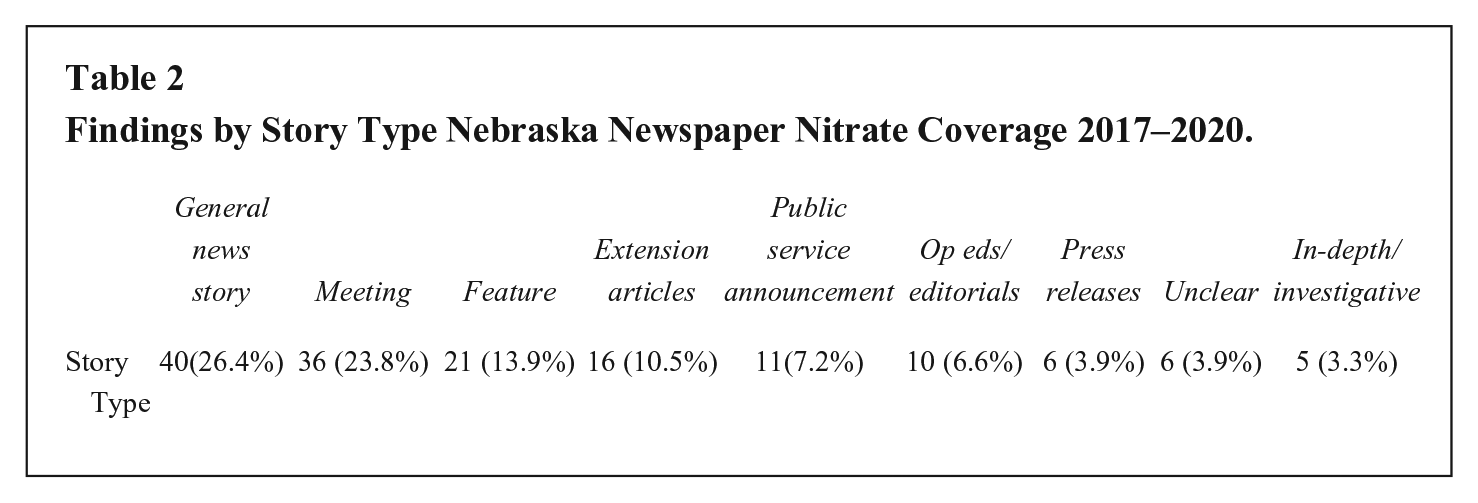
Journalists routinely covered NRD board meetings where nitrogen fertilizer regulations were discussed, hearings on a proposed industrial chicken plant, and visited schools to write feature stories about water quality. Stories based on meeting coverage, which often framed the nitrate problem through an agricultural lens, often featured sources who were at the meeting in an official capacity.
On April 22, 2020, reporter Suzi Nelson for the Wahoo Newspaper covered a board meeting where a demonstration farm (a farm to try out a new technique, in this case to decrease nitrogen fertilizer use) was approved. Reporter Kevin J. Fink, on February 20, 2020, wrote in the Gering Courier about a roundtable meeting organized by a local natural resources board where farmers discussed legislative updates and other topics including nitrates. On June 2, 2017, reporter Lori Potter in a story printed in the Kearney Hub wrote about the NRD’s progress on a $50,000 nitrate contamination study. In a few instances, meeting coverage stories drew more attention and bigger crowds.
In 2018, the Papio-Missouri NRD board voted to adopt a new groundwater management plan that limited when farmers could apply commercial fertilizer, which faced some farmer opposition. A February 12, 2018, story written by reporter Andrew J. Nelson that ran in the Omaha World-Herald as well as other newspapers, noted that the board had adopted new regulations designed to decrease nitrate contamination. One farmer questioned the science behind the regulations saying, “Everyone has a lot to learn from this,” he said. “Shouldn’t we discover what’s going on and determine where it is coming from?”
One subcategory of meeting stories emerged—a series of stories in different newspapers on a proposed Costco chicken processing plant in Fremont, Nebraska, and the barns that would support it. These took the form of meeting coverage, news stories, and one in-depth story. Of the 151 stories, 13, or 8.6%, were about plans for the Costco chicken plant or barns. The processing plant proposed was a 360,000-square-feet chicken slaughterhouse that would produce 470,000 chicks a day (Manna, 2017). A September 27, 2017, story by Sam Pimper, a reporter for the Fremont Tribune, covered a meeting where the Dodge County Board of Supervisors approved a permit for four chicken barns housing 60,000 birds. There were at least two people in attendance who voiced concern about the project, worried about air quality, property values and public health. Also quoted in the story was the farmer who wanted to build the barns as well as an agribusiness representative.
Feature stories tended to include mentions of nitrates. Of the 151 stories, 21 were feature stories or nearly 14%. For example, local journalists covered water quality-related stories in local schools, but these stories were rarely about nitrate contamination and included mostly mentions of the topic. A March 8, 2017, story in the Gering Courier by Philip Eckerberg focused on a trip local students were taking to New York City to compete in a contest related to precision agriculture. Another feature story by reporter Sandra Hansen for the Scottsbluff Star-Herald on January 22, 2019, was on the retirement of a local board member and former reporter. Often, sources in stories about or mentioning nitrates were government officials, students or teachers, or researchers. University of Nebraska-Lincoln civil engineering professor Shannon Bartelt-Hunt was quoted in a story July 13, 2019, that appeared in the Grand Island Independent and other newspapers written by a staff writer that was about a new citizen science program:
The testing is easy and it’s real-time data for our citizen scientists,” (Shannon) Bartelt-Hunt said. “If they show that they’ve got elevated levels, we provide information for helping navigate the options to treat their water.
Meeting coverage of a planning commission’s approval of a large poultry barn near a small town included sources in favor of the barn including the project applicant and government officials, including one government official from a different town who voiced opposition. In the story, “Commission gives OK to chicken barn” that ran in the Wahoo Newspaper January 10, 2018, concerns about the water were raised in the final four paragraphs of the story with one member of the public saying she was worried about high nitrates in the groundwater and one commissioner acknowledging the commission was also worried about the water “and that they drink the same water.”
There were five stories of the 151 stories, or 3.3%, that were categorized as in-depth or investigative. One such story noted above on the proposed Costco chicken operation and appearing in the Omaha World-Herald October 12, 2017, included eight sources including Jessica Kolterman of Lincoln Premium Poultry (business), Randy Ruppert (citizen and community organizer, environmentalist), Colten Schafersman (farmer), Marianne Schuler (citizen, opposed to the project), Lon Strand and Bob Missel (elected official/government), Jim Jaksha (citizen concerned about nitrates), Nutrient Advisors President Andy Scholting (business). The story was written by Barbara Soderlin, who was at the time the agribusiness reporter.
Discussion and Conclusion
Nature is the interaction between topic, type and sourcing. So, when considering the nature of nitrate contamination coverage, researchers identified the convergence of topic, type and sourcing to describe a reactionary or responsive approach to coverage of this public health issue at the local level. Most stories about nitrate contamination or mentioning it were written for an agricultural audience or designed to educate the public about the damage nitrate contamination was doing to the groundwater and let them know it could affect their health, but sometimes with little context.
In answer to RQ1, what are the primary topics covered in local stories about nitrate contamination in the water, the stories analyzed addressed public health issues connected to nitrates and the agricultural connection between nitrates and nitrogen fertilizer, but often the connection between the two was lacking. Still other stories were on the topic of public education such as public service announcements about the dangers of contaminated water or advice on how to reduce nitrogen use on fields.
In answer to RQ2, what is the type and nature of local stories about nitrate contamination in the water, the type of local stories about nitrate contamination in the groundwater were dominated by meeting stories and feature stories and educational content that were framed through educational or agricultural lens. This is in line with Weaver and Elliott (1985) who found that the local press played a transmitting role when covering a local elected body. It also points to more international conversations around news coverage in rural communities where considering an audience’s geo-social orientation (relevance of location) often changes the way the audience engages with rural information (Hess & Waller, 2020).
The Costco chicken farm board meeting written by an environmental journalist was one of the few stories that met H. M. Smith and Norton’s (2013) framework with seven stakeholders. More stories like this are needed in an agricultural state that is facing the prospect of changes to its farming and economy based on climate change effects (Basche et al., 2016; Troy et al., 2015) and as people continue to become more aware of environmental concerns (Friedman, 2015).
This coverage gap could be explained by previous research that has found that journalists struggle to understand and cover science (Dunwoody, 2021; Friedman et al., 1999) and that journalists writing about agricultural and science journalism are apt to use traditional news reporting practices and identify scientific information that is easier to explain (Harcup & O’Neill, 2017). At the local level, journalists have a key role to play in making science palatable, relevant and engaging for audiences who may not have taken science classes beyond high school.
The facilitative role of journalists means journalists cover topics that they see as valuable. For many, covering issues about nitrates in a meeting fits with the journalistic norms of covering government meetings. This also makes sense given journalists and journalism serve a facilitative role in society (Christians et al., 2010) by adhering primarily to select formats concerning scientific reporting (Dunwoody, 2021).
Given journalists have less and less time, the significance of even a few stories with the mention of the risk of nitrates is important. Covering science in a certain way can bring facts and concerns into the everyday thoughts of the public, and journalists covering these issues might be able to change or influence public opinions over time (Friedman et al., 1999). In addition, in the case of climate change, coverage is more relevant when it is integrated into news coverage (Brüggemann & Engesser, 2017).
The stories in local newspapers do matter. What publishers are putting on newspaper pages can impact policy decisions and opinions (McCombs, 2005; Tan & Weaver, 2009; Wanta & Ghanem, 2006). For communities to see these issues and be impactful, the coverage needs to run deeper. For example, few of the stories used narrative techniques, which can be more engaging and help journalists establish authority (Zelizer, 1990). Some audiences may not know the impact of nitrates on their communities without the efforts of local journalists.
After analyzing the data, there are a variety of unanswered questions: Why are there very few approaches to the local policies in place concerning agriculture? Are the journalists doing reactionary reporting? Is this because of a lack of training or decreasing number of journalists in the state and increased newspaper consolidation (Abernathy, 2016)? Is there a lack of consistency of how journalists address environmental issues because of their lack of confidence? Is this a result of news deserts or other rural problems? Perhaps these journalists are struggling with the content matter or lack of training opportunities for journalists who want to learn more about environmental concerns. The main concern with nitrate contamination is the damage it causes to the environment, which includes polluted streams and rivers and contaminated groundwater that if it is ingested untreated is associated with adverse health effects (Croen et al., 2001; Exner et al., 2014; Puvvula et al., 2021; Siegel et al., 2018; Ward et al., 2018).
This analysis answered the question how is the public health issue of nitrate contamination being covered in Nebraska, but there were limitations. This study did not speak directly with journalists, but the researchers are working in the space of rural and local journalism, and therefore had a background knowledge of the structures and conditions in which these news organizations operate. While this study did not do audience analysis, future studies should seek to evaluate how the audience observes the news coverage of issues around water quality and the environment in their communities. It also brings to light how public, nonprofit and for-profit media might handle coverage of this issue. A quantitative content analysis comparison of news coverage of this and other environmental issues in other majority rural, agricultural states could shed light on the types of news reporting readers have access to and the nature of those stories. In addition, this research illuminated the need for a clearer understanding of the decisions journalists in agricultural states make and how they cover the environment.
