




Abstract
Drawing from CARES Act news coverage, this study investigated how different market-oriented news organizations modulated the debate on the most expansive stimulus bill in modern U.S. history, released in 2020, during the coronavirus pandemic. A comparative approach was used, between news articles produced by a strongly market-oriented and a weakly market-oriented news outlet, both national news outlets, based in the United States. Using market theory as a guide to explore published news content, this study focuses on showing the range of debate, news sources and journalistic role performances employed in coverage of the same topic, coming from differently funded newsrooms. Some of the findings of this research demonstrate differences in the assessment of objectivity as a journalistic norm, and similarities as the indirect use of government official sources. To conclude, some implications for the field of journalism are discussed, including a revision of objectivity as a journalistic norm.
Keywords
Introduction
Research illustrates that the market orientation of a news organization can affect news content (Beam, 1998; Canella & Ferrucci, 2020; Ferrucci, 2015a, 2015b; Ferrucci et al., 2019; McManus, 1994). With the fresh entrance of a significant number of differently funded news organizations in the United States, inquiries about the influence of market orientation forces on news content have opened a whole new era in journalism studies. According to Ferrucci (2020), news organizations are now operating in a market continuum: On one side of the spectrum, strongly market-oriented news organizations function in an intense competition in markets for audiences, sources, advertisers and stocks, categories that compose a market theory for news production (McManus, 1994). On the other side, weakly market-oriented news organizations compete only for the market of sources and audiences.
Using market theory (McManus, 1994) as a theoretical framework, this study proposes an investigation of news content published in different market-driven news outlets, an analysis that addresses media organization level, where the hierarchy of influences (Shoemaker & Reese, 2014) is considered in news production. Market orientation is more intrinsically manifested at the organization level because identity and ownership are core concepts that function within this level of analysis (Shoemaker & Reese, 2014; Shoemaker & Vos, 2009).
This research looks into news articles published about the CARES Act, a US$2.2-trillion stimulus package that gained national coverage in 2020, labeled as the most expensive package in recent U.S. history (Lobosco, 2020). The stimulus bill was an attempt by the federal government to keep the U.S. economy afloat when the coronavirus pandemic first hit the country that year. Besides carrying the label of a multitrillion-dollar package, a topic like the CARES Act exhibits degrees of nuance and angles to be explored in journalistic coverage, ranging from economics, through to education, services and politics—giving rise to a diversity of topics that can enrich the investigation of news production. Furthermore, 2020 was a U.S. presidential election year, which constitutes an enhanced, and complex, news coverage context.
Thus, news coverage of the CARES Act is examined in this study, focusing on a strongly market-oriented news outlet, USA Today, and on a weakly market-oriented news outlet, The Intercept, for a comparative analysis. To operationalize the study, content published by both news organizations was amassed to access their range of debate; their usage of news sources because sources constitute one of the most vital elements in news production (Gans, 2004; Schmitz, 2011; Sousa, 2005); and their performance of the journalistic role, with the application of Mellado’s (2015) model.
Research has indicated that market orientation can influence news content, but a study of different market-oriented digital newspapers had yet to be designed for a comparative assessment. This study attempts to fill this gap and to further investigate the impacts of news organization funding models on news content production. News content can be influenced by the ideologies and attitudes of journalists, within the individual level of influence; journalistic routines, such as deadline pressure; interference from other institutions; or cultural premises, at a more macro level of analysis. Thus, this study asks whether the organization level, where mechanisms of ownership are most evidently exposed, exhibits a strong and solid impact on news production.
Literature Review
Market Model Orientation for News Organizations
Studies on how economic models affect news organizations began after World War II (S. Lacy et al., 1989), when research focused on understanding how newspaper ownership and competition in the journalistic field affected news content production. But the results were unrepresentative and contradictory, mainly due to “variations in research design, variable definitions, sample size and theoretical basis for research” (S. Lacy et al., 1989, p. 4). The rise of commercial journalism in the 1980s in the United States (Gans, 2004; McChesney, 2004; McManus, 1994) boosted scholarly research in this area to assess the impacts of news outlets’ funding models on news content. Contemporaneously with the mass entrance of news organizations to the stock market, McManus (1994) conceptualized journalism through a market theory, in which news organizations are placed in constant market competition. For McManus (1992, 1994), news is a peculiar commodity because it is a product that serves both the market and the public at the same time, or else it is a dual-product model articulated by Baker (1994) and Beam (1998)—the latter operationalizing market orientation in two categories, weaker and stronger.
Studies of market orientation fall within organization-level analysis because the identity and ownership of a news organization are core concepts at this level of influence (Shoemaker & Vos, 2009). Organization is one level of the hierarchy-of-influences model (Shoemaker & Reese, 2014), which also includes the levels of individual, routines, social institutions and social systems: “An organization is a collective of individuals and/or groups whose members work toward common goals, giving the organization an identity. An organization distinguishes itself from others based on its ownership, goals, actions, rules, and membership” (Shoemaker & Reese, 2014, p. 130).
Within the mechanics of organizations and furthering the articulation of news as a peculiar commodity, McManus (1994) argues that news organizations compete in four markets: the market for audiences, the market for sources, the stock market and the advertising market. News as a commodity facilitates trading in these markets. McManus (1994) describes the market for audiences as the most explicit market in which news organizations trade, and Beam (1998) adds that all news organizations trade in this market because there cannot be any news production without an audience to consume it. The market for sources was established to trade newsworthy information (McManus, 1994) and occurs across all news organizations. Stock market activity gained force in the 1980s, when news organizations in the United States started going public and made shares in their companies available for commercial markets (Gans, 2004; McChesney, 2004; McManus, 1994). Finally, the market for advertisement functions as a capital resource within news organizations (McManus, 1994).
In his vertical model of news production, McManus (1994) places the audience at the bottom of the model, with investors/owners of news organizations at the top, directing the flow of news production. Advertisers and news sources also exert force within content production; however, “of the four trading partners, consumers, advertisers, sources and investors—only the last is also a boss” (McManus, 1994, p. 32). The vertical arrangement of news production in the United States exposes the functioning of content as a “four-way commodity” (McManus, 1994, p. 60). The audiences at the bottom represent the most passive item of the structure, exposed to the influence of advertisers, sources and investors. The audiences, or consumers, as defined by McManus (1994), are nonetheless not absolutely passive in this vertical model. Consumers have the potential to trade their attention, which news organizations financially capitalize. Situated at the top of this model, according to McManus (1994), investors direct the business of the news in which legacy content must fit for-profit purposes. Thus, by upholding this model as a constant of news content production, McManus (1994) suggests that news content is, in fact, produced to attend to the interests of investors, while audiences are a trade mechanism within this design, or in other words, the “commodity audiences” (Meehan, 2007).
With nonprofit news organizations becoming more salient in the United States throughout the past decade, journalism no longer remains within the polarized framework of the for-profit news organizations and some public journalism initiatives: “For more than a century, one market model [for-profit] dominated the journalism ecosystem. Now, nonprofit journalism—in its many incarnations—is just one of many disparate market models competing for citizens’ attention” (Ferrucci, 2019, p. 100).
Ownership determines market orientation (Ferrucci, 2019, 2020; Shoemaker & Reese, 2014; Shoemaker & Vos, 2009), and to understand different funding models that have emerged in the United States, Ferrucci (2020) scrutinized a continuum of the market orientation of news organizations, placing news organizations at four different levels of ownership and categorizing their different uses of stock, advertisement, sources and audiences—as originally identified by McManus (1994). According to Ferrucci (2020) and McManus (1994), four-way commodity model still provides an efficient framework for the investigation of news content, especially now, when combined with a more nuanced news ecology established by the entrance of differently funded news organizations, and therefore, seeing the market continuum as strongly market-oriented, somewhat strongly market-oriented, somewhat weakly market-oriented and weakly market-oriented.
According to Ferrucci (2020), a strongly market-oriented news organization is a public company and competes in all the markets that McManus (1994) has identified, while on the other side of the continuum, a weakly market-oriented news organization, or nonprofit, “would not have to cater to ownership and would then be overseen by very different leadership compared to for-profit news organizations” (Ferrucci, 2020, p. 249). A weakly market-oriented news organization also competes solely for the audience and source markets. Between these two orientations on the continuum are somewhat strongly market-oriented news organizations and somewhat weakly market-oriented news organizations. Somewhat strongly market-oriented news organizations are owned by chains, a fact that affects content production because major local decisions usually happen elsewhere, made by the leaders of the chain (Ferrucci, 2020). Somewhat strongly market-oriented news organizations also compete in all four markets, but according to Ferrucci (2020), the fact that they are owned by chains affords a certain release of the pressure imprinted on public companies. Somewhat weakly market-oriented news organizations are individually owned and compete in the advertising market, but with fewer resources (Hakan, 2015, as cited in Ferrucci, 2020), while also competing for audience and source markets.
Thus, in what way can economic influence in a news organization affect news content? Recent research demonstrates that weakly market-oriented news organizations, or nonprofits, have been reporting more closely on marginalized groups, including Black people (Ferrucci, 2015a) and Native Americans (Canella & Ferrucci, 2020). By contrast, strongly market-oriented news organizations are audience-oriented when constructing content (Ferrucci, 2015b), with shorter and more factual stories (Ferrucci et al., 2019) and a higher frequency of stories focused on entertainment, sports and private life (Beam, 1998).
As a peculiar commodity, news serves the public and the market at the same time (McManus 1992, 1994), and a granular analysis of market orientation can give a hint about which service the news media is most aligned to. McManus’s (1994) four-way commodity model provides an efficient assessment of journalistic content by seeing stocks, sources, audiences and advertisement as news production markers. Further work, produced with McManus’s model, has extrapolated the degree to which these markers can affect the news (e.g., Canella & Ferrucci, 2020; Ferrucci, 2015a, 2015b, 2019, 2020; Ferrucci et al., 2019), and the model is still a timely approach to examining news content, especially during a market-driven era.
News Sources as Forces Shaping the News
News sources are vital for the process of news construction (Berkowitz, 2009; Gans, 2004; Schmitz, 2011; Sigal et al., 1986; Sousa, 2005) and can reveal much about news production in newsrooms (Gans, 2004; Tuchman, 1978). Placed more prominently within the routines level of analysis, news sources can also shape the identities of news organizations when influenced by media ownership (Ferrucci, 2019; Shoemaker & Vos, 2009). Furthermore, source diversity is a standard norm in the journalistic field (Tiffen et al., 2014), especially concerning social justice (Christians et al., 2009).
Sources can generally be classified as official and nonofficial; the former offers easier access to the media (Gans, 2004) and is most sought after by journalists because they often provide the official version of facts by being regularly available to accommodate the deadlines of newsrooms (Gans, 2004; Tuchman, 1978; Wolf, 1987). However, official sources also have their own interests and versions of the facts. Nonofficial sources are members of the community and do not present a connection with official government branches (Pena, 2005).
Not only do official sources tend to dominate the news, but journalists tend to rely on male sources (Baitinger, 2015; Geertsema-Sligh, 2018; Khuhro et al. 2019; Mitchelstein et al., 2019; Padovani et al., 2019). As a result, the problem of unequal gender representation in the media is related to an unfair society (Carter et al., 2019; De Vuyst & Raeymaeckers, 2019; Djerf-Pierre, 2011; Steiner, 2019). Movements such as #MeToo propelled news coverage toward issues involving gender equality; however, reported stories and correspondent sources were found to predominately involve Caucasian women (Evans, 2018). Furthermore, Ross et al. (2020) did not find a clear correlation between a country’s increased efforts to promote gender equality and a greater use of female sources in the news. It is worth noting, however, that bias against female sources has been well documented in legacy media, with a more significant recruitment of males than females as expert sources in Western democracies (Bennett, 2015) and across different news beats (Djerf-Pierre & Edström, 2020; Macharia, 2020). Sjøvaag and Pedersen (2019) found that female sources are represented equally to men only when females are portrayed as ordinary citizens, children and in lifestyle content; that logic is flipped when the press reports on leaders, with the broader use of men as news sources (Vu et al., 2018). Also, the underrepresentation of females in the news is still prominent on platforms that are considered more democratic, including the digital press (Mitchelstein et al., 2019).
Journalists also depend on experts to make sense of the stories that are covered: “Experts can be cited in news coverage to discuss their own research or the research of other scholars in closely related fields. But they may also be used to discuss topics unrelated to their fields of expertise” (Merkley, 2020, p. 531). Adding expert sources to a news story can help journalists evoke a rhetoric of authority and add a critical perspective to the narrative (Bossema et al., 2019). The pressure of the deadline also affects the choice of expert sources, leaving journalists with a preference for sources who can promptly and reliably answer interview requests (Peters, 2008).
Sources can also hint at consensus or dissent frames in news articles (Ashley, 2015). News in a consensus frame exhibits agreement between source discourses, whereas news in a dissent frame represents source-divergent discourses (Ashley, 2015). Diversity of speech in news media is a strategy for enacting a society’s intent to preserve democracy (Christians et al., 2009). When the intersection between economic aspects and news content more explicitly unfolded in the 1980s, norms consolidated in the journalistic field began to be exposed. Objectivity, for example, was shown to have an intimate relationship with a news organization’s commercial performance because appealing to broader audiences led to increased news consumption (Schudson, 2001).
Journalistic Role Performance in News Content
“Journalistic roles can be crucial antecedents to journalistic action” (Belair-Gagnon et al., 2020, p. 3). Since first described by Cohen (1963), the relationship between journalistic roles and news content production has been studied in academia (Shoemaker & Vos, 2009), enabling assessments of how the news media function and ought to function (Tandoc et al., 2013). In 2015, Mellado assembled a model to investigate news content more intimately by attributing dimensions to the journalistic role performance. The model contains six role conceptions: intervention, watchdog, loyal facilitator, service, infotainment and civic. Each role conception pertains to three different dimensions: “presence of the journalistic voice,” the umbrella for the intervention role; “power relations,” which accommodates the watchdog and loyal facilitator roles; and finally “audience approach,” which accommodates service, infotainment and civic roles.
Mellado (2015) argues that “these dimensions of journalistic role performance are not discreet and may overlap in practice” (Mellado, 2015, p. 103). The first dimension, presence of the journalistic voice, is the home of the intervention role and is characterized by partisan news construction, with a strong interpretation of facts and a demand for social justice action. The second dimension, power relations, is characterized by a constant observance and critique of groups that exercise power in society, with a watchdog role. The loyal facilitator role also maintains a routine of observing people in power, with an inclination to support these actors as a patriotic duty.
The third dimension, audience approach, refers to the service role and the type of journalism that is concerned with citizens’ everyday life, often providing tips for everyday matters and practical advice. The infotainment role is characterized by the emotional appeal of sensationalist news content. Finally, the civic role relates to journalistic content that originates from a citizen perspective and is more concerned with the local impact of facts.
Research Questions
Considering CARES Act coverage in different market-oriented U.S. news outlets, the range of debate, news source usage and journalistic role performance in news content, this study presents the following research questions.
What is the range of debate in CARES Act coverage in a strongly market-oriented news outlet and in a weakly market-oriented news outlet, in the 2 months that followed the bill’s approval?
How are news sources regarding CARES Act coverage utilized in a strongly market-oriented news outlet and in a weakly market-oriented news outlet, in the 2 months that followed the bill’s approval?
Which journalistic role performances are present in CARES Act coverage in a strongly market-oriented news outlet and in a weakly market-oriented news outlet, in the 2 months that followed the bill’s approval?
Method
This study employs ethnographic content analysis (ECA, Altheide, 1996) to analyze news coverage of the CARES Act, the largest economic stimulus package in modern U.S. history (Lobosco, 2020), which was passed to contain economic losses caused by the coronavirus pandemic that began in 2020. The act was passed by Congress with bipartisan support and signed into law by President Donald Trump on March 27, 2020. Among other measures, the CARES Act aided organizations, including small businesses, with a total of US$659 billion for job retention. Workers and families also received stimulus checks of up to US$1,200 per adult for individuals whose income was less than US$99,000, according to the U.S. Department of the Treasury (2020).
Also called qualitative content analysis, ECA enables the researcher to work with both numbers and narratives as tools to reveal content in a reflexive approach. Altheide (1996) emphasizes that when employing the method, items can be put into counted categories and categorized as such; however, descriptive and contextual meanings are at the core of ECA’s application. Although ECA relies on grounded theory (Glaser & Strauss, 1967), its primary focus is not to generate theory, but to shed light on concepts that have the potential to be developed into a theory (Altheide, 1996; Altheide & Schneider, 2013). ECA enables comparison between texts as a resource to identify differences and similarities in content, including news coverage (Altheide, 1996; Altheide & Schneider, 2013; Ashley, 2015; Canella & Ferrucci, 2020). A reflexive observation emerges “as one becomes immersed in relevant documents” (Altheide & Schneider, 2013, p. 27). ECA has also been effective in examining news content in studies conducted with relatively constrained sample sizes (Ashley, 2015; Canella & Ferrucci, 2020).
The market continuum presented by Ferrucci (2020) has four different levels; however, this study utilizes only the two opposite sides of Ferruci’s continuum: strongly market-oriented and weakly market-oriented, models already employed in Beam’s (1998) research. At one end of the continuum, USA Today, a for-profit founded in 1982, is categorized as a strongly market-oriented news organization. USA Today has both print and digital versions, but for the purposes of this study, only the digital version was sampled. USA Today is owned by Gannett Co., the largest U.S. mass media holding company, which owns one in six newspapers in the United States. USA Today competes in all four markets described by McManus (1994). Part of its content can be accessed digitally for free, but for full content access, a subscription fee is required. According to its website https://marketing.usatoday.com/about-us/, USA Today’s staff is composed of 4,000 journalists based in 45 U.S. states, with national news coverage. Also, there are an estimated 133 million monthly unique visits to the USA Today’s website. Besides being a for-profit news organization, USA Today was selected for this study because of its wide circulation in the United States, ranking among the top three most-read newspapers in the country (Basch et al., 2020; Boykoff & Carrington, 2020).
On the other end of the continuum, The Intercept is a nonprofit launched in 2014 in the United States; it is categorized for this study as a weakly market-oriented news organization. It is also a national news coverage outlet. The Intercept’s news content is published only in a digital format, and it is owned by First Look Media, a foundation established by eBay founder Pierre Omidyar. This nonprofit competes in the source and audience markets. Its newsroom financing, as stated on its website (https://theintercept.com), relies heavily on civil society donations and subscriptions. The Intercept news content is free and available on digital platforms. According to its website https://theintercept.com/2021/12/13/staff-demographic-survey-2021/, The Intercept has 56 journalists. The news organization does not publicize quantitative information about its reach, but SiteWorthTraffic (https://www.siteworthtraffic.com/report/theintercept.com) reports that The Intercept’s unique and monthly access is 875,220 views. Beyond being a nonprofit news organization, The Intercept was selected for this study not only because of its increasing membership growth (Fischer, 2021), but also because of its popularity in the United States (Davis, 2019; Perlberg, 2019).
The decision to exclusively analyze digital content was made to gather news articles published on a common platform, because The Intercept is a digital-only content producer, as is the case for the majority of current nonprofit news outlets (Ferrucci, 2019). News consumption has, furthermore, drastically shifted to digital platforms in the United States (Barthel et al., 2020), a phenomenon accelerated by the pandemic (Kim et al., 2022). Digital news content is now a source for 86% of U.S. adults, which means that more than eight in 10 people access news from digital media when compared with other news formats (Shearer, 2021).
The CARES Act began to be more systematically covered in diverse beats/sections in the weeks following its approval by Congress on March 27, 2020. Before that, content on the CARES Act held some ground in the analyzed digital newspapers; however, frequency exploded with the approval of the bill, especially its coverage outside economics. As a multitrillion-dollar package (US$2.2 trillion), the CARES Act has the potential to exhibit multiangled news coverage in different beats, ranging from topics covered not only in the economics section, but also in beats such as education, arts and culture, service and politics. This amplified range of news coverage was decisive in selecting the CARES Act as the focus of analysis for this study. It must also be noted that 2020 was a presidential election year in the United States, adding more contextual layers for news production in that year.
The sample for this study was collected between March 27, 2020—the day of the approval of the CARES Act—and May 31, 2020. The months of April and May were included in the sample because this time range also exhibited a high salience of news articles about the stimulus package, whereas news coverage starting in June began shifting focus to speculating heavily about a subsequent relief package—which was not an object of this study.
The sample was gathered using the following resources: both news organization’s websites (theintercept.com and usatoday.com) plus news.google.com. The search engine news.google.com is a “platform that provides useful and timely news in an aggregated fashion, allowing reaching content from many sources simultaneously” (Lago et al., 2019, p. 8), and it has become one of the most-visited online news aggregators (Newman et al., 2016). The Intercept was, moreover, not available on platforms like LexisNexis; thus, Google News has been used as a resource in comparative news research (Ashley, 2015).
Multiple searches were combined using the following key words: “CARES Act,” “Coronavirus Aid, Relief, and Economic Security Act,” “stimulus check” and “coronavirus stimulus.” As a result, the sample for this study is composed of 39 news articles from USA Today and nine news articles from The Intercept. The disparity in article numbers relates to the fact that The Intercept is known for lengthier news reporting, whereas USA Today articles are shorter but published at greater frequency. The sample was compiled exclusively from news written by the staff writers of both news organizations. Along with news about possible further stimulus relief, opinion articles and question-and-answer pieces (common in USA Today) were also excluded from the sample because the goal of this study was solely to explore content in journalistic news articles.
Data analysis was conducted to capture both numerical and descriptive data, following ECA protocol (Altheide, 1996; Altheide & Schneider, 2013). For the coding and for writing the “Findings” section, the researcher followed Emerson et al.’s (2011) scheme for qualitative data analysis: First, the memo stage is a process in which the researcher reads the articles to start getting familiarized with the content. Second, the coding stage is a line-by-line reading to identify themes found. The final process is focus coding, with proofreading of content and grouping of themes.
News sources and journalistic role performance were broad categories preestablished as a starting point of analysis for this study. Source category typologies to be examined in this study emerged with the application of Emerson et al.’s (2011) protocol, and sources were thus grouped into government official, corporate official, expert, citizen and nonidentified. Guided by the literature, the coding for each category was established as follows: Government official and corporate official were coded as representatives of government branches and of corporations, and as officially representing these institutions in news articles. Experts came from government, for-profit or nonprofit entities. The discourses of the separate categories were intrinsically used to expand a topic’s context/analysis or to add a critical layer, and not to advocate for the organization’s actions (if identified by affiliation). Citizen sources were related to the construction of news craft but were not institutionalized. Citizen sources, in other words, might be affiliated with a nonprofit or a for-profit organization; however, their membership was not revealed in the text. Finally, nonidentified sources were those mentioned in the text but not identified by name.
News sources were also categorized by gender (the binary of male/female). In the case where names were ambiguous (which was rare), pronouns related to the source in each article were used to clarify their binary gender. Concomitantly, a Google search was done to confirm gender, based on those names, when they were connected to an institution. A final category of source analysis for this research was classified by the consensus/dissent frame.
For the journalistic role performance data analysis, news articles were examined using the six previously mentioned categories of role conception proposed by Mellado (2015), namely, intervention, watchdog, loyal facilitator, service, infotainment and civic. Also, as a precoded category, the journalistic role performance data were gathered to signal frequency and extent. Once again, Emerson et al.’s (2011) protocol was used to identify numerical and descriptive data.
Findings
Range of Debate
This study’s first research question asked what the range of the debate was about coverage of the CARES Act in The Intercept and USA Today. Both news outlets dedicated coverage on March 27, 2020, to informing the public of the approval of the relief funding package, but then, they took very distinct directions on topics covered, except for one common theme: the Paycheck Protection Program (PPP), the part of the CARES Act that provided loans for small businesses. Although both news outlets dedicated space to discussion on this specific program of the stimulus money, the topic was framed differently: The weakly market-oriented The Intercept focused on the power triangle between the PPP money, President Trump’s administration and his reelection campaign:
The largest known recipient of small business rescue money has been a set of luxury hotels run by Archie Bennett and his son Monty Bennett. The pair have obtained over $59 million in PPP funds for Ashford Hospitality and Braemar Hotels & Resorts . . . The companies were eligible for PPP loans because the program was intentionally designed to benefit large franchise owners . . . The father and the son are also megadonors who have given nearly half a million dollars to Trump since 2016. (Fang, 2020)
The strongly market-oriented USA Today set an agenda centered on the inefficiency of the program for small business owners and factual coverage about government attempts to improve the relief bill:
America’s small businesses are racing against the clock to survive the economic devastation wrought by the coronavirus pandemic . . . Many firms are still struggling to apply for the money as they face technical glitches and confusion about lending terms. Hundreds of thousands of others have gotten approval but still haven’t received funding. (Davidson, 2020)
Even when reporting factual news such as approval of the CARES Act, The Intercept adopted critical language, often advocating for the most economically vulnerable sector of the public: “Some activists have started making scattered calls online for a rent strike” (Chávez, 2020). This type of critical approach shows The Intercept as a platform for adversarial journalism. Moreover, the investigative journalism of The Intercept left little space for the “other side” of the story, indicating a detachment from objectivity as a journalistic norm in the analyzed news. In most of The Intercept news stories, there was no clear indication that the journalist, or the news organization, attempted to include a contradictory narrative, one that would usually come from the powerful, such as government and corporate officials.
Apart from interpreting the CARES Act as relief money, or government economic stimulus during the coronavirus crisis, The Intercept construed the package as a “scandal” because its approval in the House of Representatives had a “unanimous consent voice vote, a procedure typically reserved for uncontroversial legislation” (Fang & Chávez, 2020), leaving room for Republicans to distribute money to campaign donors in a presidential election year. Terms used by The Intercept to refer to the CARES Act were “spending bill,” “bailout money,” “coronavirus bailout” and “sweeping $2.2 trillion bailout legislation.” Targeting the powerful, whether established in government branches or private corporations, The Intercept explored power relationships in all articles analyzed for this study.
The strongly market-oriented USA Today focused its attention on service news and stories about the distribution of stimulus money. The service articles primarily related to the distribution of stimulus checks of US$1,200, paid to roughly 80 million Americans; retirement account 401(k) no-penalty withdrawals; Internal Revenue Service (IRS) actions, including mistakenly sending checks to deceased people or withholding checks from other groups of people; and education-related topics, like college student loans. The political beat published articles about President Trump’s disagreement with universities receiving funds from the CARES Act, airlines as an essential service and Congress’s discussions about how to improve distribution of the funds. The fact-check beat also published a majority of news articles as a service so that the audience might easily access information about the stimulus package. The PPP program, as previously stated, was a large component of the sample that was gathered from the published politics and money beats. The Intercept was not analyzed according to its beats because there were no distinguishing sections for stories on the news outlet’s website.
News articles in USA Today mostly presented straightforward titles and short descriptions to facilitate audience comprehension: “The Coronavirus Aid, Relief and Economic Security Act suspends debts such as overdue student loans or back taxes that typically lead to the garnishment of tax refunds” (Menton, 2020a). A critical approach to the CARES Act was detected in source narratives: “We are confused with the process, and we have no idea who we are supposed to ask to clarify questions” (Davidson, 2020). Terms used by USA Today as synonyms for the CARES Act followed the government’s label for the package: “coronavirus relief,” “coronavirus money,” “coronavirus relief check,” “relief money,” “relief funding” and “coronavirus stimulus checks.” USA Today frequently availed space for opposing claims, engaging with the journalistic norm of objectivity. Overall, the news stories were predominantly descriptive and used a moderate tone for coverage of such a complex topic as the CARES Act.
News Sources
The second research question for this study led to an examination of source usage in both news organization’s coverage of the CARES Act. Table 1 presents the distribution of these sources. Government official sources accounted for 36% in the weakly market-oriented The Intercept, compared with 26% in the strongly market-oriented USA Today. Government officials were among the top-ranked source categories used in both newspapers. However, most government sources were not directly interviewed either by the news organizations or by the staff journalists who authored the news articles that were analyzed. Many government source quotes were extracted from Twitter accounts and other social media pages, from statements provided by public relations teams, from quotes gathered at press conferences and from statements already compiled by other news media. Key government sources for the coverage of the CARES Act, including Treasury Secretary Steven Mnuchin, were never directly interviewed by any of the journalists in either news organization. However, one important distinction was detected between the two newspapers: The Intercept frequently used government official sources as a point of departure for critical coverage on the CARES Act, while USA Today used government officials to report on the topic, including sentences like, “Treasury Secretary Mnuchin said on April 2 the first stimulus payments would arrive in some taxpayers’ accounts via direct deposit within two weeks” (Menton, 2020b), or even to add a multiangled view to the coverage.
Source Comparison (%)
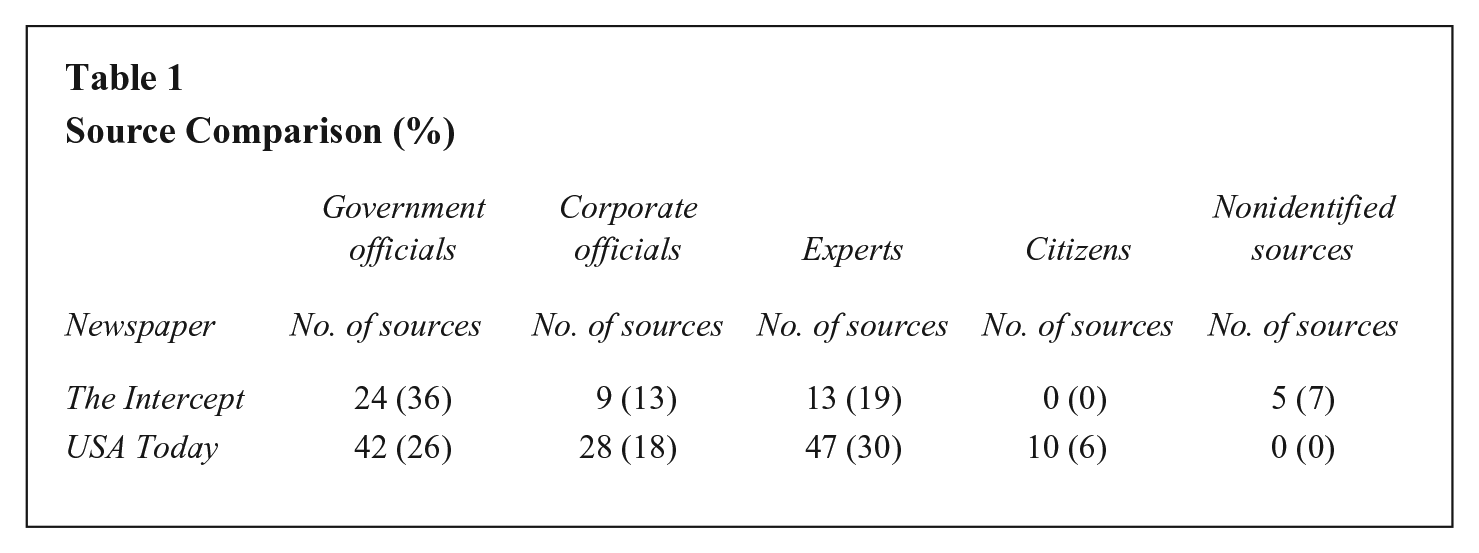
Corporate officials represented 13% of sources for The Intercept and 18% for USA Today. Both news organizations displayed similar patterns in their usage of corporate sources when covering small business, with a critical tone and directly accessing this type of source. The Intercept also dedicated coverage to large corporations that could be potential beneficiaries of the stimulus package, but none of the large corporate representatives granted interviews, with the denial of an interview request either highlighted in the text—“A spokesperson for [Joel] Freedman did not respond to requests for comment” (A. Lacy, 2020b)—or not mentioned at all.
Experts accounted for 19% of sources for The Intercept and 30% for USA Today. While the former presented experts linked to activism and nonprofits, the latter presented institutional experts, including corporate consultants. These patterns match the perspective on the CARES Act at each of the news organizations: The Intercept advocating for economically vulnerable people and voicing criticism of large corporations and the government, and USA Today providing factual and service-based coverage.
Citizen sources were found exclusively in USA Today news articles. All sources that could be categorized as citizen sources for The Intercept were linked to an activist or nonprofit group, placing them in the expert category, because their narratives were positioned as contextual and/or critical approaches to the topic, but their discourses were not institutionalized. Citizen sources in USA Today were largely in positions of conflict: “It’s aggravating,’ said Aspen Gerald of Fayetteville, N.C., a mother of two who is waiting on $8,700 the government owes her through her tax refund and stimulus payment” (Collins, 2020). Nonidentified sources were uniquely used in The Intercept news articles and represented 7% of their sources: “Two other Democratic members who declined to comment on the record said . . .” (A. Lacy, 2020a).
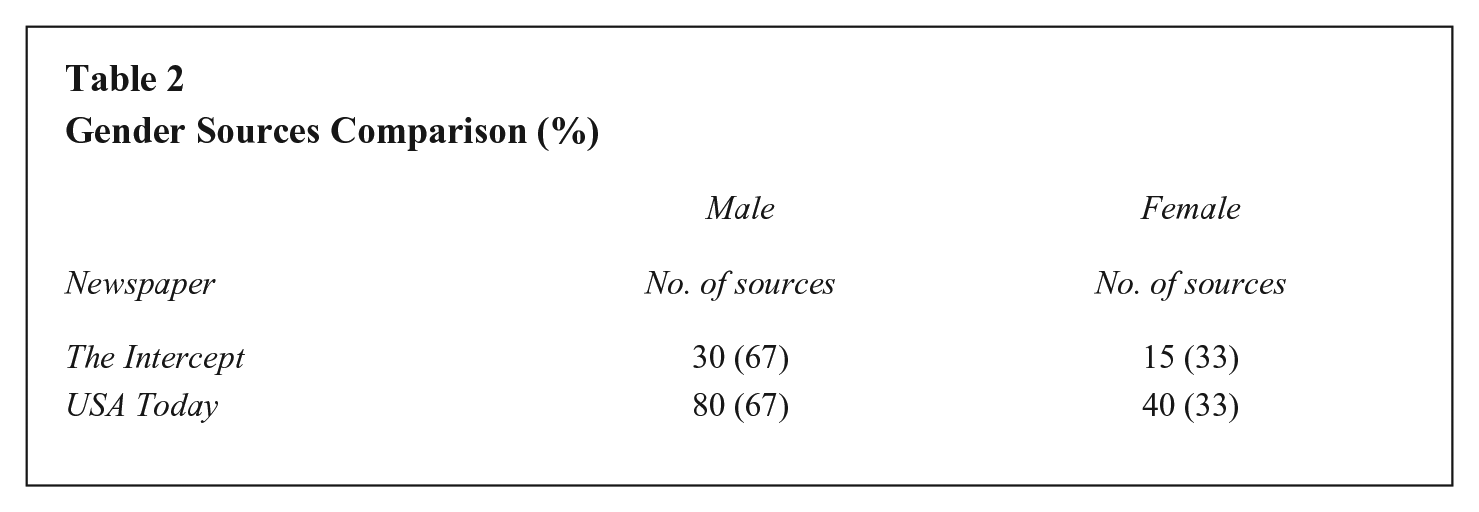
Concerning gender, both news organizations presented the same percentages for male (67%) and female (33%) sources (Table 2). News articles for both news organizations had a prevailing representation of male sources. A majority of government officials and corporate officials were male, while the experts’ category was more balanced. Citizen sources were mostly female, often profiling mothers. In The Intercept, the news article with the highest concentration of female sources was a story about a conflict between a nurses’ union and a large corporate hospital (five females and one male). In USA Today, large concentrations of female sources were found in two stories about stimulus check payment delays, mostly profiling mothers (both stories had four females and one male).
Gender Sources Comparison (%)
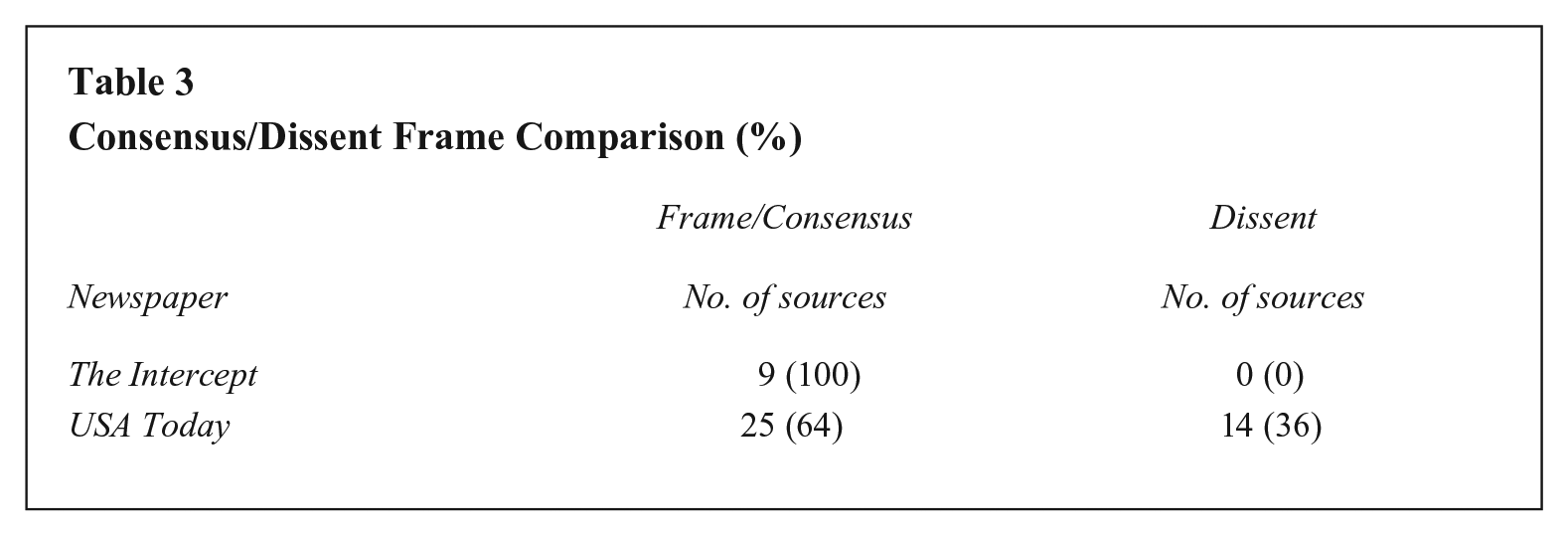
When analyzing source discourses and their points of agreement or disagreement on a topic, all news articles for The Intercept were situated within the consensus frame (Table 3). This is a finding that corroborates The Intercept’s advocacy for economically vulnerable groups, leaving no space for government or corporate discourse fallacies that could potentially “balance” the news. USA Today presented 64% consensus news articles and 36% dissent news articles (Table 3). Dissent news articles pertained primarily to the fact-check beat, with issues relating to college stimulus funds and IRS policies regarding the distribution of stimulus checks. It is important to note that USA Today consensus news articles were identified as service pieces in which the contradiction was not embedded in news content.
Consensus/Dissent Frame Comparison (%)
Journalistic Role Performance in News Content
Journalistic Role Performance (%)
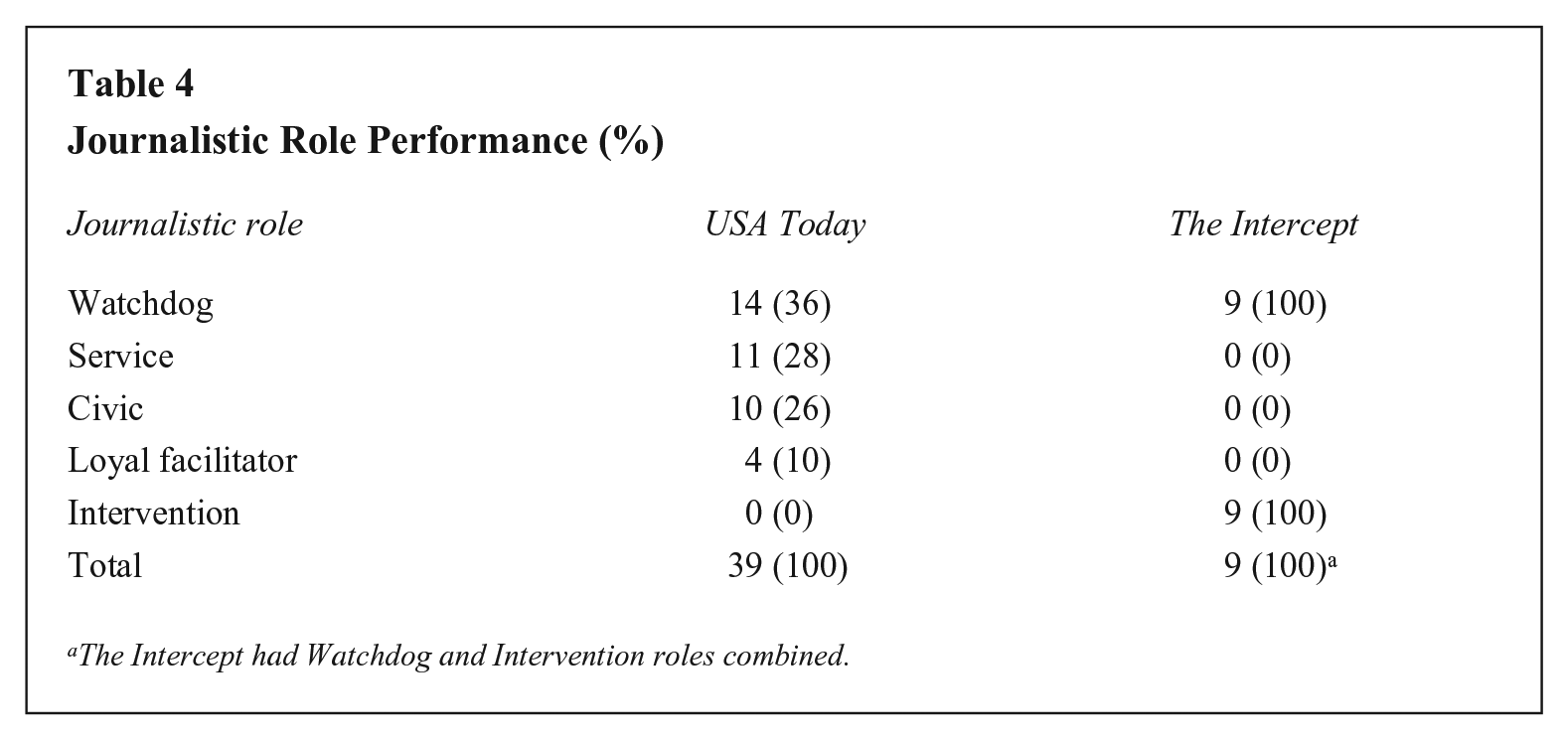
The Intercept had Watchdog and Intervention roles combined.
Although The Intercept does not explicitly claim the intervention role as a mission, this research nevertheless found this role strongly present in news stories, because the published content often took sides, interpreting and demanding social change; all these are intervention role characteristics described by Mellado (2015) as the “presence of the journalistic voice.” This finding associates with the writing style of The Intercept, which explicitly intervenes in the audience’s assimilation of a topic, using terms such as “a private equity baron” when citing corporate spokesman Joel Freedman, “exclusive concierge health clinic” when reporting about the Office of the Attending Physician at the U.S. Congress, or in sentences with sharp language: “the CARES act was publicized as aid to struggling small companies, it ended up benefiting large companies—and ran out of money in just two weeks” (Fang, 2020). Other examples include news story titles: “It’s a scandal that we don’t know who supported the coronavirus bailout. Help us find out” (Fang & Chávez, 2020).
USA Today had a mix of journalistic role performances in its news stories; the most frequent occurrence was the watchdog role (36%), followed by service (28%), civic (26%) and loyal facilitator (10%). News content relating to the watchdog role primarily confronted and denounced inadequate government policies. These news articles nevertheless employed a generally mild tone when compared with The Intercept’s news coverage, where a more assertive tone, when present, was left for source discourses: “The smallest businesses ‘are the most desperate,’ says Dylan Ruga, an attorney” (Davidson & King, 2020) and “‘today we learned Congress does not care if local restaurants close forever,’ the Independent Restaurant Coalition said in a statement” (Garrison, 2020). The service role found in USA Today news stories related to personal finances, as indicated by references to retirement funds, or to common questions about stimulus check payments, such as delays, or the IRS data system. News articles in this category usually presented direct questions: “how do I get relief money?” (Menton, 2020b). Civic role performance was found in news articles that originated in audience questions about social, political or economic matters, such as the possibility of members of Congress receiving a raise under the CARES Act: “there is no indication in the statutory language that the spending bill will support the salaries of members of the House of Representatives, and staff has confirmed the funds will be used for other purposes” (Brown, 2020). Finally, the loyal facilitator role performance was found in USA Today in reports on government institutional activities and discussions on the stimulus bill, highlighting the country’s progress: “House passes PPP bill giving small businesses more time, flexibility to access small business loans” (King, 2020).
Discussion
These findings show that different market-driven news outlets covered the same topic using different layers of assessment. Market theory (McManus, 1994) sheds light on legacy media practices and their relationship to journalistic norms, when compared with nonprofit news content. Whereas The Intercept’s news coverage concerned itself with grand schemes of money distribution under the CARES Act, including the flow of money to former President Donald Trump’s campaign donors, the USA Today agenda remained on a more visible surface, and factual layer, reporting on issues such as problems with and delays in the distribution of the US$1,200 stimulus paychecks to the general population. Data gathered in that same year by the Pew Research Center (2020) demonstrated that 91% of Americans saw only stimulus checks in the CARES Act, although the US$2.2 trillion financial package also distributed huge amounts of money for programs such as the PPP. Undoubtedly, The Intercept offered extensive coverage of backstage power relationships around the CARES Act, when compared with news coverage by USA Today. Strongly market-driven news outlets feel the need to produce material that attracts larger audiences (Ferrucci, 2015a), but audience-oriented news does not necessarily translate into content that focuses on social justice. Journalism works with an “imagined audience,” where some content is thought to be more alluring and will capture the attention of publics (Ferrucci et al., 2020; Nelson, 2021). At the same time, audiences’ wants might not represent a precise thermostat that complies with audiences’ needs, a relationship corroborated by the findings of this study.
All news organizations compete for audiences, and this study demonstrates the accountability of a weakly market-oriented news outlet in serving the public, and the accountability of a strongly market-oriented news outlet in serving the market. The Intercept clearly positions its coverage outside of government and large corporate spheres, probably as an editorial tactic to attract audiences oriented toward democratically originated content or news that serves the public (McManus, 1992). By contrast, covering news that affects the average American’s everyday life, USA Today has the potential to strategically attract the attention of the general audience, which is then sold as a commodity for the advertising market. Thus, media ownership determines journalistic role performances, with content published by The Intercept gravitating toward the democratic service function of the journalistic field, whereas content published in USA Today certainly targets a broader audience, with a commercial coverage approach serving all four markets as argued by McManus (1994). In fact, more than journalistic role performance, market-driven content can illustrate different categories of journalism: public service driven and commercially driven. This is an imperative discussion in contemporary journalism because commercially driven news content still relies on mission statements like USA Today’s, in which the goal is to “reflect the pulse of the nation” and to serve “as the host of the American conversation.”
The findings of this study show that market orientation affects journalistic norms. Content from The Intercept displayed a drop in objectivity as a norm, a finding that corresponds with Schudson’s (2001) observation that objectivity is, in fact, a standard that privileges commercial journalism. In the analyzed coverage, once market orientation is weakened at the organization level, objectivity also diminishes. Objectivity can hint at a false balance if both sides of a story are included and one of them is lying (Ferrucci, 2019). Nonprofit journalists “reject the notion of objectivity outright. They do not believe it creates quality journalism” (Ferrucci, 2019, p. 40). The diversity source norm posited by many, including Christians et al. (2009), as a standard that enables society’s representation in democratic systems has a flip side when applied by this study’s analysis of a nonprofit news organization. In silencing some voices, The Intercept’s news articles focus only on other voices, such as those of activists and civil society leaders struggling in fragile positions of power. Thus, the question arises of whom and what purpose does the objectivity norm serve? Future studies can further explore the relationship between audience awareness of political/economic/social topics and news coverage in different market-driven outlets.
The digital era exerts influence on news coverage practices, and this study found an intimate relationship between digital platforms and news source access. In general, both The Intercept and USA Today accessed government officials indirectly, through official and/or social media channels. Even though legacy media, such as USA Today, operate within the objectivity journalistic standard, it appears that the relationship of news organizations with official sources has reverted to replication of digitally distributed content, for instance, through tweets. This is not to suggest that the relationship between journalists and government officials was an intimate one before—except, of course, when this source category was willing to expand on topics of the official agenda—but access to this source category used to be primary, and not secondary. This study found that digital platforms, especially social media, were resource channels that functioned as a looping cycle, homogenizing government officials’ statements in both the nonprofit and the for-profit news outlets. Furthermore, by interpreting findings with the lens of market theory, official government sources displayed fewer access variations in different market-oriented news outlets because analysis of news sources clearly extrapolates the organizational level and can also be highly influenced by the routine level of news production.
The Intercept and USA Today utilized indirect government officials’ quotes differently, and the quotes were situated within distinct journalistic role performances. The Intercept used government officials’ quotes as a critical point of departure for its news stories to enact the watchdog and intervention performance roles, whereas USA Today used government officials’ quotes to describe information or to add an extra angle to its stories to enact the service and civic roles. However, if cited official government sources are not directly accessed by the journalists, can the institution of journalism still hold them accountable? In other words, if journalists are not directly interviewing sources that hold power, much can be lost in the process of news content production. Future studies can focus on the impacts of this huge gap formed between journalists and official government sources in contemporary social media newsrooms.
In addition to homogenized access to official government sources, both news outlets reflected similar gender representation. Research has already suggested that nonprofits focus on marginalized groups such as women (Ferrucci, 2019), but female sources did not occupy equal space in The Intercept, which exhibited a similar lack of female voices as USA Today. News sources, as a fundamental journalistic structure, might compose a more nuanced market to be investigated than other markets proposed by McManus (1994). Future studies can investigate the market of sources across differently funded news organizations, targeting an investigation of female source representation in nonprofit and for-profit news coverage.
News media market orientation represents an effective framework to investigate news content in contemporary newsrooms. Within the organization level, ownership can drive news production. With the entrance of a significant number of nonprofit news organizations in the last decade in the United States, the organization level of influence offers scope for comparative analysis. However, market orientation has to be acknowledged as one of the forces that propels news content. It is worth noting that other levels, such as the individual, routines, social institutions and social systems, can also motivate journalistic content production. As an organization force, market orientation can provide an important normative influence. This research recommends that journalism studies embrace funding models, in the investigation of published news content, as powerful forces.
Future research endeavors should aim to conduct a comparable investigation employing an expanded sample size to augment the significance and robustness of this study’s outcomes. Having only one representative of differently funded news organizations is certainly a limitation of this study, and the findings might not correspond to other news coverage that pertains to the same market orientation group. Data collected addressed only CARES Act coverage, in the months that followed the package’s official release; The Intercept and USA Today might not follow the same patterns for other coverage. As with any other qualitative study, and despite relying on counted categories with the employment of ECA methodology, the results presented in this study are not generalizable.
