




Abstract
Throughout the history of education, a pendulum has swung between emphasis on images/visual arts, and word/Word. This article considers this swing in the history of Christian education and correlations with changing technologies, integrated with Bloom’s taxonomy. In a modern world that is both fragmented and overloaded, educators approach visual means of communication through critical appropriation of technology and media. Recommendations are provided for ministry that is interactive, image-rich, and explores communal processes.
Keywords
Introduction
Today’s culture is in great flux. Within the past 60 years, air travel has created a global economy; within the past 35 years, computers have formed a digital revolution; within the past 10 years social media has formed a new industry and means of connecting people; and within the past year, perhaps even months, image-based platforms have transformed comments from words into emojis and GIFs. This new world sees people in remote jungles using generators to charge up their smartphones and global superpowers carried off by Brexit and Trump, who has become known as America’s first “post-literate” president. The power of images charging at lightning speed and affecting all arenas of life in revolutionary ways is also affecting the transmission of faith from a modern Western culture based on the written word to a generation enculturating itself through visual means. After centuries of focus on the authoritativeness of the written word and learning via books, the power of still and moving images has notably altered the experience of educating today.
Throughout history, including the history of Christian education, one can notice a push-and-pull between focus on the two primary senses of hearing and sight. Words and images, needed to convey lessons for daily life as well as the daily living of faith, ebb and flow in the role of educator for both the literate and non-literate.
What has been the role of visual arts, images, or culture in Christian education? 1 A historical question relates to the convention that stained-glass windows, a technology developed in the Middle Ages, were “Bibles for the [non-]literate” (Duggan, 2000). This question is fascinating given the suggestion of Robert W. Pazmiño that the ultra-modern reliance on images relates today’s Christian education in many ways back to the role of education for the masses in the Middle Ages. From this discussion of biblical, theological, philosophical, and historical foundations, recommended practices will be put forth for present-day use of visual communication in education.
This article will survey the role of visual communication in Christian education over time, reviewing its history, Biblical roots, and theological foundations and considering former and current shifts toward visual, as opposed to textual, communication. As noted by Solomon Rajah, “Visual arts have always been an essential aspect of the language of the Christian tradition” (2005, p. 33). This article will focus on word-based and visually-based educational domains through Christian history.
Definition of Terms
Visual Communication
The use of words can carry more meaning with less work, making communication more specific and effective, hence “a picture is worth a thousand words.” Visual media, which can include a wide array of methods, from cave painting to clipart and stained glass to projecting YouTube clips, can also convey meanings which words cannot. Benefits of visual media include: ■ Arousing interest ■ Providing a clear mental picture or more accurate, concrete impression ■ Speeding understanding, saving teaching time ■ Helping memory ■ Stimulating active thinking, providing different levels of learning simultaneously ■ Providing a shared experience
Pictures can be both universal and contextual. For instance, a painting hangs in my living room which Westerners generally see as wheat stalks, while Asian people can view it as either wheat or rice. People universally recognize it as an edible grain and staple food, and see in the picture abundance, but apply it differently to their particular context. This can be both a benefit and challenge in use of visual media for communication.
Communication, whether in word or image, derives from technology. Technology is a practical application of knowledge and does not have to include computer chips! Writing is technology. Technology continually shapes how we communicate, from papyrus to email and from dyes to projectors.
Learning Domains
One psychological principle which interrelates to the other foundations and educational outcomes is that of learning domains. These three domains—cognitive, affective, and psychomotor—are often referred to as Bloom’s taxonomy, though they were created in teamwork with Krathwohl and Harrow. Learning rarely occurs in only one domain, and use of all domains integrates learning more powerfully. 2 Table 1 explores varying descriptions of the three domains.
Three learning domains or taxonomies.

Signs and Symbols
Visual arts make use of signs and symbols which are relevant to a culture or universal. Rajah writes, “the word symbol is derived from two Greek words, syn meaning ‘together,’ and ballein meaning ‘to throw.’ Hence, symbolon,…implying throwing together or joining of an abstract idea and a visible sign of it; the sign serving to recall it not by exact resemblance but by suggestion” (Rajah, 2005, p. 32). Between sign and symbol, George Ferguson remarks, “is a distinction…A sign represents. It points to something…A symbol resembles. It has acquired a deeper meaning than the sign, because it is more completely identified with what it represents, and its character is derived from what is known by it” (Ferguson, 1961, p. 8). These definitions are useful to a discussion on how educators utilize visual symbols and signs, especially in a Christian context.
Teachers and Church leaders must ensure that when they use visual cues the student can comprehend the meaning inherent in the symbols. As Church educators encounter new cultures, whether geographically, in a distinct group within a familiar context (such as educating an age group different from the educator), or otherwise, they must test the signs and symbols that they utilize. Rajah writes, “One may end up creating ‘inward looking’ symbols and theology. For example: a symbol may be appropriate in a locality but it is not mandatory that it has to be accepted and conceived as final by the community at large. It has to be localized and universalized” (Rajah, 2005, p. 34). Flexibility in use of symbols and their application both avoids a colonizing attitude of prioritizing one’s own symbols as well as increasing the likelihood of both intellectual comprehension and affective embracing of the content over time.
The Need for this Research
Common knowledge states that stained-glass windows and the layers of symbols therein were utilized for Christian education purposes in the Middle Ages. The written word was limited by literacy rates in the population of Europe at that time, the social convention that writing and public speech were in Latin, and the labor required to copy Bibles and religious texts, and any types of documents. As Rajah writes, Christian symbols were outward and visible signs of divinity, doctrines, spiritual ideas, rites…, and sacred seasons. Creeds and confessions retain their character as symbols of faith…In later years, when early Christians were permitted to build houses of worship, acts of woodcarving and stained glass painting developed, it is within this context that Christ was often pictured together with the four evangelists. Certain animal and bird symbols were used, so as to distinguish the gospels from one another, as some of the early converts could not read, and names would prove of no value to them. (2005, p. 38)
Further, my personal experience of medieval and renaissance arts (tomb carvings, paintings/frescoes, and stained glass, among other media) is that simply looking at art does not effectively convey a specific meaning, nor does it point clearly to stories of Bible characters, saints, historical figures, or concepts (such as doctrines, rites, etc.) that would inform my Christian understanding. Further, artists or patrons are often anachronistically portrayed in the artwork. Therefore, much of what is gained from viewing this art requires interpretation and guidance. The common thinking that this artwork was a means of education is therefore questionable; however, this thinking stimulates questions on how visual communication has been utilized for Christian education and what role it can take today.
History of Christian Education: Pendulum Swings between Word and Image
History can be described as “the science of persons over time,” which necessarily includes the various technologies invented and employed by people which are a major source of change in societies (Bloch, 1953). History can also be understood as the doing or expressing of biblical and theological beliefs. Pazmiño notes that history and sociology are cultural variables and that their role in shaping education will therefore be different in diverse contexts. An approach to the history of Christian education will necessarily explore practical expressions of biblical mandate and method and applications of theology in diverse contexts. History will deal with both the lived experience of individuals and the overall expectations of a culture or society (its technologies, philosophies, and values) (Pazmiño, 2008, p. 130). 3
Earliest understandings of Christian education must refer back to ancient Hebrew people, for whom education was centered in the home as well as the community, though schooling was not in popular use. Logically, due to limited resources of paper and writing, education was primarily auditory. Two examples would include the reading of the Law to the whole community, including youth and immigrants, 4 and the synagogues (with growing influence during exilic and post-exilic times) which during the intertestamental times were known as “House of the Book,” 5 a place of public instruction (Daniel & Wade, 2008, p. 48).
Christ himself was primarily addressed as “teacher” and scholars note that he was indeed a masterful teacher, employing a variety of modes and methods of teaching, utilizing quotes and themes from the Hebrew scriptures as well as pointing out concrete object lessons, mentoring disciples and holding the attention of crowds, having exemplary character and authority, and authentically reaching out to bring the unexpected into the Kingdom that he proclaimed (Anthony, cited in Estep, Anthony, & Allison, 2008). Christ can be seen to educate through both spoken word and visual metaphor, as well as through a living example of righteousness.
The apostles and early Church leaders took up the Great Commission to both evangelize and teach, which was expressed through many methods, including founding churches and writing advisory/extortive letters, many of which are included in the canon of Scripture. Experience of religion for the earliest Christians was through Word, whether in understanding Jesus as the Word of God and fulfillment of Hebrew Scripture, or through the reading of apostles’ letters in worship, and interacting with creedal confessions.
The early Church had a very structured catechumenate, or process of educating and enculturating people wishing to join the Church. Mentoring was a primary method. In addition, initiates followed a pattern which parallels the three learning domains: hearers (head knowledge), kneelers (growing physical involvement in worship), and chosen (heart/commitment). For early Christians, audial methods were essential because of the need for secrecy, lack of copied documents, and the cultural value of the memorized word or oral tradition. Teachers in the early Church varied from Church elders (1 Tim. 3:2; Tit. 1:9) to trained apologists to Christian schoolmasters in the classical Roman education system (Pazmiño, 2008, p. 143; Daniel & Wade, 2008, p. 149). The growing influence of the Greek education system (Socrates, Plato, and Aristotle) moving into the Roman system came into the culture of the Church especially following Constantine’s conversion and the influx of large numbers of people of non-Christian background into the Church (Pazmiño, 2008, pp. 51, 145). At this point, Christian education was still essentially text-based, whether Scriptural or theological apologetic writings. 6
The Middle Ages can be known as “media aetas,” primarily because of a Renaissance understanding of history as ancient, middle (medieval, media), and modern. 7 Another layer of meaning in this phrase (Middle Ages) can be seen through roles of “middle-men” who mediated communication through various hierarchies. In the Middle Ages, priests mediated encounters with the divine, while feudal “lords” mediated rulers’ power down to the people; even the power of kings was understood as mediating God’s rule of law. Artists and craftspeople mediated meaning, often religious, to the people through changing technologies of Church architecture, stained-glass windows, and various media for visual communication. Pazmiño sums up the effect on Christian education, stating, “Although worship was directed toward God, the developing richness of symbolism in architecture, art, and music 8 taught lessons of the faith to participants…All of these nonformal vehicles functioned to convey the Christian message to a largely non-literate population who for the most part had no access to formal Christian education” (2008, p. 145). 9
A reaction to the Middle Ages came in the era of the Reformation. Starting with reformers such as Martin Luther, issues such as the perceived failure of priests to mediate God to the people, the effect of ignoring local languages, and the Church’s distortion of the Bible through sermons’ emphasis on legends of saints and papal traditions perceived as antithetical to Scripture (such as indulgences or the institution of the papacy) led to a reaction distanced from images and increasingly based on words. Translating the Bible into common languages (paired with the technology of the printing press) and emphasizing the need for people to read and understand the Bible for themselves (related to the priesthood of all believers), Luther and his colleagues led an educational revolution. State-supported but Church-run schools became more available, and catechisms for teaching faith in the home and in daily life were disseminated. Preaching became a focus of worship, and given that worship is an enculturating experience, emphasis on the power of the word (both spoken and written) grew throughout European societies.
During the Enlightenment (c.1700–c.1900), an emphasis on human reason, scientific methodology, and interest in psychology/anthropology 10 separated Christian and secular education. The nineteenth and twentieth centuries were the era of Sunday school, which also led to a need for curriculum-publishing industries and formal theological education for professionals in Church education.
During the 1900s, education (both religious and secular) became more able to make use of visual communication strategies. Relatively new technologies, such as efficient printing of color images and easily shared digital projections, reflect an educational return to visual communication throughout most areas of ministry. Today Christian education is a booming industry, creating curriculum for ministries for all ages and many settings (Church camps, vacation Bible schools, youth and confirmation ministries, Sunday school, and more).
A pendulum swing between visual and textual or word-based communication has therefore characterized the history of Christian education, from Hebrew and early Christian writings, to the varied media of the Middle Ages, to the printing revolution of the Reformation and Enlightenment. Modern education has made extensive use of visual technologies and strategies for teaching, including religious education.
Biblical and Theological Orientations to Visual Communication
In contrasting Word and words, we cite the Scripture that humans are made “in the image of God,” 11 and Gregg R. Allison translates this phrase to humans being “image bearers” (Estep, Anthony, & Allison, 2008, p. 183). Image is at the heart of being human: both our created nature and how we perceive our body, self, or reputation. Images are also essential to us and how we process our world.
In my experience, modern warnings and interpretations regarding use of images are generally aimed more toward usage in worship than for educational purposes.
12
Though care should be taken, Christians are not forbidden to use images for education and to the glory of God. There is, however, a question of Educators utilizing religious images must consider to whom glory is being given, whether intentionally or in practice, in the Church’s use of visual arts. As Greg Scheer writes, art in Western churches was not without its own problems. What began as Bible stories rendered in stained glass became more majestic…Soon, what started as art for the glory of God became intertwined with political opulence…[and] totems to the powers they represented: Christendom, the Holy Roman Empire, and European political powers. (2016, p. 194)
Changing Technology: Changing Means and Methods
As we consider the practices of Christian education in the modern and post-modern erasdays, a comparison of changing technologies may indicate the power of changing media for educators and learners (as shown in Table 2).
Changing technologies over time.
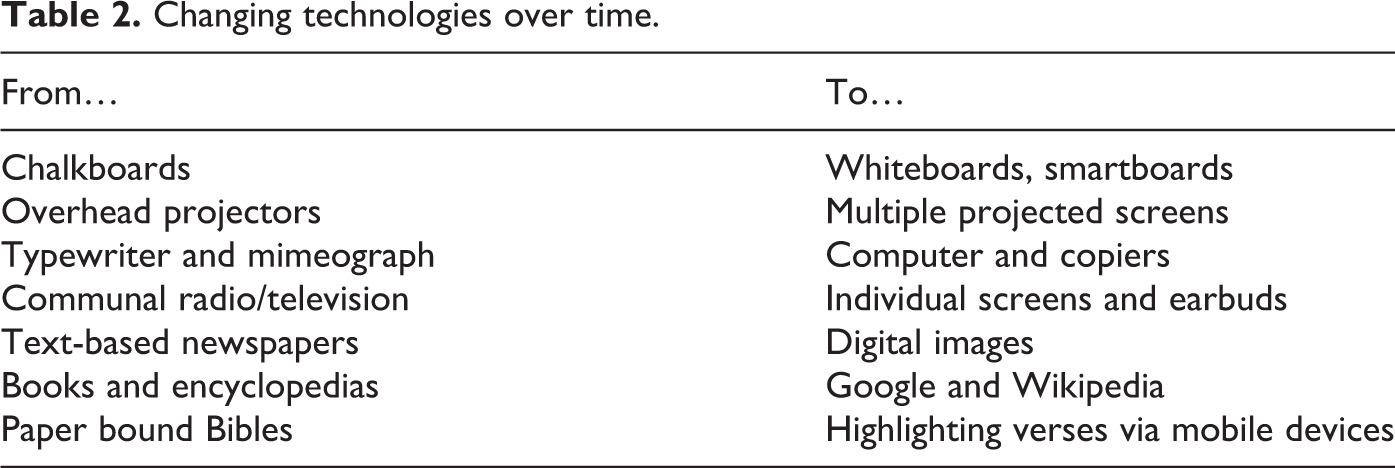
These changes in tools and practices demonstrate shifts in how most people function on a daily basis as well as in the field of education. Indeed, these changes represent a paradigm shift due to the creation of entirely new dimensions of life. 13 Further paradigm shifts for educators, learners, and most individuals in modern society include needs and methods to cope with society’s speed, fragmentation, 14 confusion of “reality,” and replacement of rational thinking (which takes time) with emotional response (Jhally, 2008, p. 200). Historian Eric Hobsbawm comments, “the dominant feelings are of information overload and disconnectedness. A pervasive sense exists that too much is happening too fast to understand,” which correlates to isolation, oversimplification, and a sense of “drown[ing] in data” (Doyle, 2014). Educators, especially in the context of the Church as a voluntary place of learning, must balance new cultural demands for technological and image-based methods of teaching while resisting education that avoids depth, connection with meaningful traditions, and systematic and sustained learning.
The words Pazmiño uses for this approach are “critical and appropriate” (2008, p. 148). The Church, from its research bodies in seminaries, colleges, and publishing houses, to its weekly practitioners (Sunday school teachers, pastors, etc.) must both critique acceptance of new paradigms and worldviews in terms of how they rest on strong foundations, whether biblical, theological, philosophical, historical, psychological, and sociological/anthropological. In addition, the Church must in a balanced way turn “appropriate” from an adjective into a verb. To “appropriate” is to take content, methods, or principles and make use of them in one’s own setting. For the Church, we must be aware of the power of images (still or motion) for this generation. We must critically appropriate ways of educating in the twenty-first century to gain and hold attention so that we may convey the breadth of blessing from Christian education.
Remarkably, the post-modern turn towards the image parallels other ways that the stained glass of past centuries can connect to the PowerPoint presentations of today. Pazmiño demonstrates many ways that post-modern trends mirror several trends in the Middle Ages. Following centuries that gave preference to auditory and word-based teaching methods, the Middle Ages, due to language barriers and greater numbers of Christians, gave preference to images for what little teaching was available to the masses. Pazmiño notes that both in the Middle Ages and in these post-modern days, evolving technologies affected practices of socialization in and for education (Pazmiño, 2008, pp. 145–148).
From Table 3, we can see movements to which the Church must adapt or find means of resisting. How will the Church’s educational ministries respond to decreasing childhood/extending adolescence and people living outside of nuclear family units? How will the Church break through the all-too-convenient boundaries of “home,” reaching out past one’s family, congregation, denomination, or nation? With the modern breadth of knowledge being required, how will the Church maintain or increase levels of Biblical literacy and holistic understanding of the Christian tradition? Finally, how will the Church adapt educational ministries, given paradigm shifts as extensive as those experienced in the Middle Ages?
Parallels between the Middle Ages and today.

Theologian Len Sweet guides the Church towards utilizing EPIC means of communication. In his study of semiotics, or “how meaning is communicated” (2014, p. 73), whether in preaching or in the general and educational life of the Church, he recommends using means that are: ■ ■ ■ ■
EPIC is a helpful acronym for checking in with the general and educational ministries of the Church, living in what he calls a TGIF world (Twitter, Google, Instagram, Facebook).
The academic field of Christian education recognizes the value of congregations and the wider Church making use of three modes of Christian education: formal (i.e., classrooms and schools), non-formal (training seminars, retreats, other ways of equipping individuals and communities), and socialization (enculturation, sharing values). These modes will be a part of most congregations, and can utilize both word- and image-based paradigms and worldviews. Educators have a weight of information, whether cultural trends, psychological data, curricular choices, or more directions in which to approach the essential task of Christian education for all generations.
Recommendations
Based on our biblical mandate to educate and trends in history, especially technological innovations and means of communication, a variety of recommendations can be made. Assuming many benefits of use of visual arts and culture, leaders must also consider what barriers may inadvertently undo the benefits of utilizing visual media. Using the three learning domains, educators should ask the following questions. ■ Body: can the recipients clearly hear and see the medium? ■ Mind: are the language and symbols understandable as well as diverse?
15
■ Emotions: Are the learners ready to receive the message (motivation, sensitivity of topic, graphic nature)?
Each domain can be applied to every setting, no matter how unique, and the creators of new media will want to engage the various learning domains. They face new processes, such as ethical issues (showing diverse participants, moderating permissions for use of images), the dissemination of resources (given today’s ability to share massive quantities of digital materials), and producers’ roles in using and influencing the adaptations of new technologies (Jandric & Hayes, 2017, p. 11).
Looking at today’s screen-based context, Janneke Adema acknowledges post-modern image-based trends, stating, “The move towards a post-literate society is not only about being able to analyze and interpret polymodal ways of communicating, but also about being able to produce these forms of communication in a good (and comprehensible) way” (Ridley, 2012). As such, Doug Johnson encourages educators of the following: …includ[e] a return to more natural forms of multisensory communication—speaking, storytelling, dialogue, debate, and dramatization. It is just now that these modes can be captured and stored digitally as easily as writing. Information, emotion, and persuasion may be even more powerfully conveyed in multimedia formats (Ridley, 2012). Michael Ridley notes that, though trends are towards image-based communication, “post-literacy has a kind of ‘hyper literacy’ by bundling it with other types of literacies or media. Literacy hasn’t been replaced or displaced; it many ways it hasn’t even been diminished. It remains core” (Ridley, 2012). Post-modern educators do not need to give up on verbal and written communication, because words and images can enhance one another in learning processes.
Educators may recognize the need for guided study. Simply providing an image will likely be insufficient. Images are limited, as are human attention spans and memory. Pazmiño (2008) states that Christian education interactions must be deliberate, systematic, and sustained. In today’s fragmented culture, learners are often multi-tasking (with several applications active on their phone while they participate in Church events). Educators must be deliberate in determining the role of “screens” of various kinds in the learning environment, balancing hospitality and use of multimedia with effectiveness and focus. Learning must be integrated and as systematic as possible to support learners and combat fragmentation. Educating must be sustained, both relationally (“I missed you last week” or “I notice you have this interest”) and with interdisciplinary reinforcement (applying formal education via informal or socializing means).
Further, humility must be a part of any conversation about universality (assuming that the meaning of a symbol is transcultural). While tears and smiles tend to be universal expressions of sorrow and joy, many symbols are limited to only the Eastern or the Western worldview and heritage, certain life experiences, or to a particular era of history. A symbol that might bring one group joy may bring another group pain; for instance, Mary with baby Jesus, seen by a new mother in contrast to being seen by a woman grieving a miscarriage. Humility and sensitivity must be foundational elements of Christian education, as well as any ministries in the Church.
Rajah (2005) suggests that the continuing creation of art can “keep symbols alive” and utilize local symbols that can carry more meaning than foreign symbols. He writes to the Churches in Malaysia, though his message can be received in any context: Both the churches in Asia in their diverse cultural settings are under the lordship of Christ. Therefore the use of indigenous forms of painting and sculpture which carry and express the Christian message naturally are encouraged. This cultural expressions local to the artist help to communicate the message to contemporary Asian people. (2005, p. 34)
Conclusion
The course of history reflects the effect of changing technologies on the cultures and educational processes of Christian educators around the world. Interplay between word and image, continuity and adaptation, tension and integration, have been experienced by Christians throughout the generations.
Biblically and theologically, as the Church looks towards the future, ministries, especially education, will adapt methods of communicating content and experiences to available technologies and resources. However, the foundations of a biblical mandate for Christ-centered and Spirit-led educating of God’s children, the Church community, and the whole world will remain strong and sure throughout changing paradigms and cultures. Barbara Brown Taylor, ever a voice of courage in Church life, writes, The Church’s central task is an imaginative one. By that I do not mean a fanciful or fictional task, but one in which the human capacity to imagine—to form mental pictures of the self, the neighbour, the world, the future, to envision new realities—is both engaged and transformed. (Sweet, 2014, p. 53)
Footnotes
Declaration of conflicting interests
The author(s) declared no potential conflicts of interest with respect to the research, authorship, and/or publication of this article.
Funding
The author(s) received no financial support for the research, authorship, and/or publication of this article.
