




Abstract
Christian educators seek to understand how each life stage influences the next. Social science has found that the childhood years are filled with experiences that contribute to spirituality in young adulthood. This article seeks to understand these possible experiences by examining the biblical and theological aspects of childhood religious education and then integrating them with social science. Conclusions reveal three findings in regards to the connection between childhood experiences and young adult spiritualty: (1) understanding God’s larger narrative, (2) enhancing Christian identity, and (3) developing godly character.
Introduction
“Children are a gift from the Lord; they are a reward from him.” ∼ Psalm 127:3
Local churches have created ministries to children for the means of spiritually nurturing these children to build a foundation of faith that sustains to their adulthood. These ministries vary in size and methodology. However, many are utilizing best practices from both social science and empirical research to assist their spiritual nurture endeavors. A Christian integration of social science theories and empirical research with the biblical educational methods of children must be considered in order to ensure children are nurtured according to Scripture. This paper seeks to describe a biblical theology of childhood education by exploring the various formal and informal educational and religious experiences children encountered in ancient Israel. Childhood will be considered the years prior to adolescence, around 13 years of age. Once these significant experiences are revealed, they will be integrated with several social science theories: the constructive development theory, James Fowler’s faith development theory, and Westerhoff’s styles of faith, as well as with empirical research. By understanding the connection between biblical educational methods of children, social science theories and empirical research, one can begin to understand how childhood faith formation forms, develops, and influences religious commitment in adulthood.
A Brief Biblical Theology of Childhood Education
For a discussion on a biblical understanding of childhood education during the times of the Old Testament, it is vital to begin with the basics of the Jewish religion. Hebrew culture during the times of the Old Testament was centered on the Torah and the practices of commandments, which influenced all elements of human life. The Jews had four distinctive beliefs that influenced their understanding of the world around them. These included: (1) monotheism and the belief in one God, (2) God as the “universal” Father, (3) mankind as a “universal brotherhood”, and (4) the connection between religion and morality (Swift, 1919, p. 13). These four distinctive views created a worldview for the Jewish people that influenced daily life, especially their view of humanity. Before revealing how daily life was influenced, we are going to begin with how these distinctive ideas created a culture that viewed children as people with great value and purpose in society.
Children are of Great Value
Human life was considered highly valuable in the Jewish culture, especially the lives of children. The Jews believed people were made in the image of God, and they applied this truth directly to children (Gen. 1:27). Being made in the image of God informed the belief that children were highly valued and a blessing from God (Ps. 127:3). This great value applied to all children, even orphans, as Scripture commands caring for and loving children with and without families (Deut. 24:19; James 1:27). Believing children to be valuable informs how they are to be treated. Scripture provides various directives on how adults are to treat children. Fathers are commanded to deal with their children in the same manner that the Lord deals with children, implying fair and loving treatment (Ps. 103:13). Finally, both parents are encouraged to expose their children to and educate them in the ways of the Lord, for this will influence the rest of their days (Prov. 22:6; Deut. 6:7-8).
Scriptural Directives for Religious Education
As mentioned above, religious transmission from parent to child was highly valued in the Jewish culture. The Shema (hear or listen) is the name of and first Hebrew word found in Deut. 6:4, which testifies to the oneness and uniqueness of God (Unterman, 1985, p. 939). Traditional Jewish practice, based on Deut. 6:7-9, involved wearing the Shema on phylacteries and posting a mezuzah on the door, as well as reciting it every morning and evening (Unterman, 1985, p. 939). The words of the Shema, found in verse four, expressed the importance of strict devotion to the one God. The verses following the Shema speak of loving God with all one’s heart, soul, mind and strength, and they command the passing on of these truths to the next generation (Deut. 6:7-9). Parents are to tell their children about God wherever they go, whether at home, outside the home, when going to sleep at night, and when waking up in the morning (Deut. 6:7). In addition, children are to see these truths on the hands and foreheads of adults wearing phylacteries and see the mezuzah on the doorposts and gates of their homes (Deut. 6:8-9). Parents living in ancient Israel upheld these truths and implemented them in their daily practice. Jesus referred to the first commandment that follows the Shema (to love God with all of one’s being) many times in his ministry. He also identified it as the greatest and first commandment in the law (Matt. 12:29).
Scripture also declared that both fathers and mothers were to pass on the truths of God to their children. Parents are admonished in Scripture to be the first educators in the teachings of God to their children (Prov. 22:6). To ensure this religious instruction occurred, children were commanded to listen to their father’s correction and to never neglect their mother’s instruction (Prov. 1:8). Collectively, the parents were to work as a unit, providing instruction on how to live to their children, applying discipline when necessary, and instructing the child to adhere to the teachings of God (Prov. 3:11; 24:21; 29:3). Finally, parents were to instruct their children with great compassion and love, as these actions demonstrate to children the great love God has for them (Ps. 103:13).
Scripture also reveals life dangers when children are not taught the ways of God. The book of Judges reveals the great misfortune that occurs when a generation dies and another grows up not knowing the Lord and remembering His mighty actions (Judg. 2:10). These people did what was right in their own eyes, served other gods, and abandoned the values of the Lord (Judg. 2:11-15). The Israelites were supposed to know how important it was to pass on their religious truth to their descendants so that the nation might continue to praise the name of the Lord and follow His commands (Ps. 78:1-8).
The ministry and teachings of Jesus supported the values presented in the Old Testament regarding the inclusion and education of children. Children were brought to Jesus so he would lay hands on them. When the disciples criticized this practice (Mk 10:13-16), Jesus admonished them, “Let the children alone, and do not hinder them from coming to me; for the kingdom of heaven belongs to such as these” (Matt. 19:13-14). The use of a child is described as an illustration of complete dependency, demonstrating to adults the status one must take on to receive the kingdom of God (Zuck, 1996, p. 214). Beyond teaching reliance, children are declared to be a model of enjoying living under God’s rule as they reveal the many blessings one receives from submitting to another’s (God’s) authority (Zuck, 1996, p. 214). Embracing the kingdom of God can now be understood in two steps. First, parents commit to pursuing a relationship with God through loving Him every day (Houser, 2015, p. 163). Second, parents begin to adopt behaviors and attitudes they witness in their own children so they may receive the kingdom of God (Zuck, 1996, p. 214). By using children as a model, Jesus is declaring that everyone can receive the kingdom of God as they will be dependent on God and seek His direction.
Childhood Educational Experiences in Ancient Israel
The Jews in ancient Israel believed the law mandated that children be educated (Deut. 4; 6; 7; 9; 11; 19). As such, children were exposed to various informal and formal educational experiences in ancient Israel. These experiences varied through the different periods of ancient Israel and involved the family, tribe, the synagogue, and formal schools (Swift, 1919, p. 6). Table 1 reveals the various types of education throughout the history of the Hebrews.
Hebrew Educational History.
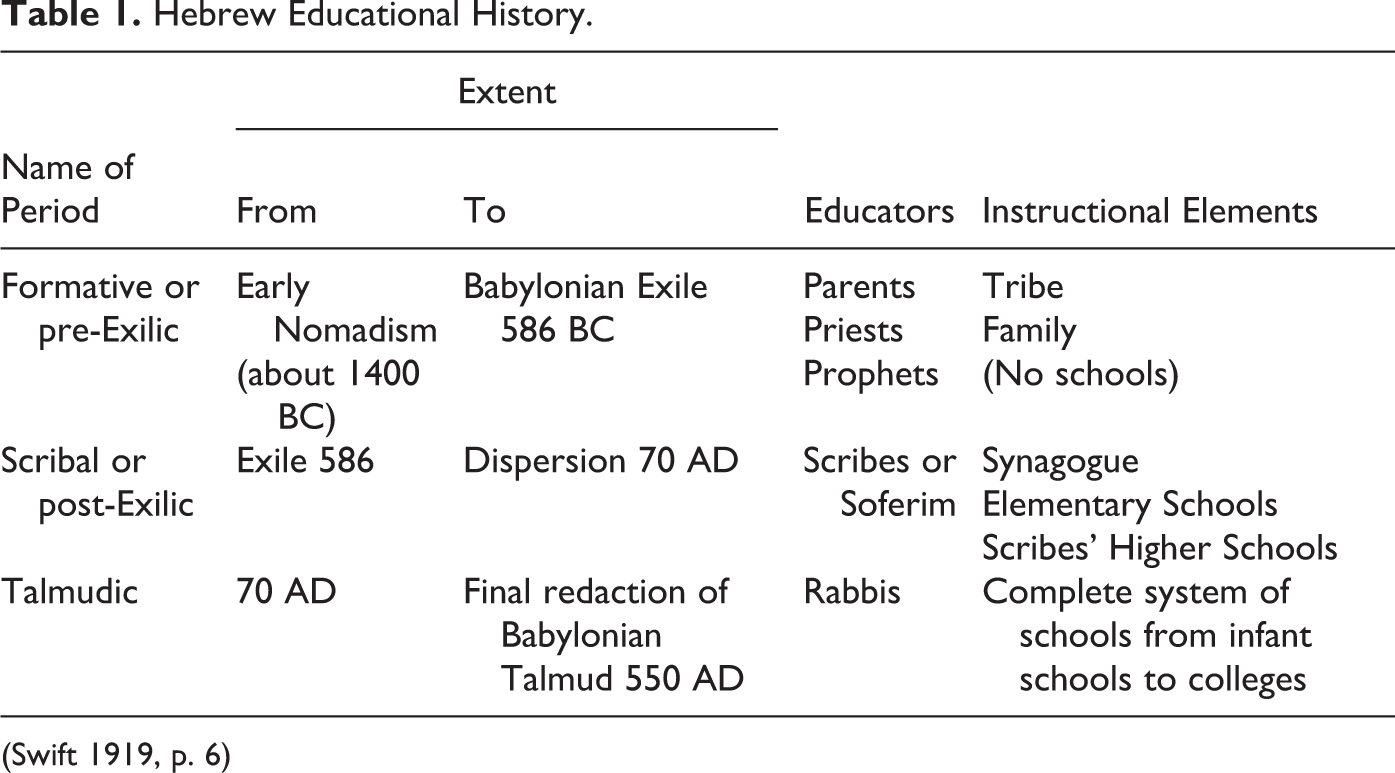
(Swift 1919, p. 6)
The synagogue is listed during the years between the Exile and Dispersion, as it has been a challenge to identify the origins of this institution. Scholars believing these to be the formational years of the synagogue use these references from Scripture: (1) Solomon refers to the Temple as a place of prayer (1 Kgs 8:22-61), and (2) Josiah removed all shrines of the high places (2 Kgs 23:19-20) (Levine, 2005, pp. 24–25). These accounts provide reason for a new means to conduct religious practices, thereby creating a need for a synagogue as well as a temple.
Parents were the primary teachers of children during the Formative period. Educational experiences during this time consisted of very young children engaging in play, and older children and youth involved in work, industrial occupations, and training in weapons (Swift, 1919, p. 23). Trades during this time consisted of: “(1) agriculture, (2) cattle-raising and grazing, (3) fishing, (4) mining, (5) building, (6) carpentry and wood-working, (7) metal-work, (8) spinning, (9) weaving, (10) dyeing, (11) tanning, (12) tent-making, (13) pottery-making, (14) making of tools to be used in crafts and trades” (Swift, 1919, p. 23). These trades were taught inside the home, providing children with an occupation once they entered adulthood.
Although the home was considered the primary location for the education of children, people outside the home were also influential. Scripture reveals Jonathan’s four-year-old son being cared for by a nurse and Ahab’s seventy sons being reared by the great men of Samaria (2 Sam. 4:4; 2 Kgs 10:6; Swift, 1919, p. 22). Very young children were exposed to religious experiences such as communal, tribal or national institutions, customs, and festivals (Swift, 1919, p. 31). These experiences occurred at shrines and at the temple and involved Levites and Priests. Scripture shares a significant religious and educational experience for children in the dedication of Solomon’s temple (2 Chron. 7).
Children growing up in ancient Israel were exposed to many home educational experiences that formed their religious beliefs in adulthood. During that time, parents would educate and train their children in the areas of religion, morality, manners, and industrial occupations (Swift, 1919, p. 49). Scripture gives an impression that both the mother and father were the teachers of children (Book of Proverbs; Crenshaw, 1998, p. 132). In regards to religion, the law entrusted parents with the responsibility of being the child’s first religious teacher (Swift, 1919, p. 49; Deut. 6:7). The overall goal of this aspect of education for children was to instill in them a sense of responsibility towards Yahweh (Swift, 1919, p. 49). This mandate commissions parents to inform their children in a manner that affects their consciousness, influencing their behavior and loyalty towards God. After instilling a heart of devotion to God, parents were also encouraged to shape the character of children so they may follow God’s law (Crenshaw, 1998, p. 132). To implant these feelings of adoration towards God, children, especially young boys, were exposed to many moments that informed their adult religious commitment.
As mentioned above, the family was greatly involved in the education of the child. Whether formal educational institutions existed during ancient Israel is still unknown; however, if they did, they would have been located in Jerusalem (Jamieson-Drake, 1991; Rollston, 2010, p. 91). Scripture implies that children were receiving formal education through the reference to childish babble, implying that people were ridiculing the prophets in the same manner they received education from teachers (Crenshaw, 1998, p. 92). The book of Proverbs also hints at formal education through the verbiage of “obtaining wisdom by investing a sum of money” (Prov. 4:5, 7; 17:16; Crenshaw, 1998, p. 97). Scholars who believe in the existence of formal educational systems in ancient Israel believe these involved buildings, paid instructors, students being trained to read and write, and time to copy the literary texts that formed the biblical canon (Crenshaw, 1998, p. 87).
As mentioned earlier, the acquiring of knowledge was a high value and aim of education in ancient Israel. Scripture reveals that the people of God attained understanding of God outside the formal educational classroom, through nature, analogy, and encounters with God (Crenshaw, 1998, p. 127). Proverbs and Ecclesiastes reveal several instances where human beings are seeking to understand or gain information about the divine through observing nature and basic human behavior (Prov. 8:27; Prov. 31; Eccl. 3:17). Analogy expresses the character of God in the book of Psalms through revealing the difference between how God interacts with the pure in heart and the wicked (Ps. 1). Finally, Scripture reveals that the people of God learned about Him through having direct encounters and interactions with Him. Job gained new perspective and insight when he encountered God directly (Job 38). Even Samuel, as a young boy, had a direct encounter with the Lord (1 Sam. 3:1-15).
Religion was not only passed on to children through the home and formal educational environment, but also through the formal religious experiences involving the community of faith. The Jewish culture had many religious practices, holy days, festivals, and celebrations. The Jewish community, including children, were involved and included in these various experiences, and children often participated in various elements. The people were instructed to gather together and include their children, even infants, as they were believed to be part of the community of faith (Joel 2:16).
Biblical Childhood Examples
As mentioned earlier, childhood religious education, as well as reading, writing, and learning a vocational trade was part of daily life in ancient Israel. Scripture tells the stories of many people who expressed their godly behavior after growing up in ancient Israel. Samuel was dedicated to God by his mother Hannah, heard from God during his childhood, lived with a priest (Eli), and was declared to be with God as he grew into a man (1 Sam. 1:19-28; 3:1-14, 19). Josiah became king at eight years old and served faithfully by following the wisdom and guidance of his ancestor David, his Queen Mother, and his regent Hilkiah the High Priest (2 Kgs 22:2). David was anointed by God to become king during his youth; however, various trials and experiences grew his dependence on God, causing him to desire to build His Lord a beautiful place of worship (1 Sam. 15; Ps. 62; 2 Sam. 7). Daniel was a young teen when he was in exile serving the king and yet was able to speak with great boldness, requesting different eating arrangements so as not to defile himself (Dan. 1). It is plausible to believe these individuals had childhood educational moments that contributed to their godly character in adulthood, influencing their service to God as a prophet, a king, or some other royal service.
A few childhood experiences of Jesus were also mentioned in Scripture. These include the purification rites, required by the Law of Moses, which involved Joseph and Mary presenting Jesus to the Lord at the temple (Lk. 2:22-24). Later, when Jesus was 12 years old, his family traveled to Jerusalem to celebrate the Festival of the Passover (Lk. 2:41). Jesus’ parents lost him during the travels and found him three days later at the temple in Jerusalem (Lk. 2:46). His parents found him sitting with the temple teachers, learning from them and asking them questions. When his parents found him at the temple, Jesus informs his parents they should have known he would be at the temple as it’s his Father’s house (Lk. 2:49). These experiences reveal the involvement of children in various festivals as well as the familiarity a child would have with the house of God.
An Integrative Assessment of Selected Matched Claims
There are several potential points of integration between childhood religious and educational experiences and constructivist learning theory, Fowler’s faith formation theory, and Westerhoff’s faith development theory. The theories seek to understand how religious formation occurs as individuals go through various life experiences. Below is a discussion revealing the points of interaction between both the theological understandings of children raised in ancient Israel and the social science terms expressed above. The areas of integration include points of agreement (also known as congruence), points of complement, and points of conflict.
Points of Congruence
The upbringing of children in ancient Israel has many points of congruence, or agreement, with social science. Points of congruence reveal the similarities between Christian theology and secular social science theories enhancing the truths revealed in Scripture. To begin, both social science and theology affirm the necessity of teaching children at a very young age. Educational theories of development discuss the reality that children comprehend and begin to understand the world around them even during infancy (Piaget, 1972, pp. 25, 86; Fowler, 1981, p. 121; Kegan, 1982, p. 118; Westerhoff, 2000, p. 89). Empirical studies revealed the significance of early childhood educational moments prior to four year of age (Horton, 2010; Lun, 2015). In addition, findings also reveal the significance of religious education in the home by Christian parents (Bader, 2006; Abel, 2011). Scripture acknowledges this reality by declaring the importance of teaching children the truth of the Lord daily at the beginning of their life as it influences the rest of their life (Deut. 6:7-9; Prov. 22:6).
These early childhood moments need to include certain elements to further develop a sense of trust in a child. Both social science and theology teach that young children learn in environments that allow them to experience moments of make-believe and play (Piaget, 1972, pp. 25, 86; Swift, 1919, p. 23). Beyond educational methods, the people that surround a young child make a significant impact. The mother is affirmed as a highly influential person in the life of an infant child. Educational theories reveal that the mother encourages the formation of trust in a child during the infancy years (Kegan, 1982, p. 118). Empirical studies also affirm the importance and value of a care-giver for religious transmission (Tenelshof & Furrow, 2000; Granqvist & Kirkpatrick, 2004; DeRoos, 2006). Empirical research supports this idea, as children raised in a religious environment during childhood were more likely to be committed Christians in adulthood (Wuthnow, 1999; DeAngelis, Acevedo, and Xiaohe, X, 2016; Basden, 2000).
Involvement in religious environments, festivals, and services during childhood is apparent in both social science theories and ancient Israel. Social science reveals that children throughout childhood are highly influenced by symbols and religious involvement (Piaget, 1972, p. 86; Westerhoff, 2000, p. 92). Being included in services and religious practices creates a sense of belonging in the child. In addition, seeing these religious symbols and activities connects to very young children as they learn about the world through moments of wonder and awe (Kegan, 1982, p. 118; Fowler, 1981, p. 125; Westerhoff, 2000, p. 92). Involvement in religious ceremonies is declared as a means of assisting people to commit to their faith, as these experiences educate people about the faith and provide opportunities for them to express their new faith (Westerhoff, 2000, p. 57). Cultural experiences provide an environment, a setting, and specific practices that surround a child’s developing habits and memorable experiences (Dewey, 1939). Through these experiences, children are involved in enculturation allowing them to participate in shaping, evaluating, and improving the environment, blessing all ages surrounding them (Westerhoff, 1980). The Jewish culture affirmed these ideas through their declaration that all people, including children, are made in the image of God (Gen. 1:27). As a result, children were included and participated in religious festivals to display their inclusion in the community of faith. These events included fasting during Yom Kippur and the Day of Atonement, being part of religious services, and attending the dedication of the temple (2 Chron. 7).
Points of Complement
Beyond areas of congruence between the variables, there are also areas of complement. Areas of complement reveal the various claims from both theology and secular social science that balance each other; however, they are not in full agreement or disagreement in these areas. The first exists in the area of educating young children. Social science reveals that children learn through verbalizing concepts to themselves during early childhood (Piaget, 1972, p. 86). The education of children in ancient Israel included exposure to the Torah at a young age, reciting the Shema daily, and memorizing other important scriptures (Deut. 6:4-9). Both of these methods include the necessity of language for educating young children. However, social science described children simply verbalizing, while ancient Israel used methods such as repetition, reciting, and memorization with young children.
Religious education beyond a religious service is revealed as part of religious transmission. Scripture shares a mandate that parents educate their children in the knowledge and love of God (Deut. 6:7-9). Social science theories do not address the necessity of Christian education; however, empirical research highlighted this component. Children who were enrolled in Christian education rather than public school education had a greater probability of being committed Christians in adulthood (Reimer and Furrow, 2001; Gunnoe and Moore, 2002; Uecker, 2009; Minor and Grant, 2014; Blanchette, 2016).
Communities of faith play an important role in the spiritual development of children. Very young children were exposed to and involved in religious experiences (Swift, 1919, p. 31). In addition, children were told the history of God, His actions, His commands, His character, and proper godly conduct (Deut. 6:13-25). Educational theories affirm this value of surrounding early childhood-aged children with adults who model their faith, display faith-based actions, and tell stories (Fowler, 1981, p. 133). Social science theories even address the value of peer relationships once a child enters preschool and elementary school. Peers become the most important relationships to children, influencing their choices and beliefs (Kegan, 1982, p. 118). Being involved in this community not only influences children’s decisions, but their relationships also remind them they are part of a bigger story, encouraging their belonging to their faith (Westerhoff, 2000, p. 92). Finally, findings from empirical studies reveal the value of exposure to generations of family, as they are involved in teaching, modeling, and sharing the faith (King, Burgess, Akinyela, Counts-Spriggs, & Parker, 2008; Deprez, 2017).
Suffering is a true reality for all individuals while on earth. Both social science and theology acknowledge the reality of difficulty at any moment in life from birth to death. Theology declares that, due to the reality of sin the innocent of society, such as children, are not removed from the effect of suffering (Balentine, 2009, p. 392). Through the lives of various biblical childhood characters, one can see a similar theme. Samuel had a powerful experience of hearing from God, David experienced great trials, Joseph was separated from his family during his youth, and Josiah was given the assignment to be king at a very young age (1 Sam. 1:19-28; 1 Sam. 15; Gen. 37; 2 Kgs 22). Scripture is not clear on whether these experiences enhanced the faith of these individuals. Therefore, it is assumed that these experiences during childhood and youth seem to influence spiritual commitment in adulthood. Social science declares that faith commitment is often connected to a “life crisis” or an experience (Westerhoff, 2000, p. 89). Findings from empirical studies reveal a connection between a traumatic childhood experience and faith commitment (Bierman, 2005; Sansone, Kelley & Forbis, 2013; Dyslin & Thomsen, 2011; Schafer, 2014). Another interesting finding was the experience of a family divorce, separation of parents, or intermarriage of parents, as these childhood experiences can deter faith development of children (DeRoos, Iedema, & Miedema, 2004; Sasson, Aronson, Chertok, Kadushin, & Saxe, 2017; Denton, 2012; Petts, 2015). Westerhoff expands this idea of “life crisis” by connecting it to significant religious experiences such as a baptism, first communion, confirmation, ordination, and last rites, as well as to a life trauma (Westerhoff, 2000, p. 89).
Points of Conflict
While there are many areas of congruence and complement between the educational theories and the upbringing of children in ancient Israel, there appear to be two minor points of conflict. These points reveal the tension between the theological understanding of various terms and the claims expressed in social science.
To begin, a heightened sense of justice is found in elementary aged children. Fowler declares that, when children enter the second stage of development during elementary school, they are concerned about fairness and justice (Fowler, 1981, p. 150). He cautions those working with this age that this great need for justice can lead to the belief that a right relationship with God is earned through personal actions or deeds rather than being a gift of God’s grace (Fowler, 1981, p. 150). An educational religious practice that children would have been involved in during the times of ancient Israel involved offering sacrifices to receive forgiveness from sins (Lev. 17:11). Knowing that children have a tendency to understand a relationship with God as something to be earned, it is plausible that this practice could teach children that salvation is earned through works. This minor point of conflict exists in ensuring educational practices teach children that the means of earning forgiveness of sins is not a means of works performed by an individual, but rather by means of a loving God. There were many instances in the Old Testament where children would have been exposed to this concept of grace from a loving God. Joseph offered forgiveness to his brothers (Gen. 50:15-21). The Israelites crossed the river Jordan to enter the Promised Land (Deut. 9). During these moments, children would have also been exposed to truths regarding trusting in a gracious and compassionate God (Prov. 3:5-7; Mic. 6:8). Deuteronomy 6:5 informs readers to simply love God and have faith in Him. This declaration mentions nothing about needing individual works to please a holy God. In addition, the Israelites were rejected by God not because they didn’t bring sacrifices, but because of their lack of faith and acts of rebellion (Heb. 3:7-19). Combining information from social science and theology may encourage those working with young children to include religious practices that reveal the truth of salvation by God’s grace through faith in Jesus, such as celebrating Christmas and Easter yearly (Jn 3:16; Eph. 2:8-9). Findings from empirical research seem to affirm the need for exposure to grace during the childhood years, as it was uncovered as a possible contributor to Christian commitment in adulthood (May, 1993; Sanders, 2013). Following the adherence of teaching grace may be a moment in childhood that contributes to Christian commitment in adulthood.
Both social science and the various childhood experiences in ancient Israel affirm the need for a process when teaching children. Children in Israel were commanded to be taught in the home by parents. In particular, children were encouraged to follow the instruction of their mother and listen to the commands of their father (Deut. 6:7-9; Prov. 1:8). Children were also included in the family of God by being involved in religious ceremonies, such as the dedication of the temple, and were part of communal practices (2 Chron. 7; Swift, 1919, p. 31). Education in ancient Israel appears to emphasize indoctrination and assimilation into the community, rather than having a season of questioning and doubting one’s early childhood faith. Westerhoff’s styles of faith reveal the need for an individual to go through a “crisis of faith” where they spend time reflecting on their early childhood teachings in order to fully embrace these ideas in adulthood and develop an owned faith (Westerhoff, 2000, p. 93). Constructivist learning theory declares that children begin to think abstractly during later childhood and early adolescence (Piaget, 1969; Kegan, 1982). Therefore, it seems that the religious education of children needs to respond to this developmental need by providing opportunities for deeper levels of thinking and questioning, rather than pure indoctrination and memorization. It is unclear if the Bible characters in Scripture went through this season during late childhood or early adolescence.
Points of Further Questioning
After considering the areas of congruence, complement, and conflict between the variables, there are still at least three questions for further study. Empirical research presents the benefits of pain or difficulty for the eventual acceptance of faith (Bierman, 2005; Dyslin & Thomsen, 2011; Sansone, Kelly & Forbis, 2013; Schafer, 2014). However, there seems to be little social science research in the area of childhood difficulty and its impact on adult core beliefs. More research will have to be conducted. Secondly, a lack of ability to comprehend grace during the elementary years seems to be a theme in social science research. This lack of ability may cause young children to view God in an overly just and harsh manner. As such, it seems important to further understand how the teachings of Jesus and His free gift of grace seem to inform adult Christian commitment. Finally, very young children seem to accept faith because of emotional, moving or powerful moments. Jewish education seemed not to include or address these moments as part of their religious educational process for children. It can be argued that inclusion in festivals and religious activities would evoke emotional responses in the heart of the child. Further research would be beneficial to understand if early childhood experiences that enhance emotional responses encourage Christian commitment.
Conclusion: Integrating Biblical Education with Secular Theories to Form a Christian Integrative Perspective
The learning theories presented in this paper are experiential in nature and therefore reveal how human beings make sense of the world around them through various life experiences. Constructivist learning theory proclaims that learners build and create knowledge daily through individual and social experiences (Narayan, Rodriguez, Araujo, Shaqlaih, & Moss, 2013, p. 169). Fowler and Westerhoff declare faith to progress gradually throughout the life cycle via stages, or styles, of faith. These stages and styles are connected to various life experiences and significant individuals (Fowler, 1981; Westerhoff, 2000). The Christian life requires transformation of the mind and heart (Rom. 12:2; Ps. 51). Therefore, it is imperative to consider these learning theories from a Christian perspective. A Christian perspective must integrate biblical perspectives on the influence that childhood experiences have on adult spirituality as a means of: (1) understanding God’s larger narrative, (2) enhancing Christian identity, and (3) developing godly character.
Answering the big questions of life, such as its origin, foundational Christian claims, and life after death, tends to occur during the later stages of faith development (Westerhoff, 2000; Piaget, 1969, p. 110). Scripture communicates many historical accounts where biblical characters discovered answers to life’s questions by reflecting on their experiences. Joseph experienced many positive and negative moments during his time on earth (Gen. 37–50). These experiences brought clarity to his life journey as well as an understanding of the plan and will of God. During his adolescent years, Joseph had a dream where his family members would bow down to him (Gen. 37). This dream was not fulfilled until many years later. After his brothers sold him into slavery, he was thrown in prison for alleged wrongdoing, then was made second in command of all Egypt to save the people from a great famine (Gen. 37:26; 39:20; 41:42). When his brothers arrived in Egypt and bowed down to him, Joseph knew that all these trials had happened for a greater purpose, so God could save many people (Gen. 50:20). This type of reflection and godly perspective provided Joseph with the opportunity to see a larger narrative for his suffering. God used these moments to protect society, not to simply have him suffer. A Christian perspective of these theories must acknowledge the importance of life experiences for learning the larger narrative of God (Tchividjian, 2014; Rice, 2014).
Social science reveals how a child’s knowledge and identity are formed and developed through interaction with a care-giver, extended family members, or a religious community (Westerhoff, 2000, p. 95; Kegan, 1982, p. 118). The Christian life is rooted in leaving an old life and creating a new identity in Jesus Christ (Jn 1:12; Eph. 1:5; Col. 3:1-3). These moments in Scripture do not show the people of God entering the Christian life alone. Rather, there are several accounts of the people of God committing to Him, then experiencing support and belonging with His people. Moses chose to embrace God’s identity by revoking his earthly identity of being raised in an Egyptian family (Heb. 11:25). During this season, Moses was supported by Aaron (Exod. 4:14), and encouraged by his father-in-law, Jethro (Exod. 3:1). Jesus changed the identity of two fishermen, Peter and Andrew, from fishing for a living to fishing for people (Matt. 4:19-20). After this event, these two were joined by ten other disciples and lived in community with them to spend time with Jesus and conduct His ministry with Him. Saul became Paul after his conversion, no longer persecuting Christians, but instead putting on a new identity to assist others in making this life change (Acts 13). Paul was not sent on this new journey alone; rather he was given a friend Ananias (Acts 9) and went on various missions with Barnabas (Acts 14). However identity is transformed, Scripture reveals the necessity of a supportive community. Therefore, it is imperative to include this element in a Christian perspective of transformational learning theory.
Finally, one must consider the development of beliefs and character when considering a Christian perspective of these learning theories. Westerhoff believed faith was connected to significant experiences, either to a difficult hardship or to a momentous religious activity such as a baptism or ordination (Westerhoff, 2000, p. 57). As mentioned earlier, Smauel, Josiah, and David are all examples of people who developed godly behavior after significant life experiences (1 Sam. 1:19-28; 3:1-14, 19; 2 Kgs 22:2, 8, 1 Samuel 15; Psalm 62; 2 Samuel 7). A Christian perspective of these learning theories must include the divine purpose of life’s good and bad experiences as a means of becoming more righteous, as found in the Old Testament, and more like God’s Son, Jesus Christ, as mentioned in the New Testament.
