



Abstract
This article identifies a contemporary concern for Christian educational ministry—namely the potential danger of men in ministry leadership—through an examination of the sexual exploitation narratives in Genesis. This article makes the concern evident by examining the narratives with a hermeneutic constructed from an appropriation of feminist theology with a doctrinally confessional foundation. Applying the hermeneutic to the text reveals a foundational and timeless ethical principle in the inerrant text. The implications of the ethical principle underscore the need to implement safeguards for men in educational ministry leadership to mitigate the potential for abuse and sexual exploitation.
Keywords
Introduction
Today, some believe men and masculinity are under attack from political and theological liberalism. Brian Neil Peterson reacts to this trend in his article “Male and Female Sexual Exploitation in Light of the Book of Genesis.” Peterson (2019) notes recent contemporary social movements “have indicted men for their toxic masculinity” (p. 693). Arguing against a limited focus on men as sexual abusers, he examines cases of sexual abuse in the book of Genesis showing the writer portrays both men and women as affected by the Fall with proclivities for sexual exploitation. Although accurate, his conclusion naturally leads one to question: but are men and woman then equal threats to contemporary society concerning sexual exploitation?
Men account for the vast majority of sexual abusers, sexual predators, and child molesters in society (see Black et al., 2011); and to be fair to Peterson, he does note men are responsible for many acts of sexual exploitation; however, he concludes the Genesis narratives teach “us that today's somewhat myopic focus on men's oppression … in no way exempts [woman] from scrutiny in this regard” (p.703). I believe Peterson's analysis misses a foundational ethical implication communicated through the Genesis narratives that certainly does not exempt woman from scrutiny but does underscore the need to place a greater focus on men.
Ironically, while Peterson is partly writing in reaction to theological liberalism, I will use a liberal viewpoint—specifically a feminist perspective—to help us see the primary ethical principle in the text that I believe Peterson overlooked. Of course, evangelical or doctrinally confessional theology and liberal theology's conflicts are no secret nor are the often-conflicting ethical implications; thus, it is important to note, I support an evangelical or doctrinally confessional position where biblical inerrancy and the five solas of the Christian faith are never compromised. Nonetheless, I do believe theologically liberal scholars or non-confessional scholars can provide insightful perspectives that can be helpful. In this instance, we will find that perspective from a feminist scholar.
Rosemary Radford Ruether has been characterized “as the chief proponent of feminist theology,” who “offers the most profound feminist reinterpretation of Christology” and “rejects traditional Christology” (Peterson, 2001, p. 1,042). However, “evangelicals ought to share Ruether's concern for oppressed women” (Peterson, 2001, p. 1,043). Although conservative evangelicals disagree with Ruether's theology as a whole, I believe she can provide an enlightening perspective concerning the oppression of women. Stated succinctly, the theology of Rosemary Radford Ruether—modified for appropriation—can provide a helpful perspective for examining the texts in Genesis concerning sexual exploitation. Therefore, I will argue the ethical implications related to sexual exploitation from the selected narratives in Genesis, when considered from a doctrinally-confessional appropriation with Rosemary Radford Ruether's four biblical themes, underscore the danger of power and the elevated threat men can pose in contemporary society. First, I will review Ruether's understanding of Scripture and the four themes for liberating biblical faith. Second, Ruether's four themes will be appropriated through “inverse consistency” to form a hermeneutical paradigm to evaluate the Genesis narratives (Trentham, 2019b). Third, I will review the same sexual exploitation narratives in Genesis identified by Peterson through the new paradigm to identify an applicable moral principle underscoring the potential threat men can pose in contemporary society. Lastly, and most importantly, I will consider the implications of the moral principle for Christian educational ministry.
Ruether and Scripture
For Ruether (1982), the Bible is a source of liberation for women from patriarchy (p.54). Nonetheless, she can be considered moderate in comparison with other feminists and views her work as a restoration of the biblical text for feminist application (Ruether, 1982, p. 54). In doing so, she characterizes the biblical text as a conflict between two religions. She writes: Let us begin by saying that there are two religions within the biblical texts. One religion provides what might be called the “sacred canopy” for existing social order. This religion models religious law and symbols, including the symbols for God, after patriarchal, hierarchical, ethnocentric and slave holding society. It uses the religious symbols to validate this society, to make it appear normative, to make God appear to be the creator and sanctioner of this society and adherence to it to be the divine will and the means of salvation. (Ruether, 1982, p. 55)
In essence, the biblical text contains two conflicting religions; the first within the biblical text is the sacred canopy—a human distortion of God's intentions.
The Sacred Canopy
This reality, according to Ruether (1982), can be seen in the Old Testament where “the laws of the Torah … make women inferior” and are “a classical expression of the patriarchally ordered society” (p. 56). The Old Testament Law—at least in part—is an expression of the sacred canopy or the distortion of God's intent by men to normalize patriarchy and the oppression of women. Additionally, where the Old Testament sanctions patriarchy through law, the New Testament sanctions patriarchy as natural law or the prescribed order of nature (Ruether, 1982, p. 56). Patriarchy as natural law is evidenced in the New Testament epistles where “all are subjugated to the same Lord; namely, the male, property owning head of family” (Ruether, 1982, p. 57). Ruether argues the social patterns of patriarchy in biblical societies—which are contrary to God's design—influenced the biblical writers to create religious imagery to support patriarchy as the natural order. Some narratives in the Bible—the sacred canopy—are purporting a religion that is ultimately in conflict with the true Word of God by supporting divine patriarchy as the source for societal patriarchy (Ruether, 1982, pp. 58–59).
Given the apparent Old Testament and New Testament support of patriarchy, according to Ruether (1982), “it is not surprising that many feminists are ready to throw the Scriptures down as a closed book … and declare that patriarchy is the sole and exhaustive meaning of biblical symbols” (p. 59). Although Ruether understands this inclination, she argues many feminists misunderstand the Scripture and “miss the essential dynamism and conflict of biblical religion and the dialectic of its own internal self-critique and development” (Ruether, 1982, p. 59). In other words, they fail to understand the sacred canopy is not the prescription but an ideology or religion that must be corrected.
The Prophetic Faith
The Bible is a depiction of the “confrontation between the religion of the sacred canopy and the prophetic faith”—the second religion in the text (Ruether, 1982, p. 59). Unlike the sacred canopy, the prophetic faith is the prescriptive voice within the biblical text, and the conflict is the centerpiece for Ruether’s (1982) hermeneutic for biblical faith: The constant renewal of the prophetic meaning of language from its ideological deformations is the creative dynamic of biblical faith. It is the very heart of what biblical faith calls ‘the word of God.’ This is the critical principle which biblical faith applies to itself. It is the hermeneutical principle for discerning prophetic faith within the Scripture itself and in the ongoing interpretation of Scripture. (p. 60)
Therefore, one must expect this conflict between the sacred canopy and the prophetic faith and not simply conclude biblical faith entails patriarchy.
Ruether (1982) quotes Isaiah and Amos highlighting their call to free the oppressed, concluding that “in this context God is seen not as the one who represents the powerful, but as the one who comes to vindicate the oppressed. God's intervention in history is to judge those who grind the faces of the poor, who deprive the widow and the orphan” (p.60, italics mine). Ruether (1982) confirms Jesus as the continuation of the prophetic faith whereby “the prophetic God is seen as overthrowing unjust society by turning it upside down” (p. 60, italics mine). For Ruether, the cross is the culmination of this conflict where Jesus was crucified because he confronted the unjust systems wrongly justified by the sacred canopy. Jesus’ death has been misinterpreted by the church throughout Christian history. Jesus was not conflicting with Judaism but with the sacred canopy (Ruether, 1982, p. 63). Paul continues the prophetic faith with his emphasis on union with Christ (Ruether, 1982, p. 61). Therefore, as opposed to a narrative prescribing patriarchy, the Scripture depicts a reality where “the prophetic tradition is destabilizing toward the existing social order and its hierarchies of power, religious, social and economic. … It is a vision of an alternative future; a new ‘deal’ of peace and justice that will arise when the present systems of injustice have been overthrown” (Ruether, 1982, p. 62, italics mine).
Since the Bible portrays the prophetic faith combating the sacred canopy or a “prophetic critique,” there must be an “internal critique” of the biblical narratives preventing a “perversion of biblical faith” whereby religion or the sacred canopy is used to justify “unjust power and to ignore God's agenda of justice” and promote an unjust social order (Ruether, 1982, p. 60, italics mine). A “critique of false power relationships is at the heart of the gospel” whereby salvation entails societal equality (Ruether, 1982, p. 64).
As a result of this inner textual conflict, one must examine the biblical texts to discern the prophetic faith from the sacred canopy. This of course leads one to question: how can we discriminate between the two religions in the biblical text? For Ruther, feminism provides the lens to sift through the text and identify the prophetic faith from the sacred canopy. Ruether (1982) explains, “Thus women rightfully can see themselves as taking up the critique of sexism in the Scriptures and Christian history in order to complete our insight into the meaning of prophetic faith and redemption in Christ” (p. 66). For Ruether (1982), “Biblical faith confirms liberation from sexism, and the critique of sexism, in turn, reveals, in a new fullness, the meaning of the prophetic faith” (p. 66). In other words, the conflict in Scripture signifies biblical faith entails liberation from sexism, and when one examines the text from this presupposition, one can discern the sacred canopy from the prophetic faith and give new meaning to the prophetic faith as the true representation of biblical faith.
Four Themes of Liberating Faith
The above listed italicized sections quoted from Ruther's article “Feminism and Patriarchal Religion,” reflect her prophetic principle and four themes which are clearly summarized in her book Sexism and God-Talk. The prophetic faith operates according to the prophetic principle. The prophetic principle, according to Ruether (1983), acknowledges “patriarchy is the social context for both the Old and New Testament” resulting in a problematic social context; however, the Bible has “resources for the critique of patriarchy” whereby feminism can appropriate “normal principles of Biblical faith which, in turn, criticize and reject patriarchal ideology” (p. 23). In other words, the prophetic principle concerns the purging of patriarchy from the biblical narrative by rejecting the texts promoting patriarchy and assigning authority to texts which seemingly reject patriarchal domination.
Ruether (1983) identifies four themes necessary for the “prophetic-liberating tradition of faith:” (1) God's defense and vindication of the oppressed; (2) the critique of the dominant systems of power and their power holders; (3) the vision of a new age to come in which the present system of injustice is overcome and God's intended reign of peace and justice is installed in history; and (4) finally the critique of ideology, or of religion, since ideology in this context is primarily religious. (p. 24)
These four feminist themes—which Ruether posits as a feminist doctrinal paradigm—provide a lens to apply the prophetic principle to the biblical text and realize the prophetic faith. Ruether (1983) explains, “Prophetic faith denounces religious ideologies and systems that function to justify and sanctify the dominant, unjust social order. These traditions are central to the Prophets and to the mission of Jesus. Hence the critical-liberating tradition is the axis around which the prophetic-messianic line of Biblical faith revolves as a foundation for Christianity” (p. 24). In summary, the prophetic principle—captured in the four themes—reflects the history of the prophets whereby modern feminists can operate under the assumption patriarchy is against the authentic biblical faith applying the themes as a lens to discern and apply the prophetic faith.
Clearly Ruether's conception of Scripture and biblical faith are quite different from an evangelical or doctrinally confessional understanding of Scripture and faith. In fact, some may even believe the differences are incommensurable. Despite the glaring foundational differences, I will propose a modification and appropriation. Therefore, a means of appropriation is paramount.
Modification and Appropriation
Although Ruether is considered a Christian theologian and ethicist; nonetheless, her concept of Christianity is so disparate with a doctrinally confessional faith that the appropriation will be considered from the perspective of merging Christianity with a secular concept, Ruether obviously representing the latter. Some models or protocols can fail to fully appreciate a secular concept and others can compromise Christianity (see Trentham, 2019a, p. 482). Both extremes should be avoided; therefore, my intent is to appreciate Ruether's contribution without compromising evangelical Christianity.
Inverse Consistency
Inverse consistency offers a protocol for the appropriation of the social sciences with Christian education. The protocol for integration is not overly dismissive of social sciences, maintains Christian authenticity, and facilitates appropriation. John David Trentham considers the problem of integration concerning the social sciences and Christian education, and posits “the principle of inverse consistency: Social science models of human development are typically oriented unto counter-biblical ideals, even while they may describe models and means of growth that reflect authentic patterns of personal maturity” (Trentham, 2019a, p. 475). Trentham recognizes the paradox of conflict and cohesion in the relationship between Christian theology and the social sciences. In other words, he recognizes the foundational verity of the Christian worldview, yet still appreciates the insights of the social sciences (Trentham, 2019a, p. 472). The principle of inverse consistency emphasizes a relationship between the Christian worldview and the social sciences that neither compromises Christian authenticity nor ignores the contribution of the social sciences.
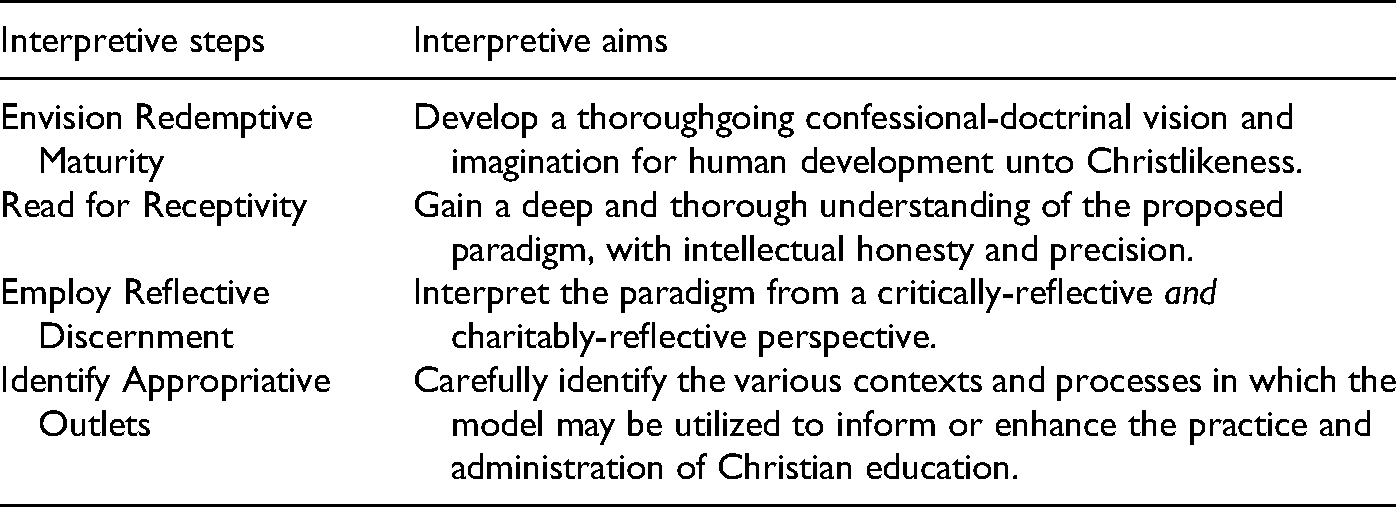
Furthermore, Trentham prescribes a protocol for engagement and appropriation. The first step involves developing a thoroughgoing biblically derived perspective (Trentham, 2019b, p. 488). Second, “gain a deep and thorough understanding of the proposed paradigm, with intellectual honesty and precision” (Trentham, 2019b, p. 490). Third, interpret the paradigm from a “critically-reflective” and “charitably-reflective perspective” (Trentham, 2019b, pp. 491–92). Fourth, “carefully consider the various contexts and processes in which the model may be utilized to inform or enhance” a particular practice (Trentham, 2019b, p. 492). Table 1 depicts the protocol (Trentham, 2019b, p. 488). Although Trentham is specifically writing about the social sciences and Christian education, his protocol for engagement and appropriation can provide a general guideline for the integration of evangelical understanding of Scripture and biblical ethics with Ruether's themes. Trentham's protocol ensures an authentic Christian foundation and the disposition—critical and charitable—to form an integrated model that maintains Christian authenticity yet appreciates and appropriates Ruether's four themes for examining the selected Genesis narratives concerning ethics. Furthermore, the consideration of contexts provides the potential for real world applicability.
Inverse Consistency Protocol.
Modified Protocol of Appropriation
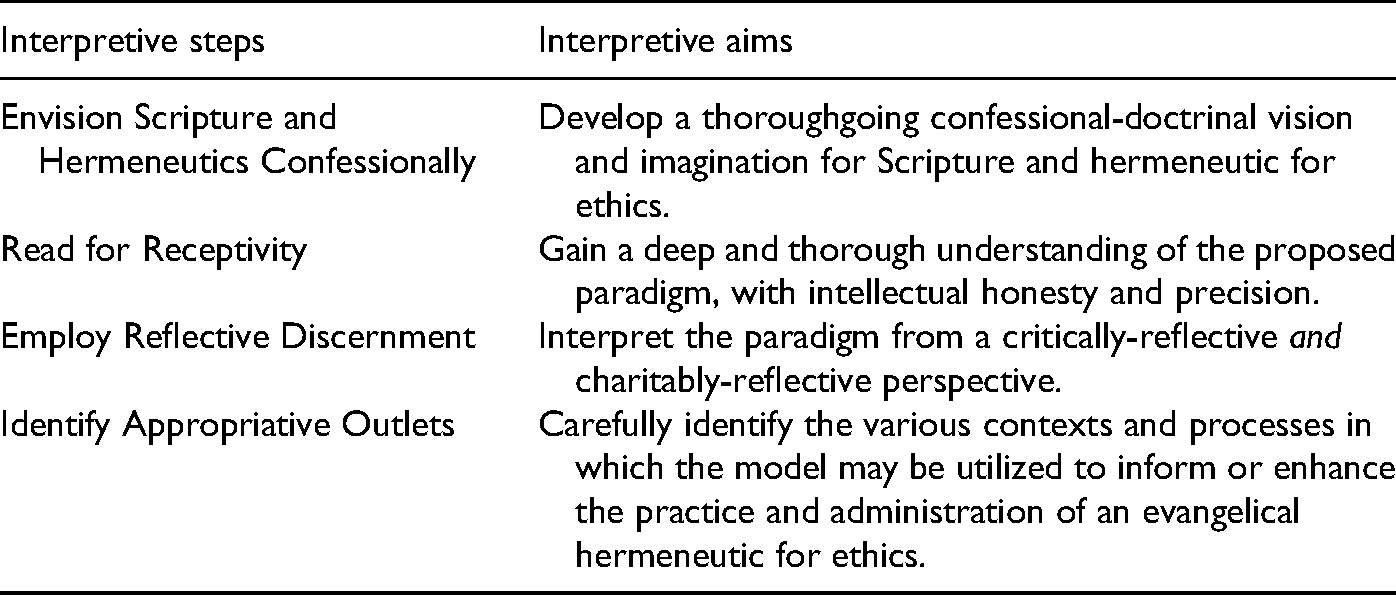
Since the appropriation does not involve the social sciences and Christian education, some modification of the protocol is necessary. Table 2 depicts the modified protocol.
Modified Protocol.
Envision scripture and hermeneutics evangelically
As alluded to in the introduction, I am writing from an evangelical or doctrinally confessional perspective whereby the Bible is the prime source for Christian doctrine clearly communicating salvation through faith alone in Christ alone by the grace of God alone unto the glory of God (see Sweeney, 2005). The Bible is inspired by the Holy Spirit and written by men who were under the inspiration of the Holy Spirit. Therefore, the Bible is the Word of God being truthful in all it says; the original text is infallible and inerrant (see Cowen & Wilder, 2013).
Consequently, one can identify fixed morals from the biblical text, but it entails a case-by-case analysis to determine if the commands represent timeless principles (see Instone-Brewer, 2019). As a result, understanding and applying the Bible entails discerning what the text meant to the original readers, understanding the differences between the biblical audience and contemporary society, finding the theological principle in the text, considering how the principle coincides with the entire biblical narrative, and, finally, considering how the theological principle can be applied in contemporary society (see Duvall & Hays, 2012).
An important understanding in this process—particularly related to the Genesis narrative—is the rule of analogy. Cosgrove (2002) explains the rule of analogy—“analogical reasoning is an appropriate and necessary method for applying scripture to contemporary moral issues”—is predicated on the idea that the subjects and moral-theological categories represented in the Bible are not identical to the same subjects and moral-theological categories in modern society and culture (p. 51). As a result, a process of analogical reasoning must be applied to the relationship between modern cases or problem cases and paradigm cases or biblical cases.
If one has the problem case (contemporary moral situation) and the paradigm case (biblical moral situation), one then engages in principiation—judging whether certain subjects or moral-theological categories are analogous (Cosgrove, 2002, pp. 61–62). Same subjects are identified as “ostensible analogies,” and similar moral-theological categories are identified as “oblique analogies” (Cosgrove, 2002, p. 63). In short, analogizing Scripture entails the comparison of a paradigm case with a problem case so one can determine to what extent the principles from the paradigm case apply to the problem case so that from the comparison an ethical judgment can be formed. In this particular situation, the Genesis narratives concerning sexual exploitation are the paradigm cases for an analogous moral-theological principle for contemporary ethical application.
In summary, envisioning Scripture and hermeneutics evangelically for ethics entails recognizing inerrant Scripture communicates fixed morals through timeless theological principles. The fixed morals are discerned through an appreciation of the ancient and contemporary contexts through a careful case-by-case analysis of the texts in Genesis using the rule of analogy to extract a moral principle for contemporary application.
Read for receptivity and employ reflective discernment
The second step of the protocol—reading for receptivity to gain a deep and thorough understanding of the proposed paradigm with intellectual honesty and precision—was accomplished in the review of Ruether's theology in the first section of the article. Concerning reflective discernment, there is great disparity between evangelicalism and Ruether's understanding of Scripture, hermeneutics, and ethical application. Nonetheless, her four themes do not need to be completely disregarded or debunked. Her first theme—God's vindication of the oppressed—reflects many narratives and assertions in the Bible. Ruether references Amos 8:4–6 and Luke 4:18–19 to support the theme (Ruether, 1982, p. 66). Certainly, as an evangelical, one can affirm God opposes the oppression of people and abuse of power in his words through Amos; and Jesus’ message was not for an exclusive class, but he cared for and loved the poor. Simply put, God opposes oppression and loves the poor.
Additionally, Ruether's second theme—the critique of the dominant systems of power and their power holders—is not completely foreign to the Scriptures and need not be rejected by evangelicals. The story of Saul and David highlights the potential of corruption from power and the accountability God places on offices of power. The Book of Kings provides numerous examples of wicked kings and the abuse of power. In fact, it could be argued the default position of sinful people who possess power is to abuse it given only the few kings who were righteous in God's eyes. Additionally, Jesus was critical of the hypocrisy of the religious leaders and their abuse of the poor. His righteous anger was released in the temple underscoring his disdain for the abuse of the oppressed and poor by a corrupt system (Matthew 21:12–13). From the Bible, one can certainly conclude humanity has a proclivity for power abuse permitting a critical assumption that people in power and power structures are in constant need of critique.
Ruether's third theme—the vision of a new age to come in which the present system of injustice is overcome and God's intended reign of peace and justice is installed in history—is clearly a theme in the Bible; however, from an evangelical perspective, God's peace is only partially realized through the inauguration of the Kingdom through Christ and will be fully realized in the second coming—which is still in real history. Nonetheless, evangelicals affirm justice is to be pursued in this age with ultimate hope in the next; thus, Ruether's third theme is able to be accommodated.
Lastly, Ruether's fourth theme—the critique of ideology, or of religion, since ideology in this context is primarily religious—has some resonance for doctrinally-confessional Christianity. Although an evangelical cannot affirm two different religions in the meta-narrative of Scripture, one can recognize—particularly in the genre of historical narrative—the Bible communicates events that are simply descriptive and not always prescriptive. For instance, no reasonable evangelical Christian reading the story of Jephthah would prescribe his actions as a righteous prescription. The narrative simply describes what Jephthah did and does not condone or promote his action as moral. Peterson (2019) emphasizes this point directly related to the Genesis narratives, “Modern readers must continually recognize the distinction between narratives that are prescriptive versus descriptive” (p. 696). In summary, from an evangelical perspective, one can exercise discernment concerning Ruether's four themes and recognize (1) God opposes oppression; (2) humanity has a proclivity for power abuse warranting the critique of power structures; (3) justice is to be pursued in this age with ultimate hope in the next; (4) the Bible contains descriptive and prescriptive passages necessitating a critique.
Identify appropriative outlets
As noted in the chart, the aim of this step is to carefully identify the various contexts and processes in which the model may be utilized to inform or enhance the practice and administration of an evangelical hermeneutic for ethics. To do so, the appropriation, generally depicted above, must be constructed clearly and succinctly. As a result, the reader should think of the paradigm as a multilayered lens. First, the foundation for the paradigm to examine the Genesis narratives is the evangelical faith, specifically the five solas and biblical inerrancy. The second level is the affirmation the Bible communicates timeless theological principles entailing fixed morals. The third level affirms a necessary comprehensive analysis of the historical and contemporary contexts. The fourth level is a confirmation of the efficacy of the rule of analogy. The last level is Ruether's modified themes. This paradigm provides a lens for the analysis of the Genesis narratives in which the evangelical faith is not compromised, yet Ruether's contribution is reasonably accommodated, and, perhaps, will provide an enlightening perspective. Figure 1 depicts the appropriation.
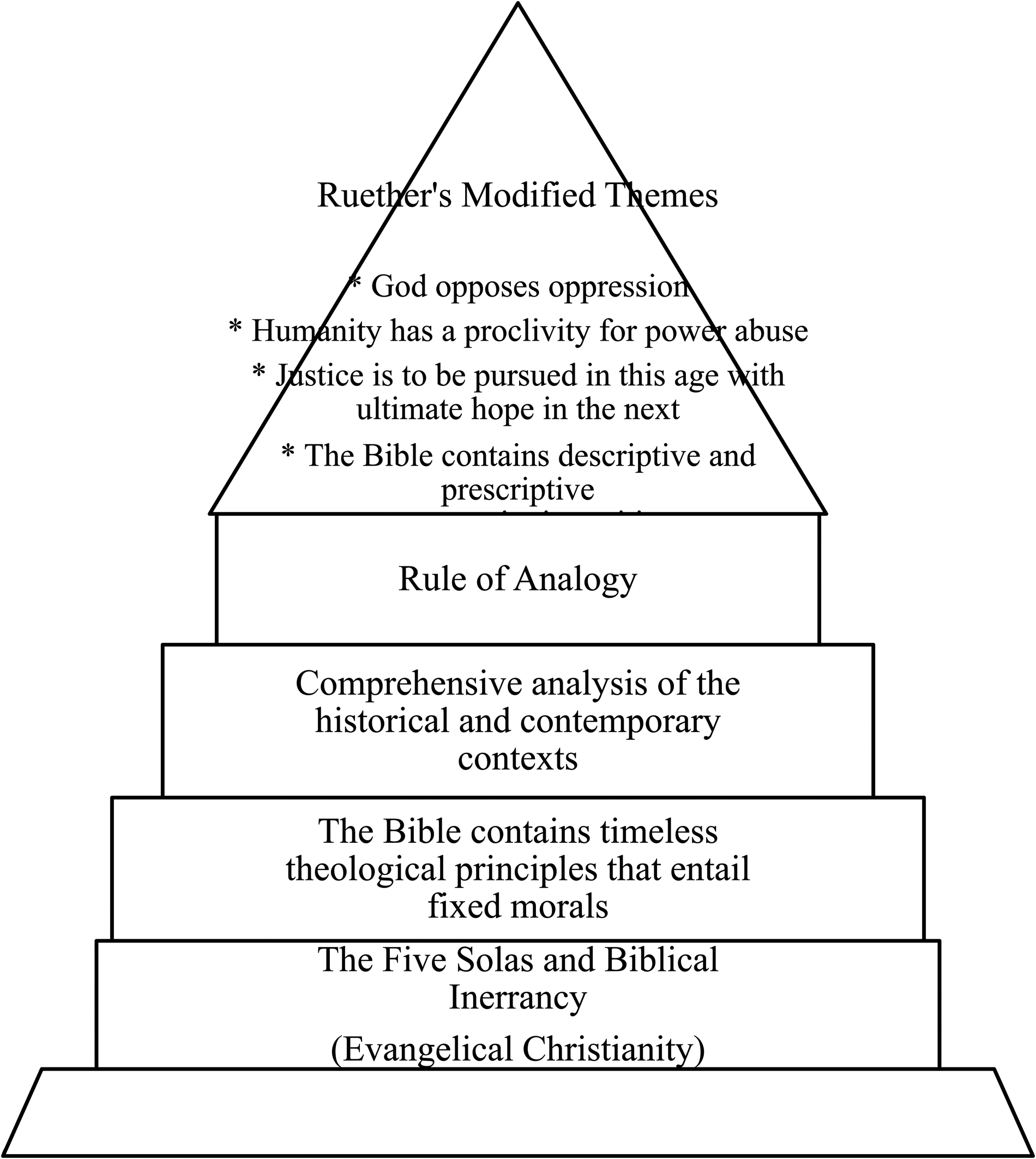
Appropriation model.
The Genesis Narratives and Power
Brian Neil Peterson's well written and insightful article identifies the Genesis narratives concerning sexual exploitation. He places the narratives into four categories: men against women, men against men, women against women, and women against men. I will follow the same outline highlighting Peterson's explanations and then consider his overall conclusion in light of the new lens or model for analysis.
Men Against Women
Peterson reviews five examples from Genesis. He notes Lamech's polygamy in Genesis 4:18–24 concluding the biblical writer presents Lamech as an “egotistical macho man, it is obvious that the ethic of ‘might makes right’ dominates his worldview both in marriage and in retribution to the wrongs done to him (4:23–24)” (Peterson, 2019, p. 696). Second, Peterson references Abraham and Isaac sexually exploiting their wives to save their own lives. Thirdly, he references the rape of Dinah by Schechem noting “Schechem used his position to take sexual advantage of a foreigners’ daughter” (Peterson, 2019, p. 697). Fourthly, Peterson (2019) references Reuben's incestuous relationship with Bilhah, his father's wife, noting Reuben used his “position to take sexual advantage” (697). Lastly, Peterson (2019) references Laban's exploitation of his oldest daughter to take advantage of Jacob noting Laban “used his position of power to the detriment of [his] daughter” (p. 698).
Men Against Men
Peterson (2019) provides three examples; the first is Ham who took advantage of this father Noah noting Ham “was of lower status” than Noah (p. 698). Next, is the incident in Sodom and Gomorrah where the men of the city wanted to sexually exploit the angels. Peterson (2019) notes, “the men of the city wanted to abuse men of lesser social status—they thought the angels were foreigners (p. 699). The last case concerns Ishmael's mockery of Isaac. Peterson suggests this passage implies sexual exploitation by the older brother Ishmael of Isaac.
Women Against Women
There are two cases in Genesis concerning women against women. The first is Sarah giving Hagar to Abraham. Peterson notes Sarah simply used Hagar for her womb and treats her miserably. The second case is when Rachel gives her maid, Bilhah, to Jacob, and Leah gives Zilpah to Jacob. They seemingly have no value for these women past their own selfish motives.
Women Against Men
Peterson (2019) identifies four cases in Genesis. The first is “Rebekah's misuse of her power over her blind husband Isaac” (p. 700). The second is Lot's daughters take advantage over drunken Lot. The third example is when Tamar takes advantage over Judah posing as a prostitute. The last example is Potipher's wife's abuse of Joseph through her sexual harassment and fabricated rape accusation.
After his analysis of the listed events in Genesis, Peterson concludes the fall affected both men and women. He also notes, “Sexual exploitation, personal agendas, power, greed, and the like, drive both men and women;” and the narrative “teaches … that today's somewhat myopic focus on men's oppression of women, as exemplified by various social movements in western society, needs to be placed within in a larger instructive framework” thereby recognizing “women are in no way exempted from scrutiny in this regard” (Peterson, 2019, p. 703). Where Ruether, perhaps, would place the onus on patriarchy as the primary impetus for evil and focus on men, Peterson—although clearly not ignoring power—focuses on the sinful nature of all genders calling for what he considers a more balanced focus on men and women. As we will see, the evangelical modification and appropriation with Ruether will highlight a different focus.
The Paradigm
Certainly, Peterson proceeded from an evangelical foundation. Additionally, his analysis reflects an effort to capture theological principles that entail fixed morals, and he explained the historical context of the narratives in Genesis as well. Although he does not state it explicitly, his conclusions for contemporary society reflect the rule of analogy as he criticizes the myopic focus of contemporary movements that concentrate on men (Peterson, 2019, p. 703). Lastly, he recognizes the need to differentiate the descriptive from the prescriptive. Therefore, he more or less employed the first four levels of the paradigm and even the fourth modified theme—discerning the descriptive from the prescriptive—from Ruether. However, Ruether's three other modified themes provide an added enlightening perspective that completes the analysis model.
Since God opposes oppression, oppression should be a sought-out theme in the text. Additionally, since mankind has a proclivity for power abuse, it should be expected in a postlapsarian world. Lastly, the reality that justice is to be pursued should further focus the Christian on the presence of oppression and power abuse in the text. Simply put, when these themes are emphasized, oppression, power abuse, and the call for justice leap off the pages of the Genesis narrative.
In every incident in the selected narratives from Genesis, Peterson notes the abuser had power over the abused; except, perhaps, with three exceptions. Since, the listed narratives clearly illustrate the power of the abuser only the possible exceptions need attention. First, although Peterson correctly explained Ham was of lower status than Noah; Ham possessed more power than Noah in the moment. Noah was drunk and unconscious; therefore, in the moment described by the text, Ham had power over Noah. Second, Peterson notes the men in Sodom were of lower status than the angels; however, the men outnumbered the angels who they believed to be men. Therefore, one can safely assume, they believed they had power in the moment thereby facilitating their potential for abuse. Thirdly, Tamar used her sexuality in the moment to exercise power over Judah to obtain his staff for even greater positional power over Judah. Our new model for analysis, therefore, highlights the dynamic and changing nature of power and highlights power as the common theme leading to abuse as well as the glaring injustice of the acts of sexual exploitation.
Consequently, what is the theological principle drawn from the new analytical lens or paradigm applied to the sexual exploitation narratives in Genesis? Power comes in many forms, and any human being with power has a proclivity for oppression and sexual exploitation. Put another way, a essential salient ethical point drawn from the text is not just that men and women are sinful—although they certainly are—but that sinful human beings are dangerous when they possess power which can fluctuate in different contexts and constructs. What is the fixed ethic drawn analogously from the selected Genesis narratives? Today, anyone with positional power of any kind—regardless of whether the power is social or physical or is temporary, situational, or fixed—is dangerous making accountability through strict scrutiny paramount. This principle can be applied analogously to contemporary moral situations concerning sexual exploitation.
Therefore, Christians should assess the dynamics of power in every construct and relationship if they wish to protect the oppressed and sexually exploited to pursue justice. This conclusion provokes the question: who often possess the most power in contemporary society? Generally, men are stronger; therefore, in any situational dynamic where men are in a relationship with women where physicality equates to power, men are more likely to be the abuser and must be accountable through scrutiny. Additionally, although it is beyond the scope of this article for a detailed defense of this point, men still possess more leadership positions and positions of power than women in contemporary society; therefore, men warrant close scrutiny for accountability. Simply stated, when the selected texts in Genesis are examined through the proposed new model or lens, patriarchy is not the primary problem nor is the sinfulness of both men and women. The salient ethical principle for application in contemporary society is that positional power in the hands of sinful people is the key factor in abuse, and men usually have more power than woman.
Implications for Educational Ministry
In evangelical contexts, the vast majority of positions of power in the local church and educational ministry institutions belong to men; and the power dynamics of these institutions can enable men to victimize woman. This potentiality becomes frightening when we realize abusers are often experts at hiding their true intentions. Before the public, they can be exemplars of Christian conduct and charity, yet behind closed doors they are oppressors and abusers to those caught in the wake of their power. Somehow these men can go undetected for years and even decades. Why? Because we assume these men will not abuse their authority. In fact, the longer they stay in power, the stronger these assumptions grow. As a result, clear warning signs can be ignored. Sadly, the Ravi Zacharias scandal epitomizes this tragic reality along with recent revelations of misconduct and abuse in local church contexts (see Barron & Eiselstein, 2021; DeGroat, 2020; and Guidepost, 2022).
Theologically, we must recognize the dangerous combination of depravity and power calls for greater scrutiny of men in power in Christian educational ministries. Consequently, I recommend two practices. First, Christian educational institutions and churches should develop clear policies and procedures that govern the behavior and practices of pastors and leaders that reflects an understanding of the proclivity for power abuse. Simply put, pastors and faculty should have strict guidelines for behavior clearly delineated in institutional policy or codes of conduct. Secondly, when an allegation of abuse emerges, churches and educational institutions should partner with investigative entities outside the church or educational institution to ensure accountability and justice. Any investigation must take place outside the existing power structure. We must show the world we are committed to integrity through transparency if we are to overcome the damage from scandal, collusion, and oversight. Speaking from my own vocational context, Southern Baptist Theological Seminary provides clear standards of conduct for faculty and employees in the Employee Handbook. Additionally, the seminary has employed an outside agency—Guidepost Solutions—to investigate allegations of sexual misconduct if they arise. Local churches and educational ministry institutions that have not established these practices would be wise to follow Southern Seminaries’ example. Doing so could protect woman from the predatory behavior of some dangerous men and help restore trust in contemporary Christian educational institutions and churches.
Conclusion
Ethical implications related to sexual exploitation from the selected narratives in Genesis when considered from a doctrinally confessional appropriation with Rosemary Radford Ruether's four biblical themes underscore the danger of power and the elevated threat men can pose in contemporary society. By appropriating the theology of Ruether, we were able to capture a primary ethical principle in the Genesis narratives. Where feminist theology would generally distort the biblical narrative, we were able to appropriate a feminist theology to clearly see what the inerrant biblical narrative is communicating—positional power in the hands of sinful people is the key factor in abuse. Since, men usually have more power than woman, if we fail to hold men accountable, we can inadvertently ignore abuse and predatory behavior. This reality calls for clear guidelines and investigative practices in Christian educational ministry to ensure accountability and transparency to garner trust with those inside and outside the Church. As Christian educational leaders we should welcome strict guidelines for accountability remembering:
You know that we who teach will be judged with greater strictness. ∼ James 3:1
