




Abstract
This article will endeavor to surface the educational principles and practices of Ezra's ministry and make practical implications for today's Christian educator. It will conclude with an itemized list of implications for contemporary Christian educators.
Ezra stands between the Old Testament's close and the advent of Second Temple Judaism. He is the pivotal figure between the culmination of the Old Testament's educational legacy, and the catalyst for Judaism's formation. Often his educational labors are not given the full attention they deserve, and his contribution to the biblical foundations and the heritage of Christian education is minimized.
This article will endeavor to surface the educational principles and practices of Ezra's ministry and make practical implications for today's Christian educator. It will first seek to put Ezra in his historical and literary context, to as to better ascertain these items. Similarly, the article will assess the conditions of post-Exilic Israel, with particular attention given to its spiritual condition. The remainder of the article will focus on Ezra himself, his role as priest and/or scribe, his educational practices, and significance in early Judaism (a feature often overlooked by Christian authorities). It will conclude with an itemized list of implications for contemporary Christian educators.
Ezra in Context
Biblical, Historical, and Higher Critical Considerations
Most of the contemporary treatments of Ezra (and Nehemiah) tend to focus on the challenges of merging their narratives chronologically, the source materials that predate the text of the Hebrew Bible, as well as the relationship of canonical Ezra to the numerous apocryphal literary pieces bearing his name (Blenkinsopp, 1988; Blenkinsopp, 1990; Duggan, 2001; Hoglund, 1992; Torrey, 1909; Ulrich, 2021). However, for the purposes of this article, we will focus on the content of the canonical Hebrew Bible almost exclusively, with no real attention given to these other matters unless they provide insight into Ezra's educational agenda for Judah.
Context of the Narrative
Ezra is first noted as leader of the second remnant's return to Judah under King Artaxerxes, however, some consider this to be Artixerxes I (Ezra 7:8) c. 458 BC or Artaxerxes 2 (Ezra 7:6–10) in 397 BC. Regardless, Artexerxes granted great authority to him (Ezra 7:11–26), for which he thanked God (Ezra 7:27–28). By the time of Ezra's arrival to Jerusalem over 50 years had passed since the dedication of the Second Temple. Ezra 8 provides a list of the list of exiles led by Ezra, along with Temple vessels which could now be returned to Jerusalem.
Many believe that the Reading of the Law (Nehemiah 8:3–8:18) chronologically fits between Ezra 8 and 9. Likewise a parallel between Ezra 7–10 and Neh. 8–10 is likely, suggesting Ezra finished all his initial work within the span of one year.
1st Month—Ezra begins on his journey back to Jerusalem 7th Month—Reading of the Law 9th Month—Condemnation of inner-religious/sectarian marriages 1st Month of next year—Divorce hearings complete its work
Shaver (1992, p. 76) contends that Ezra-Nehemiah provides a consistent chronology and relationship between the two leaders—“the two men are contemporaries,” with Ezra arriving in Jerusalem prior to Nehemiah by 14 years (Ezra 7:8; Neh. 2:1), “and thereafter they cooperated in the restoration of the political and religious life of the Jews in Beyond the River (Neh. 8–12).” However, he likewise suggests a theological motive for Ezra and Nehemiah being contemporaries, a theological one, which is to present “the restoration of the sacred and the secular spheres would appear to have been sequential” (1992, p. 86).
Condition of Post-Exilic Judah
What challenges awaited Ezra upon his return to Judah? Some exiles now in Judah were prosperous (Hag. 1:4) and some, including Levites, had married foreign wives (Ezra 9:1). “Earlier resolves to live lives of separation from their neighbors had been quietly forgotten and mixed marriage was common” (Pfeiffer, 1962, p. 108). Ezra 7:14, 15–23 may indicate that “Ezra had doubts about the priorities of the post-exilic community,” i.e., rebuilding the Temple rather than their faith (Ulrich, 2021, p. 79).
Spiritual condition of Israel was they had adopted many Persian practices that needed to be corrected as they not only returned to their ancestral homeland, but to their faith practices (Torrey, 1909, pp. 307–314). A general ignorance of the law, inter-faith marriage, they had forgotten the Hebrew language, foreign conduct … on the edge of the same precipice that was faced in the 6th century, i.e., lax and resistant to the Word of God (Ezra 9:2, 10:15). Spiritual decline illustrated by marriages between Jewish men and foreign women (Ezra 9), leading him to conduct a census and to marriages dissolved (Ezra 10).
Lafferty (2014, p. 197) comments, “Clearly they [remnant] needed help in trying to live according to their ancestral religious traditions in the [Persian] situation in which they found themselves.” Due to the spiritual condition, especially regarding the marriage with foreign wives, Peter Höffken (2010, p. 57) notes that Josephus, the first century A.D. Jewish author, regards Ezra's work to be more important than that of Nehemiah's; emphasizing the need for spiritual revival over physical reconstruction of the nation. “There ensued hence a revival of all the traditional customs and laws that became more articulate with the coming of Ezra and Nehemiah into Palestine. This spiritual reawakening brought with it a parallel idea of education” (Drazin, 1940, p. 15). While Nehemiah was tasked with rebuilding Jerusalem's walls, Ezra was tasked with rebuilding their faith.
Ezra: Priest, Scribe, or Both?
Ezra is described as a priest (Ezra 10:10, 16; Nehemiah 8:2) as well as a scribe (Nehemiah 8:1, 2, 13; 12:36), and on occasion as both a priest and scribe (Ezra 7:12, 21; Nehemiah 8:9, 12:26). Priests were entrusted with the law and told to teach it (Deut. 31:10, 33:10). Josephus in Antiquities 11.121 describes Ezra as the leading priest (Gk. prōtos hiereus), but while genealogically connected to the high priest (Ezra 7:1–5), he was indeed never considered the high priest.
Heltzer and Avishur (2002, pp. 217–221) note that his depiction as a “scribe skilled … ” or “skilled scribe … ” (Heb. sōfĕr māhīr) may designate a courtier of the Persian emperor. The phrase is similar to an Egyptian school text, “The Craft of the Scribe” (Schniedewind, 2019, pp. 131–133). “These two images of the scribe, the court official and the wisdom scholar, play out in the biblical traditions of Ezra” (Fried, 2014, p. 35).
Prior to 586 B.C., scribes and priests were somewhat separate entities, however, this was not necessarily the case in exilic and post-exilic Judah. Mark Leuchter (2007, p. 17) of the University of Sydney (Australia), comments: Perhaps most significant, the development of Israel's priestly lines during the exile became a matter of literary expression. Separated from regional shrines, village gates or a central national sanctuary, priesthood and scribalism became inextricably linked,” but not without friction and some antagonists.
As such, Ezra becomes the archetype for scribes in the post-exilic period (de Villers, 2013, pp. 1–9). Wenthe et al. (2006, p. 148) concludes that Ezra “establishes a paradigm for the scribal office” in Judaism.
Ezra as Educator and His Educational Agenda
Ezra 7:25 may indicate that Ezra's educational agenda was not just for Jerusalem, but Judea and beyond to the saytrapy [Persian province] in which he resided (Ulrich, 2021, p. 80). His endeavors were not only meant to restore the faith of a nation, but to shape its future as well. The following are insights into Ezra as an educator as well as principles that can be extrapolated from his educational practices.
Ezra's Knowledge of the Hebrew Bible
You can only teach what you know. Ezra's principal task was to teach the Torah. He was recognized as one who made diligent inquiry of the Torah, i.e., “study/seek” in Ezra 7:10. His desire was to teach the Torah, “its statutes and judgements” (Ezra 7:10). Ezra publically read the Torah (Nehemiah 8), was knowledgeable of the Law (Ezra 7:10). Fuller (2005, p. 53) asserts that Ezra even knew the book of Jeremiah (Ezra 1:1), quotes/alludes to Psalms (Ezra 3:11), recounts biblical history (Neh. 9). Ezra illustrates not a mere casual familiarity with the Scriptures, but an intentional depth of study with the text.
Public Reading of the Law
Sukkah 1.1.2, R, records, “when the Torah was forgotten in Israel, Ezra came up from Babylonia and placed it on solid foundations” (Neusner, 2002). The Hebrew Bible records four occasions for the public reading and teaching of the Scriptures:
Moses' prescription at Mount Sinai (Exodus 24:7). Joshua reading the Law at Mounts Ebal and Gerizim (Josh 8:34). Baruch's reading the Jeremiah scroll (Jer. 36:13, 21). King Josiah reading the rediscovered book of the Law (2 Kings 23:2; 2 Chron. 34:30).
Nehemiah alone has the same number of readings in it (8:3, 8; 8:18; 9:3; 13:1).
How much of the Torah did Ezra read? Speculation ranges from the Torah in its entirety or only selected portions. Duggan (2001, p. 108) suggests Ezra did not read the whole Law, but selected portions; comparing the phrase “he read from the Law” (8:3, 8) vs. Josiah's reading of the whole law (2 Chron. 34:30; 2 Kings 23:2). While critical of the historicity of the narrative of Ezra-Nehemiah, Oesterley (1932, p. 137) does postulate, “If this theory as to Ezra's reading of the Law is in any degree correct, it will be seen how important the work of Ezra was; for he was the first to bring the fullness the Judaism of Babylonian Jewry to Palestine.” The example of his reading the Law became part of the traditions of Judaism. “Ezra ordained that Israel should read in the Torah on Monday and Thursday and on the Sabbath afternoon” (Jerusalem Megillah 1.6.B; also in I.1.1.C; XXVII. 4.1.A.6; Neusner, 2002).
Ezra's commission by the Persian monarch Artaxerxes included in Ezra 7:14 indicates that in some part the legislation of the Torah was possibly included in Ezra's commission to establish rule in Judah (Hoglund, 1992). For this reason, some disagree that the law in Ezra 7:12–26 and the Law mentioned in Nehemiah 8 are the same; with the former being the royal edict of the Persian monarch and the latter being Torah (North, 1992, p. 726).
Setting of Public Instruction
Figure 1 illustrates the setting of Ezra's reading of the Torah, with the priests gathering the congregation around them to both translate and interpret it for them.

Dynamics of Ezra's Public Scripture Reading.
The location selected for the reading of the Torah was quite intentional. It was not in the temple precincts, but by the gate because of the need for capacity (Lafferty, 2014, p. 195). Reading it at the Water Gate (Neh. 8:1) was also intentional, “The purpose of Ezra's choice must have been clear enough. It was near enough to the Temple to allow prior attendance at the morning sacrifice, but since it was not sacred ground, women, the ritually unclean, and even those who for one reason or another were excluded from the religious community of Israel and its worship could attend. In this choice of site for the reading Ezra was proclaiming that the Torah was greater than the Temple and its sacrifices” (Ellison, 1981, p. 48; cf. Duggan, 2001, pp. 101–102).
Instructional Inclusion
For whom was the Torah intended? Who was invited to its reading? Nehemiah 8:2–3 specifically states that it was for both men and women (Drazin, 1940, p. 132). Not only that, it was also for aliens/foreigners who were part of Israel's commonwealth. Nehemiah 8:2–3 uses the phrase “those who could understand,” which probably indicates children who are capable of obeying the law (Duggan, 2001, p. 106). Anyone who could comprehend and benefit from the public instruction was permitted to participate in the assembly.
Levites Translate and Interpret
“Then Nehemiah, who was the governor, and Ezra the priest and scribe, and the Levites who taught the people said to all the people, “was followed by learned interpretation (Neh. 8:7–8)” (Crenshaw, 1998, pp. 6–7). Blenkinsopp (1990, pp. 310–312) concludes that, “By the time of the penning of 1–2 Chronicles [traditionally by Ezra] the Levites began assuming some of the functions previously held exclusively by scribes, including teaching the Torah, such as in Nehemiah 8:7–9.”
The Law was to be read every seven years (Deut 13: 9–13), with Levites offering interpretation and application (Lev. 10:10–11). Levitical priests work in Nehemiah 8 is parallel to Deuteronomy 31:9–13 (Lafferty, 2014, p. 197). “The reading of the Law in Hebrew was followed by a translation into the more familiar Aramaic and then by an explanation of the Law's significance”(Lafferty, 2014, p. 193), as illustrated previously in Figure 1.
Swift (1919, p. 196) explains* most thoroughly, “Following the restoration, the Jewish community, under the leadership of the priest-scribe, Ezra, bound itself to the observance of the written Law. If the was to be kept it must be known and understood; there must be teachers and interpreters. But the Law was written in ancient Hebrew, a tong almost unknown to the masses, most of whom spoke Aramaic or Greek. As the result of these conditions, those able to read the Scriptures in the original Hebrew and to interpret them to the people came to form a distinct teaching class,” i.e., the sopherim (cf. Nehemiah 13:24).
Torah-Centered Community
Ezra was to determine “the theological direction of the post-exilic community.” (Wenthe et al., 2006, p. 146). William F. Albright (1963, p. 85), father of modern archaeology, credits Ezra with “establishing the canonical Torah as the normative rule for Israel's faith. Furthermore, Ellison (1981, p. 53) suggests that the organization and Torah-center community established by Ezra perpetuated his ideals into the successive generations.
“Properly taught descendants of ‘our’ father could model a redeemed community that contrasted with the business-as-usual in the A[ncient] N[ear] E[ast] and even the covenantal infidelity of previous generations of Israelites. In this way, the post-exilic Jews could be a light to the Gentiles” (Ulrich, 2021, p. 81). How important did the Torah become to the Jewish community? One ancient authority cautioned, “Even one who is experienced in reading the Torah as was Ezra should not recite it from memory” (Jerusalem Megillah IV.4.H; Neusner, 2002), valuing the text itself over the fallibility of memory.
Feast of Tabernacles/Booths
Ezra embraced informal education as well, utilizing the occasion for a instructional occasion. Nehemiah 7:72–8:18 recounts the celebration of the Festival of Booths. In the Old Testament, feasts and festivals not only served as markers of the annual calendar, but as memorial to the history of Israel and God's intervention on their behalf. The Feast of Tabernacles was an occasion for penance, accompanying the confession of sin. Ezra 7:72, coincides with festival of Booths (Neh 8:13–18; Ezra 3:1), celebrated on the first day of 7th month. Duggan (2001, p. 96) reminds us that such feasts as in Nehemiah had a “catechetical thrust” (cf. Lev. 23:43).
Renewal of the Covenant
More than the recitation of the Torah and a recollection of the covenant, Ezra 9:38–10:39 refers to the ratification of the Law within the covenant community through signature. In these passages such measures as the opposition of foreign marriages, the affirmation of the observation of the sabbath and sabbatical year, requirements to pay a temple tax, and commitment to supply the temple with wood and legal sacrifices and offerings are itemized. It should be noted that de Villers (2013, pp. 1–9) suggests a difference of opinion on how to address the foreign wives issue, with Ezra desire their exclusion, but others affirming their acceptance and inclusion, appealing to latter portions of Isaiah and the book of Ruth for support. This only illustrates the necessity of reaffirming the covenant and bringing Judah under one rule, the Torah.
Instruction Facilitated Worship
Ulrich (2021, p. 80) contends that for Ezra “worship and mission flow from instruction” (Ezra 7:8–8:36). Similarly, Duggan (2001, p. 110) observes that “the narrative describes various gestures that suggest a communal worship service with liturgical and instructional dimensions,” noting how Nehemiah 8:1–6 contextualizes the solemnity of the reading of the Law. Worship has a didactic quality, which Ezra seemed to recognize and utilize.
Ezra's Significance in Early Judaism
Neither Ezra, or Nehemiah, are mentioned in the New Testament. Yet Ezra is indeed a significant figure not just at the close of the Old Testament, but in early Judaism. His significance is in part due to his acclaim in early Judaism as the catalytic figure at the close of the Old Testament, transitioning into second temple Judaism, which is reflected in the New Testament. How is Ezra extolled in Judaism?
Regarded as the Second Moses
“It has been said in Rabbinical Judaism that only EZRA can be compared to MOSES. … Indeed authoritative traditions which are traced back to Moses are traceable to EZRA.” (Bell, 1985, p. 15). On several occasions, ancient authorities did indeed place Ezra on par with Moses. For example:
Tosef. Sanh 4.7—“If Moses had not anticipated him, Ezra would have received the Torah” (Neusner, 2002). Parah 3.5—Moses and Ezra once again as beginning and end of the Hebrew Bible, and Ezra as a marker for the beginnings of rabbinical Judaism. Regarding the preparation of a red heifer, it reads, “Who had prepared them [the ashes of seven Sin-offerings]? Moses prepared the first, Ezra prepared the second, and five were prepare after Ezra” (Danby, 1985). “R[abbi] Yosè says, “Ezra was worthy of the Torah to have been given by him, had not Moses come before him,” and continued to draw parallels between Moses and Ezra (Danby, 1985).
Fried (2014, pp. 45–50) itemizes the parallels made between Moses and Ezra in early Judaism (Table 1).
Moses and Ezra Parallels.
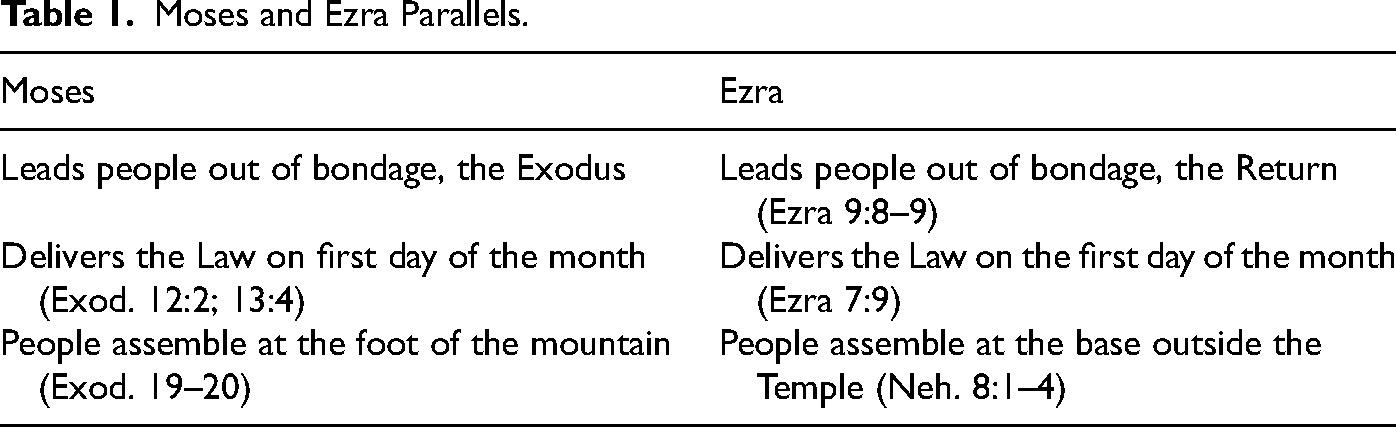
Even Ezra's most infamous piece of legislation to restore the faithfulness of the nation is set in comparison with Moses when Ezra's insistence on expelling foreign wives is similar to Moses' injunction against Israelites marrying Midianite women in Numbers 25 (Höffken, 2010, p. 46).
Scribes and Schools
Ezra 7:14, 25 describes the Torah as being “in your [Ezra's] hands.” Collins (1997, p. 54) observes that, “At least from the time of Ezra onward, there was a tradition of education in the Torah, an activity associated with the Levites in Chronicles.” As such, Ezra is a “precursor” to the rabbinical tradition, which is typically associated with Ben Sira, and the rise of the sopher, scribe, in schools (Morgan, 2002, p. 5, 8–9). Ezra is more like a scribe one would encounter in the New Testament than one associated with the royal courts of the Hebrew monarchy (Klein, 2015, p. 53). Sanhedrin 18b refers to Ezra's school, but may refer to private not public instruction (Barclay, 1959, p. 32). Even the language of discipleship is used of Ezra in the schooling context. Sanhedrin 1.VIII.2, F, states, “And when he died, they said about him, ‘Woe for the pious man, woe for the humble man, the disciple of Ezra” (Neusner, 2002). Heaton (1994, p. 41) surmises, “It is generally agreed that Ezra initiated profound changes in the school tradition of Jerusalem. He was a ‘scribe, expert in the Law of Moses’, who had ‘devoted himself to the study and observance of the law of the Lord and to teaching statute and ordinance in Israel’ [Ezra 7:6, 10]. With the help of the Levites … , Ezra developed a Seminary for the interpretation and teaching of the Law, which came to dominate the religious and intellectual life of Judaism. It is impossible to determine how many other schools were active in Jerusalem in the post-exilic period and how they may have overlapped in function and membership. Although it seems probably that the old priestly school attached to the Temple declined in importance, there is incontrovertible evidence that, alongside Ezra's Seminary for ‘the Law’, a parallel school was still faithfully preserving, teaching, producing, and reproducing ‘the Prophets’” (cf. p. 185).
Why now? Why not earlier in the Old Testament? Crenshaw (1998, p. 112) asserts, “With the collapse of the monarchy, first in the north and later in Judah, a single guild may have continued to train scribes in exile and subsequently in Judah. A decisive shift probably took place under Ezra, who threw this considerable weight behind priestly scribes.” Such a development was virtually inevitable, tied directly to Ezra's endeavor to form a Torah-centered community. “Other Jewish traditions, and especially Rabbinic sources, connect Ezra closely with the restoration of Moses' law after the exile … and the development of ‘the scribes’ as an institution for the study of Torah” (Kraft, 1979, p. 121). Essentially, the purpose of the return would not have been achieved without the advent of a scribal class.
Formalize the Hebrew Script/Font
Judaism also attributes Ezra as introducing the square Hebrew script to replace the Paleo-Hebrew script, which the Samaritans rejected (Pummer, 2007, p. 256). For example:
Babylonian Talmud—Sanhedrin 21b, 22a; Tosefta, Sab. 4.7, Sanhedrin 4.7; Jerusalem Talmud Megillah 71a-b (Neusner, 2002). Sanhedrin 4.7: “Also through him were given [both] a form of writing and language, as it is said, And the writing of the letter was written in the Aramaic character and interpreted in the Aramaic tongue (Ezra 4:7)” (Neusner, 2002). Sanhedrin 1.VIII.2.A: “In the beginning the Torah was given to Israel in Hebrew writing and in the Holy Language [of Hebrew]. Then it was given to them in the time of Ezra in Assyrian writing and in the Aramaic language. The Israelites chose for themselves Assyrian letters and the Holy Language and they left for common folk Hebrew letters and the Aramaic language” (Neusner, 2002).
While this assertion cannot be substantiated with any certainty, it is consistent with the acclaim given to Ezra within the scribal tradition of Judaism.
Completed Canonization of Hebrew Bible
Klein (2015, p. 398) asserts that the acceptance of Ezra's instruction from the Law demonstrated the idea of canonicity. Last scribe and priest has made Ezra regarded as the last “editor” of the Old Testament cannon, which is a claim even echoed by the Masoretic scribes a millennia later (Klein, 2015, p. 355). In fact, several ancient authorities connected Ezra to the prophet Malachi, the final prophet in the Nevi'im (Prophets) of the Hebrew cannon (Meg. 15a; Targum to Mal 1:1; Neusner, 2002).
Pummer (2007, p. 257), writing on the apocryphal work 4 Ezra (1st Century A.D.), comments, “Ezra receives from God the text of 94 books to replace the law that was burned when the temple was destroyed. Seventy of them he is to hide—the apocalyptic books; and 24 he is to make public—the books of the Hebrew canon. Thus, in later tradition, Ezra becomes a second Moses—an event that would not have been acceptable to the Samaritans, who elevated Moses above all other biblical figures” (cf. Bell, 1985, p. 15). Justinian, de cultu feminarum I.3 and 2 Esdras 14 likewise affirms that Ezra restored the whole record of Jewish literature, i.e., formed the canonical text.
Catalyst for Judaism
Blenkinsopp (1990, p. 312) asserts that, “Ezra marked the beginning of the process leading to Judaism as we know it, characterized above all by study, teaching, and observance of Torah.” Later, he would describe Ezra as the “first phase … in the origins of Judaism” (Blenkinsopp, 2009). Even the most critical of scholars concluded thusly: “He [Ezra] had come to serve and to teach, and it is chiefly by these two activities that the Bible shows him as leader of the community. By studying the Law and by listening to what the local Judean community themselves felt ought to be done about their mixed-marriage problems, he understandably earned the gratitude of all subsequent Judaism. The aggrandizement to which this eventually led may be due to trends, already apparent in Sirach 49:13, more separatist than Ezra himself would have approved” (North, 1992, p. 728).
For example, some assert that Ezra's reading of the Law in Nehemiah 8 may reflect the latter practice of opening a synagogue service with the reading of the Law (Ackroyd, 1968, p. 34; Drazin, 1940, pp. 74–75; Oesterley, 1932, p. 137). Ezra has been regarded by some to be the actual founder of synagogue (Hyde, 1890, p. 815), but this is indeed unsubstantiated and an overstatement. The rising place of Ezra within Judaism was to be anticipated. “With the ascendancy of Pharisaic rabbinism, after the suppression of revolts against Rome [A.D. 70], it was inevitable that Ezra the scribe rather than Nehemiah the political activist should become the model of leadership for the Jewish people” in Jewish intertestamental literature (Blenkinsopp, 1988, p. 57).
Lessons Learned from Ezra
Ezra and his ministry had an undeniable influence on the character of God's people at the close of the Old Testament as well as the trajectory into second temple Judaism. The implications from his ministry, as recounted in Ezra-Nehemiah, may also have an influence on contemporary Christian education ministry.
The Person of the Christian Educator
Ezra was the right person for the right time. Ezra 7:10 alone expresses why he was chosen to lead a remnant's return and restore Judah's faith. “For Ezra had set his heart to study [seek] the Law of the Lord, and to do it and to teach his statutes and rules in Israel” (ESV). Knowledge of Scripture is paramount in the life of a Christian educator. To make disciples you have to be a disciple, and Ezra was one who desired to know God through the Torah and practice it in his own life before passing it onto others in Israel. As Christian educators, we must commit ourselves to be life-long learners, perpetual students of Scripture.
Larger Vision of Education That Includes Evangelism and Worship
Ezra's task for restoring Israel's faith, both personally and corporately, indeed centered on the public reading and group teaching of the Torah, but it was indeed not limited to this. Other educational measures were also utilized in his ministry, such as the inclusions of foreigners during the reading of Scripture, i.e., evangelism, as well as reinstating worship practices both in the Temple but also the celebration of feasts and festivals. Far too often Christian education is limited to the classroom, or perhaps small groups; but nothing beyond the more formal approaches to instruction. Christian educators should embrace this more comprehensive vision of education's potential in the church, making Christian education not simply an aspect or division of the church's ministry, but all pervasive throughout the ministry of the congregation.
Christian Leadership Must be Cognizant of Both the Scriptures and Their Times
Just as we endeavor to study and exegete the Scriptures accurately, we should likewise become students of our congregation and community. Christian educators need to understand the condition of their hearers, participants within the congregation, as well as utilize demographic services to comprehend the conditions beyond the congregation. If we are to form a ministry that is relevant to both the believer and non-believer, then our awareness must extend beyond the study of God's Word, to include God's people and His world in which we minister.
Word-Centered Community
Ezra centered the life and community on the Torah. As Christian educators, we too should center believer's relationship with God on His Word, reminding them not only of the Divine origin of Scripture (2 Timothy 3:13–16a), but also the practical purpose it serves in the life of the believer (2 Timothy 3:16b-17). Ezra wanted Israel not only to center its beliefs on the Torah, but live lives reflective of it, consistent with it. This too should be an objective of Christian education in the church.
Covenantal Community as a Time of Covenant Renewal
Ezra emphasized that God's covenant was not only a vertical relationship but had a reciprocal horizontal dimension. While he sought the restoration of the exile's faith in God, he likewise emphasized the collective faith in Israel in God. Christian educators are likewise tasked at calling believers to a personal, mutual accountability to God, but within a covenant community of the church. Ezra also reminds us that the assembly of God's people does not simply have a social aspect, but a spiritual one as well; one that requires a commitment not only to one another but to God.
Aggressive Teaching Ministry Within the Church
Ezra himself was a student of God's Word, he read God's Law to the assembly of Israel, but even then the Levites provided instruction to groups within the crowd. Ezra then relied on other means of instruction, such as the feasts/festivals as well as symbolic ratification of the covenant to further instruct God's people. Christian educators cannot rely on one mode of instruction in the church if their ministry is going to be comprehensive and meet individuals at various levels of maturity.
Represent the Christian Faith Beyond the Congregation, the Public Square
Without over stating the case, Ezra's inclusion of all Israel and especially the foreigners who lived among them, demonstrates that his ministry was in part about reaching beyond the faith community into the lives of all those in Israel. Christian education has a voice not only within the church, but a relevant message beyond the congregation, one that would represent God in the public sphere. Just as Ezra spoke in the public sphere, so we too should be prepared to share God's Word within the community, society, and nation.
Ezra Intentionally Set a Pattern for Generations to Come with Formal and Nonformal Instructions
While we may not be fully certain of the impact Ezra actually had on the trajectory of Judaism after the close of the Old Testament, it is obvious that he was attributed with a very influential role. Ezra understood his ministry was not limited to just the generation to which he was ministering, but to future generations, leaving a legacy that would continue his ministry for generations to come.
Conclusions
Ezra deserves additional attention by the historian of Christian education as well as those studying the biblical foundations of Christian education. In this article, the educational endeavors of Ezra were itemized and some contemporary implications from his example. Just as Ezra 7:10 may serve as an expression of the model Christian teacher, his life and ministry can serve as an influence on all contemporary Christian education.
