




Abstract
This article reports on a study using qualitative methods to investigate intracultural bullying, specifically, bullying between Mexican American (MA) and Mexican immigrant (MI) high school students. Previous research has reported specific cultural conflicts and discrimination within ethnic groups due to differences in acculturation. The purpose of this study is to determine whether this phenomenon is reflected in bullying within a high school context. In-depth interviews are conducted with 6 students from each group (MA and MI) in Grades 9 through 12 at a predominantly Hispanic public school in the state of Washington. The data reveal that bullying does occur between the two groups, with Mexican American students consistently bullying Mexican immigrant students. Two major themes emerge from the data: language barrier and superiority. There are also four themes that arise from the Mexican American student participants that were not found among the Mexican immigrant student responses. These themes are bullying cycle, isolation, alienation, and school factors. Recommendations for practice are discussed.
In recent years, bullying in schools has captured the attention of the American public. Media coverage of several tragic outcomes of bullying has highlighted the severity of the problem, which is one of the most significant problems plaguing school children today (Berger, 2007). According to Olweus (1993), bullying consists of three major components: an intention to harm, repetition, and an imbalance of power (either physical or social) between the bully and victim. The prevention of bullying is important to help students feel safe and secure in school. It is also important for educators to recognize the types of students who bullies target, in order to prevent bullying before it starts.
Due to the seriousness of bullying, there is a large body of research on this issue. However, one type of bullying has received little attention: intracultural bullying, specifically, Mexican American students bullying Mexican Immigrant students. Researchers have called for further research on conflicts existing within ethnic groups (Holleran & Jung, 2005; Niemann, Romero, Arredondo, & Rodriguez, 1999).
Different Types of Bullying
Bullying takes various forms, including verbal, physical, and relational. Verbal bullying refers to name calling, teasing, and verbal threats (Eisenberg, Neumark-Sztainer, & Perry, 2003; Jacobsen & Bauman, 2007; Marsee & Frick, 2007). Physical bullying includes hitting, kicking, or any form of overt violence toward another student. Relational bullying encompasses actions such as gossiping, intentionally leaving students out of activities, spreading rumors, and other measures that seek to change peer groups. Cyberbullying refers to aggressive behavior using digital technology.
Psychological Effects of Bullying for Bullies and Victims
Bullying affects both bullies and victims. Bullies are more likely to commit crimes as they get older and are more likely to be involved in domestic violence (Klein, 2006). Chapell et al. (2006) showed that young students who bully their peers are very likely to bully other students in middle school and high school. Other research adds that bullies show high levels of depression (Klomeck, Marrocco, Kleinman, Schonfeld, & Gould, 2007).
Klomeck et al. (2007) found that victims of bullying are at significantly higher risk of depression, serious suicidal ideation, and suicide attempts compared with students who were not victims of bullying. Chapell et al. (2006) also found that students bullied throughout their school years are more likely to be bullied as an adult and in the workplace. Furthermore, bullying affects students’ academic performance, attendance, and creates a hostile learning environment for students (Eisenberg et al., 2003).
Victims of Bullies: Who Are They?
Phillips (2007) observed that victims of bullying are often targeted because they are different. Other studies are consistent with this notion, showing that students who are dissimilar from their peers in any way are frequently the victims of bullying (Davies, 2006; Heinrichs, 2003). Studies showed that victims of bullying were beleaguered because they were smaller and weaker than other students (Klein, 2006; Phillips, 2007). Heinrichs mentioned that children with handicaps or disabilities are also likely to be easy targets of bullying. Davies stated that gay, lesbian, and bisexual students “are still subject to undermining discrimination from their peers and society” (p. 1).
Racial Bullying
Victims of bullying are often targeted because they are different from the majority of other students (Davies, 2006; Heinrichs, 2003; Klein, 2006; Phillips, 2007). Hence, racial or ethnic minority students may become a target for bullies as well. Research shows that minority students in the classroom are sometimes harassed due to their distinctive physical traits (Peskin, Tortolero, & Markham, 2006). Qin, Way, and Rana (2008) found that Chinese first- and second-generation youth reported high rates of discrimination from other ethnic groups. Dake, Price, and Telljohann’s (2009) review shows that Caucasian students who were the minority in a California school were significantly more likely to report bullying than their African American and Hispanic peers. Graham and Juvonen (2002) found that the minority groups in their study were much more likely to report being a victim of harassment than the majority groups. Research has also shown that adolescents frequently experience discrimination from their same-race and cross-race peers via internet (Tynes, Giang, Williams, & Thompson, 2008).
Within-Group Conflicts, Peer Discrimination, and Bullying
Acculturation is “a social process that occurs in a context in which newcomers and members of the host culture are in dynamic contact with each other” (Padilla & Perez, 2003, p. 50). Due to intergenerational differences within an ethnic group, the process of acculturation may result in groups of individuals who share cultural background but differ on levels of acculturation to the mainstream culture (Romero & Roberts, 2003). As a result, within-group discrimination or peer pressure to adhere to a subgroup’s cultural norms can occur. Holleran and Jung (2005) illuminate the frequent clashes between more and less acculturated groups; prejudice and stereotypes often exist between these two groups. Although conflicts between different ethnic groups have frequently been studied, within-group conflicts have not often been investigated (Romero & Roberts, 2003). Several studies, however, have highlighted the cultural conflicts and within-group discrimination that arise due to different levels of acculturation.
Waters (1991) reported that West Indian immigrants felt that African Americans discriminated against immigrants by insulting them, being arrogant, and feeling superior to West Indians. Black Americans on the other hand felt that West Indian immigrants did not want to be identified as Black Americans and thought that West Indian immigrants stereotyped Black Americans as lazy. Chinese immigrant students reported that their American-born Chinese peers would taunt them because Chinese immigrants could not speak English well (Qin et al., 2008) and observed that American-born Chinese students would repeatedly tell Chinese immigrant students to “go back to China” (p. 36). According to Niemann et al. Mexican participants reported discrimination at the hands of Mexican Americans. Some Mexican participants described how Mexican Americans would “call them wetbacks, pretend not to know Spanish, and treat them worse than Anglo-Americans” (Niemann et al., 1999, p. 55). Holleran and Jung (2005) reported that Mexican Americans and recently immigrated Mexican people discriminated against each other.
Other studies have reported specific cultural conflicts and discrimination within ethnic groups due to differences in acculturation and moving away from one’s ethnic norms (Holleran & Jung, 2005; Niemann et al., 1999; Qin et al., 2008; Waters, 1991). The stress that can develop due to cultural conflicts within ethnic groups can also foster an environment conducive to bullying, specifically within the school environment (Romero & Roberts, 2003). Amid the extensive research conducted on bullying, no studies were located focusing specifically on the dynamics of within-group bullying between Mexican American students and recently immigrated Mexican students in the United States. Therefore, this qualitative study examines bullying between Mexican immigrant students and Mexican American students at a predominantly Hispanic-serving public school in the state of Washington.
Purpose of the Study
The purpose of this study is to examine the phenomenon of bullying between Mexican American students and recently immigrated Mexican students. In addition, the study examines the effects of this type of victimization on both the victims and the bullies.
Method
A qualitative methodological approach to research was selected for this study. The paucity of research on this type of bullying suggests it is useful to generate hypotheses by conducting qualitative analysis. Strauss and Corbin (1998) suggested that by collecting and examining qualitative data based on the perceptions and experiences of the participants, we can begin to construct a theory for the purpose of answering research questions. By going out into a school community, the researcher gains a first-hand view of the students’ experiences. By providing a voice for the students, initial insights are obtained.
The school from which participants were selected was chosen for several reasons. First, it is located in central Washington, where there are high concentrations of both Mexican American and Mexican immigrants whose families have migrated to central Washington because of its agricultural industry and seasonal work. Second, 82% of the student population is Hispanic. Permission was granted to conduct the study by the Institutional Review Board at Eastern Washington University; school district approval was obtained.
Research Design
The researchers chose to conduct in-depth interviews with participants. The purpose of interviews is to understand the real-life experiences of other people and to derive meaning from that experience (Seidman, 2006). In order to gain an understanding of students’ experiences of within-group cultural conflicts, it was crucial to hear and analyze the real-life experiences of students from the two groups under study. Students were chosen using a typical case sampling technique. Typical case sampling selects participants who are considered typical of the phenomenon to be studied (Ary, Jacobs, & Sorensen, 2010). The researcher worked closely with the principal of the school to choose students who met the characteristics of the two populations under study.
Sample Characteristics
Students in the Mexican American group were born and raised in the United States yet had Mexican heritage. Either their parents or grandparents were born in Mexico. Three of the six participants in this group reported that they were able to speak Spanish at some level. Five females and one male made up the six participants in this group. Table 1 provides an overview of selected characteristics of Mexican American participants. Students selected from the recently immigrated group were born in Mexico and migrated to central Washington within the past 3 years and were unable to speak or understand English fluently. Four females and two males made up the six students who participated. Table 2 provides an overview of selected characteristics of recently immigrated Mexican students.
Select Background Characteristics of Mexican American Participants
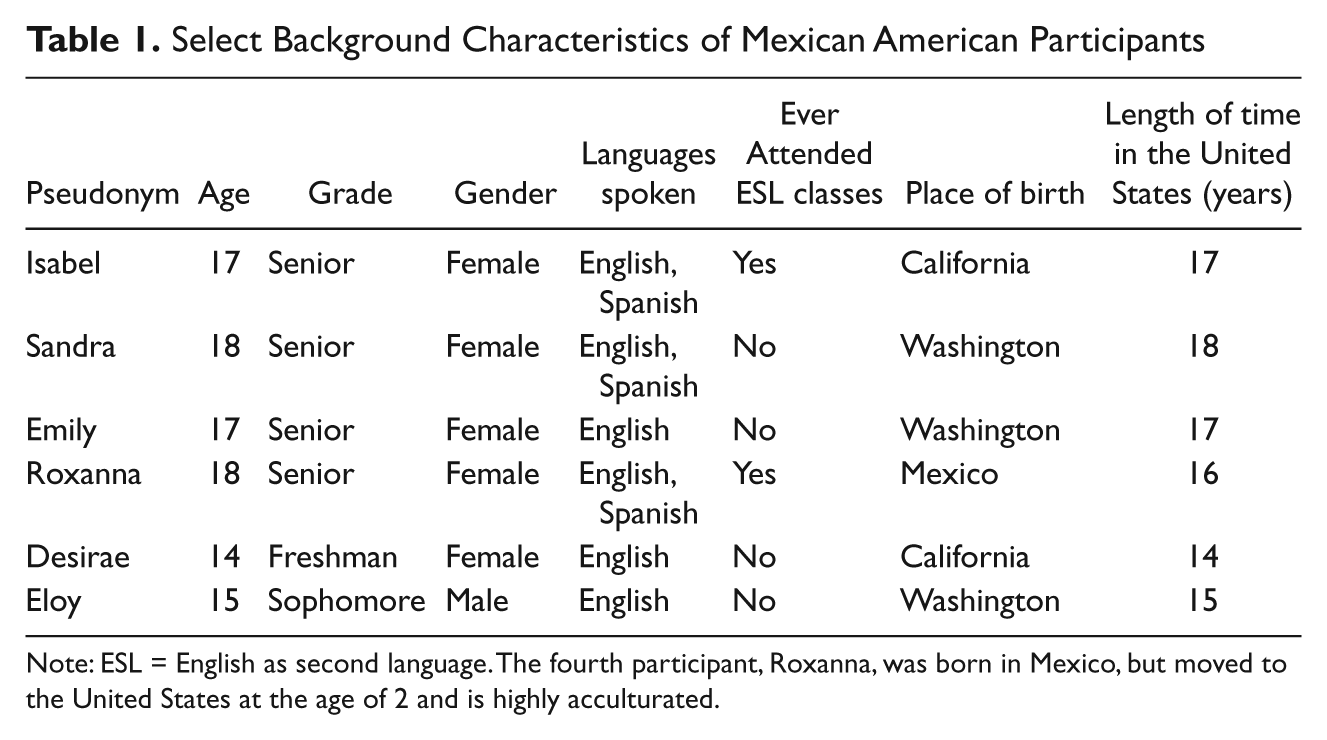
Note: ESL = English as second language. The fourth participant, Roxanna, was born in Mexico, but moved to the United States at the age of 2 and is highly acculturated.
Select Background Characteristics of Mexican Immigrant Students
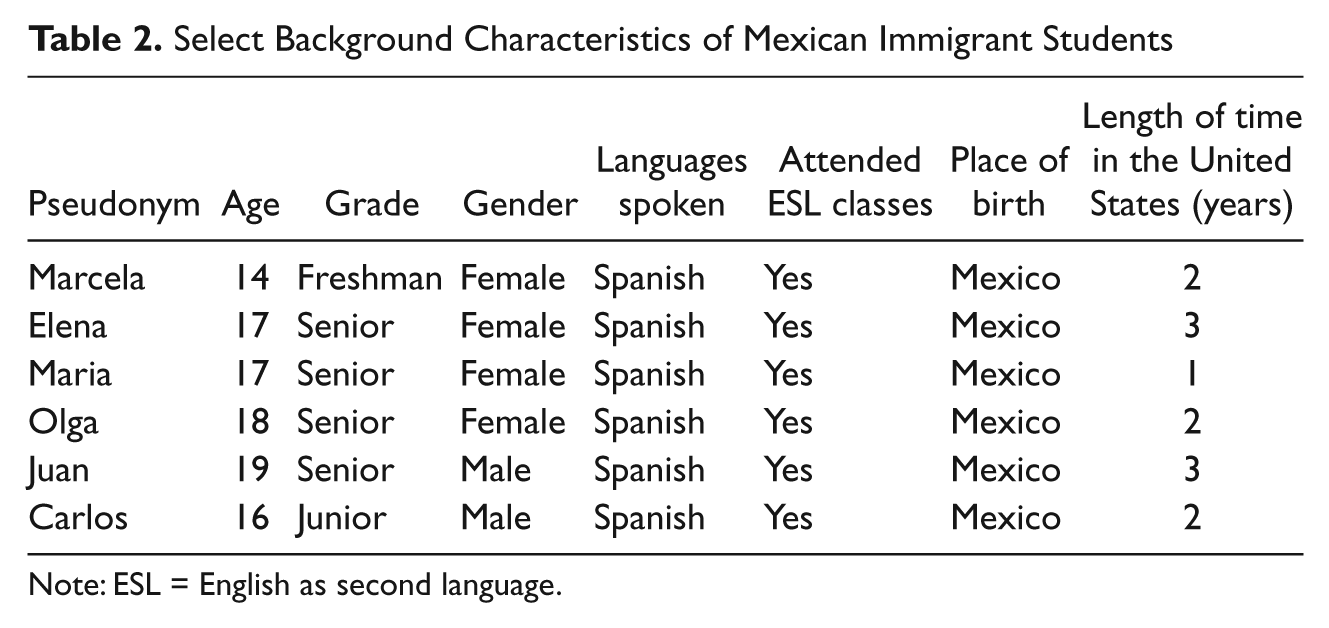
Note: ESL = English as second language.
All students were in Grades 9 to 12 and were 14 to 19 years old. Although participants had similar ethnic and family backgrounds to other students within their group, students were diverse in their experiences, disadvantages, and economic hardships they faced growing up.
Recruitment and Setting
During the morning announcements, broadcast daily to students at the school, the principal asked for volunteers to participate in a study on bullying. Students interested in the study were instructed to come to his office before school, during lunch, or after school for further information. Sixteen students contacted the principal, and 12 were chosen based on criteria for participant selection and availability for interviews. Six students who were identified as “Mexican American students” and six students who were identified as “recently immigrated Mexican students” were asked by the principal to participate in the study. Written consent forms in English and Spanish were given to students to obtain parental permission. Only those students with parental authorization were allowed to participate in the study. All interviews were conducted by the first author of this study.
The first set of individual interviews were conducted with the Mexican American group. Students were given a choice to have their interview conducted in English or Spanish. All six students chose to have their interview conducted in English. Individual interviews with the students took place before school, during their lunch period, and after school. To ensure the privacy of each student, interviews were conducted in the school auditorium because of its isolation from populated areas of the school and because it remained unused during these times. The sessions lasted between 45 min and 1 hr. Prior to the interviews, students were informed that their identities would remain anonymous and were given an additional assent form to sign. Students were provided with definitions of verbal, physical, and relational bullying prior to the interview to become familiar with terms that would be used in the interview (see Appendix A for definitions). An audio recorder and hand-written notes were used to record student responses and observations during the interviews.
The second set of individual interviews were conducted with the recently immigrated group. These students were also given the choice to use English or Spanish for their interview. All six of these students chose to have their interview conducted in Spanish. The second set of individual interviews also took place in the auditorium to ensure privacy, but on a separate day. The sessions lasted between 45 min and 1 hr. These participants were also given an assent form to sign and were informed that their identities would remain anonymous. The concepts of verbal, physical, and relational bullying were explained in Spanish to these students prior to the interviews to become familiar with terms that would be used in the interview. An audio recorder and hand-written notes were also used in this round of interviews to record student responses and observations during the interviews as well.
Data Collection and Analysis
Data collection involved asking six open-ended questions (see Appendix B for questions). Probing and clarifying questions were used when necessary. The interview questions were designed to reflect the participants’ experiences that involved bullying between Mexican American students and recently immigrated Mexican students.
Once all data had been collected and transcribed, analysis involved identification of the themes emerging from the raw data, a process referred to as “open coding” (Strauss & Corbin, 1990). During open coding, the researchers identified and tentatively named the conceptual categories into which the observed phenomena were grouped. According to Strauss and Corbin, the goal with open coding is to create descriptive, multidimensional categories that form a preliminary framework for analysis. Words, phrases, or events that appeared to be similar are grouped into the same category. The next stage of analysis, termed “axial coding” (Strauss & Corbin, 1990), involved reexamination of the categories identified to determine how they are linked. Axial coding is where discrete categories identified in open coding are compared and combined in new ways as researchers begin assembling a holistic view of the phenomena under examination. Finally, the researchers developed a conceptual model for analysis, generating a rich, descriptive account that “closely approximates the reality it represents” (Strauss & Corbin, 1990, p. 57).
Results
Names used below are pseudonyms to protect participants’ privacy. Once it was established that bullying existed between the two groups, it was important to determine the root causes. Transcriptions from both the Mexican American students and the recently immigrated Mexican students were open coded; the following themes emerged from the data: language barrier and superiority. There were also four themes that emerged from the Mexican American student participants that were not found among the Mexican immigrant student responses. Those themes were bullying cycle, isolation, alienation (i.e., Mexican immigrants not fitting in), and school factors.
Voices of Mexican American Students
Language barrier
The language barrier seemed to be a major factor in the bullying that took place. Participants reported that Mexican American students ridicule Mexican immigrant students for not speaking English well. Speaking only Spanish seemed to be avoided by the Mexican American students who could speak English well. For example, the first interview was with Isabel, a 17-year-old Mexican American female student from California. Isabel was raised by her grandmother with Spanish being the dominant language in the home. When she first started school at the age of 7, she was not yet fluent in English and had to attend an English as a Second Language (ESL) class. She was first asked whether she or someone she knew had ever been bullied because of her or their heritage at any time in her or their school career. She responded,
Actually yes. Me personally I have. I attended ESL when I was like in kindergarten to like 1st grade . . . and like they would always like make fun of me because, well they would always just be like “Oh, you attended ESL” and they would always like, call me like names about it and stuff.
Isabel was a victim of verbal bullying due to her limited English-speaking ability and because she had to attend ESL classes. Other students saw her as inferior because she could not speak fluent English, something that most Mexican Americans could do. She expressed feelings of helplessness and unworthiness from being demeaned by her classmates due to the language barrier. This student went on to explain how circumstances changed once she learned English. She stated,
Yeah, because my friends also changed like the people that would like always make fun of me when we were younger now are like the people that talk to me and like, I don’t know they see you differently just because you are in a certain kind of classroom I guess and you don’t know a certain kind of language.
Once the student learned English, she was no longer a target for bullying. The bullying seemed to subside once she was viewed as an equal and no longer an outsider due to the language barrier. She went on to state which group (e.g., by ethnicity) of students bullied her most. She stated, “It was probably like the American Mexicans. . . . Well like I’m Mexican American, but like probably the ones that actually knew English I guess.”
Sandra, an 18-year-old female from Washington, was the first in her family to be born in the United States and learned English at the age of 4. Both her parents started off working in agricultural fields, but at the time of the interview they worked in local factories after receiving their U.S. citizenship. Sandra has five siblings. This student addressed issues Mexican immigrants face due to the language barrier. When she was asked what her perceptions of recently immigrated Mexican students were, she responded,
Well it’s very hard for them. . . . I’ve heard comments like, well if they don’t know English, they’ll be like “why don’t you know English” or “you should know English because you’re in America” and things like that or they’ll be like well “go back to Mexico if you don’t know the language” or something like that so, I think it’s mostly like their obstacle is learning the language.
This student implied that the transition for recently immigrated Mexican students from Mexico to a new school in the United States can be arduous. According to her comments, the language barrier is one of many obstacles Mexican immigrants face but appears to be the main motivation for bullying exemplified by her statement: “Go back to Mexico if you don’t know the language.” Like the first participant, this student identified which group inflicted most of the bullying toward Mexican immigrant students in her school. She claimed, “I think it’s mostly . . . not only Caucasians now, but also like say other Mexicans who feel, well Mexicans who come from America.”
Five out of six Mexican American students interviewed observed that the language barrier made school very hard for recently immigrated Mexican students. Mexican Americans reported several instances of bullying based on language. Language difference was the primary motivation for Mexican Americans’ bullying of Mexican immigrants.
Superiority
Feelings of superiority was the second most frequently cited reason why bullying takes place between the two groups. Five of the six participants from the Mexican American group believed that Mexican Americans students felt superior to recently immigrated Mexican students. The participants gave several examples of perceived superiority of Mexican American students over recently immigrated Mexican students. For instance, Roxanna, an 18-year-old female from Mexico, said her parents migrated from Mexico when she was 2 years old. Her younger siblings were all born in Washington. Her parents now have U.S. citizenship, are employed in good jobs, and can speak English. Roxanna has spent most of her life in the United States and sometimes has trouble speaking Spanish fluently. She was the first of the participants who felt Mexican Americans believe they are superior to Mexican immigrants. Roxanna stated,
Americans who come from a Mexican heritage, that have already been adapted to America. They do the bullying because like they feel superior to them (Mexican immigrants) because they barely got here and they don’t know anything . . . there’s people like me who were born over there and they already know the English language and everything, but yet they’re still Mexican, but yet they feel better than the ones who barely migrated over here because they’ve been here longer. You know, they’re already adapted to everything. They probably think that the ones, who barely got here, got here illegally so factors like that make them feel superior to them.
Roxanna felt that Mexican Americans feel superior to Mexican immigrants because they were born here legally. The implication: Mexican Americans possess rights and privileges as U.S. citizens and since some Mexican Americans believe most Mexican immigrants are not legal citizens of the United States they do not have the same rights and privileges. Arguably, the interviewees believed Mexican Americans have established themselves in the United States, and represent the majority of the population in the area, which leads to a sense of superiority. Roxanna’s statement helps to explain Isabel’s bewilderment as to why her friend denigrated a Mexican immigrant. Isabel stated,
Yeah um, we were walking down the hallway, I think it was the beginning of this year and there was this girl that was walking and one of my friends, who didn’t even know why she didn’t like her, was like “ewww, look at that wab [derogatory term used to describe illegal immigrants].” I was just like I kind of got mad and I was just like “don’t talk about her like that . . . you don’t even know her” and she was like “well I just don’t like her cuz she’s a wab” and I was like “you have no reason not to like her.”
Isabel did not understand why her friend made a derogatory slur toward a Mexican immigrant who had done nothing wrong. It seems as if the Mexican American student insulted the Mexican immigrant for the reasons suggested earlier: Mexican Americans were born in the United States, are here legally, and feel superior because of it.
Bullying cycle
The next theme that emerged was a bullying cycle. The students agreed that Mexican American students bully Mexican immigrant students because Mexican Americans themselves were bullied at a younger age. Eloy, a 15-year-old student from Washington, gave an example of Mexican Americans bullying recently immigrated Mexican students.
So like when a Mexican (recently immigrated student) is talking in front of the class the people in the back (Mexican Americans) of the class will be making fun of them, like not directly to them exactly, but they’ll tell their own friends. They’ll be like “f***** beaner!” or something like that, like they say “that dude’s a wab” or something like that, but they’ll never tell that person directly, it’ll just be to their own friends.
After explaining his example of relational bullying toward a recently immigrated Mexican student, he was asked why Mexican American students would make a derogatory racial comment about someone who shares their ethnicity. He stated,
I also think that person probably got picked on before for being Mexican when he was smaller or something, so it’s a way for them to get back at people for how they use to feel. It’s kind of like a chain I guess. That’s also probably why they (Mexican Americans) say they don’t speak Spanish and things like that.
Eloy suggested that Mexican American students who bully may have been victims of bullying at one time, explaining that the inferiority they once felt is now something they want other students to feel. This same student also suggests that some Mexican Americans even go as far as to pretend not to know their native Spanish language because they were once bullied because of it.
Isolation
Another emerging theme was isolation. Three participants believed that recently immigrated Mexican students are bullied because they are not able to make friends with the majority of the student population. For the majority of the school day, Mexican immigrant students are separated into ESL classrooms where they learn English. When asked, “What is your perception of recently immigrated Mexican students who are attending Sunset Heights High School [pseudonym]?,” Emily, a 17-year-old participant stated, “I really don’t get to talk to them because they’re like set apart from everybody else. Like they’re in their own classrooms and I don’t really communicate with them.” Emily was not able to make any personal connections with recently immigrated Mexican students due to school policy of placing such students into ESL classes creating a natural division between Mexican American and Mexican immigrant students. She then indicated that other students are inclined to verbally and relationally bully any student with whom they are not familiar. She goes a step further by offering a solution to the problem, which was letting ESL students attend more classes with the general student body. Sandra supported this perspective saying,
Yeah because they’re like alone by themselves and they don’t really have like a group to like hang out with so they’re more easier [sic] to like pick out in a crowd or something because they stand out more. People will like, like I hear gossip. Like people will make little comments, like “oh look at those wabs” or you know stupid things like that or like the more popular guys will call them a joto.
The participants believe that Mexican immigrants are socially isolated from the general population and that, in turn, leads to judging, castigation, and bullying.
Alienation
The next theme that emerged was alienation. Four out of the five participants stated that they believed recently immigrated Mexican students were bullied because they did not fit in with everyone else. Roxanna stated,
Well, they dress differently because when you come from Mexico you dress differently because everybody else dresses like name-brand clothes. They go shop at Abercrombie and they’re always bragging about it and other Mexicans who barely came from Mexico don’t have the means to do that. You know, they barely came and are barely starting off so they could be criticized for that also.
Roxanna feels that most recently immigrated Mexican students cannot afford to buy name-brand clothes and do not dress fashionably. Therefore, Mexican Americans who can afford to dress this way will make fun of Mexican immigrants because they are dressed differently. Emily said,
They kind of cling to anyone who gives them a chance. You know there was this one immigrant girl who came and she was okay because she played soccer on the sport’s team. So she was somebody out in the field, but when she came to school it was totally different because no one really knew her, so she didn’t have any friends. When you haven’t gone to school with people for a long time like the rest of us, you know since like kindergarten, it’s hard to fit in. You’re kind of nobody you know?
Emily felt that recently immigrated students did not fit in with other students because once students begin attending high school, their social cliques are established and typically do not change. Therefore, when Mexican immigrants begin school, they are left out of social cliques.
School factors
Several Mexican American participants identified school factors they felt contributed to an environment conducive to bullying between the two groups. In addition, some participants offered practical recommendations to reduce tensions. When Sandra was asked what she thought teachers and school officials could do to prevent this issue, she suggested,
I think that they should be allowed to attend some classes with everybody else not just be all on their own because they come over here to America to live the American dream. How are they gonna fulfill it if they’re not around everybody else? So that’s personally what I think.
The student does not think recently immigrated Mexican students should be isolated from the general student body. For the majority of the school day, recently immigrated Mexican students attend ESL classes away from the broader population. She believes this makes it harder for them to make friends and also makes them more of a target for bullying because other students do not have an opportunity to associate with them.
Emily argued that established social cliques in school make it difficult for Mexican immigrants to make friends and offered a recommendation to reduce the problem. She states,
I went to this leadership conference one year, and they said their goal for one year was to eliminate cliques, so the leadership group went around and eliminated cliques so everybody started having lunch with other people and hanging around with other people and they did that for one whole semester and they said that by the end of the semester you didn’t see any cliques you saw people conversating [sic] with other people and administrators took action and started getting involved and helping the situation, so I think if we would do something in that manner, that it would eliminate the cliques and that would get the administrators involved.
Emily believed exercises to eliminate cliques could possibly benefit recently immigrated Mexican students because they would have more opportunities to socialize with Mexican Americans.
When addressing how administrators could reduce bullying in their school, Desirae, a 14-year-old female stated,
I would just recommend for them to get knowledge on the situation. I just think that they’re not up to date. They’re kind of old and you know from back in the day I guess you would kind of say (laughing). They don’t know what kids are going through nowadays. They can say they do, but it’s different now. So we need to inform them that it’s harder for kids nowadays to make friends and stuff. They need to be updated on discrimination and bullying. They need a little more effort on that. I mean it doesn’t happen to me cuz [sic] I’m someone here at school, but how would I feel if I had just came from Mexico and this was happening to me you know? How would I feel if I couldn’t approach a teacher or administrator? They need to be taught how to deal with this.
Desirae suggests there is an administrative disconnect between school officials and students. This appears to aggravate the bullying taking place between Mexican Americans and recently immigrated Mexican students since school personnel may not realize it is happening. In general, Desirae believes teachers and school officials need more training on school bullying and, more particularly, be aware of “intracultural” bullying. She also implies that recently immigrated Mexican students do feel comfortable approaching teachers and school officials about bullying.
Eloy suggests more bilingual education should be incorporated into the classroom to offset the effects of bullying. This student went on to say, “I think the teachers who know Spanish should like try to teach in Spanish a little as well, for like the kids who don’t know English, just to help them out a little more.”
Voices of Recently Immigrated Mexican Students
Language barrier
All six Mexican immigrants shared similar sentiments to the Mexican Americans. Both groups believe that a primary factor in bullying is the English language barrier. It was also evident that most of the discrimination was at the hands of Mexican Americans. Marcela a 14-year-old female from Mexico believes that Mexican Americans bully Mexican immigrants, “because we don’t know English so they see us as lesser human beings.” Elena, a 17-year-old female from Mexico, who was still unable to speak English, said,
No sé, pero si eh visto eso como, que hay unos a ahorita que nosotros estamos aprendiendo como el idioma, hay veces que no sabemos bien la pronunciación y empezamos a decir algo y como que ellos que entienden los dos idiomas como que se empiezan como a reír y hacen que uno se sienta incomodo.
[Translated from Spanish]:
I don’t know, but I have seen, well there’s some right now that while we are learning the language, there’s times when we don’t know the correct pronunciation and we begin to stumble and those who understand both languages begin to laugh at us and it makes us feel very uncomfortable.
Learning the English language had been a challenge for this student, but nevertheless she continued to try. When attempting to pronounce words in English, she was mocked and ridiculed by Mexican Americans resulting in feelings of embarrassment and distress.
Maria, a 17-year-old female from Mexico, who, at the time of interview, had been with her family in the United States for a year and three months, feels the United States is an “okay” place to live, but really misses Mexico. When being asked to talk about Mexican American students at her school, she stated,
Ahora si descriminan mas. La mayoria de ellos les da por discriminar contra de los mexicanos. Ellos son los que nos hacen sentir menos. Esos que hablan dos idiomas, bueno, hay personas que si nos ayudan y hay otras que no
[Translated from Spanish]:
Now they do discriminate more. The majority of them do tend to discriminate toward the Mexicans. They are the ones who make one feel less. Those who speak two languages, well there’s people that do help and there’s others that don’t.
This student felt that Mexican Americans discriminate against them more than any other race within the school. She explained that Mexican Americans taunt Mexican immigrants because Mexican Americans are bilingual and recently immigrated Mexican students are not. The student’s tone elevated as she spoke, indicating she was becoming angrier as she remembered the discrimination she experienced.
Superiority
All six recently immigrated Mexican participants also believed that Mexican American students felt superior to them. Maria stated,
Pues ellos dicen ‘que fregados haces aquí’ y que me debería ‘regresar a México’, que ‘qué hago aquí que no se ingles’ y puras cosas así . . . también dicen que ‘deberían poner como ya la barrera pa‘ que no entremos mas Mexicanos’ y que ‘deberían echarnos a todos los mexicanos para México que ya no deben, pues como yo no debería de estar aquí y todo eso.
[Translated from Spanish]:
Well, they say, ‘What the hell are you doing here” and that I should “go back to Mexico,” that “what am I doing here if I don’t know English” and stuff like that . . . they also say, “they should put a barrier so that Mexicans can’t get back in,” and that “they should throw all the Mexicans back to Mexico,” that they shouldn’t, that I “shouldn’t be here” and stuff like that.
This student has been verbally bullied more than once by Mexican Americans. The defamations were intended to make her feel like she is an outsider and as though she does not belong. The tone of her voice indicated it was obvious that being shunned by her classmates was something very hard for her to endure.
Carlos, a 16-year-old male from Mexico, who had not yet learned English, had also been a victim of bullying by Mexican American students. He gave an example of how Mexican Americans use their skills of knowing two languages to prank him. He states,
Si me vacilan mucho. Pues como la maestra a veces habla puro ingles y dicen que los hombres se pongan acá como en la clase de P.E. por ejemplo pónganse los hombres de un lado de la línea y las mujeres acá en la otra línea y me dicen ‘hey que te pongas allí Yorejas’ y yo me pongo allí ya cuando acuerdo puras mujeres aquí y es cuando todos se ríen, para ellos podrá ser un chiste pero para mí es una vergüenza estar así.
[Translated from Spanish]:
They do prank me a lot. So like the teacher sometimes only speaks English and says men get over here like in P.E. class for example. Men get in one side of the line and women over here in the other line and they tell me “Hey get over there crybaby” and I get on the line and when I turn I realize that only women are here, and that’s when everyone laughs, for them its joke but for me it’s an embarrassment being like that.
This student, relying on the Mexican American students to interpret what the teacher was saying, was deceived by being given false instructions, so that he would stand in a line intended for all girls. Although the Mexican Americans found it humorous, this student was left feeling humiliated. Elena explained why Mexican Americans would engage in this kind of bullying,
Yo creo porque como están criados aquí ellos se creen mas de aquí que de México, porque hay personas, que aunque no son nacidos aquí pero se han criado aquí ellos ya nos están discriminando nos están discriminando a todos los que no sabemos ingles no hemos vivido siempre aquí entonces
[Translated from Spanish]:
I think because they were raised here, they consider themselves from here more than from Mexico so they think they’re better. There’s people that were born here and raised here that are Mexican that are discriminating us, they are discriminating everyone who doesn’t know English.
According to the student’s statement, Mexican Americans are devaluing their own culture and language. They feel “better than” Mexicans who were not born in the United States, making recently immigrated Mexican students sense that Mexican Americans feel superior to them.
Comparative Analysis
Both the Mexican Americans and the recently immigrated Mexican students seemed to agree on most of the themes. They agreed on the motivation for the bullying and provided similar examples of the bullying. The differences between the two sets of interviews are that the Mexican Americans were able to talk about some themes that the recently immigrated Mexican students did not mention or would know nothing about. The following sections describe the similarities and differences between the two groups of participants.
The primary source of bullying that both groups agreed upon is that since Mexican immigrant students could not speak English, that it made them more susceptible to bullying. Both groups also agreed that Mexican American students tend to instigate the bullying between the two groups. The examples of bullying due to the language barrier were very similar between the two groups of students. In all, there were no apparent differences between the two groups on the issue of language as the primary source of the bullying.
Both sets of students agreed that Mexican Americans bullied recently immigrated Mexican students because they felt a sense of superiority to them. A general view among both sets of participants seemed to be the perception that Mexican Americans do not feel connected to their Mexican heritage. In addition, recently immigrated Mexican students believe that Mexican Americans identify more with their American roots, creating acrimony between the groups. This source of resentment seems to exacerbate the problem of bullying between these two groups of students.
Another contributing factor to bullying is that the Mexican American students in the sample thought that other Mexican Americans might be inclined to bully recently immigrated Mexican students because they were once bullied for being of Mexican origin. Recently immigrated Mexican students did not mention or corroborate this finding.
In addition, Mexican American students observed that recently immigrated Mexican students are separated from the general student body because of their placement in ESL classes and that they do not interact with them, thus making them more prone to bullying. Recently immigrated Mexican students, however, did not mention the ESL class separation as a source of bullying. Mexican American students also believed that recently immigrated Mexican students were bullied because they did not fit in with other students because of the way they dressed and because students are not inclined to include new students into their already established social cliques.
Discussion
Although this study is limited by the small sample it used, it provides evidence that differences within an ethnic group, particularly those related to varying levels of acculturation, can foster an environment conducive to bullying. The data revealed that bullying occurs between the two Mexican-origin groups in one high school with Mexican American students consistently bullying Mexican immigrant students. Relational bullying seemed to be the most common type followed by verbal. Physical bullying was the least common although it was reported.
Phillips (2007) and Heinrichs (2003) suggest that students are more likely to become a target for bullying if they are viewed as different or portray exceptionalities compared to the general student population. Most participants believed the language preference (English vs. Spanish) between the two groups was a major reason for the bullying taking place in the school. Being only able to speak Spanish made recently immigrated Mexican students different than most students, thus making them more susceptible to bullying. Although Mexican Americans share the same racial and national background as Mexican immigrants, the language barrier creates a natural divide between the two groups. In addition, Mexican American participants were able to explain that recently immigrated Mexican students may also be vulnerable to bullying because of isolation and alienation factors. Participants suggested that recently immigrated Mexican students are different because they are isolated by class placement that separates them from other students, cannot afford high-status name-brand clothing, and do not fit in with established social cliques. Furthermore, Mexican American participants believed that Mexican American students bully recently immigrated students because they were themselves once bullied because of their race and cultural heritage. Chapell et al.’s (2006) findings are consistent with this conclusion, which show that students who were bullied at a younger age are more likely to bully other students in middle school and high school.
In addition, Mexican Americans are the majority in the school in which this study was conducted, whereas Mexican immigrants are the minority, which made them easy targets for bullying. Prior research supports these findings, indicating that minorities are much more vulnerable to bullying than the dominant group of students (Graham & Juvonen, 2002; Peskin et al., 2006; Siann, Callaghan, Glissov, Lockhart, & Rawson, 1994). Moreover, findings suggest many Mexican immigrants are bullied by Mexican Americans because Mexican Americans have acculturated into the dominant American culture and feel a sense of superiority over Mexican immigrant students. Although both groups share the same heritage, their cultures and customs are dissimilar. By bullying the recently immigrated students, the Mexican American students assert their dissimilarity to a group that is more vulnerable to discrimination. These findings are consistent with other studies that portrayed the conflicts and discrimination that are present within an ethnic group due to different levels of acculturation and feeling superior over the more or less acculturated group (Holleran & Jung, 2005; Niemann et al., 1999; Qin et al., 2008; Waters, 1991).
Romero and Roberts (2003) indicated that stress may result from cultural conflicts within an ethnic group due to the different levels of acculturation. From these conflicts, within-group discrimination and peer pressure to conform to one’s ethnic and cultural norms can emerge. On the basis of the participants’ statements, we can determine that this is taking place between Mexican American and recently immigrated Mexican students. It appears that Mexican American students have acculturated into the dominant American culture and now discriminate against Mexican immigrant students. Results are also consistent with Holleran and Jung’s (2005) findings, which showed that there are frequent clashes and prejudice exists between more and less acculturated groups. In a school environment, these conflicts arise and take the shape of verbal, physical, and relational bullying.
Finally, several students offered suggestions to school officials for fostering a more positive school environment and reducing bullying between Mexican American and recently immigrated Mexican students. Their personal experience with this type of bullying allowed them to offer practical solutions that may help prevent the bullying. Those suggestions were considered by the authors when they reflected on the practical implications of these findings. We offer the following recommendations: It would be helpful for schools to provide more opportunities for Mexican immigrant students to interact and communicate with the general student population. Such practices could make it easier for Mexican immigrant students to make friends and become less of a target for bullying. In addition, eliminating cliques would also make it easier for recently immigrated students to make friends. Programs such as “Mix it Up” have been widely used toward this end (Nagda, McCoy, & Barrett, 2006). Formal student mentoring programs with new students being mentored by current students and coordinated by the school might help to eliminate the divide between Mexican Americans and recently immigrated Mexican students. This would allow the two groups to positively interact, create friendships, and potentially reduce the occurrences of bullying.
A positive school and classroom climate has been found to reduce bullying in schools and opportunities in classes to talk about the bullying they are observing or experiencing have been recommended (Bauman, Rigby, & Hoppa, 2008). Lastly, because the high school under examination is predominantly Hispanic and Spanish is often the first language of both Mexican American and Mexican immigrant students, having bilingual personnel who can communicate with students and parents is clearly an advantage. Such efforts would hopefully break down the barriers between the two groups of students so that students will emphasize the similarities they share as opposed to focusing on their differences. However, future research should evaluate the effectiveness of any programmatic efforts to determine whether they help to reduce bullying between the two groups of students.
Footnotes
Appendix A
English definitions: Verbal, physical, and relational bullying:
Spanish definitions: Verbal, physical, and relational bullying:
Appendix B
The author(s) declared no potential conflicts of interest with respect to the research, authorship, and/or publication of this article.
The author(s) received no financial support for the research, authorship, and/or publication of this article.