




Abstract
Family cohesion has shown to be associated with lower psychological distress and other risk behaviors for Latinos, but little is known about the relationship of family cohesion, family discord, and anxiety disorders. Using data from the National Latino and Asian American Study (n = 2,554), this study examines the relationship between family functioning and anxiety disorders for an aggregate Latino sample and for Latino subgroups (Mexican, Cuban, Puerto Rican, and Other Hispanic). Results for the aggregate sample suggest that family discord is associated with 12-month prevalence of almost all anxiety disorders for Latinos. On the other hand, strong family cohesion is only associated with generalized anxiety disorder and panic disorder. For the subgroups, different patterns of association were found, suggesting the importance of understanding the heterogeneity of Latino culture when studying and treating anxiety disorders.
Introduction
Within Latino families, family cohesion is associated with lower stress (Hovey & King, 1996; Salgado de Snyder, 1987), less alcohol use (Marsiglia, Kulis, Parsai, Villar, & Garcia, 2010), and fewer problem behaviors (Marsiglia, Parsai, & Kulis, 2009). Strong family cohesion, known as familism, is a key characteristic in Latino culture (Sabogal, Marín, & Otero-Sabogal, 1987). It includes prioritizing familial obligations, honoring the family, and using the family as referents for the definition of self (Sabogal et al., 1987; Schwartz et al., 2010). Though familism is associated with fewer problem behaviors, it is unknown whether strong family cohesion protects against anxiety disorders. Bowen’s family systems theory (Kerr & Bowen, 1988) suggest that in all families, negative interactions result in the development of clinical levels of anxiety. Due to the emphasis on family found in many Latino cultures, strong family cohesion may be associated with a reduced likelihood of having an anxiety disorder. On the other hand, high levels of family discord in these families may be associated with an increased likelihood of having an anxiety disorder. The purpose of this study is to explore the relationship between family functioning and anxiety disorders among Latinos in the United States. Drawing on tenets of Bowen’s family systems theory, it specifically investigates the relationship between family cohesion and family discord with 12-month prevalence of anxiety disorders for an aggregate group of Latinos and four subgroups (Mexican, Puerto Rican, Cubans, and Other Hispanics).
Bowen’s Family Systems Theory
Two important principles in Bowen’s family systems theory are differentiation and triangulation (Kerr & Bowen, 1988). Differentiation has two main components. One is the ability to have active and available thinking processes during emotional intensity and reactivity. The other is the ability to balance individuality and togetherness. Greater levels of differentiation are associated with higher family functioning (Klever, 2009) and greater marital satisfaction (Peleg, 2008), while low levels of differentiation are associated with chronic anxiety (Knauth, Skowron, & Esobar, 2006; Miller, Anderson, & Keala, 2004) and greater social anxiety (Peleg-Popko, 2002).
When two individuals have difficulty balancing individuality and togetherness, they experience higher levels of anxiety, stress, and conflict (Kerr & Bowen, 1988). To diffuse this tension, individuals with low differentiation often triangulate others into conflicts (Amato & Afifi, 2006; Buehler, Franck, & Cook, 2009; Oppenheimer & Frey, 1993). Triangulation occurs when a third person is brought into the conflict between two people. For example, when a couple is having perpetual conflict, one member of the dyad may begin to criticize the other member to the couple’s child. By doing so the child has become triangulated into the conflict. Often the child may be compelled to pick a side in the conflict. This type of triangulation may eventually lead to emotional cutoff. As the child and one member of the couple form a coalition against the other member of the couple, the member of the couple not in the coalition gets pushed out and can become emotionally isolated from the other two (Kerr & Bowen, 1988). Triangulation has been shown to have deleterious effects and to contribute to the development and maintenance of psychological disorders. Triangulation is associated with panic disorder (Oppenheimer & Frey, 1993), higher levels of externalizing and internalizing problems in adolescents (Buehler, et al., 2009), and lower levels of subjective well-being (Amato & Afifi, 2006).
Anxiety Disorders and Family Functioning
Anxiety disorders are linked with measures of family functioning (Whisman & Beach, 2010). When people report higher levels of family discord they have a greater risk of having panic disorder (Oppenheimer & Frey, 1993), and report more social anxiety (Peleg-Popko, 2002). However, no studies have directly examined the relationship between anxiety disorders and family cohesion for Latinos. Rivera et al. (2008) examined a similar relationship. Using data from the National Latino and Asian American Study (NLAAS), they investigated whether strong family cohesion reduced psychological distress. Psychological distress was measured by the K-10 scale (Kessler et al., 2002). When controlling for family cultural conflict, acculturation (measured as length of time in the United States), and socioeconomic variables, they found that higher levels of family cohesion was associated with lower reports of psychological distress for the aggregate Latino sample. However, when exploring this relationship among Latino subgroups, different patterns emerged. Puerto Rican and Mexican samples showed no significant relationship between cohesion and psychological distress. In the Cuban sample, however, strong family cohesion was associated with greater psychological distress. For all Other Latinos, stronger family cohesion significantly reduced psychological distress. Although it did establish a foundation for continued research on Latino family functioning and psychological distress, and emphasized the importance of examining the heterogeneity of Latino culture and mental health, this study has limitations that warrant further investigation.
First, the assessment of family cohesion used by Rivera et al. (2008) was limited to three items. Reliability of assessments is related to both the length of the scale and the standard deviation of the obtained scores (Streiner, 1989). The use of small measures of family cohesion may result in lower reliability when assessing family cohesion. The NLAAS has a total of 15 items that measure family functioning. Rivera et al. (2008) used just three of these items. While this scale demonstrated reliability, no rationale was provided for the exclusion of the other questions. It may be that within these 15 questions there are factors that represent family cohesion and family discord. It may be that by measuring these constructs individually, a clearer understanding of why certain Latino subgroups had different patterns of association with psychological distress.
Second, the relationship between family cohesion and specific anxiety disorders is still unknown. While the K-10 psychological distress (Kessler et al., 2002) scale used by Rivera et al. (2008) addresses a broad range of psychological distress, it does not get at specific symptoms or diagnoses that may be affected by family cohesion and discord. The NLAAS uses the Composite Interactional Diagnostic Interview (CIDI) developed by the World Health Organization World Mental Health Survey Initiative (Kessler & Ustun, 2004) to assess for prevalence of anxiety disorders. Using specific diagnoses may shed light on how family cohesion and discord affect the development of certain anxiety disorders.
Third, it is unknown whether the unique patterns of association found by Rivera et al (2008) between family cohesion and psychological distress for the Latino subgroups extend to anxiety disorders. Often when examining the mental health of Latinos, cultural homogeneity is assumed. However, research has shown differences between familial influences for different Latino groups. For example, family factors play unique roles in adolescent violence depending on Latino group (Estrada-Martinez, Padilla, Caldwell, & Schulz, 2011), and as shown by Rivera et al. (2008) unique patterns exist between family cohesion and psychological distress for distinct Latino groups. Therefore, it is important to examine the associations of family cohesion, family discord, and anxiety disorders in order to better understand the role of cultural heterogeneity in Latino families and mental health.
Finally, if family cohesion and family discord are associated with anxiety disorders for Latinos, it may be useful, as Kerr and Bowen (1988) suggest, incorporating the whole family into treatment of anxiety disorders. Current psychotherapy and pharmacotherapy treatments for anxiety have shown to be effective in treating symptoms (e.g., Blanco et al., 2003; Gould, Otto, Pollack, & Yap, 1997; Hofman & Smits, 2008; Newman et al., 2011); however, in some cases these treatments are only successful for about 50% of people (Arntz, 2003). If family cohesion and family discord are associated with anxiety disorders for Latinos, incorporating the family into treatment may help improve treatment outcomes.
Current Study
The present study was conducted to expand the knowledge of the association between family cohesion and psychological distress among Latinos. Bowen’s family systems theory posits that negative family process stem from the inability to balance individuality and togetherness, and that this leads to clinical levels of anxiety. Therefore, it is likely that for Latinos who report high levels of family discord will also have greater levels of anxiety, and that those who report more positive relationships with their family, will have lower levels of anxiety. Drawing on these tenets, it is predicted that for the aggregate sample of Latinos, stronger family cohesion will be associated with a lower likelihood of meeting diagnostic criteria for each anxiety disorder, and greater levels of family discord will be associated with a higher likelihood of meeting diagnostic criteria for each anxiety disorder. It is also predicted that, due unique patterns of association found by Rivera et al. (2008), unique patterns of association will be found between family cohesion, family discord, and anxiety disorders when the Latino subgroups are examine individually.
Method
Description of the Survey
Data for this investigation comes from the National Latino and Asian American Study (NLAAS). The NLAAS estimates the lifetime and 12-month prevalence of psychiatric disorders and use of mental health services, and explores psychosocial factors associated with psychiatric disorders and use of mental health services. The NLAAS follows a stratified base sampling design and included Latino and Asian American adults 18 years and older in the noninstituionalized population of the United States. This study used only data from Latino participants. Latinos were divided into four strata based on ancestry or national origin, obtained by self report: Mexican, Puerto Rican, Cuban, and Other Latinos. The final sample included 2,554 Latino respondents: 495 Puerto Ricans, 577 Cubans, 868 Mexicans, and 614 Other Latinos. The response rate for the Latino sample was 75.5%. To obtain a representative sample of the Latino population, the sampling strategy of the study included two parts: the core NLAAS sample and high-density samples of geographic areas with an above-average number of Latino households. Weighting for the study is based on the joint probability of selection from the pooled high-density and core samples.
Data was collected by the University of Michigan’s Institute for Social Research between May 2002 and November 2003. All materials were translated into Spanish for non-English-speaking respondents, and 58% of the sample completed the interview in Spanish. Comparisons of the English and Spanish versions of the NLAAS battery demonstrated high internal consistency (Alegria et al., 2004), except for the English and Spanish versions of the scale developed to measure acculturative distress. Chronbach’s alpha for the English version of the acculturative distress measure was α = .616, and for the Spanish was α = .71. Interviewers administered the NLAAS battery, lasting on average 2.6 hours. A random sample of 10% of each interviewer’s respondents was recontacted for validation. For a detailed description of the sampling and recruitment procedures, see Heeringa et al. (2004).
Measures
Anxiety disorders
Anxiety disorder diagnoses in the data were based on the Composite Interactional Diagnostic Interview (CIDI) developed by the World Health Organization World Mental Health Survey Initiative (Kessler & Ustun, 2004). This interview generates diagnoses based on DSM-IV criteria. This analysis focuses on the 12-month and lifetime prevalence of generalized anxiety disorder, post-traumatic stress disorder (PSTD), social phobia, agoraphobia, agoraphobia with panic disorder, panic attack, and panic disorder.
Discord and cohesion
A factor analysis, using principal-axis factoring and orthogonal varimax rotation, was conducted to determine the number of factors within Family Cohesion section of the NLAAS (see Table 1). This section contains a total of 15 questions. Each question included a likert-type response. For the first 10 questions, responses ranged from 1 (strongly agree) to 4 (strongly disagree). For the remaining five questions, responses ranged from 1 (hardly ever or never) to 3 (often). The factor analysis produced two factors. The first included the first 10 questions reflecting family unity and cohesion (e.g., Now I’d like to know how strongly you agree or disagree with the following statements about your family: Family members feel close to each other). This factor was given the name family cohesion (see Table 1). The family cohesion factor demonstrated good reliability (α = .930). A higher score on this scale reflected stronger self-reported family cohesion (M = 36.23, SD = 5.19, Skewness = −1.84, Kurtosis = 3.904, range 10-40). The second factor included questions reflecting conflict and disunity with family (e.g., How strongly do you agree or disagree with the following statement: Because of lack of family unity, you have felt lonely and isolated). This factor was given the name family discord. The family discord factor included the remaining five questions and also demonstrated reliability (α = .773). A higher score also reflected more self-reported discord with family (M = 6.34, SD = 1.96, Skewness = 1.82, Kurtosis = 3.33, range 5-15).
Summary of Exploratory Factor Analysis Results for Family Cohesion Measure
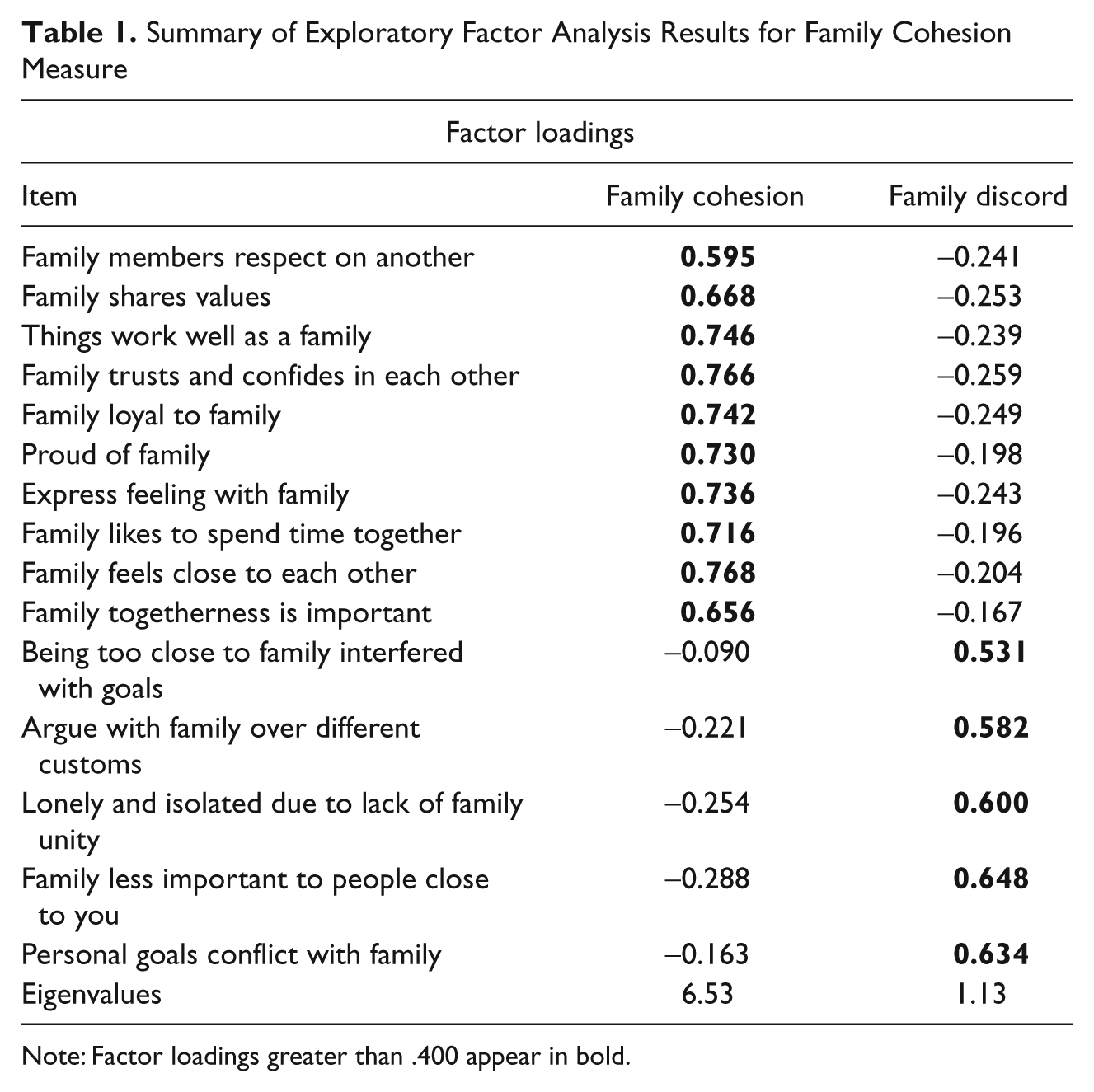
Note: Factor loadings greater than .400 appear in bold.
Covariates
Covariates in this analysis included gender, socioeconomic status (measured by work status: employed, unemployed, or not in labor force, and by education: 0 to 11 years, 12 years, 13 to 15, 16 or more years ), acculturation ( measured by amount of time in the United States: U.S.-born, less than five years, 5 to 10 years, 11 to 20 years, 20 or more years), ethnicity (Puerto Rican, Cuban, Mexican, Other Latino), and marital status (married/cohabiting, divorced/separated/widowed, never married). These controls were used due to their links with psychological distress. Hovey and King (1996) found that higher acculturation was linked to higher psychological distress, and lower socioeconomic status has also been linked to anxiety disorders (Stansfeld, Clark, Rodgers, Cladwell, & Power, 2011).
Statistical Analysis
The association between family cohesion and family discord and 12-month prevalence of anxiety disorders were evaluated using logistic regression analysis first for the aggregate Latino sample, and then for the 4 subgroups (Mexican, Cuban, Puerto Rican, and All Other Hispanic). Anxiety disorder diagnoses were regressed on family cohesion and family discord while controlling for the covariates. The exponential of the logistic coefficient from all analyses were expressed as odd ratios, and a logit d was computed for each logistic regression as a measure of effect size. Dividing the logistic coefficient by π/√3 results in logit d value that is comparable to Cohen’s d. Weighted data was used in all analyses.
Results
Twelve-month prevalence rates for specific anxiety disorders along with logistic coefficients, odds ratios with 95% confidence intervals, and effect sizes (logit d) for each logistic regression are presented for each group (aggregate sample, Mexican, Cuban, Puerto Rican, and All Other Hispanic). The odds ratios presented represent the change in odds of having any anxiety disorder when the value of either the family cohesion or family discord measure changed by one unit, when controlling for sociodemographic variables.
Results for the aggregate sample are reported in Table 2. Family cohesion was significantly related to generalized anxiety disorder (GAD) and panic disorder. Stronger reported levels of family cohesion significantly lowered the likelihood of meeting diagnostic criteria for GAD and panic disorder. On the other hand, family discord was significantly associated with every anxiety disorder except panic disorder. The strongest relationships were found for agoraphobia, agoraphobia with panic, social phobia, and PTSD.
Summary of Logistic Regression Analysis for Family Cohesion and Family Discord Variables Predicting 12-Month Anxiety Disorder Prevalence for Latinos (N = 2,554).
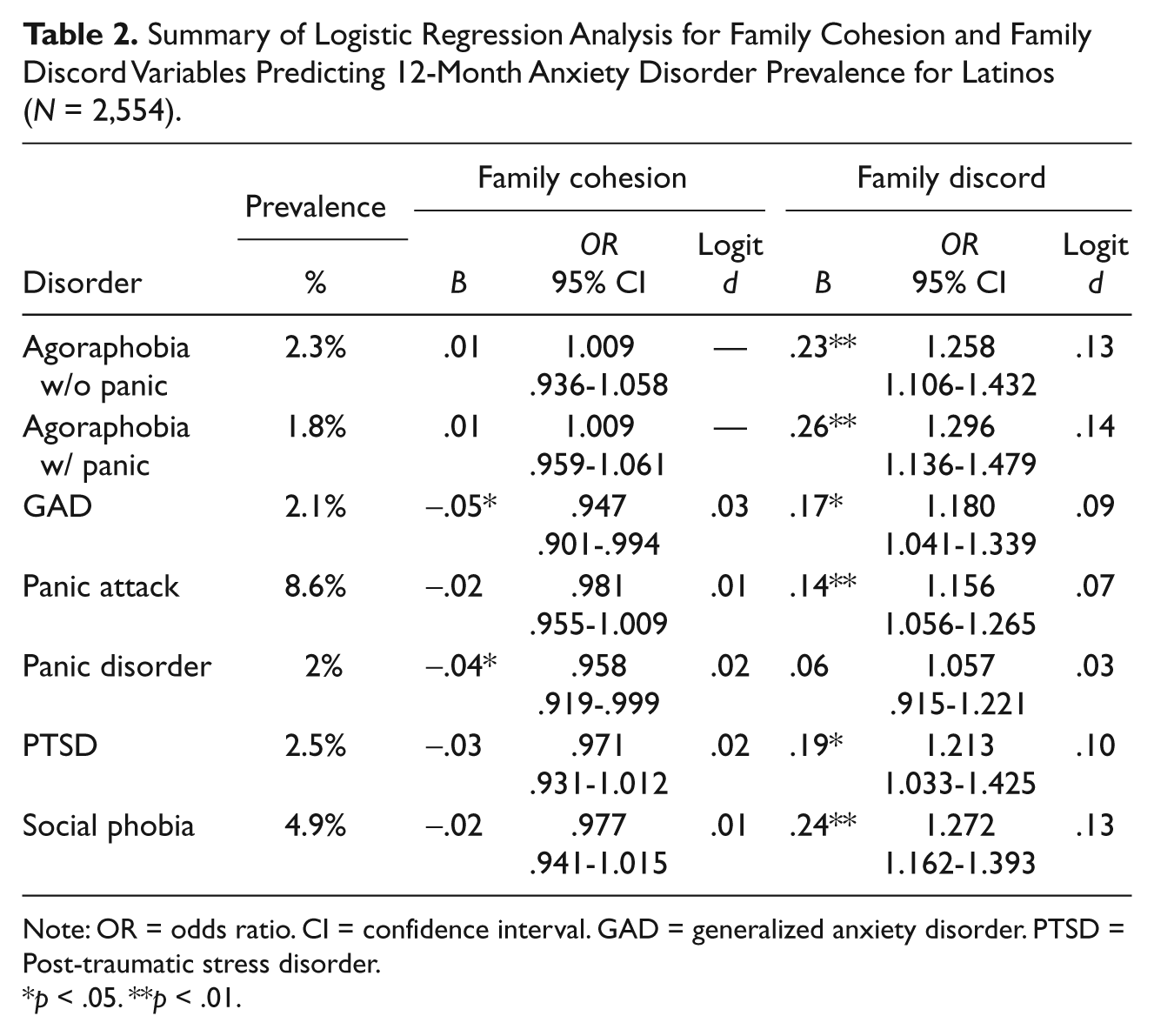
Note: OR = odds ratio. CI = confidence interval. GAD = generalized anxiety disorder. PTSD = Post-traumatic stress disorder.
p < .05. **p < .01.
Results for the Mexican sample are presented in Table 3. Family cohesion was significantly related to GAD and panic disorder. More reported family cohesion reduced the odds of meeting criteria for either of these disorders. Family discord was significantly associated with agoraphobia with panic, GAD, panic attack, and social phobia. Higher reported levels of family discord increased the likelihood of meeting criteria for each of these disorders.
Summary of Logistic Regression Analysis for Family Cohesion and Family Discord Variables Predicting 12-Month Anxiety Disorder Prevalence for Mexicans (N = 868).
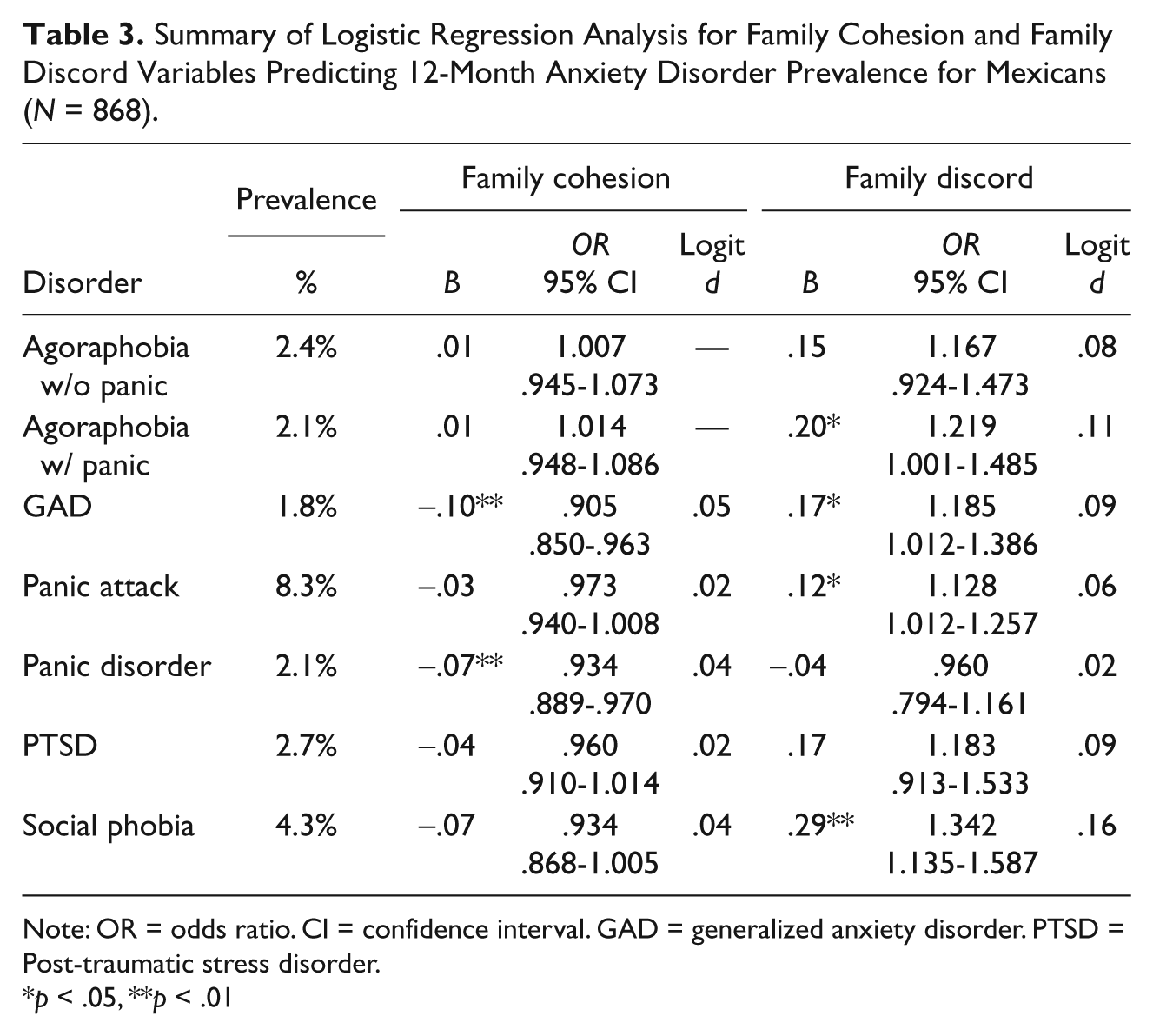
Note: OR = odds ratio. CI = confidence interval. GAD = generalized anxiety disorder. PTSD = Post-traumatic stress disorder.
p < .05, **p < .01
Results for the Cuban sample are presented in Table 4. Family cohesion was significantly associated with PTSD. Higher levels of family cohesion reduced the odds of having PTSD. Family discord was significantly associated with agoraphobia without and with panic, GAD, panic attack, and social phobia. Higher reported levels of family discord increased the odds of meeting criteria for each of these disorders.
Summary of Logistic Regression Analysis for Family Cohesion and Family Discord Variables Predicting 12-Month Anxiety Disorder Prevalence for Cubans (N = 577).
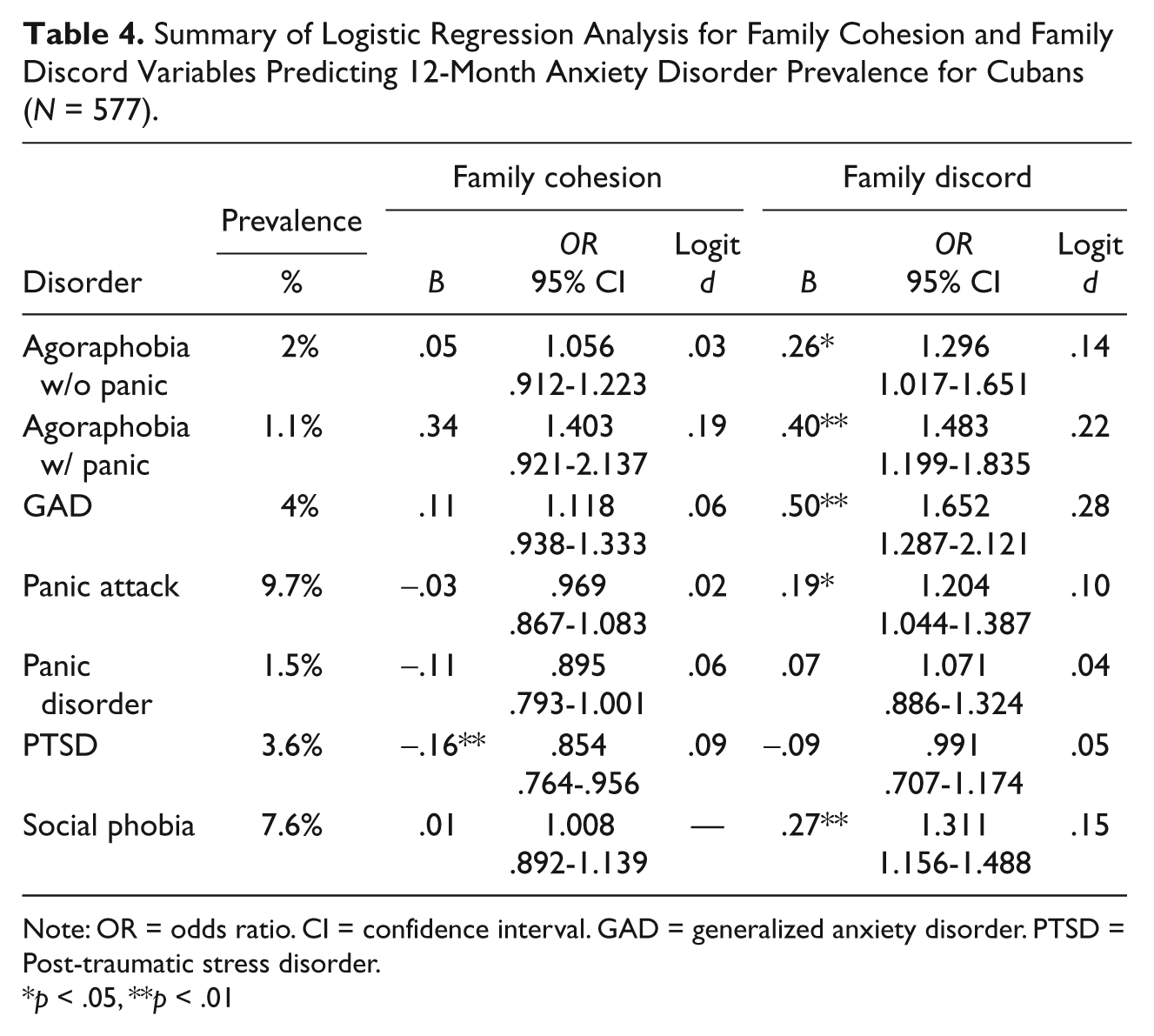
Note: OR = odds ratio. CI = confidence interval. GAD = generalized anxiety disorder. PTSD = Post-traumatic stress disorder.
p < .05, **p < .01
Results for the Puerto Rican sample are presented in Table 5. More reported family cohesion was significantly associated with decreased odds of panic attack. Family discord was significantly associated with agoraphobia without and with panic, panic disorder, PTSD, and social phobia. Greater levels of reported family discord increased the odds of meeting diagnostic criteria for each of these disorders.
Summary of Logistic Regression Analysis for Family Cohesion and Family Discord Variables Predicting 12-Month Anxiety Disorder Prevalence for Puerto Ricans (N = 495).
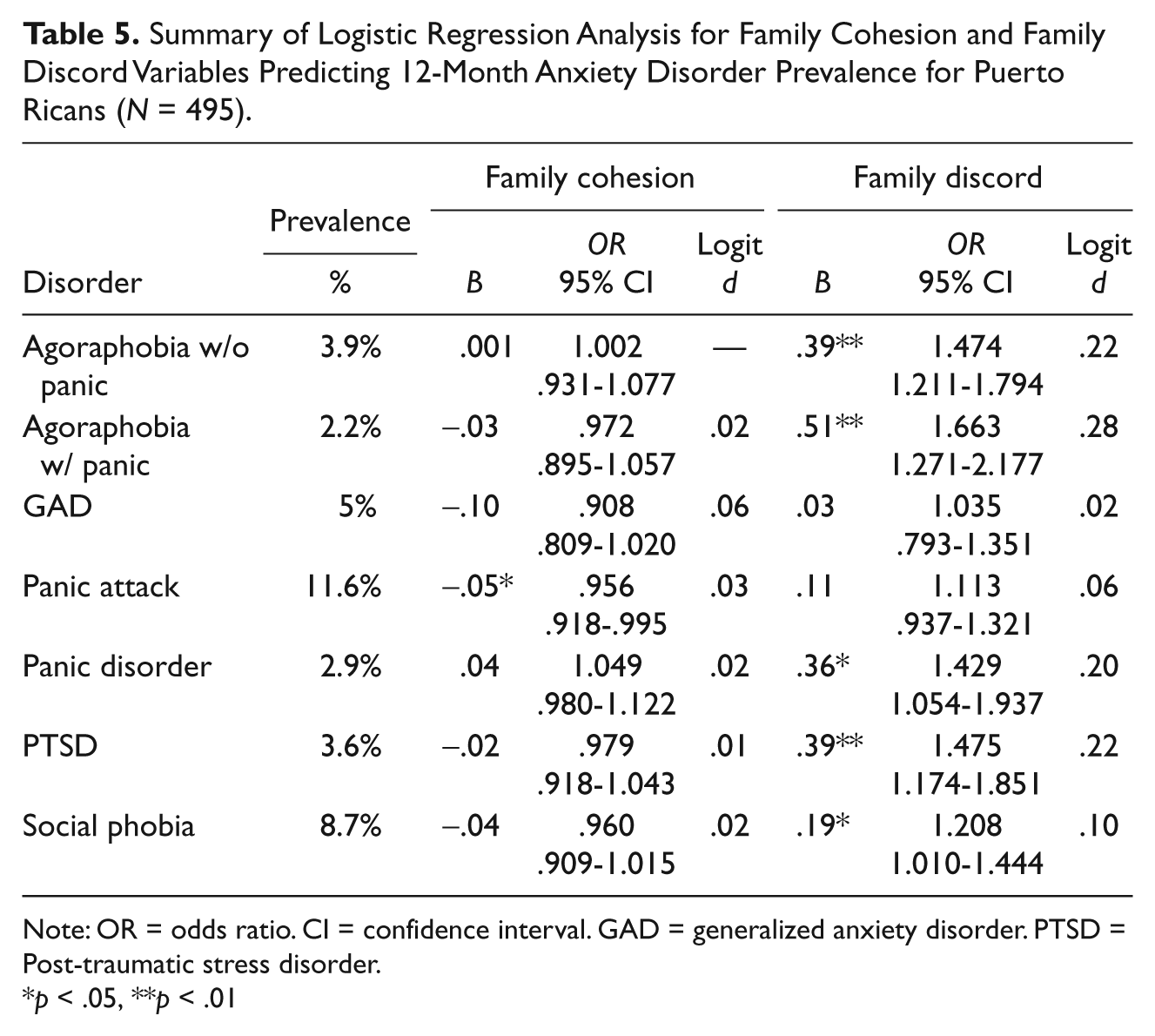
Note: OR = odds ratio. CI = confidence interval. GAD = generalized anxiety disorder. PTSD = Post-traumatic stress disorder.
p < .05, **p < .01
Results for the All Other Hispanic sample are presented in Table 6. No significant associations were found between family cohesion and any anxiety disorder. Family discord was associated with agoraphobia with and without panic, GAD, PTSD, and social phobia. For each association, more reported family discord was associated with increased odds of having each disorder.
Summary of Logistic Regression Analysis for Family Cohesion and Family Discord Variables Predicting 12-Month Anxiety Disorder Prevalence for All Other Hispanics (N = 614).

Note: OR = odds ratio. CI = confidence interval. GAD = generalized anxiety disorder. PTSD = Post-traumatic stress disorder.
p < .05, **p < .01
Discussion
As hypothesized, in aggregate sample of Latinos in the United States, a consistent relationship was found between family discord and anxiety disorders. Self-reported family discord was associated with 12-month prevalence for every anxiety disorder except panic disorder. Furthermore, because this analysis controlled for ethnicity, acculturation, and socioeconomic differences, the results here indicate that family discord is associated with anxiety disorders above and beyond the effects of sociodemographic variables. The strongest relationship to family discord was found for those with agoraphobia, agoraphobia with panic, and social phobia. People with social phobia tend to have fewer social relationships, are less likely to date or marry, have fewer friends, and perceive their levels of social support as low (Mendlowicz & Stein, 2000). Similarly, people with agoraphobia often report that interpersonal discord was the context that led to the onset of their disorder (Goldstien & Chambless, 1978) and that family conflict is a common life stressor (Kleiner & Marshall, 1987).
The symptoms of these three disorders are centered on fear. From a Bowen’s family systems perspective, the fear symptoms in these disorders are reflective of lower differentiation. It may be that the fear of being in places where escape might be difficult, or fear of being outside the home alone found in agoraphobia, and the fear of social or performance situations found in social phobia result from the individuals inability to manage emotional reactivity. This inability may result in the need to triangulate someone into helping manage these emotions (e.g., making sure you are with someone each time you leave the house). Given the emphasis on family relationships in Latino culture, it is likely that those who are triangulated are often family members. Thus, the association between family functioning and these anxiety disorders may stem from these processes.
The family cohesion measure for the aggregate sample was only significantly related to GAD and panic disorder, and the effects sizes for these relationships were small. While Rivera et al. (2009) found an association between family cohesion and psychological distress among this aggregate sample, these findings show that family cohesion has little effect on anxiety disorders when accounting for family discord. It may be that regardless of the connection or cohesion within a family, high levels of stress or conflict may foster an association with anxiety disorders. However, it should be noted that when compared with African Americans and White Americans, Latino Americans have lower prevalence rates of social phobia, generalized anxiety disorder, panic disorder, and PTSD(Asnaani, Richey, Diamite, Hinton, & Hofmann, 2010). Though results here suggest that strong family ties are not associated with anxiety disorders, it may be that the familism found in many Latino families lowers the risk of developing an anxiety disorder when compared with other ethnic groups.
When the subgroups were analyzed individually, family discord was associated with the majority of the anxiety disorders; it should be noted that the magnitude of these relationships varied by subgroup. Few associations were found between family cohesion and anxiety disorders for the subgroups. Though some associations were significant, the effect sizes of these relationships were very small.
Rivera et al. (2009) found that family cohesion neither increased nor decreased psychological distress for Mexicans. The findings here show a different pattern. Strong family cohesion was associated with GAD and panic disorder, and higher levels of family discord were associated with agoraphobia with panic, GAD, panic attack, and social phobia. Rivera et al. (2009) suggest that the multigenerational and traditional family structures found in Mexican culture could account for their findings, suggesting that family structure is not related to distress but to task performance. However, the findings here suggest that family discord and family cohesion are associated with many anxiety disorders. It may be that the multigenerational and traditional family structures may serve a different function depending on whether they are used to triangulate and created rigidity in family functioning, or if they are flexible and able to adapt to stress. Risk of anxiety disorders may exist for families where task performance and family structure are used to reinforce negative family patterns such as triangulation.
Rivera et al (2009) found that higher levels of family cohesion were associated with greater psychological distress for Cubans. They suggest that high levels of family cohesion, compared to moderate levels, may produce harmful psychological effects. The findings here suggest that strong family cohesion is associated with reduced risk of some anxiety disorders and high levels of family discord is associated with all anxiety disorder except panic attack and panic disorder. Rivera et al. (2009) further suggest that the stable migratory patterns of Cubans may foster an environment where it is more difficult to escape negative family patterns. The findings here support this idea. Family discord was associated with agoraphobia, with panic, and while not significant, strong family cohesion also increased the odds of agoraphobia with panic. If Cubans are less likely to escape negative family patterns, such as triangulation, they may be at greater risk for anxiety disorders.
For the Puerto Rican sample, family discord was associated with all anxiety disorder except GAD and panic attack, while family cohesion was associated with panic attack, but this association was small. Rivera et al. (2009) found that family cohesion was unrelated to psychological distress, suggesting that Puerto Rican’s have greater socialization into U.S. society, leading some to reject strong family norms and values. However, the findings here suggest that family discord, not family cohesion, plays a stronger role in anxiety disorders. It may be that for those who may have rejected strong family norms or values may be in conflict with members of their families over these choices. Kerr and Bowen (1988) suggest that triangulation can lead to cutoff. The rejection of strong family values for some Puerto Ricans may stem from patterns of triangulation that eventually lead to cutoff.
For the All Other Hispanic sample, family cohesion was associated only with panic disorder; family discord was associated with each anxiety disorder except for panic disorder. Rivera et al. (2009) found that strong family cohesion reduced psychological stress for this subgroup, though here the findings suggest that when controlling for family discord, family cohesion has little effect on most anxiety disorders. Because the data did not allow for further breakdown of this group, it is difficult to determine what cultural factors may influence these results. However, the differences between the four subgroups suggest that lumping together all Latino groups may hinder the understanding of culture and its influence on anxiety. For example, the association between GAD and family discord was different for the groups. For the Mexican group the effect size for this relationship was .09, for the Cuban group it was .28, for the Puerto Rican group it was .02, and for the All Other Hispanic group it was .19. Similar differences were found for PTSD and agoraphobia with panic. If researchers assume homogeneity of Latino cultures, they may miss important distinctions that may contribute to the onset and course of anxiety disorders.
Limitations
This study included limitations. One is that the cross-sectional design of the NLAAS data does not allow testing for directionality. Family discord may lead to the development of anxiety disorders, or anxiety disorders may increase levels of family discord. Overbeek et al. (2006) found that marital discord can predict the development of anxiety disorders over a 2-year period, but the directionality between family discord and anxiety disorder onset is still unknown. Future research should explore the direction of this relationship.
Another limitation was the measurement of family functioning and discord. Though the scales used in this study are an improvement over previous measures used to examine family cohesion and psychological distress, the scales only provide broad measures of family cohesion and discord. Specific negative family processes hypothesized by Bowen to increase anxiety were not available in the data provided (i.e., levels of differentiation, triangulation, etc.). The results of this study support future research exploring how levels of differentiation and triangulation influence discord within Latino families. If these processes are found to underlie the development of anxiety disorders in this population, trials comparing a Bowen family systems theory based treatment and established treatments of anxiety would be warranted.
Finally, though acculturation was used as a covariate in the analyses, the variable used to represent acculturation (length of time in the United States) does not fully encompass the construct of acculturation. Schwartz, Unger, Zamboanga, and Szapocznik (2010) have argued that acculturation should be viewed as a multidimensional process. The NLAAS did use a measure of accultrative distress; however, it was not shown to be internally consistent for those in the sample that completed the interview in English (Alegria et al., 2004), and therefore, was not used in this study. The use of a single variable to measure this complex process may not fully control for the effects of acculturation. Given past research that has linked higher acculturation to greater psychological distress (Hovey & King, 1996) and the present findings which suggest a link between family discord and anxiety disorders, future research could benefit from exploring how the interaction between acculturation and family discord may be associated with psychological distress and anxiety disorders for distinct Latino groups.
Footnotes
Declaration of Conflicting Interests
The author(s) declared no potential conflicts of interest with respect to the research, authorship, and/or publication of this article.
Funding
The author(s) received no financial support for the research, authorship, and/or publication of this article.