




Abstract
This study examined the role of parent-child separations during serial migration to the United States in predicting individual- and family-level outcomes in Mexican immigrant families. We assessed parents’ subjective appraisals of their family’s separation and reunion experiences to explore associations with self-reported acculturative stress, depression and family functioning. Data were collected from an urban, low-income community sample of Mexican immigrant parents (N = 53). Seventy percent (N = 37) of the parents experienced a separation from at least one child during immigration. Separated status parents reported significantly higher levels of acculturative stress, but no significant differences were found between separated and nonseparated status parents on depression or family functioning. Findings also revealed that negative appraisals of the family’s reunion experience were associated with higher levels of acculturative stress, depression, and unhealthy family functioning. We discuss the implications for future research to address the mental health of Mexican immigrant families in the United States.
Mexico is the leading country of origin among the foreign-born in the United States, with an estimated 5.1 million children of Mexican immigrants living in the United States (Shields & Behrman, 2004). Mexican families commonly migrate in a serial fashion, wherein the initial migration wave is followed by subsequent stages involving family members and extended kin. This phenomenon is deeply rooted in the sociopolitical context of U.S.-Mexican relations (see Durand, Telles, & Flashman, 2006; National Research Council, 2006, pp. 27-33; Rumbaut, 2006; Waddell, 1998), which has been indelibly shaped by agricultural labor opportunities, workforce demands during World War II, as well as legislation agendas that fluctuate from sponsorship to amnesty to deportation and criminalization agendas.
Brief History of Mexican Serial Migration
Mexican men historically immigrated first and subsequently sent for their wives and children after establishing housing, employment, and adequate financial assets in the United States. (Kanaiaupuni, 2000; Salgado de Snyder & Díaz Guerrero, 2003). Women became more commonly included in the first wave of migration due to the expansion of employment opportunities in the service industry, domestic work, and manufacturing (Hondagneu-Sotelo, 2002), coupled with the difficulty men encountered in securing sufficient income to support the family. Children remained in the care of family members (e.g., grandparent, aunt/uncle, godparent) until parents were able to send for them, often leading to separations between siblings as well. Reunification of the entire family can take several years or may never be completed, as this is often made difficult by immigration laws, undocumented status, and the inherent cost/danger of immigration. Transnational Mexican families adapt to maintain economic, social and cultural ties, as has been well described elsewhere (Dreby, 2006; Hirsch, 1999; Hondagneu-Sotelo & Avila, 1997; Orellana, Thorne, Chee, & Lam, 2001).
Implications of Serial Migration on Mental Health
Cervantes, Mejía, and Guerrrero Mena (2010) recently highlighted the implications of serial migration for Latino mental health, and several recent qualitative studies illustrated the effects of immigration-imposed separations on family adaptation to the United States (Bacallao & Smokowski, 2007a; Ko & Perreira, 2010; Perreira, Chapman, & Stein, 2006). Research conducted in Mexico similarly highlighted the emotional costs of emigration to those left behind and identified family separations as a contributing factor to mental health service use (Aguilera-Guzman, Salgado de Snyder, Romero, & Medina-Mora, 2004; Gómez de León del Río & Vincencio Guzmán, 2006). Yet, few mental health outcomes studies with Mexican immigrants in the United States account for serial-migration family separations (e.g., length of separation, family members involved, child’s age at reunification) or attempt to measure subjective appraisals of these experiences.
The prevalence of Mexican parent-child separations has been reported between 75% and 85% (Potochnick & Perreira, 2010; Suárez-Orozco, Todorova, & Louie, 2002). Data have further revealed that children who experienced a separation, particularly girls, report higher depression (Suárez-Orozco, Todorova, & Louie, 2002), which also has been replicated with adult samples. Separated status Latina mothers were found to be less educated, less likely to be insured, and 1.5 times more likely to be clinically depressed than their nonseparated counterparts (Miranda, Siddique, Der-Martirosian, & Belin, 2005). The link between family separation stress and depression held true for women, but not men, in another sample of Mexican immigrants (Hiott, Grzywacz, Arcury, & Quandt, 2006); however, focus groups demonstrated that Mexican men view separations from loved ones as central to depression in case vignettes of their peers (Lackey, 2008). These findings are consistent with parent narratives that reflect themes of sadness, guilt and self-blame (Dreby, 2006; Hondagneu-Sotelo & Avila, 1997). The long awaited reunification also presents challenges and risks to the family, including children’s experience of secondary separations from their surrogate caregiver (Suárez-Orozco & Suárez-Orozco, 2001) and feelings of estrangement and alienation from parents (Mitrani, Santisteban, & Muir, 2004).
Acculturative Stress Framework
There are several reasons to adopt an acculturative stress framework when examining the effects of parent-child separations on mental health outcomes. First, there is a well-documented negative relationship between acculturative stress and mental health in adult Mexican immigrants (e.g., Finch & Vega, 2003; Thoman & Surís, 2004). Second, Mexicans have been found to report the highest levels of acculturative stress compared to other Latino subgroups (Guarnaccia et al., 2007), and family separation status (i.e., separated from spouse, children or both) has been found to uniquely predict extrafamilial stress (Arbona et al., 2010). Third, the process of acculturation often produces stress in the family system by creating generational differences in acculturation levels (see Santisteban & Mitrani, 2003). Youth acculturate to the U.S.-American context via continual interactions at school and with peers, while parents often have fewer opportunities for reciprocal interaction with the host culture. Even though parent-child acculturation gaps have not been consistently linked to negative outcomes (see Lau et al., 2005), related factors such as family conflict or parent-child conflict (Bacallao & Smokowski, 2007b; Gonzales, Deardorff, Formoso, Barr, & Barrera, 2006) often are associated with negative outcomes. Strains in family functioning may lead to increased levels of acculturative stress and depression in Mexican-origin adolescents and adults (e.g., Formoso, Gonzales, & Aiken, 2000; Hovey, 2000). Fourth, serial migration reshapes family membership and the structure of family ties, making it difficult for parents and children to assume new roles or reestablish past roles after the family has been reunited (Falicov, 2002). Family members might adopt different frames of reference for the migration experience, which impedes a sense of joint resiliency in the face of acculturative stress. Parents can have trouble setting limits and appropriately monitoring children due to guilt or fear of further alienating their children.
This study fundamentally asserts that parents’ interpretation of the migration experience has important implications for mental health, and by extension, the family’s adjustment to life in the United States. Thus we aimed to examine the role of serial migration (i.e., parent-child separation experiences) in predicting depression, acculturative stress and family functioning in an urban community sample of Mexican immigrant parents. We explored whether parents that experienced a separation from their child (ren) report higher levels depression and acculturative stress, and lower levels of family cohesion and functioning, when to nonseparated status parents. We additionally proposed that a more nuanced assessment of the separation and reunification experience is necessary to understand these associations (i.e., moving beyond proxy measures to measure mental health impact). As such, we created a self-report measure and predicted that parents’ negative appraisals would be associated with negative individual- and family-level outcomes.
Method
Participants
Data were collected from a total of 53 participants: 37 categorized as separated status and 16 as nonseparated status families. The majority were mothers (72%) and currently married or living with a partner (62% and 19%, respectively) with a mean age of 41.8 years (SD = 9.5). The sample was predominantly low income, with 80% of the families reporting family income less than US$2,000 per month and an average household size of 4.7 members. The majority of participants had some level of employment (49% full-time, 9% part-time, 11% temporary work), with 40% reporting dual earner households. The majority (70%) did not attend school past the equivalent of 9th grade, with 30% attending 6 years or less of primary education in Mexico. On average, participants immigrated to the United States as young adults (M = 26.6, SD = 7.5) and 70% lived in the United States for 10 years or more.
Procedure
Participants were recruited from a large Midwestern city from sites located within predominantly Latino or Mexican communities. Initial recruitment efforts involved in-person announcements at adult ESL classes and church services, one-on-one recruitment at after-school program pickups and citizenship workshops, as well as public flyers and word of mouth. Participants were eligible if they were Mexican immigrant parents who either (a) experienced a separation and reunification with at least one child during immigration (separated status) or (b) immigrated with their children or had children born in the United States (nonseparated status). Data were collected in interview format in Spanish via close-ended surveys, the majority of which were conducted by the first author, but also by trained bilingual psychology undergraduate assistants. 1 Participants could opt to complete the interview at the community site or their home, if preferred. Participants received a US$20 dollar gift card and a list of community health/social service resources.
Measures
Demographics
Participants reported on both individual-level demographics including age, gender, marital status, level of education, employment status, length of time in the United States, and age at immigration. They also reported on their spouse/partner’s personal information and family-level characteristics (e.g., number of people in the household, number of children, family income).
Serial migration measures
Separated status parents were asked to report objective characteristics of the family’s serial migration, including child’s age at the time of the separation, length of separation, family members involved in the separation (1 = one parent, 2 = both parents, 3 = one parent and sibling/s, 4 = both parents and sibling/s), type and number of separations (one long separation without seeing each other, series of separations with temporary visitations), and surrogate caregiver arrangements in Mexico. They also endorsed the types and frequency of communication they maintained with their child during the separation and with the surrogate caregiver postreunification (e.g., sending money monthly, phone calls once a week, sending presents a few times a year). Parents also reported the child’s age at reunification, length of time since reunification, new family members at the time of reunification, and the number of children still living in Mexico.
The separated status group completed a 30-item Immigration Imposed Family Separation Experiences scale (IFSE) that asked them to appraise items about the family separation (15 items) and reunification (15 items) on a 4-point scale (1 = strongly agree to 4 = strongly disagree; 0 = does not apply) with higher total scores indicative of negative experiences. This scale was developed and initially translated to Spanish by the first author, based on prior work and clinical experience with immigrant families. Back-translation for semantic and conceptual equivalence was conducted by a bilingual group of undergraduate research assistants and any discrepancies were reconciled via group format.
Level of acculturation
The 42-item Abbreviated Multidimensional Acculturation Scale (AMAS; Zea, Asner-Self, Birman, & Buki, 2003) measured parents’ familiarity with U.S.-American and Mexican cultural dimensions. Cultural Identity items were rated on a 4-point agreement scale (1 = strongly disagree to 4 = strongly agree) and Language Competence and Cultural Competence items were rated on a 4-point familiarity scale (1 = not at all to 4 = extremely well). This scale has shown adequate internal consistency with community-based Latino immigrant samples (α = .83 to .97; Zea et al., 2003).
Depression
Parents rated their depression symptoms over the prior week (1 = rarely or none of the time to 4 = most or all of the time) using the 20-item Spanish version of the original Center for Epidemiological Studies Depression Scale (CES-D; Radloff, 1977). The Spanish CES-D has been widely used and validated with Mexican American adult samples (e.g., Golding & Aneshensel, 1989; Golding & Burnam, 1990; Guarnaccia, Angel, & Worobey, 1989; Hovey, 2000).
Acculturative stress
The 25-item Hispanic Stress Inventory-Short Form (HSI-SF; Cavazos-Rehg, Zayas, Walker, & Fisher, 2006) included five items with high factor loadings from each of the original five subscales of the HSI (Cervantes, Padilla, & Salgado de Snyder, 1990; Cervantes, Padilla, & Salgado de Snyder, 1991) and yielded adequate to high reliability (α = .68 - .83). Participants reported whether each stressor occurred within the last three months (0 = no, 1 = yes) to calculate a Stress Frequency score and then provided a Stress Appraisal rating (1 = not at all to 5 = extremely; “no” responses = appraisal rating of 1).
Family-level outcomes
The Spanish translation of the 20-item Family Adaptability and Cohesion Evaluation Scale (FACES-III; Olson, 1986) asked parents to rate how each statement describes their family (1 = never to 5 = almost always). This version demonstrated modest reliability with a Mexican adult sample (α = .69; Ponce-Rosas, Gómez-Clavelina, Terán-Trillo, Irigoyen-Coria, & Landgrave-Ibáñez, 2002). Participants also completed the Spanish translation of the 12-item General Family Functioning subscale of the Family Assessment Device (FAD-GFF; Epstein, Baldwin, & Bishop, 1983) that has demonstrated adequate reliability with Mexican samples (α = .71-.72; Hovey, 2000; Hovey & Magaña, 2002). Items are rated on a 4-point scale (1 = strongly agree to 4 = strongly disagree) with higher scores indicative of unhealthy functioning.
Results
Serial Migration Characteristics
Seventy percent (N = 37) of participants experienced a separation from at least one child during immigration for an average of 3.27 years (SD = 2.95). For most families (N = 24, 65%), the separation was best described as one discrete separation period without visitation. The remaining cases included families that had opportunities to see each other during the separation (e.g., parent returned to Mexico) as well as those whose serial migration involved multiple separations. Fifty-seven percent of separations involved only one parent, but some included the child’s separation from both parents (N = 9, 24%) or parents and siblings (N = 7, 19%). Surrogate caregivers in Mexico included grandparents (N = 15, 40%), remaining parent (N = 11, 30%), aunts/uncles (N = 5, 14%), family friend/other (N = 3, 8%), or multiple caregivers (N = 3, 8%). In approximately 30% of these families (N = 12), the child was introduced to new or unknown family members at the time of reunification in the U.S (e.g., stepparent/parent’s significant other, sibling, aunt/uncle, cousin). On average, families had been reunited for several years (M = 11.23, SD = 7.53); however, five parents had another child still living in Mexico. Table 1 provides a summary of the objective characteristics of these separations.
Descriptive Statistics for Serial Migration Characteristics (N = 37).

All but two parents reported that they maintained some form of communication with their child (ren) during their separation. Families reported maintaining contact via phone calls (89.2%), sending money (81.1%), cards/letters (59.5%), sending photos (43.2%), gifts/material goods (32.4%), and visits to Mexico (16.2%). Frequency of communication varied, but weekly calls and sending monthly remittances were the most commonly endorsed methods. Seventy-eight percent of families maintained communication with the person who served as the child’s surrogate caregiver. In 13 of these cases the caregiver migrated in the same wave as the child or was now living in the United States; three families reported the surrogate caregiver was deceased.
Individual-Level Outcomes: Acculturative Stress and Depression
Descriptive statistics for all individual- and family-level measures are included in Table 2. On average, this sample can be characterized as a low acculturated group. Neither cultural domain score was significantly associated with HSI-SF appraisal scores, indicating that stronger affiliation with native cultural domains was not related to higher acculturative stress. The average CES-D score was 15.89 (SD =12.76, range 0 to 48). A high percentage (43.4%; N = 23) met caseness (scores ≥ 16) and half of these scores fell within the range considered to be indicative of major depression (≥ 27; Zich, Attkisson, & Greenfield, 1990). The mean HSI-SF Appraisal score was 51.64 (SD = 16.11), with scores ranging from 29 to 95 (out of a possible 125).
Individual- and Family-Level Outcomes.
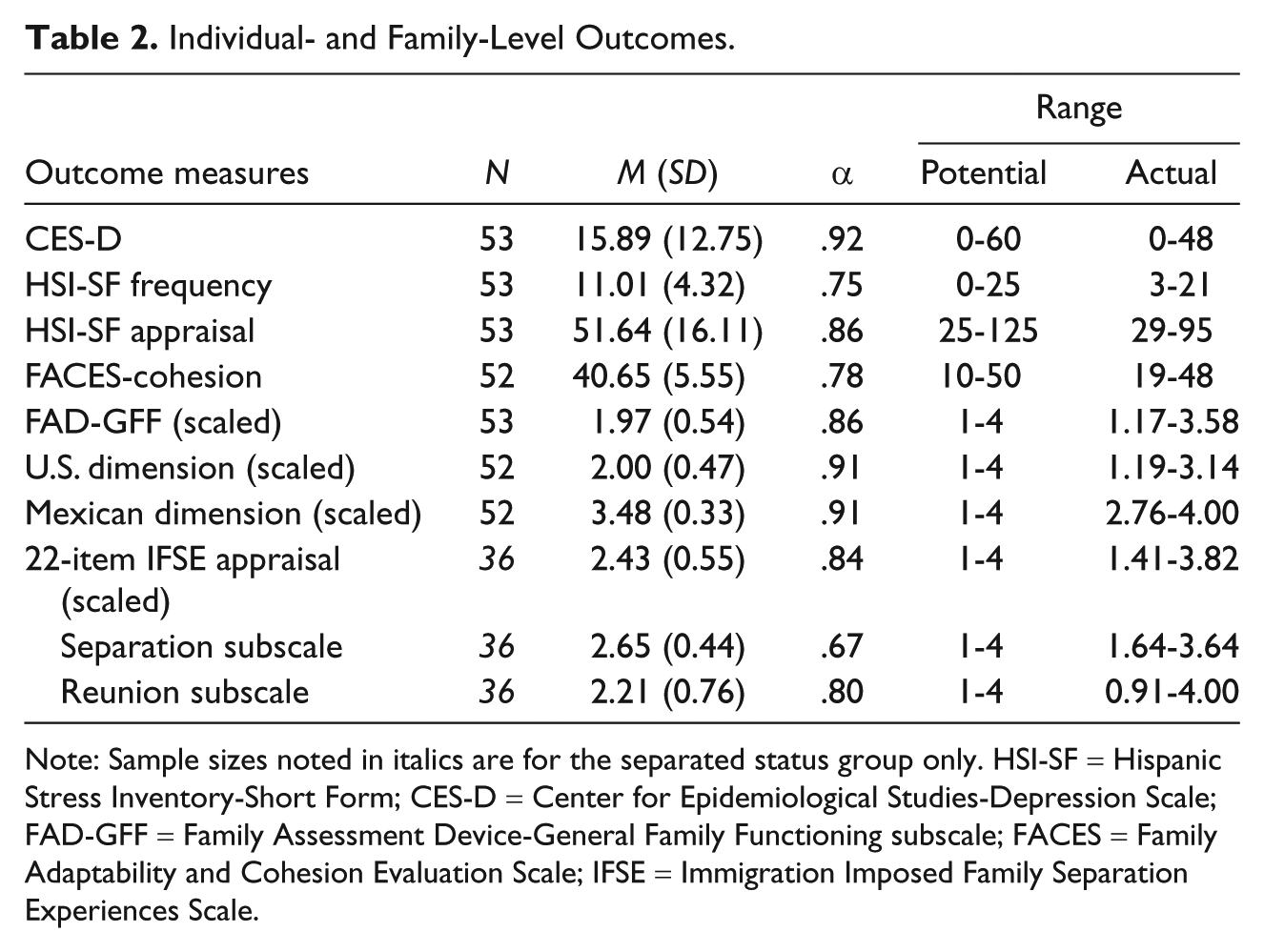
Note: Sample sizes noted in italics are for the separated status group only. HSI-SF = Hispanic Stress Inventory-Short Form; CES-D = Center for Epidemiological Studies-Depression Scale; FAD-GFF = Family Assessment Device-General Family Functioning subscale; FACES = Family Adaptability and Cohesion Evaluation Scale; IFSE = Immigration Imposed Family Separation Experiences Scale.
Based on skewness (> ±2) and kurtosis (>±7) cutoffs suggested by West, Finch, and Curran (1995), appropriate square root transformations were performed on all variables with moderate Fisher’s Skew values (CES-D = 2.03, HSI-Appraisal = 2.26, and FAD-GFF = 2.17), and log transformations were made to the FACES subscales that had larger Fisher’s Skew values (Cohesion = −4.57 and Adaptability = 3.93). Given that the minimum value for total CES-D score was zero, a constant of +1 was applied to the square root transformation (Osborne, 2002). FACES-Cohesion was significantly negatively skewed; thus, data reflection was performed prior to conducting the square root transformation.
Family-Level Outcomes: Family Cohesion and Family Functioning
On average, families were in the moderate range of functioning on the FAD-GFF, which demonstrated high internal consistency reliability (α = .86). Consistent with data based on other low acculturation-status families (Miranda, Estrada, & Firpo-Jimenez, 2000), the current sample had relatively higher FACES-III Cohesion scores (M = 40.44, SD = 5.87) and lower Adaptability scores (M = 26.10, SD = 5.64). Internal consistency was high for the Cohesion scale (α = .78) and comparable to an urban Mexican sample (Gómez-Clavelina et al., 1999) with the majority of families categorized as Separated (26.9%) or Connected = (38.5%; see Forjaz, Cano, & Cervera-Enguix, 2002). The Adaptability subscale performed poorly (α = .20) and, despite improvement after deletion of four poorly performing items (α = .59), was omitted from further analyses.
As shown in Table 3, increased levels of acculturative stress were moderately correlated with higher CES-D scores (r = .56, p < .01), and significantly, but weakly correlated with poor family functioning on the FAD-GFF (r = .33, p < .05) and FACES-IIII Cohesion (r = –.39, p < .01). 2 There was a positive association between depression scores and poor family functioning on the FAD-GFF (r = .27, p < .05), but this did not remain significant with transformed variables. Of note, there was a moderate negative correlation between FAD-GFF and FACES-Cohesion scores (r = –.58, p < .01), lending support for the construct validity of these scales with low acculturated groups.
Associations between Acculturative Stress, Depression, and Family-Level Outcomes.
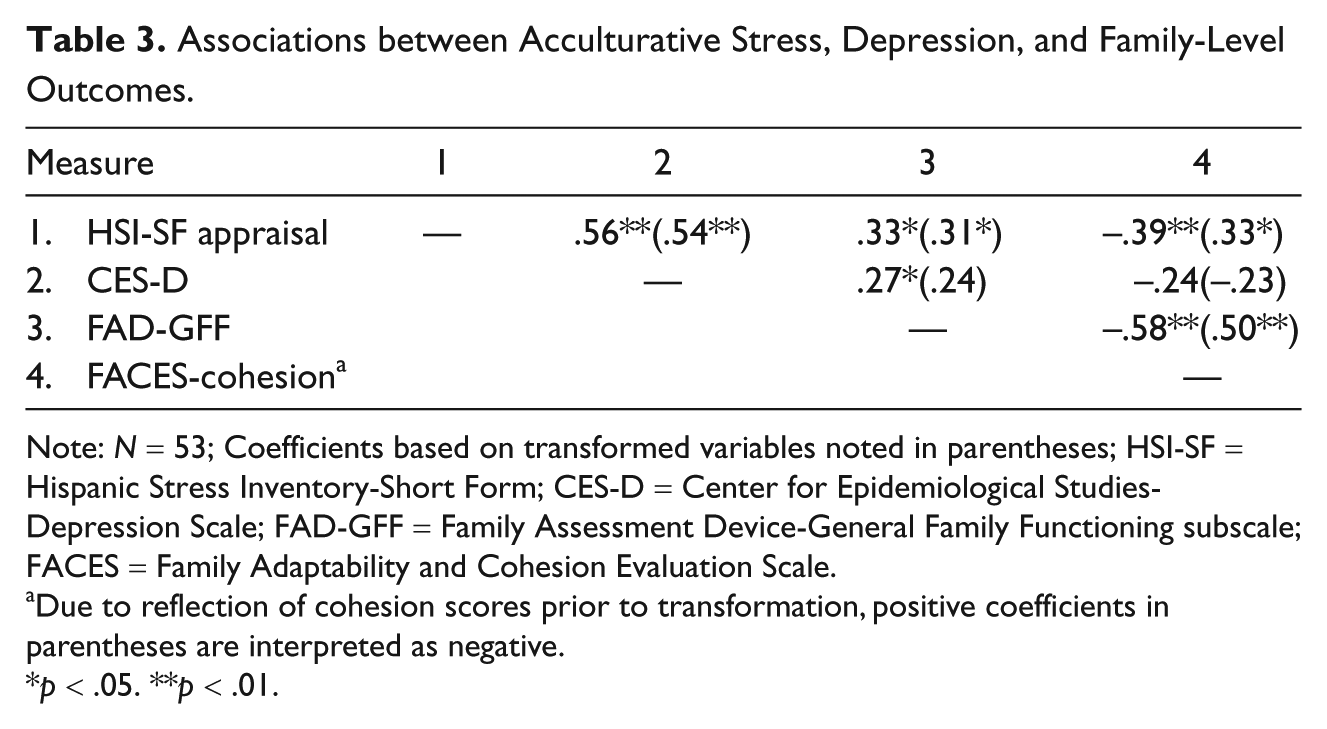
Note: N = 53; Coefficients based on transformed variables noted in parentheses; HSI-SF = Hispanic Stress Inventory-Short Form; CES-D = Center for Epidemiological Studies-Depression Scale; FAD-GFF = Family Assessment Device-General Family Functioning subscale; FACES = Family Adaptability and Cohesion Evaluation Scale.
Due to reflection of cohesion scores prior to transformation, positive coefficients in parentheses are interpreted as negative.
p < .05. **p < .01.
Mental Health Effects of Separation Status
A series of t test comparisons were conducted to examine mean differences between separated status and nonseparated status groups on all outcomes of interest. There was no significant difference between these groups on CES-D scores or family-level functioning (FAD-GFF, FACES-Cohesion), but separated status parents reported significantly higher levels of acculturative stress compared to nonseparated parents (M = 54.68 vs. 44.63; t51 = −2.16, p < .05). Levene’s Test of Equality of Variance was significant (F = 4.07, p = .05), thus a Mann-Whitney U test was conducted. The mean rank order of acculturative stress appraisals was significantly higher for the separated status participants compared to the nonseparated group (M = 29.81 vs. 20.50; U = 192.00, p < .05). Even though there was no significant difference between the length of time these groups had been living in the United States, the separated status group immigrated at a significantly later age than their nonseparated counterparts (M = 28.3 vs. 22.5; t51 = −2.73, p = .01).
The 30-item IFSE scale demonstrated good internal consistency (α = .80), but deleting four items with low corrected item total correlations from each subscale yielded a total 22-item scale (α = .84) with improved alphas on each 11-item subscale (Separation items α = .67, Reunion items α = .80). The total IFSE scores and subscale scores are based on this revised 22-item scale. The average total IFSE scaled score was 2.43 (SD = .55), with slightly higher scores on the Separation items (M = 2.65, SD = .44) compared to the Reunion items (M = 2.21, SD = .76). These scores indicate that, on average, families reported moderately negative appraisals.
The significant and positive correlation between parents’ negative appraisals on the separation items and negative appraisals on the reunion items (r = .63, p < .01) suggests that difficult separation experiences present ongoing challenges during the reunification process. As predicted, that negative IFSE appraisals were related to negative mental health outcomes with the reunion subscale emerging as more consistently associated with negative outcomes. Table 4 shows lower levels of family cohesion associated with more negative appraisals on both the separation (r = –.38, p < .05) and reunion subscales (r = –.50, p < .01), but negative appraisals on the reunion subscale were also associated with higher levels of acculturative stress (r = .50, p < .01), depression (r = .44, p < .01) and unhealthy family functioning (r = .38, p < .05).
Correlations Between IFSE Appraisal Scores, Separation, and Reunion Objective Characteristics, and Outcomes of Interest.
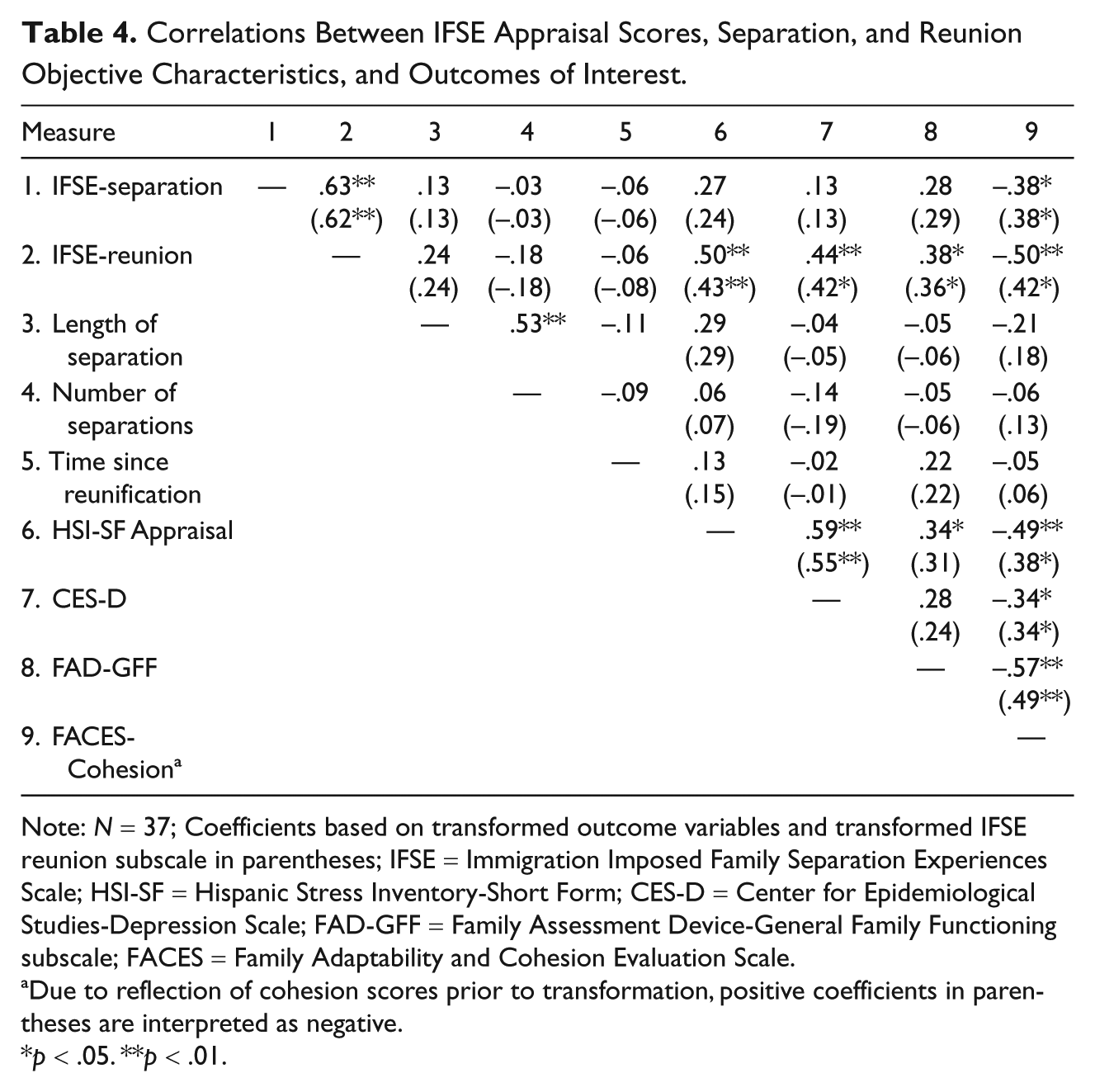
Note: N = 37; Coefficients based on transformed outcome variables and transformed IFSE reunion subscale in parentheses; IFSE = Immigration Imposed Family Separation Experiences Scale; HSI-SF = Hispanic Stress Inventory-Short Form; CES-D = Center for Epidemiological Studies-Depression Scale; FAD-GFF = Family Assessment Device-General Family Functioning subscale; FACES = Family Adaptability and Cohesion Evaluation Scale.
Due to reflection of cohesion scores prior to transformation, positive coefficients in parentheses are interpreted as negative.
p < .05. **p < .01.
Discussion
As U.S. Census 2010 commenced, immigration reform stood at the forefront of national debate, marking a critical time for public policy to coalesce around immigrant health. The primary aim of this study was to examine how family separations during serial migration influence the mental health outcomes of Mexican immigrant families living in the United States. Our results demonstrate that an acculturative stress framework can help to advance our understanding of the effects of this phenomenon on both individual- and family-level mental health. The high levels of depression and acculturative stress in this community sample point to the need to better understand how pre- and postmigration factors affect mental health outcomes among Mexican immigrant families in the United States.
We did not find differences in depression levels based on separation status. The effect of separation status on depression arguably could represent a distal pathway, such that the direct effect of separation status becomes better accounted for over time by more proximal effects of acculturative stress or other family-level factors (e.g., parent-child conflict) found to predict negative mental health outcomes in immigrant families. The high CES-D caseness scores (43%) in our sample, however, are consistent with those from other studies with Mexican immigrant and migrant worker samples (Grzywacz, Hovey, Seligman, Arcury, & Quandt, 2006; Magaña & Hovey, 2003). This has important implications for the mental health risk of immigrant children given the association between parent depression and negative child emotional and behavioral health outcomes (e.g., Aisenberg, Trickett, Mennen, Saltzman, & Zayas, 2007; McNaughton, Cowell, Gross, Fogg, & Ailey, 2004).
Separated status parents reported significantly higher levels of acculturative stress; a notable finding given the link between acculturative stress and mental health risk. Grzywacz et al. (2006) argue that conceptualizing this link as solely based on postmigration experiences does not allow for meaningful examination of a family’s decision to come to the United States. They found that Mexican migrant workers who endorsed more ambivalence about their decision to come to the United States (i.e., doubt about migration due to leaving children or spouse behind) reported more anxiety and difficulties upon arrival. Our findings echo this message and suggest that the meaning parents ascribe to the family’s separation/reunification is shaped by a complicated cost-benefit analysis.
Our results showed significant associations between negative appraisals of the reunification experience and higher depression and acculturative stress, as well as poor family-level functioning. This supports our central assumption that serial migration and the ways that parents interpret separation experiences have important implications for mental health. In fact, parents recalled the circumstances of their family’s migration process and emotionally laden details of their family separations, even though the majority had been living in the United States for 10 years or more. Parents’ appraisals of the reunion experience were more consistently associated with negative individual- and family-level outcomes when compared to appraisals of the separation experience. This could be explained in part by the length of time that had passed since separation given that families had been reunified for an average of 11 years, or could reflect the temporal salience of the reunification process and the lingering effects of being ill-prepared to navigate these difficulties.
None of the objective characteristics of the family separation (e.g., length of separation, number of separations, time since reunification) were significantly associated with acculturative stress, depression or family-level outcomes and thus do not appear to be sufficient proxy measures for measuring psychological effects. These characteristics can help describe the variability between families, but inferences based on these alone are likely to be shortsighted when taken out of the broader migration context. This has important measurement implications for researchers interested in studying the effects of serial migration on immigrant mental health.
Limitations
A major limitation to interpreting these results is the small sample size and unequal distribution of participants in the separated and nonseparated groups. This limited statistical power made it difficult to detect potentially small but significant effects. A larger sample of parents could have allowed for more interpretable differences to emerge between these groups. Nonetheless, the first author worked diligently to gain credibility within the community in light of the mistrust and fear created by current sociopolitical tensions; extensive outreach efforts were required to earn the trust of study participants. We realize that more purposive recruitment of nonseparated status families is warranted in light of the prevalence of separations in this urban poor immigrant sample.
Secondly, high levels of acculturative stress also could be due to factors that were not directly measured in this study. Parents talked about the challenges captured by the acculturative stress items of the HSI-SF (e.g., fears of deportation, economic strain, language barriers, discrimination), but many also raised concerns about physically ill family members, children with special needs, domestic violence, family members’ deportations, and children’s high-risk behaviors. Families might not have the emotional or social resources to successfully traverse family reunification challenges amidst these psychosocial stressors. It is also possible that parents negatively view their separation experiences due to stressful postmigration experiences or current depression.
Future Directions
The APA Presidential Task Force on Immigration calls for research that responds to the unique context of immigrant families, which includes understanding the risk pathways that are unique to separated families. Through these models we can understand processes that mediate the link between acculturative stress and depression, which could provide important targets for intervention, as well as more contextually relevant strategies for supporting community-based mental health prevention. Social support networks for parents and successful school transitions for children may emerge as powerful factors that help mitigate reunification stress.
One challenge for researchers is the need to design longitudinal studies with immigrant families at different stages of the migration experience (i.e., planning, initial stages of separation, reunification process) in order to examine causal pathways of risk and resilience. This includes more careful attention to the range of family separations that immigrant families experience and effective family coping strategies. Study participants often mentioned being separated from their spouse or partner during immigration, ongoing separations from their extended family members in Mexico (elderly parents, siblings, extended kin), and the significance of separations from their own parents and siblings as children themselves. The pervasive nature of family separations during the migration process might call for a more all-encompassing categorization of separated status among Mexican immigrant families. All of these separations (i.e., parent-child, spouse/partner, adult separated as a child, extended family separations) are likely to be influential in predicting acculturative stress given the overarching importance of familismo in Latino culture.
The harsh sociopolitical climate created by increasing anti-immigrant rhetoric presents challenges in carrying out this research with Latino immigrant families. Therefore, it is crucial to build trust with community liaisons by participating in community initiatives that are relevant to immigrant families and to remain informed about local and national policy. Advancing this line of research calls for a community-based participatory research framework to incorporate community voice in the research process, build upon local knowledge, and strengthen community capacity to address the mental health needs of immigrant families. We encourage the use of mixed method designs in this area that allow for a more iterative research approach, convergent methods and data analysis, and a richer interpretation of study findings.
Footnotes
Acknowledgements
We express our sincere gratitude to the immigrant families who entrusted us with their experiences and acknowledge the invaluable support of our community site collaborators. We thank several people who assisted with participant recruitment and data collection: Iliana Perea, Diego Muñoz, Gabriela Lagunas, Juliana López, Lizette Quintana, Lizette Herrera, Elizabeth Montalvo, Claudia Nuno, Elhjaer Alvárez (undergraduate research assistants), Eduardo Bustamante, Gladys Rojas, Christine Leone, & Felipe Hernández (Institute for Juvenile Research research staff). Dr. Rusch is also grateful to Dr. Stacy Frazier, Dr. Marc Atkins and Dr. Ané Maríñez-Lora for comments on an earlier draft of this manuscript.
Declaration of Conflicting Interests
The authors declared no potential conflicts of interest with respect to the research, authorship, and/or publication of this article.
Funding
The authors received no financial support for the research, authorship, and/or publication of this article.