



Abstract
The debate surrounding immigration reform to address undocumented Latino immigrants in the United States has been emotionally charged and polarizing. This study’s goal was to better understand some of the psychological predictors of attitudes toward undocumented Latino immigrants in the United States, namely, collective identity as an American, group-level narcissism, and their interaction. A university sample (N = 223) completed an online survey measuring attitudes toward undocumented Latino immigrants. As anticipated, we found that, at mean and high (but not low) levels of group narcissism, national in-group identification was a significant predictor of attitudes toward undocumented Latino immigrants. The implications of these findings, limitations, and suggestions for future research are discussed in light of the current debate on undocumented immigration in the United States.
“Go Home” “Illegal is Criminal” “What part of illegal don’t you understand?”
The quotes above are taken from signs that were carried during recent rallies praising the passage of the Arizona’s Senate Bill 1070 (Arizona SB 1070; amended House Bill 2162), which has been characterized as one of the most “drastic anti-immigration legislations in generations” (Archibold, 2010, p. 1). These phrases illustrate attitudes that are manifest in the contentious debate surrounding immigration policy in the United States (Archibold, 2010; Condon, 2010a). The U.S. Supreme Court upheld the Arizona SB 1070 key provision, mandating that local police officers verify the residency status of criminal suspects if there is “reasonable suspicion” (Condon, 2010b) that the suspect may be in the United States illegally (Arizona v. United States, 2012). Proponents of the bill praise its aggressive stance, whereas opponents of the bill, including President Obama, denounce it for being a license for racial profiling, discrimination, and violation of citizens’ human and civil rights (Archibold, 2010; Montopoli, 2010; Goldblatt, 2010).
The controversy regarding the presence of undocumented Latino immigrants in the United States, recently ignited by Arizona SB 1070, is not new. Negative attitudes toward undocumented Latino immigrants in the United States have been associated with support for propositions banning social services for illegal immigrants (e.g., Quinton, Cowan, & Watson, 1996), and attitudes regarding police brutality in arrests of illegal immigrants (specifically, reactions to California’s Riverside County beatings; Cowan, Martinez, & Mendiola, 1997), as well as political scapegoating that covers up racially motivated negative stereotypes and discrimination (Short & Magaña, 2002).
The purpose of the present study was to identify psychological predictors that might be associated with divergent attitudes toward undocumented immigrants in the United States. We propose that negative attitudes toward undocumented Latino immigrants in the United States can be explained, in part, by the confluence of two psychological constructs, in-group identification as an American and feelings of collective, group narcissism. A brief theoretical overview of these psychological predictors is presented below.
National In-Group Identity as Social Identity
According to social identity theory (hereafter SIT; Tajfel & Turner, 1986) an individual’s group membership can become incorporated into one’s self-concept and, in turn, serve to enhance individual-level self-esteem. Through in-group identification, a collective self-esteem develops, providing the basis for intergroup comparisons. In-group members seek to maintain a positive evaluation of their group by positively differentiating their group from relevant outgroups, especially when collective identity is salient (Tajfel & Turner, 1986). One of the tenets of SIT is that in-group identification and the motivation to maintain the group’s positive distinctiveness, and by extension, one’s own self-esteem, provides some of the impetus for out-group derogation. However, the extant evidence reflects a weak relationship between in-group identification and prejudice or discrimination toward the out-group (de Zavala, Cichoka, Eidelson, & Jayawickreme, 2009; Leong, 2008; Lyons, Kenworthy, & Popan, 2010). The collective self-esteem derived from one’s identification as an American, for example, may engender positive feelings toward other Americans and a sense of pride in one’s country, but it may not reliably predict negative feelings or hostility toward immigrant groups (Leong, 2008), unless other conditions exist, such as a feeling of “moral superiority” (Brewer, 1999, p. 435).
Group Narcissism
Individual narcissism is characterized by a grandiose self-image, and a sense of superiority and entitlement (e.g., Konrath, Bushman, & Campbell, 2006; Rhodewalt & Peterson, 2010). Furthermore, narcissistic high self-esteem is distinguished from healthy high self-esteem by the need for narcissists to receive constant admiration and confirmation of their superior status (e.g., Rhodewalt & Peterson, 2010; Twenge & Campbell, 2003). When this need for recognition and deserved respect (Twenge & Campbell, 2003) goes unfulfilled or becomes threatened, inflated narcissism has been associated with aggression, hostile intent, and violence toward others (Baumeister, Bushman, & Campbell, 2000; Bogart, Benotsch, & Pavlovic, 2004; Twenge & Campbell, 2003).
Narcissism at the group level is based on theory and research on individual narcissism. Group-level narcissism is defined as an inflated image of one’s group based on feelings of superiority, entitlement, and the need for constant attention and praise at the collective identity level (de Zavala et al., 2009; Lyons et al., 2010). Rhodewalt and Peterson (2010) suggested that the “fragile self concept” (p. 264) of narcissists can be bolstered by interpersonal relationships and memberships in groups that are pursuing common goals. In the context of intergroup relations and, specifically, national in-group identification, identifying oneself with similar others and relying on perceptions of group superiority and entitlement characterizes narcissism at the group level. And, like individual narcissism, when group narcissism is high, there is a greater tendency for negative attitudes and hostility toward relevant out-groups when the group’s image or position is threatened or underappreciated (de Zavala et al., 2009; Lyons et al., 2010).
The measure for group narcissism is adapted from the superiority and entitlement subscales of the Narcissistic Personality Inventory (NPI; Raskin & Hall, 1979), which was validated by Emmons (1984). Questions related to superiority address aspects of inflated ego and perceived superior social status and self-confidence. The entitlement questions are related to ambition, the need for power, and intolerance of others (Raskin & Hall, 1979).
Although the group narcissism measure is derived from the individual-level narcissism measure, it is important to note that group-level narcissism is independent of, and orthogonal to, individual narcissism (but see Rhodewalt & Peterson, 2010, for a discussion of the interdependence between individual and group-level identities). In separate studies conducted in the United States and Europe, group-level narcissism was only weakly correlated with individual narcissism (Lyons et al., 2010: r = .15, p < .05), and was not significantly correlated with personal self-esteem (de Zavala et al., 2009: r = .002, p =.98; Lyons et al.: r = .12, p < .07). Thus we assert that high individual narcissism is not a determinant of group-level narcissism, and vice versa, and that group-level narcissism is not a general trait that transfers from group to group or that applies to all individuals in-groups equally.
Recent research supports the theoretical argument that group-level narcissism is related to hostile attitudes and behavior toward targeted out-groups (de Zavala et al., 2009; Lyons et al., 2010). At mean and high (but not low) levels of group narcissism, identification as an American citizen predicted negative attitudes and behaviors toward an Arab immigrant campus group (Lyons et al., 2010). It should be noted that in that study, Lyons et al. (2010) found no effect of national in-group identification strength moderated by group narcissism when predicting attitudes toward Latino immigrants. However, no distinction was made about the status (i.e., documented or undocumented) of the Latino immigrants in question (Lyons et al., 2010). We suspect, however, that the effect might emerge in the context of attitudes toward undocumented Latino immigrants, given the current social and political climate.
Current Study
Overview and Hypothesis
To date, the effects of group-level narcissism on attitudes towards Latinos, specifically undocumented Latino immigrants, have not been investigated. Past studies have found group narcissism to predict negative attitudes toward Whites and Blacks in Britain, Jews in Poland (de Zavala et al., 2009), and Arab immigrants in the United States (Lyons et al., 2010). The present study would apply and extend this research to a novel out-group—undocumented Latino immigrants—in an effort to better understand the negative intergroup attitudes dividing Americans’ opinions. The extant evidence indicates that group narcissism (collective narcissism; de Zavala et al., 2009) has a moderating effect on the relationship between in-group identification and negative out-group attitudes, such that the negative association between in-group identification and out-group attitudes is more pronounced at mean and high levels of group narcissism. At low levels of group narcissism, however, in-group identification does not predict more negative out-group attitudes. Based on the research discussed above, we hypothesized (1) a main effect of national ingroup identification as an American citizen on attitudes toward undocumented Latino immigrants, but (2) that this effect would be significant only at mean and high levels of group narcissism. Furthermore, we predicted that these effects would be significant even after controlling for attitudes toward documented Latino immigrants in the United States.
Method
Participants and Procedures
Participants were undergraduate psychology students at a large public university in the United States; the racial diversity of the student population is ranked in the top 10% among national universities in the United States (Morse, 2010). Data were collected through an online questionnaire using the psychology department’s online research administration system. Participants were required to be at least 18 years of age (or to have explicit parental permission if underage) and to be an American citizen. Each participant received class credit, participated voluntarily, and, in compliance with the university’s internal review board (IRB) guidelines, agreed to an online informed consent statement before proceeding with the study. Of the 348 participants who completed the survey, 42 indicated that they were not citizens of the United States, and their data were not included in the analyses. Also, data from participants who indicated that they were Latino (non-White Hispanic) were omitted (n = 75) to reduce confounds that could be caused by ethnic identification with the targeted out-group. In the final analysis, there were 223 (Male = 36; Female = 187) participants, with an average age of 21 (ranging from 17 to 58). Approximately 86% of participants volunteered their annual household income as follows: 22% under US$30,000 (42), 25.1% US$30,000 to US$49,999 (48), 15.2% US$50,000 to US$69,999 (29), 11% US$70,000 to US$89,999 (21), 9.9% US$90,000 to US$109,999 (19), 6.3% US$110,000 to US$129,999 (12), and 10.5% more than US$130,000 (20). The ethnic identity of the participants was 21.5% White (n = 48), 19.3% Asian (n = 43), 13.9% African American (n = 31), 10.8% Multiethnic (n = 24), and 34.5% “Other” (n = 77), which comprised Middle Eastern, Native American, Pacific Islander, “Other,” and “None.”
Test Variables
Immigrant attitudes
Attitudes toward documented and undocumented immigrants were measured using two feelings thermometers (e.g., Esses, Haddock, & Zanna, 1993), with scores ranging from 0 to 100 in increments of 10; higher numbers indicated more favorable attitudes. On separate thermometers, participants were asked to rate their general attitude toward “legal,” or documented Latino immigrants, and “illegal,” or undocumented Latino immigrants in the United States. Undocumented Latino immigrants were described as people from countries such as Mexico, El Salvador, Cuba, Guatemala, and Honduras.
National in-group identification
National in-group identification was measured with nine statements rated on 7-point scales (1 = I strongly disagree, 7 = I strongly agree): Questions included “I see myself as an American,” “Being an American is central to my sense of who I am,” “Overall, being an American has very little to do with how I feel about myself” (reversed), “Being an American is an important reflection of who I am,” “In general, being an American is an important part of my self-image,” “I value being an American,” “I feel proud to be an American,” “Being an American is unimportant to my sense of what kind of person I am” (reversed), and “I feel strong ties to other Americans.” Reliability for this scale was good (α = .88; Lyons et al., 2010).
Group narcissism
Group narcissism was measured using items adapted from the Narcissistic Personality Inventory scale (Emmons, 1984; de Zavala et al., 2009; Lyons et al., 2010). We used 14 items, rated on 7-point scales (1 = I strongly disagree, 7 = I strongly agree). Examples of questions for this measure include “America will never be satisfied until we get all that we deserve,” “If America ruled the world it would be a much better place,” “America insists on getting the respect that it is due,” “America deserves a lot of respect from others,” “America likes to be complimented,” “America’s destiny is to be the greatest country of all,” and “America is the best country in the world.” Reliability for this scale was good (α = .87).
Results
Simultaneous multiple regression analysis was used to test the effects of both national in-group identification as an American and group narcissism, and their interaction term, as predictors of attitudes toward undocumented Latino immigrants. The national in-group identification and group narcissism variables were centered before creating the interaction term in order to reduce multicollinearity in the model (Aiken & West, 1991; Cohen, Cohen, West, & Aiken, 2003). The measures for attitudes toward documented and undocumented Latino immigrants were on a scale of 0 to 100. The scale was divided by 10, so, for example, a score of 10 was transformed to a score of 1; a score of 20 was transformed to a score of 2, and so on. Table 1 displays descriptive statistics and intercorrelations for the study variables used in the analyses.
Descriptive Statistics and Intercorrelations Between Key Test Variables for the Overall Model.

Note. N = 223. The mean values and standard deviations are shown before centering.
p < .05. **p < .01.
To examine the effects of our predictors on attitudes toward undocumented Latino immigrants, we tested a regression model with attitudes toward documented Latinos in the first step, the key predictors (viz., national in-group identification as an American and group narcissism) in the second step, and the interaction term between in-group identification and group narcissism in the third step. Below, regression coefficients for each of the predictors and their interaction are reported from the third step of the regression model. The full model was statistically significant, F(4, 218) = 33.18, p < .001, R2 = .38. Attitudes toward documented Latino immigrants accounted for 35% of the unique variance in attitudes toward undocumented Latino immigrants, B = .60, t(218) = 11.13, p < .001, indicating that more positive attitudes toward documented Latino immigrants predicted more positive attitudes toward undocumented Latino immigrants. Attitudes toward documented Latino immigrants, national in-group identification as an American, and group narcissism together accounted for a significant change in R2 (ΔR2) of 2.2%, p < .01. There was a significant main effect of national in-group identification as an American, B = −.14, t(218) = −2.52, p < .02, indicating that as national in-group identification as an American increased, attitudes toward undocumented Latino immigrants were more negative. There was no main effect for group narcissism, B = −.02, t(218) = 0.35, ns. However, as expected, the interaction between national in-group identification as an American and group narcissism was significant, B = −.15, t(218) = 2.83, p < .01. The interaction term accounted for a change in R2 (ΔR2) of 2.3%.
In order to probe the interaction further, we conducted a separate set of simple slopes analyses, which tested of the effects of national in-group identification as an American at high, mean, and low (+/–1 SD of the mean) levels of group narcissism. As hypothesized, these analyses revealed that at low (–1 SD) group narcissism, national in-group identification did not predict attitudes, B = −.0002, t(218) = −.002, ns. However, at mean and high (+1 SD) levels of group narcissism, national in-group identification as an American was a significant, negative predictor of attitudes toward undocumented Latino immigrants, B = −.14, t(218) = −2.52, p < .02, and B = −.28, t(218) = −3.47, p < .01, respectively. Figure 1 illustrates this relationship.
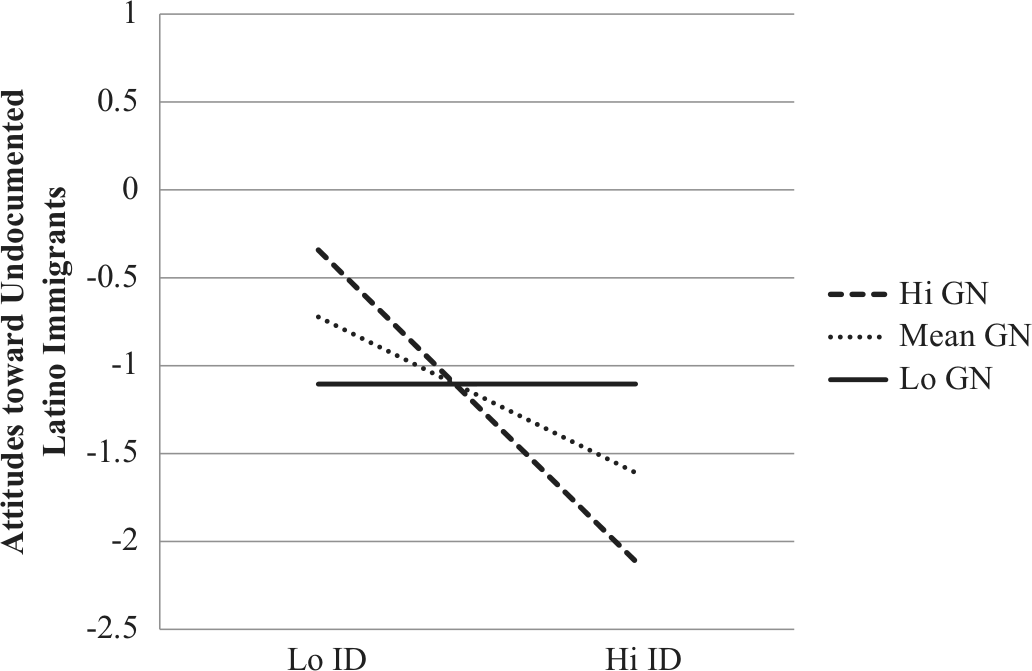
Effects of national identity as an American on attitudes toward undocumented Latino immigrants in the United States at high (+1 SD), mean, and low (–1 SD) levels of Group Narcissism.
Discussion
This study adds to the growing body of evidence that suggests attitudes toward out-groups are influenced by a complex array of predictors beyond mere in-group identification strength. Attitudes toward undocumented Latino immigrants have been studied as outcomes of racial prejudice and discrimination (Cowan et al., 1997), political scapegoating (Short & Magaña, 2002), and perceived threats (e.g., Stephan, Ybarra, & Bachman, 1999), to name a few. In the current political and social climate surrounding the debate on undocumented immigrants in the United States, this study gives us a glimpse of additional predictors of negative attitudes toward this particular out-group. We found that at high and mean (but not low) levels of group-level narcissism, national in-group identification strength predicted more negative attitudes toward undocumented Latino immigrants even after controlling for attitudes toward documented Latino immigrants.
Group narcissism is defined as a sense of entitlement and superiority in relation to other groups. When this position of superiority is threatened, or when one’s group is not receiving the recognition that it deserves, negativity and hostility toward the out-group can develop. We contend that undocumented Latino immigrants represent unique perceived threats to people high in narcissism at the national in-group identity level. The integrated threat theory (ITT; Riek, Mania, & Gaertner, 2006; Stephan et al., 1999; Stephan & Stephan, 2000) provides a framework for understanding how different types of perceived threats at the group level can moderate and mediate attitudes toward immigrants. For example, realistic threats are characterized as threats to the “very existence of the in-group” (Stephan et al., 1999, p. 241), its resources, security, and sovereignty. Among the rhetoric in the debate surrounding undocumented immigrants are sentiments that undocumented immigrants create a financial burden on tax-paying American citizens by taking advantage of America’s superior social, medical, and educational services to which they are not entitled (e.g., Short & Magaña, 2002). Symbolic threats are perceived as threats to the in-group’s “worldview” (Stephan et al., 1999, p. 241), which includes the group’s values, beliefs, customs, and norms. Latinos comprised 14% of the total U.S. population (Pew Hispanic Center, 2008). By the year 2050, the Latino population is projected to increase dramatically to an estimated 29% of the U.S. population, and Whites will be a minority at 47% (Pew Hispanic Center). Embedded in the debate over illegal immigration are fears surrounding the United States becoming a “brown” and bilingual nation, and changes to the culture and values that distinguish America from other nations. These deviations from traditional American customs and values may be perceived as not only threatening, but disrespectful to the superior status of American citizens.
Limitations and Future Research
We concede that we made assumptions based on related studies (e.g., Stephan, Diaz-Loving, & Duran, 2000; Stephan et al., 1999) that threat mediates the relationship between the predictors and the attitudes toward undocumented immigrants. We did not measure the role of threat directly in this study; something that might be undertaken in future studies. Additionally, the measure for attitudes toward Latino immigrants is perhaps too broad and does not address some of the specific issues surrounding attitudes toward undocumented Latino immigrants in the United States, as discussed above. Future studies should probe the relationship between pertinent issues that ignite national in-group identification strength and group narcissism in relation to attitudes toward undocumented Latino immigrants in the United States. One starting point might be the examination of differing attitudes toward undocumented Latino immigrants who have been in the United States for several years versus those who have come here more recently. Regional differences may emerge, with residents of southern (especially border) states exhibiting more negative attitudes than those residing in states less impacted by immigration. Whereas the current study measured only attitude valence (i.e., positive or negative), a more nuanced picture may emerge in future endeavors if various attitude dimensions and emotions (e.g., trust, fear, or hostility) are assessed. Finally, to fully understand the debate surrounding immigration, future research should examine these issues and relevant attitudes from the perspective of the immigrants themselves.
This study is an important contribution to the examination of how and in what context national in-group identification strength, moderated by group-level narcissism, serves as a predictor of attitudes toward undocumented Latino immigrants. The underlying hope is that by having a better understanding of what motivates divisive attitudes, on both sides of the debate, efforts can be directed toward repairing and improving relationships between groups. In this instance, three groups are involved: those in favor or immigration reform and pathways to citizenship for undocumented immigrants; those diametrically opposed to amnesty or reform; and the undocumented immigrants who are at the center of this debate.
Footnotes
Declaration of Conflicting Interests
The authors declared no potential conflicts of interest with respect to the research, authorship, and/or publication of this article.
Funding
The authors received no financial support for the research, authorship, and/or publication of this article.