




Abstract
Parents’ aspirations and expectations are communicated to their offspring. Children internalize their parents’ aspirations and accept some of the expectations while rejecting others, all part of the developmental process and identity-consolidation. When the aspirations and expectations of youth and parents are incongruent, the outcomes in youths’ behavior can be deleterious, such as when adolescents manifest suicidal behaviors. We examined aspirations expressed by 12 Latina adolescent suicide attempters and their parents and compared them to 12 nonsuicidal Latinas and parents. Qualitative analyses revealed that incongruence of aspirations between girls and their parents were greater among suicidal teens. Suicidal and nonsuicidal Latinas presented contrasting aspirations: the former on gaining independence and the latter on completing their education and pursuing careers. Findings may inform developmental research and ways in which clinicians and policymakers can help Latinas achieve their own and their parents’ aspirations.
Children’s aspirations and parental academic, social, and occupational expectations are good predictors of youth’s academic and professional outcomes (Glick & White, 2003; Goldenberg, Gallimore, Reese, & Garnier, 2001; Kao & Tienda, 1995, 1998; Manaster & Chan, 1992). Parents’ wishes influence their children’s own ambitions and achievements in academic, societal, and work-related realms (Hossler & Stage, 1992; Qian & Blair, 1999; Goldenberg et al., 2001). National surveys indicate that the majority of immigrant parents expect their children to attend college and beyond (Glick & White, 2003), and many Latino parents report that their immigration to the United States was in part motivated by the wish to improve their children’s academic opportunities and future outcomes (Behnke, Piercy, & Diversy, 2004). Many families of immigrant backgrounds, as well as ethnic and racial minorities, however, do not have access to information about the educational system in a way that helps support their children to be successful in the U. S. school system (American Psychological Association, Presidential Task Force on Educational Disparities, 2012).
The literature is relatively sparse on aspirations of Latino parents and their adolescent daughters. Yet, the demographics of the United States indicate that considerably more attention is needed in this area. After all, Latinos are the largest minority in the United States, and are much younger than the U.S. population as a whole. Today, almost one in five teens is Latino (National Council La Raza, 2011), and by 2050, approximately one third of the U.S. population will be of Latino descent (Passel & Cohn, 2008). Latino adolescents also show high levels of academic failure and school dropout (U.S. Department of Education, 2010). As they age, Latinos’ socioeconomic achievements tend to show lower earnings and family income (Marotta & Garcia, 2003). For young Latinas living in the United States, the challenges of normal adolescence tend to be compounded by multiple environmental and developmental pressures.
The Center for Control Disease reported that nationwide in the year 2011, 7.8% of high school students attempted suicide (Centers for Disease Control and Prevention [CDC], 2012). Latina adolescents present high rates of suicide attempts (CDC, 2010, 2012; Zayas, Lester, Cabassa, & Fortuna, 2005). Latina teens have a higher rate of suicide ideation, suicide planning, and suicide attempts than their male counterparts (21%, 17.6%, and 13.5% vs. 12.6%, 11.1% and 6.9% respectively; CDC, 2012). Latinas also have higher rates of suicide attempts than their White and African American peers (13.5% vs. 7.9% and 8.8% respectively; CDC, 2012).
Our conceptual framework is anchored in the fact that aspirations play important roles in the developmental trajectories and mental health outcomes of adolescents, including the likelihood of engaging in suicidal behavior. Our conceptualization of adolescents’ and parents’ aspirations is guided by Glick and White (2003), who defined aspirations as the expression of idealistic wishes for the future that are beyond the individual’s realistic performance level, and that are more closely related to cultural value systems. As Latina adolescents begin to look ahead in their own lives and plan for the future, they at times may experience their parents’ aspirations as incompatible with the American mainstream values and with the behavioral systems that they are exposed to in school, peer group, and media. These differences indicate that parents and daughters often have conflicting opinions of what the future holds. In turn, this incongruence of expectations and aspirations between girls and their parents can lead to less mutual understanding, more strain on families, and may be related to psychological functioning, such as suicidal behavior. In one report (Zayas, Bright, Alvarez-Sanchez, & Cabassa, 2009), as the reciprocity in Latina mother-daughter relationships increased 1 point in a 6-point scale, there was a corresponding 57% reduction in the likelihood of a suicide attempt.
By understanding the aspirations of Latina adolescent suicide attempters and their parents, and those of nonsuicidal girls and their parents, this report is intended to contribute to a more nuanced understanding of the relationship between adolescent and parental aspirations and decisions to attempt suicide.
Method
Data for this study were drawn from a mixed-method project that studied sociocultural processes among adolescent Latinas suicide attempters (see Gulbas et al., 2011). Of 122 suicide attempting adolescent Latinas and 110 nonsuicidal teen Latinas, 73 and 68, respectively, completed in-depth qualitative interviews. Of 88 mothers of suicide attempters and 83 mothers of nonattempters who participated in the study, 46 and 28 mothers, respectively, also completed similar interviews. Among 19 fathers of attempters and 17 fathers of nonattempters who participated in the study, 16 and 14 fathers respectively completed in-depth interviews. We selected randomly 12 interviews of attempters (16.4% of interview) and 12 of nonattempters (17.6% of interviews) for this report.
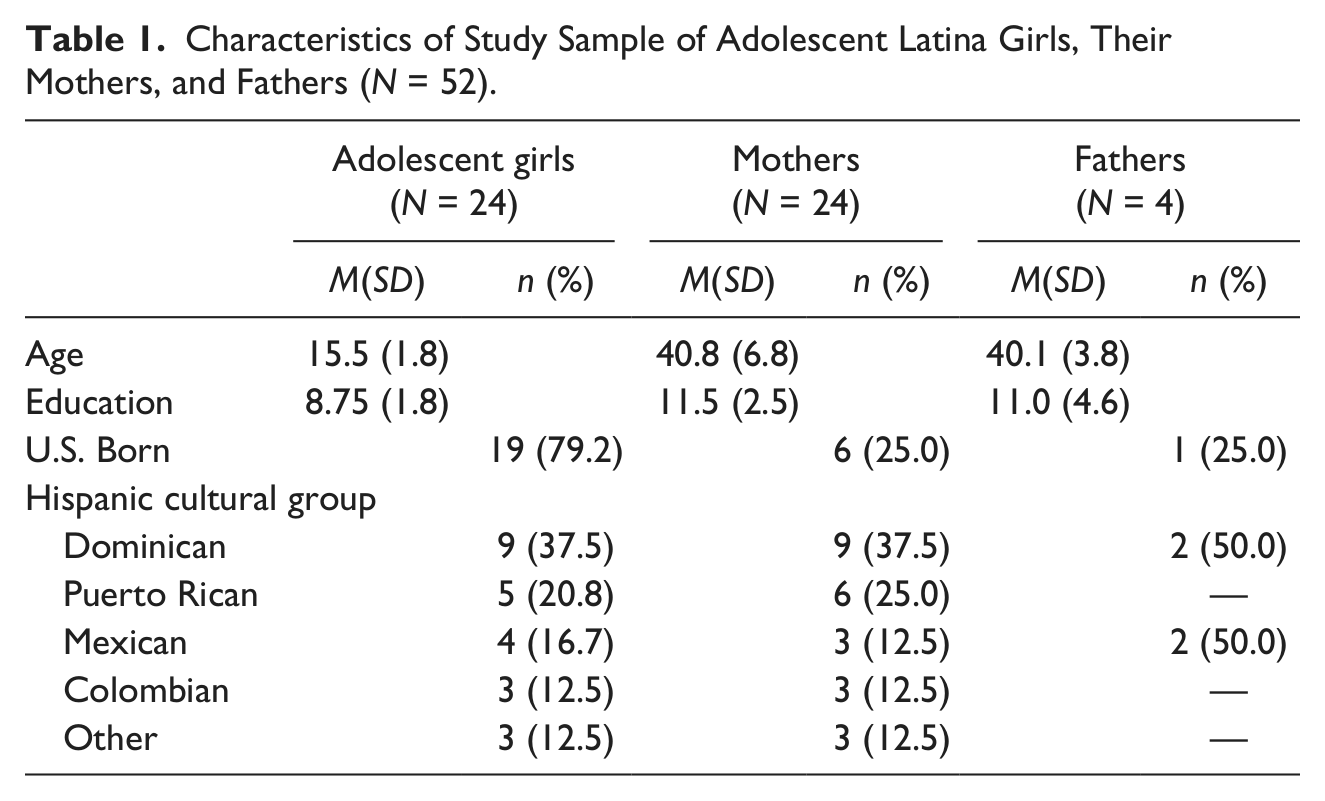
The average age of all girls was 15.5 (SD = 1.8) and there was no significant difference between the two groups. Mothers overall had a mean age of 40.8 (SD = 6.8) years old and fathers on average a mean age of 40.1 (SD = 3.8) years old. The majority of the adolescents were born in the United States (79.2%), whereas 75% of parents reported being born in Latin America. The majority of adolescent participants reported being of Dominican, Puerto Rican, and Mexican descent (see Table 1).
Characteristics of Study Sample of Adolescent Latina Girls, Their Mothers, and Fathers (N = 52).
Qualitative In-Depth Interviews
Among the many topics addressed in the interview, participants were asked: “How do you see yourself in ten years?” Parents were asked: “How do you see your daughter in ten years?” This kind of research question encourages participants to answer through a listing of words. For example, when an adolescent was asked to describe how she saw herself in 10 years, she listed several different words or phrases: “with a house, with kids, married; and with a profession in nursing.” This kind of listing activity is a simple yet powerful qualitative tool because it allows a researcher to identify and analyze the structure of a given cultural domain (in this case, the domain of future aspirations) from the perspective of the participant (Bernard, 1995; Gravlee, 2005). Because interviewers were systematic in the ways in which they asked research participants about future aspirations, the kinds of answers given by adolescents and parents can be described and compared among attempting adolescents, nonattempting adolescents, parents of attempters, and parents of nonattempters (see Ryan & Weisner, 1998).
Content Analysis of Qualitative Data
In order to analyze descriptions of future aspirations, transcripts were imported into NVivo 7 (QSR International, 2006). Two members of the research team read, coded, and identified themes within individual interviews. A broad code was created for the attempter and nonattempter teens, “aspirations,” and systematically applied to any text that referred to hopes, plans, desires, and wishes for the future. A similar code was created for the parents that captured their desires, wishes, and hopes for the girls’ future. To assess intercoder reliability, we calculated percent agreement using the coding comparison module in NVivo 7. The team established a threshold of 75% agreement, which is commonly used in qualitative studies (Miles & Huberman, 1994). The research team held a meeting to discuss coded text that fell below the established threshold. Less than 20% of coded text fell below the threshold, and this text was recoded based on consensus.
Text coded within the broad code of “aspirations” was extracted through a coding summary report. This data was then imported into ANTHROPAC 4.0 (Borgatti, 1996) for analysis. ANTHROPAC 4.0 (Borgatti, 1996) is a DOS menu program that exports salient terms used by a group of research participants and calculates the level of consensus shared by members in this group (Bernard, 1995; D’Andrade, 1995). Using the free-listing module within ANTHROPAC 4.0 (Borgatti, 1996), a data display was exported to illustrate word frequencies for each group: attempters, nonattempters, parents of attempters, and parents of nonattempters. The consensus module was utilized to calculate the degree of shared knowledge within these four different groups, which indicates the level of internal validity within the data (D’Andrade, 1995). Data displays were compared by members of the research team to: (a) document similar and different words used among the groups; (b) the priority of certain words used; and (c) the kinds of words used (e.g., interpersonal future expectations or individualistic future expectations). To examine the context in which words were used, we returned to the original transcripts to contextualize the data. For those participants who completed interviews in Spanish, their quotes were translated to English and referenced to the original Spanish version as footnotes.
Results
Aspirations of adolescent suicide attempters and nonattempters
Overall, Latina adolescent suicide attempters described few personal, educational, and professional aspirations, and instead reflected on the little opportunity for change in their lives (see Table 2). This often led to general feelings of pessimism towards their potential future. For example, one attempter described her future as “being nothing.” She explained the “nothingness” in terms of an inability to escape a future that held little ambition for her: “You know, like what nothing is? Like you graduate high school maybe, or probably get a GED and like, you stay home living with your parents and I guess it’s just like, you work at McDonald’s or Burger King, and you do that for the rest of your life. Like that scares me; I don’t want to do that.”
Free-Lists of the Most Frequently Elicited Terms Among Adolescents.
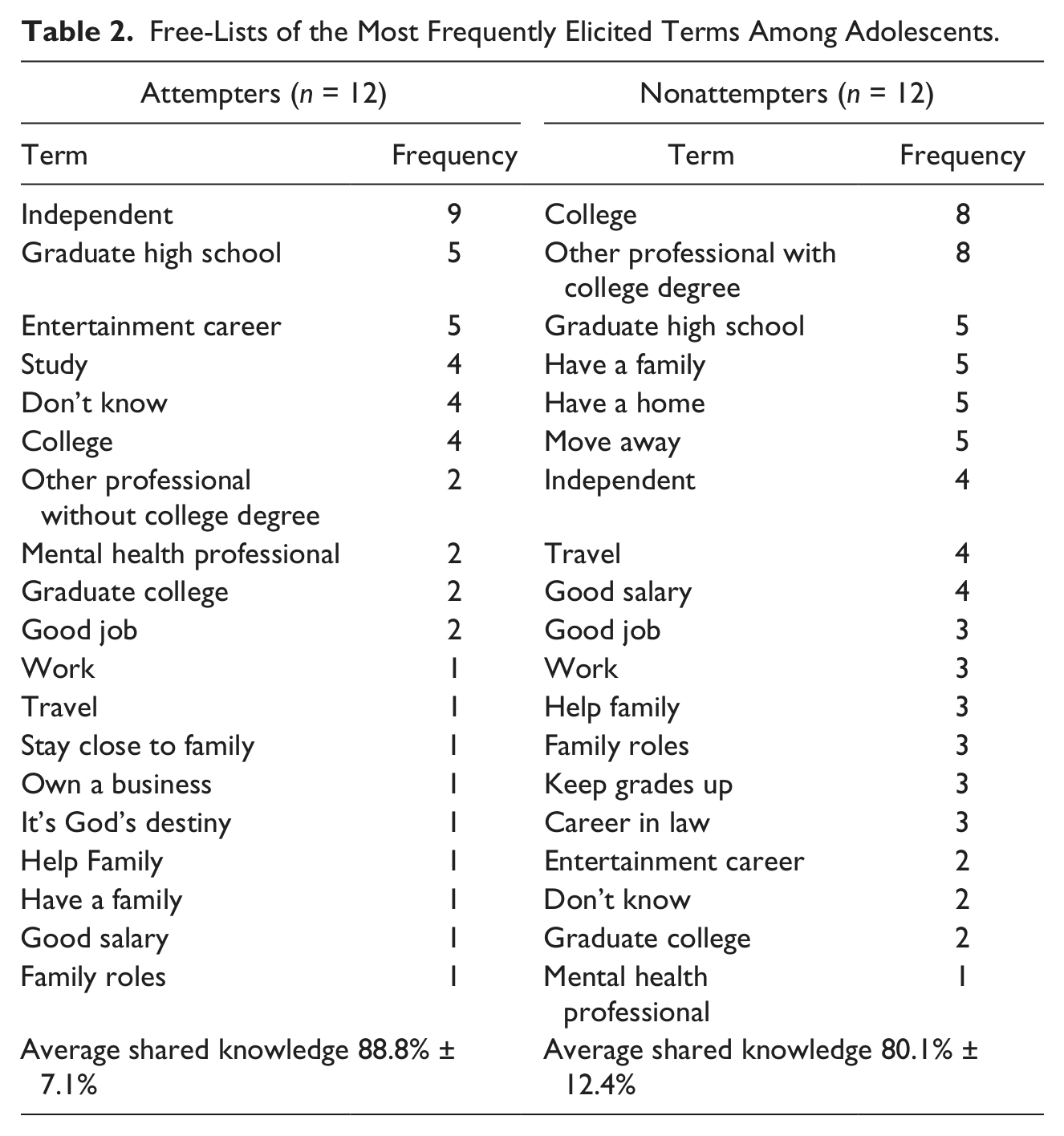
This model for a future life, wherein attempters perceived little hope for an education beyond high school, few career aspirations, and an explicit dependence on parents for household support, frightened a number of participants. Not surprisingly, when asked what they aspired to be more than anything, most research participants cited “independent.” As one attempter explained, “I wanna be independent. I wanna have my own money. I don’t like depending on nobody.”
Although some of the attempters planned to attend college, most were unable to describe which career paths they would like to pursue. Among those who listed careers, they selected some that required little formal training, including careers in the entertainment industry. Interestingly, a few participants mentioned a desire to explore a career related to mental health services, a career choice shaped by their own experiences as patients. For example, an adolescent wanted to become a psychologist, but expressed that her suicide attempt made her wish “ironical.” Of those who wished to become a psychologist or counselor, many expressed doubts about their ability to do, fearing their suicide attempt would preclude their pursuit of this opportunity. Again, we see an orientation towards the future in terms of doubt, fear, uncertainty, and ambivalence.
Most attempters perceived educational and professional accomplishments as a means to access material goods. As one girl described, “I hope I get a good job when I get older ‘cause . . . like I have to get a good job, I like good stuff, like I don’t settle for less, I’m not like that.” Although the girl had a difficult time describing what would constitute a “good job,” she nevertheless saw “the good stuff” as a way to escape her surrounding environment: she is the oldest daughter of an immigrant mother who works as an elderly care assistant. The girl described her mother’s life as “depressing, a single mother in New York.” She could see her mother’s daily struggles to provide for her children and the lack of opportunities available to low skilled females.
Several suicide attempters spoke about starting a family, but none of them described traditional family aspirations, like marrying or having a husband. Overall, they thought that women should start having children at an early age and only after completing their high school education. They linked a girl’s sexual initiation with pregnancies, “at 18 or older.” Among these girls, questions about their aspirations often elicited descriptions of their future role within their families of origin. For instance, they stated that they wished to be able to help relatives or to stay close to their family, as parents either needed or expected them to do so.
In contrast, Latinas without a history of suicide attempts described wanting to complete their education, pursue careers, create financial capital, access experiences such as traveling, and settle into a perceived traditional approach to family life. Included in their descriptions were the ways in which they had defined these aspirations, such as researching the potential income of graduate degrees, as well as the steps needed to accomplish them.
Overall, the nonsuicidal adolescents held a realistic perspective of the opportunities and challenges they could encounter while pursuing their dreams, and understood that they would have to struggle to accomplish their aspirations. These participants were aware of the long-term negative consequences resulting from what they saw as normative adolescent trajectories among their inner-city peers. For some of these girls, their aspirations and sense of self-efficacy distinguished them from other adolescents growing up in similar circumstances. As one Latina explained in describing her peers, “You don’t see the hungriness in graduating and going to college, and that is one of my dreams too, it’s to go to college.”
Attending college and developing careers that required a college education were the most frequently cited aspirations of this group of adolescents, even when these choices would imply a big effort on their side, and a transition to an unknown world beyond the boundaries of their inner-city neighborhoods. For example, one 17-year-old girl reflected on the hopes for her future, a future that would take her far away from the environment within which she grew up: “That is one of my dreams . . . it is to go to college, far away college and see that there is more people than just people (from the Bronx), you know. So that’s why I think the way I think . . . and I notice that things are hard but you have to fight and get out of it.”
All of the adolescents in this group stated specific career plans, such as becoming a nurse, a teacher, or lawyer. Investing in a college education was perceived as providing a number of benefits. For example, one research participant described the ways in which an education would be beneficial. First, the attainment of a college degree was seen as a pathway for social mobility, and she commented “school is important because without school you can’t get nowhere.” Second, she perceived education as providing a sense of self worth, noting that a college degree was essential in order to “make something of myself.” Finally, she saw education as a way to achieve economic wealth, equating the desire to go to college with a view of her future self as rich. This participant’s future aspirations were strongly linked to her own desires to leave behind a difficult family environment. A history of victimization through harsh discipline and witnessing domestic abuse resulted in feelings of disempowerment. Thus, education would provide not only an escape, but also a way to distance herself from her personal history. Education could transform feelings of disempowerment into self-worth, and poverty into wealth.
Having a family was another frequent hope among these girls. Their future family aspirations could be characterized as traditional, including marriage, a husband, and children. For them, dating during their teen years did not translate into commitment to marriage. More so, dating was viewed as an opportunity to explore relationships with the opposite sex. Prior to marrying and settling down, these girls wished to develop careers, travel, and secure their finances through good jobs and built equity. These adolescents hoped to have children starting at their early- to late-20s. Not surprisingly, for these adolescents, the management of their reproductive choices shaped their future aspirations. “I went to clinics, like teenager clinic and I got birth control and stuff like that because that’s one thing I don’t wanna have kids. I don’t wanna be stuck in welfare, carrying, I don’t wanna live like that.”
Aspirations of parents of Latina adolescents
Parents of suicidal teens focused on the delay of dating, and educational and character development aspirations (see Table 3). Parents often perceived dating as a threat to their daughters’ success in school and accomplishment of potential future career aspirations. As one mother noted, “That was always my fear, that if she would start to date, her focus would be on the relationship, and she would neglect her education.” 1 Overall, they expected their children to ask permission to date and respect their parents’ position. For instance, a participant told her daughter “wait until you finish 11th grade. Starting the 12th grade I will authorize you to have a boyfriend.” 2 Thus, many parents hoped their daughters would aspire to be “good,” meaning that the child would comply with her parents’ rules about academic performance and dating.
Free-Lists of the Most Frequently Elicited Terms Among Parents.
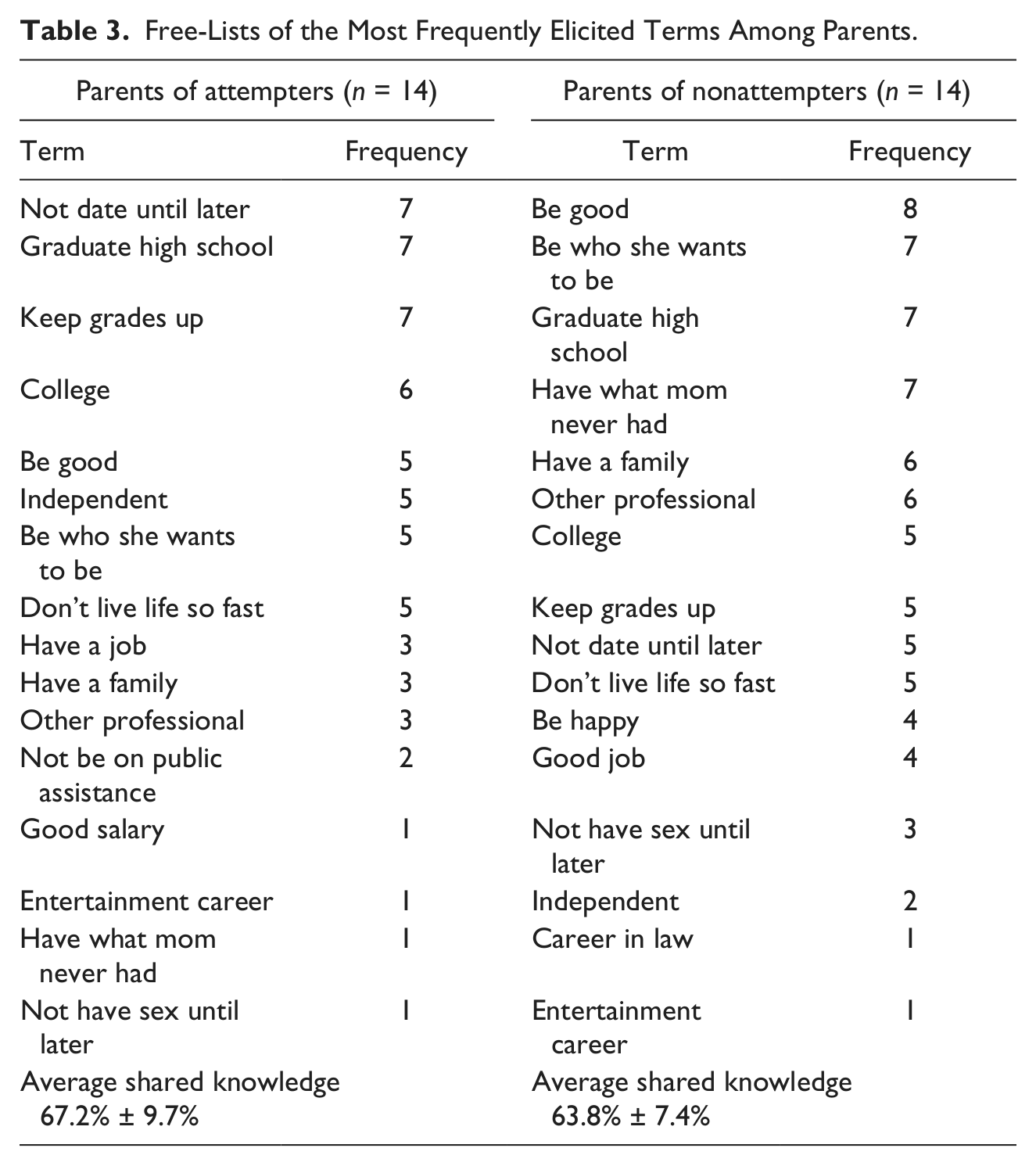
These parents delineated clear educational aspirations for their children, hoping that their daughters would keep their grades up, graduate high school, and attend college. Informed by their own experiences of poverty, domestic violence, and abuse, parents hoped that their daughter’s education would spare them depending on abusing partners or on the welfare system. For example, one mother of a suicide attempter explained that “If she does not study, what will she depend upon? Welfare? Food stamps? If she gets pregnant they give her welfare and that is it.” 3 More than personal, professional, or material fulfillment, these parents saw in the girls’ education a pathway to help them escape the circle of abuse and violence that engulfs so many families in the inner city. A mother reported telling her daughter: “If you don’t become a professional, you will marry a man you would depend upon. Then, when you depend on a man, this man abuses you.” 4 The expectation that by engaging romantically with a partner, their daughters would become physically abused was a constant in the interviews. “How this person is gonna do that my daughter, because I guarantee you the day my daughter calls me and says: daddy, so and so hit me, that’s the day that I go to jail.”
Although parents listed expectations for their daughters’ futures, in addition to citing potential threats to future accomplishments, parents of attempter adolescents conveyed a sense of losing their children to their futures. Parents often expressed fear that they would be left behind and loose contact with their daughters, or that their daughters would rely on a man for care and authority rather than on her natal family. As one father expressed, “I wish my daughter never gets married, my fear when she gets married . . . giving her to someone else.”
In contrast to parents of Latinas who had attempted suicide, parents of nonattempters aspired to the fulfillment of moral character, personal, educational, professional, and material goals, including being good, starting a family with the right partner, graduating from high school, attending college, and having things and experiences that their parents could not have accessed (see Table 3). Moral character development was the most important expectation of parents of Latina adolescents without a history of suicide attempts. Being good meant to “follow traditional rules of society. . . that she observes the rules of the house, that she attends school . . . everything positive is expected from her… a girl is expected to behave well in [the] educational, moral, sexual aspects.” Although some parents expected their daughters to improve their behavior, most hoped that they would continue their current behavioral trajectories. As one mother commented, “I can’t say that I see her behaving any better than she does now . . . she is a typical teenager, one of the better ones . . . she doesn’t do any drugs, she doesn’t have sex . . . she is not promiscuous . . . she doesn’t smoke, so she doesn’t do much . . . I can’t ask for much more than that.”
This set of parents aspired that their daughters would accomplish their own dreams, often stating that the girls would go on to reach goals that they themselves were not able to accomplish due to a lack of opportunities. For this group of parents, their daughter’s education offered an opportunity to change the family trajectories of poverty and lack of access to resources. More specifically, the mothers hoped that education would carry social mobility and gender role transitions for their daughters. For example, one mother discussed generational differences in opportunity: “Where my mother was and where my grandmother was is nowhere where I am, and I hope to God, and it’s farther away from where my daughter is heading . . . not just to think that there’s only life by having just children . . . there’s a lot more offering to them.” Furthermore, some of these women accepted that their daughters would not want children, would have smaller families, or would prefer to adopt.
Parents of nonattempters aspired to delay daughters’ dating and sexual initiation. They worried that dating would distract the girls from their academic responsibilities, and that premarital sexual encounters would tarnish the family honor and the girl’s self-respect. They perceived the adolescent transition towards adult roles as accelerated in their surrounding environments, noting that in their neighborhood, there were many “pregnancies, a lot of dating.” Recognizing the fast pace of the transition from adolescence to adulthood, many parents expressed a desire to slow down the process. As one mother commented, “I wish she would not live her life so fast, everything will arrive at good time.” 5
Many parents of nonattempters realized that their daughters’ often held ambitious career goals, and parents frequently discussed their daughters’ wishes to become doctors, models, lawyers. They framed these aspirations in contrast to the lack of opportunities they encountered while growing up, acknowledging that some of these barriers might still exist for their daughters: “We are not treated as equally as an Anglo-Saxon American girl. There’s still disadvantages, and they know that they have to continue to push because we still haven’t crossed that boundary yet.”
Discussion
Latina adolescents with and without a history of recent suicide attempts shared their aspirations for their futures during in-depth qualitative interviews conducted as part of a mixed-method study about sociocultural processes among Latina suicidal teens. Their parents provided descriptions of their desires, wishes, and hopes for the girls’ future. Overall, adolescents aspired to gain independence, education, and to develop careers and access material goods. Parents were more concerned with what they saw as current threats to their daughter’s futures and character development. A common theme across all groups was the desire to escape the poverty and violence perceived to be endemic to life in the inner city. For attempters, escape was viewed as impossible, whereas for nonattempters, escape was perceived as something to strive for.
In tune with extant literature (e.g., Rotheram-Borus & Trautman, 1988; Schotte & Clum, 1987), adolescent suicide attempters felt hopeless about their future. Hopelessness is one of the strongest predictors of suicidal behavior (Abramson et al., 1998; Joiner & Rudd, 1996). Adolescents who did not have a history of suicides were very hopeful and had clear personal, educational, and professional aspirations. We argue that the lack of aspirations and negativistic outlook needs to be understood to establish the degree to which they influence the tendency toward a suicide attempt. Parents of attempters did not convey a sense of optimism about their children’s future either, probably reinforcing the adolescent’s pessimistic perception of their future and their hopelessness. The combination between the girl’s and her parent’s pessimism may be a contributing factor to her suicidality.
Developmentally, adolescence is a period marked by an increased mastery of personal abilities and by the development of cognitive schemes and problem-solving skills that help individuals project their identities onto the future. Suicidal youth, however, have been found to have less problem-solving skills and to be less hopeful about positive outcomes resulting from their actions than nonsuicidal adolescents (Schotte & Clum, 1987).
Parents of suicidal girls had lower aspirations for their daughters when compared to parents of nonsuicidal adolescents. Parents were more concerned with addressing what they perceived as currents threats to their daughters futures such as delaying their sexual initiation, than in thinking of their children’s career aspirations and long-term personal fulfillment.
Most Latina adolescents without a history of suicide attempts interviewed for this project reported specific career aspirations and described the steps that they were taking to accomplish those goals. Their achievement orientation (Torres, 2009) was combined with the understanding that reaching their goals would depend more on their efforts than on external factors (Phinney, Baumann, & Blanton, 2001). They described their aspirations and drive as differentiating them from their inner city peers and from the overall lack of opportunities offered in areas of systemic poverty. More importantly, these teens saw their education as having a positive long-term multidimensional effect on their lives, including that of social mobility, geographic relocation, sense of self worth, and material rewards. For Latina suicide attempters, the rewards offered by education were limited to material goods. Both group of adolescents emphasized material goods as means to differentiate from their impoverished contexts. However, nonattempters teens and their parents referred to the aspiration of becoming homeowners, suggesting the internalization of middle-class values (Clark, 2003).
Both groups of adolescents and parents discussed their aspirations regarding families in the future. For most attempters, these were tied to roles within their families of origin and to having children. The family aspirations of attempters reproduced single-parent family structures that are common among the poor (McLanahan, 2004). This differs significantly from the nonattempters, in that they aspired to establish traditional family, with weddings, husbands, and children. Nonattempters hoped to accomplish these goals after a period of personal search that included completing their education, traveling, and gaining some professional and material capital. Not surprisingly, nonattempters described the ideal age for a woman to start having children much later than attempters. For attempters, the perspective of mirroring their single mothers’ harsh lives, and the awareness of their lack of resources may be important elements to consider when analyzing these girls’ suicidality.
The aspirations regarding their daughter’s future families varied among parents with and without a suicide attempter child. The main focus of attempter’s parents was on their children avoiding becoming dependent on abusive partners. They worried that if daughters were to become romantically involved and pregnant at early age, they would not gain the skills needed to insert themselves in the workforce. This would make them vulnerable for abuse. Both group of parents and the nonattempter adolescents described that the management of the girl’s reproductive choices would have a direct impact on their trajectories. Parents of nonattempters also hoped that education would allow their daughters to access a pool of suitors that were as future-oriented as their children. Interestingly, nonattempter’s mothers saw that with education and social mobility, their children’s gender roles would change generational-old traditions of female submission and personal realization tied to motherhood (Perrone, Wright, & Jackson, 2009). Moreover, the parental concerns regarding the delay of dating sexual initiation may translate into rules and prohibitions for the girls. In turn, these may be experienced by the adolescents as further frustration, and lead to conflicts between the girl and her parents. A period of escalating conflict regarding the girl’s dating and sexuality has been shown to precede most suicide attempts among Latina adolescents (Zayas, Gulbas, Fedoravicius, & Cabassa, 2010).
Finally, the parents of this group of Latina adolescents stressed the importance of developing moral character, while their children aspired to accomplish personal, educational, and professional goals. For attempters’ and some nonattempters’ parents, their daughter’s current behaviors needed to be changed, with an eye on becoming demure and obedient. For others, their children’s behavior was a source of optimism for their girl’s future. Attempters hoped to become independent, perhaps in response to their parents request for submission. These tensions between the parental expectation of submission and the developmentally appropriate search for autonomy may have an impact on these girls’ suicidal behavior.
The Latina adolescents interviewed for this project were developing in bicultural families living in an areas characterized by lack of opportunities and systemic poverty. Further research is needed to help identify those cultural and contextual factors that matter the most for shaping the aspirations and suicidal behavior of this population. Research in this area could assist the development of educational and psychotherapeutic interventions for Latina suicide attempters and their families.
Footnotes
Acknowledgements
The authors wish to thank Allyson P. Nolle, MSW, Karen Hidalgo, and Andrea Campetella, PhD for their assistance in the preparation of this manuscript.
Declaration of Conflicting Interests
The authors declared no potential conflicts of interest with respect to the research, authorship, and/or publication of this article.
Funding
The authors disclosed receipt of the following financial support for the research, authorship, and/or publication of this article: Support for this article was provided by grant R01 MH070689 from the National Institute of Mental Health to Luis H. Zayas. Additional support was provided by a Training Grant from the National Institute of Mental Health to Enola Proctor, PhD (NIMH – T32 MH19960).