




Abstract
A vast literature documents a host of advantages conferred upon middle class European American children whose parents employ an authoritative style of parenting, including enhanced academic achievement and positive behavioral outcomes. The literature is much less clear about the relationship between parental authority style and child outcomes in other cultural contexts. In this study, we examined the relations among authoritative, authoritarian, and permissive parenting styles and practices and several academic and behavioral outcomes among fifth grade Latino/a students. We found significant positive relations between parental authoritativeness and grades, academic engagement, social competence, self-regulation, and perspective-taking as well as negative relations between authoritativeness and aggression. We found no relations between authoritarian or permissive parenting styles and child outcomes. We consider these findings in light of what other researchers have posited about collectivist parenting styles and practices.
A review of curricular standards and learning outcomes in the United States reveals that schools demand that students be both academically and socially competent (California State Board of Education, 2013; Common Core: State Standards Initiative, 2012). Expectations for academic competence include, for example, cognitive exploration, intellectual curiosity, and content mastery. Expectations for social competence include self-reliance, independence, and cooperation with peers as well as with adult authority such as teachers. Variations in academic and social competence are significantly associated with variations in parenting children experience in the home (Sorkhabi, 2005, 2012). This association may be because children in the context of the home learn interactional patterns and societal rules and expectations and receive linguistic and cognitive stimulation, which they transfer to the school context. Research on outcomes associated with various parenting styles reveals that some parenting styles are congruent, while others are incongruent with school demands.
Literature grounded in Baumrind’s (e.g., Baumrind, Larzelere, & Owens, 2010) seminal studies has documented a host of advantages conferred upon middle class European American children whose parents employ an authoritative parenting style, including enhanced academic achievement and positive behavioral outcomes. Baumrind found that authoritative parents are high on firm/rational control, monitoring, maturity demands, reasoning, explanation, warmth, autonomy granting, and nurturance. By contrast, authoritarian parents are low on these practices and high on coercion, psychological control, verbal hostility, and physical punishment. Permissive parents are low on firm/rational control, monitoring, maturity demands, reasoning, and explanation but high on warmth, autonomy granting, and nurturance. Baumrind’s research spanning preschool to high school has revealed that the authoritative parenting style compared to authoritarian and permissive parenting styles is related positively to developmental outcomes such as academic achievement and engagement, social competence and peer acceptance, cooperation, self-regulation, perspective-taking, cognitive exploration, intellectual curiosity, self-reliance, and independence in unstructured situations.
There is a controversy, however, regarding whether the link between parenting styles and practices and child outcomes found for European American children is the same for children belonging to other cultures (Sorkhabi, 2005; Sorkhabi & Mandara, 2012).
Cultural Variation in Parenting Styles/Practices and Child Outcomes: Hispanic Families
The literature on Latino parenting styles and associated outcomes for Latino children, especially elementary school-age children, is sparse. Much of the empirical evidence pertains to Latino adolescents, and the findings here are mixed in establishing the potential benefits of authoritative parenting and the deleterious effects of authoritarian and permissive parenting for Latinos. An influential series of studies by Steinberg, Dornbusch, and Brown (1992) found that authoritative parenting is related to positive academic achievement for Latino adolescents―especially girls. They further indicated that the greater prevalence of authoritarian parenting in Latino families compared to European American families may impede the academic achievement of Latino children. Existing studies with young children to middle-school-age Latino children suggest the positive effects of authoritative parenting practices. De Von Figueroa-Mooseley, Ramey, Keltner, and Lanzi (2006) found that Latino kindergarteners whose parents were responsive to their input compared to those who were less responsive had higher academic achievement. Gayles, Coatsworth, Pantin, and Szapocznik (2009) found that in two-parent Latino families living in low income neighborhoods, Latino parenting practices of rule setting, effective discipline, shared time with child, involvement, and positive parenting were each negatively related to problem behaviors exhibited by Latino children in sixth and seventh grades. Interestingly, Latino parents’ discipline avoidance, which is consistent with the permissive parenting style, was positively related to problem behavior.
By contrast, other researchers (Suarez-Orozco & Suarez-Orozco, 1995) argue that independence training which is a central aspect of authoritative parenting and found to be related to positive outcomes for European American children who have been reared with individualist values may not hold for Latino children whose values are collectivist. Lindahl and Malik (1999) found that what they called a hierarchical parenting style, which is consistent with the authoritarian parenting style, was related to externalizing problem behaviors for European American and biethnic children, aged 7 to 11 years, but not for Hispanic American children. Similarly, Park and Bauer (2002) found that whereas higher levels of authoritative parenting and lower levels of authoritarian parenting were related to academic achievement of European American adolescents, such a relationship did not hold for Hispanic American adolescents for whom parental strictness was related to academic achievement.
Parenting Styles Versus Parenting Practices
Darling and Steinberg (1993) and Smetana (1995) have suggested that parenting styles are global constructs and have recommended that specific parenting practices in relation to specific child activities (e.g., school achievement) or domains (i.e., moral, conventional, personal, and prudential) be examined to more clearly elucidate the link between different parenting practices and different developmental outcomes. However, Stewart and Bond (2002) suggest that it may be valuable to obtain data on specific parenting practices as well as to systematically describe and classify the constellation of specific parenting practices that go together and form patterns―a dual approach that is useful for research and practice.
In this study, we addressed the gap in knowledge concerning parenting effects on developmental outcomes for Latino elementary school-age children by examining relations among both parenting styles and practices and several school-related, social, and cognitive outcomes of academic achievement and engagement; social competence, self-regulation, aggression, and perspective-taking among Latino fifth graders. Fifth grade participants were chosen, because fifth grade is a pivotal transition year to middle school where children will have to be prepared to interact with multiple teachers and accommodate more complex scholastic content, greater quantity of work, and more complex peer relationships. Fifth grade is also an important time period to study because this developmental time period of middle to late childhood is understudied in parenting research. Furthermore, data on the parenting of mothers and fathers were analyzed separately to underscore the unique contribution of fathers, which has been understudied in socialization research. Given the dearth of research in this area as well as the mixed findings, we advance no specific hypotheses and explored the relations among parenting styles and practices and child outcomes.
Method
Participants
Participants were 73 Hispanic fifth graders from two public urban elementary schools in California. For both schools, over 90% of children qualified for free or reduced price lunch. The sample comprised 58% girls and 42% boys. The majority (82%) of these children was born in the United States and the remaining (18%) in Mexico. The children were from households with an average of 4.1 children (1.9 SD), and 88% lived in a two-parent household made up of the mother and father or step-parents. Of those two-parent households, 84% lived with both biological parents, 14% lived with their mother and step-father, and one child (2%) lived with the father and step-mother. The 12% of children who did not live in a two-parent household lived with a single-mother. All children in the study were fluent in English.
The parents of these children were born in Mexico (75%), Central America (7%), or were of Hispanic origin and born in the United States (18%). For the highest level of education completed, 13.7% of mothers completed elementary school, 34.2% high school, 5% community college or trade school, 15.1% a bachelor’s degree, and 31.5% unknown. Of the fathers, 8.2% completed elementary school, 24.7% high school, 1.4% community college or trade school, and 12.3% a bachelor’s degree, and 53.4% unknown.
Measures and Procedures
Parental authority styles
Children were interviewed about their parents’ parenting style using the Parental Authority Questionnaire (PAQ; Buri, 1991). Children were asked how frequently their parents engaged in particular behaviors (0 = never, 1 = a little, 2 = sometimes, 3 = a lot). The PAQ contains 30 items that provide scale scores along three parenting styles: authoritative, authoritarian, and permissive. Each of the 30 items of the PAQ was simplified to promote comprehension at the fifth grade level. Children’s reports were obtained as opposed to that of parents’, because as Villar, Angeles Luengo, Gomez-Fraguela, and Romero (2006) found with a sample (N = 302) of Latino mothers, fathers, and children that mothers and fathers tended to overestimate their authoritativeness and underestimate their authoritarianism. The children in our study were asked each of the items twice for the adults they lived with―once in reference to their mother and a second time in reference to their father or in some cases step-father/step-mother. Internal consistency alphas for the authoritative, authoritarian, and permissive scales were .75, .68, and .54, respectively, across mothers’ items and .80, .66, and .53, respectively, across fathers’ items. Nine children lived with a single-mother and were only asked about parenting styles for that one parent.
Parenting practices
Information on parenting practices was obtained from two sources. The first source was from individual items of the PAQ to examine the effect on child outcomes of specific parenting practices. The second source was obtained from teachers who completed the Elementary School Student Profile for Teachers (ESSP; Bowen, 2006). The participating schools are small community schools where teachers are in regular contact with central office staff, administrators, as well as the parents of their students. Given that data were collected late in the academic year, the teachers had sufficient knowledge to complete the items of the ESSP regarding the parents’ school-based practices. Among the items on the ESSP, teachers rated the frequency with which parents (1) had transportation to get to school when needed, (2) go to school for parent-teacher conferences, (3) volunteer at the school or in the classroom, (4) go to school when invited to fun events, (5) contact the teacher or school staff about the child’s school progress and behavior, (6) go to school for information sessions for parents, and (7) go to parent-teacher association (PTA) meetings. Each of the seven items was rated on a four-point scale (0 = never, 1 = sometimes, 2 = often, 3 = always). In addition, teachers also rated how involved parents were in their child’s learning at home (0 = not involved, 1 = low, 2 = average, 3 = high).
Child outcome measures
Data pertaining to child outcomes were collected from teachers using the ESSP. The teachers reported children’s grades in language arts, math, and science, which were averaged together to obtain a grade point average on a four-point scale. Additionally, teachers rated children on a number of behavioral measures, which were collapsed into scales reflecting their levels of academic engagement, social competence, self-regulation, perspective-taking, and aggression. The teachers’ ratings on each of these child outcomes were on a six-point scale ranging from never to always. Academic engagement consisted of eight behaviors that teachers rated as being descriptive of the student such as, “completes assignments.” Social competence consisted of seven behavior items such as “plays with others.” Self-regulation consisted of three items such as “can calm down when excited or all wound up.” Perspective-taking consisted of three items such as “Is stubborn.” Aggression consisted of four items such as “Harms others.” The internal consistency alphas for all scales were .79 to .98.
Results
Parenting Styles of Mothers and Fathers and Demographic Correlates
Overall, children reported their mothers (M = 2.30, SD = 0.50) and fathers (M = 2.14, SD = 0.59) to be relatively high in authoritativeness with mothers rated significantly higher on authoritativeness than fathers, t(63) = 3.43, p = .04. Ratings on the authoritarian and permissive styles were low for mothers (authoritarian: M = 1.67, SD = 0.53; permissive: M = 1.21, SD = 0.41) and fathers (authoritarian: M = 1.68, SD = 0.53; permissive: M = 1.20, SD = 0.41) with no significant difference between mothers and fathers. To determine if demographic factors influenced the parenting style scores, we conducted analyses with parents’ country of origin, parents’ marital status, number of children in the family, and child’s gender for each of the parenting styles.
Parents’ country of origin and parenting styles
To determine if parents’ country of origin had any influence on parental style, we examined whether parents born in the United States versus those who immigrated to the United States differed on the three parenting styles. For mothers, there were no significant differences on any of the three parenting styles. However, U.S. born fathers were rated higher (M = 1.98, SD = 0.52) on authoritarian parenting than fathers who immigrated (M = 1.60, SD = 0.52), t(57) = 2.09, p = .04. Therefore, we controlled for fathers’ country of origin in all analyses.
Marital status and parenting styles
Using t tests, we examined whether parents who were married versus those who were not married (e.g., divorced, separated, or never married) differed on the type of parenting style they employed. For mothers, no significant differences emerged. However, fathers who were married had lower ratings on authoritarianism (M = 1.54, SD = 0.54) than fathers who were not married (M = 1.87, SD = 0.43), t(61) = 2.49, p = .02. Therefore, we controlled for fathers’ marital status in all analyses.
Number of children in family and parenting style
We examined whether mothers’ and fathers’ parenting styles vary in accord with the number of children they have. No significant relations emerged for mothers. However, fathers’ authoritativeness decreased (r = −.28, p < .03) and authoritarianism increased (r = .25, p < .05), as the number of children in the family increased. Therefore, we controlled for the number of children when examining fathers’ parenting and child outcomes.
Child’s gender and parenting styles
We examined whether parenting styles differed based on child’s gender. For mothers, no significant differences emerged. However, boys rated their fathers as more permissive (M = 1.33, SD = .36) than girls (M = 1.12, SD = .43), t(62) = 2.09, p = .04. We did not control for child’s gender in later analyses because non-significant results emerged for fathers’ permissive parenting and child outcomes.
In summary, parents’ country of origin, marital status, and the number of children in the family were significant covariates for fathers’, but not mothers’, authoritative and authoritarian ratings.
Parenting Styles and Child Outcomes
Mothers’ authoritative ratings were significantly and positively correlated with children’s grades, social competence, perspective-taking, and self-regulation and negatively correlated with children’s aggression (see Table 1). After controlling for fathers’ country of origin, marital status, and number of children, fathers’ authoritativeness was significantly and positively related to children’s academic engagement, social competence, and perspective-taking (see Table 2).
Correlations of Mothers’ Parenting Style Scores With Children’s Outcomes.
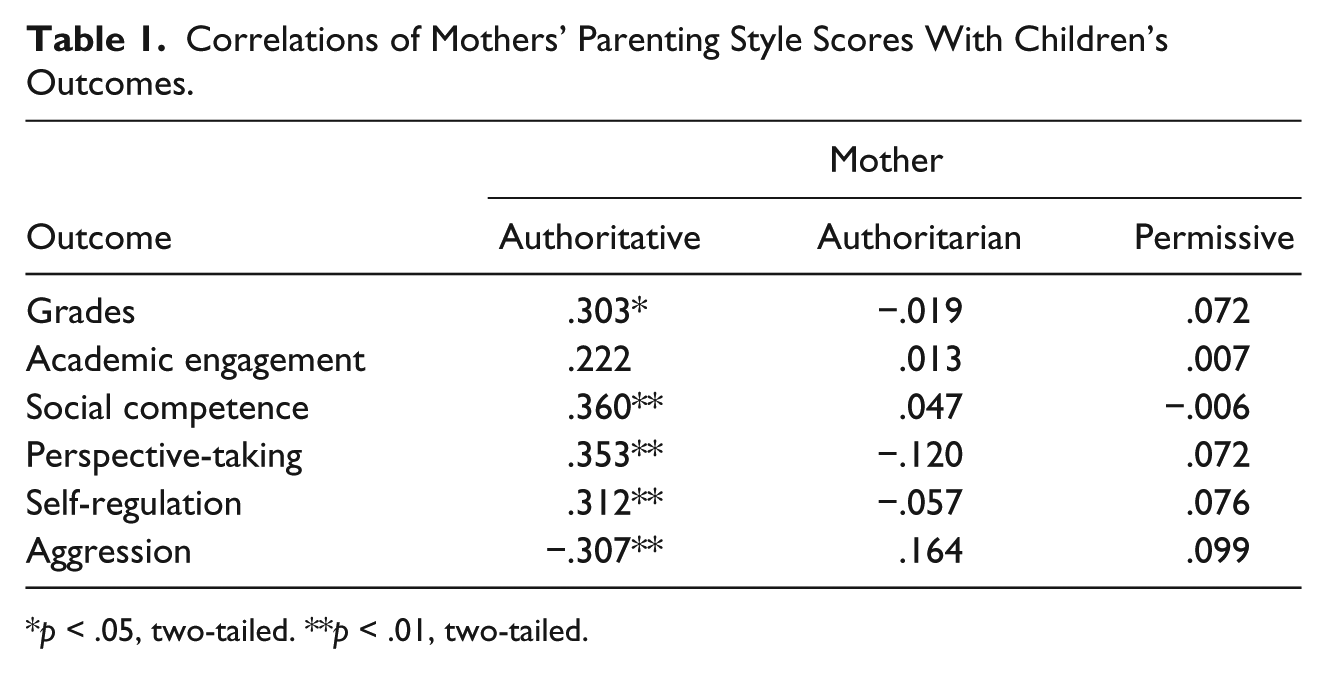
p < .05, two-tailed. **p < .01, two-tailed.
Correlations of Fathers’ Parenting Style Scores With Child’s Outcomes Partialing Out Place of Origin, Marital Status, and Number of Children in Family.
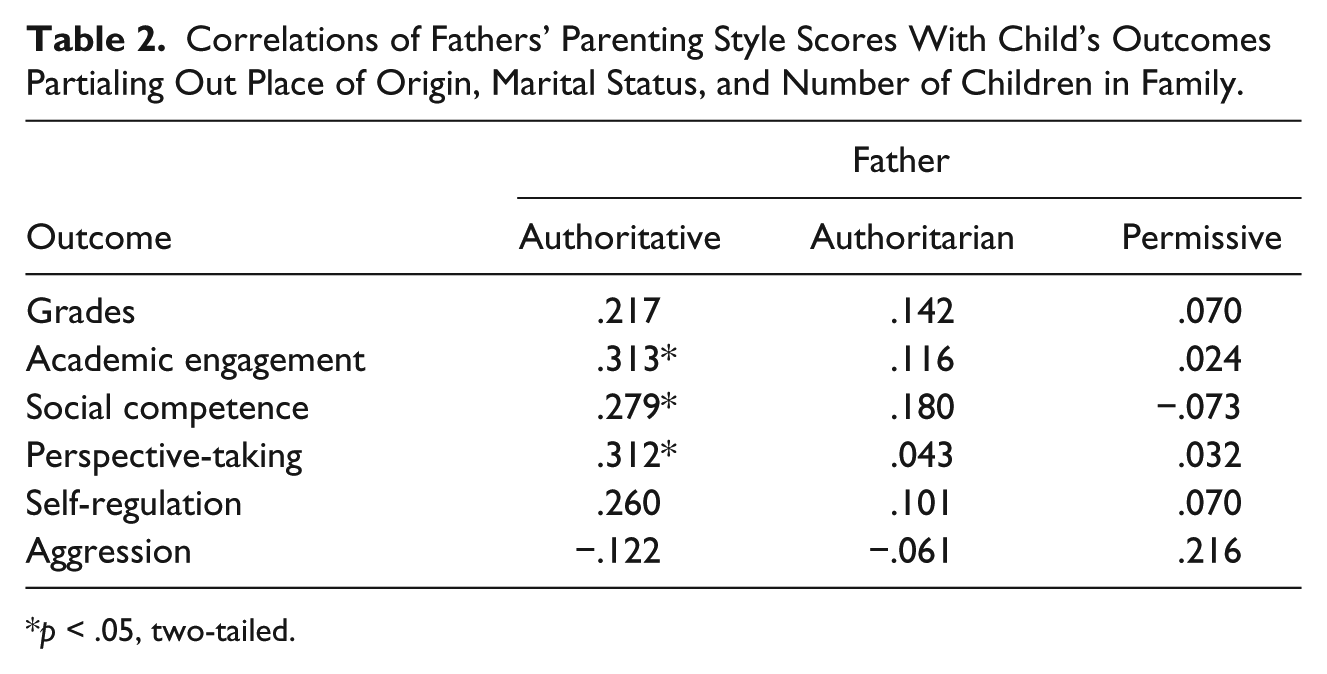
p < .05, two-tailed.
Regression Analyses of Specific Parenting Practices From PAQ and Children’s Outcomes
In order to determine what specific parenting practices best predicted children’s outcomes, stepwise regression analyses were conducted for both mothers and fathers on each of the child outcomes using the individual items from the PAQ as predictors (see Table 3 for summary of each of the regression models). With respect to child grades, for mothers, only item, 11, “Does your mother tell you exactly and clearly what she expects of you?” explained 14.3% of unique variance (t = 3.32, p < .01). For fathers, after controlling for fathers’ country of origin, fathers’ marital status, and number of children in the family (9.8% combined explained variance), one item, 4, “When your father makes a rule or expects you to do something, does he explain the reason for it?” explained 11.2% of unique variance (t = 2.67, p = .01) in child grades.
Stepwise Regression Models of Children’s Outcome Variables Using the Parental Practices From Parental Authority Questionnaire as Possible Predictors.

Note. Predictors for the regression analysis are represented with a short description followed by the item number on the Parental Authority Questionnaire. A full description of each item can be found in the text portion of the results. Because immigrant status, marriage status, and number of children were found to be significant covariates in earlier analyses for fathers’ parenting, those variables were entered first in the regression models to serve as covariates (gray shaded variables). The covariates were not found to be significant for mothers’ parenting and therefore were not included in the models for mothers’ practices.
With respect to child academic engagement, for mothers, three items explained 19.6% of the unique variance: 11 “Does your mother tell you exactly and clearly what she expects of you?” (8.3% variance explained; t = 2.67, p = .01), 1 “Does your mother let you have your way as often as she does?” (5.5% variance explained; t = 2.52, p = .01), and 5 “When your mother makes a family rule that you think is unfair or too strict, does your mother allow you to say what you think and discuss it with her?” (5.8% variance explained; t = −2.12, p = .04). For fathers, after entering the three covariates in the first step of the regression analysis (6.1% of the combined variance), only item, 4 “When your father makes a rule or expects you to do something, does he explain the reason for it?” explained a significant portion of unique variance (18.2%; t = 2.67, p = .01).
With respect to child social competence, four maternal practices explained 31.0% of the unique variance: 1 “Does your mother let you have your way as often as she does?” (11.5% variance explained; t = 3.36, p < .01), 4 “When your mother makes a rule or expects you to do something, does she explain the reason for it?” (6.5% variance explained; t = 2.82, p < .01), 16 “Does your mother get very upset when you try to disagree with her?” (6.5% variance explained; t = 2.67, p = .01), and 13 “Does your mother tell you how you should behave?” (6.5% variance explained; t = −2.43, p = .02). For fathers, after entering the three covariates (8.4% of combined variance explained), two practices explained an additional 20.8% of unique variance in child social competence: 4 “When your father makes a rule or expects you to do something, does he explain the reason for it?” (13.8% variance explained; t = 3.22, p < .01) and 13 “Does your father tell you how you should behave?” (7% variance explained; t = 2.20, p = .01).
With respect to child perspective-taking, two practices explained a significant portion of unique variance for mothers: 1 “Does your mother let you have your way as often as she does?” (15.7% variance explained; t = 3.00, p < .01) and 7 “Does your mother allow you to ask questions about the decisions she makes?” (7.3% variance explained; t = 2.48, p = .016). For fathers, after entering the three covariates (3.2% combined variance explained), item 7 “Does your father allow you to ask questions about the decisions he makes?” (13% variance explained; t = 2.79, p < .01) was the only practice that explained a significant portion of unique variance in children’s perspective-taking.
With respect to child self-regulation, two practices explained 28.6% of the unique variance for mothers: 1 “Does your mother let you have your way as often as she does?” (20.1% variance explained; t = 4.02, p < .01) and 27 “Is your mother understanding when you disagree with her?” (8.5% variance explained; t = 2.77, p < .01). For fathers, after entering the three covariates (2.7% combined variance explained), three practices explained an additional 31.5% of unique variance in children’s self-regulation: 1 “Does your father let you have your way as often as he does?” (13.9% variance explained; t = 3.36, p < .01), 4 “When your father makes a rule or expects you to do something, does he explain the reason for it?” (13.8% variance explained; t = 3.17, p < .01), and 14 “Does your father do what the children in the family want when making family decisions?” (7.3% variance explained; t = −2.31, p = .03).
Lastly, with respect to child aggression, for mothers one item, 27, “Is your mother understanding when you disagree with her?” explained 21.8% of the unique variance (t = −4.28, p < .01). For fathers, after entering the three covariates (5.6% combined variance explained), three practices explained an additional 37.4% of unique variance in children’s aggression: 4 “When your father makes a rule or expects you to do something, does he explain the reason for it?” (22.1% variance explained; t = −4.96, p < .01), 14 “Does your father do what the children in the family want when making family decisions?” (8.1% variance explained; t = 2.72, p < .01), and 13 “Does your father tell you how you should behave?” (7.2% variance explained; t = −2.47, p = .02).
In sum, eight maternal practices of varying combinations explained child outcomes (see Table 4). The practices that were most consistently significant were when mothers allowed reciprocity and give-and-take such as allowing children to have their way as often as they do, when they were exact and clear about their expectations, and when they were understanding when their child disagreed. With regard to fathers, five practices of varying combinations explained child outcomes. The practice that was most consistently predictive across the outcome measures was when fathers used reason and explanation. Another significant practice was fathers providing their children with clear guidelines for proper behavior.
Summary of Significant Specific Parenting Practices From the Parental Authority Questionnaire (PAQ) Predicting Child Outcome Variables.
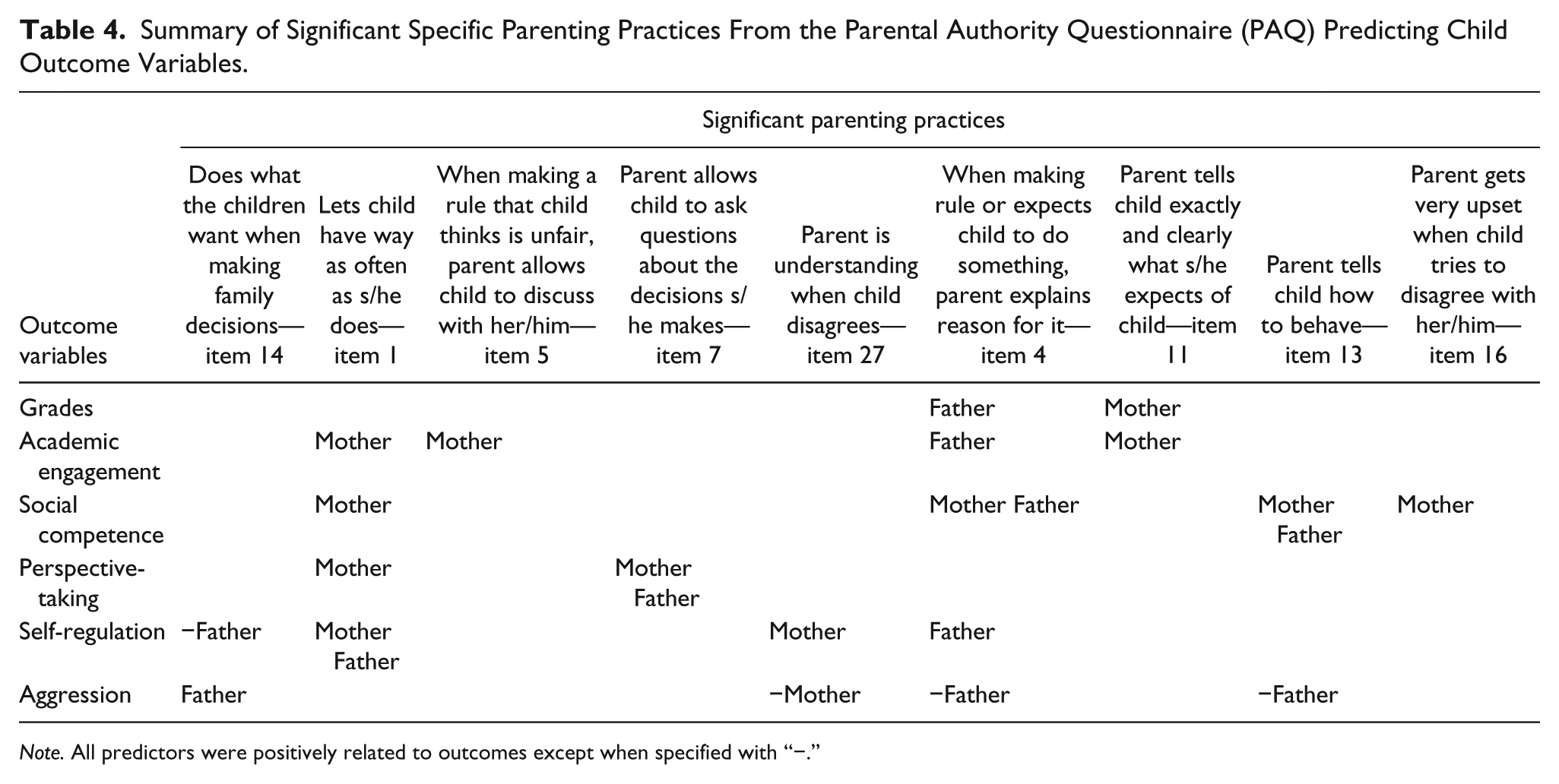
Note. All predictors were positively related to outcomes except when specified with “−.”
School-Related Parenting Practices As Reported by Teacher and Child Outcomes
Lastly, we examined the relations between various school-related parenting practices and child outcomes (see Table 5 for correlation matrix). Parents having transportation to get to school when needed was significantly and positively related to children’s academic engagement (r = .52), social competence (r = .44), perspective-taking (r = .47), and self-regulation (r = .43). The frequency with which parents attended parent-teacher conferences was significantly related to children’s grades (r = .31), academic engagement (r = .45), perspective-taking (r = .28), and self-regulation (r = .32). Frequency of parents volunteering at school was significantly correlated with children’s academic engagement (r = .47), social competence (r = .32), perspective-taking (r = .31), and self-regulation (r = .31). Parents’ willingness to attend fun events at school was significantly and positively correlated with all of the outcome variables except aggression. How involved parents were with their child’s education at home was significantly related to academic engagement (r = .42), perspective-taking (r = .36), and self-regulation (r = .32). Attending school information sessions and PTA meetings was not significantly correlated with any of the outcome measures.
Pearson’s Correlations Between School-Related Parenting Practices and Children’s Outcome Variables Controlling for Mothers’ and Fathers’ Authoritative Ratings.
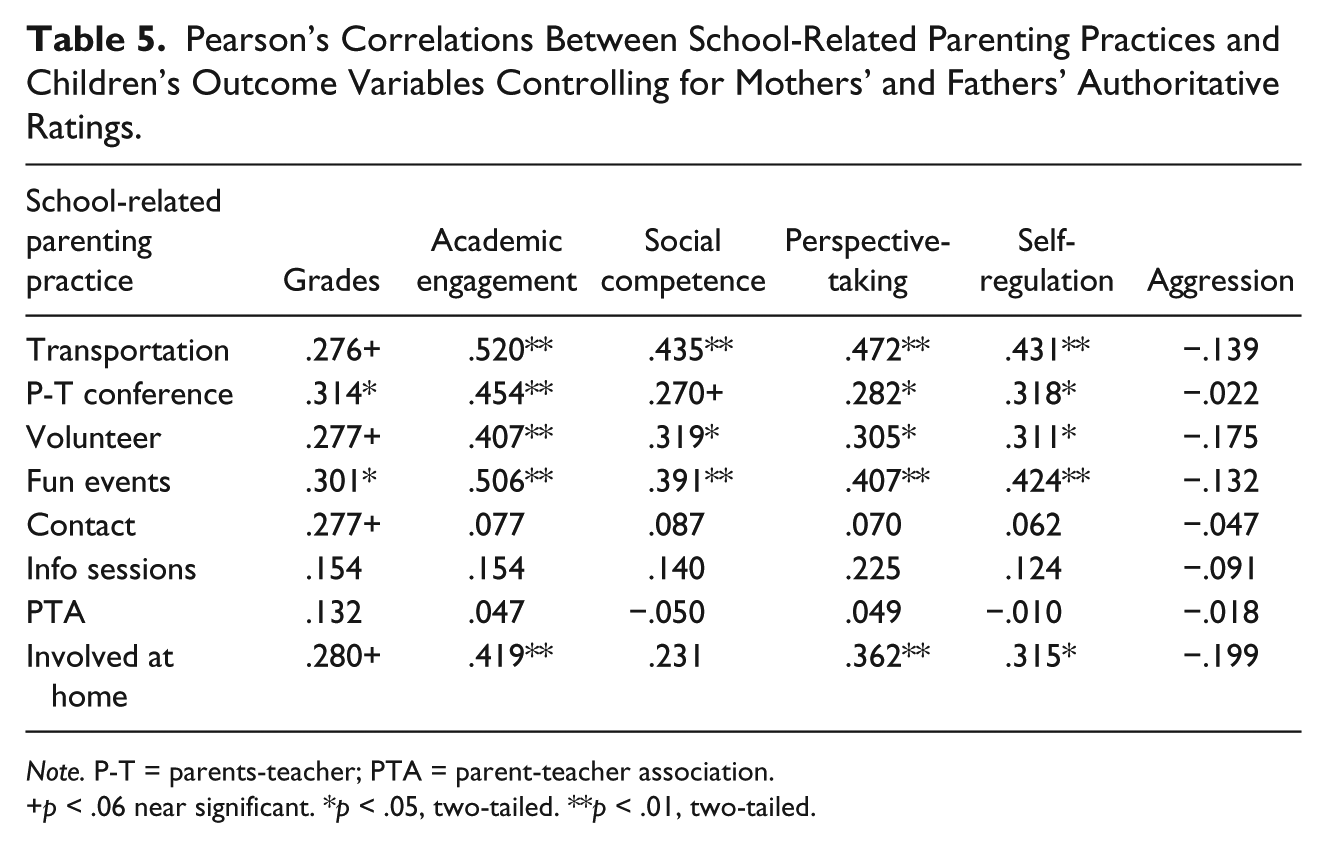
Note. P-T = parents-teacher; PTA = parent-teacher association.
p < .06 near significant. *p < .05, two-tailed. **p < .01, two-tailed.
Discussion
We examined qualitative variations in mothers’ and fathers’ parenting styles, specific practices, and school-related practices that are associated with variations in academic, social, and cognitive outcomes of Latino children in fifth grade―a pivotal, transitional year.
Parenting Styles and Outcomes
We found that authoritative parenting style is consistently and positively related to positive child outcomes and negatively related to negative child outcomes. Children who were more than less likely to view their mothers as authoritative had higher grades and self-regulation and lower aggression. Fathers who were more than less likely to be viewed by their children as authoritative had children who were more academically engaged, socially competent, and displayed higher levels of perspective-taking. Therefore, our results reveal that fathers, not just mothers, play a critical role in their children’s developmental competence. Our results also add to the controversy on cultural differences in the effects of parenting styles. We found, as did Steinberg et al. (1992) with Latino adolescents, that the more authoritative immigrant parents are the more positive are the outcomes for Latino children. Requirements for such proper behavior and compliance with societal rules need not be implemented in an authoritarian or hierarchical way, as has been suggested by some researchers (e.g., Lindahl & Malik, 1999). We found that the more authoritative the means are that Latino parents use to socialize their children the more likely they are to reach their parenting goals.
Also, it is interesting to note that we found, as have other socialization researchers, that fathers’ parenting styles more so than mothers’ parenting styles are affected by demographic factors of parents’ country of origin and marital status, number of children in the family, and sex of the child.
Parenting Practices and Outcomes
Derived from individual items of Buri’s PAQ measure, the six outcomes associated with specific parenting practices will be discussed for mothers and fathers. Interestingly, all practices, with one exception, that were significantly related to positive outcomes were consistent with authoritative parenting.
For mothers, the parenting practice that was most important was reciprocity and give-and-take (i.e., Mother lets child have his or her way as often as mother does), which was related to teachers’ ratings of the child’s academic engagement, social competence, ability to take others’ perspective, and self-regulation. The practice of mother being understanding when child disagrees was related to self-regulation and lower levels of aggression. The practice of mother telling child exactly and clearly what her expectations are was related to academic engagement and good grades.
These findings suggest that Latino mothers, not just European American mothers, do indeed engage in reciprocal interactions with their child, restraint and understanding when their child disagrees, and communicating clear expectations. These practices, which as we have found Latino mothers do indeed implement, are often deemed to be based on individualistic, democratic philosophy and ideology―inconsistent with Latino mothers’ collectivistic, hierarchical values (Markus, Mullally, & Kitayama, 1997). Our findings reveal that contrary to the suggestion by some researchers that authoritarian means are needed to achieve collectivistic ends, egalitarian means may be more effective in producing ends that are often attributed to cultures that are labeled collectivistic.
Moreover, mother discussing rules that the child deems unfair, mother allowing child to question decisions the mother has made, mother providing guidelines for proper behavior, and mother using reason and explanation were all also related to positive child outcomes of academic engagement, perspective-taking, and social competence, respectively. All of these practices are consistent with authoritative parenting, which involves the parent accommodating the child’s needs, perspective, and individuality but also requiring the child to also accommodate parental and societal expectations and rules (Baumrind, 2012).
A maternal practice that was inconsistent with authoritative parenting but was positively related to child social competence was mother becoming upset when child disagrees with mother. The lesson these children may have drawn from their mothers becoming upset when they disagreed with them is that disagreement has to be conveyed respectfully and in ways to maintain social harmony and cooperation.
For fathers, the parenting practice that was most significant was paternal use of reason/explanation which was related to good grades, academic engagement, social competence, self-regulation, and low aggression. Other paternal practices that were significant included children who reported that their fathers provide them with guidelines for proper behavior who in turn were viewed by their teachers as socially competent and low on aggression. Furthermore, children who reported that their fathers allow them to ask questions about their fathers’ decisions and who engaged in reciprocal interactions and give-and-take were viewed by their teachers as adept at taking others’ perspective and being self-regulated, respectively. Again, these practices are consistent with authoritative parenting and the positive outcomes that are associated with authoritative parenting.
A parenting practice that children reported for their fathers that is consistent with permissive parenting is fathers’ routinely giving-in to child (i.e., does what the children want when making family decisions). The teachers of these children viewed them as aggressive and lacking self-regulatory skills. Our findings reveal that fathers’ involvement by means of authoritative practices such as using reason and explanation and having guidelines for proper behavior are especially important in deterring aggressive behavior in children. Conversely, when fathers’ involvement is lacking and fathers are inactive or easily give-in and relinquish control, developmental outcomes are negative―in particular outcomes of self-regulation and aggression. Our findings support Baumrind’s (2012) proposition and findings (Baumrind et al., 2010) that parental control must not only be rational, reasoned, and outcome-oriented, but also firm, so that children are able to clearly differentiate the boundaries of acceptable and unacceptable behavior. When fathers routinely give-in and do not take a firm stand to enforce basic rules and limits or to curb unacceptable child behaviors, children are deprived of the opportunity to redress their misbehavior or control frustration and negative emotions that may be associated with having to delay gratification (Eisenberg et al., 2004; Patterson & Fisher, 2002).
Practices that both mothers and fathers implemented, that were significantly related to child outcomes, included use of reason and explanation which was positively related to child social competence, allowing child to question parental decisions which was positively related to child perspective-taking, reciprocity/give-and-take which was positively related to child self-regulation, and providing guidelines for proper behavior which was positively related to child social competence. Therefore, it is important for both mothers and fathers to engage in practices that heighten children’s own logical capacities to understand cause and effect relationships and thus societal rules and consequences.
School-Related Parenting Practices and Child Outcomes
We found that parents providing transportation to school, attending parent-teacher conferences, volunteering at school, attending fun events at school, and being involved in their child’s academic work (education and learning) at home are positively and significantly related (although in some cases marginally significant: p < .06) to both grades and academic engagement as well as to social competence, perspective-taking, and self-regulation.
Although 90% of our participants qualified for free or reduced price lunch, many of their parents were resourceful enough to provide transportation, attend parent-teacher conferences, volunteer at school, attend fun events at school, and be involved at home in their child’s education. Our results are similar to those of Jarrett (2000) with African American parents and Delgado-Gaitan (1992) with Mexican American parents who found, as we did, that despite living in low income circumstances, parents in these studies were affectively warm, nurturant, and deeply committed to their children’s success. Our results and that of Jarrett’s and Delgado-Gaitan’s reveal that families living in low income circumstances are not a homogeneous group, and the strengths they possess in being able to cope with and triumph in low income conditions need to be further studied, so that interventionists are apprised of their strengths and resources.
The sample for the present study was modest in size due to the intensive interviews we conducted to collect data, and caution should be exercised about drawing conclusions from non-experimental and cross-sectional data. We also did not assess variations in social class, economic access, and level of acculturation to be able to distinguish cultural and value-based factors associated with parenting and child outcomes from economic and social class factors. The potential differences and interactions among these factors and the unique outcomes associated with social class, economic access, and level of acculturation are grossly understudied. However, in the present study, we did “control” for economic access by having a relatively homogeneous sample of children who qualified for free and reduced price lunch (over 90%) and statistically controlled for fathers’ country of origin (mothers’ country of origin was not significantly related to child outcomes). Nevertheless, research is needed to systematically examine differences attributable to different levels of economic access and acculturation, which in some existing studies in the literature are confounded.
The strength of the present study is the absence of shared-source variance, which leads to the inflation of significant findings and is prevalent in the parenting literature. We obtained the parenting styles data from the children and the outcome data from teachers. We also studied an age group and a minority group that is understudied. Our results would appear to provide further support for the assertion that an authority style akin to Baumrind’s authoritative parenting does, indeed, confer academic and psychological advantages upon Latino children. We found no significant links between degree of authoritarian or permissive parenting styles and child outcomes with the exception of the practice consistent with permissive parenting involving fathers routinely giving-in to their child, which was negatively related to child self-regulation and positively related to child aggression―a pattern that has also been found for European American children (Patterson & Fisher, 2002) and is consistent with the findings of Gayles et al. (2009) for Latino sixth and seventh grade children.
Unlike other studies (e.g., Steinberg et al., 1992), we did not find that our elementary-school-age Latino children viewed their parents as authoritarian. We found that the Latino children in our study were likely to regard both their mothers and fathers as authoritative not authoritarian―findings that are similar to those of Varela et al. (2004). The authoritative pattern we found is consistent with Latino cultural values, which involve the adoption of non-punitive control by parents, as they seek to promote the values of harmonious interpersonal relationships (respeto) and training in responsibility and morality (educacion), as well as support for and dedication to children’s academic success (Valdes, 1996).
Footnotes
Acknowledgements
We would like to thank the teachers and students who participated as well as our student research assistants.
Declaration of Conflicting Interests
The authors declared no potential conflicts of interest with respect to the research, authorship, and/or publication of this article.
Funding
The authors disclosed receipt of the following financial support for the research, authorship, and/or publication of this article: The study was supported by a grant from the Lurie College of Education.