




Abstract
This study explores the psychological and family well-being of Mexican undocumented and unaccompanied children sent back through the U.S. border region of Sonora-Arizona. Procedures included exploring children’s own accounts using semi-structured interviews with 13 minors (9-17 years old) conducted at border shelters within Mexico. Based on previous qualitative findings, psychological measurement scales were administered to 53 participant children and adolescents during the second phase. There were statistically significant correlations between number of crossing attempts and resilience, as well as between number of days in the shelter and depression. The findings suggest that children possess psychological resources to face distress and negative affect caused by family separation, unaccompanied travel, and crossing experiences. These findings contribute to informing future public health policy and programs directed at the increasing population of unaccompanied minor migrants.
Keywords
Despite a downward trend in the number of repatriation events (i.e., record of persons who have been “sent back” from the United States to Mexico by U.S. Immigration Services), the Mexican Institute of Migration reported that during 2012 there were 15,984 repatriation events involving children and adolescents under 18 years of age. The statistics also show that 79% of these cases were of unaccompanied children and adolescents; these are children who travel without the company of a family member or other adult person legally responsible for their care and safety. A total of 35.6% of these unaccompanied children were under 11 years of age (Instituto Nacional de Migración, 2012, p. 37). Although there is literature discussing the implications of unaccompanied child migrants on children’s health and safety, there is an absence of information on how migration affects children’s psychological well-being (Salgado-Snyder, González, Bojorquez, & Infante, 2007; Valdez-Gardea, 2007, 2008).
The literature exploring mental health outcomes for Latino and Mexican immigrants, youths along the Mexico-U.S. border region, is available (Cauce & Domenech-Rodríguez, 2002; Flores & Kaplan, 2009; Love & Buriel, 2007; Roche & Kuperminc, 2012); this is not the case for the group targeted in the present study. The undocumented and unaccompanied children are “sent back” by U.S. Immigration Services because they failed in their attempt to cross the border and are, then, sheltered by Mexican governmental agencies. The children wait to return to their communities of origin in Mexico. Thus, these children cannot be considered U.S. Mexican-origin immigrants, nor can be seen as residents of border cities. These children are in transit to the United States, and the available literature on them is scarce. From previous studies, we know that the primary reason for the children to cross the border is to seek employment, and second, to reunite with family members already in the United States (Fimbres, 2008; Valdez-Gardea, 2008).
As stated by Valdez-Gardea et al., a third of all unaccompanied children and adolescents cross the border seeking family reunification. The literature refers to transnational families as persons who are tied to more than one country, spread across geographical and legal borders keeping long-distance, border-crossing connection (Vertovec, 2004). Some studies suggest that transnationalism may lead to non-normative family experiences with potentially strong effects on children’s psychological well-being (Bernardi, 2011). For example, some studies have described the emotional costs of siblings born on both sides of the border who may never meet, and the experience of facing unequal opportunities in development and life expectancies. Researchers have also focused on children’s feelings of abandonment, especially for those left behind, suggesting that these family experiences involve risks for children’s psychological well-being (Faulstich-Orellana, Thorne, Chee, & Lam, 2001; Mummert, 2009). Similarly, other studies explore how parents maintain their roles helped by affordable communication technology, while questioning the quality of such childrearing practices and the eventual impact on children’s developmental outcomes (McGuire & Martin, 2007).
In sum, the literature shows that extraordinary life experiences are part of transnational families. For most of the undocumented young migrants targeted in this study, the journey to reunite with their families in the United States has already involved years of separation, emotional costs, as well as objective risks during traveling, and sometimes unsuccessful attempts of reunification, all of which may have important consequences for their psychological well-being.
Objective
The purpose of this study was to explore familial and psychological well-being of children and adolescents sheltered by a Mexican government agency located along the Sonora-Arizona border. The first objective was to obtain, from the perspective of the actors, the experiences and resources they used to cope with family separation. The second objective was to gather a quantitative description of these children and adolescents’ experiences by means of a self-report questionnaire that included several psychological scales to assess well-being. This information is needed to inform policymakers and to guide intervention efforts addressing the well-being of these young migrants.
Method
Participants
During the qualitative inquiry, 13 minors aged 9 to 17 years were interviewed in Mexican shelters located in two main cities within the Sonora and Arizona’s borderline: Agua Prieta and Nogales, Sonora. For the quantitative phase, a total of 53 children and adolescents ranging in age from 12 to 17 years responded to the questionnaire in the Nogales shelter.
Procedure
After obtaining Human Subject Protection approval from the University of Sonora, we contacted the authorities of Sistema de Desarrollo Integral para la Familia (DIF-Sonora) to ask for authorization to come into the shelters and conduct the interviews. A total of seven visits were made to the shelters during 2010 and 2011. In order to create a trust-and-leisure–type environment, the research team developed a recreational workshop to be implemented while visiting the shelter. During 3-day visits, the research team explained the objectives of the study to the group of children and adolescents (approximately 50 children, most of them different at each visit) and invited them to participate in all activities. Once good rapport was achieved, those children and adolescents who agreed to be interviewed or to complete the questionnaires filled them out individually in a quiet place (i.e., dining room used during the workshops).
Measures
Interview
During the qualitative inquiry, researchers conducted semi-structured interviews. The script for this interview explored children’s experiences before and after their family’s migration; examples of the questions included, “What did you use to like most when you all lived together?” Interviews were recorded, except in the case of one from an adolescent who did not consent to be recorded, and fully transcribed for purposes of analysis. The analyses consisted of identifying themes/subthemes within the respondents answers (Patton, 1990).
Questionnaire
During the second phase, the research team applied several measurement scales that were selected with the purpose of extending our exploration of the psychological themes that emerged during the qualitative phase. Additionally, the questionnaire included several demographic items as well as items that asked about crossing experiences taken from the Encuesta sobre Migración en Frontera Norte EMIF (Consejo Nacional de Población [CONAPO], 2010). Also, a set of items created by the principal researcher were included to inquire about children’s perception of the consequences that migration brought to them, for example, “Since your parents migrated to the U.S., how often did you have to pay for your material things (i.e., clothes, school supplies)?” After a pilot application with 12 participants, some questions were reworded and a couple of scales removed as unsuitable or inappropriate for the study goals. The final version included the following psychological measurement scales: Attachment Quality (adapted from Buhrmester & Furman, 1987), Resilience (Gaxiola, Frías, Hurtado, Salcido, & Figueroa, 2011); Familism Value (Wozniak, Sung, Crump, Edgar-Smith, & Litzinger, 1996); Risky Neighborhood, Peers, and Behavior (adapted from Questionnaire D20; Charles & Egan, 2005), and Depression/Anxiety (set of 10 items from the original Beck Depression Inventory; Beck, 1961). All the measures used a 5-point Likert-type scale ranging from 0 = no/never, to 4 = always). Reliability analyses were performed only for the measurement scales; Cronbach’s alpha scores were from adequate to excellent for all the scales (ranging from .69 to .97), but for Familism Value which had a disappointing reliability alpha (.53) and which requires that caution be used in interpreting the results of this scale (see Table 1).
Scale’s Descriptive Analyses and Cronbach’s Alpha.

Results
Qualitative Inquiry
Seven topics/themes were identified in order to describe the experience of the interviewed children about migration of their parents or significant relatives. Topics indicate the adjustments of the children to everyday life in their communities and their effects on psychological well-being.
Parent-child relationship before departure/separation
Children indicated that their previous relationship with parents was positive since they had developed parent-child attachment. They described a positive mother figure as someone who was protective, warm, and with a positive behavioral guidance. In addition, mothers were described as being good providers. When the mother was identified using an authoritative style, children tried to maintain positive parent-child bonding and mothers were described as possessing positive values and behavior even though a great geographic distance separated mothers from their children.
Children’s reactions to departure/separation
Children reacted to separation with sorrow/sadness and a sense of being abandoned. Parents/relatives keep in contact with children by periodical phone calls, and children interpreted this situation as if they were still present in their parents/relatives lives.
But distance made changes in children’s lives, which were mainly difficulties related to remaining in school and/or excelling in their classes and receiving good grades. These effects are non-permanent if children live with relatives assuming observation and approving good school grades. But staying at school is difficult for kids with younger brothers and sisters because they have to take care of younger siblings or find a job to help youngsters to stay at school.
After parents’ departure, children report that they start to forget their parent/relatives faces, and do not remember how they look. One interviewed child started crying and feeling anxious when he mentioned that he could no longer see his mother’s face. Also, transition to loneliness and independence was observed among some of the interviewed children, mainly those whose parents left them when they were children, and who are now adolescents. The transition to living without their parents was successful when children lived with caring relatives.
Current communication with parents/relatives
Maintaining parent-child communication through phone calls works as a valuable resource to strengthen parent-child bonding/attachment and has a positive effect on the child’s well-being. Children reported feeling protected when they talked to their parents, but they also felt that this was not enough because they needed their parents on a day-to-day basis in their lives.
Another group of children were those seeking to cross the border to reunite with older brothers already established in the United States. Most of their parents had remained in Mexico, but crossing the border to them meant better opportunities to go to school, especially to high school or the university. This was true mainly for children from rural or small communities.
Adapting to caretakers
The majority of interviewed adolescents reported that they succeeded in adapting to their new caretakers, usually assigned by their parents before leaving for the United States, especially if they were left in the care of their grandparents. But they still missed their parents, especially their mothers, which is indicative of the enormous importance of mothers’ nurturing through childrearing.
Sources of social support and positive behavior guidance
Children who lived with relatives while their parents were in the United States reported having better sources of social support and positive guidance for their behavior. The Mexican extended family works as an effective support because children feel family warmth and caring from other adult family members. They also are exposed to positive behavioral guidance, not only from family, but also from religious congregations that work as surrogate families for children who do not have an extended family in the community. Children with strong extended family support return home and typically do not try again to cross the border.
Well-being in the community of origin
Material well-being including access to healthy meals, clothing, education, leisure, and working opportunities in the home community can promote migration when parents are gone. Most of the interviewed children came from rural communities, but against most expectations they felt satisfied with the opportunities provided by their communities, and interestingly even though they were poor, they felt better off than other children living in poorer conditions. The difference was due to the money they received from parents and relatives working in the United States. In some cases, older children sought better opportunities in the United States, but this was not the rule in most cases. It seems that younger children, however, were more concerned with reuniting with their parents because of the filial bonding they felt toward their parents.
Exposure to risk in the home community
Rural communities in Mexico are not absent of risks. Violence and exposure to alcohol and drugs are prevalent, resulting in children becoming involved in antisocial behavior. This situation is recognized, and authorities worry about children because of these negative influences. Children, on the other hand, felt relatively safe if they lived with relatives, but children appeared cognizant of their greater risk because of the absence of their parents.
Quantitative Phase
Demographics
Of the 53 participants in this phase of the study, 96% of the participants were between 14 and 17 years of age; 81% were male. Almost two third were from central and southwest states of Mexico (i.e., Guerrero [30%], Puebla [16%], and Oaxaca [18%]). A total of 89% reported that they possessed writing and reading skills in Spanish; however, only 19% were attending school in their communities. About 44% of the participants had, at most, completed elementary school; the remaining 52% attended middle school, but 25% of these had not completed middle school; 45% of the participants had been employed in some capacity, and only 24% had full-time work. The most frequent occupations were in agriculture (34%) and non-formal retail (31%). Importantly, 17% reported that the main economic support for the family came from remittances made from family members working in the United States.
As seen in Table 1, mean scores of Attachment, Resilience, and Familism Value are at the highest values of the scale, whereas scores on perception of family and work well-being, Risky Neighborhood Peer Behavior, as well as Depression/Anxiety are at the lowest values of the scale with risky behaviors reaching the lowest value (M = 0.03; see Table 1).
Table 2 describes children’s family and crossing experiences. As shown, 69% indicated that their reason for crossing the border was to obtain a job, which is consistent with previous studies (Valdez-Gardea, 2007): 83% of the informants indicated that they had been separated from their family members between 3 and 14 years of age; 31% of participants were left behind in Mexico under the care of extended family members or friends; 88% reported at least three crossing attempts and 43% reported that they would try it again.
Percentages of Response for Family Migration and Crossing Experiences Questions.

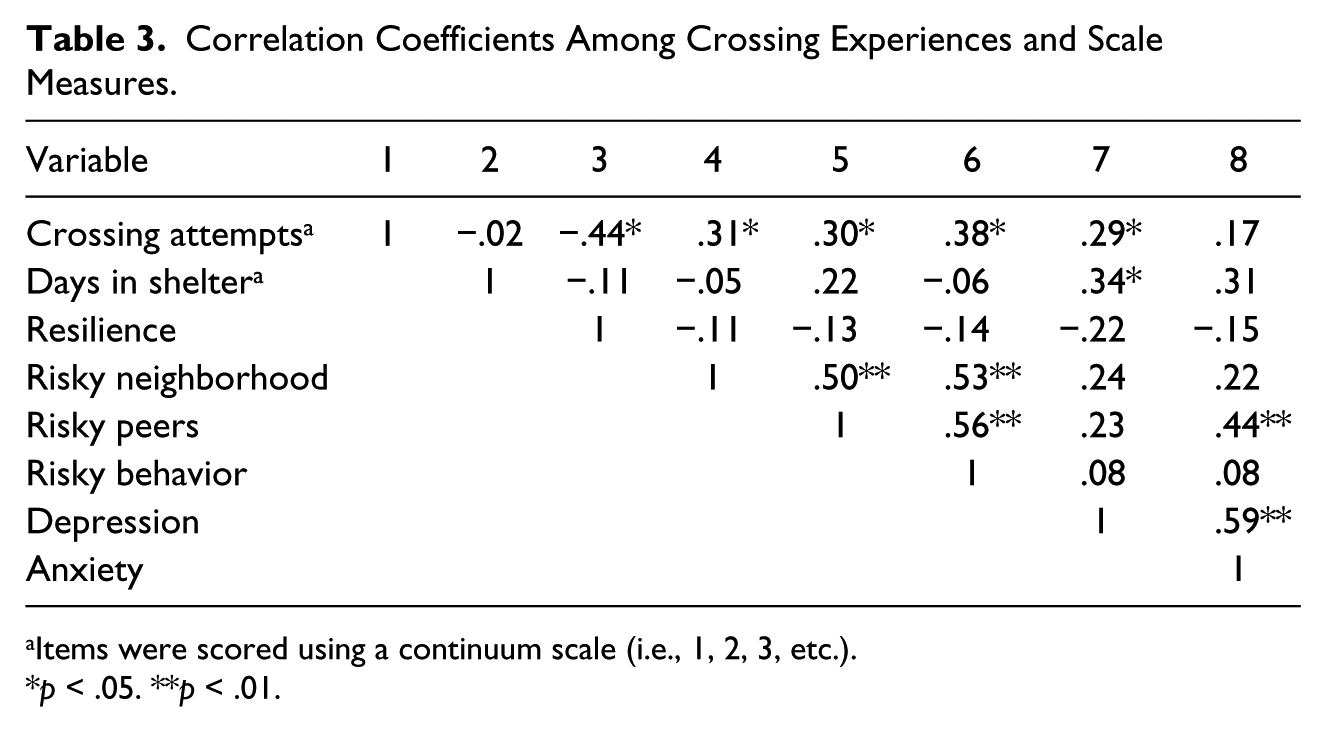
Bivariate correlation analyses were performed for crossing experiences and the scales of psychological well-being. Table 3 shows only those variables reaching at least one statistically significant correlation. As can be seen, number of crossing attempts is associated with most of the variables within a range of r = .29, to −.44. The variable number of days in the shelter is positively associated with depression (r = .34, p ≤ .05). There is also a negative correlation between number of crossing attempts and resilience (r = −.44, p ≤ .05). Risky neighborhood, risky peers, and risky behaviors were all highly correlated (r = .50-.56, p < .01).
Correlation Coefficients Among Crossing Experiences and Scale Measures.
Items were scored using a continuum scale (i.e., 1, 2, 3, etc.).
p < .05. **p < .01.
Discussion
Despite the exploratory nature of the data obtained and given the emerging nature of the topic, the study reveals important issues around migration experiences of unaccompanied undocumented children on the Mexico-U.S. border. The adequate levels of reliability in most of the scales suggest that attachment quality, resilience, risk perception, depression, and anxiety are potential indicators for a more exhaustive assessment of psychological well-being in this group of children. In the same vein, acceptable levels of association were found among psychological well-being variables and migration experiences, such as number of crossing attempts and time spent in shelters. With regard to the negative association between number of crossing attempts and resilience, this suggests the harmful effect of failing in crossing the border and thus failing to reunite with their families. To explain the inconsistencies found between risk perception (i.e., neighborhood and peers), depression, and anxiety, more research is needed. However, it is important to better understand how youth draw support from their peers before and during the process of crossing the border.
These results are preliminary findings. Future studies will consider improving psychometric properties of the measures as well as efforts to increase the sample size. That way, it could assure enough statistical power to perform more rigorous statistical analyses that may clarify the association among variables and explain the inconsistencies found in this study.
In summary, our findings suggest that children and adolescents have good coping resources that foster their psychological well-being. This is consistent with the perception that managers of the shelters as well as employees of Mexico immigration agencies have of this group of young people who they believe to be good children searching for better opportunities (Sotomayor-Peterson, 2012). These findings are also consistent with Miller’s (1996) study with children from Guatemalan refugee families in México, and with Vera, Robles, Lunes, and Yáñez (2010), and their study of children of national migrant families working in the fields of Sonora, who found only occasional psychological trauma and negative emotional effects associated with the migration of children’s families. Additionally, the findings are consistent with studies highlighting the role that communication technology (phone calls from disposable cell phones or computers) is playing in maintaining family cohesion and parent-child attachment among transnational families (Bernardi, 2011; Faulstich-Orellana et al., 2001; McGuire & Martin, 2007; Mummert, 2009).
Given our findings, there is a clear need for further research. Future studies should take into account the parents’ perspective, given the enormous influence that parents’ functioning has on child developmental outcomes (Belsky, Putnam, & Crnic, 1996).
Our findings have implications for public health policy. Social policymakers need data resulting from scientific research that may help in developing evidence-based programmatic efforts oriented to improve life conditions of this vulnerable population. It is important to document the effects of international, transnational, undocumented migration over family unity, as well as the psychological and mental health of children and adolescents in order to highlight the urgent need of caring for children left behind in the migration process (Castañeda, 2007; Salgado-Snyder et al., 2007).
Footnotes
Declaration of Conflicting Interests
The authors declared no potential conflicts of interest with respect to the research, authorship, and/or publication of this article.
Funding
The authors disclosed receipt of the following financial support for the research, authorship, and/or publication of this article: This material is based upon work supported by a grant from the Health Initiative of the Americas (HIA) from the School of Public Health of the University of California at Berkeley through the Programa de Investigación en Migración y Salud (PIMSA) 2009-2010.