



Abstract
The 2.5 generation refers to individuals who have one parent born in the United States and one born in another country. The presence of both native-born and foreign-born parents has the potential to enhance bicultural adaptation. Across two studies with Latino young adults, we examine the extent to which the 2.5 generation is distinct from members of other generations with regard to cultural orientation, acculturative stress, and parent ethnic socialization. Results suggest that the 2.5-generation individuals report greater native cultural orientation, ethnic identity, and parental socialization compared with third-generation individuals, along with greater American orientation than first-generation individuals. The 2.5 generation also reports less language use and more acculturative stress due to Spanish competency pressures than first- and second-generation individuals. These results demonstrate that the 2.5-generation individuals may have some bicultural advantages compared with third-generation individuals; however, they may also experience similar challenges with regard to language maintenance.
Recent demographic evidence points to changes in the generational composition of the Latino population in the United States. Immigration rates have slowed, while the number of U.S.-born Latinos has begun to grow more rapidly (Krogstad & Lopez, 2014). Social science researchers must continue to keep up with the changing demography of the Latino population with particular attention to the implications of these changes for the psychological adaptation of individuals. A central issue is the process by which Latino youth maintain the dual processes of adapting to the dominant culture (i.e., acculturation) while simultaneously learning to adopt the values and standards of their native culture (i.e., enculturation) in order to develop a bicultural identity (Birman, 1998). The ability to successfully alternate one’s behavior between two cultural contexts, also known as bicultural competence, is associated with positive psychological health outcomes (e.g., life satisfaction, self-esteem, academic adjustment, and an absence of behavioral problems; Berry, Phinney, Sam, & Vedder, 2006). Yet the attainment of such competence is not always easy due to challenges of achieving bilingual proficiency and cultural socialization (Portes & Rumbaut, 2006), particularly the familial and non-familial resources available to support bicultural competence that depend on generational status (Padilla, 2006).
For the last few decades, the largest segment of the Latino population has been composed of foreign-born individuals, also known as first generation. Nevertheless, the second and third generations are rapidly increasing in size (Krogstad & Lopez, 2014). The second generation refers to those who have both parents born outside the United States, but often in the literature are not distinguished from individuals who have one foreign-born and one U.S.-born parent. The latter group is occasionally called the “mixed generation” (Portes & Rumbaut, 2001) and recently referred to as the 2.5 generation (Ramakrishnan, 2004). Although researchers rarely conduct analyses examining 2.5 individuals, we strongly believe this distinction may be quite significant when considering access to ethnic cultural knowledge and adaptation to American customs. Therefore, the purpose of this study is to examine the extent to which those we will refer to as the 2.5 generation are distinct from members of other generations with regard to cultural orientation, acculturative stress, and parental ethnic socialization.
Theoretical Orientations Regarding Biculturalism
The alternation model views biculturalism as the ability to accommodate one’s behavior and language between two cultures, adapting to the contexts without having to sacrifice the benefits of either culture (LaFromboise, Coleman, & Gerton, 1993; Padilla, 2006). An extension of this model is the bicultural competence theory that states that in order for an individual to develop a bicultural identity, an individual must perceive competence among different cultures. A continuum of personal and social skills are deemed necessary to achieving bicultural expertise, including language fluency, knowledge of cultural beliefs and history, positive attitudes and bicultural efficacy, and culturally appropriate behavior, including social networking among cultural groups (LaFromboise et al., 1993). Individuals may possess different constellations of these skills, achieving competence in some areas, while simultaneously falling short in others.
For this reason, research on acculturation has also considered the extent to which individuals experience acculturative stress as a result of the process of cultural learning and adaptation (Berry et al., 2006). While the first generation experience stress due to pressure to learn English and adaptation a new culture, later generations may experience pressure to learn Spanish and fit in with those who are Latino oriented (Rodriguez, Myers, Mira, Flores, & Garcia-Hernandez, 2002). These pressures may be due to perceived discrimination from out-group members or marginalization from members of their own ethnic group when their behavior is perceived as too American or “white-washed” (Romero, Carvajal, Valle, & Orduña, 2007).
In order to better understand the bicultural process, we draw on the cultural socialization theory that grew from ecological systems theory (Bronfenbrenner, 1989) and the social cognitive model of cultural development (Knight, Bernal, Garza, & Cota, 1993), which emphasize the importance of considering the family context and non-familial socialization agents for achieved bicultural balance and competence. Particularly, the family context plays a key role helping the child to adapt to larger society, develop ethnic identity, and form cultural cognitive scripts. Thus, the extent to which children are able to become biculturally competent depends in large part from the support received from the family and other close socialization agents (e.g., extended family, peers, teachers) who provide instruction, exposure to traditions and practices, and feedback to behavior on a regular basis.
Because bicultural competence involves cultural knowledge and proficiency, it is also important to consider Bourdieu’s (1977) theory of cultural capital. Cultural capital involves familiarity and facility with the practices and assumptions of the dominant culture, and this is often transmitted via the educational system and media. Similarly, the family context is also an important source of cultural capital; therefore, this theory can be useful in making predictions about the 2.5 generation. For the 2.5 generation, having access to parents from both the ethnic and mainstream culture allows individuals to reach greater cultural capital not only with regard to the dominant culture but also their heritage culture. In sum, the above theoretical orientations point to reasons of why the 2.5 generation may be advantaged and disadvantaged relative to other generations. Specifically, the 2.5 generation is expected to have greater bicultural capital compared with third-generation youth, while also having increased acculturative stress relating to enculturation compared to first generation youth who have more heritage cultural capital within the home.
Generational Differences in Bicultural Orientation
Although there is an abundance of research investigating first- and second-generation Latino youth with new emerging research on third generation (Padilla, 2006), less is known about 2.5 generation in relation to the above bicultural processes. One study provided a more nuanced approach and measured generation status as a continuous variable by counting the number of foreign-born parents and grandparents of a child (Umaña-Taylor, Alfaro, Bámaca, & Guimond, 2009). They found that generation status measured this way was related to greater family ethnic socialization and language fluency, which in turn was related to greater ethnic identity. Others have made comparisons between those with two foreign-born parents and those with only one. For example, Portes and Rumbaut (2006) found that youth who we refer to as the 2.5 generation (i.e., with only one foreign-born parent) were more likely to graduate high school and to be employed. Although the 2.5 generation was advantaged with regard to these indicators of educational and economic adaptation, 2.5-generation was less likely to consider themselves fully bicultural and bilingual (Portes & Rumbaut, 2001).
Current Study
In examining marriage patterns across generations, Lichter, Carmalt, and Qian (2011) point out that the second-generation Latino population is increasingly likely to marry foreign-born individuals, possibly as a way to hold on to the culture of origin. This would suggest that the number of 2.5-generation individuals might continue to increase or remain steady in the coming years. Investigating the process of bicultural transmission within the 2.5 generation may be valuable to acculturation researchers because of the unique cultural capital available to these individuals. The purpose of the present study is to examine the extent to which 2.5-generation Latino young adults compare to young adults from other generations with respect to variables relevant to bicultural competence. In the first study, we examine cultural orientation and knowledge for both Latino and American cultures, ethnic identity, and acculturative stress across all four generations (U.S.-first, U.S.-second, U.S.-2.5, U.S.-third). In the second study, we use a different set of questionnaires measuring several dimensions of cultural orientation, with the addition of a measure of parental ethnic and racial socialization.
Based on the previous findings and bicultural theories mentioned above, we expect 2.5 generation to be unique from other generations in several domains:
Nevertheless, given that the presence of one U.S.-born parent is associated with greater use of English in the home (Portes & Rumbaut, 2001), we also expect that the 2.5 generation will experience difficulties with regard to Spanish competence and acculturative stress relating to acculturation. Furthermore, past research has not found generational differences with regard to perceived discrimination (Cervantes, Padilla, Napper, & Goldbach, 2013).
Additionally, in Study 2 we test differences across generations on family ethnic and racial socialization. The term ethnic socialization commonly refers to practices that promote cultural retention and identification, while racial socialization involves preparation for racial bias (Hughes et al., 2006). Given that the number of foreign-born families have been linked to increased support for cultural traditions (Umaña-Taylor et al., 2009), we expect the 2.5 generation to report increased family ethnic socialization compared with the 3rd generation. Although we do not offer a hypothesis regarding racial socialization, we include this variable in order to explore possible generational differences. Thus,
Study 1
Method
Participants and procedure
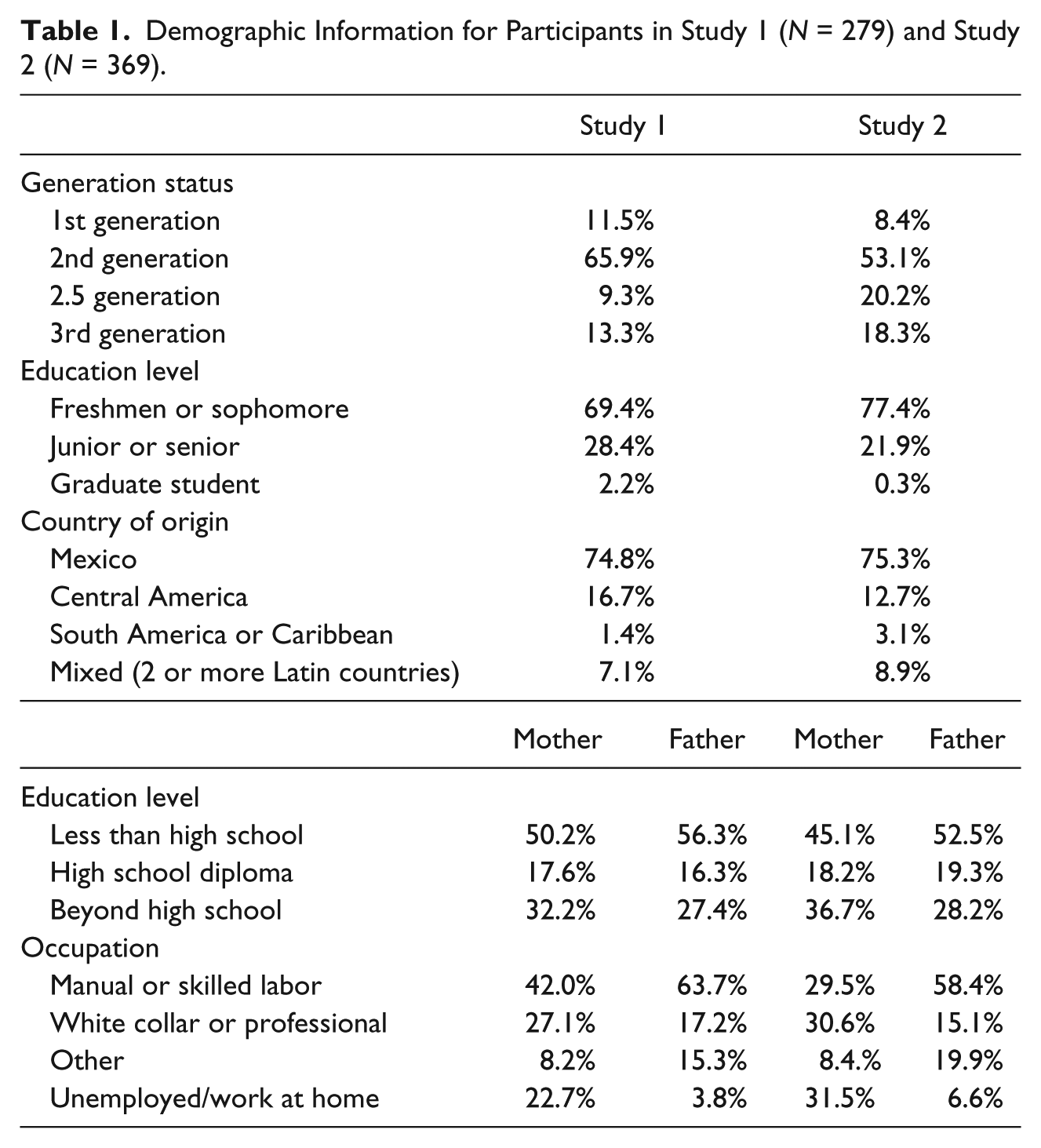
Two-hundred and nine Latino students (179 female, 100 male) ranging from 18 to 32 years of age with a mean of 20.07 years (SD = 2.59) participated in the first study. With regard to generation status, 32 were 1st generation, 184 were 2nd generation, 26 were 2.5 generation, and 23 were 3rd generation. Of those who were 2.5 generation, 10 (38%) of their mothers were the foreign-born parent (M age at immigration = 23.4 years, SD = 15.04) and 16 (62%) of the fathers were the foreign-born parent (M age at immigration = 30.0 years, SD = 10.54). The age at immigration for these parents was similar to that of the other foreign-born parents in the sample (M = 25.06, SD = 8.59 for mothers, M = 27.64, SD = 8.59 for fathers). The majority (97%) of the participants were recruited from the university subject pool of a Latino-serving institution in Southern California, with an additional 3% recruited from a local community college near the university. Paper survey packets were distributed in a research lab and classrooms to take home and were later collected. See Table 1 for other demographic characteristics of participants and their parents, including education level and country of origin.
Demographic Information for Participants in Study 1 (N = 279) and Study 2 (N = 369).
Measures
Participants reported demographic information about themselves and their parents, including age, gender, ethnicity, birthplace, and education level.
The Acculturation Rating Scale for Mexican Americans-II (ARSMA-II; Cuellar, Arnold, & Maldonado, 1995) contains 31 questions rated on a 5-point scale from 1 = not at all to 5 = extremely often or almost always (17 items for Latino orientation, α = .92, 14 items for Anglo orientation, α = .78). Since the ARSMA-II was created for use with Mexican Americans, the scale was adapted for use with Latinos in general (e.g., “My contact with Mexico has been” was changed to “My contact with my culture of origin [e.g., Mexico, El Salvador, etc.] has been.”).
American knowledge (e.g., “How well do you know American national heroes”) and Latino knowledge (e.g., “How well do you know popular television shows in your native language”) were measured using items each from Zea, Asner-Self, Birman, and Buki (2003) rated from 1 = not at all to 7 = extremely well (6 items for American knowledge, α = .83; 6 items for Latino knowledge, α = .74).
Multigroup Ethnic Identity Measure (MEIM; Phinney, 1992) was used to measure level of exploration and commitment of participants’ ethnic identity. It consisted of 10 items, each of which ranged from 1 = strongly disagree to 7 = strongly agree (e.g., “I understand pretty well what my ethnic group membership means to me”). Cronbach’s alpha was .90 in this study.
Multidimensional Acculturative Stress Inventory (Rodriguez et al., 2002) was used to measure perceived stress during acculturation. Participants were asked whether a specific event had occurred in the past 3 months. They were then asked to rate the degree of stressfulness on a 5-point Likert-type scale from 1 = not at all stressful to 5 = extremely stressful. The inventory consisted of 4 subscales: Spanish competency pressure (7 items, α = .92, e.g., “I have been discriminated against because I have difficulty speaking Spanish”), English competency pressure (7 items, α = .90, e.g., “It bothers me that I speak English with an accent”), pressure to acculturate (7 items, α = .86, e.g., “It bother me when people pressure me to assimilate to the American ways of doing things”), and pressure against acculturation (6 items, α = .87, e.g., “I have had conflicts with others because I prefer American customs over Latino ones”).
Data analysis
In order to examine generational status differences, two multivariate analyses of variances (MANOVAs) were conducted with generation status (1st -, 2nd -, 2.5-, and 3rd-generation) as the grouping variable. 1 In order to group together variables that are conceptually similar, one MANOVA was conducted for the cultural orientation variables (Anglo orientation, Latino orientation, American cultural knowledge, Latino cultural knowledge, ethnic identity) and one was conducted for the acculturative stress variables (Spanish competency pressure, English competency pressure, pressure to acculturate, pressure against acculturation, pressure from discrimination). When the multivariate and univariate tests indicate significance, post hoc tests were conducted using Tukey’s honestly significant difference (HSD).
Results
In the first MANOVA with cultural orientation variables, analysis revealed a significant multivariate effect for generation status, Wilks’s lambda = .62, F(15, 740) = 9.36, p < .000, η2 = .149. To explore the multivariate effect, a univariate analysis of variance (ANOVA) was conducted on each dependent variable (see Table 2).
Means by Generation Status for Study 1.
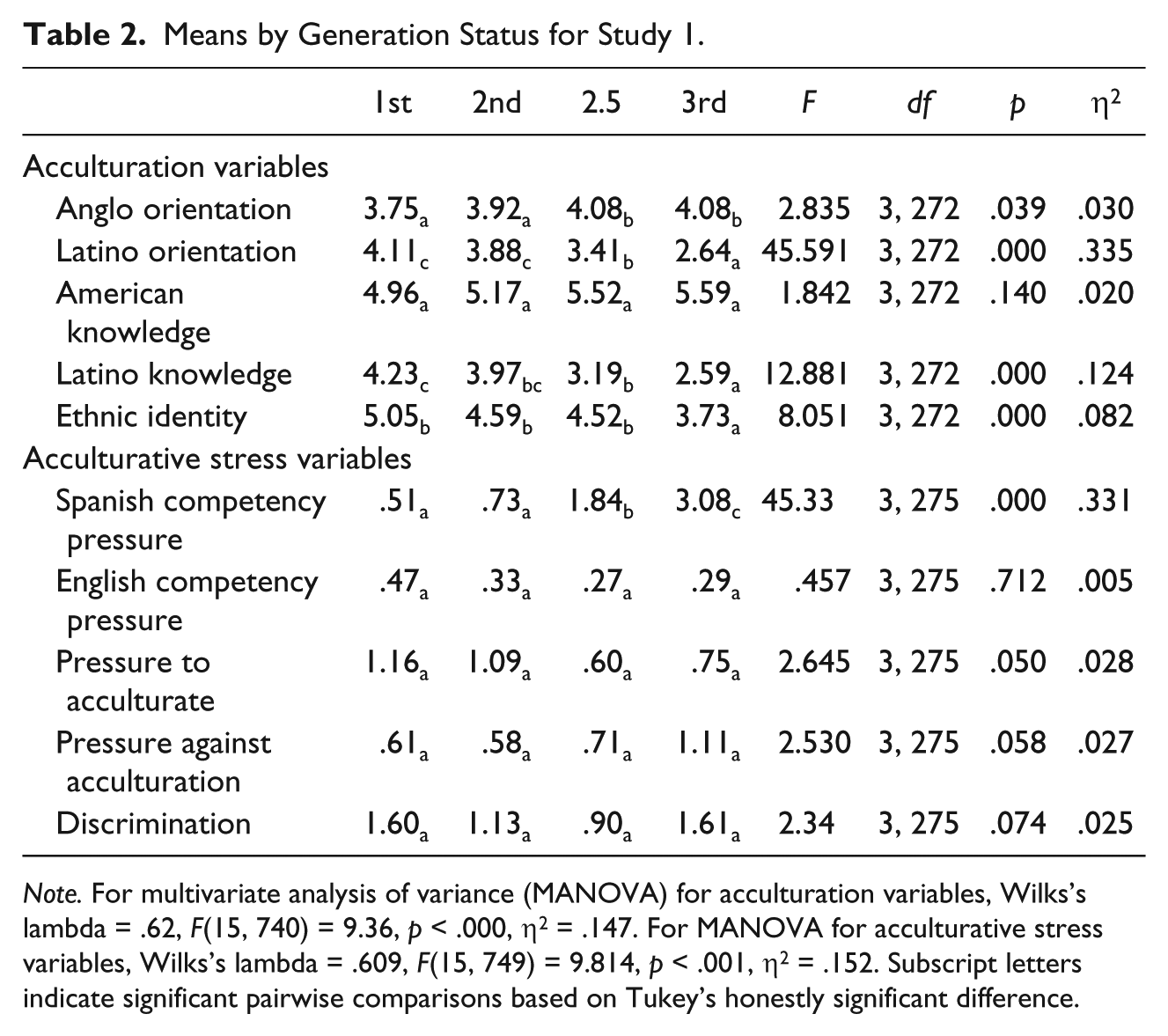
Note. For multivariate analysis of variance (MANOVA) for acculturation variables, Wilks’s lambda = .62, F(15, 740) = 9.36, p < .000, η2 = .147. For MANOVA for acculturative stress variables, Wilks’s lambda = .609, F(15, 749) = 9.814, p < .001, η2 = .152. Subscript letters indicate significant pairwise comparisons based on Tukey’s honestly significant difference.
In line with Hypothesis 1, post hoc tests found that 2.5 generation had significantly greater ethnic identity than 3rd generation and was no different from 1st and 2nd generations for this variable. Also in partial support of Hypothesis 1, 2.5 generation had higher Latino orientation than 3rd generation; however, 2.5 generation was significantly lower than 1st and 2nd generations for this variable. For Latino knowledge, 2.5 generation was significantly lower than 1st and higher than 3rd generation, but not significantly different from 2nd generation.
Hypothesis 2 expected that that integration to American cultural orientation variables would be higher among 2.5 generation than the 1st and 2nd generations but not significantly higher than 3rd generation. Post hoc tests gave partial support for this hypothesis. For Anglo orientation, the 2.5 generation was significantly higher than 1st and 2nd generations but was not significantly different from 3rd generation. There was no significant generational effect for American knowledge.
The second MANOVA was performed on acculturative stress variables and indicated a significant multivariate effect, Wilks’s lambda = .609, F(15, 749) = 9.814, p < .001, η2 = .152. See Table 2 for univariate and post hoc results. Hypothesis 3 predicted 2.5 generation to report less acculturative stress relating to English competency and pressure to acculturate than 1st and 2nd generations, but greater acculturative stress than these two groups for Spanish competency and pressure against acculturation. This hypothesis was only supported for Spanish competency pressures, for which 2.5 generation was significantly higher than 1st and 2nd generations and significantly lower than 3rd generation. Although the univariate test revealed a significant generation effect for pressure to acculturate, post hoc tests did not reveal any significant differences. There were no further significant generation differences for any of the other acculturative stress variables.
Discussion
The results of the first study indicate at least partial support for Hypotheses 1 and 2. The pattern of findings is consistent with the idea that the 2.5 generation has greater cultural capital with regard to both heritage culture and American culture. Specifically, the 2.5 generation had significantly greater ethnic identity and Latino orientation than 3rd generation who has no foreign-born parents. They had greater Anglo orientation than 1st generation indivdiuals who have no American-born parents and who were not themselves born in the United States. Furthermore, they were distinct from both the 1st and the 2nd generations with regard to lower Latino cultural orientation and greater Spanish competency pressures. This may indicate that the native cultural capital provided by foreign-born parents in the home is still not enough to encourage the internalization of culture to the same level as those born in the original country or those with two foreign-born parents. The measure of Latino orientation used in this study includes many items relating to Spanish use and competency, so it is not surprising that the 2.5 generation also report more acculturative stress due to problems with language competency. In the next study, we examine native language use separately from the practice of native customs, and this may help to further disentangle these findings. Furthermore, we include a measure of parental ethnic and racial socialization in order to more directly examine the role that parents play in promoting cultural knowledge and awareness among the 2.5 generation.
Study 2
Method
Participants
A total of 369 participants (269 female, 100 male) aged 18 to 26 years (M age = 19.54 years, SD = 1.49) were recruited from a Hispanic-serving public university in Southern California. The generation status breakdown was as follow: 31 were 1st generation, 196 were 2nd generation, 75 were 2.5 generation, and 68 were 3rd generation. Of the 2.5 generation, 30 (40%) of their mothers were the foreign-born parent (M age at immigration = 27.36 years, SD = 15.07), while only 45 (60%) of the fathers were the foreign-born parent (M age at immigration = 29.5 years, SD = 10.98). The mean age at immigration for other foreign-born parents in the sample was 25.06 years (SD = 8.59) for mothers and 27.64 years (SD = 8.59) for fathers. All participants were recruited via the university’s psychology subject pool. Participants completed questionnaires online using computers in a researcher lab. See Table 1 for other demographic characteristics of participants and their parents.
Measures
A modified version of the Stephenson Multidimensional Acculturation Scale (Stephenson, 2000) was used to measure cultural orientation. The 32 items of the Stephenson Multigroup Acculturation Scale (SMAS) scale were included, as were 9 items relating to areas of bicultural competence (LaFromboise et al., 1993) not currently covered on the SMAS scale including role repertoire and participation in traditions. All items were rated on a 5-point scale from 1 = strongly disagree to 5 = strongly agree. The 41 items were factor analyzed using principal components extraction method and a promax rotation (see Dennis et al., 2016, for more information) and four factors were found: native language use (α = .91, 9 items, e.g., “I like to speak my native language.”), native cultural participation (α = .78, 7 items, e.g., “I eat traditional foods from my native culture.”), American language and customs (α = .78, 8 items, e.g., “I feel comfortable speaking English.”), and American social engagement (α = .83, 8 items, e.g., “I attend social functions with American people.”).
As in Study 1, MEIM (Phinney, 1992) was used to measure ethnic identity. Cronbach’s alpha was .92 in this study.
Parent cultural and racial socialization was measured by adapting three items from Tran and Lee’s (2010) Ethnic-Racial Socialization Scale and 10 items from Berbery and O’Brien’s (2011) Cultural and Racial Socialization Self-Efficacy Scale (CRSSES). Items were adapted so that each item was similar in syntactic structure (i.e., “My parents have . . . ”). All items were rated on a 5-point scale from 1 = never to 5 = very often. The 13 items were factor analyzed using responses from the present study (see Dennis et al., 2016, for more information) and two factors emerged: racial socialization items relating to preparation for bias (α = .85, 7 items, e.g., “My parents have taught me to confront stereotypes that people may have about me due to my racial or ethnic background.”) and cultural socialization items relating to the promotion of cultural knowledge, fluency, and ethnic pride (α = .82, 6 items, e.g., “My parents try to ensure that I am fluent in the language of my birth culture”).
Data analysis
As in Study 1, generational status differences were examined using MANOVA with generation status as the grouping variable and the cultural orientation variables (native language, native cultural participation, American language and customs, American knowledge, ethnic identity) and parent socialization variables (cultural socialization, racial socialization) as the dependent variables (see Note 1). When multivariate and univariate tests indicated significance, post hoc tests were conducted using Tukey’s HSD.
Results
A MANOVA was conducted to examine generation status differences in cultural orientation variables. This analysis revealed a significant multivariate effect for generation status, Wilks’s lambda = .631, F (24, 1024.41) = 7.336, p < .000, η2 = .142. To examine the multivariate effect, univariate follow-up ANOVAs were conducted and revealed significant generation status effects for all variables (see Table 3).
Means by Generational Status for Study 2.
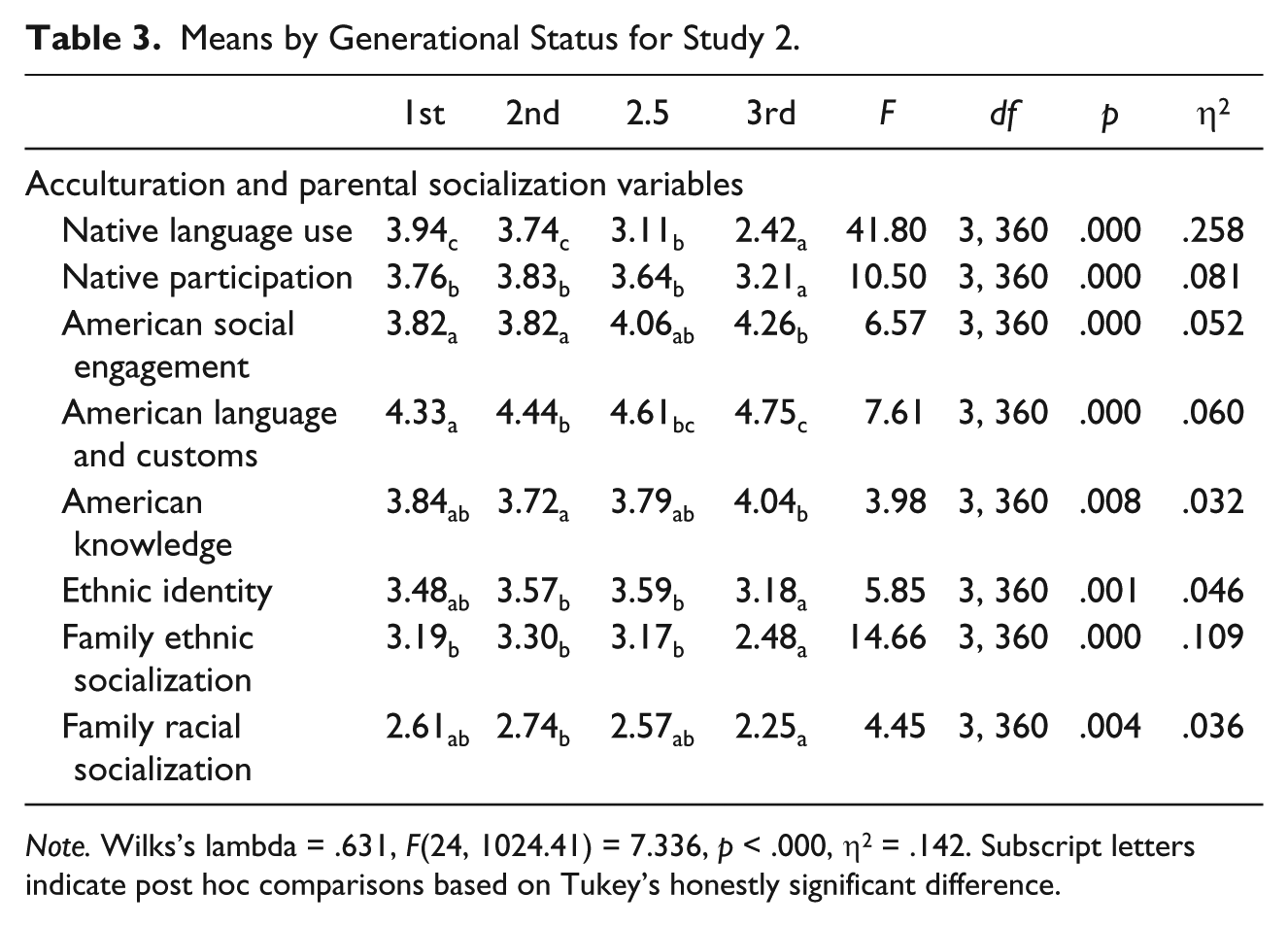
Note. Wilks’s lambda = .631, F(24, 1024.41) = 7.336, p < .000, η2 = .142. Subscript letters indicate post hoc comparisons based on Tukey’s honestly significant difference.
Supporting Hypothesis 1, post hoc tests revealed that 2.5 generation reported greater native cultural participation and ethnic identity than 3rd generation, and were no different from 1st and 2nd generations for these variables. Also in partial support of Hypothesis 1, 2.5 generation had higher native language use than 3rd generation, but significantly lower language use than 1st and 2nd generations.
Hypothesis 2 predicted higher levels of integration to American cultural orientation for 2.5 generation than the 1st and 2nd generations, but not significantly higher than 3rd generation. Post hoc tests revealed partial support for this hypothesis. For American social engagement, American language and customs, and American knowledge, the 2.5 generation was not significantly different from 3rd generation; however, 2.5 generation was also similar to the 2nd generation for American social engagement, as well as American language and customs. Furthermore, the 2.5 generation was similar to both the 1st and 2nd generations on American social engagement and knowledge.
Finally, post hoc tests confirmed Hypothesis 4, revealing that 2.5 generation reported significantly more parental socialization regarding cultural traditions the 3rd generation, but were similar to 1st and 2nd generations on this variable. For racial socialization, the 2.5 generation was not different from any of the other generations.
General Discussion
The goal of this study was to examine the extent to which the 2.5 generation could be differentiated from other generational groups with regard to several variables related to bicultural development. Our results suggest that the 2.5 generation is unique in a number of ways consistent with the proposed theoretical rationale. Across both studies, there was support for Hypothesis 1, specifically the 2.5 generation had greater native cultural orientation than 3rd generation due to the presence of a foreign-born parent in the home. The 2.5 generation had greater overall Latino orientation (Study 1), native cultural participation (Study 2), language use (Study 2), and ethnic identity (both studies) compared with the 3rd generation. The 2.5 generation was similar to the 1st and 2nd generations on most of these variables; however, they did report less language use than these two groups in Study 2. This is consistent with Portes and Rumbaut’s (2001) findings that those with only one foreign-born parent (which they refer to as “mixed generation” and we refer to as 2.5 generation) were less likely to be fully bilingual compared with those with two immigrant parents. Our findings help to elucidate why the 2.5 generation reported more acculturative stress due to Spanish competency pressures (Hypothesis 3), a variable linked to increased generation status and years in the United States from previous studies (Rodriguez et al., 2002). Taken together, these results demonstrate that the presence of a foreign-born parent in the home provides the 2.5 generation with the cultural capital needed to maintain their ethnic heritage in the form of customs and identity; however, the simultaneous presence of an American-born parent may mean that Spanish is not spoken in the home as frequently as for 1st- and 2nd-generation youth. The 2.5 generation may have some language loss and, therefore, also experience greater intragroup pressure due to lower Spanish proficiency.
Hypothesis 2 expected that that the 2.5 generation would report greater integration to American culture than the 1st and 2nd generations as a result of the presence of an American-born parent in the home. This hypothesis was only partially supported; the 2.5 generation was only significantly different from the 1st generation with regard to Anglo orientation (Study 1) and American language and customs (Study 2). The 2.5 generation was similar to the 3rd generation on all of these variables and was also similar to the 2nd generation for most of these (they were lower than the 2nd generation only for Anglo orientation in Study 1). These results suggest that cultural capital afforded by the presence of an American-born parent gives the 2.5 generation only a very slight edge over those without such capital. In particular, the fact that they are similar in most ways to the 2nd generation who have no American-born parents means that the acculturation to the dominant culture is not impacted to a large extent by the parents, but instead is more strongly the result of the child’s own experiences outside the family such as through the school and media. The rapid acculturation of 2nd generation youth who were born in the United States has been described and documented by others (e.g., Portes & Rumbaut, 2001), and our study further demonstrates that 2.5-generation youth are not very different in this regard from those who have either one or two American-born parents.
Finally, results confirmed Hypothesis 4, revealing that 2.5 generation reported significantly more parental socialization regarding cultural traditions than the 3rd generation and that they were similar to 1st and 2nd generations on this variable. This is in line with contextual theories such as Knight et al. (1993), which emphasize the central role of the family in providing ethnic socialization and cultural transmission. Since the 2.5 generation has at least one parent who was born in the native country, these individuals receive more encouragement and familial support for the preservation of cultural traditions compared with those who have no native-born parents. Future research must examine the extent to which each parent is involved in this ethnic socialization. It is possible that the foreign-born parent is not the only person in the home providing this support, but it may also come from the U.S.-born parent and from general family practices in which all members take part. Lichter et al. (2011) have proposed that the increasing trend of U.S.-born Hispanic individuals marrying foreign-born individuals may represent a desire among the 2nd generation to avoid the loss of their cultural roots and help them to pass cultural traditions to their children. Thus, the 2.5 generation may be the result of two parents from different generations in the United States, but who both have similar levels of ethnic pride and cultural loyalty. Future research can examine this possibility.
Also of interest is the fact that the 2.5 generation did not differ with respect to racial socialization. To help understand this, we can point to our findings from Study 1 that, consistent with previous research (e.g., Cervantes et al., 2013), showed that the generation groups did not differ in discrimination-related acculturative stress. These findings indicate that discrimination experiences can occur regardless of generation and that U.S.-born and foreign-born parents are similarly likely perceive the need to discuss racial bias with their children.
Overall, the present study demonstrates that the 2.5 generation is distinct in a number of ways from not only 1st generation individuals but also the 2nd and 3rd generations, two groups with which that they are often combined during analysis. This suggests that researchers should avoid lumping the 2.5 generation in with those of other generations and instead should examine this group separately, particularly when issues relating to bicultural competence are concerned. Nevertheless, this study was a first attempt to examine the unique characteristics of this group and thus is limited in a number of ways. We did not specifically target the 2.5 generation when recruiting participants, and due to limitations in sub-sample sizes, we were not able to separate those for whom the mother was foreign-born from those for whom it was the father. Previous research has documented that the gender of the parents and children is often significant when it comes to the transmission of culture (Keefe & Padilla, 1987). For example, in a study of biracial adolescents, those with Latina mothers reported more family ethnic socialization than those with Latino fathers, especially among adolescent boys (González, Umaña-Taylor, & Bámaca, 2008). Clearly, the inability to examine this issue is a limitation of our study, and more information is needed regarding the characteristics (e.g., acculturation, language use, values) and role of each parent with regard to the socialization of 2.5 generation youth, including the relative impact of interactions with mothers versus fathers in promoting linguistic and social competence.
Although we did not find significant gender differences (see Note 1), our sample was also limited by an overrepresentation of female young adults. As has been noted by others (e.g., Gloria, Castellanos, Scull, & Villegas, 2009), Latino men are often underrepresented in the literature dealing with college populations. It is imperative for researchers to closely consider gender differences in future research since men and women may confront cultural challenges in distinct ways. Additionally, our study was limited to college students in a single location of the United States that is culturally diverse and where Latinos represent the majority. Thus, the participants are part of a community where Latino cultural traditions are pervasive and where bicultural transmission may unfold very differently compared with other parts of the United States. The college environment may also pose unique opportunities for bicultural involvement that may not be available to individuals in other settings.
This study included measures of several key factors relating to bicultural competence such as cultural orientation, acculturative stress, and family ethnic socialization; however, there were a number of important variables that were not included which may also influence bicultural competence. For example, future research may examine the role of other key socialization agents in the lives of the 2.5 and other generations. Although most of the literature focuses on parents, the impact of siblings, grandparents, peers, and other external agents are relatively less studied. Researchers who wish to have a more complete understanding of the factors that promote bicultural competence among Latinos must consider the interplay of these various sources of support within each generation and must seek to build a more nuanced picture of the new possibilities that emerge as individuals from different generations and backgrounds interact.
Footnotes
Declaration of Conflicting Interests
The authors declared no potential conflicts of interest with respect to the research, authorship, and/or publication of this article.
Funding
The authors received no financial support for the research, authorship, and/or publication of this article.