




Abstract
The present study investigates the mediating role of self-esteem and the moderating role of gender in the relationship between ethnic identity components (i.e., exploration, resolution, affirmation) and depressive symptoms and life satisfaction. Participants were 294 Mexican descent adolescents (55.4% female) ages 14 to 18 years (M = 15.27 years; SD = 1.00 years). A mediated multigroup path analysis was conducted. The final model indicated that self-esteem is a potential mediator between ethnic identity affirmation and resolution with depressive symptoms and life satisfaction due to significant indirect relationships. The full model achieved acceptable model fit. Ethnic identity exploration was not significantly related to self-esteem, and no gender differences were present in the model. This study helps those working with Mexican descent youth come to a better understanding of self-esteem as a potential mechanism through which ethnic identity is related to psychological functioning (i.e., life satisfaction and depressive symptoms). Implications for practice and suggestions for future directions are discussed.
Identity formation is a fundamental aspect of development among adolescents, progresses through early adulthood, and continues throughout the life span (Erikson, 1968). As a central component to adolescent development, the achievement of a stable sense of identity is linked to psychosocial well-being (Tajfel, 1981). For many adolescents, ethnic identity (EI) is a defining aspect of overall identity (Phinney, 1992). It involves feelings and conceptions about one’s ethnic group membership and may have a significant impact on psychological functioning (Huynh & Fuligni, 2008). The psychological process of EI formation includes three distinct components: exploration, resolution, and affirmation. Exploration is the period when one actively learns about their culture/heritage; resolution refers to one’s commitment and clarity regarding their ethnic group; and affirmation is the affective element to EI that focuses on an individual’s positive or negative feelings regarding one’s ethnic group (Umaña-Taylor, Yazedjian, & Bamaca-Gomez, 2004).
EI and Psychological Functioning
Past research suggests that the three EI components (i.e., exploration, resolution, and affirmation) show varying associations with psychological functioning outcomes (Umaña-Taylor, Gonzales-Backen, & Guimond, 2009). For example, in a study with Latina/o youth, higher levels of EI affirmation were associated with lower levels of depressive symptoms (Gaylord-Harden et al., 2007). This is consistent in the literature with other ethnic minority groups (Yip, Seaton, & Sellers, 2006). In a study with African American adolescents, researchers found that individuals with high levels of affirmation had better psychological outcomes than individuals with high levels of exploration (Yip et al., 2006). In addition, higher levels of overall EI are related to improvements in life satisfaction (Romero & Roberts, 2003). The positive relationship between EI and life satisfaction among minority groups has been consistent across multiple social contexts, such as gender, race, and socioeconomic status (Smith & Silva, 2011). Given that previous research has established that EI development is related to lower levels of depressive symptoms and higher reports of life satisfaction, the present study seeks to expand the literature through examining one potential mechanism that may explain this relationship: self-esteem.
EI and Self-Esteem
Self-esteem is an overall manifestation of one’s self-worth, encompassing beliefs about oneself and the emotional response to those beliefs (Rosenberg, 1965). Several examples of the positive relationship between EI development and self-esteem for Latina/o youth exist. For example, in a study with Latina/o middle school students living in a rural Texas border town, Romero and Roberts (2003) found a positive relationship between EI and self-esteem. Piña-Watson, Ojeda, Castellon, and Dornhecker (2013) found a similar relationship in a study of Latina/o high school students. These relationships continue to exist across time as well. In a study with Latina/o high school students, Umaña-Taylor, Yazedjian, and Bamaca-Gomez (2004) found that growth in EI exploration predicted growth in adolescents’ self-esteem over a 4-year period.
Individuals who report high levels of exploration tend to be most resistant to threats to their self-esteem (Marcia, 1994). Increased exploration provides individuals with the tools to better understand their ethnicity. This increased knowledge may make individuals feel more self-assured or self-confident with regard to their ethnicity. In addition, higher levels of resolution are significantly associated with higher levels of self-esteem for both boys and girls (Umaña-Taylor & Updegraff, 2007). Indeed, when EI was measured as a single construct, it was overall associated with higher levels of self-esteem among individuals of Mexican descent (Roberts et al., 1999). It is clear that EI development is an important process for Latina/o youth through the research that connects it with higher levels of self-esteem.
Self-Esteem and Psychological Functioning
In addition to having a relationship with EI development, self-esteem may serve as a determinant of adolescent psychological functioning. This appraisal of one’s self-worth is experienced on a continuum ranging from low to high levels of self-esteem (Branden, 1995). Low self-esteem has been linked to a number of psychological, physical, and social consequences including depression, anxiety, and suicide, which may be related to the development of adolescents and their transition to adulthood (McClure, Tanski, Kingsbury, Gerrard, & Sargent, 2010). Conversely, past research suggests that adolescents with higher levels of self-esteem experience less depressive symptoms and greater life satisfaction (Crocker & Wolfe, 2001). In a study specifically focusing on Mexican descent adolescents, findings in the literature where supported such that high self-esteem predicted more positive mental health outcomes (Kiang, Yip, Gonzales-Backen, Witkow, & Fuligni, 2006) and less depressive symptomatology (Portes & Zady, 2002).
Self-Esteem as a Mediator
Given that self-esteem can have a significant relationship with adolescent psychological functioning and that EI formation is central during adolescence (Marcia, 1994), self-esteem may explain the relationships that have been previously found between EI components and psychological functioning outcomes. It is through exploration of options that adolescents come to preserve a secure identity and it is suggested that EI formation may serve as a catalyst for higher self-esteem by providing a mechanism to build a strong sense of identity (Erikson, 1968; Marcia, 1994). When ethnic minority youth come to more fully understand themselves as part of an ethnic group, and develop a positive appraisal of this membership, they may in turn have higher self-esteem, which may be related to better psychological well-being.
Gender as a Moderator
To further explore the mediating role of self-esteem in the relationship between EI and psychological functioning, it is imperative to also study for which this relationship is most applicable. Studies that examine EI have seldom looked at gender differences in the relationships with psychological functioning variables. The few studies that explore these relationships yield mixed results. For example, previous work with various ethnic minority groups found that adolescent girls score significantly higher on measures of EI than adolescent boys (Martinez & Dukes, 1997). In addition, past research has shown both higher levels of EI for boys more so than girls (Smith & Silva, 2011), and, conversely, girls more so than boys (Umaña-Taylor et al., 2009). Researchers have also found no differences between males and females’ EI in Latina/o participants (Martinez & Dukes, 1997). Due to these inconsistent findings, the present study will explore gender as a potential moderator to the proposed model.
Purpose of Study and Hypotheses
The purpose of this study is to investigate the mechanism through which components of EI (i.e., exploration, resolution, affirmation) are related to life satisfaction and depressive symptoms of Mexican descent adolescents, exploring self-esteem as a potential mediator and gender as a moderator between these relationships. See Figure 1 for a full account of the specific hypotheses.
Method
Participants
Participants were 294 Mexican descent adolescents (55.4% female) who attended high school in a midsized South Texas city. Participants’ ages ranged from 14 to 18 years (M = 15.27 years, SD = 1.00 years) and were in 9th through 12th grade. The majority of the sample was born in the United States (97.6%) and indicated that their family income was “same as most others” in their school (46.9%) and community (53.1%).

Hypothesized model.
Procedures
Approval was obtained from the Institutional Review Board of the first author’s academic institution and from the principal of the high school where the data were collected. Students were provided with consent and assent forms, and only students who returned the form signed by their parents/guardians were allowed to participate. Each participant was given a study information sheet, which explained the benefits and risks of participation, the purpose of the study, and gave contact information for the principal investigator and the Institutional Review Board. Participating students were taken to a large computer lab (>60 computer stations). Once consent forms were checked by the principal investigator, participants were given the link to the questionnaire. They read a brief assent form and chose whether or not they wanted to participate. Participation was voluntary and responses were anonymous. Students completed the questionnaire in about 45 minutes during class time. Participants were entered into a drawing for one of 10 US$25 gift cards to a local cinema.
Measures
EI
The 17-item Ethnic Identity Scale (Umaña-Taylor et al., 2004) measures EI exploration, resolution, and affirmation on a 4-point Likert-type scale. For each subscale, responses were averaged with higher scores indicating greater overall levels of EI. Studies with ethnically diverse high school and college students reported coefficient alphas ranging from .72 to .93 (Supple, Ghazarian, Frabutt, Plunkett, & Sands, 2006; Umaña-Taylor, 2005). For the current study, α = .80 exploration, α = .85 resolution, α = .77 affirmation.
Life satisfaction
The 5-item Satisfaction With Life Scale (Diener, Emmons, Larsen, & Griffin, 1985) measures a person’s level of satisfaction with their overall life on a 7-point Likert-type scale. Responses were averaged with higher mean scores indicating higher satisfaction with life. A previous study using this scale demonstrated acceptable internal consistency with an undergraduate sample (α = .87; Diener et al., 1985). For the current study, α = .90.
Self-esteem
The 10-item Rosenberg Self-Esteem Scale (Rosenberg, 1965) measures global self-esteem on a 4-point Likert-type scale. Responses were averaged with higher mean scores indicating higher self-esteem. This scale has shown acceptable internal consistency with a sample of Latina/o adolescents (α = .79; Supple & Plunkett, 2011). For the current study, α = .86.
Depressive symptoms
The 10-item Center for Epidemiological Studies Depression Scale–10 (CES-D-10; Eaton, Muntaner, Smith, Tien, & Ybarra, 2004) was used to measure depressive symptoms. Responses were based on a 4-point Likert-type scale ranging from rarely or none of the time/less than one day (1) to all of the time/5-7 days (4). For the current study, α = .78.
Data Analysis Plan
In order to test the mediation model, moderated by gender, MPlus Version 7.11 will be used. To assess for fit of the path model, the following criteria will be used: a chi-square (χ2) that is not statistically significant at the p < .05 level, a comparative fit index (CFI) ≥ .95, a standardized root mean square residual (SRMR) < .08, and a root mean square error of approximation (RMSEA) < .06. Full information maximum likelihood (FIML) will be used to handle missing data (Kline, 2005). In order to determine whether the model is moderated by gender, a multigroup analysis method will be used in which we will compare the χ2 values of the fully constrained and fully unconstrained models to determine whether the models significantly differ from one another based on gender. If it is determined that the difference between the χ2 values of the fully constrained and fully unconstrained model is statistically significant (p < .05), further analyses will be conducted to determine the exact paths that differ by gender, and a partially constrained model will then be tested in which those paths that differ by gender are allowed to vary. To power our model, a sample size of at least 40 participants in each gender group (80 participants total) was needed based on a Bentler and Chou’s (1987) suggestion of five participants per estimated parameter (8 estimated parameters × 5 participants = 40 participants per group). The present study includes well over this minimum per gender group.
Results
Multigroup Analysis
First, the hypothesized model was tested to determine whether gender differences were present. To do this, the model was allowed to be fully unconstrained and fully constrained. The change in χ2 to change in degrees of freedom was compared, and it was determined that significant differences by gender were not present in the model (Δχ2 = 7.74, Δdf = 5, p = .171). Since there were no gender differences and the fully constrained model had adequate model fit (Kline, 2005; χ2 = 24.70, df = 17, p = .101; χ2 / df = 1.45; CFI = .96; Tucker–Lewis index (TLI) = .95; RMSEA = .06; and SRMR = .06), it was accepted and interpreted.
Direct Paths
Although the path from EI exploration to self-esteem was not significant (B = .03, p = .636), the paths from EI resolution (B = .11, p = .029) and affirmation (B = .17, p = .014) to self-esteem were. In the accepted model, the EI variables accounted for 6% of the variance in self-esteem (R2 = .06). In addition, self-esteem accounted for 26% of the variance in life satisfaction (R2 = .26) and 28% of depressive symptoms (R2 = .28).
Mediation Analyses
After the fully constrained model was accepted, a multiple mediation test through bootstrapping was conducted (5,000 iterations; Preacher & Hayes, 2004). Based on this analysis, self-esteem was found to be a significant mediator between (1) EI affirmation and the psychological functioning outcomes of life satisfaction (B = .24, SE = .10; p = .017; 95% confidence interval [CI] = [0.05, 0.46]) and depressive symptoms (B = −.09, SE = .04; p = .019; 95% CI = [−0.18, −0.02]), and (2) EI resolution and the psychological functioning outcomes of life satisfaction (B = .16, SE = .07; p = .034; 95% CI = [0.02, 0.31]) and depressive symptoms (B = −.06, SE = .03; p = .028; 95% CI = [−0.11, −0.01]). In other words, self-esteem fully explains, or mediates, these relationships. Full reporting of the model statistics are presented in Table 1 and visually represented in Figure 2.
Full Reporting of Accepted Model Direct Path Coefficients.

Note. CI = confidence interval; EI = ethnic identity; SE = self-esteem; LS = life satisfaction; Dep = depressive symptoms.
p < .05. **p < .01. ***p < .001.
Discussion
Our study contributes to the Mexican descent adolescents’ psychological functioning literature by examining self-esteem as an explanatory mechanism (mediator) to the relationship between EI components (i.e., affirmation, exploration, and resolution) and life satisfaction and depressive symptoms. The hypotheses that the components of EI development will be significantly and indirectly related to the psychological functioning variables through self-esteem were demonstrated for two out of the three components: EI affirmation and resolution. The hypothesis whereby EI exploration and the psychological functioning outcomes would be mediated by self-esteem was not supported. The model also did not differ by gender.
Our findings support previous findings that connect EI affirmation and resolution to positive psychological functioning outcomes (Gaylord-Harden et al., 2007; Umaña-Taylor et al., 2009; Umaña-Taylor & Updegraff, 2007), and are consistent with Erikson and Phinney’s theories that EI developmental processes are critical for ethnic minority adolescents (Erikson, 1968; Phinney, 1990, 1992). Adolescence is a pivotal time whereby youth are creating their sense of self, which includes their EI. Given that EI is a component of one’s self-concept, when one is unable to form meaning or feels negatively about the ethnic component of their self-concept, our study supports that their sense of self-worth can be impacted (self-esteem). Our findings suggest that Mexican descent youth who feel more positively about being of Mexican descent (affirmation) and who have a more refined idea of what their ethnic group membership means to them (resolution) report higher self-esteem. Furthermore, higher levels of both affirmation and resolution were indirectly related to higher levels of life satisfaction and lower levels of depressive symptoms because through higher self-esteem. This is consistent with writings by Marcia (1994), which support that EI formation may serve as a catalyst for higher self-esteem by providing a mechanism to build a strong sense of self. This is important given self-esteem has an important role in normative development into adulthood (Phinney & Ong, 2007; Rosenberg, 1965).
Although the findings noted above are consistent with Marcia’s (1994) theory, we did not support the notion that individuals who report high levels of exploration would be most resistant to threats to their self-esteem (Marcia, 1994). This is contrary to studies that have found this relationship (Umaña-Taylor & Updegraff, 2007; Umaña-Taylor et al., 2004). Umaña-Taylor and Updegraff (2007) ran a very similar model whereby they examined the role of EI resolution and exploration within the context of discrimination on depressive symptoms. In their study, it was found that EI exploration did in fact have a significant relationship with depressive symptoms. Their study did not, however, examine the potential of self-esteem to mediate this relationship nor did they examine the role of affirmation. Brittian and colleagues (2015) did, however, find similar results in which EI exploration was not related to depressive symptoms, but resolution and affirmation were related. Their study did not, however, include affirmation as was done in the present study.
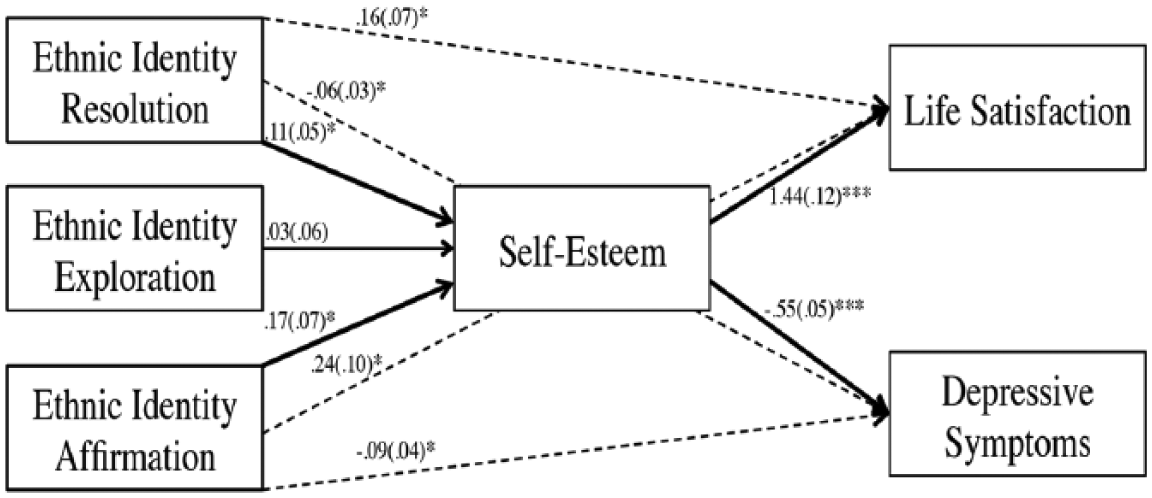
Accepted model with path coefficients.
It is possible that our findings can be explained within the cultural context that our data were collected. The sample was drawn from an area where individuals of Mexican descent are the numerical majority. When adolescents grow up in a context that is a cultural enclave, individuals around them are likely engaging in activities that celebrate the cultural heritage and the adolescent does not have to actively seek out, or explore, their ethnicity. As they do not have to actively seek out these experiences, they are just living in them; perhaps this is why exploration was not related to one’s self-esteem in the present study. Our work suggests that for a group in this sort of context, the exploration portion of EI development is not necessarily as salient; however, forming meaning and a positive evaluation of one’s group are salient. This supports the need to study EI components separately (Umaña-Taylor et al., 2004) and to take into account the context youth are embedded to understand the EI development of ethnic minority youth (Umaña-Taylor & Alfaro, 2006; Umaña-Taylor et al., 2004). These findings highlight the importance of community in the Latina/o culture. Findings of the present study could be used to inform youth programming aimed at increasing ethnic affirmation and resolution. In addition, if these cultural aspects are targeted, self-esteem may also be improved in the process of working to improve mental well-being.
Limitations and Future Research
Although the present study was able to find significant indirect relationships, we cannot conclude that self-esteem is the actual mediator between EI and the psychological functioning variables as true mediation requires longitudinal data. Our results merely suggest that a potential mediation relationship may exist, but will have to be confirmed with data at multiple time points (Maxwell & Cole, 2007). It is plausible that alternative models, whereby the psychological functioning variables, are actually more representative of how these constructs operate across time. Longitudinal data would allow us to test these competing models.
Future research should also investigate what other health outcomes self-esteem mediates for Mexican descent youth and how to encourage ethnic affirmation and incorporate self-esteem as a core component of prevention interventions, family-based programs, and other counseling sessions. Research should also look into what factors moderate higher life satisfaction and lower depressive symptoms to precisely adapt interventions for specific age groups and/or genders to promote the most psychological change. By promoting EI affirmation and making youth feel more positively about ethnic group membership, trained interventionists and/or mental health professionals could have a positive impact on the psychological functioning of Mexican descent youth.
Footnotes
Declaration of Conflicting Interests
The authors declared no potential conflicts of interest with respect to the research, authorship, and/or publication of this article.
Funding
The authors received no financial support for the research, authorship, and/or publication of this article.