




Abstract
This study examined the impact of the Abriendo Puertas parent education program among a large sample of low-income, Latino parents and caregivers of preschool children. In all, 922 parents were randomly assigned to the program (n = 468) or a waitlist control group (n = 454). Pretest data and posttest data (5-6 weeks postintervention) from parents (86.4% response rate) were collected from both the treatment and control groups. At each time point, parents reported on their knowledge, attitudes, and behaviors related to enhancing their children’s school readiness. Confirmatory factor analyses were conducted to assess the factorial validity of each survey scale, and path analyses were conducted to compare the outcomes of the treatment and control groups. In addition, to assess fade-out of program affects among treatment parents, follow-up data were collected 3 months postintervention. Intent-to-treat analyses found that, compared with the control group, the treatment group adopted parenting practices that enhanced preschool children’s preparation for school, gained knowledge about high-quality early child care and education settings, improved their ability to set goals for their children, and gained an appreciation for their role as models for their children. No differences were found between the control and treatment groups on parenting practices related to emotional expression, parental advocacy, or healthy behaviors. Results indicate that the Abriendo Puertas program improved parents’ and caregivers’ knowledge, attitudes, and behaviors. Results of this evaluation help build the evidence base on culturally relevant parenting programs for Latino parents of preschoolers.
Introduction
Although Latinos in the United States value education, too many low-income young Latino children enter kindergarten without the skills and competencies they need to be successful in school, and research indicates that Latino children are less likely to be ready for school than their peers (Child Trends Databank, 2015; Murphey, Guzman, & Torres, 2014). For example, fewer than one in five Latino children aged 3 to 6 recognize the letters of the alphabet, compared with more than one in three White children (Murphey et al., 2014). In addition, compared with White children, Latino children are also less likely to be able to count to 20 or higher or read books (National Center for Education Statistics, Institute of Education Sciences, U.S. Department of Education, 2008). This is problematic because children’s school readiness is linked to later educational and employment success (Duncan et al., 2007; Hair, Halle, Terry-Humen, Lavelle, & Calkins, 2006; Sabol & Pianta, 2012).
Children’s school readiness can be enhanced through participation in quality early care and education settings (Ruhm, Magnuson, & Waldfogel, 2007; National Research Council and Institute of Medicine, 2000) and through parent engagement (e.g., parent-child educational activities and parent involvement with schools; Mendez, 2010; Sheridan, Knoche, Edwards, Bovaird, & Kupzyk, 2010). However, compared with their White counterparts, low-income Latino children are less likely to participate in structured early care and education settings (Susman-Stillman & Banghart, 2011). Furthermore, although low-income Latino parents typically have high educational aspirations for their children (Goldenberg, Gallimore, Reese, & Garnier, 2001) and want their children to succeed in school, they often face a number of barriers to parental engagement (Chrispeels & Rivero, 2001; Quiocho & Daoub, 2006; Young & Vrogistinos, 2010).
Some of the barriers Latino parents face are logistical, whereas others reflect a cultural mismatch between Latino parents and the American educational system. The American educational system expects and relies on parents to be actively involved in school activities and to advocate for their child’s education. However, challenging authority is frowned upon in Latino cultures, and educational systems in Latin America often do not invite parental engagement in their child’s education in the same way that the American school system expects (Medina, Guzmán, & Wong-Ratcliff, 2015). In addition, many Latino parents face language barriers and long work hours as obstacles to communicating with teachers and other school officials. Moreover, research indicates that many Latino parents lack access to the tools and financial resources needed to provide a home environment that fosters children’s educational outcomes (e.g., books to read with children, teaching children colors, shapes; O’Donnell & Kirkner, 2014).
Given the positive impacts of parent engagement and children’s participation in high-quality early childhood education programs, one way to address disparities in Latino children’s school readiness is through the provision of a culturally responsive program that provides Latino parents with the skills needed to both foster their child’s school readiness and ensure their child’s educational success once they enter school. Accordingly, a number of parent education programs have been developed or adapted to for Latino parents (e.g., Dumas, Arriaga, Begle, & Longoria, 2011; Farber, 2009; Johnson, Walker, & Rodriguez, 1996; Lakes et al., 2009; Lakes, Vargas, Riggs, Schmidt, & Baird, 2011; Mendelsohn et al., 2007; Wagner & Clayton, 1999). However, only a few have been rigorously evaluated (e.g., Johnson & Walker, 1991; Lakes et al., 2011). Thus, the purpose of this study was to build the evidence base on culturally relevant parenting programs for Latino parents of preschoolers through examining the impact of a culturally responsive parent education program, Abriendo Puertas.
Abriendo Puertas
Abriendo Puertas/Opening Doors (AP/OD) is a parent education program specifically developed for Latino parents of children under 5 years of age. AP/OD is a brief but comprehensive educational program based on the premise that enhancing parenting skills early in a child’s life leads to educational benefits for the child, as well as economic and societal benefits. The interactive 10-session program, which can be delivered in Spanish in school or community settings, provides parents with tools and techniques needed to engage with their child’s school and enhance their parenting skills. It responds to an evolving literature suggesting that culturally sensitive programs are more likely to be associated with behavioral changes than mainstream programs (Mier, Ory, & Medina, 2009). The curriculum follows a pedagogical approach based on the work of Paulo Freire. Freire believed in a “liberating education,” where a constant dialogue exists between teachers and students. Friere’s method within AP/OD follows a train-the-trainer model wherein more experienced trainers train and provide technical assistance to less experienced ones (Freire, 1968/1970).
To deliver the information in a culturally sensitive and responsive way, the AP/OD includes language, metaphors, and sayings (dichos) from the Latino culture. For example, a lesson discussing the importance of reading and going to the library begins with “saber es poder” or “knowledge is power.” The program was intentionally developed in Spanish to avoid inaccurate English-to-Spanish translations, and it has been translated into English for English-speaking Latino parents. In addition, at the beginning of each lesson, parents listen to children’s music that they (or their relatives) grew up listening to.
The program anchors its teachings in Latino cultural values. For example, it aligns with the cultural value of interdependence and family by recognizing and reminding parents that they are their children’s first teachers and that they are critical to their children’s development. It draws on the cultural value of respect (respeto) for one another by teaching the facilitators that they need to address parents with respect and devotion. In addition, group discussions always consider the sociocultural context and experience of being a Latino parent in the United States and discuss the ways that parents can successfully fit their experience and culture within their current context.
Current Study
Although AP/OD has been implemented across the nation, before this study, the program had yet to be rigorously evaluated. Thus, to build the evidence base on this culturally relevant parenting program for Latino parents and caregivers of preschoolers, an experimental evaluation of AP/OD was conducted with a large, low-income sample of Latino parents. This evaluation was designed in collaboration with the program developer to assess the extent to which AP/OD changes the knowledge, attitudes, and behaviors of Latino parents in ways that will enhance the school readiness of their children.
Based on the material in the curriculum and the expectations of the program developer and program staff, it was hypothesized that, compared with parents in the control group, parents exposed to the AP/OD program, would
See themselves as important early educators of their children;
Engage in more reading, language, and learning activities with their preschool children;
Engage in more positive discipline strategies that encourage expression of emotions and feelings;
Engage in healthier behaviors;
Gain confidence in their ability to advocate on behalf of their child;
Acquire knowledge about the characteristics of good child care;
Become more planful in their approach to childrearing; and
Take their child to their local library.
Method
To assess the impact of AP/OD) a multisite randomized control trial (RCT) was conducted across 23 schools. All materials were available in Spanish as well as English, and all procedures and materials were tested in a pilot study at one school during the previous school year (Child Trends Hispanic Institute, 2014). All procedures and materials were reviewed and approved by Child Trend’s Institutional Review Board (IRB) prior to the start of the study.
Participants
A total of 922 low-income Latino parents/caregivers (89% identified as parents) living in a southwestern U.S. city participated in the study, with 468 randomly assigned to the treatment group and 454 to the waitlist control group. As shown in Table 1, the demographic composition of parents/caregivers in the treatment and control group only differed in marital status. The mean age of parents/caregivers was 33.58 years (SD = 7.66), and the mean age of the focal child was 3.44 years (SD = 1.32). Most parents reported being born in Mexico (74%) or another country outside of the United States (13%); however, most parents reported living in the United States for 15 years or longer (37%). In addition, the majority of participants spoke only Spanish (76%), and just over 20% reported that they were bilingual. Although three quarters of parents/caregivers reported making less than US$20,000 a year, the majority (58%) indicated that they were not recipients of food stamps. Finally, approximately 60% of parents/caregivers had a middle school education or less and 34% had previously taken a parenting class.
Demographics of Study Participants.

χ2(3) = 4.33, p < .05.
Procedures
AP/OD staff at each of the 23 schools implementing AP/OD recruited parents by distributing flyers in the community and at the school. Flyers and school staff described the AP/OD program and the study to all potential participants. Potential participants, who expressed interest in taking part in the study, were given a time and date to visit the school to enroll in the study and program. Parents who enrolled in AP/OD completed consent forms, provided demographic information, and reported on 15 baseline questions measuring parenting knowledge and behaviors (see Measures section). Completion of consent and measures was done in either Spanish or English, depending on each parent’s preference. Parents were then randomly assigned to the treatment or a waitlist control group using a random number generator in Excel.
Parents in the treatment group were enrolled in AP/OD in the fall of 2012 and parents in the control group were enrolled in AP/OD the following spring. Both groups were contacted for follow-up telephone surveys approximately 5 to 6 weeks after the end of the program, and there was a response rate of 86.2% (n = 795). Members of the treatment group were contacted again for a second follow-up telephone survey approximately 3 months after the end of the program to assess whether any initial impacts had faded by that time. A total of 333 (71%) treatment group parents completed the second follow-up.
Measures
A parent survey based on the program’s logic model was developed to assess the impact of AP/OD. During the evaluation pilot phase, items and scales were developed based on conversations with the curriculum developer, the program theory of change, and the literature base. These scales were then tested with the population of interest, including cognitive testing to ensure ecological validity for this population (e.g., Bernal, Bonilla, & Bellido, 1995) and an exploratory factor analysis.
For the current study, confirmatory factor analyses (CFAs) were conducted to assess the factorial validity of survey scales. In general, CFAs can be used to test whether a hypothesized relationship exists between observed variables and an underlying or latent construct. CFAs were conducted in Stata, version 13.1, using the structural equation modeling (SEM) commands. CFA models were assessed by goodness-of-fit statistics, and modification indices were used to guide model respecifications, as needed; improvements to model fit were assessed using likelihood ratio tests between the nested models. The goodness-of-fit indices used to assess CFA models were root mean square error of approximation (RMSEA) using acceptable fit level of <.08 and comparative fit index (CFI) and Tucker-Lewis index (TLI) with acceptable fits of >.95 (Byrne, 2013).
Model fit indices, Cronbach’s alphas, and factor loading ranges are presented in Table 2. As can be seen in Table 2, across all CFA models, all goodness-of-fit statistics exceeded our cutoffs: All CFI and TLI estimates were above .95 and all RMSEA values were below .06. Factor loadings for items ranged from .30 to .85, and alpha values ranged from .60 to .89. Once scales were confirmed, individual items were averaged. Participants who were missing data on greater than 75% of the items were recoded as missing (ranging from 6% to 15% across scales and indices). Individual scales are summarized below.
Goodness-of-Fit Statistics for Measures.

Note. CFI = comparative fit index; TLI = Tucker-Lewis index; RMSEA = root mean square error of approximation; CI = confidence interval.
Language and learning scale
The six-item scale captures parents’ knowledge about children’s ability to learn at a young age. Example items include “Parents should wait to start reading to their children until their children are learning to read,” “I think that a child who uses two languages would get confused,” and “A child starts learning when he/she enters kindergarten.” Items are based on a 5-point Likert-type scale ranging from 1 (strongly agree) to 5 (strongly disagree).
Parental advocacy scale
This six-item scale captures parents’ confidence in supporting the needs of their child and advocating for these needs outside the home. Items are presented as “How confident would you feel,” and responses are based on a 4-point scale ranging from 1 (not at all confident) to 4 (very confident). Example items include “Discussing a problem or concern with your child’s teacher/child care provider,” “Advocating with social agencies to obtain the necessary services for your child,” and “Discussing a problem or concern with your child’s doctor or health care provider.”
Parent educational activities scale
This scale consists of five items that gauge the frequency in which parents engage in a variety of educational activities, such as “playing counting games,” “going over the letters of the alphabet,” and “using trips to the supermarket as an opportunity to teach things to the child.” The scale was standardized to reflect differences in response sets between the items, with a final averaged score ranging from 1 to 6. The scale has acceptable goodness-of-fit statistics and moderate internal consistency.
Early development knowledge scale
A nine-item scale was developed to assess parents’ knowledge about child development around literacy and learning. Items were scored from 1 (strongly agree) to 5 (strongly disagree) and included “Even parents without formal education should talk regularly to their preschool child,” “Parents should use the correct and accurate names of things while speaking to a 2-year-old child,” and “I can help my child’s brain develop by doing activities with him or her.” The scale showed high internal consistency (α = .78).
Family organization/planfulness scale
This scale captures parents’ planning practices across seven items. The response set is a 4-point Likert-type scale ranging from 1 (none of the time) to 4 (all of the time). The scale has high acceptable internal consistency (α = .72). Respondents were asked how often they participate in activities including “Talking with your child about family plans and activities,” “Having someone you can talk to when you need help or advice about parenting” and “Develop plans to reach family goals for your child(ren)?”
Emotional expression scale
This scale includes four items on a 5-point scale ranging from 1 (strongly agree) to 5 (strongly disagree). The items capture parents’ attitudes about children’s emotional expressions, such as “Developing positive/emotional skills means a child should always hide their true feelings” and “Children should only express positive feelings.” The alpha was .61.
Knowledge of child care scale
The final scale comprised four items that have high internal consistency (α = .89). These items assess parents’ knowledge of important characteristics for a high-quality early care and education settings. Items were scored on a 4-point response set ranging from 1 (not important) to 4 (completely important). Respondents were asked “How important is it that” on items including “Child care providers provide healthy snacks for children?” “Child care providers teach children how to play with others?” and “Child care providers read to children every day?”
We did not conduct CFAs for the constructs that were conceptualized as indices, as the components of an index do not represent a single latent trait, skill, or characteristic. For example, diet and active play both reflect healthy habits, and they are additive, but families who do one do not necessarily do the other. Items in the indices were summed.
Reading index
This index has four items and assesses parents’ approaches to reading. Respondents were asked how often they “Read a book again if your child wants to?” and “Let your child choose what he or she wants to read?” These items were reported on a Likert-type scale ranging from 1 (none of the time) to 4 (all of the time).
Library index
It combines two items to assess parents’ use of the library in the previous 2 months and whether respondents checked out children’s materials to take home. These items were reported on a 5-point frequency scale of 1 (never), 2 (once), 3 (twice), 4 (3 times), and 5 (4 or more times).
Encouragement index
This index measures parental practices meant to reinforce children’s positive behavior. A total of three items make up this index and were rated on a 4-point scale of 1 (none of the time) to 4 (all of the time). Respondents were asked to report how often they “Tell your child that you appreciate it when he/she behaves well?” and “Let your child know that you appreciate what he/she tries to do?”
Modeling index
It is based on three items which assess the extent to which parents agree that the example they set for their child matters. Respondents scored items on a 5-point scale ranging from 1 (strongly agree) to 5 (strongly disagree). Items include “How I deal with problems sets an example for my child,” “The example I set for my child matters more than what I say,” and a reverse-coded item “What I say to my child matters more than what I do.”
Healthy habits index
It combines five standardized items to assess healthy behaviors among families with a young child. Items include “How many days did you provide opportunities for your child to play actively or exercise?” and “How often did you take time to prepare a healthy dinner?”
Controls
In addition to the outcome variables described above, demographic information was also obtained, including parental education (highest level of education was reported and categorized into “middle school or less” and “high school or more”), place of birth (United States or other), marital status (married or other), and income.
Data Analysis
First, we conducted t tests and chi-square tests to examine whether there were significant differences in the demographic composition and baseline scores of parents in the treatment and control groups. Second, given that parents were nested within 23 schools, we calculated intraclass correlation coefficients (ICC) and their 95% intervals to assess the extent the proportion of variation in the outcome variables that were accounted for by schools. Results showed that ICC estimates ranged from <.001 to 0.03, representing little to no variance accounted for by grouping. Third, employing an intent-to-treat approach (in which all parents assigned to the treatment group were included in the analysis regardless of whether or how often they attended sessions), we estimated a series of path analysis models to compare the outcomes for those in the treatment group with those in the waitlist control group, controlling for the key demographic and social characteristics outlined in the “Controls” subsection, above. Analyses were conducted in Stata, version 13.1, and full information maximum likelihood (FIML) was used to address missing data.
Results
Descriptives
Table 3 shows the descriptives of the scales and indices. As can be seen in Table 3, on average, parents demonstrated moderately high values in reported educational activities (M = 3.86, SD = 1.23), emotional expression (M = 3.53, SD = 0.61), and language and learning (M = 3.44, SD = 0.59). Parents reported high levels of knowledge of early development (M = 4.15, SD = 0.32) and lower levels of behaviors related to family organization and planfulness (M = 3.15, SD = 0.56).
Descriptives of Scales and Indices at Follow-up (All).

Path Analyses
Results from the path analyses are displayed in Table 4. The AP/OD program had a positive and significant impact on parent educational activities (β = 0.15, SE = 0.09, p < .001), approaches to reading (β = 0.11, SE = 0.04, p = .05), library use (β = 0.07, SE = 0.04, p = .05), knowledge about appropriate child care settings (β = 0.04, SE = 0.04, p =.05.), family organization and planfulness (β = 0.13, SE = 0.04, p < .001), and parents as positive role models (β = 0.33, SE = 0.15, p < .04). Model effect sizes were small, ranging from η2 = .04 to η2 = .08. No significant differences between treatment and control groups were observed for parental advocacy, knowledge of early development, language and learning, emotional expression, healthy habits, and encouragement.
Regression Results on Parental Educational Activities (n = 922).
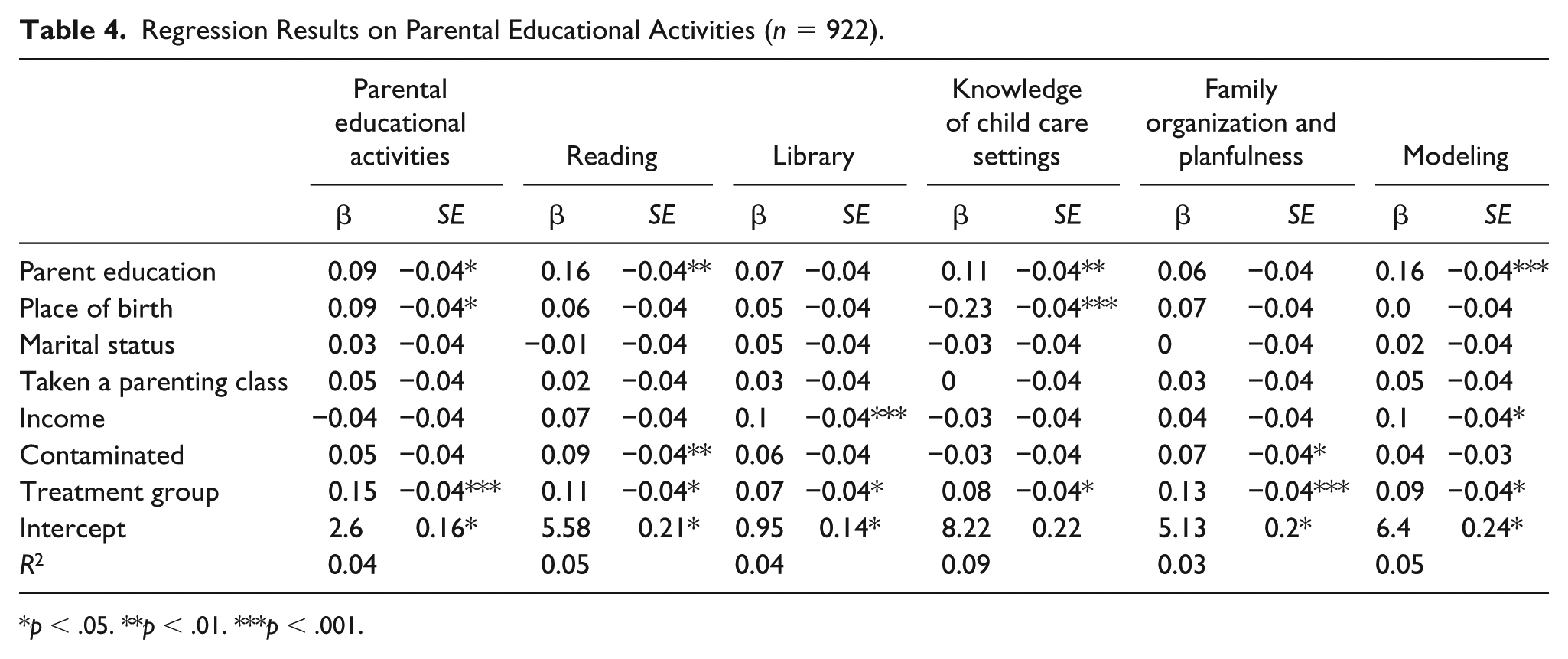
p < .05. **p < .01. ***p < .001.
Discussion
This experimental evaluation found that parents and caregivers in the AP/OD treatment group made modest but important behavioral and knowledge-based changes to foster their children’s learning. The AP/OD program was found to have positive impacts on reported parental educational activities at home, approaches to reading with the child, library use, knowledge about child care quality, family organization and planfulness, and being a role model for the child. However, significant effects were not found for healthy behaviors, being an advocate for the child, or fostering emotional development.
This evaluation found significant changes in reported behaviors related to educational practices and experiences. First, parents and caregivers in the experimental group reported providing more educational activities and games for their children. In addition, a significant increase in family organization and planfulness was found for those in the intervention group, perhaps highlighting the importance of both planning and execution of activities that improve educational outcomes for children (e.g., Sanders & Dadds, 1982). We also found significant differences in frequency of library use and reading practices of parents for their children. These findings are not surprising as previous research (e.g., Hill & Torres, 2010; Moore, Manlove, Guzman, & Walker, 2014), along with focus groups with AP/OD program participants, indicates that Hispanic parents have high educational aspirations for their children. Thus, it is likely that the AP/OD program reinforced and built on parents’ educational values by providing them with the relevant information they needed to better align their behaviors with the aspirations they have for their children.
The evaluation also found positive impacts on parental perceptions of being a role model for the child. This finding aligns with aspects of Latino culture, which often stress the importance of family and familial solidarity (e.g., Harwood, Leyendecker, Carlson, Asencio, & Miller, 2002), perhaps reinforcing the learning aspect of these interactions for parents and caregivers in the experimental group. We also found a significant increase in knowledge of child care, particularly characteristics of quality child care programs; this is likely due to the relevance of the curriculum to these families.
The nonsignificant findings of the intervention on emotional expression and healthy lifestyles are not surprising. Previous research has found that Hispanic parents are more likely to socialize their children to openly express positive emotions compared with negative emotions (Bowie et al., 2013), so our nonsignificant finding may reflect established beliefs about emotion expression in this population. Moreover, parents in the focus groups reported having basic knowledge about healthy lifestyle behaviors, but they also noted that the recommended healthy behaviors are expensive and not practical for them. Other research studies have found similar findings among low-income Latino parents (Kumanyika & Grier, 2006) and other populations.
While not experimental, results from the second follow-up, designed to assess fade-out among the experimental group, are intriguing. Specifically, the 15 items in the baseline question were also included in the first and second follow-ups, and the trend over time was examined. Responses in the second follow-up did not decline significantly for any of the items, based on t tests. That is, based on these items, there is no evidence of fade-out. Indeed, responses to the four advocacy items and the question asking whether the parents read what the child wants to read were statistically significantly higher than the parent’s response at the second follow-up. This pattern suggests the possibility that it takes some time for parents to try out a new role as an advocate for their child with a teacher, principal, or health care provider or advocating for the child’s rights in the school. As the first follow-up was completed just 5 to 6 weeks after program completion, a long-term experimental follow-up may be warranted.
The largely positive findings for this evaluation are important, in that it is a relatively brief and “light-touch” intervention. We attribute the success of the AP/OD intervention primarily to the cultural relevancy of this program. Previous research on program evaluations finds that behavioral and attitudinal changes are more likely to occur when programmatic messages and information align with the beliefs and values of the target population (Kreuter, Lukwago, Bucholtz, Clark, & Sanders-Thompson, 2003). AP/OD focuses on the key role of parents as children’s “first teachers,” so our significant findings on parental and caregiver educational beliefs and practices align with our expectations. Culturally relevant parenting programs will provide parents and caregivers in these populations with the tools and information they need to make decisions for their child. Long-term follow-up is needed in this area to better understand the lasting effects of AP/OD; it would also be helpful to assess the aspects of the program that are related to change, such as the use of hands-on activities (e.g., Williams & Dixon, 2013) or the variety of topics covered.
As with any study, there are limitations, and these suggest opportunities for future research. Namely, future research investigating whether the program affects outcomes for children, including academic outcomes and school success, would complement the findings from this evaluation. In addition, this sample was drawn from an urban school district and was conducted with a primarily Spanish-speaking immigrant population, so investigation into how the intervention is received in other Latino communities would be beneficial. Finally, this study did not follow the control group beyond the first follow-up, which would have been important to experimentally assess the program’s impacts over time.
Nonetheless, this rigorous random assignment intent-to-treat evaluation fills a major knowledge gap by examining a light-touch program that nevertheless has a number of positive impacts for Latino parents, a growing and important group in the United States. This evaluation suggests that AP/OD increases parents’ educational engagement with their young children. The evaluation also provides evidence that behavioral changes occur when there is an alignment between programmatic messages and participants’ values and beliefs.
Footnotes
Acknowledgements
The authors gratefully acknowledge the support of the Heising-Simons Foundation for preparation of this article.
Authors’ Note
Selma Caal is now a consultant in Bethesda, MD, USA
Declaration of Conflicting Interests
The author(s) declared no potential conflicts of interest with respect to the research, authorship, and/or publication of this article.
Funding
The author(s) disclosed receipt of the following financial support for the research, authorship, and/or publication of this article: Financial support was received from the Heising-Simons Foundation.