




Abstract
In this article we estimate gross, net, and interactive effects of race, ethnicity, marriage and family status, labor and capital markets, class/occupation and education and employment experience/effort, using the 2017 Current Population Survey, March Supplement. Following the Tilly and Hogan conceptualization of durable inequality and the Hogan and Hogan and Perrucci empirical work on Black and White racial and gender inequality, we update and expand that analysis to include Latinos and Latinas, focusing on the ways in which relations with Anglo men create or sustain distinctive forms of exploitation and opportunity hoarding, concluding that Latinas are truly disadvantaged due to ethnic barriers to educational and employment opportunities and exploitation as unpaid or underpaid labor, at home and at work.
In this examination of earnings inequality, we update and extend the empirical work of Hogan (2013) and Hogan and Perrucci (2014) to focus on two races—Black and White, two genders—male and female, and two ethnicities—Latinx and Anglo.
Classes and class fractions are more complicated (Hogan, 2005; Wright, 1997), but we can limit our attention to a few relationships—employment, supervision, and management, and one claim to monopoly power within a domain of professional competence (Abbott, 1988). Also, in keeping with this idea of monopoly, or what Tilly (1998) calls “opportunity hoarding,” labor markets, including regions and industrial sectors, will be considered (Beck et al., 1978). Finally, the constraints imposed, particularly on women, by marriage and parenthood ensure that we must include these variables, making for a rather complex but comprehensible model of the most important structural constraints on annual earnings (England et al., 2016).
We expect the constraints of employment, labor and capital markets, marriage and family relations to vary considerably by race, ethnicity, and gender. We also expect similar patterns of variation in achievement and effort—particularly education and hours/weeks of work per year, and in the “unexplained” or residual inequality that distinguishes well educated White women, for example, in contrast to similarly educated Black men, Latinos, and Black women, and Latinas.
We follow a path in which we assume race, gender, and ethnicity to be significant net predictors of logged earnings. White Anglo men are expected to earn the most, and the ways in which the earnings of Anglo women, Black, and Latinx men and women are constrained (and diminished) can be explained by qualitative differences in their relations with Anglo men. We expect to find that Latinas are even more disadvantaged than Black women, given the ways in which their labor has been exploited, at work and at home. Thus, once we establish how gender, race, and ethnic relations differ in producing and reproducing what Tilly (1998) calls “durable inequality,” we shall indicate how Latinas suffer the worst of all worlds, as women and as Latinxs, even though they are White.
The fact that Latinxs are White is based empirically on their claims. There are some Latinxs who claim to be Black or something else, but the overwhelming majority—more than 85% in these data, identify as “White only.” We propose some expectations (or hypotheses) that the literature has suggested, and then explain data and analytical methods as a prelude to specifying and then deconstructing our model of race, ethnic, and gender inequality in annual employment earnings, in the United States in 2016. We return to the question of who is most disadvantaged in which ways, and how future research should proceed, in conclusion.
Beginning in 2000, the federal census enumerates multiple races, “self-identified” (by the respondents): “White, Black or African American, Asian, American Indian or Alaska Native or Other Pacific Islander, or some other race. Survey respondents may report multiple races.” Ethnicity is either “Hispanic or Latino [or] Not Hispanic or Latino. Hispanics may report any race” (U.S. Bureau of the Census, 2017). This is the convention that we follow here, although we limit our sample to Blacks and Whites and code Latinxs who self-identify as Black only” as Black and not as Latinx or Hispanic. This seems to be the convention, not just with the federal census but with the social science literature (Snipp & Cheung, 2016), to which we now turn.
Analyzing Race, Ethnic, and Gender Inequality
The earliest earnings research to include Hispanics focused on men only. For example, Reimers (1985) used the 1976 Survey of Income and Education to study earnings among four groups of Hispanic White men in comparison to Anglo men. For Puerto Ricans she finds a net disadvantage of 18%; for Mexicans, 6%; for Central and South Americans, 36%; and for “other” Hispanics, 12%. Comparing foreign-born with native-born, Reimers (1985, p. 55) finds that “U.S.–born Mexican men have as a high a return to education as U.S.–born Anglos, while the Mexican-born have a much lower return, as do the other minority groups.” In addition, Reimers (1985, p. 55) notes that “[l]ow levels of education are apparently a much more serious problem than discrimination for Mexicans.”
More recent research involving Hispanic men tends to focus on their poverty (Keister & Borelli, 2014; Mattingly & Pedroza, 2015, 2018). For example, controlling for gender in their analysis of data from the National Longitudinal Study of Youth, 1979–2008 cohort, Keister and Borelli (2014) find that regardless of religious background, most African Americans in their study did not receive much financial assistance from prior generations (parents and other relatives). Evidence of progress in wages since the Civil Rights Movement for several minority group men—African Americans, American Indians, Chinese Americans, and Japanese Americans, is found by Sakamoto et al. (2000), controlling for labor market characteristics. The exception is Hispanics.
Women—African American and Latina, are brought into the analysis of the 1993 wave of the National Longitudinal Study of Youth, adults aged 28–35 years, by England et al. (1999). They find that the factors important in ethnicity-based pay gaps differ from those important in gender-based gaps. Specifically, cognitive skills, education, and access to jobs with high cognitive demands are important in accounting for ethnicity-based and race-based pay gaps; whereas, experience and seniority (except for Blacks, for whom women have higher levels of seniority) and the gender segregation of occupations and industries are more determinative of gender pay gaps. In addition, a higher proportion of ethnicity-based gaps are explained by education and a measure of cognitive skills for women. Ethnic groups differ in the amount of male–female pay gaps that are explained by occupational and industrial segregation by sex; these factors are especially important for African Americans.
Here, we continue to explore the nature of the marriage and family status benefits and penalties, updating the analysis to 2016 earnings and including Latinos and Latinas in the analysis. We consider a marriage or parenthood penalty or bonus as the dollar amount in annual personal earnings associated with marital or family status (Hogan & Perrucci, 2014).
We explore here the working hypotheses of Hogan and Perrucci (2014, p. 117), with modest modifications to include Latinos and Latinas.
There are, however, many ways in which labor markets are structured by gender, race, and ethnicity that are relatively independent of marital and family status. Education, for example, seems to be gendered, first in the extent to which women are overrepresented among teachers and, second, in the relative advantage that women, particularly Anglo women, have in educational achievement. It seems that Black men have been particularly disadvantaged in education, and we expect to find Latinos and Latinas to be similarly disadvantaged, partially due to language barriers.
More complex are the effects of labor markets. Regional effects are clear, with Blacks still concentrated in the South and Latinxs in the West, but access to unions, core industries, and large firms are a more complicated issue. It appears that Anglo women can use their education and their family and school connections to take advantage of professional employment, in large firms and in core industrial sectors, while Blacks and Latinxs are less advantaged in that regard. At the same time, women, including Anglo women seem less likely to join unions, which still tend to serve male occupations (England et al., 2016
Proprietorship requires wealth and tends to serve professional or skilled labor, while the public sector might offer a more viable alternative, particularly for those lacking the education and skill that Anglo women might possess. There is also evidence to suggest that self-employment offers different ways of accommodating life and work, for women and men, but so far this seems to be limited to Anglos.
In sum, in addition to the family and parenting hypotheses:
In the abovementioned
Exploitation in gender relations is accommodated by firms Erecting barriers to full-time, year-round employment, which should significantly increase the gap (explained effects: see p. 10) between Anglo male and female earnings. Sustaining the devaluation of women’s work experience: in these data, represented by significantly higher returns (unexplained effects: see p. 10) on age for Anglo men in contrast to Anglo women. Erecting barriers to union jobs—including right-to-work union-busting policies, to significantly increase the gap (explained effects) between men and women, Anglo, Black, or Latina Erecting barriers to core sector “masculine” jobs (explained effects) and lower benefits, in earnings, (unexplained effects) for women in core sector jobs. Gender exploitation, ethnic, and racial opportunity hoarding are emulated and accommodated by firms, resulting in Significant husband and Daddy bonuses (explained and unexplained effects) for working Anglo men, more likely to be married, have more children, and profit more (in earnings) from marriage and fatherhood. Significant (explained and unexplained) effects of education for Anglo men in contrast to Black men and Latinos, who should have lesser educational credentials and claim lesser benefits in earnings from education. Significant (explained) effects of racial barriers to “middle class” professional and managerial jobs and gender barriers to “blue-collar” supervisorial jobs. Significant (explained) effects of geographic (regional) racial enclaves (South) and ethnic enclaves (West), yielding opposite effects on wages-which are higher in the West, representing what might be the only Latinx advantage based in Whiteness. Gender exploitation and racial opportunity hoarding inspire various strategies by Blacks, Latinos, and women coping with disadvantage, including Anglo women turning to low pay but flexibility in self-employment: earning less than Anglo men (unexplained effects) as proprietors or employers. Black men turning to union jobs with higher earnings and more stable employment opportunities (explained effects). Blacks, Latinos, and women turning to large firms and public-sector employment (explained and unexplained effects) where federal equal opportunity laws are more likely to be enforced.
These hypotheses guide us in exploring the extent to which, first, this pattern of race and gender inequality still obtains in 2016 and, second, how the inclusion of Latinxs and the use of Anglo (non-Hispanic White) males as the reference category affect the results that were reported earlier, using data for earnings in 2000 (Hogan, 2011).
Data and Methods
All data reported here are from the Current Population Survey (CPS), March Supplement, of 2017, which reports annual earnings for all persons above the age of 15 years, including the self-employed. We limit our attention to White and Black respondents, including Latinos and Latinas who self-identified as White or Black (the latter, as noted above, were coded as Black rather than Latinx) who reported some (nonzero and nonnegative) earnings in 2016. In all of the tables reported here, we used analytical weights (marsupwt) to control for sampling bias (N = 72,215).
We begin our analysis with (weighted) average earnings for Anglo, Black, and Latinx men and women, who were married or single, with no children, one or two children, or three or more children. Here we use “pelnmom” and “pelndad” in a rather complicated coding operation to count the number of children in each household who identify each respondent as mother or father (procedures available to interested parties). This was the measure recommended by the U.S. Bureau of the Census (R. Kreider, personal communication, August 6, 2018).
In multivariate ordinary least square (OLS) regression we use dummy variables for married (married = 1; single = 0), few kids and many kids (“no kids” is the reference or excluded category). Other predictors of personal earnings include age (in years), which serves as a surrogate for experience in these data. Education is coded 0–6, following the general logic of Wright and Perrone (1977): “3” is high school graduate and “6” is postgraduate degree. Occupational or employment status is represented by continuous variables for hours worked per week, weeks worked in 2016, and firm size (coded categorically in CPS and recoded using midpoints to approximate an interval scale: 5–1,250 [representing the range from less than 10 to 1000 or more]).
Beyond these occupational status measures, labor market effects are represented by “core” industrial sector (core = 1, periphery = 0; following Beck et al., 1978), public sector (public = 1), and region (dummies for Northeast, Midwest, West—South is excluded/reference category). Occupations (or classes) include dummies for employers, proprietors (with fewer than 10 employees), professional, managerial, and supervisorial workers—coded from occupational codes (“worker” is the excluded or reference category). Another dummy, “union” is coded “1” if “worker” is covered by a union contract. These variables predict logged personal earnings, using OLS regression. We then decompose the observed race, ethnic and gender differences using the Blinder–Oaxaca method (Blinder, 1973; Jann, 2008; Oaxaca, 1973).
This method compares “groups” (categories) on the dependent variable (logged personal earnings) and decomposes the difference into distributional (“explained”) and other (“unexplained”) effects. The former refers to the effect of different “group” scores for the predictors (e.g., marriage rates for Anglo men vs. Anglo women). The latter is the residual effects (unexplained) associated with that predictor (e.g., the extent to which marriage predicts higher earnings for Anglo men vs. Anglo women). In these multivariate analyses, since we are looking at many statistics and we have a large representative national sample, we ignore effects that are not significant at p < .01, a standard that facilitates the comparison of multiple effects.
Findings
Table 1 reports weighted mean annual earnings for 2016 earners who were single or married, with no children below 18 years of age living at home, only one to two children, or three or more, computed separately for Anglo men and women, Black men and women, Latinos and Latinas.
Weighted Mean Value (and SD) Personal Earnings From 2016 for Anglo, Black, and Latinx Men and Women by Marital and Family Status.

Source. Current Population Survey March Supplement, 2017, downloaded 6/2018: http://www.nber.org/data/current-population-survey-data.html
Clearly, Anglo men earned the most, on average (US$70,288), followed by Black men (US$48,325), Anglo women (US$46,610), Latinos (US$45,924), Black women (US$37,407), and Latinas (US$32,081)—the truly disadvantaged, as indicated in the last (“Total”) column in Table 1. Similarly, we see the effect of marriage in last row. Total earnings for all single earners are US$41,195, which is substantially less than total married earnings (US$64,396). If we remain, for now, in the last row, we can see that there is very little difference in earnings for married persons with no kids (US$63,813), few kids (US$65,485), or many kids (US$62,835). Unlike the marriage bonus, the parent penalty is pretty much limited to single parents with three or more kids (US$35,368).
Focusing on those with three or more children at home, we see clearly that Anglo men are deviant. Anglo men with three or more children earn more, even compared with other Anglo men, whether single (US$61,585) or married (US$97,796). This gross effect Daddy Bonus does not obtain for Black men or for Latinos, who earn more, on average, with one to two children—which is likewise true for the women, again, whether married or single, except for married Latinas, who earn slightly more on average with no children.
Exploring net effects, we estimated OLS regression models. Model 1, in Table 2, reports unstandardized coefficients and standard errors for the net effects of ethnicity, race, gender, marital, and family status. All effects are positive and significant (p < .001), except for the effect of race. Anglos earn more but the net effect of Whiteness is negative, indicating that Latinxs earn less than Blacks. This effect persists in Model 2, which adds the interactive effect of marriage for men and many kids for Anglo men. These significant positive effects specify the effect of many kids in Model 1, which is not significant in Model 2. Only the marital advantage for men and Daddy bonus for Anglos remain significant, although marriage and few kids remain significant, indicating that even women and non-Anglo men claim not just a marriage bonus but a bonus for one to two kids.
Ordinary Least Squares Models Predicting Weighted Logged Personal Earnings in 2016 (N = 72,215).

Source. Current Population Survey March Supplement, 2017, downloaded 6/2018: http://www.nber.org/data/current-population-survey-data.html
**p < .01. ***p < .001.
This same pattern of net and interactive effects remains in Model 3, after we control for labor and employment markets and relations, along with labor enhancement due to education, hours, weeks, and so on. All of these additional variables yield positive significant results, except for the Midwest, where earnings are no better than the South, and proprietorship or public-sector employment—both of which yield lower average earnings.
There are, however, some changes in the race, gender, marital and family status effects between Model 2 and Model 3. First, race is now significant and positive—all else being equal, Latinos and Latinas earn more than Blacks. Second, the effect of many kids is now significant and positive, as it was in Model 1, indicating that not only Anglo men but everyone else, to a lesser extent, earns more with three or more children—when all else is equal. At this point we seem to have evidence of a marriage bonus for men and a Daddy bonus for Anglo men, but no particular Motherhood penalty, since everyone seems to earn more, on average, with kids at home—after we control for everything else that seems to affect earnings.
We have not yet decomposed the earnings differences into distributive and interactive effects—the effect of unequal parenting or marital rates across race, ethnicity, and gender, as opposed to the different effects of parenting and marriage for men and women of different race and ethnic backgrounds. These effects are reported in Table 3 as “explained” (distributional) or “unexplained” (interactive) effects, based on the full model (Model 3 from Table 2).
Explained and Unexplained Effects of Marital and Family Status in Comparing Anglo Black and Latinx Men and Women.

Source. Current Population Survey March Supplement, 2017, downloaded 6/2018: http://www.nber.org/data/current-population-survey-data.html.
**p < .01. ***p < .001.
In all cases, we are comparing these effects against Anglo men—always the reference category. To simplify the comparison, we compare Anglo men and women in the first panel. Then, we counter-pose the comparison of Anglo men to Black men and Latinos—in the top of Table 3, and to Black women and Latinas, in the bottom panel.
The explained effects indicate that Anglo women with earnings were less likely (than Anglo men) to be married but more likely to have many or few kids (rather than no kids). The unexplained effects indicate that these Anglo women did not reap the same marriage or parenting bonus as their male counterparts. For Black men, we see similar explained effects, except for many kids, where there is no significant difference, and few kids, which is less likely for Black men. Unlike Anglo women, Black men do not suffer a relative marriage penalty or a parenting penalty for one to two kids, but they do earn significantly less (compared with Anglo men) with three or more kids. Latinos actually look more like Anglo women, without a significant marital penalty.
Moving to the bottom of Table 3, we see that Black women look like Latinos—no significant marriage penalty (unexplained effect) but significant Motherhood penalties across the board—compared with Anglo men. Latinas—the truly disadvantaged, suffer the same marital and Motherhood penalties as their Anglo sisters, in addition to their other problems, which we will consider shortly. First, however, we look at Anglo women, Black men, and Latinos, and see how education and employment status operate differently across race, ethnicity and gender (Table 4).
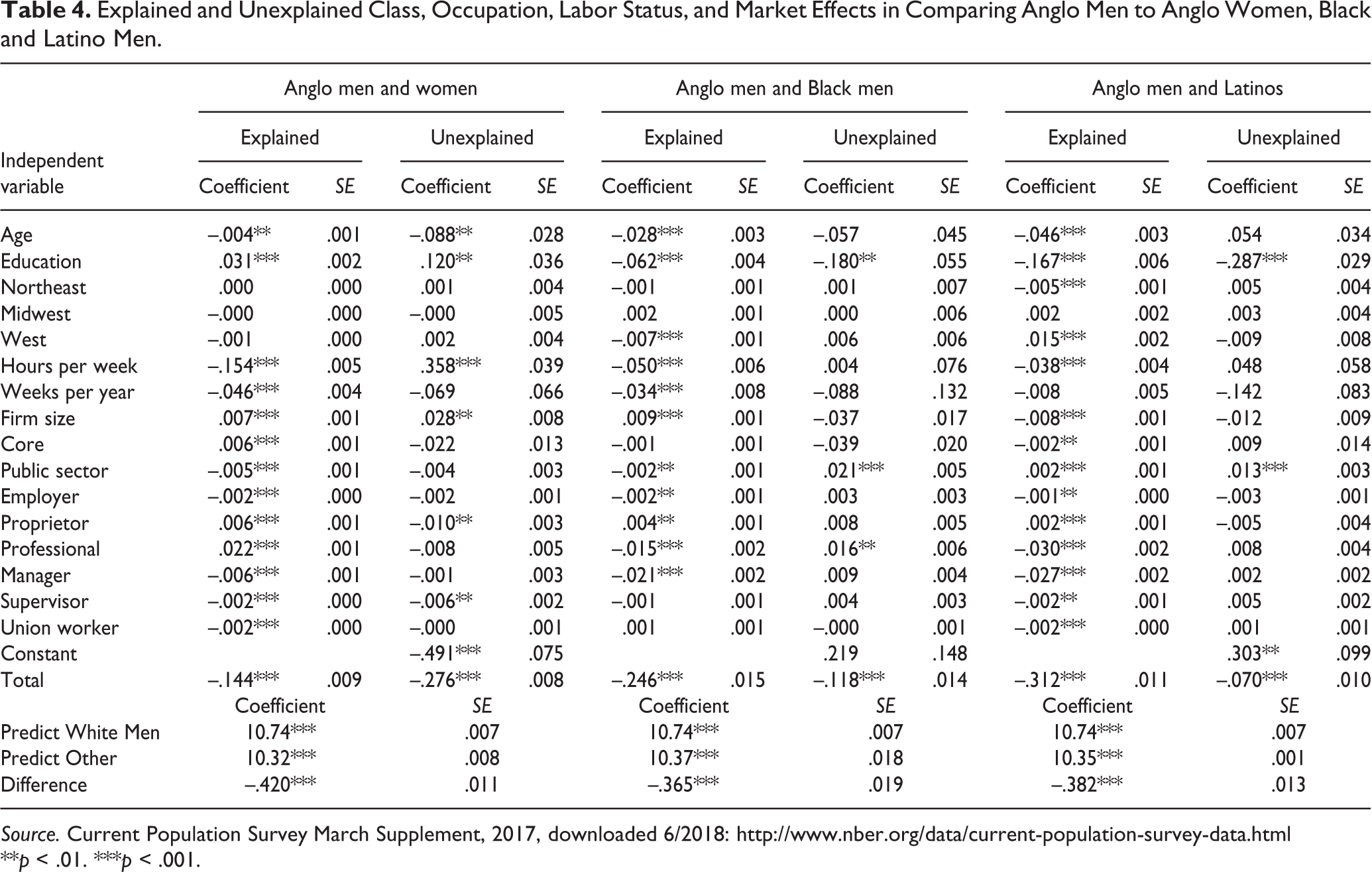
Explained and Unexplained Class, Occupation, Labor Status, and Market Effects in Comparing Anglo Men to Anglo Women, Black and Latino Men.
Source. Current Population Survey March Supplement, 2017, downloaded 6/2018: http://www.nber.org/data/current-population-survey-data.html
**p < .01. ***p < .001.
Beginning with age, we find that Anglo women earners tend to be younger and gain significantly less advantage with age. Black men and Latinos are similarly younger than their Anglo counterparts but do not suffer the disadvantage (unexplained negative effect) of increasing age. Education differences are even starker. Anglo women are advantaged, both in acquiring more education and in cashing in with increased earnings (unexplained effect). Black men and Latinos suffer on both fronts—less education and less earnings for increased education. Not surprisingly, geography favors the Latinos, who are more likely to live and work in the West, but there are no significant unexplained effects.
Hours and weeks of work tend to favor Anglo men across the board—they work more (explained effects), but only Anglo women enjoy a significant bonus for more hours. Anglo women who work more hours tend to earn more—to a greater extent than Anglo men—who tend to earn more and to work more hours but not to get more earnings per hours worked (unexplained effect). This is not true for Black men or Latinos, but is true for women generally. Large firms in core industrial sectors and employment in the public sector seem to offer advantages and disadvantages that vary, once again, across race, ethnicity and gender. Anglo women work in larger firms, in core industries, and in the public sector (compared with Anglo men), but they enjoy earnings benefits in these sheltered labor markets only in large firms (again, compared with Anglo men: unexplained effects). Black men also work more in large firms and in the public sector, but not in core industries (explained effects), and their earnings benefits are only significant in the public sector (unexplained effect). Latinos do not work in large firms, or in core industries, or in the public sector. The public sector does, however, reward them with higher earnings (again in comparison to Anglo men: unexplained effect).
We find similar differences in the class or occupational effects across gender, race, and ethnicity. Anglo women are less likely to be self-employed, more likely to be professional but less likely to be managers, supervisors or union workers. Also, they suffer even lower earnings when self-employed—as a proprietor, or when employed as a supervisor (unexplained effects). Black men are similarly less likely to be self-employed, but are also less likely to be professionals, or managers, but not less likely to be supervisors or union workers. When they do work as professionals, however, Black men earn even more (compared with Anglo men: unexplained effect). Latinos are disadvantaged across the board in access to better jobs, but they suffer no disadvantage or enjoy no advantage (unexplained effects) in any case—unlike Anglo women and Black men.
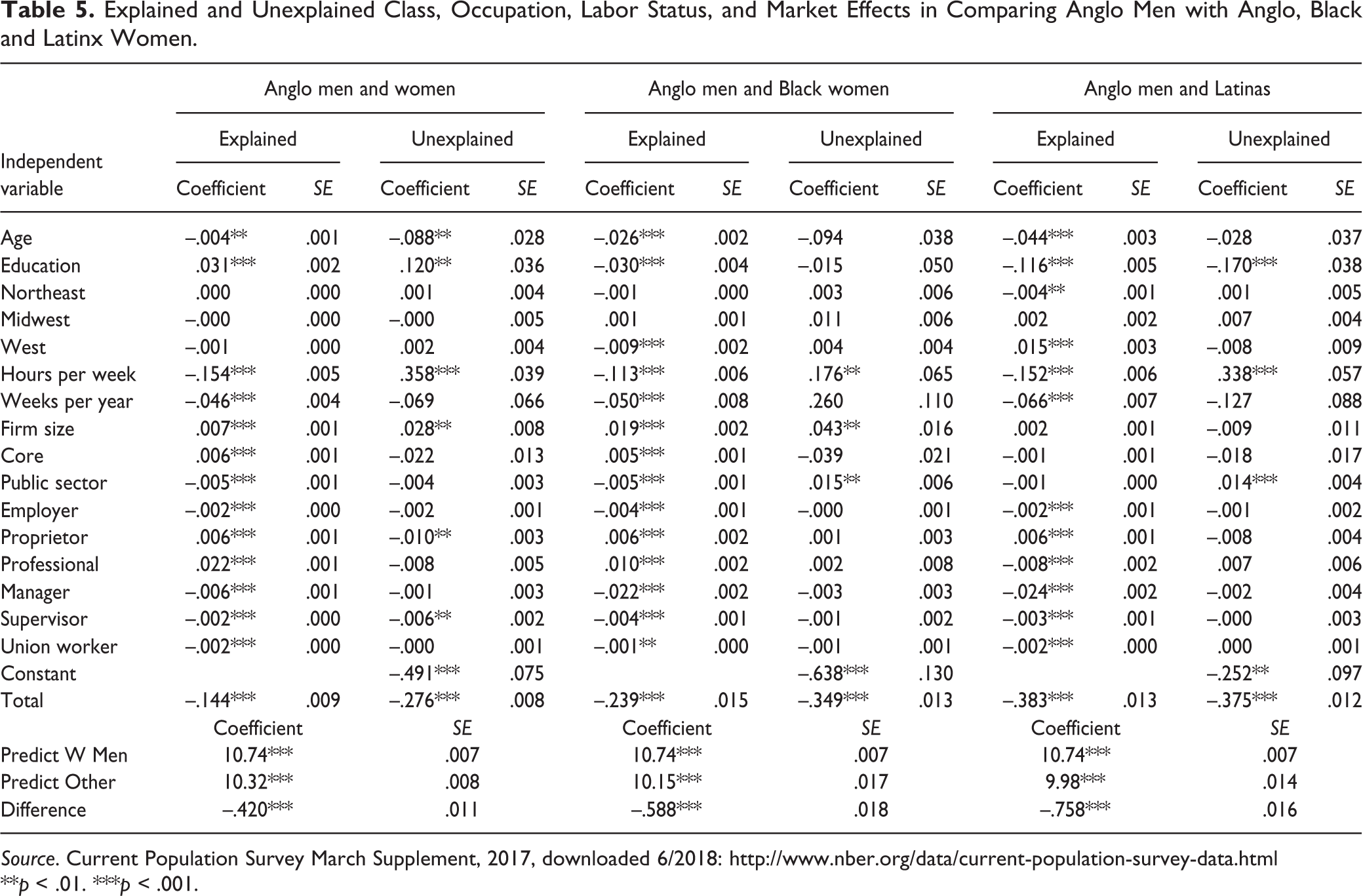
As seen in Table 5, Black women and Latinas, like Anglo women, tend to be younger (explained effect), but, unlike Anglo women, do not suffer an aging penalty (unexplained). On the contrary, unlike Anglo women, they are less educated and Latinas even suffer an education penalty (unexplained effect), like their male counterparts, which Black women do not suffer. Black women are less educated but still enjoy benefits of education that are comparable with the benefits enjoyed by Anglo men—if not Anglo women. Their regional advantages and disadvantages mirror their male counterparts—Blacks still concentrated in the South and Latinas still in the West. Hours-per-week affects all women in the same way. All are less likely to work as many hours as Anglo men (explained effects) but claim significantly larger earnings when they do work more (unexplained effects). Weeks-per-year also exhibit similar gender patterns across race and ethnicity, in this case, irregular employment (explained effects) but no significant added benefits for working like an Anglo man (insignificant unexplained effects).
Explained and Unexplained Class, Occupation, Labor Status, and Market Effects in Comparing Anglo Men with Anglo, Black and Latinx Women.
Source. Current Population Survey March Supplement, 2017, downloaded 6/2018: http://www.nber.org/data/current-population-survey-data.html
**p < .01. ***p < .001.
Labor market segmentation is more complex. On explained effects, Black women resemble Anglo women, but there are no significant effects for Latinas. There are, however, significant unexplained effects of public sector employment for Black women and Latinas (but not for Anglo women). Thus, it appears that the generally lower paid positions in the public sector offer bonuses for Black women and Latinas—just like their male counterparts. On the contrary, Black women, like their Anglo sisters, gain an earnings boost when working for large firms (unexplained)—in comparison to Anglo men, which Latinas do not enjoy.
Finally, both Black women and Latinas are less likely to be self-employed but do not suffer the penalty of proprietorship—as Anglo women do. Black women mirror their Anglo sisters in professional positions, where Latinas are underrepresented, but they do not claim the professional earnings boost of their Black male counterparts. Other than that, Black women and Latinas are underrepresented in managerial, supervisorial, and union jobs but do not suffer the earnings penalty of female Anglo supervisors.
Discussion
Race, ethnicity, and gender pose constraints on relations at work and at home. Blacks and Anglos work together more readily than they live together, while the opposite is true for men and women (Hogan, 2001, 2013). That is why some male workers are trapped in the South or the West, where race and ethnic enclaves persist, while some female workers are trapped in marriages, which are also enduring ethnic and racial enclaves.
So what can the disadvantaged do? Anglo women can use their educational advantages to pursue professional careers and can use proprietorship as a strategy for balancing the demands of life and work. They earn less but have more flexible hours and the option of working at home or possibly bringing their children to work. The professional option is also increasingly available to Blacks, particularly Black women, but it seems to benefit Black men more—which may be due to who follows whose career. Clearly, there is more work to be done on this front.
The fact that Black men, Latinos, and Latinas suffer an educational deficit and a limited return on education suggests some fundamental problems in life that translate into serious problems at work. For the Black men able to gain professional employment, there is access to middle-class earnings. Aside from that, public sector employment seems to be a sheltered labor market, where the disadvantages of race and ethnicity, and even gender for Black women and Latinas, seem less profound.
Conclusion
Latinas are, as we expected, especially disadvantaged, at home and at work, despite the advantage of Whiteness. Perhaps the wages of Whiteness do not extend to Latinas. They suffer the same marriage penalty as Anglo women—unlike their Black counterparts or the Black men and Latinos who share the Anglo male benefits of marriage, if not their Daddy Bonus. In fact, Latinos and Latinas suffer a more profound parenting penalty than Blacks. Perhaps the Black family has served them better than the more traditional Catholic patriarchy or the Latinx community. Marriage is good for Latinos and bad for Latinas (in terms of earnings), but their fertility does not seem to be helping either to earn more than their childless counterparts.
We need more research on life and work, class, labor markets, and the racial, ethnic, and gender barriers to prosperity and domestic bliss. Anglo men are particularly advantaged in this regard, and it is not clear that Anglo women are better off with them, although they do seem to enjoy some of the benefits of life with Anglos not available to their Black and Latina sisters. How relations with Anglo men, at home and at work, are the source of income inequality deserves more detailed analysis than we can offer here, both theoretically and empirically (Hogan & Perrucci, 2007, 2014). We have indicated here that Latinxs are “truly disadvantaged” in ways that are comprehensible theoretically, but which deserve more empirical evidence.
Footnotes
Declaration of Conflicting Interests
The author(s) declared no potential conflicts of interest with respect to the research, authorship, and/or publication of this article.
Funding
The author(s) received no financial support for the research, authorship, and/or publication of this article.