



Abstract
Previous research has found mixed results regarding the association between acculturation and substance use in Hispanic populations. Additional research is warranted to examine relations among facets of acculturation, particularly acculturative stress, and marijuana use. The purpose of this study was to examine whether self-esteem mediates the relation between acculturative stress and a lifetime history of marijuana use among a sample of Hispanic college students. Hispanic college students (N = 204; Mean age = 20.3 years) from a large southwestern university participated in an online study and reported on lifetime marijuana use, self-esteem, and acculturative stress. We evaluated the hypothesis that self-esteem would mediate the relation between acculturative stress and the likelihood of reporting a history of marijuana use, utilizing Hayes’ SPSS macro, which provides estimates of boot-strapped confidence intervals for the indirect effect. Results showed that self-esteem did not significantly mediate the relation between acculturative stress and likelihood of marijuana use [b = .157, 95% CI (−.003, .017)]. Future studies might examine other facets of acculturation in relation to substance use, utilizing a longitudinal approach to better understand these associations.
Introduction
The number of Hispanic individuals residing in the U.S. is increasing (United States Government Census Bureau, 2016), yet health-related disparities remain an overlooked problem relevant to this sizable sub-population. Substance use is prevalent among Hispanics, with elevated rates of marijuana use often reported among Hispanic adolescents and young adults relative to their White, non-Hispanic peers (Oluwoye et al., 2016). Previous research has also shown significant increases over the past 10 years in incidence of marijuana initiation and prevalence of use among Hispanic youth and adults (Marzell et al., 2017). There is a need to study unique factors that may be associated with substance use, especially marijuana use (Marzell et al., 2017; Oluwoye et al., 2016), among Hispanic young adults.
A possible factor that may partially account for the burgeoning rates of marijuana use among Hispanic young adults is acculturative stress. Multidimensional in nature, acculturative stress can be defined as experiencing stress in language competency and cultural norms due to adaptation to a new culture and can negatively affect the health status of a particular individual (Berry et al., 1987). Berry et al. (1987) defines acculturative stress as “a reduction in the health status of individuals, and may include physical, psychological and social aspects; to qualify as acculturative stress, these changes should be related in a systematic way to known features of the acculturation process, as experienced by the individual” (p. 493).
Hispanic individuals may experience discrimination or changes in identity, which, along with perceived need to acculturate to the dominant culture, may be associated with increased likelihood of substance use as a potential means to cope with distress (Pokhrel et al., 2013). Though different dimensions of acculturative stress (e.g., social/personal, societal, and environmental) are probable risk factors for increased substance use among Hispanic individuals, mixed results have been found in the literature. That is, some studies (e.g., Pokhrel et al., 2013; Salas-Wright et al., 2015) show that increased acculturative stress leads to elevated marijuana use, whereas other research has shown that acculturative stress is linked to decreased marijuana and cocaine use and may serve as a protective factor against illicit-drug initiation (Mercado et al., 2017).
One construct that may be relevant to the acculturative stress-substance use relation is self-esteem. Trait self-esteem, defined as an evaluative judgment in one’s own worth or abilities (Kling et al., 1999), has been inversely associated with substance use behavior. Previous research has found that lower levels of self-esteem are correlated with engagement in risky behaviors, such as marijuana use; for example, Lian-Yu et al. (2017) showed that older boys and girls with lower self-esteem were more likely to use marijuana. Conversely, higher levels of self-esteem may serve as a protective factor; Fisher et al. (2017) found that elevated levels of self-esteem served as a mediator, accounting for shared variance between respondents’ ethnic identity and their substance use behavior. It is important to clarify the potential mediating role of self-esteem in the relation between acculturative stress and marijuana use.
Despite the increased availability and acceptability of marijuana use, due to recent policy changes, coupled with a surge in the number of Hispanic individuals in the U.S., there remains a paucity of research on substance use behavior among Hispanic young adults (Lopez-Tomayo et al., 2016), especially those enrolled in college. With increased rates of marijuana use among Hispanic individuals (Lopez-Tomayo et al., 2016), additional research is needed to address which facets of acculturative stress may be associated with a greater likelihood of reporting marijuana use among Hispanic young adults. The present study investigated associations among facets of acculturation, trait self-esteem, and marijuana use among a sample of Hispanic college students. We hypothesized that greater acculturative stress would be associated with increased likelihood of reporting lifetime marijuana use and that this relation would be mediated by levels of trait self-esteem.
Method
Sample
Participants (N = 204) ranged in age from 17 to 48 years old (M = 20.27, SD = 3.44). The entire sample self-identified a Hispanic ethnicity and was composed of a majority of females (n = 143; 70%). A total of 85 participants were freshmen, 35 were sophomores, 42 were juniors, and 42 were seniors. Forty-six participants (22.5%) were members of a fraternity or sorority and 83 (40.7%) were currently employed.
Procedures
Young adults were recruited from a large Southwestern university to participate in a larger study examining health behaviors of college students. For the current study, analyses were limited to the subset of Hispanic participants (n = 204); 21.3% of total overall sample. After providing electronic consent, participants completed an online survey and received course credit for their research participation. All participants were informed that their responses would be kept anonymous and that the results of the survey would be used for research purposes only. The affiliated Institutional Review Board approved the study’s protocol.
Measures
Demographics
Participants completed a baseline measure of demographic questions including age, gender, race, and ethnicity. Here, ethnicity was ascertained with the question, “Do you consider yourself Hispanic/Latino?”
Multigroup Ethnic Identity Measure
The Multigroup Ethnic Identity Measure (MEIM; Roberts et al., 1999) measures the extent to which a particular ethnic group identifies with a given culture. Participants rate how strongly they agree or disagree with a series of statements, using a 4-point Likert-type scale from 1 “Strongly disagree” to 4 “Strongly agree.” To measure acculturative stress in this study, we used the Affirmation/Belonging subscale, which consists of seven items. A sample item is, “I have a lot of pride in my ethnic group.” Reliability coefficients ranged from .80 to .89 across previous studies (Cavazos-Rehg & DeLucia-Waack, 2009; Worrell, 2000). For the current study, Cronbach’s alpha was .75 for the Affirmation/Belonging sub-scale.
Rosenberg Self-esteem Scale
The ten-item Rosenberg Self-esteem Scale (Rosenberg, 1989) measures one’s level of trait self-esteem. Participants rated how strongly they agreed or disagreed with each item, using a 4-point Likert scale from 1 “Strongly disagree” to 4 “Strongly agree.” A sample item is, “I feel that I have a number of good qualities.” Reliability coefficients ranged from .79 to .83 across previous studies (Smokowski & Bacallao, 2007; Supple & Plunkett, 2010). For the current sample, Cronbach’s alpha was acceptable at a level of .88.
Lifetime marijuana use
A single, dichotomous question was asked assessing marijuana use, “Have you ever used marijuana, hash, THC, or grass?” Participants answered either “yes” (35.8%) or “no” (64.2%).
Analysis plan
Spearman correlations measured the relation among lifetime marijuana use, self-reported self-esteem, and acculturative stress, as assessed by the MEIM. Chi-square analyses were conducted to assess for potential differences in prevalence of lifetime marijuana use based on participant gender. Independent sample t-tests were conducted to assess age-related differences in lifetime marijuana use. The hypothesis that self-esteem mediates the relation between level of acculturative stress and likelihood of lifetime marijuana use was tested using logistic regression path analysis via the SPSS PROCESS macro (Hayes, 2013; Preacher & Hayes, 2008). The PROCESS macro provides estimates of the path coefficients in the moderation model with a bootstrapped 95% confidence interval. The PROCESS macro allows testing of direct and indirect effects of mediating and moderating variables. Due to missing data (14 cases from self-esteem; one case from MASI scale) on key constructs included in the analysis 190 participants were included in the final analytic sample.
Results
A minority of participants (38.4%, n = 71/204) reported lifetime marijuana use. There were no significant differences between males and females in prevalence of lifetime marijuana use (χ2 = 1.77, p = .41). In addition, there was no significant difference in likelihood of reporting lifetime marijuana use based on respondent age, t(202) = −.730, p = .47. Lifetime marijuana use and trait self-esteem were not correlated (r = .028, p = .70); there was a significant negative correlation between current levels of acculturative stress and likelihood of reporting lifetime marijuana use (r = −.163, p < .05).
In the moderation model (see Figure 1), when lifetime marijuana use was regressed on self-esteem, self-esteem was not associated with lifetime marijuana use (b = −.020, OR = 1.03, p = .98; 95% CI [−0.21, 1.28]). In addition, acculturative stress was associated with lifetime marijuana use (b = .−1.57, OR = 1.01, p = .010; 95% CI [.−654, −1.590]). Based on 5,000 bootstrap resamples, a test of whether self-esteem would mediate the relation between lifetime marijuana use and acculturative stress was not significant (unstandardized b = −.009, OR = .86, 95% CI [.983, 1.015]).
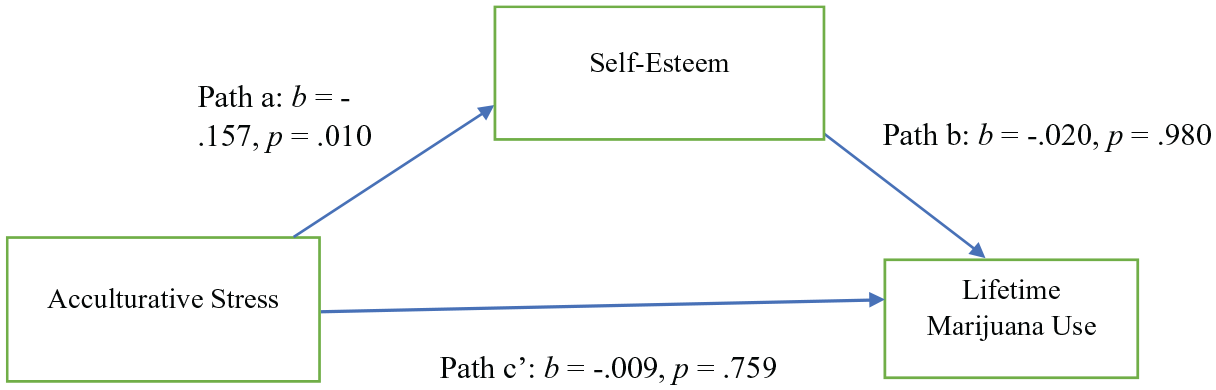
Self-esteem as a moderator between acculturative stress and lifetime marijuana use among Hispanic college students (N = 190).
Discussion
Marijuana use disparities among Hispanic sub-populations continue to be a major health concern. The present study found that 38.4% of Hispanic college students reported lifetime marijuana use, which is somewhat higher than what previous research has found (e.g., 36.4% in Mercado et al., 2017; 15% in Pokhrel et al., 2013). The higher prevalence of reported marijuana use is consistent with national data from the Monitoring the Future Survey, suggesting a trend toward greater cannabis use among high school students in the U.S. (Miech et al., 2017). This finding underscores the need to create theoretically informed interventions to address increasing marijuana use among college students, particularly among Hispanic students who may exposed to higher levels of acculturative stress.
Identifying potential psychological and psychosocial factors related to marijuana use among Hispanic sub-populations may elucidate risk factors to target in future prevention and intervention efforts. Self-derogation theory (Kaplan et al., 1982) posits that adolescents and young adults who experience low-self-esteem may engage in risky health behaviors to increase their self-esteem, as risky behavior engagement represents a violation of authority and social norms, which is positively regarded by peers. In contrast to this work, the present study found that self-esteem did not explain the association between acculturative stress and lifetime marijuana use. This finding is contrary to previous research suggesting that self-esteem is a potential protective factor against marijuana use (Fisher et al., 2017; Zamboanga et al., 2009). As college students age, it may be that the protective nature of trait self-esteem is overpowered by situational factors that potentiate marijuana use. Lee et al. (2018) examined associations between self-esteem and marijuana longitudinally and did not find a relation between self-esteem and marijuana for those entering young adulthood. Additional longitudinal research examining a more diverse sample of Hispanic young adults may be warranted in order to advance an understanding of the role of acculturative stress in potentiating marijuana use behavior in Hispanic populations. Additionally, further research to elucidate other psychological variables (e.g., depression, lack of self-confidence) that may be associated with increased marijuana use among Hispanic individuals is needed.
Interestingly, there was a significant negative correlation between acculturative stress and marijuana use, suggesting that acculturative stress could be a protective factor against marijuana use, contrary to findings from previous literature (Fisher et al., 2017). Perhaps young adults are cognizant of the harms associated with marijuana, and thus are finding other activities to reduce their stress. Moreover, greater societal acceptability for marijuana use could explain the negative relationship between stress and marijuana use. Additional information regarding acculturative stress among a diverse population of Hispanic young adults (e.g., not just individuals who had recently immigrated) may be particularly important to examine.
There is a paucity of literature examining the role of self-esteem in the relation between acculturative stress and marijuana use. To our knowledge, this is the first study examining these associations among Hispanics, whereas other research has focused on minority groups as a collective whole (White vs. “Other”; Fisher et al., 2017). Increasing marijuana prevalence among Hispanic young adults (Oluwoye et al., 2016) highlights the need for culturally sensitive interventions targeting substance use behaviors, which have been tailored for Hispanic young adults. Implementing interventions focusing on familism, cultural values, and diversity may be protective against future initiation and maintenance of marijuana use. For example, interventions aimed at addressing acculturative stress could serve as potential buffers against initiation and continued use of marijuana. Such strategies could lead to promising interventions intended to decrease marijuana use and increase self-esteem in Hispanic young adults (Oluwoye et al., 2016). Further, incorporating the use of protective behavioral strategies, such as avoiding buying marijuana and avoiding large social gatherings where marijuana may be present, have been shown to decrease the likelihood of marijuana use (Pedersen et al., 2016) and may serve as important protective factors against increased marijuana use in young adulthood.
Strengths and Limitations
Several limitations of this research should be noted. The study was conducted at one Southwestern university, tempering the generalizability of study results to other Hispanic young adults. Recruiting from multiple campuses would increase generalizability. We only focused on lifetime marijuana use, so we cannot differentiate recent patterns of marijuana use or marijuana associated problems. In addition, we did not examine other facets of acculturation in our study. Notable strengths of our study include a large sample of Hispanic students and a reliable measure of acculturation. In addition, we examined specific a specific facet of acculturation (acculturative stress) rather than focusing on language as a marker of acculturation.
Footnotes
Declaration of Conflicting Interests
The author(s) declared no potential conflicts of interest with respect to the research, authorship, and/or publication of this article.
Funding
The author(s) disclosed receipt of the following financial support for the research, authorship, and/or publication of this article: This research was supported by research development funds from Texas Tech University.