



Abstract
Acculturation is multidimensional in that it encompasses both heritage and dominant cultural orientations, and it can take place across multiple domains; therefore, biculturalism, an acculturation strategy involving strong orientations to both heritage and dominant cultures, can also occur for the domains of behaviors and practices, values and beliefs, and cultural identity. The current study is the first to compare the relations between biculturalism and self-esteem across these three cultural domains. Mexican American undergraduate students (N = 219; Mage = 18.82 years, SD = 1.09), who were primarily women (72.15%) and born in the US (81.74%), responded to an in-person survey. We found that biculturalism is differentially associated with personal and collective self-esteem depending on the domain, with stronger associations for bicultural behaviors and weaker associations for bicultural values. Our findings highlight the importance of recognizing the multidimensionality of biculturalism in theory, research, and practice.
Acculturation is a topic that has received a great deal of theoretical and empirical attention. Anyone who has prolonged and extensive exposure to more than one culture (Berry, 1997), including ethnic minorities, immigrants, and refugees, such as U.S.-born and foreign-born Latinxs in the United States, are examples of individuals who undergo the process of acculturation via navigating their heritage culture and U.S. American culture (Padilla, 2006). Individuals of Latinx origin comprise the largest ethnic/racial minority group in the United States: 59.9 million Americans or 18.3% of the national population (U.S. Census, 2019). Of Latinxs living in the United States, the largest group is of Mexican origin (Pew Research Center, 2019). Given these numbers, it is essential to understand how Mexican Americans (i.e., individuals of Mexican origin living in the United States) negotiate Mexican and U.S. American cultures in their practices, values, and identifications (Schwartz et al., 2010), and the implications of this biculturalism process for their self-esteem. Therefore, the goal of this study was to compare the associations between Mexican Americans’ biculturalism and self-esteem across three cultural domains: behaviors, values, and identity.
Generally, individuals desire to maintain and protect a positive self-concept, and therefore, a positive self-esteem (Luhtanen & Crocker, 1992). However, certain experiences, such as acculturation, can make the maintenance of a positive self-esteem difficult. Self-esteem is particularly important because findings suggest that low self-esteem is a risk factor for outcomes like depression (Orth et al., 2014); hence, it is not surprising that research in biculturalism has focused on self-esteem as a correlate. Although self-esteem encompasses two interrelated aspects, biculturalism researchers have primarily studied personal self-esteem and not collective self-esteem (CSE). However, for individuals from cultures that value collectivism (e.g., Mexican Americans), it may be more appropriate to consider CSE in addition to personal self-esteem (Giang & Wittig, 2006). Only one study has investigated the relation between acculturation strategies and both personal self-esteem and CSE (Giang & Wittig, 2006). Those researchers found that compared to the other acculturation strategies, integration and assimilation related to higher levels of both personal self-esteem and CSE.
Personal self-esteem is the positive and negative attitudes about oneself as related to one’s values or goals (Rosenberg, 1965), and collective self-esteem is the positive and negative attitudes of one’s self-concept relative to the values or goals of one’s in-groups (such as one’s cultural groups’; Luhtanen & Crocker, 1992). Personal self-esteem is related to lower depression among Mexican American adolescents (Orth et al., 2014), higher ethnic identity for Latinx participants (Umaña-Taylor et al., 2002), and higher endorsement of caballerismo (the positive dimension of machismo) for Mexican men (Ojeda & Piña-Watson, 2014). For Latinx college students, higher CSE is related to greater psychological well-being (Gloria et al., 2009), a greater likelihood of feeling that they mattered in the university (Dueñas & Gloria, 2017), and greater cultural congruity (Constantine et al., 2002). These findings suggest that personal self-esteem and CSE are meaningful and relevant constructs to consider for Mexican Americans’ biculturalism.
Integration, also known as biculturalism, is one strategy of acculturation (Berry, 1997). As stated in Berry’s (1997) model of acculturation, retention of one’s heritage culture and adoption of the dominant culture are independent of one another, and can be crossed to create four acculturation strategies: assimilation, separation, marginalization, and integration. 1 In this paper, we focus on integration, where individuals engage with both their heritage and dominant cultures. Integration is the most beneficial way to negotiate two cultures (e.g., Berry et al., 2006) and has been found to be positively related to better psychological and sociocultural adjustment (Nguyen & Benet-Martínez, 2013).
Acculturation and thus biculturalism are multidimensional not only because they consist of independent cultural orientations, but also because they involve different cultural domains (Guo et al., 2012; Schwartz et al., 2010). The biculturalism process may be different depending on whether individuals are negotiating two sets of behavioral repertoires and practices (e.g., language, affiliations, customs), two sets of beliefs or value systems (e.g., familismo, respeto), or two cultural identifications (i.e., ethnic identity and national identity). Although most studies on acculturation and biculturalism have included measures of cultural behaviors only (Schwartz et al., 2010), researchers are increasingly assessing two or more domains. For example, Latinx and U.S. American behavioral acculturation versus value acculturation have different magnitudes of association with psychological adjustment (Smokowski & Bacallao, 2007; Smokowski et al., 2010). Latinx and U.S. American behavioral acculturation versus identity-based acculturation are also associated differently with psychological adjustment (Meca et al., 2020). Despite these advances in acculturation research, there is no published study examining simultaneously bicultural behaviors, values, and identities. Although biculturalism seems to be adaptive in that it is associated with higher personal self-esteem for Latinxs in the United States (Torres & Rollock, 2009), the question of whether this positive biculturalism-adjustment association holds across cultural domains (i.e., cultural behaviors, values, and identifications) remains.
Cultural Behaviors
Cultural behaviors refer to language use and involvement (e.g., eating cultural foods, attending cultural events, having cultural affiliations) in heritage and dominant cultures (Schwartz et al., 2010). Previous studies have yielded inconsistent results regarding the relation between heritage cultural behaviors and adjustment for Latinxs. Some studies found that greater involvement in Latinx cultural practices is associated with higher personal self-esteem (Smokowski et al., 2010). Other studies found non-significant, null-to-weak associations between Latinx behaviors and personal self-esteem (Meca et al., 2020), depression (Lorenzo-Blanco & Cortina, 2013), and internalizing symptoms (Smokowski & Bacallao, 2007). The relation between dominant cultural behaviors and adjustment is not much clearer. Some studies found that greater involvement in U.S. American cultural practices is associated with greater well-being and personal self-esteem (Meca et al., 2020), and fewer internalizing symptoms (Smokowski et al., 2010) for Latinxs. Conversely, other studies found that greater involvement in U.S. American cultural practices is associated with lower perceptions of self-worth among Latinxs (Birman, 1998). Additionally, there are studies that found non-significant, null-to-weak associations between U.S. American behaviors and personal self-esteem and depression for Latinxs (Lorenzo-Blanco & Cortina, 2013; Meca et al., 2020; Smokowski & Bacallao, 2007).
Investigating bicultural behaviors (i.e., high involvement in both Latinx and U.S. American cultures) may be the key to understanding these mixed findings between heritage and dominant cultural behaviors and adjustment. If bicultural behaviors were driving the empirical findings reviewed above, it is possible that the studies that found positive associations between Latinx (or U.S. American) behaviors and adjustment had participants who were also highly engaged in U.S. American (or Latinx) practices (i.e., participants who were behaviorally bicultural). Further, the negative or null associations found between cultural behaviors and adjustment may be because those studies consisted of participants who were highly involved in behaviors of only one culture and not the other. Only a handful of studies have examined bicultural behaviors and adjustment. Although one study found that bicultural behaviors are not associated with personal self-esteem for Latinx adolescents (Smokowski & Bacallao, 2007), the majority found a positive relation between bicultural behaviors and adjustment, such as fewer internalizing symptoms for Latinx adolescents (Smokowski & Bacallao, 2007), less loneliness and alienation (Suarez et al., 1997) and more positive school attitudes (Moní et al., 2018) for Latinx young adults, and lower stress for Mexican American young men (Fernandez-Barillas & Morrison, 1984). Therefore, we hypothesized that for Mexican Americans, greater involvement in both Mexican and U.S. American cultures would be associated with greater adjustment, specifically higher personal self-esteem and CSE.
Cultural Values
Cultural values are ideologies or beliefs about what is important and desirable according to members of a specific cultural group (Piña-Watson et al., 2013). The relation between cultural values and adjustment for Latinxs is more consistent than that between cultural behaviors and adjustment. There is overwhelming evidence that familismo or family connectedness (a Latinx value) is associated with positive adjustment variables, such as higher personal self-esteem (Smokowski et al., 2010), greater satisfaction with life (Piña-Watson et al., 2013), fewer depressive symptoms (Stein et al., 2015), and fewer internalizing symptoms (Smokowski & Bacallao, 2007). However, not all Latinx cultural values have positive associations with adjustment. Gender-related Latinx cultural values (e.g., traditional gender roles, traditional machismo, marianismo) are associated with poorer adjustment (Arciniega et al., 2008), including depression, anxiety, and life satisfaction. An exception to this is caballerismo, which is positively associated with greater satisfaction with life among Mexican American men (Arciniega et al., 2008).
Research on cultural values endorsed by Latinxs in the United States has primarily focused on Latinx values with very few studies on U.S. American values and no studies on bicultural values (i.e., endorsement of both Latinx and U.S. American values). It is possible that adhering to a set of cultural values, regardless of which one, is associated with positive adjustment variables; therefore, adhering to two sets of values would also be associated with better adjustment. On the other hand, it is equally likely that adhering to two sets of values would result in a conflict of values (Cheng et al., 2014), which would be associated with poorer adjustment. Because the direction of the relation between bicultural values and adjustment is unclear, we did not propose a hypothesis regarding the association between bicultural values and personal self-esteem and CSE for Mexican Americans.
Cultural Identity
Broadly defined, cultural identity refers to the feelings, attitudes, and attachments regarding one’s cultural groups (Phinney et al., 2001; Schwartz et al., 2010). Cultural identity includes both a heritage cultural identity (e.g., Latinx identity; commonly referred to as ethnic identity) and a dominant cultural identity (e.g., U.S. American identity; commonly referred to as national identity). For Latinx individuals, the relation between ethnic identity and adjustment is largely consistent. A stronger ethnic identity (including its components of exploration, resolution, and affirmation) is associated with higher personal self-esteem and satisfaction with life for Mexican American adolescents (Piña-Watson et al., 2013), and greater well-being and fewer depressive symptoms for Latinx young adults (Meca et al., 2020). However, previous research has also found a non-significant association between ethnic identity and personal self-esteem for Mexican American adolescents (Der-Karabetian & Ruiz, 1997). Nevertheless, a narrative review of the literature concluded that ethnic identity and personal self-esteem are positively related for Latinx adolescents (Umaña-Taylor et al., 2002). Considerably less research has been conducted on national identity and adjustment. Studies have found non-significant, near-null associations between national identity and adjustment for Latinx adolescents and young adults (e.g., personal self-esteem, depression; Der-Karabetian & Ruiz, 1997; Meca et al., 2020).
The association between bicultural identity and self-esteem was once uncertain, but a review asserts that the association is positive. Whereas one study found that those who identified biculturally did not have a higher personal self-esteem than other Mexican American adolescents (Der-Karabetian & Ruiz, 1997), another study found that those who identified biculturally had higher self-esteem and less psychosocial discomfort (e.g., depression, tension) than other Mexican American adolescents (de Domanico et al., 1994). A narrative review of the literature suggests that bicultural identity is the most adaptive with positive associations with adjustment (Phinney et al., 2001), thus providing some conclusions to previous mixed findings on bicultural identity and adjustment. Based on existing literature on bicultural identity, we hypothesized that for Mexican Americans, stronger identification with both Mexican and U.S. American cultures would be associated with greater adjustment, specifically higher personal self-esteem and CSE.
Current Study
Despite the multidimensionality of acculturation and subsequently biculturalism, many studies have focused, and continue to focus, on only one cultural domain (Schwartz et al., 2010). Measuring only one domain ignores the complexity of biculturalism. Examining and comparing all domains of biculturalism at the same time may paint a clearer picture of how biculturalism relates to self-esteem. Therefore, we hypothesized that higher personal self-esteem and CSE would be associated with higher biculturalism in one’s behaviors and practices (Hypothesis 1) and in one’s identity (Hypothesis 2). We did not have a specific hypothesis about biculturalism in one’s values and beliefs. We also hypothesized that the relation between biculturalism and self-esteem would differ across cultural domain for Mexican Americans (Hypothesis 3).
Method
Participants
Participants were 219 (72.15% women, 27.85% men) Mexican American undergraduate students from a large, public university in southern California (Mage = 18.82 years, SD = 1.09). The majority (81.74%) of participants were born in the United States, and participants born elsewhere had lived in the United States for an average of 14.44 years (SD = 4.52).
Measures
We assessed the behavioral domain of biculturalism using the Acculturation Rating Scale for Mexican Americans—Version II (Cuellar et al., 1995), which has two independent subscales: the Mexican Orientation Subscale (MOS; 17 items) and the Anglo Orientation Subscale (AOS; 13 items). We excluded six items pertaining to cultural identification, resulting in 13 items from the MOS (α = .90, 95% CI [.88, .91]) and 11 items from the AOS (α = .67, 95% CI [.60, .73]). Note that the lower Cronbach’s alpha for the AOS is likely due to its short length (i.e., less than 20 items) rather than the unreliability of the subscale (Schmitt, 1996). Sample items include “My thinking is done in the Spanish/English language” and “I associate with Mexicans/Anglos.” Participants rated items using a 5-point Likert-type scale ranging from 1 (not at all) to 5 (extremely often or almost always). We computed a bicultural behaviors score by multiplying the mean of MOS items with the mean of AOS items (Birman, 1998), with higher scores indicating higher frequency of bicultural behaviors.
We assessed the values domain of biculturalism using the Latino Cultural Values Scale (LCVS; Benet-Martínez & Santana, 2004), which has two subscales: Latinx (19 items) and U.S. American (19 items). It was developed specifically for Latinxs and was found to be a reliable and valid measure of cultural values for a sample of 237 Mexican American adults (Benet-Martínez & Santana, 2004). The items cover six categories of values: power distance (respeto vs. horizontal relationships), time orientation (time flexibility vs. punctuality), simpatía (simpatía vs. assertiveness), gender roles (machismo vs. gender equality), familismo (familismo vs. independence), and allocentrism (cooperation vs. competitiveness). Sample items are “One can count on help from relatives to solve most problems” (Latinx value of familismo) and “One should live one’s life independently of others” (U.S. American value of independence). We excluded a cultural identity item from each subscale, leaving 36 items total across the two subscales (Latinx subscale: α = .67, 95% CI [.62, .74]; U.S. American subscale: α = .68, 95% CI [.61, .73]). The lower Cronbach’s alpha coefficients are likely due to the multidimensionality of the values assessed as well as the subscales’ short length rather than their unreliability (Schmitt, 1996). Participants rated items using a 5-point Likert-type scale ranging from 1 (strongly disagree) to 5 (strongly agree). We computed a bicultural values score by multiplying the two mean subscale scores, with higher scores indicating stronger endorsement of bicultural values.
We assessed the identity domain of biculturalism using the two items from the LCVS (Benet-Martínez & Santana, 2004) that we excluded from our measurement of bicultural values: “Overall, I identify with Mexican culture” and “Overall, I identify with U.S. American culture.” Participants rated these two items using a 5-point Likert-type scale ranging from 1 (strongly disagree) to 5 (strongly agree). We computed a bicultural identity score by multiplying these two items together, with higher scores indicating a stronger bicultural identity.
We assessed personal self-esteem using the 10-item Rosenberg Self-Esteem Scale (Rosenberg, 1965), which has been validated with Mexican Americans, Salvadoran Americans, and Guatemalan Americans (Supple & Plunkett, 2011). A sample item is “I feel that I have a number of good qualities.” Participants rated items using a 5-point Likert-type scale ranging from 1 (strongly disagree) to 5 (strongly agree). We computed the mean to create a scale score, with higher scores indicating higher personal self-esteem (α = .86, 95% CI [.83, .89]).
We assessed CSE using the 16-item Collective Self-Esteem Scale (Luhtanen & Crocker, 1992), which has been validated with Latinx adolescents (Giang & Wittig, 2006). A sample item is “I often feel I’m a useless member of my social groups” (reverse-scored). Participants rated items using a 5-point Likert-type scale ranging from 1 (strongly disagree) to 5 (strongly agree). We computed the mean of these items to create a scale score, with higher scores indicating higher CSE (α = .81, 95% CI [.78, .85]).
Procedure
A Latina research assistant administered a 30-minute in-person, paper-and-pencil English-language survey to participants. The survey, which was completed individually, included the above measures as well as demographic questions. As compensation, participants received research credit in partial fulfillment of an Introduction to Psychology course.
Results
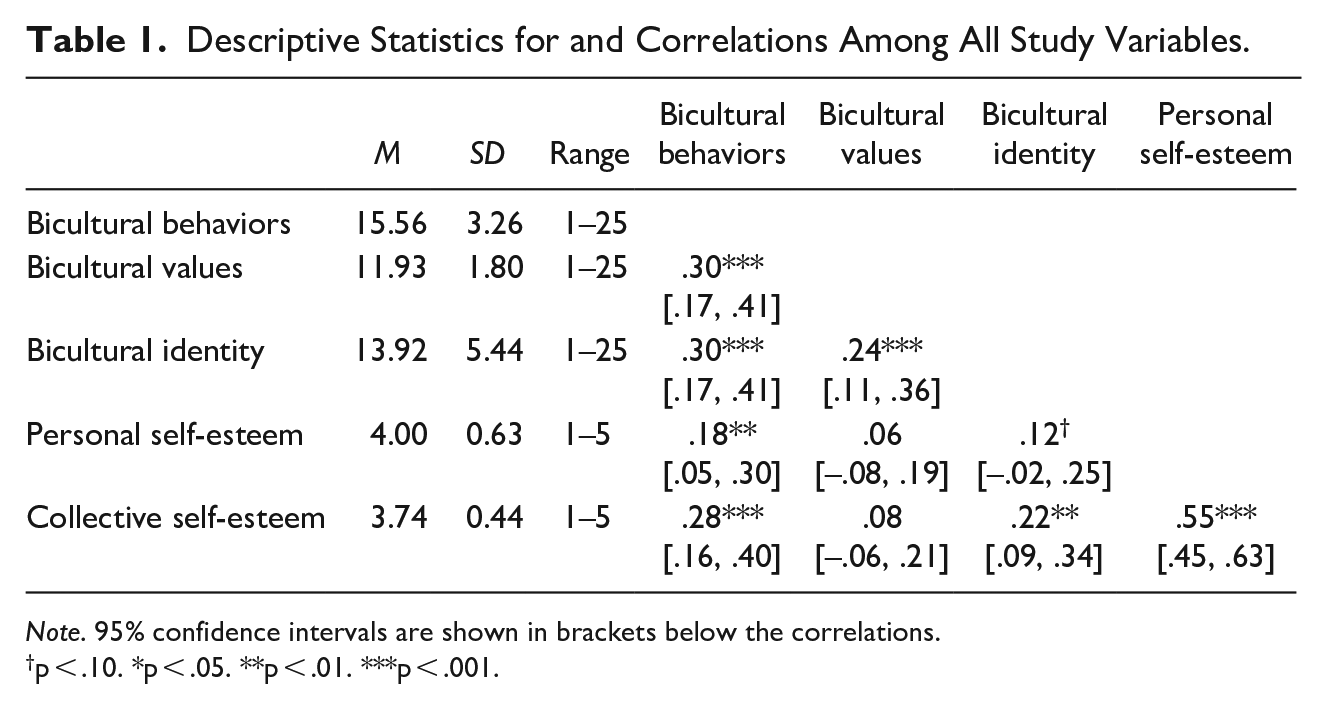
Descriptive statistics and product-moment correlations among all the variables are displayed in Table 1. These correlations were used to answer Hypotheses 1 and 2. Overall, participants were well-adjusted with high (above-midpoint) personal self-esteem and CSE scores. To determine whether we should control for gender and country of birth in our multiple regression analyses, we conducted several independent-samples t tests. There were no significant differences in gender for personal self-esteem (t(216) = −0.64, p = .52, 95% CI [−0.25, 0.13], r = −.04), but women had significantly higher CSE than men (t(217) = 2.35, p = .02, 95% CI [0.02, 0.29], r = −.01). Therefore, we controlled for gender in analyses involving CSE. There were no significant differences in country of birth for personal self-esteem (t(216) = −0.64, p = .53, 95% CI [−0.29, 0.15], r = −.04) or CSE (t(217) = −0.17, p = .86, 95% CI [−0.17, 0.14], r = −.01). Note that the three domains of biculturalism were only moderately interrelated. If these domains were not distinct, then the inter-correlations would be stronger in magnitude.
Descriptive Statistics for and Correlations Among All Study Variables.
Note. 95% confidence intervals are shown in brackets below the correlations.
p < .10. *p < .05. **p < .01. ***p < .001.
Supporting Hypothesis 1, correlation analyses revealed that bicultural behaviors were significantly, positively, and weakly-to-moderately related to greater personal self-esteem, and significantly, positively, and moderately related to greater CSE (see Table 1). In other words, Mexican Americans who participated in both Mexican and U.S. American practices were more likely to have a higher sense of self-worth and were more likely to value their social groups than those who did not engage in bicultural behaviors.
Our exploratory correlational analyses indicated that bicultural values had non-significant, weak associations with personal self-esteem and CSE (see Table 1). Because gender-related Latinx values may have a different pattern of results than other Latinx values (Arciniega et al., 2008), we recomputed the bicultural values score without the scale items pertaining to gender roles (machismo vs. gender equality) and conducted additional correlations. With the exclusion of gender roles, bicultural values were marginally, positively, and weakly related to greater personal self-esteem (r(216) = .12, p = .08, 95% CI [−.02,.25]), and significantly, positively, and weakly related to greater CSE (r(217) = .13, p = .05, 95% CI [0, .26]). In other words, Mexican Americans who endorsed both Latinx and U.S. American cultural values (but not those related to gender roles) were more likely to have a higher sense of self-worth and were more likely to value their social groups than those who did not endorse bicultural values.
Supporting Hypothesis 2, correlational analyses revealed that bicultural identity was marginally, positively, and weakly related to greater personal self-esteem, and significantly, positively, and weakly-to-moderately related to greater CSE (see Table 1). In other words, Mexican Americans who strongly identified with both Mexican and U.S. American cultures were more likely to have a higher sense of self-worth and were more likely to value their social groups than those who did not identify biculturally.
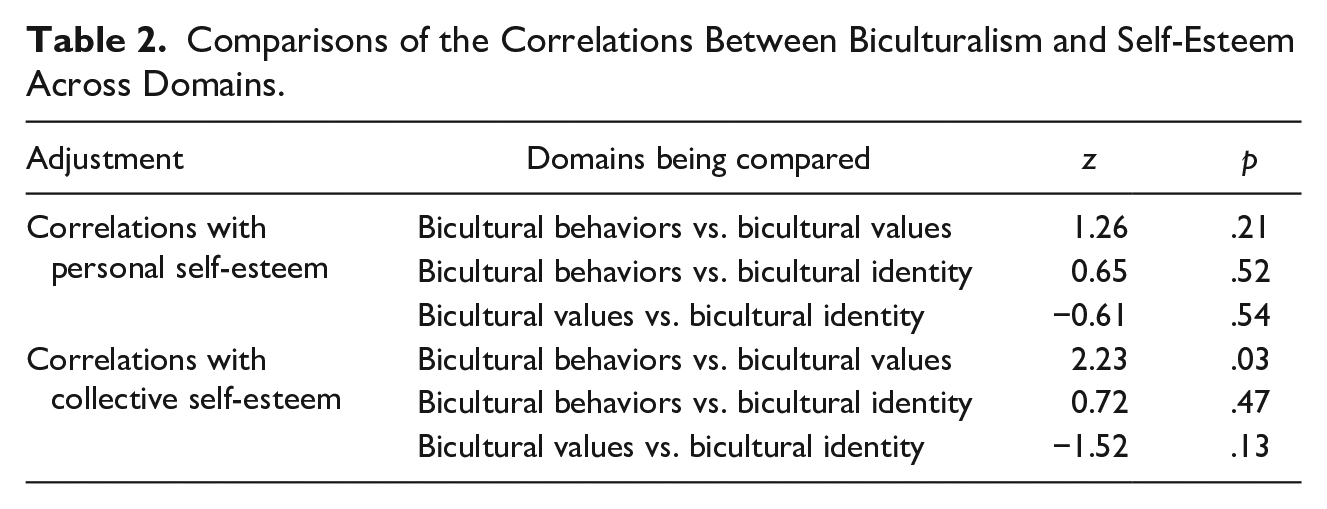
To test Hypothesis 3, we first compared pairs of the above correlations by conducting z tests on the Fisher’s z transformation of the correlation coefficients (see Table 2). The correlation between bicultural behaviors and CSE (r = .28 from Table 1) was significantly different from the correlation between bicultural values and CSE (r = .08 from Table 1) 2 . No other pairs of correlations were significantly different from each other. In other words, supporting our hypothesis, the relation between biculturalism and self-esteem differs by cultural domain.
Comparisons of the Correlations Between Biculturalism and Self-Esteem Across Domains.
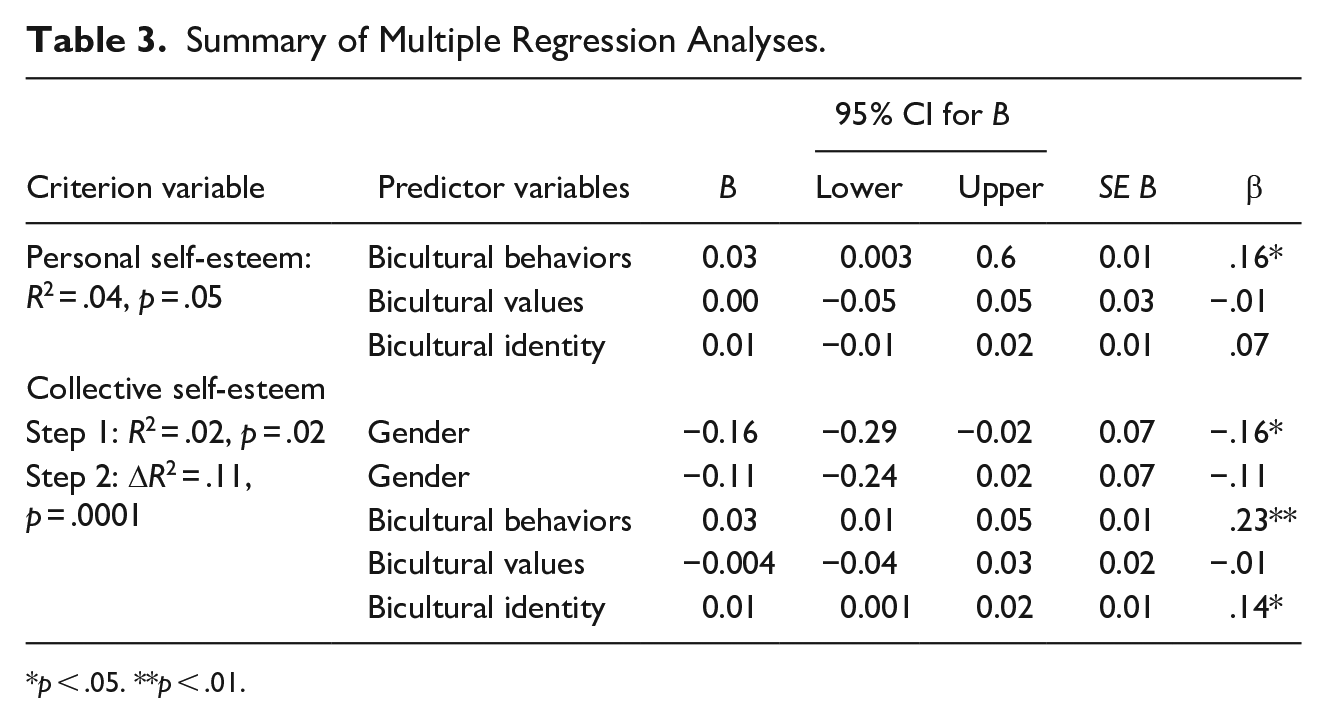
Second, to compare the relations between each biculturalism domain and self-esteem, we conducted two multiple regression analyses (one for personal self-esteem and one for CSE), with self-esteem as the criterion variable, gender as a control variable (only for the regression predicting CSE), and bicultural behaviors, values, and identity as the predictor variables (see Table 3). With bicultural behaviors, values, and identity in the same model, only bicultural behaviors significantly predicted greater personal self-esteem. Although bicultural identity had a significant zero-order correlation with personal self-esteem (see Table 1), it did not predict unique variance in personal self-esteem beyond that accounted for by bicultural behaviors and bicultural values. Regarding CSE, both bicultural behaviors and bicultural identity significantly predicted greater CSE. These regression results provide further evidence that the relation between biculturalism and self-esteem differs by cultural domain.
Summary of Multiple Regression Analyses.
p < .05. **p < .01.
Discussion
Mexican Americans may negotiate Mexican and U.S. American cultures in their behaviors and practices, values and beliefs, and identifications (Schwartz et al., 2010). They may be bicultural to different extents, depending on which of these three domains is being examined (Guo et al., 2012), but researchers have yet to simultaneously compare the correlates of bicultural behaviors, values, and identity. The purpose of the current study was to address this gap in the literature by examining whether bicultural behaviors, values, and identity differentially relate to personal self-esteem and CSE. At the bivariate level, bicultural behaviors, values (without gender roles), and identity were all related to personal self-esteem and CSE; however, when considered together, only bicultural behaviors predicted greater personal self-esteem, and only bicultural behaviors and bicultural identity predicted greater CSE. Further, the association between bicultural behaviors and CSE was stronger than that between bicultural values and CSE; thus, the magnitude of the association between biculturalism and self-esteem differed by cultural domain. As predicted, how biculturalism relates to self-esteem depends on the cultural domain; therefore, these findings support previous propositions that biculturalism is multidimensional (Guo et al., 2012; Schwartz et al., 2010).
Specifically, acting, thinking, and feeling bicultural have different associations with personal self-esteem and CSE for Mexican Americans. First, performing behaviors from both cultures was associated with higher personal self-esteem and higher CSE. That is, the more Mexican Americans engage in heritage and dominant cultural behaviors, the higher their self-esteem. Our findings are congruent with previous findings on bicultural behaviors and adjustment (Fernandez-Barillas & Morrison, 1984; Moní et al., 2018; Smokowski & Bacallao, 2007; Suarez et al., 1997). Second, believing in values from two cultures (but not those pertaining to gender roles) was associated with higher personal self-esteem and higher CSE. That is, the more Mexican Americans endorse Latinx values (e.g., cooperation, respeto) as well as U.S. American values (e.g., competition, horizontal relationships), the higher their self-esteem. Our findings regarding the nuanced relation between bicultural values and self-esteem (i.e., relation magnitude depends on whether or not gender roles are included) provide some initial insights on the never-before examined association between bicultural values and adjustment. Third, feeling like a bicultural person was associated with higher personal self-esteem and higher CSE. That is, the more Mexican Americans identify as both Mexican and American at the same time, the higher their self-esteem. Our findings regarding the positive relation between bicultural identity and self-esteem are aligned with previous findings on bicultural identity and adjustment (de Domanico et al., 1994; Phinney et al., 2001).
Overall, our findings suggest that behavioral biculturalism is more relevant to personal self-esteem and CSE than value biculturalism or identity-based biculturalism for Mexican Americans. One possible explanation is that bicultural behaviors encompasses daily physical involvement in both the heritage and dominant cultures. This high frequency of bicultural enactment may make bicultural behaviors more important to Mexican Americans’ sense of self-worth (self-esteem) than bicultural values or bicultural identity, which may not be experienced as frequently. It is also possible that the stronger associations between bicultural behaviors and self-esteem may be due to the behavioral domain being the most explicit and observable of the three cultural domains. That is, Mexican Americans who are literally seen as more behaviorally bicultural may receive positive messages from observers that increase their personal self-esteem. Regarding CSE, it is possible that behavioral biculturalism is more strongly related to CSE than biculturalism in other domains because cultural behaviors are typically practiced with other cultural group members and might prompt thinking about the self-worth one derives from one’s group (CSE). It is important to note that bicultural behaviors were not the only predictor of CSE; bicultural identity also predicted CSE. This predictive relationship is intuitive because both bicultural identity and CSE concern one’s pride in one’s cultural groups, and a sense of self-worth that is directly tied to one’s cultural groups.
The current findings have important implications for theory, research, and practice. Theorists and other researchers tend to make blanket statements about the adaptive qualities of biculturalism (e.g., Berry et al., 2006; Nguyen & Benet-Martínez, 2013), but these statements should be qualified with specifications about cultural domain. From our finding that bicultural behaviors (vs. bicultural values) are more strongly associated with CSE, it is possible that although behavioral biculturalism is adaptive, value biculturalism is more or less inconsequential. Because biculturalism is not a global construct—with only moderate correlations among bicultural behaviors, values, and identity—researchers should measure biculturalism in each of these domains separately. If researchers measure only one cultural domain, then they should specify the domain under investigation rather than use “biculturalism” as an umbrella term. For clinicians and other practitioners, it is important to acknowledge that there are many ways to be bicultural. For example, clients who are bicultural in identity may not necessarily be bicultural in values.
The current study contributed to a deeper understanding of biculturalism domains and their relations to personal self-esteem and CSE; however, this study is not without limitations. First, the sample was comprised of Mexican American undergraduate students residing in an area with a high concentration of Mexican Americans; therefore, their experiences may not be representative. Future studies should recruit other Mexican American samples (e.g., those without a college education or living in areas with few Mexican Americans). Second, some of the subscales used had low reliability, which might underestimate the magnitude of relations between variables. That is, the results reported here are conservative estimates, and results with more reliable subscales would most likely reveal stronger associations between biculturalism and self-esteem. Third, as the first study to compare biculturalism across its domains, we focused on only the overall domains of behaviors, values, and identity (Schwartz et al., 2010). Therefore, future research should investigate the various facets within each of these bicultural domains (e.g., different facets of Mexican American values).
In order to better align research practices with research theory, we measured all three cultural domains of biculturalism (behaviors, values, and identity; Schwartz et al., 2010) and investigated how personal self-esteem and CSE relate to each of those domains. We found that for Mexican American undergraduate students, biculturalism and self-esteem are differentially associated depending on the cultural domain, with stronger associations for behavioral biculturalism and weaker associations for value biculturalism. Our findings highlight the importance of conceptualizing and studying biculturalism as a multidimensional construct.
Footnotes
Acknowledgements
We would like to thank participants for providing their time and responses. We would also like to thank Ashley Arellano, Liduvina Rios, and Irene Vasquez for their help with data collection.
Declaration of Conflicting Interests
The author(s) declared no potential conflicts of interest with respect to the research, authorship, and/or publication of this article.
Funding
The author(s) received no financial support for the research, authorship, and/or publication of this article.