



Abstract
Writers typically produce their writing in bursts. In this article, the authors examine written language bursts in a sample of 33 children aged 11 years with specific language impairment. Comparisons of the children with specific language impairment with an age-matched group of typically developing children (n = 33) and a group of younger, language skill–matched children (n = 33) revealed the role of writing bursts as a key factor in differentiating writing competence. All the children produced the same number of writing bursts in a timed writing task. Children with specific language impairment produced a shorter number of words in each burst than did the age-matched group but the same as the language skill–matched group. For all groups, spelling accuracy and handwriting speed were significant predictors of burst length and text quality. The frequency of pauses at misspellings was related to shorter bursts. These results offer support to Hayes’s model of text generation; namely, burst length is constrained by language and transcription skills.
Over the last 30 years, John Hayes has been at the forefront of observing and explaining the development of writing behavior. Among many of the pioneering and influential contributions made by Hayes is his continuing work on written language bursts. These bursts were first noted by Kaufer, Hayes, and Flower (1986) and appear to show that writers compose in bursts of writing activity broken by long production pauses. Hayes and other researchers have consistently replicated these findings over the years in a number of adult writer populations (Chenoweth & Hayes, 2003; Hayes, 2009; Hayes & Chenoweth, 2006, 2007; Kaufer et al., 1986).
Hayes (2009, 2012) hypothesized that written language bursts are symptomatic of a text production process such as that illustrated in Figure 1. This model shows the path from idea to text for skilled writers. The proposer moves an idea package to be translated into an appropriate word string for written language (translation). The word strings are then transcribed. Transcription entails the cognitive and physical processes involved in forming written representations of text on the page (or screen) through spelling and handwriting (or keyboarding, texting, etc.). Hayes ascribes bursts to limitations in the translation process but that transcription can also constrain and influence written language bursts. Written language bursts are interesting, according to Hayes, because they may reflect translation and transcribing processes at work. Work so far has demonstrated that bursts are not produced when only transcription is required in writers (e.g., in a copying task; Hayes & Chenoweth, 2006) but do occur when translating but no new proposing is required (e.g., in a sentence-combining task; Hayes & Chenoweth, 2007). Thus, bursts are hypothesized to be symptomatic of the operation of translating and not of proposing.

Chenoweth and Hayes model of the text production process
Bursts are highly associated with linguistic skill (Hayes, 2009, 2012). Adults with greater oral language experience produced longer and faster bursts than those with less oral language experience (Chenoweth & Hayes, 2001). Revisions were also less likely in those with greater language skills. Burst length is the average length of words produced per writing burst and is thought to reflect translation. Burst length has also been shown to vary by working memory load in adult writers (Chenoweth & Hayes, 2003; Hayes & Chenoweth, 2006, 2007; Hayes, 2009). Increases in burst length in words have been positively associated with increases in text quality and text length as well as increasing levels of grammatical complexity (Kaufer et al., 1986). Thus, Hayes (2009, 2012) has speculated that burst length may be a useful indicator of developmental progress in writing and so could aid in the diagnosis of developmental writing problems. However, no evidence has yet been presented to demonstrate the usefulness of burst length as a diagnosis of developmental writing problems.
Hayes’s model as shown in Figure 1 is adapted from the influential Hayes and Flower (1980) cognitive process model. However, this is a model of skilled writing, and it is increasingly accepted that models of skilled writing do not account for all aspects of writing development (e.g., Alamargot & Fayol, 2009; Berninger, Fayol, & Alamargot, 2012; Berninger & Swanson, 1994). While the theoretical factors that underpin writing have been the focus of much discussion over the last 40 years, there is no single model of writing development that provides a comprehensive analysis of all the barriers that may be experienced by children with writing difficulties. However, one of the most well-known developmental models of writing—that of Berninger and Swanson (1994)—theorizes that the development of the components of Hayes’s model relating to proposing and translation are severely constrained by the slow development of transcription skills during childhood.
Children’s writing, just like that of adults, develops within a limited working-memory capacity system (Just & Carpenter, 1992; McCutchen, 2000; Swanson & Berninger, 1996), which also has temporal constraints (Berninger, 1999). Thus, learning to write within a limited capacity system means that children have to gradually automate low-level processes (e.g., transcription skills such as handwriting and spelling) so that resources can then be freed up for more cognitively demanding and complex processes (Alamargot & Fayol, 2009), such as the translation process. Low-level skills, such as handwriting and spelling, at the beginning of learning to write are very demanding and need to be taught and practiced many times before automaticity is achieved (Jones & Christensen, 2012).
Recently, written language bursts were demonstrated in 10-year-old Portuguese-speaking children (Alves, Branco, Castro, & Olive, 2011) showing that the writing burst pattern is not just indicative of experienced writers but can be shown in developing writers. This work showed that skill in transcription (i.e., typing or handwriting while composing) while engaged in translating is also a contributor to burst length in children (Alves et al., 2011). This mirrored previous work showing the same effects in adults (Alves, Castro, & Olive, 2008). Thus, although translation of thought into language is one constraint on written language bursts (Hayes, 2009), so are transcription skills, just as Berninger and Swanson (1994) would predict. Given Hayes’s proposition about the utility of bursts as developmental indicators of writing progress and the recent work above on transcription and bursts, it would seem opportune to examine writing bursts in a population of writers who have developmental writing difficulties and who also struggle with coordinating transcription and translation.
Children With Specific Language Impairment
One group of children with developmental writing problems are those diagnosed as having specific language impairment (SLI). Children with SLI typically initially experience problems with the acquisition, processing, and production of oral language and, then, written language as well. The most commonly used core criterion to identify children with SLI is that their language problems cannot be explained in terms of other cognitive, neurological, or perceptual deficits (Leonard, 2009). Language problems are evident by a protracted rate of language development as well as difficulties with subcomponents of the language system. They have reported difficulties with both the phonological and nonphonological aspects of language. Measurements that tap children’s proficiencies with phonological processing, sentence recall, nonword repetition, and tense marking have all demonstrated high levels of specificity and sensitivity in differentiating children with SLI from their typically developing peers (Conti-Ramsden, Botting, & Faragher, 2001; Ellis-Weismer, Evans, & Hesketh, 1999). Although conventionally identified by discrepancy between language levels and nonverbal ability, children with SLI are heterogeneous in their profile of language impairments and in terms of nonverbal ability (Botting, Faragher, Knox, Simkin, & Conti-Ramsden, 2001). Patterns of performance across measures of morphosyntax, vocabulary, and semantics in relation to receptive and expressive measures also vary over time (Botting, 2005; Conti-Ramsden & Botting, 1999). For many young people with SLI, the difficulties with spoken and written communication persist into adolescence (Beitchman, Wilson, Brownlie, Walters, & Lancee, 1996; Botting et al., 2001; Stothard, Snowling, Bishop, Chipchase, & Kaplan, 1998) and adulthood (Clegg, Hollis, Mawhood, & Rutter, 2005; Johnson et al., 1999).
These children have difficulty in learning to write, and they fall behind their peers early on in schooling and rarely catch up (Connelly, Dockrell, & Barnett, 2011; Dockrell, Lindsay, & Connelly, 2007; Dockrell, Lindsay, Connelly, & Mackie, 2009), although interventions have not been systematically implemented and evaluated. The texts of children with SLI show grammatical errors (Gillam & Johnston, 1992; Scott & Windsor, 2000; Windsor, Scott, & Street, 2000) and spelling errors. Spelling errors are reported to be similar in number and kind to children with dyslexia (Puranik, Lombardino, & Altmann, 2007). In contrast, difficulty in generating ideas in written texts appears to be a specific indicator of difficulties with the language system (Bishop & Clarkson, 2003; Puranik et al., 2007). The influence of spelling difficulties has been shown to be separable from those of language and vocabulary in their relationships to text generation (Dockrell et al., 2007; Dockrell et al., 2009). Children with SLI are also reported to have slow handwriting (Dockrell, et al., 2009). Recent work has demonstrated that children with SLI were in fact failing to coordinate translation and transcription at age 11 in comparison to children of the same age who were able to successfully coordinate these factors (Dockrell & Connelly, 2011). However, the children with SLI were developmentally similar in their writing to younger children of the same language ability (LA), suggesting that the difficulty in coordinating translation and transcription reflects their language level rather than any specific cognitive impairment (Connelly et al., 2011).
Purpose
The current study aimed to establish whether children with SLI produce written language bursts in a writing task as adults and typically developing children do. We hypothesized that children with SLI would indeed produce writing bursts but that the nature of these bursts would be commensurate with children matched for their ability to generate oral language sentences and not chronologically age-matched peers (Connelly et al., 2011; Dockrell et al., 2007; Dockrell et al., 2009). This would demonstrate and further confirm the close links between language level and writing bursts hypothesized to exist by Hayes and colleagues.
Furthermore, we hypothesized that the children with SLI would also be constrained by their poor transcription skills, as reflected in their handwriting fluency and spelling. This would provide support for the work of Alves et al. (2011), who demonstrated that transcription limits written language bursts production in developing writers. Alves et al. considered handwriting fluency to be the major transcription constraint on typically developing children. Spelling has also been shown to be a major transcription constraint (Berninger et al., 2002), and children with SLI have been shown to have significant problems with spelling as well as handwriting (Connelly et al., 2011; Dockrell et al., 2007; Dockrell et al., 2009). Therefore, we extend the work of Alves in this study by also considering the impact of poor spelling on writing bursts and text quality in children with SLI and typically developing controls.
Hayes and colleagues make explicit predictions that translation and transcription exert combined but separable effects on burst length. Using children with SLI and two typically developing comparison groups (chronological age [CA] matched and LA matched), we hypothesized that it would be possible to demonstrate separable effects of language skill and transcription skills on burst length and overall text quality. To examine this hypothesis, regression is used to evaluate the independent contribution of oral language and transcription to writing.
Finally, by studying the writing bursts of children with SLI and appreciating how their writing bursts may reflect their overall writing quality, we investigate Hayes’s proposal that burst length may be a useful indicator of developmental progress in writing and so could aid in the diagnosis of developmental writing problems. Following Hayes, burst length is operationalized by calculating the average number of words produced per burst. If burst length is a significant predictor of writing quality in children with developmental writing difficulties and typically developing children, then it could be a useful indicator to education professionals of the progression of children in learning to write.
Method
Participants
The total sample consisted of 99 children in three matched groups: 33 children diagnosed with SLI (22 = males, 11 = females), 33 children matched for CA and gender; and 33 children matched for gender and LA as measured by the formulated sentences measure of the Clinical Evaluation of Language Fundamentals, fourth edition, United Kingdom (CELF-4 UK; Semel, Wiig, & Secord, 2006).
To recruit the SLI sample, children were identified across five counties in southern England. Professionals were asked to nominate children who had SLI. These children were defined as (a) having a discrepancy between their level of functioning in the area of speech and language and that which would be expected given the child’s functioning in other areas and (b) experiencing significant language-based learning needs.
Diagnosis of SLI was confirmed via a screening process using (a) the four core subtests from the CELF-4 UK (Semel et al., 2006) to establish the language impairment and (b) the matrices subtest from the British Ability Scales II (BAS II; Elliott, Murray, & Pearson, 1997) to establish that nonverbal abilities were within the average range. In total, 68 children were screened for SLI, but 35 were excluded for not meeting the above criteria and/or for any additional complicating factor that would preclude the diagnosis of SLI—for example, a further diagnosis, such as autism spectrum disorder or attention-deficit/hyperactivity disorder. Confirmed participants in the SLI group demonstrated a significant difference between their CELF-4 UK test score and their BAS II matrices subtest: t(df) = 15.39, p < .001.
The two groups of comparison children attended the same primary schools as those diagnosed with SLI, and they were selected by teachers on the basis of average attainment on curriculum assessments and no additional learning needs. The CA comparison children were confirmed as having LA and nonverbal ability within the normal range using the same CELF-4 UK core subtests and the BAS II matrices subtest and were matched in age to the children with SLI within 3 months and did not differ overall in age. The LA comparison children also had normal language and nonverbal abilities and were matched with the children with SLI using their raw score on the formulated sentences task from the CELF-4 UK: t(64) = 0.27, ns. Despite the fact that the CA group was chosen purely for its age, it did score significantly higher than the other two groups for nonverbal ability, although the SLI and LA groups did not differ. Results from the screening measures across groups are presented in Table 1.
Participant Data and Performance on the Skills Associated With Composing

Note: SLI = specific language impairment (n = 33); CA = matched on chronological age (n = 33); LA = matched on language ability (n = 33).
p < .01.
Measures
Nonverbal ability
With the BAS II matrices subtest (Elliott et al., 1997), children are presented with a set of patterns where one pattern is incomplete. There is a choice of six responses, and children are required to point to the missing piece: reliability = .85; validity with the Performance Scale of the Wechsler Intelligence Scale for Children, third edition = .47.
Spelling
The BAS II spelling test (Elliott et al., 1997) provides a number of phonetically regular and irregular words to assess the child’s ability to produce correct spellings. Each item is first presented in isolation, then within the context of a sentence, and finally in isolation. The child has to respond by writing the word: reported reliability = .91.
Working memory
This was based on a listening span task from Henry (2001). Children are orally presented with some silly/sensible sentences and asked to judge whether they are true or false while also trying to remember the final word of the sentence. The task increases in difficulty, from one to four sentences being presented at a time. The score is the longest list length where two trials were passed, plus a half-point credit if one trial at the next list length was correctly recalled, and so ranges from 1 to 4. This task has a reported reliability of .76 and validity with other working memory measures of .74.
Handwriting fluency
Our handwriting fluency task was based on a task used in a number of studies (Alves et al., 2007; Berninger, Mizokawa, & Bragg, 1991; Connelly, Campbell, MacLean, & Barnes, 2006) and taken from the Detailed Assessment of Speed of Handwriting, developed by Barnett, Henderson, Scheib, and Schulz (2007). This task requires students to write out the letters of the alphabet, in lowercase, in order, as quickly as possible in 1 minute. Letters are counted toward a total number of letters per minute only if they are in the correct order and legible. The task has a very high interrater reliability (r = 0.99), and Barnett, Henderson, Scheib, and Schulz (2009) detail how it conforms fully to psychometric standards of reliability and validity.
Writing task
The child was asked to write his or her response to the prompt “One day I had the best weekend ever . . . ” Each prompt was presented at the top of a sheet of lined paper that was positioned on a digital writing tablet, with additional writing sheets available if required. After explaining the task, students were given 30 seconds to think about what they wanted to write and 5 minutes to write their response. This task has been shown to have a high interrater reliability (r = 0.85) and high validity with other standardized writing assessments (0.62), such as the writing assessment task of the Wechsler Objective Language Dimensions (Rust, 1996)
Writing tablet details
The writing task was performed on a digitizing tablet (100 Hz, Intuos 4; Wacom, Vancouver, Washington) and recorded using Eye & Pen software (Version 1; University of Poitiers, Poitiers, France). This requires writing on lined paper (taped onto the tablet) with an inking pen. The tablet surface records the xy coordinates of the pen’s position to a Windows-based computer (Alamargot, Chesnet, Dansac, & Ros, 2005). The procedure is therefore identical for the child to a typical written composition task undertaken in the classroom using lined paper and an inking pen.
Procedure
All children were assessed individually in a quiet room at school. Informed consent from schools, parents, and children was provided prior to any testing. Testing occurred over 2 days. The first session involved a familiarization with the researcher and an introduction to the project. Children were allowed to terminate the session if they wished. All tests were administered using the standard procedures in the manuals. Children were asked to read back their written texts, to prevent penalizing children who were poor spellers, and the tester noted the unclear words on a separate sheet. Testing was carried out on a digitizing writing tablet for the writing task, using normal writing paper with a standard digitizing tablet inking pen, while the other tasks were carried out with standard materials.
Online Analyses and Text Quality Measures
Writing task quality scoring scheme
The scripts were then assessed using a variant of the writing assessment scoring criterion of the Wechsler Individual Achievement Test, second edition, United Kingdom (Wechsler, 2005). This specified a scale of 0 to 6, where 6 was the highest score. A score of 0 would be for text that “demonstrates no relationship to the prompt. Or has written too little to score.” A score of 6 was for a text that was “well written and presents clear, organised and developed descriptions of the topic. The ideas and details are clarified and related through the use of effective transitions, resulting in an overall sense of the subject. Effectiveness is enhanced through the use of vivid imagery.”
Two scorers rated all the scripts, which had been typed to reduce bias. The interscore agreement on 10% of the sampled scripts was highly reliable (reliability = .93).
Writing task burst analysis
The handwritten scripts were analyzed into pauses and language bursts. Following common convention in this research area (e.g., Alves et al., 2011; Chenoweth & Hayes, 2001; Kaufer et al., 1986; Strömqvist, Holmqvist, Johansson, Karlsson, & Wengelin, 2006), pauses were defined as a period of writing inactivity that lasted 2 seconds or longer. A burst was defined as a period of writing activity between two consecutive pauses in which at least one word was written.
Results
Comparisons for the three groups on the cognitive tasks associated with writing are in Table 1. Separate analyses of variance were conducted on each task. Post hoc comparisons using Bonferroni tests revealed that the children with SLI were poorer on a listening span task assessing working memory than were both other groups of children. The children with SLI were also significantly worse at spelling ability than were the other two groups of children. However, the children with SLI showed no significant differences in scores from the LA group on the number of letters written in 1 minute in the alphabet task—a common measure of handwriting speed.
Table 2 demonstrates that the children with SLI score as well as children of the same LA on the overall quality rating of the writing task. They also produce the same number of total words in the writing tasks and the same number (and, so, the same proportion) of spelling errors as the LA group children while doing worse than their same-aged peers in the CA group on all measures.
Means and Scores for the Writing Task Measures for the SLI, CA, and LA Groups

Note: SLI = specific language impairment; CA = matched on chronological age; LA = matched on language ability.
p < .05. ** p < .01.
In terms of our original research questions, all the children show language bursts when writing, even the youngest, in the sample aged 8 to 9 years, and including the children with SLI. Three extracts to illustrate this fact are shown in Figure 2. Extract 1 is from a child with SLI; Extract 2 is from an LA match; and Extract 3 from a CA match. It can be observed that all the children show the characteristic written language bursts. These extracts are typical of the children in each group. They also illustrate the typical level of written language that the children with SLI can produce in comparison with children of the same age and children of the same LA.
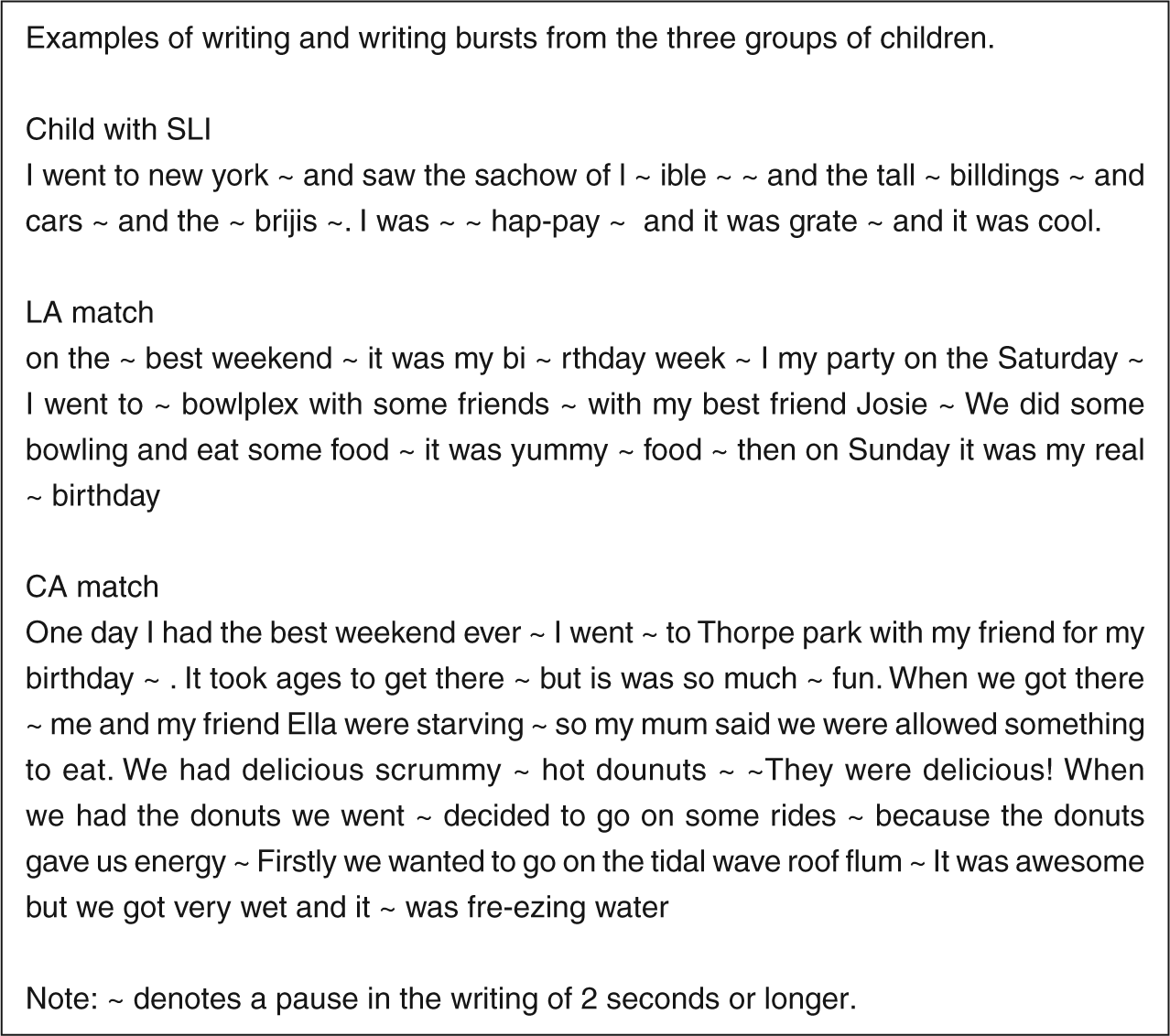
Examples of writing and writing bursts from the three groups of children.
Table 2 also gives detail on the number and length of the bursts in words and the duration of the bursts in the written samples collected for each group. Interestingly, the number of bursts measured within the 5-minute task is the same across the three groups, and the average duration of bursts is the same, but the actual burst length in words varies significantly. The children with SLI produce bursts that are shorter in number of words than do children of the same age (CA) but not different from children matched for LA. Thus, the CA children are producing, on average, 7 words in 6 seconds, while the SLI and LA groups are producing 4 words in 6 seconds.
Therefore, the children with SLI and the LA group produce the same number of words overall in the 5-minute task but substantially less than the CA group, whose burst length is greater. The writing task was carried out on a digital tablet, and when timings are split into the total proportion of composing spent pausing for 2 seconds or more, we can see that the three groups did not differ in the overall amount of time pausing. There is also no difference in the proportion of time spent writing within the overall composing time. However, there is a small but significant difference in the overall actual time spent composing. Here the CA group and the LA group composed for a slightly longer period than did the children with SLI despite it being a supposedly fixed 5-minute task. The children with SLI, on average, composed for slightly less time than the other two groups. However, the actual time difference is of the order of 10 to 15 seconds, and the effect size is very small. Given the lack of difference in writing and pause time, this small difference is likely to reflect the children with SLI taking less thinking time at the start of the task and beginning their writing slightly earlier but while still writing for the same amount of overall time as the other groups.
Correlations Between the Composing Task Results and Skills Associated With Composing
Two correlation analyses were carried out. Table 3 shows intercorrelations for all measures across the entire sample after partialing out age and nonverbal ability. The pattern of significant correlations (with Bonferonni corrections) varied across measures. The overall quality score was significantly related to all measures, including burst length and number of words, confirming previous research in this area. Handwriting speed was significantly correlated with overall quality, burst length, and number of words but not working memory and pause duration. The measures related to writing, such as listening span, formulated sentences, and single-word spelling, were significantly related to burst length but not number of pauses and pause duration.
Correlations Between Various Measures Controlling for Age and Nonverbal Ability Across All Three Groups of Children

Note: LS = listening span, FS = formulated sentences, BAS = British Ability Scales spelling ability, AT = alphabet task raw score.
Significant at .007 (Bonferonni adjusted for multiple comparisons).
Table 4 shows identical partial correlations to illustrate the associations between variables for the children with SLI only. The associations between burst length and overall text quality are reduced in size compared to the overall sample, which may reflect the reduction in sample size; nonetheless, the patterns are similar. These results confirm previous findings that overall text quality is positively related to burst length (Alves et al., 2011; Hayes, 2012; Kaufer et al., 1986). However, the data also show that pauses are negatively related to text quality, spelling ability, and handwriting speed. This would appear to confirm Hayes’s hypotheses that pauses between bursts are related to bottlenecks in processing and, in the case of children, are most likely related to transcription difficulties, such as spelling and handwriting.
Correlations Between Various Measures for the Specific Language Impairment Group (n = 33) Controlling for Age and Nonverbal Ability

Note: LS = listening span, FS = formulated sentences, BAS = British Ability Scales spelling ability, AT = alphabet task raw score.
Significant at .007 (Bonferonni adjusted for multiple comparisons).
The link between processing bottlenecks and transcription was further reinforced when pauses in the text were examined for associations with spelling mistakes in the text. All pauses where a misspelling occurred immediately after, before, or during the pause were logged. The average number of pauses linked with spelling mistakes was then calculated for each participant. Table 2 shows that the SLI and LA-matched children had significantly more pauses linked with spelling mistakes than did the CA match despite showing no significant difference in the overall number of pauses in the writing task. However, when we look at the percentage of misspellings that are associated with a pause (so controlling for number of spelling mistakes), we see that it is only the LA group that is proportionately producing more pauses per misspellings. The effect size is quite small, though, and while there may be some group differences, this result confirms that spelling is a constraint for all three groups, with between 20% and 50% of misspellings associated with pauses. The amount of pauses linked with spelling mistakes is negatively related to burst length across the three groups, r(98) = −0.37, p < .001. Therefore, the more pauses that a child produced that were linked to misspelling, the greater the likelihood that the child would produce shorter bursts.
Predicting Writing Quality and Burst Length From Skills Associated With Composing
Hierarchical multiple regressions were conducted on the combined data from all three groups to examine the extent to which working memory, language, spelling, and handwriting explained variability in overall text quality, burst length, and number of words written.
The order of measures entered into the regression was based on Hayes’s (2007, 2012) review of the important factors that may bottleneck processing and impair text quality and burst length when composing. Working memory as measured by listening span was entered first after controlling for age and nonverbal ability. Hayes sees working memory as a key constraint on the whole writing system. LA was entered next in line with the ability to move idea packages to the translator stage. Skills related to transcription were then entered next with spelling first and then handwriting. Finally, group as a variable was entered to establish if group membership accounted for any additional variance in the outcome variables.
Hierarchical Regression Analyses Predicting Quality Rating, Burst Length, and Words Produced

Note: SLI = specific language impairment; CA = matched on chronological age; LA = matched on language ability.
p < .05. ** p < .01.
As shown in Table 5, significant variability in overall writing quality scores was explained by age and nonverbal ability, working memory, language, spelling, and handwriting. Group was the only variable that did not add any significant additional variance. A very similar pattern was also shown for burst length and number of words, except that age and nonverbal ability, along with group, did not contribute to these models. These results show that all three groups are broadly similar in the factors that predict writing quality, text length, and written language bursts.
Discussion
This study has demonstrated that children with SLI produce writing bursts in a similar pattern to typically developing children and adults when composing text. In this case, they demonstrate written language bursts like other children of their age, but the length of the bursts is dictated by their working memory and language skill and constrained by their transcription skills in handwriting and spelling. This means that their actual writing performance is similar to that of younger children with a similar language profile who also are constrained by spelling and handwriting. Broadly speaking, the relationships between bursts and text generation are similar across all three groups of children and are similar to that found in previous research. The results also provide support for previous work showing that children with SLI have delayed and not different writing profiles (Connelly et al., 2011; Dockrell & Connelly, 2009; Dockrell et al., 2007; Dockrell et al., 2009).
Level of language skill was significantly associated with burst length and overall text quality, confirming the previous work of Hayes and colleagues (Chenoweth & Hayes, 2003; Hayes, 2009; Hayes & Chenoweth, 2006, 2007; Kaufer et al., 1986). Burst length was significantly correlated with overall writing quality, and this is also in line with Hayes’s published work on adults.
The results also provide confirmation that written language bursts are a developmental pattern found not just in skilled writers but also in children with developmental writing difficulties. This is in line with previous work showing that 10-year-old typically developing children produce writing in bursts (Alves et al., 2011). However, we have been able to take this further by showing that burst lengths vary by language skill level and are constrained by both spelling and handwriting.
The strong association of handwriting fluency with burst length and overall writing quality supports previous work by Alves and colleagues on handwriting and typing fluency (Alves et al., 2011; Olive, Alves, & Castro, 2009). In addition, the current study extends our understanding of developmental predictors of writing by demonstrating that spelling also plays a role in constraining the length of written bursts in children. The results reported in this current study are similar to other work carried out on children with dyslexia in English showing that spelling is also the major influence on their writing speed (Sumner, Connelly, & Barnett, 2011). It also provides support for developmental models of writing, such as that of Berninger and Swanson (1994), where transcription factors such as spelling and handwriting are major predictors of writing development.
The results also show that many of the spelling errors in children’s writing are associated with pauses. Those children who paused more often around spelling errors generally produced shorter bursts. This is a slightly different pattern from that found in adults, where the shorter bursts of those who are poorer at writing are more directly related to the so-called revision pauses, where the less skilled writers go back and correct semantic errors in the text (Hayes, 2009). However, revision bursts similar to those noted in adults were almost never spotted in the children’s data reported here. It is likely that children do not yet have the cognitive resources to revise online while writing. It takes all their effort to produce writing in a fluent manner, and many studies have failed to find children revising text at all when writing until well into teenage years (McCutchen, 2000). That we noted a number of pauses associated with spelling errors may be some limited evidence of online spelling revision, or it could be an indicator of the children simply being unable to retrieve a correct spelling. Even if the pauses are associated with spelling revisions, they were only a relatively small proportion of the total spelling errors produced by the children. Less than half of spelling errors were associated with pauses and so may have passed unnoticed by the children. This may be worth further investigation with shorter pause thresholds to verify this finding.
A new finding is the fact that the number and duration of bursts produced in the writing task across the three groups did not vary while the length of the bursts in number of words produced did. Based on Hayes’s model, this may show that the number of ideas proposed and generated in the 5-minute task generally does not vary across the children taking part. However, the linguistic quality of the bursts produced and the limitations on speed imposed by poor spelling and slow handwriting differentiated performance between the groups and led to differences in overall writing quality and in burst length. The presumably less effort devoted to spelling and handwriting in the older, typically developing children suggests that more time can be devoted to translating their ideas into writing, and their faster transcription meant that text was produced more fluently. This is an objective demonstration of the constraint of language level and transcription fluency on effective translation directly leading to poorer text generation. The results of the regressions demonstrated that language and transcription have separable effects on burst length and text quality as we predicted, and they further confirm Hayes’s model and support the proposed bottlenecks in processing that occur.
Hayes’s contention that burst length may be a developmental indicator of writing skill is supported by the current results. However, identifying these bursts required a writing tablet and sophisticated software. Since there was no variation in the number of bursts, then a more simple measure of the number of words written in a constrained period may suffice as a quick and easy predictor of written language skill. This more simple emphasis on the amount of text produced is important when we have seen that the speed at which the child can get his or her message onto the page (through having fluent handwriting and spelling) will in itself allow language to be translated and transcribed onto the page in a more efficient fashion. Bursts are useful to demonstrate how children are writing, but we do not yet see how they could be used to identify writing skill in the classroom beyond the simpler measure of word count.
Our results have provided further confirmation that children with SLI struggle with writing and that their writing closely reflects their poor level of oral language attainment compared to children of the same age. Since the number of bursts was the same, it may be that the number of ideas produced by the children was the same as well. However, even if the number of ideas proposed by the children with SLI may be similar to children of the same age, their poor level of language translated the ideas into lower-quality text riddled with spelling errors and handwritten in a slow and effortful manner. Handwriting (or word processing) and spelling need to be at least partly automated to open the way up for pupils to develop text production (Berninger & Swanson, 1994).
For children with language learning difficulties, even the best classroom support may not be enough; more intensive and explicit instruction will be required (Troia, 2006). Approaches to supporting translation skills are a basic prerequisite to any intervention program for children with SLI but are not enough. An analysis of spelling errors can provide reliable cues for successful spelling instruction (see Berninger & Amtmann, 2003), and handwriting interventions can improve handwriting speed. Thus, there are a number of effective strategies that have been identified to improve the writing of children with SLI. The appropriate mix for children with language learning still needs to be more clearly established, and individual intervention approaches may be required (Nelson & Tattersall, in press). Only then will we see burst length increase and children with SLI improve their writing.
Footnotes
Declaration of Conflicting Interests
The author(s) declared no potential conflicts of interest with respect to the research, authorship, and/or publication of this article.
Funding
The author(s) disclosed receipt of the following financial support for the research, authorship, and/or publication of this article: The authors gratefully acknowledge the support of the Leverhulme Trust, Oxford Brookes University and the UK Economic and Social Research Council for the research reported in this paper.