



Abstract
In Section 1 of this article, the author discusses the succession of models of adult writing that he and his colleagues have proposed from 1980 to the present. He notes the most important changes that differentiate earlier and later models and discusses reasons for the changes. In Section 2, he describes his recent efforts to model young children’s expository writing. He proposes three models that constitute an elaboration of Bereiter and Scardamalia’s knowledge-telling model. In Section 3, he describes three running computer programs that simulate the action of the models described in Section 2.
My history in writing research, which extends for more than 30 years, has been closely tied with the activity of modeling writing processes. In this article, I would like to review that history very briefly, explaining the differences between the earlier and later models. Then I will describe my current research on children’s writing, and, finally, I will discuss what I plan to do in the next 30 years.
Section 1: Evolution of the Writing Models
The beginning of my career in writing was marked by the publication of the Hayes-Flower model (Hayes & Flower, 1980) shown in Figure 1. Despite its age, the model contains features that are still current in modern representations of writing. The distinction between the writer, the writer’s task environment, and the writer’s long-term memory; the attempt to identify separate interacting writing subprocesses; and the importance of the text produced so far all are still regarded as useful ideas. However, since Flower and I first proposed that model, I have been involved in many empirical studies, have engaged in a number of modeling efforts, and have learned a great deal from the research and theories of my colleagues. All of this has led to a gradual evolution in my thinking about the best way to represent writing processes. My most recent model, shown in Figure 2, differs from the 1980s model in a number of ways. Some of the changes require little explanation. For example, the addition of working memory repaired an obvious oversight in the original model. However, the rationale for some of the changes is less obvious and deserves some discussion. I will explain why I added the transcription process and motivation and removed the monitor, the planning process, and the revision/reviewing processes.

The Hayes-Flower model (Hayes & Flower, 1980)
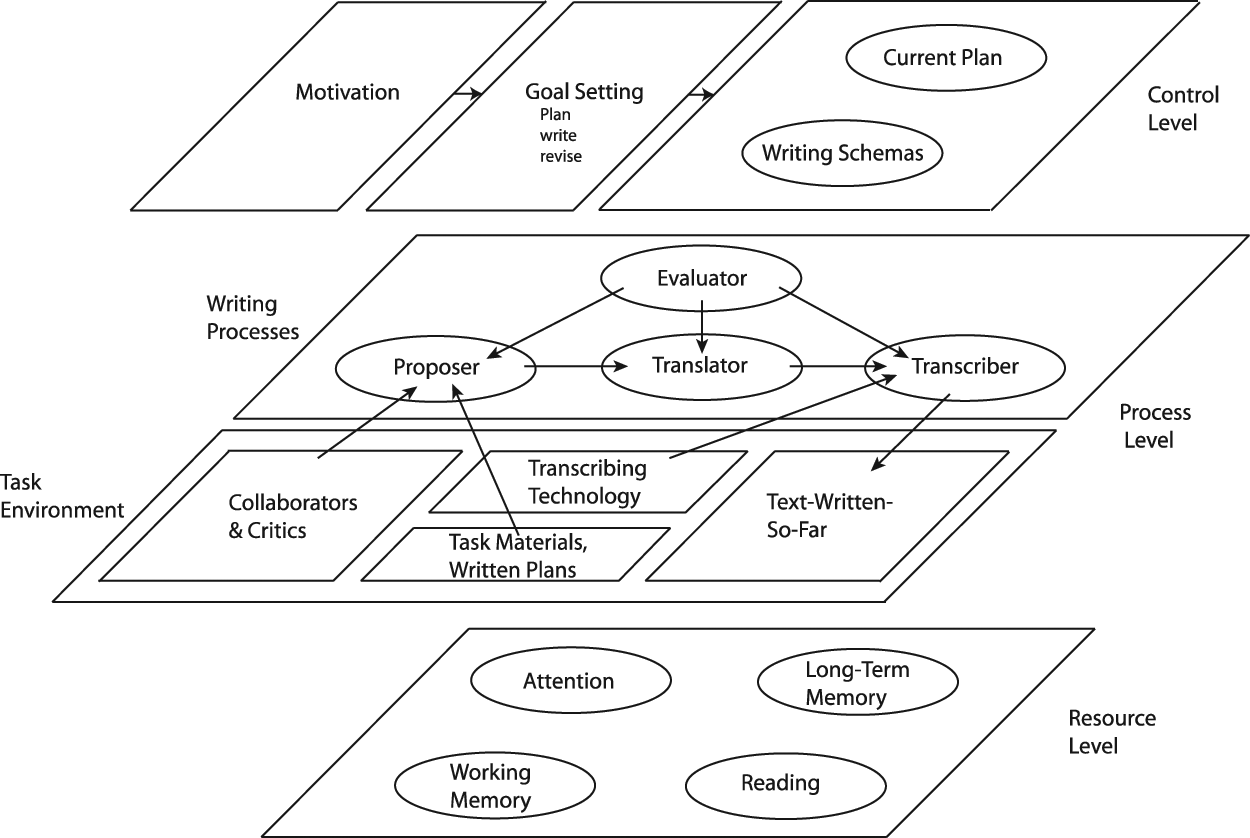
Current version of the writing model
Transcription and Transcription Technology
What requires explanation about the addition of a transcription process is why my colleagues and I did not think to include it in any of our writing models until 2001 (Chenoweth & Hayes, 2001). I believe that this omission was due to a widely shared belief that transcription in adults was so thoroughly automated that it would not have any significant impact on other writing processes and could safely be ignored. The pioneering work of Berninger and her colleagues (Berninger, Cartwright, Yates, Swanson, & Abbott, 1994; Berninger et al., 1992) made it clear that transcription, including spelling and orthography, played a critical role in the development of children’s writing in the early school years.
Furthermore, Bourdin and Fayol (1994) showed that if you tinker with the writing task just a bit (e.g., by making adults write in all caps), then transcription may be as burdensome to adults as ordinary handwriting is to children. When Chenoweth and I conducted the research reported in Hayes and Chenoweth (2006), we were surprised to find that adult writers’ transcription was slowed when verbal working memory was reduced. This convinced me that transcription does compete with other writing processes for cognitive sources in both adults and children and must be accounted for in modeling all writers.
In addition, researchers showed that the means by which texts were transcribed mattered. De La Paz and Graham (1995) found that if primary school children dictated rather than wrote their texts, text quality improved significantly. Jones and Christensen (1999) showed that handwriting practice improved the quality of children’s handwritten texts. Christensen (2004) found that typing practice improved the quality of eighth and ninth graders’ texts that were typed but did not change the quality of their handwritten texts. Other research compared composing across transcription modes. Connelly, Gee, and Walsh (2007) compared fifth and sixth graders’ essays written by hand and by keyboard. Students wrote significantly faster by hand than keyboard, and handwritten essays were significantly superior in quality to typed essays. Studies such as these indicated that the transcription technology must be included as an important component of the writers’ task environment.
Motivation
The topic of motivation was not addressed at all in the early model. Since that time I have become convinced that to account adequately for how people write, we have to learn how to combine motivation with cognitive processes in our models—something that I believe we have not as yet adequately done.
The most obvious way in which motivation is important to writing is through its influence on people’s willingness to engage in writing. Hayes, Schriver, Hill, and Hatch (1990) found that students who had been admitted to college as “basic” writers engaged much less in an activity designed to improve their writing skills than did average and honors students. The basic students attended fewer training sessions than did the average and honors students. Furthermore, when basic students did attend training sessions, they spent less time attending to the instructional materials than did the average and honors students. These results suggest that the basic students were less motivated to engage in writing activities than were the average and honors students.
Protocol studies show that writers often produce more language than gets written down (Chenoweth & Hayes, 2001; Kaufer, Hayes & Flower, 1986), indicating that writers edit the output of the translation process. Hayes (2012) points out that some of the sentences produced by the translation process are edited because they fail in large or small ways to convey the author’s meaning. Presumably, writers who are strongly motivated to produce high-quality texts will be more likely to edit proposed language than are writers who are less motivated. Observations such as these suggest that whether people write, how long they write, and how much they attend to the quality of what they write will depend on their motivation.
Another facet of the relation between writing and motivation is revealed in studies by health psychologists. Pennebaker (1997) and Pennebaker, Kiecolt-Glaser, and Glaser (1988) asked people who were exposed to stress (e.g., unemployed workers) to write about their stress (e.g., what it is like to be laid off). They found that writing about traumatic events reduced stress, as indicated by reduced visits to medical facilities and enhanced immune function. How might this come about? We do not know, but perhaps there is a hint in David Galbraith’s (1999) theorizing. He suggests that unexpressed dispositions can become manifest in the act of translation. It may be through this process that hard-to-access feelings can be brought into consciousness during writing.
Because motivation appears to be intimately involved in many aspects of writing, I included it as a major component of my revision of the 1980 model (Hayes, 1996) and in the current model (see Figure 2). Notice that the representation of motivation in the current model is not fully adequate to account for various ways that motivation can influence writing. The current model seems adequate to account (in a general way) for the impact of motivation on goal setting. However, it does not in any way suggest how motivation may influence transcription or evaluation.
What Ever Happened to the Monitor?
The monitor occupied a prominent place in the 1980s model. Graphically, it appeared to be the master process—the process that controlled all the other writing processes. Actually, our intention for the monitor was much more modest. It was designed to account for an individual difference among writers. Some writers tended to do all their planning before they began to write, and others interleaved planning with writing. The monitor represented the writer’s predisposition to sequence the writing processes in a particular way. It was not intended to control how those processes were carried out.
A concept similar to the monitor was introduced in Hayes, Flower, Schriver, Stratman, and Carey’s (1987) model of revision. (See Figure 3.) Differences in people’s definition of the revision task were intended to account for differences in their approach to revision. For example, definitions might differ in goal—elegance or accuracy; in scope—attend to local features, global features, or both; or in procedure—one pass or many. However, unlike the monitor, task definition was not seen as a process but rather as a kind of plan stored in memory that could guide revision but vary from person to person or within the same person depending on the situation. In particular, experts were seen as differing from novices in their goals for revision and in the features of the text that they believed should be attended to.

Revision model redrawn from Hayes, Flower, Schriver, Stratman, and Carey (1987)
David Wallace and I (Wallace & Hayes, 1991) applied the concept of task definition to improve revision performance in college freshmen. A number of researchers (Bridwell, 1980; Sommers, 1980; Stallard, 1974) have observed that when freshmen students were asked to revise, they attended primarily to local text problems, such as spelling and grammar, and ignored global text problems, such as organization. In contrast, experienced revisers attended to problems both global and local. Scardamalia and Bereiter (1983) had proposed that young writers have trouble with revision because they lacked the necessary executive skills to coordinate problem detection and problem repair. We guessed that this was not true of college-age writers. Rather, we speculated that the difference between these two groups had to do with the way they defined the task of revision. We believed that if we told the freshmen to adopt the experienced revisers’ definition of the task, they could do so and that the change would improve the quality of their revisions. To test this hypothesis, we designed 8 minutes of instruction to explain to the freshmen what experienced revisers did when they revised. The result was a dramatic improvement in revision quality. The success of this project suggested that the reviser’s representation of how to perform revision tasks is stored as declarative knowledge in long-term memory (as a stored plan or task schema) and that it can be modified by instruction.
Hayes et al. (1987) also recognized that the outputs of the reading process had to change in response to the writer’s goals. For example, when the goal was to understand a text to use it as source material, the writer typically attempted to extract the gist and paid little attention to problems of spelling, grammar, and ambiguity. In contrast, when the goal was to edit, such problems must be detected and fixed. Setting a particular goal for reading to carry out a specified writing task should be considered part of the task definition or task schema for that task.
Like Chenoweth and Hayes’s 2001 model (Chenoweth & Hayes, 2001), the current model (see Figure 2) is divided into three levels: a control level, a writing process level, and a resource level. Task schemas for various writing tasks, such as revising, collaborating, summarizing, and so on, are represented as part of the control level, although they are presumably stored in long-term memory. All of these schemas are assumed to be modifiable by experience and instruction and to constitute an important part of writing skill.
Where Are Planning and Revision/Reviewing?
In the current model, there is nothing at the process level labeled “planning” or “revision.” This may seem counterintuitive because we know that planning and revision happen. To understand the rationale behind this change, remember that the purpose of dividing writing into subprocesses was to try to understand writing as the interaction among subprocesses, each of which does part of the writing job but not the whole job. Generally speaking, writing is an activity designed to create a text for some audience. Within this broad definition, it is useful to identify certain specialized writing activities. What we most commonly think of as writing is the activity of producing text to be read by other people—for example, writing articles or school essays. I will call this formal writing. In formal writing, the author must meet standards for spelling, grammar, and other rules of good communication. But formal writing is not the only writing activity. For example, journal writing is writing for which the writer is the sole audience. Here, formal rules may be relaxed a bit.
Creating a written plan should also be considered a specialized writing activity. Creating a written plan not only involves setting goals, generating ideas, and evaluating them but also necessarily involves translation and transcription to produce a written product: a plan. Thus, creating a written plan involves a complete writing process that produces a text designed to aid the author of the plan in producing another text. Viewed in this way, a separate planning process would simply duplicate an activity that can already be performed by the writing model.
Of course, writers create many plans that they do not write down. For example, short plans that can easily be stored in memory for later execution need not be transcribed. Such plans involve the proposer, the evaluator, and very possibly the translator and are represented in the control level of the model. In contrast, written plans become part of the task environment (see Figure 2).
Revising written text is also best thought of as a specialized writing activity. Revising is typically initiated by the detection of a problem in an existing text. It involves planning a solution to the problem (in written form or not), translating that solution into language, and transcribing that language into new text to replace the old text. In this view, revision, like planning, is seen not as a separate writing process parallel to the other writing processes identified in Figure 2 but rather as a special application of the writing model.
Section 2: Modeling Young Children’s Writing
Until relatively recently, my own modeling efforts have been focused on adult writing. I admired the developmental models that Bereiter and Scardamalia (1987) and Berninger and Swanson (1994) had created. However, it was not until I reread Berninger, Fuller, and Whitaker (1996) that I decided to become actively involved in the modeling of children’s writing. The Berninger et al. (1996) article included a description of Fuller’s (1995) analysis of text structures produced by children in Grades 1 through 9. It struck me that some of the structures that Fuller identified suggested the possibility of greater differentiation within Bereiter and Scardamalia’s knowledge-telling model. For example, in one of the structures that Fuller identified, writers started with a main topic, moved to a subtopic, and then returned to the main topic. These writers appeared to have a process for handling subtopics (and by implication, subgoals) that was not specified (but not ruled out) in the knowledge-telling model. I wondered if the knowledge-telling strategy might actually consist of several strategies: if there might be kinds of knowledge-telling. The work I will discuss below is described in greater detail in Hayes (2011).
Building on Fuller’s (1995) analysis, I chose three kinds of texts that offered promise for modeling. I called these flexible-focus texts, fixed-topic texts, and topic-elaboration texts.
Flexible-focus texts
Flexible-focus texts have no global topic. Instead, the topic may change from one statement to the next. For example, the topic of a statement may be the comment that the writer made about the topic of the immediately previous statement. Figure 4 provides an example of such a text. Fuller (1995) called such structures “chains.”

An example of a “flexible-focus” text from Fuller (1995)
Fixed-topic texts
In fixed-topic texts, each statement in the text references a common topic. In the example in Figure 5, the common topic is Erin. (Note that in the fourth statement, the topic “we” includes the common topic, Erin.) Fuller (1995) classified such texts either as “wheels” or as “lists.”

An example of a “fixed-topic” text from Fuller (1995)
Topic-elaboration texts
In topic-elaboration texts, there is a global topic, but that topic may be elaborated in subtopics. In the example in Figure 6, the global topic is dinosaurs, and the subtopics are Rex, Triceratops, and Stegosaurus. Fuller (1995) called such texts “wheels-with-fanning” or ‘hierarchical’ structures.”

An example of a topic-elaboration text from Fuller (1995)
The model shown in Figure 7 is designed to produce flexible-focus texts. In this model, the writer’s initial focus of attention is on an initial topic that is either assigned or chosen by the writer. Taking the focus as the topic, the writer then makes a comment on the topic and adds it to the text. This act of writing may (or may not) change the writer’s focus from the initial topic to the writer’s comment about the topic. Next, the writer decides whether or not the text is finished. If not, he or she will make a new comment on the current focus and the cycle continues.

The flexible-focus model. The line between the “make comment” box and the focus box is dotted to indicate that this connection represents a flow of information rather than a flow of control that is indicated by solid lines.
The model shown in Figure 8 is designed to produce fixed-topic texts. It is similar to the flexible-focus model. However, in this model, the writer sets a goal to maintain the initial topic throughout the text. The writer may control the topic either by rejecting off-topic statements after they are proposed (a process represented by the “On Topic?” decision box in Figure 8) or by suppressing off-topic statements before they are proposed or both. Suppression might be accomplished using a variety of mechanisms such as giving special salience to the initial topic, suppressing distracters such as the current comment, or inspecting the physical writing assignment (if available) or the text written so far. Think-aloud protocol studies could provide evidence to refine this model by showing whether or not off-topic statements are proposed and, if so, how frequently.

The fixed-topic model
The model shown in Figure 9 is designed to produce topic-elaboration texts. This model is substantially different from the previous two models in that it incorporates structures for handling subtopics. These structures include a last-in, first-out topic stack; a means for adding topics to the topic stack (the “elaborate” box); and a means for removing topics from the topic stack (the “topic done?” box). As it is presented here, this model could produce texts with very deeply nested sets of subtopics. Therefore, the model likely needs to be modified for younger writers who have limited ability for nesting subtopics. This might be accomplished by limiting the depth of the topic stack according to the size of the writer’s working memory.

The topic-elaboration model
Changes in Writer’s Strategies With Grade
Raters classified each of the essays in Fuller’s corpus as flexible-focus, fixed-topic, topic-elaboration, or other (none of the above). Figure 10 shows the percentage of each of the text structures in each grade from 1 through 9.

Percentage of texts consistent with each text structure in each of Grades 1 through 9
The results shown in Figure 10 indicate that the three text categories, representing three different kinds of knowledge-telling, have different developmental trajectories. Flexible-focus and fixed-topic texts are most common in the early grades. However, after sixth grade, the topic-elaboration texts become the most common. If our analysis is correct, writers who produce the different kinds of texts, have different writing strategies available to them and may respond best to different instructional procedures. If so, differentiating among the kinds of knowledge-telling may be helpful to teachers.
Section 3: Programming the Models
Creating running programs to simulate human task performance has been an important tool in cognitive science since Newell and Simon (1956) introduced the practice. McCutchen and Perfetti (1982) introduced the use of running programs to study children’s writing. Running programs are typically better specified than box-and-arrow models because the latter may involve substantial “hand waving.” That is, they may assert that a mechanism will work without having to specify exactly how it works. With running programs, the mechanisms have to work, or the programs will not run.
To be sure that the box-and-arrow models that I have proposed (shown in Figures 7-9) could actually produce the text structures that they are designed to produce, I programmed them as running computer programs written in the Python language. The programs all use the same database to represent information in the writer’s long-term memory. All of the programs require the user to provide a person’s name as the initial topic of the essay, the gender of that person, and the school grade of the writer of the essay. The program uses this information together with information in the database to compose the sentences with gender-appropriate pronouns that constitute the story and to determine the story’s length (to be discussed later).
The database for the programs consists of statements organized in topic/comment fashion. It includes a set of possible responses to the expository prompt “I like [name] because . . . ,” for example, “he/she has a dog” or “he/she has a new computer.” For each of these responses, the database also includes a set of statements that use the comment of the previous statements as its topic—for example, “The dog has four puppies” and “The computer was a Christmas present.” The current database has three topic/comment levels and about 80 statements but, in principle, could be expanded without limit.
The flexible-focus program
After the flexible-focus program chooses a response to the initial prompt, it decides (at random) whether to write another statement on the same topic or to switch the topic to the comment in the statement it just wrote. The program proceeds in this way until it runs out of knowledge or motivation (to be explained later). Figure 11 provides an example of a story produced by the flexible-focus program. Notice that subgoal depth keeps increasing as the text proceeds.

An expository essay written by the flexible-focus program
The fixed-topic program
This program proposes statements for inclusion in the text in the same way that the flexible-focus program does. That is, the topic of a proposed statement may be either the topic or the comment of the previously written statement. However, it differs from the flexible-focus program in that any proposed statement with a topic that is not the initial topic is edited out; that is, it is not added to the text. Figure 12 shows a text written by the fixed-topic program. Notice that any statement with subgoal depth greater than 0 is edited out.

An expository essay written by the fixed-topic program
An alternative program for writing fixed-topic essays would be one that never proposed off-topic statements. This could be achieved simply by decreasing the probability of topic switching in the fixed-topic model. Evidence to differentiate these two alternatives might be obtained from think-aloud protocol studies. Adult writers do propose statements and translate them into spoken language (as can be seen in think-aloud protocols) but then decide not to add them to their texts. An interesting question is “Does that happen in children who write fixed-focus texts or do they never propose subtopics?”
The topic-elaboration program
This program differs from the first two in that it manages topics using a topic pushdown list to keep track of the current topic and previous topics in the order of their recency. The program randomly decides whether to keep writing about the current topic, to write about the comment in the most recently written statement, or to return to the previous topic. Figure 13 shows a story written by the topic-elaboration program. The distinguishing feature of topic elaboration program is that by using its goal stack, it can write about a topic, then about a subtopic, and then return to the original topic.

An expository essay written by the topic-elaboration program
The important thing to notice is not that the computer-generated stories sound vaguely like essays that young children might write. Rather, it is that the programs that produced the stories embody the mechanisms proposed in the flexible-focus, fixed-topic, and topic-elaboration models to control topical structure. The programs provide verification that the models can do what is claimed for them. In fact, the programs produce topical structures consistent with 96% of the texts in Fuller’s (1995) sample of expository texts.
A final feature of these programs is that they all incorporate a mechanism to account for an influence of motivation on the number of clauses children include in their essays. In the Fuller corpus, the number of clauses increased from 4.3 in Grade 1 to 10.6 in Grade 6 and then remained fairly constant through Grade 9 (see Figure 14).

The average number of clauses in expository essays written by children in Grades 1 through 9
There is substantial evidence reviewed in the Transcription and Transcription Technology section that transcription competes with the other writing processes for cognitive resources. As children hone their transcription skills over the early school years, the demands of transcription on cognitive resources should lessen, and more resources should become available for other processes, such as idea generation and translation. It seems plausible to believe that the increasing availability of cognitive resources may be causally related to the increase in number of clauses in children’s essays. But there is a problem in explaining how that happens. If a young child is using a knowledge-telling strategy, as most children writing essays for the Fuller corpus do, then each sentence is produced independently of the previous one and in essentially the same way. Demands on cognitive resources will be cyclical, as shown in Figure 15. These demands may vary during the production of a sentence: starting at some baseline value, perhaps peaking for young writers during transcription, but then returning to baseline. During production of the next sentence, demands on cognitive resources go through a similar cycle. The critical point is that demands on cognitive resources do not cumulate over sentences. If a child can produce one sentence, there is no clear reason, based on the availability of cognitive resources alone, why she or he should not be able to produce any number of sentences. In Hayes (2012), I argue that the most natural way to account for the small number of clauses in young children’s essays is that fatigue accumulates and results in decreased motivation to write. Fatigue might result from cognitive factors (handling high cognitive loads) or somatic factors (tired hands) or both. This perspective holds that the transcription process may, in some cases, act not so much to interfere with children’s ability to carry out other writing activities as it does to reduce children’s willingness to carry out those activities.

Hypothetical processing loads for a knowledge-telling writer
All of the programs include a fatigue factor that is larger for younger children than older ones. The fatigue factor is subtracted from the writer’s initial motivation to write with each clause that is written. When motivation falls below zero, the program stops. This account of how motivation influences the amount that young children will write is admittedly crude. It is, simply, an attempt to include motivation within the structure of a cognitive process model of writing.
Summary
In this article, I have traced the development of my approach to modeling writing processes from 1980 to the present. The transition from the earliest box-and-arrow model of adult writing (Figure 1) to the latest one (Figure 2) has involved some substantial changes in my perspective about what should be included in such models (e.g., adding transcription and motivation) and how it should be represented (e.g., re-representing planning and revision). The expansion of my interest to include children’s writing has led me to propose some elaborations of Bereiter and Scardamalia’s knowledge-telling model. In turn, modeling children’s writing, which is in some ways much simpler than adult writing, has given me courage to try modeling with running programs (a task that seemed once and, perhaps, seems still, too difficult to accomplished with adult writing). I believe that using running programs to model writing is fundamentally superior to using box-and-arrow models. Running programs force us to be very specific about how writing processes work and about the structure of the memory resources that the writing processes rely on.
Footnotes
Declaration of Conflicting Interests
The author(s) declared no potential conflicts of interest with respect to the research, authorship, and/or publication of this article.
Funding
The author(s) received no financial support for the research, authorship, and/or publication of this article.
Bio
References
Supplementary Material
Please find the following supplemental material available below.
For Open Access articles published under a Creative Commons License, all supplemental material carries the same license as the article it is associated with.
For non-Open Access articles published, all supplemental material carries a non-exclusive license, and permission requests for re-use of supplemental material or any part of supplemental material shall be sent directly to the copyright owner as specified in the copyright notice associated with the article.
