




Abstract
Scholars in the field of writing and rhetorical studies have long been interested in professional writing and the ways in which experts frame their research for disciplinary audiences. Three decades ago, rhetoricians incorporated stasis theory into their work as a way to explore the nature of argument and persuasion in scientific discourse. However, what is missing in these general arguments based on stasis are the particular arguments in science texts aimed at persuasion. Specifically, this article analyzes arguments from the stasis of value in introductions of science research articles. This work is grounded in the Classical topoi, or topics, cataloging types of arguments and identifying seven topoi. I analyzed 60 introductions from articles in three different science journals, totaling the number of value arguments and arguments comprising the topoi. Findings yielded different proportions in types of arguments, sharp disparities among the journals, and widespread use of value arguments. The broader issue at work in this article is how scientists make a case for the importance of their research and how these findings might inform writing and argumentation in the sciences.
Incentives for publishing in top academic journals seem to be getting higher. In the United States there are the usual inducements of tenure and promotion, but for faculty who manage to publish in the best international journals, there are additional perks, such as awards for multimillion-dollar grants, lucrative retention battles, and eager offers to move to more prestigious universities (Reich, 2013). Outside the United States, a study by Franzoni et al. (2011) shows that many governments direct incentives for high achievements in publication, mainly in STEM (science, technology, engineering, and mathematics) disciplines. For example, the United Kingdom launched a system by which departments are rewarded according to the publication records of their faculty. This approach spread to other countries but was modified so that the institutions themselves received extra funding commensurate with the level of research productivity. In other countries, compensation goes straight to individual researchers in the form of cash awards for each journal article in preeminent international journals. In their analysis of articles published in Science, Franzoni et al. (2011) found that these incentives had their intended effect: While submission and publication rates by U.S. scientists plateaued, incentives of all kinds used in other countries evidently led to notably higher rates (see also Backes-Gellner & Schlinghoff, 2008; Lee & Lee, 2013; Neff, 2018; van Dalen & Henkens, 2012). This push to publish raises the question of how, whether for top tier or middling journals, researchers convince reviewers and editors that their research is important enough to publish.
One answer to that question comes from the literature in linguistics that analyzes research articles under the rubric of promotion or self-promotion. For example, Harwood (2005b) studied the use of first-person pronouns and self-citations to draw the reader’s attention to the authors’ contribution to the field and elevate their status as researchers. Hyland and Tse (2005) analyzed the use of evaluative that constructions that occur with some frequency in abstracts with the effect of emphasizing the value of the research summarized. Shehzad (2010) described how presenting an overview of the research findings in introductions boosts their importance by pointing up their originality, potential applications, or theoretical implications. Mur-Dueñas (2012) examined the research niche (Swales, 2004) in introductions and statements of limitations in discussions, demonstrating how authors promote their studies by using lexical and grammatical markers to highlight their occupation of the research niche and to justify the validity of their studies despite limitations. And Basturkmen (2012) observed that discussions have a promotional function as well as a practical one as authors use the background subsection and the survey and commentary of results to stress the importance of their research. 1
Though studies of this sort have shown how lexical cues highlight promotion, more research is needed to illuminate the role of rhetoric, specifically argument, in establishing the value of research. Addressing this issue in a classic article in the rhetoric of science, Fahnestock and Secor (1988) applied stasis theory to an analysis of science research articles. Stasis is the ancient art—developed by Aristotle, Hermagoras, Hermogenes, and others—of identifying the point of contention in a charge and countercharge as conjecture or fact, definition or classification, quality or value, or sometimes jurisdiction or procedure (Dieter, 1950; Kennedy 1963, 1983; Martin, 1995; Nadeau, 1959). Fahnestock and Secor (1988) found that the principal stasis in science articles was either fact or definition, that is, an overall argument for the veracity of a contested fact or for the appropriateness of a disputed classification. However, referring to what they dubbed “a full stasis model” (p. 433), Fahnestock and Secor (1988) also pointed to the role that the stasis of value plays in science research articles: It is used to establish the importance of the particular stasis of an article, the fact or definition in question. But they also found that such arguments from value are largely tacit, their value typically already accepted by the audience of scientists who represent the potential readership for a given article.
Fahnestock and Secor (1988) do, however, cite two overt instances in the Science articles they analyzed in which the scientists evidently felt that they could not rely on preliminary value arguments on the part of readers and thus spelled out the importance of their research: “The biogeochemical roles of sulfur in tidal wetlands is an area of intense research” (Luther et al., 1986, p. 746) and “The centers of origin of species have been discussed in the literature of biogeography and evolution for over a century” (Buzas & Culver, 1986, p. 775). For my purposes, these opening sentences of the introductions are worth pointing out because they are sentence-level value arguments for the importance of the research presented. The two arguments are grounded in the heightened attention drawn to the research by other scientists: the first emphasizing intensity and the second emphasizing longevity. These two value arguments have claims, reasons, and warrants. But for one exception (Carter, 2016), I am aware of no subsequent scholarship after Fahnestock and Secor (1988) that has used stasis theory to examine such value arguments in science research articles. 2 It would seem, though, that the pressure to publish mentioned above would provide a compelling reason for scientists to argue for the importance of their research.
In a previous study of 60 science research articles from three different scientific journals (chemistry, neurobiology, and animal ecology), I (Carter, 2016) observed that value arguments are perhaps more common than what Fahnestock and Secor had found. For the present study, I offer a novel approach to stasis theory by analyzing particular arguments of value in those introductions and then quantifying the arguments according to type and to topical category, or topos. Specifically, these arguments may be sorted into three types of argumentative structures (explicit, semiexplicit, and implicit) and seven species of value arguments, offering a multidimensional view of how scientists argue for the importance of their research. Such studies would make it possible to analyze the construction of value in a wide array of research genres and subgenres—for example, grant proposals, proposal abstracts, literature reviews, research letters, journal abstracts, discussions—and comparative research of value arguments across and within disciplines. In the conclusion, I suggest the possibility of broadening the analysis of stases to include arguments from the other stases (i.e., fact, definition, and action).
Here, I analyze the same corpus of research introductions used in my previous study (Carter, 2016), but in this instance I carry out a quantitative rhetorical analysis 3 of how authors of scientific research rhetorically construct the value of their research. This analysis offers a detailed, numerical report of arguments of value, the goal of which is a richer understanding of the stasis of value and, more broadly, writing and argumentation in the sciences. However, before undertaking this analysis, I will examine the significant role played by value topoi in the rhetorical space between stases and individual arguments.
Topoi and Arguments From Value
The development and study of topoi emerged in response to the need of Classical rhetoricians—for example, Aristotle, Hermagoras, Hermogenes, Quintillian—to advance a system of cataloging appropriate and persuasive arguments (Dieter, 1950; Kennedy 1963, 1983; Miller, 1987; Nadeau, 1959, 1964). Topoi have been described as “reservoirs of generalized key ideas from which specific statements or arguments can be generated” (Richardson, 2004, p. 230) and “a conceptual place to which an arguer may mentally go to find arguments” (Miller, 2000, p. 132). As these descriptions suggest, topoi are figurative locations where rhetors can invent particular arguments deemed effective to a situation. Thus, topoi are not themselves arguments but categories of arguments existing between the broader stases and actual arguments from those topoi.
There is empirical evidence of topoi in science and how they can be identified. For example, in what he describes as a process of “reverse engineering,” Ross (2012) coded 125 interviews from people visiting the Glen Canyon Dam in northern Arizona seeking an answer to the question “What are the commonplaces of environmental rhetoric?” His work yielded 12 topoi, including experience, seeing is believing, balance, Al Gore, and extremism. And Walsh (2010b) analyzed 18 research articles in STEM and identified 30 topoi, 20 from Aristotle—for example, opposites, precedent, compare/contrast, and consequences—and an additional 10 new ones— for example, hypothesis, assumptions, and future work. In both cases, the authors analyzed their data and used themes to guide them to topoi. Both studies demonstrated how the use of these topoi allowed the researchers to tease out the complexities of argumentation. Walsh and others (e.g., Walsh, 2010a, 2012; Walsh & Boyle, 2017; Walsh & Ross, 2015) have continued to develop work in this area of study.
The present study of 60 research articles across three scientific disciplines is generally comparable to those of Ross and Walsh but differs in three important ways. First, I am interested only in topoi related to the stasis of value, which has been largely overlooked in science research articles compared to stases of fact and definition. Second, my focus is specifically on arguments, under the assumption that identifying and then classifying value arguments would reveal value topoi. Though some of the data cited by Ross and Walsh could have been framed as arguments, most did not present in that way. And third, the topoi I identify are special as opposed the common topoi used by Ross and Walsh and defined by Aristotle (1991) as “applicable in common [koinēi] to questions of justice and physics and politics and many different species [of knowledge]” (p. 46). In contrast, special topoi are described by Miller (1987), following Aristotle, “as materially grounded in the resources of particular situations” (p. 64; see also Jack et al., 2017). Thus, the special topoi I have discerned in the introductions of science research articles could be specific to the discourse of science; however, research in the scholarship of other disciplines may show that these topoi are also special to academic scholarship in general. In the rest of this section, I concentrate on the role of value topoi in advancing the importance of research in introductions to published articles.
A key to determining value topoi in my corpus was to identify value arguments and classes for those arguments. Toward that end, I needed to establish a framework for argumentation that could function as the common vehicle for the value arguments. For that framework, I used Toulmin’s (2003; Toulmin et al., 1979) concept of a basic argument consisting of a claim, a ground or reason supporting the claim, and a warrant, usually unstated, on which the claim and reason are premised. I defined value arguments as making a claim that something is important to study—linking the claim to value through importance—and a reason supporting that claim. The warrant is the premise underlying the claim and reason, as represented in this rough syllogism from my corpus (first author and journal from corpus in parentheses): Minor premise: Stress is a major contributing factor in the emergence of depression and anxiety disorders. (Padival, Neuroscience [NS]) Conclusion: Therefore stress is important to study [because it is a major contributing factor in the emergence of depression and anxiety disorders]. Warrant/major premise: Anything that is a major contributing factor in the emergence of depression and anxiety disorders is important to study.
As will be shown below, the structure of claim and reason provides a consistent vehicle for making value arguments.
I identified three structures of argumentation according to their levels of explicitness: explicit, semiexplicit, and implicit. I incorporated linguistic analysis to identify textual cues to determine the explicitness of the arguments. In explicit arguments, the value claim is made overt by using important or a synonym (e.g., essential, critical, promising) and the value reason by using because or a synonym (e.g., due to, since) as a marker for reasons. The following example is an explicit argument: Identifying source populations of foraging animals is important because individuals from different populations may mix on foraging grounds. (Stewart, Journal of Animal Ecology [JAE]) Claim: Identifying source populations of foraging animals is important [to study] Reason: because individuals from different populations may mix on foraging grounds
In semiexplicit arguments, the claim is overt but the reason is implicit, not marked by because or a synonym. For this kind of statement to be interpreted as an argument, readers must recognize the reason supporting the value claim without the because marker: Early diagnosis of cancer is particularly important for reducing cancer mortality. (H. Zhang, Journal of the American Chemical Society [JACS]) Claim: Early diagnosis of cancer is particularly important [to study] Reason: [because it] reduces cancer mortality
For implicit arguments, both the value claim and reason are implicit. This type of argument depends on readers to infer that a statement is a value argument without an explicit value claim, that is, no overt assertion of importance. To understand how readers may draw such inferences, I have turned to studies in the linguistics of evaluation, which have examined how value-laden words indicating relative good or bad, positive or negative, can shape readers’ attitudes, feelings, judgments, viewpoints (e.g., Hunston 1989, 1993, 1994). Specifically, I have drawn on Thompson and Hunston (2000) and Gray and Biber (2012) in their examination of particular kinds of value-laden words: (1) comparisons (better or worse), (2) connotations (positive/negative, appropriate/inappropriate, desirable/undesirable, etc.), (3) intensifiers (ordinarily adverbs that strengthen the sense of the positive or the negative), and (4) predicative and attributive adjectives (amplifying the value import of nouns). The value-laden words in a sentence must be strong enough, in contrast to the relatively value-neutral words that comprise the bulk of science research article introductions, for readers to interpret the sentence as a value argument: Example A. Parasites are ubiquitous and can threaten the survival prospects of their hosts, dramatically impacting upon their fitness. (Cotter JAE) Claim: Parasites are [important to study] Reason: [because they are] ubiquitous and can threaten the survival prospects of their hosts, dramatically impacting upon their fitness Example B. Fragile X Syndrome (FXS) is the most common, inherited, single-gene cause of intellectual disability and the largest known genetic cause of autistic behaviors. (Dansie, NS) Claim: FXS [is important to study] Reason: [because it] is the most common, inherited, single-gene cause of intellectual disability and the largest known genetic cause of autistic behaviors
The subjects or subject phrases of these sentences may be read as implicit claims because of the strong value-laden terms in the predicate phrases implying value reasons. Example A uses negative connotations to construct value reasons—”threaten the survival prospects”—and the adverbial intensifier dramatically to heighten the effect of parasites on their hosts. Example B employs comparisons to magnify the negative connotations of intellectual disability and autistic behaviors by associating them with the superlatives most and largest.
To discern what topoi were at work in the introductions, I reviewed all the value arguments I had identified, noted recurrent themes in the arguments, and selected those that occurred most often (>3 instances). I (Carter, 2016) had initially referred to these value topoi as functions because they describe various tasks for advancing the importance of the research in the introductions; however, the concept of topoi provides a much richer sense of the term. In addition, one way of conceiving the roles of value topoi is to be aware of where they occur in introductions. Swales’s (2004; Swales & Feak, 2012) Create a Research Space (CARS) structure describes three parts of introductions, each with its own broad linguistic move and a subset of steps or strategies for the moves (Appendix A). Because the CARS model identifies functional elements within introductions, it provides a scheme for identifying the various topoi (Walsh, 2010b). In what follows, I outline seven value topoi; for examples of each topos, see Appendix B.
Topos of establishing value context for the research: Arguments in the first or second sentence of an introduction whose role is to provide the broad value within which the research derives its importance. This function is specific to Move 1 (Appendix A).
Topos of adding value reasons: Arguments whose subjects are the same as or pronominative for immediately preceding value arguments and whose predicate phrases provide further reasons in support of the value claim in the first argument (Move 1).
Topos of narrowing focus of the research: Two consecutive arguments, the second of which establishes a more specific grammatical subject than the first argument to advance the overall progression of Move 1 toward the specific research niche in Move 2.
Topos of intensifying importance of research gaps: Arguments that directly precede a sentence that points to a gap in the research literature, specifically the literature review in Move 1 and the research niche in Move 2.
Topos of justifying importance of a gap in the literature: Arguments that immediately follow sentences with contrastive turns (however, despite the fact that, little is known) and make the case that a gap in the literature is important (Moves 1 and 2).
Topos of demonstrating value of overall research project: Arguments that make the case for the importance of the research study itself (Move 3).
Topos indicating value of research findings: In contrast to the previous kind of arguments, these argue for the importance of results of the research (Move 3).
These topoi, structured by argumentation based on Toulmin, are classes of value arguments identified inductively. Thus, I certainly cannot claim that the researchers in my corpus were aware of the topoi. However, as my quantitative analysis will show, arguments from the topoi occurred with enough frequency among the researchers that it is likely they operated intuitively in applying these categories.
Method
Corpus
I analyzed the introductions of 60 complete research articles (thus ensuring all had full introductions), 20 from each of three science journals: Journal of the American Chemical Society (JACS), Journal of Animal Ecology (JAE), and Neuroscience (NS). Specifically, my corpus consisted of the following journal issues:
JACS: Volume 135, Issue 31, August 7, 2013, 16 articles covering pages 11541 to 11677; Volume 135, Issue 30, July 31, 2013, four articles covering pages 10998 to 11031.
JAE: Volume 82, Issue 4, July 2013, 18 articles covering pages 739 to 921; Volume 82, Issue 3, May 2013, two articles covering pages 509 to 528.
NS: volume 246, August 29, 2013, 20 articles covering pages 59 to 280.
I selected these three journals in the initial qualitative study because they represented a variety of scientific disciplines: chemistry (JACS), a physical science; zoology (JAE), a life science; and neuroscience (NS), a relatively new and highly interdisciplinary science. This diversity provided a basis for identifying different value arguments and topoi across disciplines. The quantitative analysis of the same corpus that is reported here highlights interesting differences among the three journals. In addition to the obvious differences in disciplines, there were also differences in impact factors in the year the articles were published: JACS 11.444; JAE 4.726; NS 3.327 (Journal Impact Factor List, https://www.scijournal.org/index.html).
But there may be deeper differences in the cultures within which these journals exist, reflecting the individual traditions, attitudes, behaviors, and values of the organizations that publish them. JACS, for example, is the flagship journal of 53 publications produced by the American Chemical Society (ACS), which has over 151,000 members, more than 28,000 of whom are international (ACS, n.d.-b). The society was established in 1876 and publication of the journal began in 1879 (ACS, n.d.-c). ACS describes itself as “the world’s largest scientific society” and proudly states that it has over 8,700 publications by Nobel Laureates in chemistry (ACS, n.d.-a). In 2013, the date of my corpus, the journal was ranked
4
eighth among 452 chemistry journals worldwide; however, eliminating the five journals ahead of it that were not comparable (i.e., focused on reviews, letters, etc.), its ranking was three, behind Nature Materials and Nature Chemistry from the Nature Publishing Group. The high standards of JACS are indicated in the ACS Author Guidelines: JACS is devoted to the publication of original, fundamental research of unusual urgency and significance in all fields of chemistry that appeals to a broad, general audience. Competition for publication within JACS is intense, and the journal is simply unable to publish all the sound work received. (2018, p. 17)
The force of this language, such as unusual urgency, does not appear in the notes to authors in the other journals I analyzed.
In 2013, JAE was ranked the top journal worldwide among the 381 in the category of animal science and ecology. JAE is one of six publications of the British Ecological Society (BES), founded in 1913 and characterized as “the oldest ecological society in the world.” Its membership is about 6,000 worldwide (BES, n.d.-b).
A primary aim of the journal is to publish articles detailing novel and important work that will challenge the way animal ecologists think. We encourage papers that make significant advances to the field through the development of ecological theory or methodology which generate ecological insights that extend beyond the study system utilised. (BES, n.d.-a)
This elevated standard for the development of new theories or methods distinguishes JAE from many of the more specialized journals in the field whose scope is more limited to the object of the study itself.
NS was ranked 38th (in the second quartile) of 148 journals worldwide in the category of neuroscience (miscellaneous). It is published in the Netherlands by Elsevier BV. The journal is one of two sponsored by the International Brain Research Organization (IBRO), founded in 1961 and based in Paris. IBRO is composed of over 90 neuroscience societies representing over 75,000 neuroscientists around the world, overseen by a Governing Council (IBRO, n.d.). The Guide for Authors (NS, n.d.) says, Papers most suitable for publication are those that report new observations that directly contribute to our understanding of how the nervous system works. Any paper, however short, will be considered for publication provided that it reports significant, new and carefully confirmed findings with full experimental details.
The Guide for Authors (NS, n.d.) also emphasizes no charges for publication, a rapid turnaround of articles, and the convenience of the journal’s membership in the Neuroscience Peer Review Consortium, which expedites the peer review process whereby papers that have been rejected by one neuroscience journal can be easily forwarded to another one along with the peer reviews of the former (neuroscience, n.d.). Unlike the previous two journals, the overall message here seems to be directed toward encouraging researchers to submit papers to this journal.
Of course, these brief sketches cannot fully describe the cultures of these journals. But they provide some appreciation for their differences. The venerable ACS is itself a powerhouse publisher with JACS at its head. Its very large membership indicates the respect it has garnered over its many years and its role in the elevated prestige of the field itself. And the very high standard of articles published in JACS is reflected in its discouraging submissions that do not meet that standard. Though JAE was the highest ranking journal in its field, its impact factor and other measures were substantially lower than those of JACS. And the membership of the BES is a very small fraction of ACS, suggesting that there are many fewer researchers publishing in this area and thus many fewer citations and articles published. The data bear that out: Whereas JACS had 9,412 citable documents and 113,688 total citations over 3 years, JAE had 405 and 2,197. It is likely that it was the stature of the BES in ecological studies that made it the top journal. In contrast to ACS and BES, both professional societies with memberships, IBRO has a loose structure with its neuroscience societies, Governing Council, and neuroscientists who evidently have no formal membership. The relatively low ranking of the journal may explain why the Guide for Authors (NS, n.d.) sought to persuade researchers to submit to the journal. I will return to the cultures described here below.
Quantifying Value Arguments
I read each of the introductions of the 60 articles multiple times, identifying possible value arguments and testing them to determine whether they could stand as arguments. I acknowledge that the aim here is not an analysis of the reader response of scientists but a rhetorical examination of the language of argument. Given that explicit and semiexplicit arguments were denoted by value claims, these were relatively easy to identify. Implicit arguments, which have no clear value claim, were more challenging. As described above, I applied the linguistics of evaluation and the use of value-laden words in particular (Gray & Biber, 2012; Thompson & Hunston, 2000) to distinguish those arguments. In almost all cases it was clear whether a statement passed the test, but there were a few that required judgment. Here is one example: “Repeated exposure to social and physical stress alters neurochemical pathways in the rat brain associated with motivated behaviors and dopaminergic activity” (Sweis, NS). This is the first sentence of the introduction, and as I show below, such sentences are often value arguments. This was a borderline case because though the attributive adjective repeated intensified the following noun and the reference to physical stress may have some negative connotations for some readers, the language in the predicate phrase was relatively neutral, as is indicated by motivated behaviors and dopaminergic activity in lieu of more value-laden terms. Thus, I ruled that it would be unlikely for this sentence to be construed as an argument.
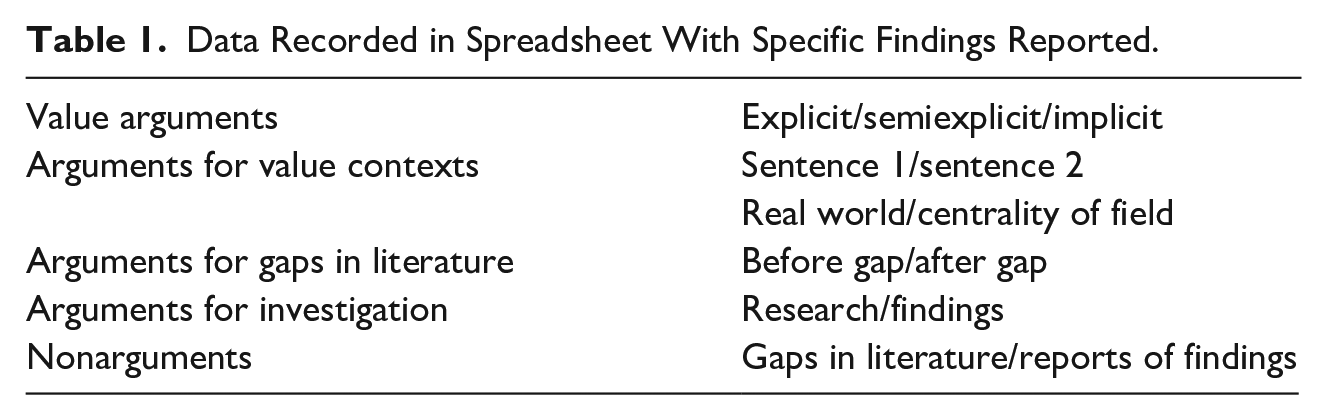
Having identified value arguments, establishing them as explicit, semiexplicit, and implicit, and marking them in the text of the introductions, I coded the arguments for recurring themes that could be topoi. The results were the seven topoi I listed above. Based on these topoi, I created a spreadsheet sorted by the three journals and the first authors of the articles in the order in which they appeared in the publications. For each first author, I noted the paragraph and sentence number for each relevant argument by type and also pertinent nonarguments (Table 1). I totaled the number of the various items in the spreadsheet and entered the numbers in tables in the following Results and Discussion.
Data Recorded in Spreadsheet With Specific Findings Reported.
Results and Discussion
Types of Value Arguments
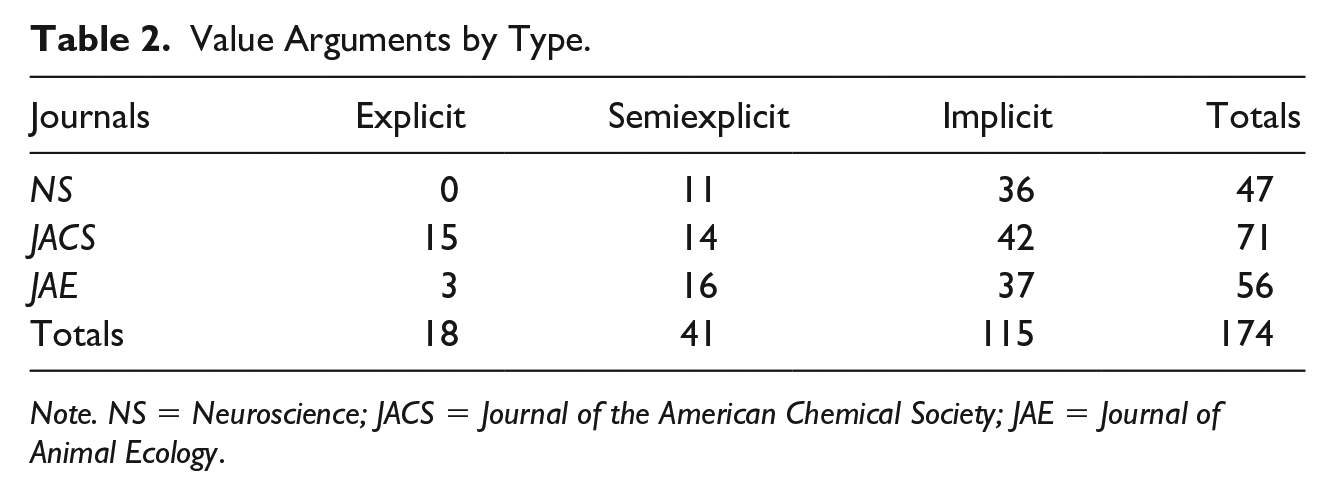
Because value claims and reasons form the vehicles for arguments that constitute the value topoi, I begin with a consideration of these arguments. Regarding the bottom line of Table 2, of the 60 introductions I examined, 54 (91.6%) contained at least one value argument for a total of 174 arguments. Of these, 10.3% were explicit, 23.5% semiexplicit, and 66% implicit.
Value Arguments by Type.
Note. NS = Neuroscience; JACS = Journal of the American Chemical Society; JAE = Journal of Animal Ecology.
Though the use of value arguments was widespread, what stands out is the relatively small number of explicit arguments, those with overt claims and reasons. There were about twice the number of semiexplicit and more than six times the implicit arguments. It would appear that the authors of these articles were somewhat reluctant to make such straightforward arguments. However, combining the explicit and semiexplicit arguments shows that just over one third of all arguments had explicit value claims, suggesting that authors were not so reluctant to make such claims for the importance of their research. Thus, one could conclude that what the scientists were balking at was, rather, the use of explicit value reasons with their because (or synonym) phrases. It may be that it was not the explicit value claim itself but the explicit value reason that these scientists tended to avoid, and consequently a preference for implicit value reasons. Indeed, nearly 90% of all value arguments—semiexplicit and implicit—in the corpus had implicit reasons.
About two thirds of the value arguments in the introductions were implicit, with covert claims and reasons, indicating an inclination toward greater subtlety. Because these types of arguments predominate, it is important to better understand what they are and how they argue for value without making explicit value claims. I see them as residing in the rhetorical tradition of the enthymeme, which Paglieri and Woods (2011a) define as “an argument in which something essential to its evaluation is not explicitly mentioned in its formulation and has to be inferred or known in advance by the hearer” (p. 468) or reader. Because what is missing from an enthymeme is often described in syllogistic terms, I incorporate that reasoning to show how readers may infer statements without value claims as value arguments by filling in the missing elements of the enthymeme.
As a useful contrast to the implicit argument, explicit and semiexplicit arguments have embedded within them all the elements of a syllogism, as this semiexplicit argument in syllogistic form shows: Warrant/major premise: Anything that can lead to the rational development of electrochemical devices, such as batteries, fuel cells, electrolyzers, and supercapacitors, is essential [important] to study. Minor premise: Understanding the mechanisms of charge separation and charge transfer at electrochemical interfaces can lead to the rational development of electrochemical devices, such as batteries, fuel cells, electrolyzers, and supercapacitors. Conclusion: “Understanding the mechanisms of charge separation and charge transfer at electrochemical interfaces is essential for the rational development of electrochemical devices, such as batteries, fuel cells, electrolyzers, and supercapacitors.” (C. Zhang, JACS)
The quoted value argument in the conclusion has its warrant and minor premise built into it. The value premise in the warrant is drawn from the value claim in the quotation.
However, because implicit value arguments have no value claim to warrant a value argument, they are missing the major premise of value. Thus, both the value warrant and the value conclusion of the implied syllogism must be constructed by readers: Warrant/major premise: Anything that is a major contributing factor in the emergence of depression and anxiety disorders is important to study. Minor premise: “Stress is a major contributing factor in the emergence of depression and anxiety disorders.” (Padival, NS) Conclusion: Therefore stress is important to study [because it is a major contributing factor in the emergence of depression and anxiety disorders].
In this case, the quoted value argument is not in the conclusion but in the minor premise because it is an incomplete argument. Constructing a value warrant, as I have suggested, relies on value-laden words, which in the example are the attributive adjective major linked to the strong negative connotations of depression and anxiety disorders (e.g., Gray & Biber, 2012; Thompson & Hunston, 2000). These words imply a value warrant that grounds an implicit value conclusion. As enthymemes, implicit value arguments depend on readers to fill the gaps in a statement and thus infer that it is an argument. Following Paglieri and Woods (2011b), we can assume the authors “meant” these statements to be inferred as value arguments by their choice of value-laden words.
In addition to the broad overview of types of arguments, Table 2 also shows differences among the journals in the frequency of types the arguments. JACS had the largest number (40.8%) of all value arguments in comparison to JAE (32.1%) and NS (27%). An even greater difference was the occurrence of explicit value arguments, 78.9% in JACS, 15.7% in JAE, and 5.2% in NS. Semiexplicit (JACS 35%, JAE 40%, NS 25%) and implicit (JACS 36.5%, JAE 32.1%, NS 31.3%) arguments were distributed more evenly. Combining explicit and semiexplicit arguments provides the number of explicit value claims for each journal. Only 11 of the 47 value arguments in NS had explicit claims (23.4%), in contrast to 19 (33.9%) in JAE, and 29 (40.8%) in JACS.
One way to account for the differences among the journals in overall value arguments and explicit value arguments is that JACS had a much higher impact factor (10.677) than the other two (JAE 4.841, NS 3.122). It is perhaps no coincidence that the ranking of the journals in use of value arguments reflects their ranking by impact factor. It is reasonable to hypothesize that the higher the impact factor of a journal—and generally the greater difficulty in getting published in it—the more value arguments and explicit value arguments in introductions. Authors seeking publication in such journals may be aware that they must elevate their construction of value to persuade reviewers and editors of the importance of their research and thus to enhance their chances of acceptance. However, there could be other factors involved, such as the culture of the particular journal, which I address below, and also the result of revisions as drafts evolve through the editorial processes of journals.
Analyses of the Seven Topoi of Value Arguments
To present the data on the value topoi more efficiently, I pair those that are similar where appropriate: (1) value contexts, (2) gaps in the literature with arguments before and after them, (3) principal findings and present research, and (4) adding to and narrowing topics in preceding value arguments. The order of these headings accords with their frequency in the corpus from most to least. Because particular sets of value arguments tend to delineate the topoi, I focus mainly on those arguments.
The topos of value contexts
Value context arguments, which I have restricted to the first or second sentences of introductions, may be understood as framing the specific research study as contributing to something of broader import. The arguments under this topos composed a quarter of the 174 value arguments in my corpus, much higher than any other topos. As shown in Table 3, 18 (90%) of the 20 introductions in JACS included these arguments compared to JAE at 65% and NS at 60%. JACS also had the most in first-sentence positions (45.7%, JAE 22.8%, NS 31.4). Overall, there were many fewer introductions with second-sentence value contexts, most of which were in JAE (62.5%).
Value Contexts in First or Second Sentences With Reference to Real World or Field of Study.

Note. NS = Neuroscience; JACS = Journal of the American Chemical Society; JAE = Journal of Animal Ecology.
One role this topos plays is to provide a value frame of reference for the literature review in Move 1 (Appendix A): Establishing a value context can give the review a sense of importance beyond simply narrowing the research focus. A second, and I think more critical, role is to provide a foundation for the value of the research niche or gap in Move 2, the central research problem for a study. Because a research niche is usually quite narrowly defined, the importance of the study may be lost on the reader if it is not understood in the context of its broader value. For example, the authors of an article in JAE established a research gap that can be expressed in the question, What are the patterns of diversity among groups of birds isolated on islands in a large artificial lake in China? On its own, the importance of that gap may not be comprehended by most readers. But the authors in this example set up the basis for that importance in a first sentence implicit argument as value context (ellipses replace citations): Habitat fragmentation is widely recognized as one of the greatest threats to global biodiversity . . . as reduced habitat area and increased isolation almost invariably lead to rapid decline in local species richness and/or to increased extinction risk of remnant populations. (Ding, JAE)
Thus, studying the diversity of the bird groups in this article is important insofar as it has implications for understanding habitat fragmentation, which, it is argued, is a major danger to the world’s biodiversity. The topos of value context differs from Swales’s (Appendix A) Move 1a with its focus on the importance of “the general research area.” Rather, arguments under value context institute a value structure that encompasses the review of literature and the research niche.
Again, JACS stands out among the three journals for the high percentage of value context arguments and also first-sentence arguments. I would contend that because of the prominence of a first sentence in an introduction, value contexts in that position have a greater effect on readers in stating the value of the research in the article, fitting the larger pattern of more intensive construction of value of research in this journal. Also, six of the 20 introductions in JACS had explicit value claims in first or second sentences in contrast to two in JAE and zero in NS.
JAE had the highest percentage of value context arguments in second sentences, 25% (Table 3). In each case, the opening sentence played an orienting function, setting up the value argument by establishing a key concept or definition the reader should understand to grasp the importance in the argument, as in this example: Many species live in spatially delimited local populations, known as metapopulations, connected by migration. . . . Without migration, the metapopulation as a whole would go extinct, as local extinctions would continuously reduce the number of occupied patches. (Ebert, JAE)
In this case, the definition of metapopulation helps establish the importance of migration in the survival of metapopulations and provides readers with a (commonplace) foundation for articulating the value of their research.
Table 3 also describes the focal point of each of the value context arguments, a topos that grounds its importance in the real world or in the field of study. The latter appears to be what Swales (1990) refers to as claiming centrality, “appeals to the discourse community whereby members are asked to accept that the research about to be reported is part of a lively, significant or well-established research area” (p. 144). Samraj (2002) notes that in addition to claiming importance to the field, there are also claims related to the real world beyond the field itself. In the following examples, the first is real world and the second field: A: Drug addiction is a chronically reoccurring disorder characterized by compulsive behaviors, the development of drug tolerance, and the appearance of a depressive state during withdrawal. (Zhao, NS) B: The neural basis of memory remains a central problem in neuroscience. (Bieszczad, NS)
Whereas Example A argues that drug addiction is important to study because of its negative effects in the real world, Example B argues that the neural basis of memory is important to study because of its status in neuroscience.
Samraj (2002) found that about half the articles in her corpus of wildlife behavior and conservation biology articles were based on the field and half on the real world. In my corpus, real-world arguments dominated the value contexts at 79%. JACS had the highest percentage of both real-world arguments (40.6%) and field arguments (55.5%). The large majority of overall real world versus field value contexts suggests that the scientists in my corpus conceived the former as more persuasive for their audiences. The fact that in the sciences, real-world problems are likely to be considered more persuasive does not seem unusual. However, arguments for importance to the field still seemed to carry some weight. Indeed, three introductions included value contexts of both kinds. Two of them (Ding, JAE; Jiang, NS) had first-sentence real-world arguments with field-based ones in the final sentences of the first paragraphs and one (Frasconi, JACS) reversed the order of those arguments. These findings suggest that both real-world and field-specific arguments offer some basis for persuasion and the expression of value.
The topoi of gaps in the literature
The primary focus here is on the two topoi related to gaps in the literature that are paired with value arguments, one immediately before and the other immediately after the gaps. These gaps are typically marked by what Swales (1990) calls “adversative-sentence-connectors” (p. 154), such as however, although, despite, little research has been done. I use preliminary gaps—those in Move 1 associated with the review of literature (see Shaw, 2003)—to distinguish them from gaps that are preliminary to the research niches in Move 2 (Swales, 2004).
There was a total of 107 gaps in my corpus, 67 preliminary and 40 research niches, the latter because there was only one research niche for each of the 40 introductions that included one. Thirty-two of these gaps (29.3%) were paired with value arguments, comprising 18.3% of all arguments (Table 4). JAE had the most (43.7%) and JACS the least (21.8%). Overall among preliminary gaps, there were more than twice as many arguments preceding them as those that followed. It was the opposite for research niches in Move 2, those that followed (61.5%) being the more numerous. JAE had the most arguments in Move 1 (47.3%) in contrast to NS (31.5%) and JACS (21%).
Value Arguments Related to Gaps in the Literature in Moves 1 and 2.

Note. NS = Neuroscience; JACS = Journal of the American Chemical Society; JAE = Journal of Animal Ecology.
It is notable that whereas authors in JACS provided far more arguments than those in the other two journals in the preceding topoi, and continued to do so in the following topoi, they rank last in this category. It is tempting to account for this by the disproportionately large number of gaps in JAE (47 with 31 in JACS and 29 in NS) and thus more opportunities to link value arguments to them. However, though NS had fewer gaps it still had more arguments than JACS (Table 4). The authors of only one introduction in JACS had a postgap argument for a research niche, suggesting the possibility that, overall, authors in that journal may have felt somewhat less of a need than the others to justify their research problems. But there were also fewer arguments for preliminary gaps as well and that is difficult to account for.
The overall preference among researchers for arguments preceding as opposed to those following preliminary gaps are due to the large number in JAE. Generally speaking, value arguments that precede the gaps are indirect, meaning that they typically act as a foil for the following gap statement by emphasizing the importance of what is known and thus lending greater importance to what is not: One of the key issues to benefit from the fascinating properties of nanostructures is to understand their formation mechanisms in order to achieve a good control of their morphological and structural parameters. However, despite the increasing number of publications in the field, the early stages of nanocrystal formation are still under discussion. (Ustarroz, JACS)
In the first sentence the authors argued that understanding the mechanics of the general development of nanocrystals was important because of the benefits that can accrue to the control of their morphology and structure. While that may be true, the primary effect of this argument was to set up the preliminary gap statement in the second sentence, centering on the need to learn more specifically about the initial phases of formation. The heightened importance of that need was derived indirectly from the value argument. The gap statement shifted the focus of the literature review to research describing techniques for studying the growth of nanocrystals. The authors in my corpus included more instances of the indirect approach to imparting value to gaps in the literature, perhaps because its position before the gap makes the argument relatively oblique.
As opposed to indirect, the topoi of arguments that follow gaps tend to be direct, meaning that they refer specifically back to the gap to argue its importance. The authors showed a modest preference for postgap arguments for the research niche. The following example has a postgap argument: In order to prioritize the use of available resources for neurorehabilitation, more knowledge is required on examination and training methods in patients with compromised tongue function. A main objective of many motor rehabilitation regimes is to encourage neuroplasticity at the subcortical and cortical levels, such that long lasting and beneficial alteration in motor control strategies can be achieved . . . (Kothari, NS)
Positioned immediately after the gap statement, this argument used motor rehabilitation to refer directly to the key word neurorehabilitation in the preceding sentence. The authors evidently believed that their statement of the need for more knowledge in training methods for people with tongue disabilities would not be understood as sufficiently important on its own, possibly because the authors may have perceived readers of NS as unfamiliar with neurological problems with tongues. Thus, the succeeding sentence made the necessary argument for the importance of motor rehabilitation as providing significant benefits through neuroplasticity to justify the research niche (Appendix A). The argument made the connection between the training methods in the research and their possible benefits (for similar arguments, see, e.g., Jiang, NS and Smith, JACS). Because of its postgap position and definite reference to the gap, a direct argument may be understood as stronger than the more oblique indirect arguments.
Topoi of principal findings and value of present research
Berkenkotter and Huckin (1995) observe that there is a premium on novelty in research articles, to the extent that researchers tend to search for the news value in articles they read. There were four arguments in three introductions (Akkerman, JACS; Dansie, NS; Preston JAE) for new findings of previous research in the literature reviews of Move 1 (Appendix A). But I concentrate here on arguments for the value of research and findings in Move 3 because these arguments make overt cases for novelty.
Swales, in his description of the various strategies for occupying a niche in Move 3, makes a useful distinction between “stating the value of the present research” and “announcing principal findings” (Appendix A). This distinction allows me to examine the two kinds of value arguments to be found in Move 3, one topos for research and one for findings. Using Swales’s (2004) terms, the difference I am drawing is that present research refers to arguments for the importance of the study itself and principal findings to arguments specifically for the importance of the results of a study. One way to understand these arguments in Move 3 is that those for principal findings point forward toward the results section and those for the present research point backward to the research niche.
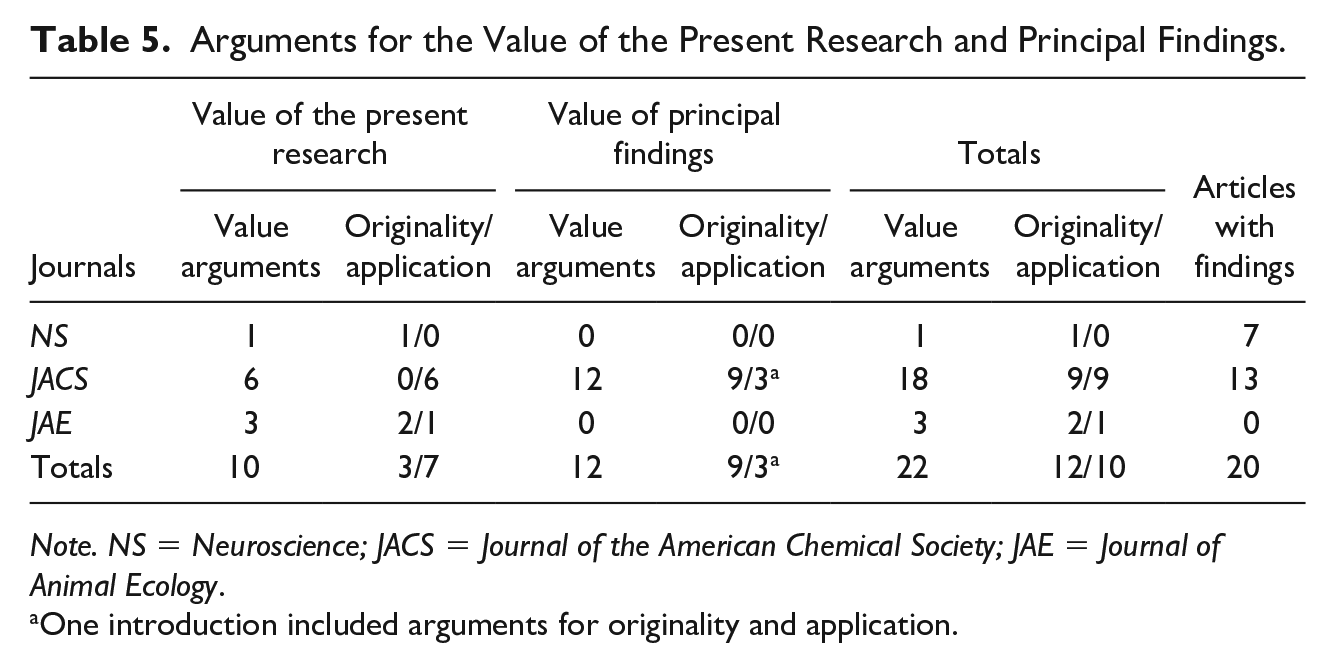
Overall, 12.6% of all the value arguments were for research and findings. As Table 5 shows, JACS far exceeded the others with 81.8% of these 22 arguments compared to JAE 13.6% and NS 4.5%. Another key difference was that JACS had 12 arguments for the value of findings in contrast to none for the other journals, this despite the fact that seven NS articles presented principal findings (none in JAE). Also, regarding the topos for the value of the present research, 60% of the arguments were in JACS with 30% in JAE and 10% in NS. The sharp contrast in overall arguments for novelty (Berkenkotter & Huckin, 1995) on the part of authors in JACS suggests, again, that highlighting the news value of their studies may advantage researchers seeking publication in more prestigious journals.
Arguments for the Value of the Present Research and Principal Findings.
Note. NS = Neuroscience; JACS = Journal of the American Chemical Society; JAE = Journal of Animal Ecology.
One introduction included arguments for originality and application.
Anthony (1999) points out that the importance of research and of findings may be grounded either in the potential application of the research or in its originality, as these examples demonstrate: A: In investigating the neural correlates of domain-specific stress resiliency, more may be revealed about the distinct roles such neural circuits play in managing various aspects of stress. (Sweis, NS) B: Because of its facile preparation, stability, and emission properties, this photoactive drug delivery system provides a potential route to use this multifunctional agent as a dual luminescence imaging and therapeutic nanomedicine. (Frasconi, JACS)
Example A was an argument for the importance of research based on originality, as indicated by “more may be revealed.” Generally, markers of originality in other introductions were terms such as “insights,” “the first time,” “novel,” and “not yet been reported.” In Example B, the authors made the case that the “delivery system,” the result of the research, may be applied to a therapy. Arguments for findings usually made a direct reference to them, as this and its reference did in the example. Overall, the 12 arguments from originality (54.5%) and the 10 from application (45.4%) reflected the dominance of JACS in arguments of both. Of the four arguments for the value of the research in NS and JAE, three were from originality (Table 5).
To argue for the topos of the importance of findings, authors must first report findings. JACS and NS combined for 20 introductions with reports of findings with zero for JAE (JACS 65% and NS 35%). In JACS, 61.5% of its introductions that reported findings had value arguments for those findings. The fact that JAE had zero overviews of findings would seem to point to quite a different understanding of the place of findings in introductions. The wide variation in the employment of principal findings among these journals suggests the need for broader research in their usage.
Shifting to the topos of the value of present research, the differences among the journals were not as dramatic. Whereas arguments for findings addressed the importance of what the study produced, these addressed the importance of the study itself. In most cases, the argument shifted from the narrow focus of the research niche to a broader understanding of the value of the research, as the following example shows: [Research niche in Move 2]: Still, growth by nanocluster aggregation and coalescence has never been seriously considered, although suggested by some authors to account for irregular deposit morphologies. [Two paragraphs later in the last sentence of the introduction, Move 3]: The understanding of the proposed growth mechanism allows better control of electro-chemical deposition processes toward obtaining supported nanostructures with desired morphology and enhanced properties. (Ustarroz, JACS)
The research niche indicated that what was missing in the literature for this introduction was a serious consideration of growth by nanocluster aggregation and coalescence related to deposit morphologies. The argument refers back to the issue of growth and makes a broader case for why it is important to understand how it works.
Topoi of adding to or narrowing topics of preceding arguments
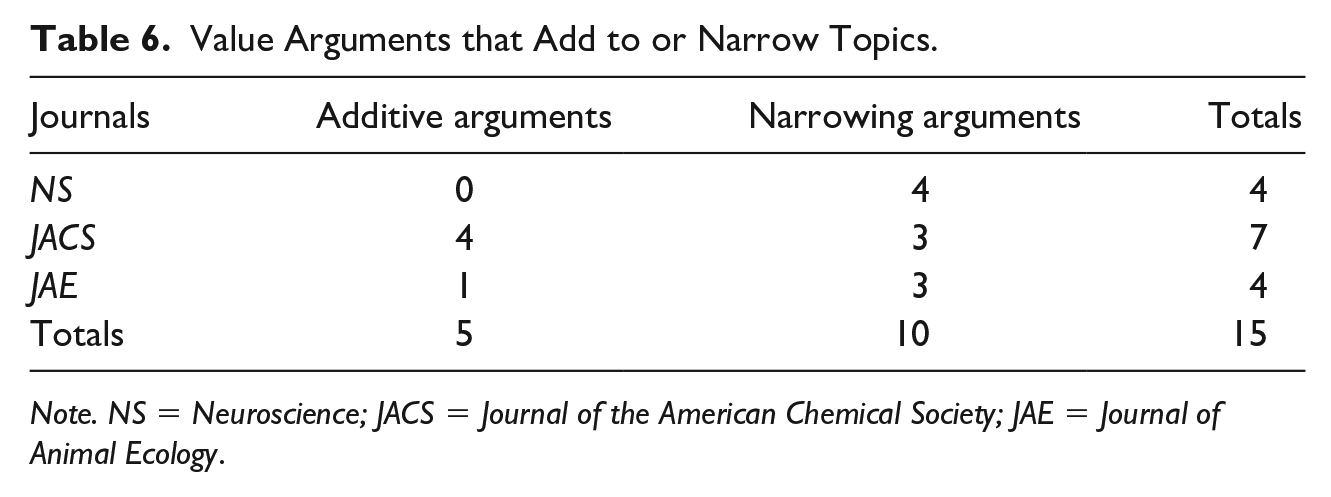
For these topoi, one value argument follows another, either adding reasons to the grammatical subjects of preceding arguments or narrowing the subjects of those arguments to advance the overall narrowing of the literature review. As seen in Table 6, there were 15 of these arguments, 8.6% of the total. Of them, all but two (Li, NS; Frasconi, JACS) followed value context arguments, which had the overall effect of extending those context arguments. The 13 arguments following first-sentence value contexts comprised a substantial portion (37.1%) of those 35 context arguments in my corpus. Comparing among the journals, JACS had most of these arguments (46.6%), but with the small numbers for arguments under this topos, this journal does not dominate the way it has in others.
Value Arguments that Add to or Narrow Topics.
Note. NS = Neuroscience; JACS = Journal of the American Chemical Society; JAE = Journal of Animal Ecology.
Narrowing arguments outnumbered additive (66.6%/33.3%). These arguments reflected the overall movement in a literature review from the relatively general to the relatively specific, as this example shows (emphasis added): Cancer is one of the major causes of death worldwide and in 2008 resulted in 7.6 million deaths (13% of the total). Early diagnosis of cancer is particularly important for reducing cancer mortality. (H. Zhang, JACS)
The authors first argued that the broad area of cancer research was important to study due to its death toll and then that the early diagnosis of cancer, the specific focus of the article, was important because it could lower that toll.
Because only three introductions incorporated the five additive value arguments, they had little impact on the corpus. In contrast to the narrowing arguments in which the effect was in the grammatical subject, in these cases the subject was the same and the effect was in the predicate phrase, advancing the preceding argument through additional value reasons (emphasis added): Predation is a strong selective force that can directly affect an individual’s fitness through its or its offspring’s death. . . . Predation can also indirectly affect an individual’s fitness due to costs associated with antipredator behavior and predation risk . . . (Steyaert, JACS)
Here, the importance of studying predation because of its direct affect was augmented by the importance of its indirect impact, which was the focus of the research study. The also marked this argument as additive.
Two Trials Testing the Sources of Quantitative Differences Among Journals
This quantitative study has highlighted the differences among types of argument and topoi among the three journals, which raises the question: What are the sources of these differences? I see three possible sources. One, which I mentioned above, is the prestige of the journal: The greater the prestige and thus the difficulty of publishing in it, the greater the quantity of value arguments. Among the three journals I analyzed, JACS would appear to support this hypothesis. The second possible source is the culture of the journal: As I noted in the discussion of methods above, each of these three journals reflects its particular traditions, values, behaviors, and attitudes. Thus, differences in these cultures may have an impact on the journals. Third is the discipline of the journal: The particular disciplinary codes that mold researchers also shape particular ways of framing value topoi through arguments in disciplines. I have not addressed this factor here because it would require a study of multiple journals in various disciplines and thus an entirely new corpus and new analysis.
Short of a new study, however, I performed two trials to test the concept of identifying sources of differences among journals, including discipline. Toward that end, I analyzed 10 introductions in Neuron (N) for the first trial and 10 in New Journal of Chemistry (NJC) for the second trial. For the comparison of these analyses to be proportional with the 20 introductions in NS and JACS, I doubled the results of N and NJC. For each journal, I collected introductions at the same general time as those from NS and JACS: N, Volume 79, Issue 3, August 7, 2013, pp. 447 to 578; NJC, Volume 37, Issue 8, August 1, 2013, pp. 2280 to 2368.
For the first trial, I compared NS with N. The latter was the highest-ranking journal in the field in 2013 with an impact factor of 15.79 in contrast to 3.32 in NS and its ranking of 38 in the field. N is published by Cell Press, home of the highly respected flagship journal Cell along with 18 other research journals and 16 review journals across a variety of fields in biology. The two are similar in that they publish articles in general neuroscience, unlike more specialized journals in the field. According to the prestige hypothesis, N should exceed NS in the quantity of value arguments. But as shown in Tables 7 and 8, this was not the case. The journals are essentially the same in nearly every category. This suggests that at least in this instance it is the shared discipline that shapes the topoi through value arguments. However, there are intriguing differences related to findings. Authors in N were twice as likely to report findings in the introductions and made proportionately 10 arguments for the importance of the findings in contrast to zero in NS. I suggest that these arguments are a function of the prestige of N, authors taking advantage of these opportunities to promote the value of their work. As to the difference in the number of findings presented, this is more likely due to difference in cultures because it is not related to the prestige factor.
Value Arguments by Type.
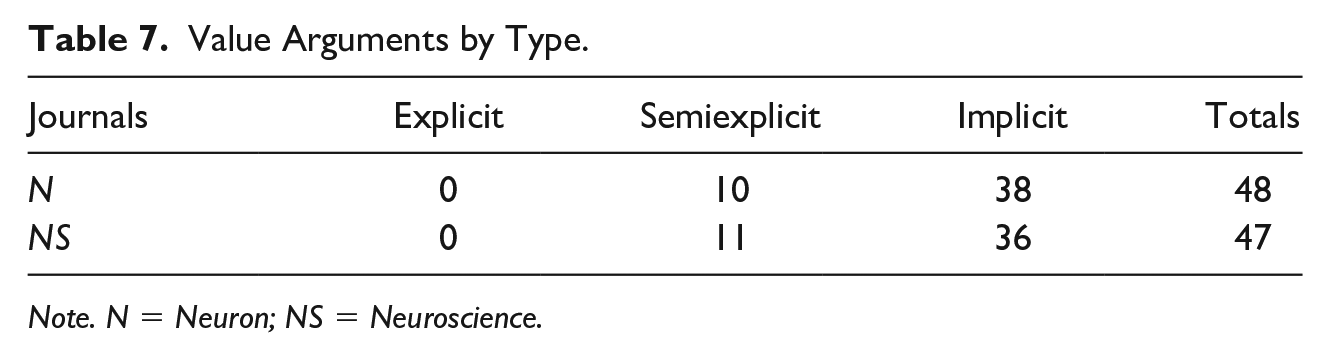
Note. N = Neuron; NS = Neuroscience.
Value Arguments by Topos.
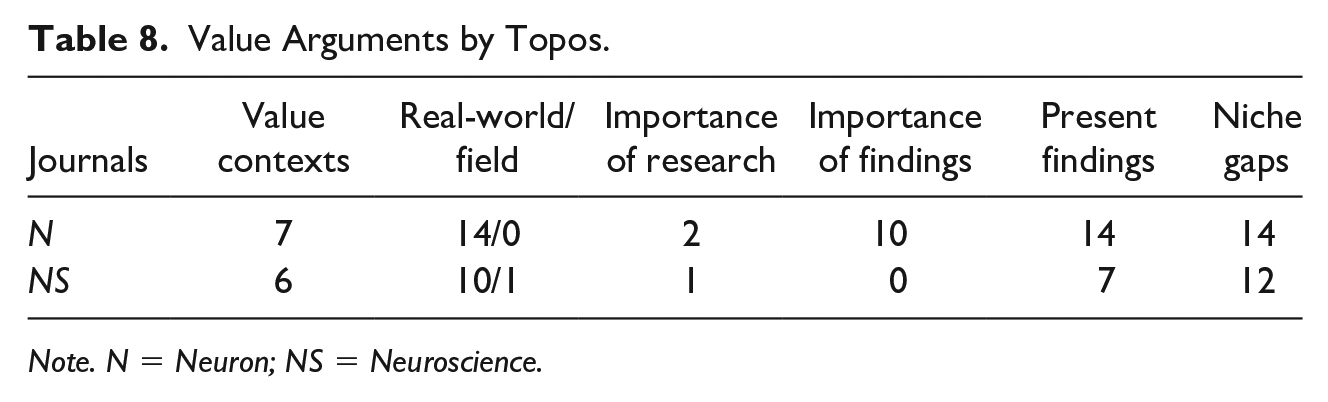
Note. N = Neuron; NS = Neuroscience.
For the second trial, I compared JACS with the NJC, impact factor of 2.61 and ranked 71 among 452 journals in chemistry, in contrast to JACS’s third-place ranking and impact factor of 11.44. Both publish general articles in the field. NJC was launched in 1996, published by the Royal Society of Chemistry (RSC) in the United Kingdom and owned by the National Center for Scientific Research in Paris, an arm of the French Ministry for Higher Education and Research. With a wide gap in prestige and ranking of these journals, two key differences in data stand out (Tables 9 and 10).
Value Arguments by Type.
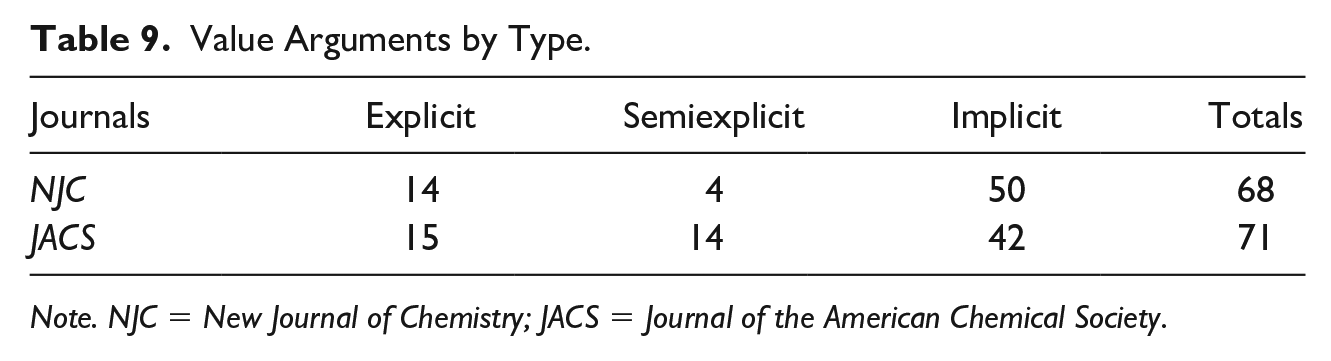
Note. NJC = New Journal of Chemistry; JACS = Journal of the American Chemical Society.
Value Arguments by Function.
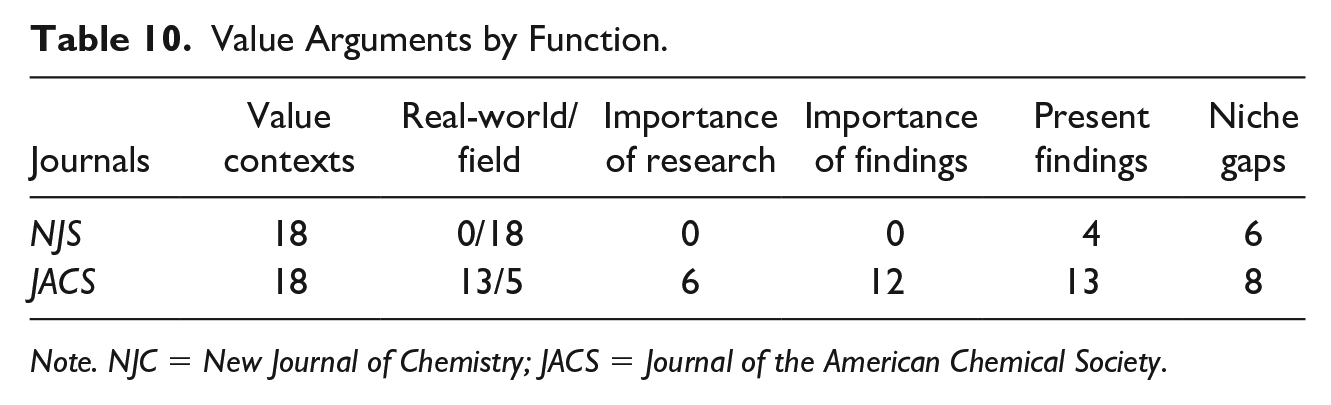
Note. NJC = New Journal of Chemistry; JACS = Journal of the American Chemical Society.
First is the dramatic distinction in the two topoi of the importance of research and of findings—together there are 18 for authors in JACS and zero for those in NJC. The highly competitive nature of publishing in JACS would suggest that these authors would be more likely to take advantage of this kind of argument. But the difference is so great that there may be a cultural difference as well. Perhaps in NJC there is an implicit bias against what may be considered an ostentatious promotion of one’s research. Whatever there is in the culture, it must be strong because it is adhered to by a wide representation of international authors with no such guidance in the journal’s Prepare Your Article (RSC, n.d.).
The second major difference in the data is the type of value contexts. Above, I cited Samraj’s (2002) distinction between claims of interest to the field and what she calls real-world claims, and I noted that the former tend to be weaker because they are relatively parochial. Whereas JACS had a mix of value context arguments (13 real-world and five field, three introductions with both), NJC, also with 18 value contexts, had zero real-world arguments. Those introductions all used language emphasizing the field, such as “is of current interest,” “very relevant in the fields of,” “have attracted great interest,” and “are of considerable practical concern.” As before, such consistency suggests that there is something in the culture that is evidently perceived by prospective authors across many countries. Again, there was nothing in Prepare Your Article (RSC, n.d.) about that kind of value argument and it’s difficult to imagine that there is a policy requiring editors to promote these kinds of value contexts for the sake of consistency.
It is important to emphasize that these are just trials. However, they point to the potential of deepening our understanding not only of the value topoi in introductions but also their implications in the journals themselves. Beyond the widely used impact factor, the disciplines and the cultures of journals offer the potential for a rich mode of analysis.
Conclusion
I began this article with the question of how researchers convince journal reviewers and editors that their submissions are important enough to be published. There is, after all, persuasion at work here: The scientist-rhetors in my corpus made arguments for the value of their research. And the various kinds of arguments occurred commonly enough across the introductions that they coalesced in the seven discrete topoi I identified. These topoi are critical rhetorically because they bind the individual value arguments to the stasis of value in the science research articles. Of course, unlike ancient rhetors, contemporary scientists do not possess a list of value topoi they can peruse to find appropriate arguments. However, the fact that these arguments were used with appreciable consistency across the introductions suggests that most of the scientists had at least taken steps to boost the value of their research using these topoi. And as mentioned above, these topoi could be special not only to science research genres but also to other academic scholarship.
This study and the previous one (Carter, 2016) also suggest that rhetoricians can identify value topoi in scholarly articles. And the ability to discern those topoi further allows rhetoricians to quantify value arguments to better understand the use of argumentation in introductions. To my knowledge, this is the first quantitative study of sentence-level arguments from value in research introductions. This kind of analysis could offer the possibility for rhetoricians to better understand how researchers and scholars across disciplines and research genres characterize the importance of their work. It also contributes to the rather substantial literature on the study of introductions in research articles. These contributions include the predominance of implicit arguments and their enthymemic structures, the prevalence of value context arguments (in first- and second-sentence positions) and the important roles they play, the use of what I call preliminary gaps in the literature in the construction of literature reviews, and the different tasks of direct and indirect arguments in the gaps.
Finally, I would point to the implications of stasis theory itself. Its primary use has historically been to determine the point of contention that frames and directs an argument. The typical practice is to identify a stasis or stases as the overall approach to argument in persuasive texts. Though this method has been useful for understanding persuasion, what has been missing from rhetorical analyses is the further step of identifying the specific arguments and topoi used to support stases. The sentence-level analysis I have applied in this article may be employed for this purpose, not just for arguments of value but also arguments of fact, definition, and procedure, applying the “full stasis model” suggested by Fahnestock and Secor (1988). This approach to rhetorical analysis could provide a more comprehensive appreciation of argumentation in general and scientific writing in particular.
Footnotes
Appendix A
Appendix B
Organophosphate nerve agents are among the most toxic compounds that have been chemically synthesized. (Meier, JACS) Claim: Organophosphate nerve agents [are important to study] Reason: [because they] are among the most toxic compounds that have been chemically synthesized
Metal nanocrystals are of great interest due to their unique properties which differ from their bulk counterparts and can be tuned by adjusting their size and shape. When supported on different substrates, they [metal nanocrystals] represent the cornerstone for numerous applications in different fields, such as catalysis or sensing. (Ustarroz, JACS) Claim: When supported on different substrates, they represent the cornerstone [are important] Reason: [because of their] numerous applications in different fields, such as catalysis or sensing
Endoplasmic reticulum (ER) is an adaptive cellular response to a number of cellular insults including excess unfolded protein accumulation, cellular calcium disruption, microbe infection, and other stresses in the cell. . . . ER stress sensor proteins detect cellular stress and then activate a number of basic region leucine zipper (B-zip) transcription factors in a coordinated fashion to initiate the transcription of adaptive response genes that work to bring the cell back to homeostasis or to trigger apoptosis if the insult is too severe . . . (Pavlovsky, NS) Claim: ER stress sensor proteins [are important to study] Reason: [because they] detect cellular stress and then activate a number of basic region leucine zipper (B-zip) transcription factors in a coordinated fashion to initiate the transcription of adaptive response genes that work to bring the cell back to homeostasis or to trigger apoptosis if the insult is too severe
Therefore, movements are the primary behavioural adaptation to dynamic resource landscapes . . ., and play a central role in evolutionary biology . . ., ecology . . . and conservation. . . . However, movements are a relatively poorly understood individual and population process, and the development of a general theory of movement is still in its infancy . . . (van Moorter, JAE) Claim: Therefore, movements [are important to study] Reason: [because they] are the primary behavioural adaptation to dynamic resource landscapes, and play a central role in evolutionary biology, ecology and conservation
However, evidence for benefits of delayed direct breeding is more likely to be found in species in which helpers are not close relatives and so do not receive additional (immediate direct or indirect) benefits from cooperation. . . . The cooperatively displaying lance-tailed manakin Chiroxiphia lanceolata offers an excellent opportunity to investigate the role of cooperative experience in influencing success as a breeder. (DuVal, JAE) Claim: The cooperatively displaying lance-tailed manakin Chiroxiphia lanceolata [is important to study] Reason: [because it] offers an excellent opportunity to investigate the role of cooperative experience in influencing success as a breeder
Our objective was to develop an understanding of the disease that will ultimately aid in identifying and assessing intervention options. (Cassirer, JAE) Claim: Our objective to develop an understanding of the disease [was important] Reason: [because it] will ultimately aid in identifying and assessing intervention options
These results provide insight into the high temperature surface chemistry on mixed ionic/electronic conducting ceria (CeO2-x) electrodes. (C. Zhang, JACS) Claim: These results [are important] Reason: [because they] provide insight into the high temperature surface chemistry on mixed ionic/electronic conducting ceria (CeO2-x) electrodes
Declaration of Conflicting Interests
The author(s) declared no potential conflicts of interest with respect to the research, authorship, and/or publication of this article.
Funding
The author(s) received no financial support for the research, authorship, and/or publication of this article.