



Abstract
Researchers’ investment in reader engagement includes the construction of an appealing abstract. While numerous studies have been conducted on abstracts’ rhetorical features, scant empirical attention has been paid to negation use in academic writing. The current study seeks to narrow the research gap from a general and diachronic perspective by adopting an interpersonal model of negation. We found that while not, no, and little tend to be the commonly used negative markers in Science abstracts, little increased diachronically but decreased for not and no. Functionally, writers prefer to use interactive negations and employ relatively more negative markers that function as consequence (interactive dimension) and hedging (interactional dimension) in their abstracts. Finally, we discuss the possible reasons for such results as well as their pedagogical implications.
In academic writing, abstracts may function to grab readers’ attention (Ngai & Singh, 2020), since they can be strategically crafted to intrigue readers into the subsequent reading of the full text (Hyland & Tse, 2005). To do so, writers tend to use language that expresses attitudinal and evaluative meanings in academic writing (e.g., Hyland, 1998, 1999, 2004, 2005). Negation is such a rhetorical device that authors adopt to engage with readers in academic writing (Jiang & Hyland, 2022).
The significance of negation in academic communication cannot be neglected. Dialogistically, negation brings up an alternative positive position to the dialogue and then acknowledges it to reject it ( J. R.Martin & White, 2005). In academic writing, negation is seen as one of “the nuts and bolts of written academic English” (Swales, 2019, p. 79) that demonstrates the complex interplay between meaning and structure with different aspects (Miestamo, 2007). Loghmani et al. (2020) argue that successful thesis writing is characterized by skillful employment of interpersonal language, introduction of authorial stances, interaction with opposing viewpoints, and the forging of connections with disciplinary groups. The flexible use of negative markers may help writers to achieve these characteristics. However, current understanding of negation in academic writing, especially in abstracts, remains divergent. In 1985, Graetz denied the presence of negation in academic abstracts. The claim was later rebutted by Swales (2019), who argued that it would be too early for Graetz (1985) to claim that negation is absent in abstracts. Most recently, Jiang and Hyland (2022) joined the debate by revealing not only the significance of negation but also its interpersonal roles in academic abstracts. Thus, to deepen our understanding of negation in academic writing, especially in research abstracts, further research is needed.
To offer a more specific picture of negation in academic abstracts, the current research studied negation in the abstracts of one journal, Science, across 35 years. The journal Science was chosen because of its cross-disciplinary nature, which may make the findings relatively generalizable and helpful to academic writers from different fields. With a worldwide reputation and global readership, the Science journal can be a typical case for researching and teaching academic writing to academics and students from various disciplines. Therefore, our case study on negation may also generate important findings and implications for generalists or students.
Finally, we traced the diachronic change of negation in Science to examine and validate Jiang and Hyland’s (2022) findings. We improved upon their design by investigating negation use across 35 years consistently, instead of time periods as they did. Methodologically, such a case study may offer a closer and more specific view of the diachronic change of negation in academic abstracts.
Negation in Academic Writing
Negation and Its Classification
Negation usually indicates “the absence or opposite of something, or to say that something is not the case” (Hands & Sinclair, 2017, p. 45). Though negation is not as commonly seen in writing as in speech (Biber et al., 1999), the role of negation in academic writing contributes to shaping academic arguments to make writers’ views more persuasive to intended readers (Jiang & Hyland, 2022).
Based on the exploration of negation over years, some typological knowledge of negation can be summarized here. “Standard negation,” also called “clausal negation” (Biber et al., 1999), is the basic form (Miestamo, 2005; Payne, 1985; Tottie, 1991) used to negate declarative verbal main clauses (Miestamo, 2007), and it is usually considered a direct way of expressing negation (Miestamo, 2009). Jiang and Hyland (2022) conclude that there are two forms to achieve a clausal negation: (1) by negating the lexical verb or auxiliary (Example 1) and (2) by negating the non-verbal components in a sentence (Example 2).
(Example 1) Space weathering of Bennu surface materials does
(Example 2) Such an activity has been observed for condensin, which forms loops in mitosis, but
Another commonly seen classification of negation is discussed by Dahl (1979), who proposes 2 types: “morphological negation” and “syntactic negation.” Morphological negation is characterized by the negative affix (e.g., dis-, non-, and un-) in constituting a lexical verb. Syntactic negation, on the other hand, is negation in uninflected particles or auxiliary verbs (Miestamo, 2007). It is also categorized as non-affixal (Tottie, 1991) or clausal negation as mentioned above and shown in Examples 1 and 2.
Other classifications of negation have also been proposed and widely discussed in the field. From an ideational aspect, Pagano (1994) proposes the idea of overt negation (with a formal negative marker in a proposition; e.g., not and no), and covert negation (propositions with a positive form but indicating a negative meaning; e.g., I forgot). From a meaning perspective, Tottie (1987) classifies negation into rejections (referring “to reject suggestions, including refusals” in Example 3) and denials (referring “to deny assertions” in Example 4). Pagano (1994) points out that the truth of the fact usually predominates meaning in denials, whereas in rejection, interpersonal function predominates.
(Example 3) A: Would you care for a drink?
B:
(Example 4) A: So you are still living out there.
B:
Among the classifications, Webber (2004) offers another distinction about the information denied by writers. When a writer denies background information, the negation is called extratextual. In Example 5, the author denies the shared knowledge in the field.
(Example 5) Despite the prevalence of mechanosensory systems,
If the information a writer denies is within the text, then the negation is intratextual, just as in Example 6.
(Example 6) We also surveyed 491 glacier lakes for earthquake damage but found only nine landslide-impacted lakes and
Webber’s categories are similar to Tottie’s (1991), which base the difference between implicit negation and explicit negation on whether the negation is explicitly stated in the proposition or needs to be inferred from the context. In the written text, “there is no physical receiver of the producer’s message at the moment of composition” (Pagano, 1994, p. 253); thus writers need to convey their negative arguments while imagining a reader with certain knowledge background and experience in mind, and then anticipate the possible questions, actions, and views of this reader. Similarly, Jiang and Hyland (2022) refer to the creation of a virtual reader position in academic writing: challenges to the possible views and actions of this virtual reader create “a dialogic space” between writer and readers (p. 62).
It can be seen that negation not only connects expressions in the text itself to improve the internal cohesion of a text but also helps convey the writer’s position to the prospective readers persuasively. Therefore, it is necessary to acknowledge the importance of such interaction in academic writing when investigating negation.
Empirical Studies of Negation in Academic Writing
To date, researchers have explored negation in pragmatics (Pitts, 2011) as well as in more specific areas such as metalinguistic negation (Davis, 2011) and activation of presuppositions (Seuren, 2000). Their research has revealed the complex role negation plays in human discourse. However, such studies have not explored negation from an interpersonal perspective in academic writing, except for Jiang and Hyland (2022). Our research furthers into insights of negation by constructing a typical case study from a diachronic perspective.
Specifically, Jiang and Hyland (2022) conducted disciplinary research on negation in abstracts. They investigated the use of negation (i.e., clausal negation) relating to its form, functions, and distributions in 6,000 abstracts from 10 high-impact journals in four disciplines over three periods diachronically (1990, 2005, 2020). By researching 17 typical negative markers under the interpersonal model of negation (see next part for detail), their results indicated that the use of negation as consequential connections was the most frequent, and negative markers were rarely employed to convey personal affect by researchers. They observed a rise in the use of hedging, comparison, and addition, as well as a decrease in the usage of boosting and consequential expressions in the sample of abstracts they studied. Interestingly, their study revealed a change in the way writers shaped their arguments over time, which they attributed to a less specialized readership.
The current study is designed to use a typical case (i.e., Science) to validate and complete further research on the use of negation in academic writing from an interpersonal perspective. To the authors’ knowledge so far, no study has focused on a particular case to trace and verify the diachronic development of negation use in academic writing. The present study investigates the diachronic change of negation use in academic writing by focusing on a typical case (i.e., Science) with consecutive data from 1987 to 2021, in the hope of validating Jiang and Hyland’s (2022) research and contribute to our understanding about the development of negation in academic abstracts. Because Science tends to publish more articles in hard science domain, our results may especially be more reflective in negation use of academic abstracts of hard sciences.
Theoretical Framework
An interpersonal model of negation (Jiang & Hyland, 2022) was adopted in the current research. This model sets out from the social constructionist point of view in understanding interaction in writing and combines both conceptions of metadiscourse and Thompson’s (2001) communicative dimensions in analyzing negation.
From the social constructionist point of view, interaction in writing is seen as “a collection of rhetorical choices rather than as specific encounters with real readers” (Hyland, 2022, p. 28). Negation functions to shape the reader-writer relationship in a way that writers have already presumed the possible opposite views held by putative readers, so as to negate these opposite views by proposing them first to persuade and guide readers in following the authors’ mind ( J. R.Martin & White, 2005).
Based on the interpersonal model, negation used in the texts can be illustrated both from the
In terms of the function of
(Example 7) We found that cancer cells, but
For the function of
(Example 8) We determined that
According to J. R.Martin and White (2005), the above two functions of negation (comparison and addition) also convey the meaning of “countering,” which depicts the current proposition as replacing or supplanting one that would have been anticipated in its place. Countering, also labeled adversative (Tottie, 1987), functions to “invoke a contrary position which is then said not to hold” and to “project onto the addressee particular beliefs or expectations” ( J. R.Martin & White, 2005, pp. 120-121).
The negation function as
(Example 9) These findings show that most floodplains along mid-Atlantic streams are actually fill terraces, and historically incised channels are
The
For hedging, Jiang and Hyland (2022) argued that the use of negation “contributes to the writer’s efforts to limit the full illocutionary force of a statement or evaluation, toning it down to either express reservations about the proposition or provide the reader with a sense their possible alternative view is respected” (Jiang & Hyland, 2022, p. 63). Example 10 presents a case of hedging negation, here writer(s) use “little” to tone the voice down and allow possible “empirical support” to exist.
(Example 10) Although this situation was suggested decades ago, it previously had
The function of
(Example 11) Although messenger RNA (mRNA) translation is a fundamental biological process, it has
The use of negation as
(Example 12) The mammalian eye is a remarkable optical device, but its design is
What is worth pointing out is that analyses of the functional effect of negation must consider not only the negative particles but also the relevant contextual constructs (including the relevant modal verbs, adverbs, etc.). This is to say that some of the negative markers we analyzed are highly dependent, like in the combination may not that indicates hedging, or no longer that indicates boosting in function. At the same time, the other particles in the context also exert an effect on the interpersonal meaning of negative markers. Therefore, the negative markers cannot be analyzed alone without considering the effects exerted on them from other relevant contextual constructs. According to the dialogic space theory of J. R.Martin and White (2005), writers selectively establish their stance firmly or invite alternative positions in their writings by allowing or challenging alternative stances. By introducing this idea into negation use, we can delve deeper into the functional use of some negative devices from an interpersonal perspective.
Following Swales’s (2019) appeal that EAP (English for Academic Purposes) studies yield more rhetorical organization and contextual analysis, the current study is designed to investigate negation rhetorically with contextual information considered when coding the data. Additionally, we intend to reveal more precise diachronic trends by constructing a consecutive corpus that spans 35 years diachronically from an interpersonal perspective. Therefore, to further reveal the development of negation in Science abstracts from an interpersonal perspective, the present research addresses the following questions:
How has the frequency of negation changed in the abstracts of Science research articles?
How have the functions of negation changed diachronically in the abstracts of Science research articles?
Methods
Data Collection
The corpus analyzed in the present study was built from abstracts extracted from the research articles of the journal Science over the past 35 years. Focusing on one journal in a 35-year frame guarantees the internal consistency of the data collected diachronically, since Hyland and Jiang (2019) have pointed out the difficulties in diachronic research due to the inconsistency of the time periods of articles published in journals.
For collecting data, we constructed a diachronic corpus of abstracts for academic writing based on the journal Science with a crawler script we developed in Python. Our data were retrieved from the Science website through institutional access granted by the Nanjing University Library. Noticeably, we set the crawl delay to 10 seconds to conform to the Robots Exclusion Standard issued by the journal website to prevent any potential disruption to the journal’s web server. Then, the data retrieved was stored in an Excel file, forming the corpus with 35 years of abstracts from Science in the current study.
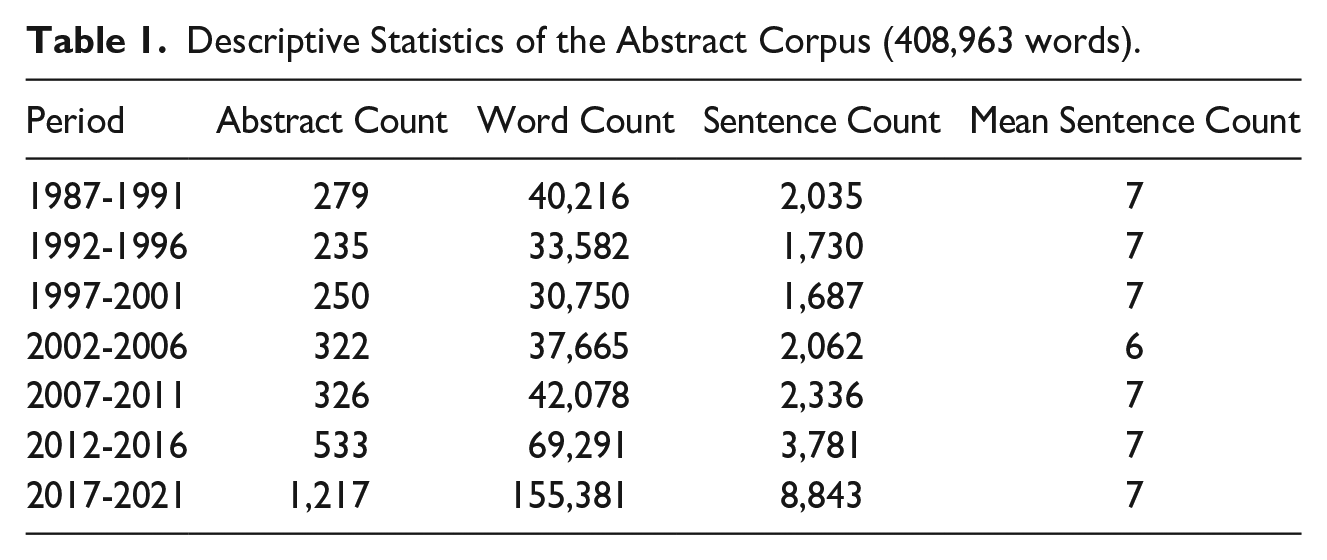
The corpus we analyzed in the present study consisted of 3,162 abstracts for a total of 408,963 words over a 35-year span: January 1987 to December 2021 (Table 1). This corpus contains all the abstracts of Science research articles from 1987 to 2021 consecutively. It is worth noting that the descriptive statistics were calculated by each year, but due to the space limit, they were displayed by five-year increments in Table 1.
Descriptive Statistics of the Abstract Corpus (408,963 words).
Data Analysis
To investigate negation in our study, we adopted a list of negative markers from Jiang and Hyland (2022), consisting of 17 typical negative markers that focus on non-affixal or clausal negation (Table 2).
Typical Negative Markers.

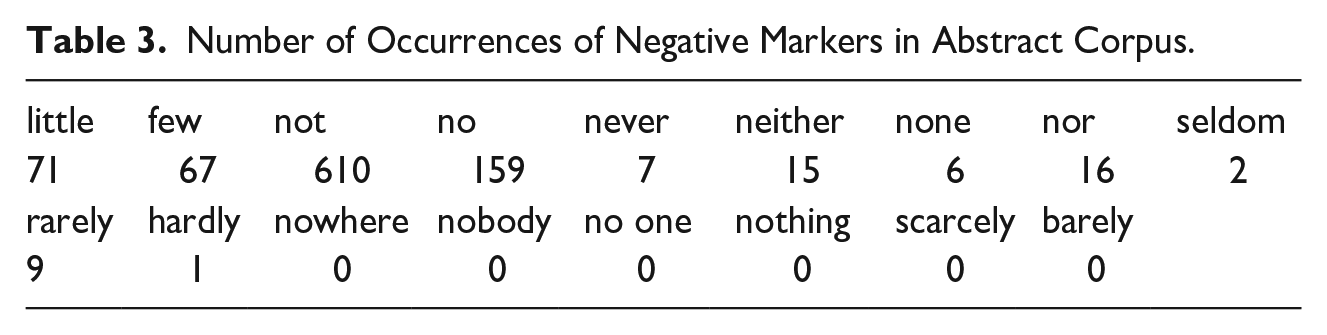
Since the goal of this study was to examine the diachronic development of negation, mixed methods were adopted. We first imported the abstract data into Lancsbox and searched for the 17 negative markers in the corpus. We extracted 963 concordances that incorporate these negative markers, which are shown in Table 3. Next, two raters manually checked each concordance based on the interpersonal model proposed by Jiang and Hyland (2022) to categorize the negations. We also verified and ruled out the retrieved instances that were not functioning as negation. For instance, in Example 13 when the word few is considered together with the indefinite article a, it clearly does not function as a negative device; similarly, in Example 14, the capitalized NO is simply the abbreviation of Nitric Oxide. After ruling out 61 such concordance lines, we were left with 902 negations concordances for the subsequent coding process.
(Example 13) One hundred and seventy-two eustatic events are documented for the Paleozoic, varying in magnitude from a
(Example 14) This production rate is faster than previously thought and implies that anthropogenic activities that add
Number of Occurrences of Negative Markers in Abstract Corpus.
Some of the 902 negations we found could not be categorized into any of the six negation types based on the coding scheme provided by Jiang and Hyland (2022). For example, in Example 15, negation is just used to state a fact without any interactive or interactional purpose detected. Cases like Example 15 were ruled out from our data, and 735 concordances were categorized successfully based on the contextual information provided.
(Example 15) Intergenic regions include three “gray holes,” 0.6 to 0.8 kilobases, with
It is also worth mentioning that the meaning of negation can be incorporated into a word not only via some explicit negative prefix such as dis-, un-, non-, or some explicit negative particles like no and not, but also refers to the word that conveys negation in its context. Take the negative marker few again as an example here: in case (13) above, few does not incorporate negation but refers to a small amount. However, in Example 16, few here is used to indicate that almost no relevant data was provided, thus entailing negation in its meaning. Therefore, manual coding is necessary for accurate categorization.
(Example 16) Evidence for this structure must therefore be sought from the fossil record. Until now, that record has provided
During the coding process, two raters manually coded all examples independently, and a third rater was involved in the discussion when checking disagreements. All disagreements were discussed to reach a consensus. The causes of disagreements included: 1) the marker itself does not indicate negation in context; 2) the marker is a negation in context but does not entail any interactive or interactional function (see Example 15 for detailed explanations). To solve these disagreements, the raters would read extensively, and even cover the whole abstract if necessary, to identify and classify the functions of negation when the extracted concordance was not clear enough to support our judgments. Rounds of discussions were made to avoid errors to the largest extent possible.
Finally, we normalized all the results to 10,000 words to balance the distribution of abstract word counts during the years examined, and conducted the Mann-Kendall trend test to reveal the possible trends of negation development in Science abstracts.
Results and Discussion
General Diachronic Patterns of Negation and Negative Markers
Altogether 902 cases of clausal negation were identified in the current abstract corpus. After calculating, 2.2 cases occurred per thousand words (divided by 408,963 words), with approximately 3 casual negations in every 10 texts (given the assumption that negations were distributed evenly in abstracts). Though this distribution is less than that found by Jiang and Hyland (2022), it further contradicts Graetz’s (1985) impression that abstracts incorporate no negatives. In solving the first research question, we performed the Mann-Kendall trend test to reveal the general trend of negation and negative markers in abstracts within the 35-year frame.
Table 4 presents the normalized frequencies of negation and some of the negative markers with salient results. Descriptively, the use of negations as a whole has fallen from 23.62 to 13.13 cases during the examined years. However, statistically, the use of negations revealed no significant trend during the last 35 years (change rate = −1.2497, p = 0.2114 > 0.05) (Table 5). This finding indicates that over the past 35 years, the use of negation has neither decreased nor increased, revealing its quite stable role in academic abstracts.
Normalized Frequencies of Negation and Negative Markers.

Results of Mann-Kendall Trend Test for Negation and Negative Markers.

p < 0.01, **p < 0.05.
Among the 17 negative markers we investigated, the markers not, no, and little were found to be used most frequently, echoing findings by Jiang and Hyland (2022). Specifically, both the use of not and no showed significant but slight downward trends. Tables 4 and 5 suggest that the use of the negative marker not has dropped from 26.85 in the period of 1987-1991 to 10.88 in the period of 2017-2021 (change rate = −2.8687). As for the negative marker no, its normalized frequency has fallen from its high point of 6.85 during 1992-1996 to its lowest of 2.12 in the period of 2017-2021 (change rate = −2.8403). These findings indicate that Science authors are slightly less likely to use the negative markers not and no in their abstracts over time, which echoes what Jiang and Hyland (2022) have found in their study. Interestingly, we found that the use of the negative marker little has demonstrated a significant but slight upward trend (change rate = 0.02219), indicating a slightly greater adoption of the negative marker little over time. These combined results can possibly be explained from three perspectives. First, compared to the broad negative marker little, which is used to “make a statement almost negative” (Hands & Sinclair, 2017, p. 648), no and not negations tend to possess relatively more intensity and prominent pitch. In the following examples, the negative marker little in Example 17 and Example 18 hedges the position more than no and not negations in Example 19 and Example 20, respectively, by downplaying the author’s assessment of the current research background in the field.
(Example 17) Although much of flagellin signaling is understood,
(Example 18) Although this situation was suggested decades ago, it previously had
(Example 19) But there have been
(Example 20) The evolutionary origin of metazoan cell types such as neurons and muscles is
According to Yaeger-Dror (1985) and Larsen-Freeman and Celce-Murcia (2016), from the aspect of the social function of negations, the intensity and pitch of negations are usually reduced to maintain social harmony; thus, scientists may resort to the negative marker little more often than no and not in academic abstracts.
Second, based on the interpersonal mode of negations proposed by Jiang and Hyland (2022), writers are likely to engage readers by constructing a friendly reading environment to convey their stance and make connections with their readers, especially in the abstract. Consequently, it is necessary for writers to create some space for readers to further negotiate in constructing abstracts, as Pinker (2014) explains: writers (i.e., readers) today “are infused by the spirit of scientific skepticism and the ethos of questioning authority” (pp. 9-10). Third, the high intensity of no and not negations may limit the academic rigor, leaving no more space for further scientific investigation, which may impede the development of a certain field.
Overall Distribution of Negation Functions
To answer the second research question, we identified 735 negations in our data, and categorized them into 6 functions from two dimensions (interactive dimension: consequence, addition, comparison; interactional dimension: hedging, boosting, affect) based on the interpersonal model proposed by Jiang and Hyland (2022). As shown in Figure 1, we found that 61.36% of the clausal negations we investigated were interactive (n = 451), whereas 38.64% were interactional (n = 284). This finding also corresponds to that of Jiang and Hyland (2022). Our results suggest that interactive negations tend to be a more salient negation type in abstracts in academic writing compared to interactional negations.
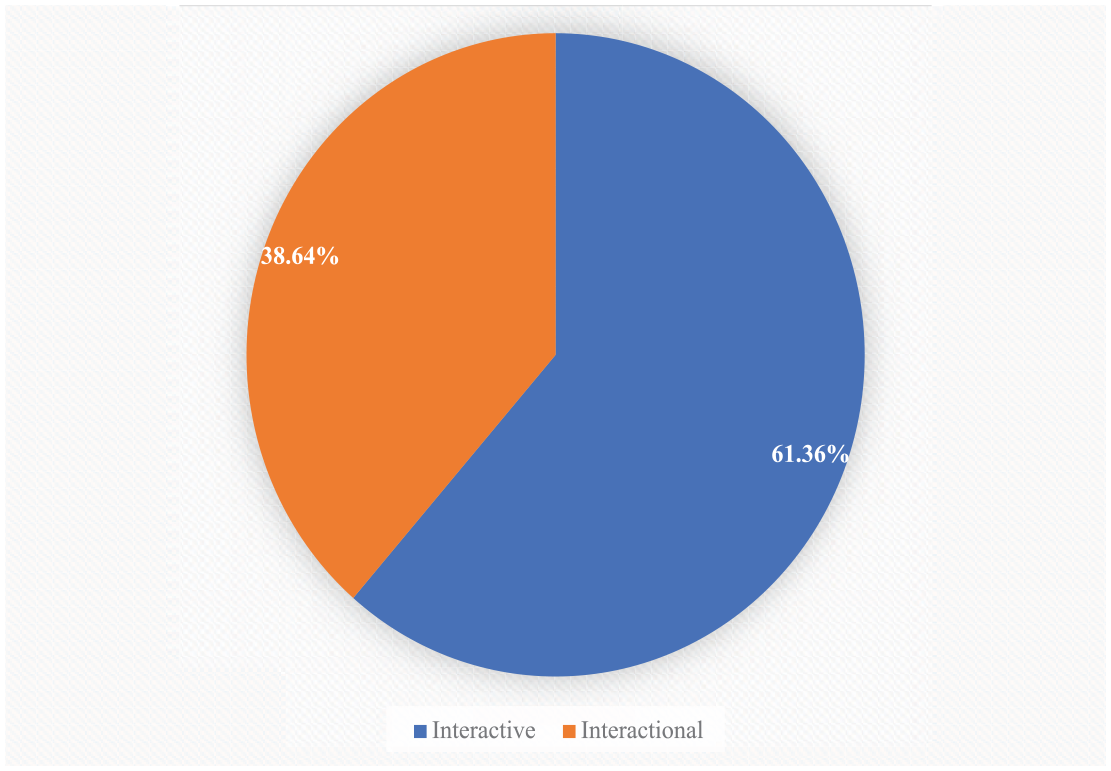
Overall distribution of negation types.
The predominant use of interactive negations indicates that writers are more likely to use certain interactive negations to construct their abstracts to be more coherent and persuasive textually, (Jiang & Hyland, 2022). Such behaviors of writers, to some extent, may reflect that academic writers tend to rely more on the text itself when communicating with readers than on creating an intimate relationship through but beyond texts between writers and readers in terms of using negations. For the use of interactional negation, our results aligned with Jiang and Hyland (2022) in that interactional negations did not play a dominant role in our data; nevertheless, this finding does not diminish the significance of interactional negations, and its prominence in written communication as we demonstrate later.
Table 6 shows the six functions of negation and the negative makers that have been found with functions of each kind.
Negative Markers in Each Function.

Note. Illustrations of the six functions of negation were adopted by Jiang and Hyland (2022).
Functional examples are extracted from the corpus of the current study.
As shown in Figure 2 and Table 7, we found that the negations that were used most frequently in our case were consequence in the interactive dimension (n = 239) and hedging in the interactional dimension (n = 205), which is consistent with Jiang and Hyland’s (2022) findings.
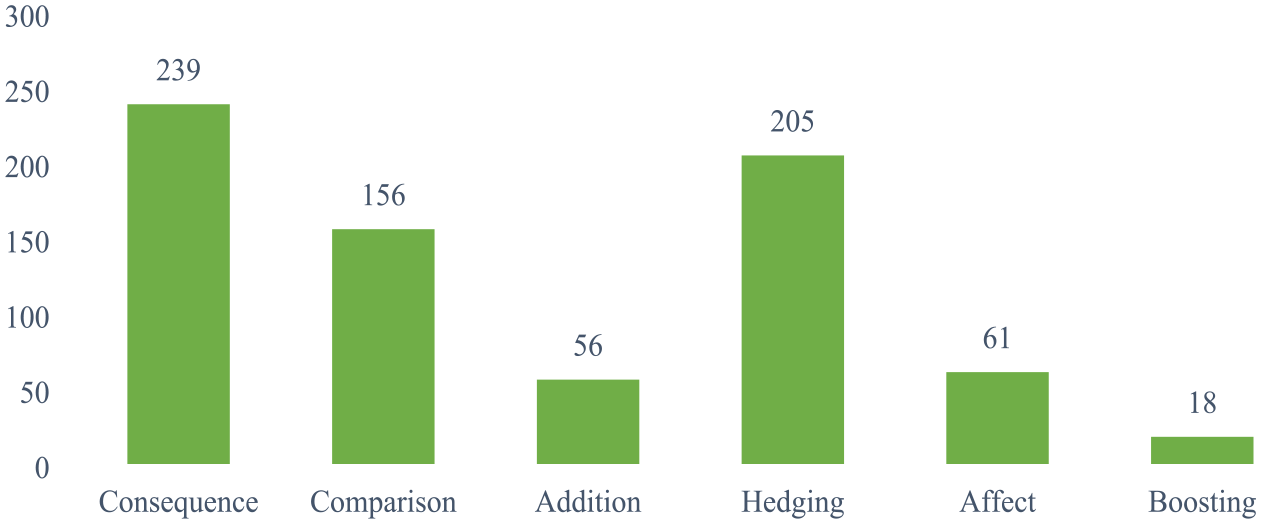
Raw frequencies of six interpersonal negations.
Percentage of Functional Use of Negation in the Corpus.
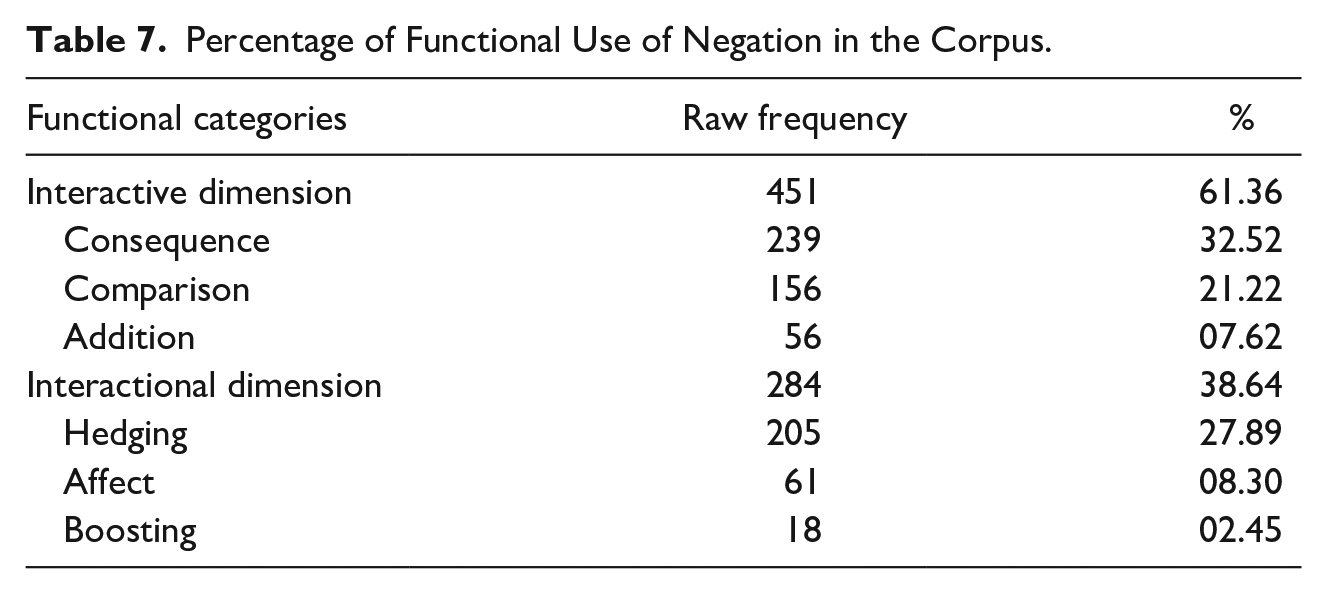
In the interactive dimension, about 53% of the total negations function as consequence, which is employed to show that something is not an outcome or effect of an argument or study (Jiang & Hyland, 2022, p. 63). Therefore, in academic writing, negation as consequence often indicates the consequential connections between arguments, such as in Example 21, in which the negation adopted by the authors presents a lack of positive results between “modernization and pathogen prevalence theories” and “the data,” and therefore highlighting a negative consequence of their study.
(Example 21) We also find that modernization and pathogen prevalence theories do
(Science, 2014)
According to Jiang and Hyland’s (2022) model, negation as hedging “contributes to the writer’s efforts to limit the full illocutionary force of a statement or evaluation, toning it down to either express reservations about the proposition or provide the reader with a sense their possible alternative view is respected” (p. 63). They found that in the interactional dimension, hedging was the predominant function of negation in academic abstracts. We observed the same pattern in Science abstracts. Specifically, hedging took about 72% among 284 cases of interactional negations. As shown in Example 22, the negation led by the negative marker “little” acknowledges, but also hedges, the lack of empirical evidence of “how habitat transformations such as forest loss and gain are reshaping biodiversity over time.” Here, the hedging negation was used to indicate the scares of the relevant investigations and further highlight the significance of the current research.
(Example 22) Global biodiversity assessments have highlighted land-use change as a key driver of biodiversity change. However, there is
It is also worth noticing that in Example 22, the writer(s) bring a shared negative view (“there is little empirical evidence”). By broadcasting the amount of empirical evidence negatively, the writer(s) can highlight the importance of their study. Also, the writer(s) are trying to build a connection with putative readers when proposing this shared negative view by assuming a prerequisite that readers and writer(s) are from the same academic community and share common background knowledge.
Contrary to Jiang and Hyland’s (2022) finding that affect, which contributes to the writer’s attitude to presented content (p. 63), was the least used function in negations, we also found that the least commonly used function of both the interactive and interactional dimensions was boosting, which comprises only about 6%. According to Jiang and Hyland (2022, p. 63), negation as boosting emphasizes the expressive force of a proposition. Take Example 23 as a case in point: the negation “has never been sampled,” instead of “has not been sampled,” strengthens the force of the negation by indicating a case with absolutely no exception.
(Example 23) The complementary enriched reservoir has
A limited number of negations that function as boosting indicates that writers are more cautious about the effectiveness of their negative arguments than expressing attitudes in academic abstracts. In explaining why boosting is the least frequent function, Hyland (1999, Hyland & Jiang, 2016) explained that the use of boosters tends to mute the different viewpoints of readers, and thus may not only decrease the willingness to communicate but also impede effective interactions between writers and readers. We could also hypothesize that publishing in high-impact journals such as Science made the writers less confident about their negative arguments. Combined with the results that hedging comprised a high portion of the negative markers we investigated in our data, the claim of “a deliberate, cautious expression of scientific claims, rather than by the authoritative stance of an ‘omniscient’ academic” can be further validated (Gillaerts & Van de Velde, 2010, p. 137).
Diachronic Patterns of Negation Functions
To better explore the second research question, a series of Mann-Kendall trend tests were performed regarding the change in functional use of negations over time, and the results are presented in Figure 3 (interactive negations) and Figure 4 (interactional negations), respectively. In terms of

Diachronic development of interactive negations.
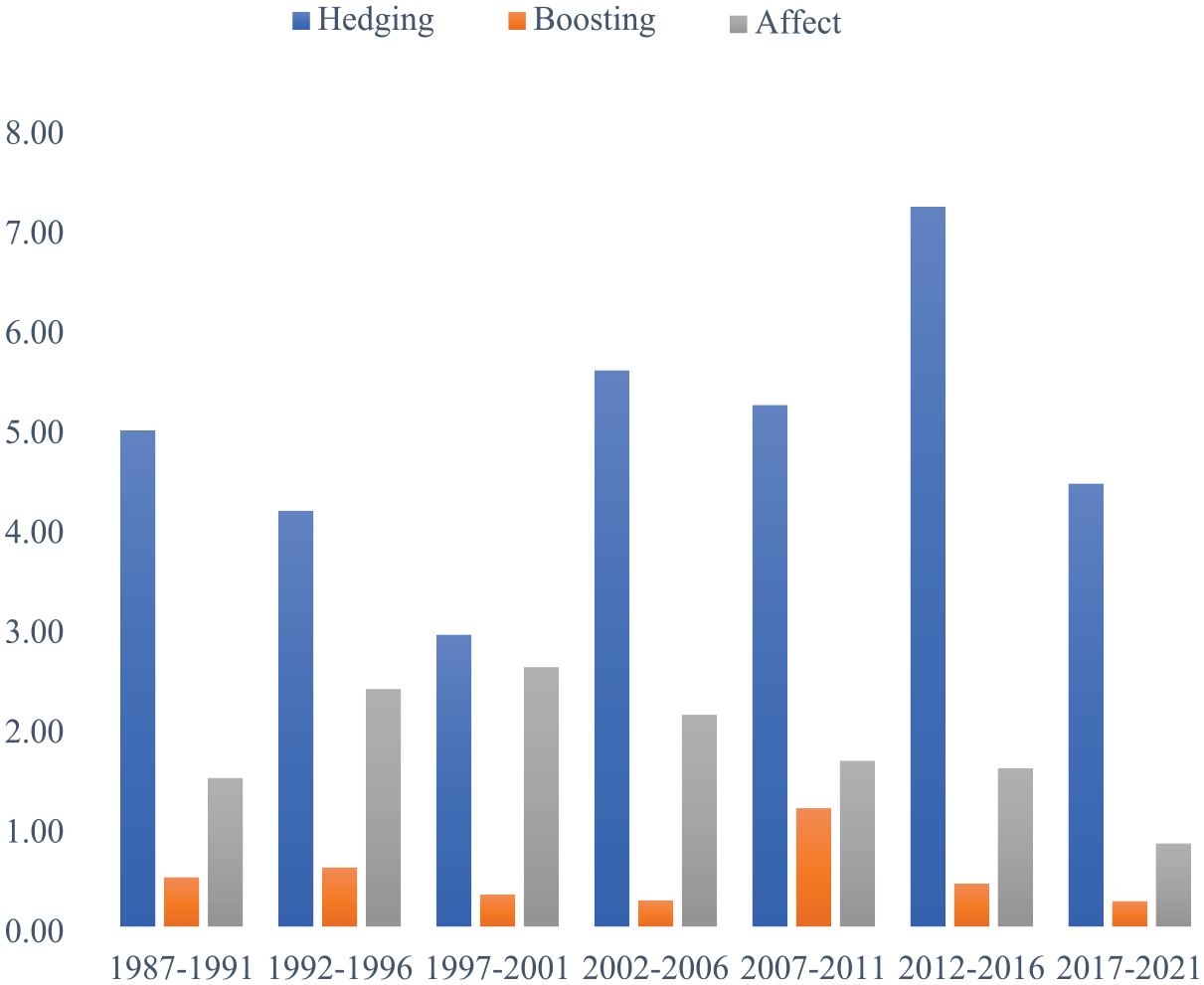
Diachronic development of interactional negations.
Among the results,
(Example 24) Sensory inputs did
The decrease in using comparison may indicate a change to a more succinct way of academic writing, as conciseness is one of the most commonly noted features in academic writing (Snow, 2010), and it is especially the case in abstracts, which is considered to be “an abbreviated, accurate representation of a document” (Weil, 1970, p. 352); thus a concise fashion, without complex information structured, is of importance in writing abstracts.
(Example 25) Transfer of other chromosomes, namely X and 13, had
(Example 26) Comparative analysis suggests that partial pressure of carbon dioxide (P
The slight but insignificant decrease of consequence in negation over time may be explained in two ways. First, Jiang and Hyland (2022) argue that a positive fashion of illustrating the causal relationship contributes to the clarity or efficacy of the connection made in the argument. Writers may resort to the explicitly affirmative fashion when expressing casual relationships in their abstracts to make them more understandable. Second, language that expresses consequence in research abstracts can usually be found to indicate the possible findings of a study. Such a drop in negative consequence diachronically may also be associated with a positive language-using trend in academic writing (Hyland & Jiang, 2021; Vinkers et al., 2015; Wen & Lei, 2021), which is largely attributed to the competitive environment in academic publishing (Hyland & Jiang, 2021; Wen & Lei, 2021). Recent research has revealed that studies with positive or statistically significant findings are more likely to be published (Hyland & Jiang, 2021; Mlinarić et al., 2017); therefore, writers may avoid presenting their negative results in their studies, especially in abstracts.
The use of
(Example 27) Conventional binary stellar evolution models predict
(Example 28) Recent research
Finally, the use of additive negation also reflects J. R.Martin and White’s (2005) argument that writers tend to presume readers’ confusions and negate them in advance based on their assumptions. In Example 27, writers negated both the existence of “large orbital eccentricities” and “main-sequence companions” as writers may assume that readers tend to be confused about it so as to clarify it in advance.
For
Specifically,
(Example 29) A cost concern about free provision is that some recipients may
(Example 30) Cambrian arthropods are now well known, but there has been
(Example 31) In earlier Monte Carlo simulations of the merger of these embryos, it was assumed that embryos did not form in the asteroid belt, but this assumption may
The slightly increased use of negation as hedging in Science abstracts diachronically, which echoes the results of Jiang and Hyland (2022), may lie in three aspects. First, academic writers are slightly more likely to mitigate their scientific claims to be more cautious ( P. M.Martín, 2008), and subsequently, reduce the potential criticism from a range of readers. Second, writers may hedge more in their research writing to reduce the force of statements to avoid threatening peer readers and express modesty toward them, which can be seen in Example 31 (Myers, 1989). Third, as it is acknowledged that scientific research is an ongoing process, new investigations emerge every day, and established claims might be disproved at any time, hedging in research articles might be a way of being prepared for new discoveries and changes that are brought about by new investigations.
(Example 32) How the brain effectively switches between and maintains global states, such as sleep and wakefulness, is
(Example 33) To date, mass constraints for exoplanets are predominantly based on radial velocity (RV) measurements, which are
The decrease in affective negation suggests that Science writers tended to use fewer negations to deny or reject particular evaluations and feelings that have been conveyed through texts over time, thereby projecting a trend toward a more objective stance. Combined with our result that the use of negation functions as consequence raised diachronically in the examined period, we can further extend the claim of Jiang and Hyland (2022) that a growing preference for data-supported observation and research interpretation over more subjective accounts is reflected.
Based on our data, the rhetorical tenor of
(Example 34) We can
In addition, it can be noticed from the publication list of the journal Science that the scope of this journal falls more into hard science; thus, to better explore the functional use of negation in academic writing diachronically, we further compared our results with the results of hard science disciplines (i.e., Biology and Engineering) in Jiang and Hyland’s (2022) research. We found that out of six negation functions, the diachronic pattern of four (i.e., addition, comparison, hedging, affect) revealed a resemblance to Jiang and Hyland’s (2022) study, further confirming the validity of their research. Further explanations may be drawn from the divergence of some of our results with previous studies. Specifically, when publishing articles in high-impact and high-stakes journals like Science, academic writers increasingly tend to adopt some writing strategies like avoiding negating their results in abstracts—as reflected by the decreasing use of consequence—but at the same time retaining the use of a boosting strategy.
Pedagogical Implications
Pedagogically speaking, negation, as a rhetorical device in academic writing, helps writers to mediate their relationship with putative readers through texts but also beyond texts. As academic writers or students with EAP writing needs, learning to take advantage of using negatory devices by acknowledging their functions bridges their relationship closer to their imagined readers. For some researchers especially, knowing this may increase the possibility of publishing their articles in journals. Jiang and Hyland (2022) pointed out that the importance of negation has always been overlooked pedagogically because of its lower frequency of use, relative to past tense, third person, and passive (Graetz, 1985). However, this does not mean that negation teaching/learning should be neglected, instead, negation appears later in children’s language development (Miestamo, 2009), which makes it a relatively hard language form to comprehend and master, so extra attention is needed in teaching, especially for the ESL/EFL learners.
Together with Jiang and Hyland (2022), our results may contribute to strategy guidance in both academic writing teaching and self-learning with respect to negation use for students or writers from various disciplines. More importantly, from our results, we can notice that writers from Science, who face a global readership, tend to be selective in the use of negative devices diachronically. These diachronic patterns, to some extent, suggest that some negative items are preferable to others in use over time.
From this point of view, our results may provide useful suggestions based on the writers’ preferences in general. Specifically, our results indicate that writers are more and more likely to use the item little instead of not or no to negate their propositions over time, to mitigate their tones in expressions. Additionally, writers are likely to increase their use of negative words that indicate a hedging function. The use of these words when negating certain arguments helps guarantee that writers leave more space for readers to negotiate their own stances. Therefore, by learning the various functions of negative devices, writers or students from various fields in academia can better construct their texts to maximize reading when negating certain statements.
Conclusion
Taken together, our findings confirm the functions of negation from both the interactive and interactional dimensions and show that negation not only functions to construct a coherent text but also possesses the function to engage readers and convey the stance of writers. Our results are broadly consistent with what Jiang and Hyland (2022) have found regarding negation use in academic writing from the interpersonal perspective, with some nuance understandings added. The diachronic functional use of negation of consequence and hedging may indicate a trend of positive results-presenting, language-using, and assertion-calibrating in academic writing. Nevertheless, there are still some variations in the negation use of comparison, addition, affect, and boosting over time, revealing a shift of succinct language use and less personal affect in academic writing. Such rhetorical changes fit in the high-stake journal writing of Science.
Our findings contribute to the investigation of negation as a rhetorical resource. It also contributes to the exploration and validation of the interpersonal model that Jiang and Hyland (2022) proposed in investigating elements pertaining to academic writing. By examining negation through a more nuanced angle of two dimensions and six types, we can see how writers use negation in scientific texts to express their research precisely while leaving space for further negotiation with readers.
Footnotes
Author Note
Huiyu Wang is now affiliated to School of Foreign Language Education, Jilin University, Jilin Province, P. R. China.
Declaration of Conflicting Interests
The authors declared no potential conflicts of interest with respect to the research, authorship, and/or publication of this article.
Funding
The authors received no financial support for the research, authorship, and/or publication of this article.
