



Abstract
Peer review is useful for providing students with formative feedback, yet it is used less frequently in STEM classrooms and for supporting writing-to-learn (WTL). While research indicates the benefits of incorporating peer review into classrooms, less research is focused on students’ perceptions thereof. Such research is important as it speaks to the mechanisms whereby peer review can support learning. This study examines students’ self-reported approaches to and perceptions of peer review and revision associated with WTL assignments implemented in an organic chemistry course. Students responded to a survey covering how they approached peer review and revision and the benefits they perceived from participating in each. Findings indicate that the assignment materials guided students’ approaches during both peer review and revision. Furthermore, students described various ways both receiving feedback from their peers and reading their peers’ drafts were beneficial, but primarily connected their revisions to receiving feedback.
Introduction
Writing-to-Learn (WTL) is a multifaceted pedagogy that is gaining support as an instructional practice in STEM to support students’ conceptual learning and engage students in disciplinary thinking practices (Finkenstaedt-Quinn et al., 2023; Gere et al., 2019; Reynolds et al., 2012). Instructors can use WTL as a way to formatively assess students’ knowledge as their understanding of course content is made explicit through the act of writing. Scholars have theorized how writing is connected to learning in a variety of different ways, primarily falling into cognitive perspectives and sociocultural perspectives (Klein & Boscolo, 2016; Klein et al., 2015). The cognitive perspectives posit that as writers go through the processes of writing, they are actively reprocessing their knowledge while they are thinking about, elaborating on, and organizing ideas (Arnold et al., 2017; Bereiter & Scardamlia, 1987; Galbraith, 1992). Perspectives that see writing as a sociocultural process consider the context in which the writer is situated and the social interactions that may influence the writing process and lead to the development of the writer (Bazerman, 2009; Prior, 2006). Considered together, as students go through processes of writing they revisit their knowledge and must consider it in light of the context and social interactions surrounding their writing process, which may lead to them developing a better understanding of the material. Related to elements of both perspectives, meta-analyses of WTL indicate the importance of four features for making the assignments effective: incorporating meaning-making tasks, providing clear writing expectations, stimulating metacognition, and incorporating interactive processes (Anderson et al., 2015; Gere et al., 2019; Klein, 2015).
Beyond intentionally designing the assignment prompt to incorporate these features, incorporating peer feedback and revision can also support students’ learning (Y. H. Cho & Cho, 2011; K. Cho & MacArthur, 2011; Gere et al., 2019; Lu et al., 2023). Furthermore, it provides students with experience in negotiating the feedback process, which may support the development of scientific practices. Thus, it is important to examine the utility of peer feedback for supporting WTL in STEM specifically, as it is a less used practice in these disciplines (Finkenstaedt-Quinn et al., 2022). Initial research indicates the utility of incorporating peer review paired with revision to support student learning as they respond to WTL assignments in STEM courses (Finkenstaedt-Quinn et al., 2019; Finkenstaedt-Quinn, Polakowski, et al., 2021; Halim et al., 2018; Watts et al., 2022). However, there is minimal research in the context of WTL in STEM that is focused on how students approach peer review and revision as well as on their perceptions of how peer review supports their learning. Herein we describe a study exploring students’ experiences with peer review and revision in the context of WTL in an introductory organic chemistry course.
Benefits of Peer Feedback
Feedback supports students in identifying how their knowledge and abilities align with intended course outcomes and instructor goals (Hattie & Timperley, 2007; D. J. Nicol & Macfarlane-Dick, 2006). Furthermore, peer feedback is thought to enhance students’ learning as it may help them reflect on their own responses and reduce cognitive load (D. J. Nicol & Macfarlane-Dick, 2006; Shute, 2008; Topping, 2009). Providing students with the opportunity to use the feedback they receive, such as through revision, is also important as it enhances the benefits students can gain from the feedback process (D. Nicol, 2010; Price et al., 2011). Thus, in the context of writing assignments, incorporating peer feedback processes paired with revision allows for timely feedback that students can use as they revise and may enhance their learning.
However, the way the feedback process is structured is important. For example, peer feedback can involve individual or multiple peers, occur face-to-face or online, or involve a training stage. Several studies have compared the impacts on students’ writing from receiving feedback from an expert, a peer, multiple peers, or self-assessment (Anson & Anson, 2017; K. Cho & MacArthur, 2010; K. Cho et al., 2006; Huisman et al., 2019; Patchan et al., 2009). Overall, they indicate that peers can provide feedback approaching that of instructors and that students received more comments when receiving feedback from multiple peers and made more complex, higher order revisions to their writing. Research comparing face-to-face with online peer review indicates students interact similarly in the two environments (Chang, 2016; Kim, 2023; Pritchard & Morrow, 2017). Furthermore, research indicates that students who receive training for peer feedback provide more constructive feedback than untrained students (Hanjani, 2021; Zhu, 1995) and that training increases adoption of feedback (Chang, 2016). Despite these findings, additional research indicates that students can benefit from peer feedback irrespective of reviewer ability (Finkenstaedt-Quinn, Polakowski, et al., 2021; Patchan & Schunn, 2016).
Examining the mechanisms underlying the benefits of peer feedback, studies demonstrate that both receiving and providing peer feedback enables revision (Huisman et al., 2018; Wu & Schunn, 2021). In fact, reading and providing feedback to peers has been shown to bemore impactful on revisions and learning than receiving it (Y. H. Cho & Cho, 2011; K. Cho & MacArthur, 2011; Finkenstaedt-Quinn, Polakowski, et al., 2021; Lundstrom & Baker, 2009; Wu & Schunn, 2021). D. Nicol and McCallum (2022) found that students generated more internal feedback (i.e., reflected on their own knowledge and writing), when reviewing their peers’ writing than from receiving comments from their peers. Studies have also examined the relationship between features of feedback and revision; these have found that directive, solution focused feedback is more likely to lead to revision (Chang, 2016; Leijen & Leontjeva, 2012; Lu et al., 2023; Nelson & Schunn, 2009). Affective features in peers’ feedback language are also thought to play a mixed role in the uptake of feedback (Y. H. Cho & Cho, 2011; Lu et al., 2023; Yallop et al., 2021). While peer review appears to be effective, it is also important to consider students’ affective responses to peer review as it may mediate how they participate in the process.
Research focused on students’ affect toward peer review with respect to writing is mixed (Huisman et al., 2018; Kaufman & Schunn, 2011; Lu et al., 2023; D. Nicol et al., 2014; Strijbos et al., 2010). Van der Pol et al. (2008) found that students were more likely to revise based on peer feedback they viewed as more important. Contrastingly, otherstudies have found that students’ use of peer feedback to revise isnot tied to their perceptions (Huisman et al., 2018; Kaufman & Schunn, 2011; Strijbos et al., 2010). D. Nicol et al. (2014) found that students primarily had positive perceptions of peer review and identified that they learned from the process and viewed peer review as informing their revisions. While students described viewing both aspects of peer review as helpful, during focus group interviews students became more aware of the benefits of reading their peers’ writing and giving feedback to the extent of considering this aspect of peer review as the more beneficial. In a review of research on the use of peer review in writing classes for second language learners, Chang (2016) found that across studies students had the most positive perceptions of instructor feedback, but viewed peer review as beneficial to their learning. This review also found that students did have concerns related to their peers’ competency and preferred peer feedback to be paired with, rather than replace, instructor feedback. However, much of the above research evaluated students’ perceptions of peer review to support learning to write, with minimal research in the context of WTL or STEM courses. It is important to consider how the aims of the assignment and disciplinary context may influence students’ perceptions of and experiences with peer review and revision. This is especially important as students learn how to write in a genre through reading and experience (Bazerman, 2009; Prior, 2006). Thus, their ability to provide feedback may be hindered when working in a genre with which they do not have experience.
Peer Review and Writing-to-Learn in Chemistry
WTL is a versatile pedagogy that STEM instructors can use to support students as they apply content, use models, interpret data, construct explanations, and engage in argumentation (Finkenstaedt-Quinn et al., 2023; Gere et al., 2019; Reynolds et al., 2012). Additionally, incorporating peer review into WTL assignments can help alleviate the barriers instructors cite as inhibiting their use of writing in large, introductory STEM courses (Finkenstaedt-Quinn et al., 2022; Moon, Gere, & Shultz, 2018) while also supporting the goals of WTL (Finkenstaedt-Quinn et al., 2023; Gere et al., 2019). Thus, further research in specific disciplinary contexts, such as chemistry, demonstrating how peer review can be used effectively to support writing implementation and student learning is warranted.
Current research on peer review incorporated into chemistry courses indicates that the broader literature on peer review translates in that context (Atarés Huerta & Llorens Molina, 2023; Cox et al., 2018; Finkenstaedt-Quinn et al., 2023; Russell, 2013). Furthermore, research demonstrates that engaging in writing affiliated with peer review supports student learning of chemistry concepts (Cox et al., 2018; Moon, Zotos, et al., 2018; Russell, 2013). As part of a larger research program, focused on supporting the use of WTL in STEM, we have demonstrated that students can successfully provide their peers substantive feedback on fundamental STEM content (Finkenstaedt-Quinn et al., 2019; Finkenstaedt-Quinn et al., 2020; Halim et al., 2018; Moon, Zotos, et al., 2018) that is linked to content-focused revisions in alignment with the learning objectives of the assignments (Finkenstaedt-Quinn, Polakowski, et al., 2021; Finkenstaedt-Quinn et al., 2024; Halim et al., 2018; Moon, Zotos, et al., 2018; Schmidt-McCormack et al., 2019; Watts et al., 2022). Aligned with the studies on peer review described earlier, our research similarly indicates that reading peers’ drafts may have a greater impact on students’ revisions than receiving feedback (Finkenstaedt-Quinn, Polakowski, et al., 2021; Watts et al., 2022). Our research on WTL in a chemistry context demonstrates that students made productive revisions to assignments focused on atomic and molecular structure, thermodynamics and kinetics, quantum mechanics, acid-base chemistry, and organic reaction mechanisms related to the peer review process (Finkenstaedt-Quinn et al., 2019; Finkenstaedt-Quinn et al., 2020; Moon, Zotos, et al., 2018; Schmidt-McCormack et al., 2019; Watts et al., 2022).
However, our research also indicates that there is room for improvement, that is, supporting students to better utilize the benefits of the peer review process. To do so, it is important to characterize how students experience peer review and revision for WTL in chemistry course contexts. Initial research indicates that both peer review and revision support student learning via the affective domain (Gupte et al., 2021; Petterson et al., 2022). However, the studies focused on students’ experiences with the assignments broadly, and further research is needed that specifically targets how students approach peer review and revision and their perceptions of how peer review supports their chemistry learning. To address this need, we sought to characterize students’ experiences with peer review and revision for two WTL assignments implemented into an introductory organic chemistry course that targeted mechanistic reasoning. The study was guided by the following research questions:
How do students approach giving feedback to their peers on the WTL assignments?
What benefits did students perceive from the peer review process?
What types of revisions do students make on WTL assignments and how are these revisions informed by the peer review process?
Methods and Data Collection
Study Context
This study was part of the research efforts of the MWrite program. The MWrite program is a successful initiative at the University of Michigan that works with instructors to incorporate WTL into large, introductory courses (Finkenstaedt-Quinn, Petterson, et al., 2021). We have worked with instructors across many disciplines, with a focus on STEM. In addition to supporting instructors, there is a research component to the MWrite program that aims to characterize how the MWrite WTL design functions to support student conceptual learning and disciplinary thinking (Finkenstaedt-Quinn et al., 2023). This study is situated within the context of an introductory organic chemistry laboratory course that has incorporated WTL since the beginning of the MWrite program.
To achieve the aims of this study, we collected student responses to a survey focused on peer review and revision following completion of two WTL assignments incorporated into the course. The study received institutional review board approval (HUM00200868) and student consent was obtained prior to data collection. All analysis was performed on de-identified data.
Assignment Design
Each year the primary course instructor, graduate students, and researchers affiliated with the MWrite program meet about a month prior to the start of the semester to discuss the WTL assignments. During these meetings the team discusses the assignments used in the prior year and whether any changes should be made or if new assignments should be designed. Following these meetings, the assignments are also reviewed by MWrite Fellows, who are undergraduate students who took the course and are hired to support current students with their writing. This serves as an additional check to ensure that the assignments are well designed for the intended audience. The assignments are designed to target key concepts or reasoning important for organic chemistry, as well as to support students’ understanding of the relevance of the course content. Past assignments have targeted ideas of acid-base chemistry (Schmidt-McCormack et al., 2019), resonance (Brandfonbrener et al., 2021), mechanistic reasoning (Watts et al., 2020; Zaimi et al., 2024), and representational competence (Watts et al., 2022). Furthermore, the assignments as a whole are designed to engage students in scientific practices such as constructing explanations, engaging in argumentation from evidence, and evaluating and communicating information (National Research Council, 2012). The structure of the assignments are described in Finkenstaedt-Quinn, Petterson, et al. (2021). Briefly, students receive a prompt that presented them with a context, a genre, and an audience. Students apply their content knowledge to the context as they respond to the prompt. They then participate in peer review where their initial drafts are randomly and anonymously distributed to about three of their peers, and they receive approximately three of their peers’ drafts to read and provide feedback on. Peer review is guided by a content-focused rubric with open response questions to which students respond. Lastly, students revise their drafts.
For this study, survey responses were collected following two WTL assignments: one focused on the aldol reaction and the other on the Wittig reaction. The assignments have been previously described in Watts et al. (2022) and Zaimi et al. (2024), respectively. Both assignments asked students to construct chemical explanations using acid-base chemistry, interpret organic chemistry representations, and engage in mechanistic reasoning; all are key components of reasoning in organic chemistry and areas where students are known to need more support (Dood & Watts, 2022). In the assignment focused on the aldol reaction, students were placed in the role of a lab technician working on the synthesis of a drug. They were asked to describe two potential mechanisms for an aldol reaction, as well as the corresponding reaction coordinate diagrams, and to select which mechanism was most likely to occur. For the assignment focused on the Wittig reaction, students were placed in the role of a chemist working on synthesizing analogs of bioactive compounds. They were asked to describe and compare the mechanisms of two Wittig reactions, one that requires an external base and one that does not, and to explain why a base is or is not needed for the reaction to proceed. For both assignments, peer review was guided by questions directing peers to consider and comment on specific components of students’ chemical explanations and reasoning. The questions were phrased using directive language prompting students to provide their peers with suggestions for revision, such as “comment on the parts of the response where the author could improve X.” Example rubric questions include: “How does the author justify their choice of the mechanistic pathway that is most likely to occur? Suggest the parts from the author’s descriptions and explanations of the reaction mechanisms and reaction coordinate diagrams that the author could incorporate and would further justify their choice.” and “Does the author’s comparison provide a description as well as an explanation of Scheme 2 occurring but Scheme 3 not occurring? Comment on the structure and the electronic, chemical property that the author attributes as the reason.”
Data Collection and Analysis
To characterize student approaches and perceptions of peer review and revision, we administered a survey following students’ completion of the two WTL assignments. The survey design was informed by D. Nicol et al. (2014). The final survey is presented in the Appendix (Appendix 1). The survey consisted of both closed and open response questions asking students which aspects of peer review they learned from (i.e., providing feedback and receiving feedback) and how they approached peer review and revision. In total, 518 complete responses were collected across the two assignments (aldol reaction n = 290; Wittig reaction n = 228). The two sets of survey responses were analyzed together. For two of the closed-response questions, students’ responses for both assignments were combined and quantitatively analyzed via descriptive statistics.
A thematic analysis approach was used for qualitative analysis of the four open response questions on the survey (Braun & Clarke, 2006). The coding scheme was developed primarily through inductive coding, with some codes developed deductively informed by the findings of D. Nicol et al. (2014), to capture the features students focused on or learned about during peer review and revision (e.g., content vs. writing) and aspects of their approaches to the processes (e.g., various resources that informed their approach). For two of the questions (“Give an example of something you learned from giving/receiving feedback as part of the peer review process”) a single set of codes was developed due to the similar nature of the questions and students’ responses. Separate sets of codes were developed for the other two questions that focused on how students evaluated their peers and the revisions they made. For the question that asked students to provide an example of a revision they made, only responses where students gave both an example and stated which aspect(s) of the peer review process informed the revision were coded. Each response was coded for the features of the revision and which aspect of the peer review process the student identified as informing the revision. For all of the open response questions, each response was treated as a unit of analysis and could receive multiple codes.
Two researchers were involved in developing the coding scheme for each survey question. First, one researcher read through a subset of responses that included responses from both assignments and developed a set of codes. Then both researchers individually applied the codes to a new subset of responses (coding evenly across the two assignments), compared the applied codes, and discussed any differences and how to refine the coding scheme. This process was iteratively followed until an acceptable interrater reliability value was achieved on a 15% subset of the intended sample size (Watts & Finkenstaedt-Quinn, 2021). Fuzzy kappa was used as the measure of interrater reliability, where a value of 0.8 or greater is considered strong. Fuzzy kappa values of 0.80 to 0.85 were reached across the three coding schemes. The final coding schemes, with associated fuzzy kappa values, are presented in Appendix 2. The coding schemes were applied to a random subset of the remaining responses by both researchers, and differences were discussed to reach full consensus of application of the codes, resulting in a total of 131 coded responses (66 responses for the aldol assignment and 65 responses for the Wittig assignment) for each of the four questions. At this point, no new codes had been generated and the researchers felt the coding scheme suitably captured student responses and that saturation of the data set had been reached. Lastly, one researcher read through the coded responses and characterized themes across the responses. Codes and themes developed through analysis are displayed in Table 1.
Codes and Themes From Analysis.

Limitations
The findings of this study are bounded by the nature of the survey methodology. As there were no incentives to respond to the survey, our collected responses may be biased toward those students who found peer review and revision, or the WTL assignments more generally, beneficial. Additionally, students’ perceptions of the benefits of peer review may have been impacted by the act of responding to the survey questions or the phrasing of the questions (e.g., the act of responding may have led students to recognize benefits of peer review they may not have otherwise). Lastly, as students may be new to the genre of WTL it may have been more difficult for them to respond to the assignment prompt and participate in peer review. Furthermore, if they are less experienced with peer review, they may have parroted the language used in the peer review rubrics, which could minimize the benefits of engaging in peer review and revision.
Results
How Do Students Approach Giving Feedback to Their Peers on the WTL Assignments?
Students described various approaches to evaluating their peers’ drafts, including both single-step and multistep approaches (i.e., using a single approach or combining multiple approaches). Students often described referencing different resources to inform their evaluation and check that their peers had included relevant information (n = 81 of 131, 62%). Most commonly, students stated that they referenced the assignment prompt or peer review rubric.
I made sure that I could understand the mechanisms just by reading their explanations, and I made sure that they clearly answered the questions about the reaction coordinate diagrams.
Students also described comparing between the drafts they reviewed, often during an initial read-through prior to giving feedback, or to their own draft to identify whether their peers responded fully to the assignment and whether the content was correct. Others stated that they examined their peer’s draft for specific features (e.g., correctness of the chemical descriptions, use of figures such as reaction coordinate diagrams, and electron pushing formalisms) before giving suggestions. Many (n = 68 of 131, 52%) students discussed combining several approaches into multiple steps when evaluating their peers’ drafts, such as in this response:
I looked at the prompts first and then read through their draft. As I was reading through, I noted down anything I felt could be expanded on or if something was missed. I also tried to look at their mechanisms and compare it to what I would have said to make sure they were accurately being explained.
Students also described completing an initial read-through of a draft to get familiar with the content and the overall argument of the draft (e.g., which mechanistic pathway a reaction was most likely to follow) and then would continue by giving suggestions in alignment with the peer review rubric. One student said:
I read through each mechanism first then went to answer the relevant questions based on things I noted that could be improved. Then I went on to read the rate-determining step and conclusions and answered those questions afterward.
The multistep approaches described by some students would have extended the number of resources they interacted with while considering their peers’ drafts.
Students also described what they focused on when evaluating their peers’ drafts (n = 64 of 131, 49%). Some students explicitly described how they focused on chemically relevant features and more abstract characteristics of the responses as a whole rather than on the writing itself. Some students described considering the accuracy of their peers’ chemical descriptions and reasoning, such as describing how mechanistic arrows and structures were accurately related to their reaction coordinate diagrams; others described making judgments on whether their peers provided sufficient, chemically relevant and correct evidence to support the argument they were asked to craft for each assignment as seen in this student’s comment:
I looked to make sure the writer provided the reasoning of why each step happened through describing things such as partial charges, nucleophilicity and resonance.
While many comments related to content, some evaluated writing quality. These comments were more abstract, where students described considering the quality of a draft or trying to gauge the amount of effort their peer had put into the draft. Related to quality, a few students considered the draft they were reviewing from the perspective of the audience given in the assignments. Students described this as considering whether the drafts were “clear,” “comprehensible,” or “easy to read.” This consideration informed the content they focused on in their reviews.
What Benefits Did Students Perceive From the Peer Review Process?
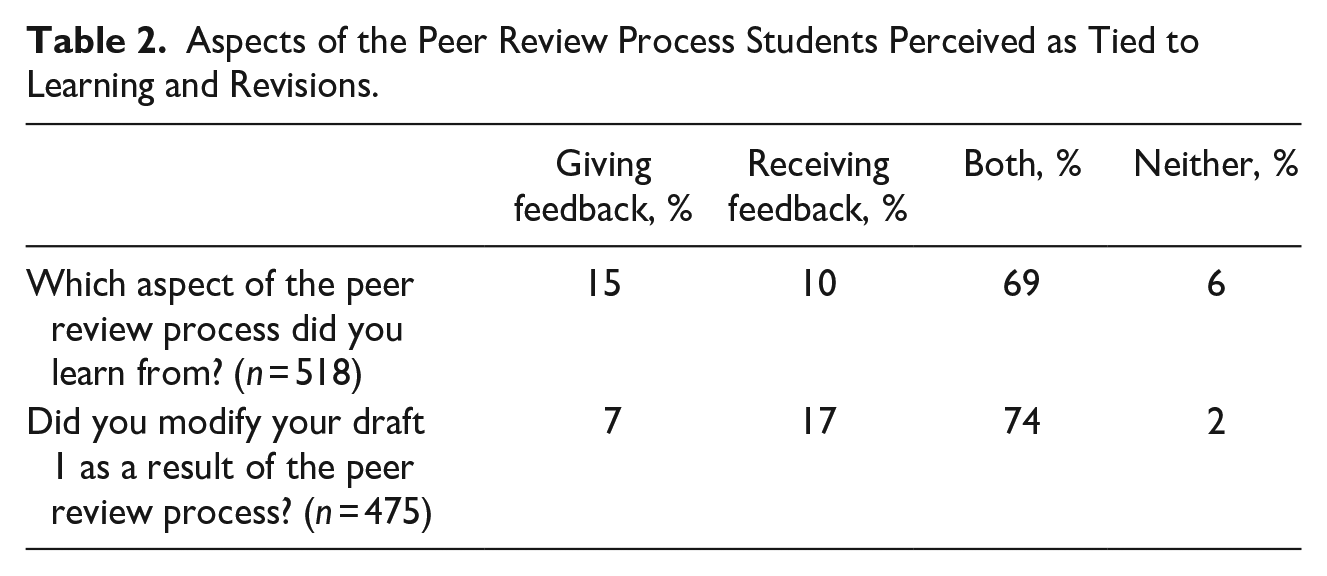
To gain insight into whether and how students perceive benefiting from the peer review process, we asked them to identify which aspect they learned from (i.e., reading peers’ drafts and giving feedback, receiving feedback, or both) and then asked them to provide an example of something they had learned for each aspect they identified. Across the two assignments, 69% of students (n = 360 of 518) identified learning from both receiving and giving feedback, 15% (n = 78 of 518) from giving feedback only, 10% (n = 53 of 518) from receiving feedback only, and 6% (n = 30 of 518) indicated they did not learn from either aspect of the process (Table 2).
Aspects of the Peer Review Process Students Perceived as Tied to Learning and Revisions.
The examples students gave in the open response questions indicate that they perceived similar benefits arising from both aspects of the peer review process. Between two questions, we asked students to give an example of revisions made based on learning from giving feedback and learning from receiving feedback. In responding to these two questions, students described learning about what to include in their drafts, and how to best do so, and the content they were writing about (n = 90 of 260, 35%). In general, students identified gaining a better understanding of what an appropriate balance of information would be for their draft, what details were or were not important to include, and where they needed to add more detail and reasoning to their draft (e.g., chemical properties such as electrophilicity/nucleophilicity and acidity/basicity, describing electron movement, adding explanations related to energetics and transition states, explaining inter- vs. intramolecular). Additionally, they perceived learning about how they could use diagrams and figures more effectively (e.g., comparing reaction coordinate diagrams). Lastly, they reported learning about chemistry content they had described or conceptualized incorrectly (e.g., identifying the rate-determining step of a mechanism).
Students described a few processes leading to these benefits. A common mode they discussed, related to both aspects of peer review, was seeing their peers’ perspectives (e.g., on the chemical processes) and how they responded to the assignment. Students described how gaining the different perspectives and understanding informed how they approached revising their own responses. One student said:
The peer reviews I received filled the holes in my own thought process. Again, I didn’t really think about the resonance effects for why Scheme 3 didn’t work and [two] of my peer reviews pointed that out, so that was something new I learned.
Specific to receiving feedback, students appreciated having an outside perspective on their draft. For example, one student felt an outside perspective helped them see how their response “could potentially be viewed from a grader.” Similarly, some students described how they were able to view their own draft from a different perspective after evaluating those of their peers:
People saw the [rate determing step] as something different from me which made me rethink my thinking and correct myself.
As is exemplified by the above quote, for some students the benefits of giving feedback to their peers was related to the peer review rubric. While taking the role of a reviewer and comparing the mechanistic and energetic descriptions in the draft they read against the rubric, students took note of what aspects of the rubric were not incorporated into their peer’s draft, which would focus them back towards the content learning objectives of the assignment. They could then go back and revise their own drafts to address chemistry content that they realized they had also missed. Other students were able to reflect on their understanding after comparing drafts of their peers as well:
Some of my peers focused more on the reaction coordinate diagram and others more strongly on other aspects of the assignment. Reading through these really helped me develop deeper understandings of the material that I utilized in my report.
From both receiving feedback and reading their peers’ work, students also identified how this exposed them to different approaches for formatting their responses, when and how to use chemical representations to support their written descriptions of a chemical mechanism or energetics, and various levels of detail and terminology (e.g., naming specific atoms and functional groups). Relatedly, some students discussed how receiving feedback helped them identify what should be clarified for the intended audience to understand the content.
A few students also discussed learning about peer review from participating in the process (n = 18 of 260, 7%). For some students, this was developing their ability to provide meaningful feedback. In adopting the role of a reviewer, one student mentioned they learned to “make suggestions instead of critiquing.” Relatedly, students discussed how giving feedback to their peers led them to think about what helpful and constructive feedback looks like (e.g., that providing praise is less valuable than suggesting specific changes that may elicit improvements in future drafts). Students also discussed recognizing the benefits of participating in peer review. Specifically, there were mentions of how peer review fills in the “holes of thought processes” and “gaps in coherency.”
What Types of Revisions Do Students Make on WTL Assignments and How Are These Revisions Informed by the Peer Review Process?
Lastly, we characterized the types of revisions that students described making and how they perceived the peer review process as informing their revisions. We first asked students to identify what aspect(s) of the peer review process informed revisions they made (i.e., reading and giving feedback, receiving feedback, both, or neither). The majority of the students selected that they made revisions informed by both aspects of the peer review process (n = 350 of 475, 74%), with some (n = 81 of 475, 17%) modifying their draft only due to feedback received, and a few (n = 35 of 475, 7%) only due to reading and giving feedback (Table 2). For further insight, an open-ended question asked each student to give an example of a revision they made and identify which aspect of peer review it was informed by. Of the 131 coded responses, 114 stated what aspect of peer review (receiving feedback, giving feedback, or both) lead to their revision. In contrast to the closed-response question, most students attributed their revisions primarily to feedback they received (n = 81 of 114, 62%), followed by both aspects of peer review (n = 23 of 114, 18%), and with the fewest informed only by reading and giving feedback (n = 10 of 114, 7%).
The types of revisions students described making were primarily focused on chemistry content, with some revisions more related to clarity and audience, aligning with the aims of WTL assignments. There was overlap between the types of revisions students discussed informed by the two aspects of the peer review process. However, the specificity of the revisions differed where students made more chemistry-specific revisions as a result of receiving feedback and more holistic revisions focused on overall succinctness of their response because of reading their peers’ drafts. Many of the students who discussed a revision due to both aspects of the peer review process mentioned how the two aspects of peer review worked together. For example, one student said:
I changed my explanations for the mechanisms to be less wordy. This was mainly due to feedback I received, but also seeing how other students wrote those sections helped me better formulate what a good/bad explanation can look like.
Some students described this as seeing a feature in a peer’s draft that led them to consider including it in their own draft, which was reinforced by receiving feedback of a similar nature.
The content-focused revisions that students identified making included expanding on the descriptions of (or comparison between) the reaction mechanisms targeted by the assignment, strengthening or revising their arguments for why a specific mechanism would be more likely to proceed, or adding explanations to terms or concepts (e.g., electrophilic/nucleophilic, rate-determining step). The most common type of revision that students identified was totheir descriptions of the reaction mechanisms targeted by the assignments. For both assignments, these revisions entailed students expanding on their comparisons between two reaction mechanisms, either comparing two mechanisms which differed in terms of whether a base was required to proceed, or comparing two potential mechanisms by which a reaction could proceed. They attributed these types of revisions to both aspects of the peer review process.In some cases, feedback from peers had suggested that they more clearly describe what was happening in each of the mechanisms, and in other cases, the students tried to model the descriptions they saw in their peers’ drafts. Students also made clarity-focused revisions to their descriptions of the reaction mechanisms. These were primarily prompted by feedback they received from their peers, with some students stating that this type of revision resulted from reading their peers’ drafts. One student wrote:
As a result of giving feedback, I decided to include more information in my section comparing scheme 2 and scheme 3. I noticed that others had good descriptions of the one reaction occurring intramolecularly versus intermolecularly and I decided to elaborate on this in my paper because I had the opportunity to peer review their writing.
A small subset of students added figures related to the reaction mechanisms (either electron pushing formalisms or reaction coordinate diagrams), to support the clarity of their explanations of the reaction mechanisms. These were prompted by both aspects of the peer review process. Furthermore, for the aldol WTL assignment, some students revised their claim about which reaction mechanism was more energetically favorable and almost exclusively attributed this change to receiving feedback from their peers. Students primarily added evidence and reasoning about the reaction mechanisms to support their claim within their response. For example:
I added a lot about why mechanisms occur and why the energy levels of transition states were higher than the intermediates which was something that my peers suggested I do.
As in the above exemplar, the majority of students stated that this type of revision was due to feedback they received.
Students also described making smaller-scale revisions. A number of students identified revising to define specific terminology. For example, one student said:
My peer reviewers said that I needed to be more descriptive in my explanations. I added a brief sentence on what resonance was, and what nucleophiles/electrophiles were.
For some students, adding definitions was related to clarity and was motivated by their consideration of the audience given in the assignments. Several students similarly described rephrasing their language, primarily with intentions to improve the “succinctness and clarity” of their mechanism or argument. Several students moved toward using more disciplinary language (e.g., revising “carbon-carbon double bond” to “alkene”) and some were able to revise where they had conflated related, but opposing, terms (e.g., carbanion with carbocation), revisions they mostly attributed to feedback they received. Additional clarity-based revisions included reorganizing the structure of their draft, which often related to their placement of their figures. The least prominent type of revision students described was removing content from their drafts, which was attributed to receiving feedback in all cases and often due to peers indicating that information was unnecessary.
Discussion
To provide further insight into students’ perceptions of peer review and extend the research into a WTL context, we examined how students described their approaches to peer review and revision for chemistry-focused WTL assignments and the benefits they identified from participating in these processes. Furthermore, our findings may provide insight into how peer review can be used in an undergraduate chemistry context to support the type of learning targeted by WTL. Students described constructively participating in the peer review process, both in terms of how they evaluated their peers’ drafts and in how they used the feedback from their peers to inform their revisions. This is an important skill for students pursuing STEM careers to develop as it relates to the key scientific practice of obtaining, evaluating, and communicating information (National Research Council, 2012). Both the evaluation of their peers’ drafts and their own revisions were supported by resources that students identified, namely, comparison between peers’ drafts and the assignment materials. This indicates that the structure of the WTL process (e.g., social interactions and clear writing expectations) functioned as intended to support student engagement in peer review in a chemistry context.
Students described a variety of approaches for how they evaluated their peers’ drafts, where many employed a multistep approach. The students who utilized a multistep approach may more actively engage with the peer feedback process, which could support their revision process (Finkenstaedt-Quinn et al., 2024; Han & Hyland, 2019). Compared to their peers, these students may learn more of the chemistry content targeted by the assignments from participating in the peer review process as they spend more time and cognitive effort during the process of reading their peers’ drafts and providing feedback. Furthermore, students described primarily focusing on content when reviewing their peers’ drafts, which is in alignment with the goals of the assignments. This is similar to a study by Lu et al. (2023), which found that students provided their peers with higher level feedback, compared to surface level feedback seen in prior studies, and hypothesized that this was due to the focus of the assignment. This finding indicates that students are likely thinking critically about the chemical principles and reasoning being targeted by the assignments and that students’ learning from responding to the assignments may be enhanced through their role of reviewer, overall supporting the development of their mechanistic reasoning and representational competence. This conjecture would align with literature in writing studies focused on the benefits of reading and providing feedback to peers (Y. H. Cho & Cho, 2011; K. Cho & MacArthur, 2011; Lundstrom & Baker, 2009). Additionally, the students described revising their mechanistic descriptions, explanations of chemistry concepts, use of representations, and arguments in alignment with existing WTL research in STEM that demonstrates that students can provide constructive, content-focused feedback to their peers tied to revisions (Finkenstaedt-Quinn et al., 2019; Finkenstaedt-Quinn et al., 2020; Halim et al., 2018; Moon, Zotos, et al., 2018).
Students were also reflective about the peer review process itself, specifically considering what good feedback looks like and recognizing the benefits of participating in the process. This is an important aspect of developing feedback literacy (Carless & Boud, 2018). These findings point toward an unintended benefit of incorporating peer review with WTL, namely, that it may help students develop the skill of providing constructive feedback, which could be useful outside of the WTL context for students who experience peer review as part of the scientific practice of communicating research findings. This skill is especially important for science students to develop as they learn how to engage in the genre in which they are writing (Bazerman, 2009). However, it is worth noting that some students may just be learning how to address the rubric in their comments, rather than meaningfully engaging with the process. Irrespective of whether students are only learning how to address the rubric, learning how to craft a response that attends to and addresses the guiding rubric is still a key aspect of feedback literacy (Carless & Boud, 2018). This can include knowing the type of feedback to give and how to craft the text (Chong, 2021). Additionally, in a feedback process guided by content-focused rubric questions, students may still gain exposure to and familiarity with the content targeted by the questions as they search through their peers’ drafts to craft an adequate response, even if they are not engaging in chemical reasoning themselves. This exposure may also lend itself to students’ development of assessment literacy. In other words, if students attend to the terms, concepts, or big ideas highlighted in the rubric questions, then they may consider them to evaluate their own work (Winstone et al., 2017). However, these potential benefits rely, to a certain extent, on students positively engaging in the learning process and metacognitive reflection.
The overwhelming majority of students identified that they both learned from and made revisions informed by both aspects of the peer review process. This adds to the literature indicating that students have positive perceptions of peer review (Huisman et al., 2018; D. Nicol et al., 2014; Strijbos et al., 2010). The positive perceptions indicate that incorporating peer review could be beneficial for reducing student anxiety related to writing in an undergraduate chemistry context (Petterson et al., 2022). Of those students who only found one of the two aspects of peer review to be beneficial, a greater percentage reported only learning from giving feedback compared to receiving feedback, whereas a greater percentage of students reported modifying their draft due to receiving feedback only (Table 2). Furthermore, students primarily provided examples of revisions they made related to peer feedback. This supports prior studies demonstrating that students revise content due to feedback from their peers without feedback from their instructors generally (K. Cho & MacArthur, 2010; Nelson & Schunn, 2009), and in chemistry specifically (Finkenstaedt-Quinn et al., 2019; Finkenstaedt-Quinn et al., 2020; Moon, Zotos, et al., 2018). However, despite potentially learning more from giving feedback, students appear to find it easier to incorporate information gained from receiving feedback. Alternatively, students may not as easily perceive the impact of reading their peers’ drafts on their revisions, as perhaps these impacts are less tangible. This explanation would align with research indicating that reading and providing feedback may be more impactful than receiving feedback in both WTL (Finkenstaedt-Quinn, Polakowski, et al., 2021; Watts et al., 2022) and non-WTL contexts (Y. H. Cho & Cho, 2011; K. Cho & MacArthur, 2011; Lundstrom & Baker, 2009; Wu & Schunn, 2021).
Overall, however, our findings contrast with those from D. Nicol et al. (2014). Comparatively, they found fewer students reported learning from both receiving and giving feedback and giving feedback alone, with a greater percentage of students reporting learning from receiving feedback alone. Comparison between the peer review aspect(s) that led to student revisions shows a similar trend, suggesting that compared with peer review in a learning to write context, students more readily perceive the benefits of reading and providing feedback to peers when completing WTL assignments, and that students may more readily revise based on both aspects of the peer review process when the assignment is focused on content and reasoning. Additionally, the learning objectives of the assignment could have facilitated the benefits students gained from the process, in that the targeted chemistry was well defined and at an appropriate level where students could substantively evaluate their peers’ chemical explanations and arguments as well as use the process to improve their own. As it takes time for students to develop writing competency within specific genres (Bazerman, 2009; Prior, 2006), in STEM courses where students have less exposure to writing in specific genres the opportunity to see their peers’ drafts may be particularly useful.
Students also described using resources (e.g., peer review rubric, comparison across peers’ drafts) to guide both their feedback and revisions. The use of provided resources by students when in the role of reviewer speaks to the importance of including this type of scaffolding to support peer review generally and in chemistry contexts to direct students toward commenting on content. Students also described how the various resources guided reflection on their own draft and informed their revisions. This manifested in two ways: (1) students considered how their draft fulfilled the criteria outlined in the assignment description and rubric questions and (2) students considered how the feedback they gave their peers could apply to their own draft and whether there were ideas from their peers’ drafts that they should incorporate into their own draft. The way the peer review rubric served as a resource to students during both peer review and revision aligns with the WTL assignment design of providing students with clear writing expectations (Finkenstaedt-Quinn, Petterson, et al., 2021) and may serve to reduce the cognitive load they experience when responding to an assignment (Chang, 2016). This is especially important for writing assignments targeting disciplinary content as undergraduates tend to focus their feedback on lower-order concerns (Johnson et al., 2017). However, it is worth noting that students may be engaging in the act of parroting back what the rubric says. Peers’ drafts serving as a resource aligns with prior research indicating the benefit of reviewing (Y. H. Cho & Cho, 2011; K. Cho & MacArthur, 2011; Lundstrom & Baker, 2009). Furthermore, the reflective processes students engaged in are similar to those seen by D. Nicol et al. (2014) and demonstrate this may be a benefit of incorporating peer review processes irrespective of assignment type and that peer review could be used more broadly in undergraduate chemistry courses. Furthermore, the importance of the students reflecting on their own chemistry content knowledge during peer review is supported by Kaufman and Schunn (2011) who found that students who were reflective about peer review tended to revise more. Thus, the ways students used the written documents as resources demonstrate how the act of providing feedback can support students’ revisions in contexts such as undergraduate chemistry courses through reflective processes.
Implications
The findings from our study provide further support for incorporating peer review processes into writing assignments broadly, and into WTL specifically. Furthermore, they demonstrate the utility of peer review for supporting writing in undergraduate chemistry courses. Students’ experiences with peer review were primarily positive, which is promising for how students will receive assignments that incorporate peer review in contexts such as undergraduate chemistry courses. In conjunction, the approaches students described demonstrate how participating in peer review can enhance the benefits of WTL assignments focused on STEM content as students described better understanding the targeted course content, engaging in disciplinary thinking, and developing skill with important scientific practices. Our findings also indicate that the assignment prompt and peer review rubric play an important role in guiding how students approached providing feedback to their peers, as well as informed their revisions, similar to how rubrics are thought to support writing in general (Chang, 2016). For example, the assignment prompts and peer review rubrics for the assignments studied herein successfully directed students to consider their peers’ mechanistic reasoning and chemical explanations. Thus, instructors should carefully consider when and how to incorporate peer review. Specifically, instructors should carefully consider how they present peer review to students (i.e., as an opportunity for learning from their peers) and that the resources they provide students align with and support the learning goals for the assignments (Anderson et al., 2016; Andrade, 2005). Instructors should also encourage students to use the variety of resources available to them through peer review to reflect on how they could improve on their own draft.
Further research is merited on whether students perceive different benefits of peer review or go through peer review differently depending on the learning objectives and structure of the assignment. For example, research focused on the impact of assignment characteristics on how students approach peer review and revision may indicate how to best scaffold peer review to support student learning and revision. Similarly, research directly comparing how students approach peer review for learning to write vs. WTL assignments could provide insight into whether incorporating peer review into certain types of assignments (e.g., WTL) could serve as a gateway for enhancing students’ abilities to constructively engage with peer review and further the development of scientific practices of evaluating and communicating information. Similarly, examining student approaches to peer review for assignments with different types of learning objectives (e.g., higher order chemical reasoning vs. conceptual knowledge) across disciplines would indicate the types of assignments where incorporating peer review is most beneficial.
Footnotes
Appendix
Acknowledgements
We would like to thank the students who agreed to participate in the study and Rebecca Fantone for feedback on the manuscript. We would like to acknowledge the University of Michigan Rackham Merit Fellowship and the National Science Foundation under Grant No. 2121123 for funding.
Declaration of Conflicting Interests
The authors declared no potential conflicts of interest with respect to the research, authorship, and/or publication of this article.
Funding
The authors disclosed receipt of the following financial support for the research, authorship, and/or publication of this article: We would like to acknowledge the University of Michigan Rackham Merit Fellowship and the National Science Foundation under Grant No. 2121123 for funding.
