




Abstract
Empirical studies have found that participation in international service increases learners’ intercultural competence, language skills, appreciation of cultural differences, and tolerance for ambiguity. While previous studies suggest that international service experience is potentially transformative in nature, the present study examined international service experience and explored the factors that encourage transformation. Based on transformative learning and social psychology, the theoretical framework of the present study included three perspectives: environment–person interaction, schema adjustment, and the Johari Window. Data were obtained from 10 international service participants by observation, semistructured interviews, and written documents. Analysis of the data identified three components that enhanced transformation through environment–person interaction in cross-cultural settings: exploring the unknown world, relearning from the basic levels, and the unknown self revealed.
Keywords
In the field of education, community service has been suggested as an active means to enhance participants’ learning (Astin, Vogelgesang, Ikeda, & Yee, 2000; Berry & Chisholm, 1999; Crabtree, 1998; Shumer & Duckenfield, 2004). Such endeavors have been extended to international arenas. In an international society, many challenges, such as humanitarian aid, disaster relief, medical assistance, literacy, and education development, rely on global collaboration between nations. Such needs for global collaboration create a new frontier for involvement in international development. Some choose to participate in international work with the hope of contributing their time and knowledge to a local community, whereas some use such opportunities to gain overseas experience for their future careers. Regardless of the purposes, the transformative experiences in international work have received increasing attention.
In the literature, empirical studies have reported that participation in international work increases learners’ intercultural competence, language skills, appreciation of cultural differences, tolerance for ambiguity, and experiential understanding of complex global problems (Crabtree, 1998; Kiely, 2002; Porter & Monard, 2001). Studies have described the effects of international service learning on students as “transformative.” For example, Grusky (2000) stated that international service learning can fulfill its potential as a “transformational learning experience for students informing subsequent study and career choices”(p. 858). Hartman and Rola (2000) contend that as a result of their international service learning experience, “students are transformed as individuals” (p. 21). Thus, it is often suggested that international service learning programs are potentially transformative in nature (Berry & Chisholm, 1999; Grusky, 2000; Hartman & Rola, 2000; Kadel, 2002; Kiely, 2004; Roberts, 2003; Sternberger, Ford, & Hale, 2005).
However, these results raised the critical question of why international service is likely to produce transformative outcomes. Some researchers have suggested that involvement in a cross-cultural process catalyzes personal change. Although this explanation recognizes the difference between domestic and international settings, it does not clearly explain why cross-cultural service enhances participant transformation. Therefore, the transformative process that occurs in cross-cultural settings remains an unopened box, containing an unsolved mystery. Recognizing this knowledge gap, Miller and Gonzalez (2009) called for more research on the transformative process:
While it appears the international service-learning experience may have been more powerful in terms of personal/professional growth and questioning of previously held assumptions, further examination is needed to more thoroughly explore the potentially transformative nature of international field-based experiences. (p. 5)
In the literature, many studies have addressed the learning outcomes of international service (e.g., personal growth, different career choices, and a new perspective on life), whereas the present study focused on the cognitive processes that are responsible for these changes. Mezirow (2009) defined transformative learning as learning that transforms frames of reference and further explained that “a frame of reference is a predisposition with cognitive, affective, and conative (striving) dimensions” (p. 22). Understanding the cognitive aspect of the transformation process is important for adult educators and learning facilitators. It informs us as to how experiences, the core learning resource for adults, are processed in the mental sphere and how they urge perspective change.
In different fields, researchers use various terms to describe the factors that are responsible for change. For example, in adult learning, researchers use the term triggers to describe such factors, whereas in cross-cultural studies, the concept of “cultural shock” is usually viewed as the initiator of learning (Lyon, 2002). International work involves cross-cultural experience, which typically causes the participant to experience cultural shock. Subsequently, cultural shock often triggers learning that leads to the development of new viewpoints. However, the discussion regarding the mental process between triggers (input) and change (outcome) is limited. A closer examination of both cognitive and psychological processes would help with the understanding of how people respond to various new stimuli as they accomplish the purpose of their mission and obtain personal growth in another culture. Mezirow (2009) addressed the relationship between transformative learning and psychology. He wrote, “Through a dialogue between the conscious and unconscious, mediated through symbols and images, learners gain insight into aspects of themselves that are outside conscious awareness but influence their sense of self, as well as their interpretations and action” (p. 25). As Eisner (1985) stated, “Our internal life is shaped by the forms we are able to experience,” and “the experience is influenced by our past as it interacts with our present” (pp. 25-26). This study discussed learning by examining the interaction between an individual’s past and present experiences. Through a lens of transformative learning, the present study explored the triggers in cross-cultural settings, and, more important, how these triggers influence the individual and bring about a sense of transformation.
To accomplish this research goal, the concept of environment–person interaction was used as the theoretical foundation, in which both the schema theory (Piaget, 1975) and the Johari Window (Luft, 1969) were used to examine participants’ cross-cultural experiences. The present study collected and analyzed interview data from 10 Taiwanese international volunteers who went abroad to provide educational and medical assistance to local children or adolescents. Using the experience of the volunteers, this study examined the cognitive processes behind the transformative outcomes that occurred during international service.
Theoretical Framework
This section reviews international service and cross-cultural learning from three theoretical perspectives: environment–person interaction, schema adjustment in cross-cultural settings, and the known and unknown areas in the Johari Window.
Environment–Person Interaction
International service involves cross-cultural learning and adjustment. Compared with those who participate in domestic service learning, volunteers who provide international service often face more dramatic cultural differences in both their physical and psychical surroundings. In the existing educational literature, the impact of international service on various aspects of participant learning, including interpersonal, personal, and professional development, has been extensively documented (Astin et al., 2000; Eyler, Giles, Stenson, & Gray, 2001).
In the early 1900s, the social psychologist Lewin (1936) suggested that people’s behaviors are strongly influenced by the interaction between a person and their environment. A person’s interaction with their environment is a dynamic process in which individual and environment influence one another. An environment shapes a person’s mind-set and his or her cognitive framework; on the other hand, a person’s needs, goals, values, interests, and preferences affects how he or she interprets and responds to his or her environment (Neufeld et al., 2006). For individual development, a mismatch between a person and his or her environment provides a better opportunity for continual growth than a perfect person–environment match (Creamer & Associates, 1990). A certain degree of mismatch and incongruence presents challenges that encourage an individual to learn new skills and cope with disequilibrium.
Environment–person interaction theory provides a foundation for transformative learning (Mezirow, 1990, 1997) in which the disequilibrium or disorienting dilemmas that occur during an individual’s life sometimes serve as an important trigger for significant growth (Brock, 2010; Hussey, 2009; Locklin, 2010; Mezirow, 2009). Paige, Cohen, Kappler, Chi, and Lassegard (2006) identified 10 factors that made an intercultural experience more or less intense for participants. The factors included cultural differences, ethnocentrism, language, cultural immersion, cultural isolation, prior intercultural experience, expectations, visibility and invisibility, status, as well as power and control in intercultural situations. Taylor (1994) used transformative learning theory as a framework to examine the intercultural competence of people with expatriate experience. English (2002) discussed informal and incidental learning in the lives of 13 female workers in international adult education. Based on qualitative research with 13 women doing international adult education, English (2005) reported that these practitioners learned actively, which was reinforced by experience and critical reflection. During the learning process, cultural disequilibrium was an important trigger that encouraged change. By combining the concepts of cultural disequilibrium and cultural shock, Lyon (2002) used the term cultural trigger to describe the primary mismatch between an individual and his or her host culture. These cultural triggers or shocks were proven to influence expatriate workers’ cross-cultural learning at the peripheral, cognitive, and reflective levels (Chang, 2007). In the present study, environment–person interaction theory was used as a primary framework for analysis. Then, the following two perspectives, schema adjustment and Johari Window, which share a conceptual foundation similar to that of environment–person interaction, were also used to help build the theoretical framework for the present study.
Schema Adjustment in Cross-Cultural Settings
Heeding the dynamic between environment and person, researchers suggest that although the new stimuli from a different culture cause disequilibrium, new experiences also encourage schema extension (Bartlett, 1932; Bird, Osland, Mendenhall, & Schneider, 1999; Molinsky, 2007; Taylor & Crocker, 1981). According to Piaget (1975), human development and environment cannot be separated. He suggested that the cognitive conflict between an existing schema and new information serves as a starting point for schema adjustment. Schemas develop by the accumulation of life experiences. The knowledge of appropriate behaviors is stored in the schema and saved for application to similar situations. Therefore, the more experience people have regarding a specific situation, the more established their schema is for that particular situation, which allows them to more effectively and appropriately respond to a given situation (Beamer & Varner, 2003).
This process also occurs in cross-cultural settings. Although a schema helps people respond more quickly and easily to stimuli in a familiar context, it often causes unexpected shocks, obstacles, or even severe conflicts when people apply their existing schemas to different cultural contexts (Chang, 2009). In other words, these taken-for-granted frameworks often cause dilemmas in cross-cultural settings, particularly when they involve invisible and intangible values (Chaney & Martin, 2007; Jandt, 2004). To adapt to a new environment, people are required to adjust their schemas (Piaget, 1975). As Mezirow (2000) suggested, learning occurs in one of four ways: elaborating existing frames of reference, learning new frames of reference, transforming points of view (meaning schemes), and transforming habits of mind (meaning perspectives).
During international encounters, Beamer and Varner (2003) suggest that when people interact with a new culture, they create a projection regarding the target culture based on the information they collect and on their cultural framework. The projection serves as an initial stereotype (primary schema), but it inevitably varies from the true nature of the culture. The primary schema is gradually modified and moves closer to reality through more interaction with the new culture. For example, an expatriate worker’s experience in Tibet demonstrated such an adjustment. The worker was responsible for hygiene education, and he consistently told local people that appropriate habits could protect their lives. However, such a rationale received little attention. Later, the frustrated expatriate worker consulted with a local master and found that because of local people’s concept of reincarnation, Tibetans did not worry much about their own lives. The local master suggested that he remind the villagers that good hygiene habits could keep them healthy to promote and spread Buddhism. Such an adjustment received better results for hygiene education (Chang, 2009). As the difference between the projection and reality of a culture shrinks, outsiders have a greater capacity to correctly interpret the meanings behind the behavior of local people.
Known and Unknown in the Johari Window
The present study examined the cross-cultural experiences of international service participants through a psychological perspective. To help understand a person’s inner world, the Johari Window (Luft, 1969) was used for analysis. The Johari Window is a cognitive psychological tool that was created by Joseph Luft and Harry Ingham in 1955. The Johari Window, which also involves person–environment interaction, includes four quadrants that represent the self that is known and unknown to an individual and the self that is known and unknown to others (Figure 1). The first quadrant refers to an inner area that both we and others know (open or free area). The second quadrant is the part that others see but that we are not aware of (blind area). The third quadrant is a private space, which we know but keep from others (hidden/avoided area). The fourth is a mysterious space in that neither we nor others are aware of certain behaviors or motives (unknown area).
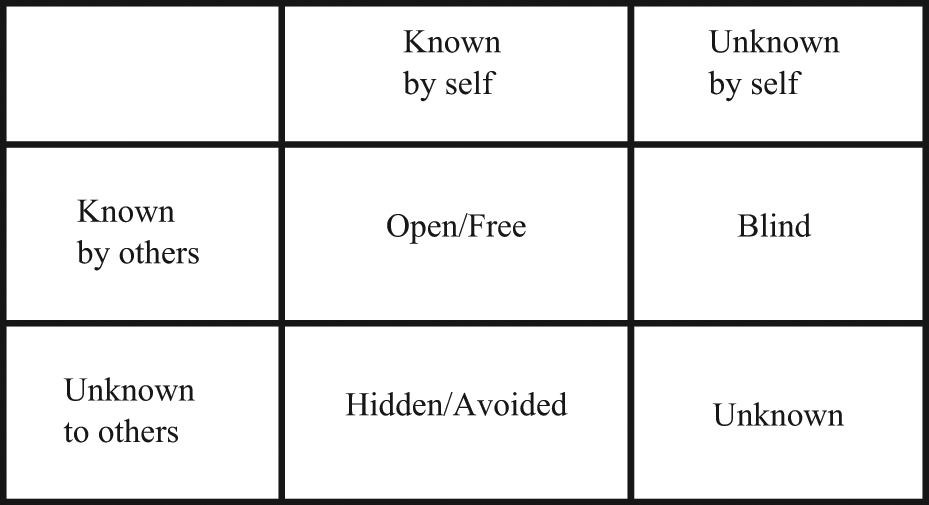
The Johari Window
The Johari Window has been used to study intercultural interactions. For example, in international business, Schneider and Barsoux (2003) and Nardi (2006) used the window to understand the process of negotiation. They suggested that because understanding existing cultural differences is important in international negotiations, the Johari Window provides a way to understand how an individual sees his or her own culture and how others see the culture. Such an understanding helps improve interactions during negotiation. In addition, Chaney and Martin (2007) pointed out that people in various cultures differ in how much they are accustomed to sharing their inner self with others. In some cultures (e.g., the United States), people are more comfortable expressing their opinions and feelings, whereas in other cultures (e.g., Japan), people are more conservative regarding sharing their personal feelings in public. Chaney and Martin wrote that “US citizens readily express their opinions and reveal their attitudes and feelings to a larger extent than do persons from the Asian cultures” (p. 87). In contrast, “The Japanese offer fewer opinions and feelings and have fewer physical contacts” (p. 88). When people from these two types of cultures interact, misunderstandings might occur. Moreover, Pedersen (2010) presented an empirical study regarding a year-long study abroad program, in which the Johari Window was used as a tool for intercultural learning and self-exploration. In this study, the Johari Window was employed to analyze a person’s inner change, particularly between known and unknown.
Research Method
The present study used a qualitative approach and applied the method of significant event review. Brookfield (1990) noted that a structured and deliberate review of a significant event is a useful way to encourage reflection. This method is similar to critical event analysis, which has been widely used in medical education and professional development (Bowie, Pope, & Lough, 2008; Mckay, Shepherd, Bowie, & Lough, 2008). Through a review of the significant events experienced by the participants, the process encourages them to describe what happened, how they made sense of the incident, and what they learned from the significant experience. This review process invites participants to discover gaps in their understanding or capabilities, which may help them adopt a different perspective.
Sampling Strategies and Criteria
We began searching for a sample through the public documents posted by the Taiwan Ministry of Foreign Affairs. The document provided a list of organizations that involved international service or recruitment of Taiwanese volunteers for international missions. We contacted the organizations and received positive feedback from five. All the leaders in the five organizations agreed to help identify appropriate candidates. In addition, two of them further approved our participation in their activities related to international service.
During the sampling and data collection period, the researchers of the present study also participated in conferences, predeparture training, and cultural workshops for international service. The participation and observation provided the researchers with opportunities to gain background knowledge and greater understanding of the context of the volunteers’ work. Such an understanding contributed to the sample criteria determination and to the interview question design.
This study used two criteria for participant selection. First, the participants had to have experience as an international service volunteer that led to personal change. Second, the participants had to have at least six months of international service experience. Six months was selected as the minimum duration based on two considerations. First, the length of international volunteer service varied from 1 month to 2 years. Using 6 months as the criterion provided this study with the flexibility to enlist research participants. Second, the reaction to exposure to a new culture often follows a U-shaped (Lysgaard, 1955) or J-shaped curve (Ward, Okura, Kennedy, & Kojima, 1998). People who move into another culture often go through significant changes initially, such as excitement similar to that of a honeymoon or frustrated shock. However, after a few months, people begin to settle down and adjust to the local environment. Based on these considerations, the present study selected volunteers with at least 6 months of international service experience.
Through assistance from the organizations and from the list of primary names they provided, we began to identify potential interviewees. In addition, participation in relevant activities, networking, and a snowball recruitment strategy (Mertens, 2005) also were used to extend the number of research participants for the present study.
Research Participants
This study enlisted 10 Taiwanese international service volunteers. The participants included five females and five males who had gone to Panama, Belgium, England, Iceland, Thailand, Germany, or Brazil for international service. Their work involved adolescent counseling, health care assistance, computer instruction, and teaching English. The participants ranged in age from 24 to 35 years with various backgrounds, such as law, sociology, foreign languages, computer science, translation and interpretation. The international volunteer service experience of the 10 participants was as follows: six had 1 year of experience; three had 2 to 6 years of experience; and the remaining participant had 8 months of experience.
Data Collection and Analysis
This study used three data collection methods: semistructured interviews, participatory observation, and document review. The interviews were conducted with the help of a tape recorder with participants’ agreement. Significant event review or critical incident analysis was used to explore the schema of the participants’ cross-cultural experiences and the meaning of those experiences. The significant event could be both positive, that is, an event that produced enlightenment, and negative, that is, an event that caused anxiety or distress (Hogard, 2007). The interviewees were invited to recall special events, memorable incidents, and impressive stories that occurred during their service, as long as these experiences had personal significance to the participants (Bowie et al., 2008). In addition to the interviews, participatory observation was also conducted. The authors participated in related conferences and activities in Taiwan, collecting relevant materials and documents, such as brochures, training materials, and service reports. In addition, one author also joined a 1-week volunteer trip to a small village in Chiang Rai in Northern Thailand. The researcher helped teach Chinese and assist in agricultural work for local people. Although the participation time was constrained, during data analysis, the experience helped deepen the research team’s understanding of the service process and helped us choose categories that were closer to reality.
For analysis, we first transcribed the interviews and followed the techniques for coding, categorizing, and comparison, suggested by Strauss and Corbin (1998). We broke the transcription into small pieces, assigned codes, grouped similar concepts into categories, and identified themes that emerged from the empirical data. Since environment–person interaction theory, schema theory, and the Johari Window were used as framework for this study, the data and theoretical framework were compared throughout the analysis.
Research Findings
In the present study, learning and change were mentioned in each participant’s recounting of his or her international service experience. Different stimuli from new environments served as the triggers that led participants to recognize and reexamine their existing perspectives and mental frameworks. Although the triggers varied among individuals, they often challenged the participants’ cognitive framework (schema), which made the learning more fundamental. In the present study, the triggers for change were categorized into three major themes:
Explore the unknown world
contrasting experience reality beyond the existing schema
Start from zero
Unknown self revealed
Explore the Unknown World
In the present study, most of the interviewees decided to participate in international service because they wanted to explore the world and experience a new culture. One interviewee said, “Through international volunteer service, we could serve people and know the world.” Lin said, “I want to become more independent.” “I want to do something memorable, for example, to see the polar lights, or to go to someplace totally different” (Wu). Ben said, “I want to provide myself with different experiences and opportunities by seeing a different life, environment, and people, because when you are in Taiwan, there are many things that you cannot experience.” Ben’s last statement, “many things that you cannot experience,” expressed his anxiety regarding the routine in his life. According to environment–person learning theory, an individual’s experiences are based on his or her interactions with his or her environment. When the environment is stable and routine, then an individual’s schema and experiences are generally stable. Because of discontent with the routine and a desire to learn more about the world, these international service participants moved out of their homeland, stepped into another culture, and faced new challenges. The significant incidents that they described included both contrasting experience and reality beyond the existing schema. These experiences served as cultural triggers for additional learning.
Contrasting experience
The first trigger consisted of the contrast between the existing schema and the conditions that differed essentially from those of the home county. This contrast was reported from the peripheral perspective (e.g., food, weather) to the more invisible perspective (e.g., values, life philosophy). At the peripheral level, participants mentioned that the local way of cooking made familiar foods very unfamiliar. Furthermore, natural phenomena, such as the very cold weather, the polar day (24 hours of sunlight), and polar night (24 hours of darkness), different ways of doing family chores, two cold meals a day (in contrast with hot meals in Taiwan), mixed-race communities all demonstrated the different facets of the world to these cultural newcomers.
At a deeper level, the profound contrast regarding living conditions between the local area and Taiwan influenced the participants’ values and assumptions. For example, some international service participants reported that local poverty, scarce medical resources, or lack of access to education caused them to critically review their life back in their homeland and suddenly realize that these resources (sufficient food, computer equipment, education opportunities) had been greatly taken for granted at home. One participant, Hao, shared an incident in which a local child stole his watch and sold it for a little money. He recounted the situation:
The watch was actually worth several thousand dollars, but they sold it just for one dollar as long as they could get the money. I really felt lucky to live in Taiwan . . . how could the gap (in finance) be so huge? I felt sad because I realized that there were so many things we could do.
In a similar manner, when exposed to people who were deeply constrained by their limited finances or their lack of opportunity to change their environment or pursue their dreams, another volunteer said, “I felt I was lucky.” Such exposure to social contradictions aroused critical consciousness (Gay & Kirkland, 2003). After observing these essential contrasts, some participants (Yu, Fan, Hao, An) developed a deeper understanding of the significant imbalance between poverty and wealth and pointed out that they became thriftier and cherished the resources and opportunities they received in Taiwan. As Yu said, “What I learned from them was more than I provided.”
Contrast also occurred regarding the pace of life. An interviewee, Jia, who volunteered in Panama said, “In contrast to people here, people in Taiwan worry about too many things including social status, fame, benefit, etc., which makes life quite stressful.” From her perspective, the local people were more relaxed and never pressed for time. “I am not as nervous as before and I am happier after having learned the attitude here,” she said. Contrast was also identified in communication, where an interviewee working in England found it difficult to directly say “No” even though she was very tired and hoped to stop working. She said, “People from the East may feel embarrassed to reject others’ requests. Even though you are very tired, you still say you can do it.” In addition, when observing the more autonomous education climate in England, Ben felt his past experience in the cram school in Taiwan was ridiculous. Regardless of right or wrong, these contrasting experiences made participants ponder and examine their way of life. It reflects Kegan’s (1994) viewpoint that contradictions were inevitable at the heart of the dialectical process.
Reality beyond the existing schema
In other situations, what participants encountered was more than a contrast with their past experience, but a scenario completely beyond their existing framework, which called for a creation of a new category or solution in their schema.
For example, a female volunteer, Fan, recalled that, although she had suffered a serious attack from mosquitoes, what really shocked her was a bat falling from the ceiling. Another volunteer learned to plant his own vegetables because of the limited supply in the local area. In addition, several participants (Ben, Penny, Wu) shared their shock and distress when they experienced discrimination or were called “yellow monkey” in the host country.
Another volunteer, Hao, shared an unexpected difficulty encountered when establishing a computer classroom for the local community. When the plan started, he thought that, through government assistance, the task would be accomplished easily. However, he later found out that the time required to obtain government approval would be longer than his stay in the country, which forced him to search for other alternatives.
During this study, one of the authors also experienced an incident beyond his expectations when he participated in volunteer work in Thailand. He described the situation thus:
One night, in the countryside, I led several children to the venue for activities. It was dark, so I used the flashlight which I took from Taiwan. While walking, I planned to give this flashlight to the children after tonight’s activity. I thought, as they never had seen such device in their life, they must be very happy about this gift. However, when I planned to do so, a child looked at me and asked, “Why do you need that (flashlight)? Do you have vision problems?”
Although the Taiwanese researcher planned to provide this small gift to local children out of sympathy, they viewed the flashlight as unnecessary if one’s eyes functioned well. The perspective of the local children was unexpected, and the researcher was reminded that there are perspectives besides his own. As volunteer Ben stated, “The gap between the expectation and reality was very huge . . . I really would not realize (the gap) if I did not come.”
When international volunteers were faced with something beyond their existing mental framework, they were often stunned and needed some time to make sense of the situation. A few decades ago, Lewin (1958) suggested that the process of change often began at the stage of unfreezing. For international service participants, these contrasting and out-of-framework episodes, either significant or trivial, mirrored their own views (e.g., lifestyle, values) and served as sparks that gradually began to unfreeze participants’ long-established framework of the world.
Start From Zero
In addition to the new stimuli in the unknown world that were experienced as a result of moving into a new culture, all the interviewees mentioned the need to learn new things from scratch. “You started over from zero,” an interviewee said, “you learned everything from the beginning, including language, interpersonal network, as well as how to live (e.g., taking bus, making phone call) and work.” For example, a very fundamental challenge for these volunteers was the language barrier. Because of her limited language ability, Lin (service in Netherlands) said, “I was mute in the first two months. . . . It was very difficult.”
In addition to the language barrier, another challenge the volunteers faced was a significant shrinking in their interpersonal network. One interviewee, Ben, said, “Basically, you were disconnected with all people in Taiwan. Although you still contacted them with e-mail, they were not in your daily life. You were all disconnected.” Although their connections with people in their homeland were reduced, new networks were not yet established in the new environment. Wu said, “The most rough feeling was loneliness . . . sometimes I spoke less than one sentence in the whole day . . . you did not know whom to chat with.”
With a considerable shrinking in the breadth and depth of external interpersonal connections, the volunteers relied on themselves in many situations. For example, when the interviewee Hao found limited assistance from the government to establish a computer room, he figured out other ways to find secondhand computers, arranging shipping, and handling the tax issue in Panama. Because he did not have any past models for reference on how to accomplish his task, he had to learn the basics at every step. He recounted the experience as follows: “Think. You need to think. When you meet difficulties, you just think whether there are solutions. This brought significant growth for international volunteers. If you see no way, you need to find a way.”
Similarly, volunteer Lin said, “You need to plan and handle all things by yourself.” Another interviewee stated, “Brave, you really needed to be brave, and then face it with your whole heart.” He elaborated, “When facing with difficulties, the solution was to observe. Observe the environment, observe people, and observe yourself, and then you begin to think the best solution. You are forced to be brave, to observe, and to think.”
It seemed clear that, while their connection with the external world decreased, individuals’ attention to their inner world increased significantly. Ben said,
You are only with yourself. You would not enter your own world unless you were alone. When I was in Taiwan, I was busy with friends and family. I was in a group most of time and rarely spent time in myself.
When participants’ usual connection with others suddenly decreased, they began to pay much more attention to themselves, such that their values and thoughts were reorganized. In addition, some of their characteristics were further explored and revealed.
Unknown Self Revealed
During the international service process, the volunteers began to learn not only about their new environment but also new things about themselves. When they interacted with the new environment, new challenges increased, but their usual support system was not available. Consequently, there was a strong motivation for introspection from a deeper and closer perspective. Through this process, many of the international service participants experienced a redefinition of their “self.” The findings included both negative aspects (e.g., temper, selfish, discrimination to different races), as well as positive characteristics (e.g., persistence, courage, and flexibility). The participants found themselves demonstrating these characteristics to a greater extent than before. For example, several participants were surprised when they learned that they would discriminate against people from different races, which was a trait they had not recognized while living in Taiwan. One interviewee said, “I thought I did not have discrimination.” However, after he arrived in Middle America, working with people of color, he found the following to be true:
[In Taiwan] we tended to pursue “white” in skin color and were inclined to white people’s thinking style . . . I thought we did not have discrimination . . . However, unconsciously, we discriminated. After being here and working with people of color for a period of time, I felt people were all the same . . . I gradually learned to break colors’ limitation [stereotype] and saw their nature inside.
A similar situation occurred for other interviewees (e.g., An, Gee, Yu, and Wu) who encountered people of different skin colors. As interviewee Wu realized that “in Taiwan, we did not treat those foreign laborers well. You ran away when you saw them.” The volunteers recognized their hidden discrimination, and then learned to remove it and accept diversity gradually.
In cross-cultural settings, new stimuli caused the volunteers to experience reactions that might never have occurred in their home environment. While the participants handled these new challenges in all aspects of their lives, they learned something new about themselves through their responses. Similarly, interviewee Ben described a situation where as they consistently faced new problems, they needed to “return” to themselves, and it was a process to “re-realize yourself.” He recounted the situation as follows:
You would begin to think. For example, when you made a decision, what was your reason? Then you realized that the real reason why you did not talk to someone was your fear. You did not ask people to do something because you felt embarrassed . . . Through this process, you understood who you were. Through this process, it was easier to know yourself.
Almost all interviewees indicated that they learned something about themselves because of their experience. As Fan said, “It is like that you found yourself in a different place.”
The participants’ understanding of the inner unknown area also influenced their relations with others. When they found themselves more tolerant, independent, sensitive, flexible, confident, their attitude toward their family, friends, Taiwan, and the world also changed (Ben, Fan, Lin, Penny, Lin, Wu, Yu). While new facets of themselves were recognized, the volunteers often sensed that their worldview was extended, and a broader perspective was obtained. From personal to interpersonal, from individual to society, their attitudes and behaviors often changed. An interviewee recounted the situation as follows:
(Before), I complained a lot . . . Now you would think they probably need care and encouragement. This is an issue of perspective. Your thinking changed . . . Before I thought only of myself most of time, always thought about what I want. Now I would think about what I could do for this society, this family, and these friends.
Another volunteer, Hao, also extended his service for children in Panama. After coming back to Taiwan, he recruited and trained young volunteers to continue in child education in Panama and financially supported these volunteers’ expenses for traveling abroad. In the past 6 years, he had spent more than US$30,000 to continue this international service. Such a connection between individual change and action for the society reflects Daloz’s (2000) viewpoint that when people can identify a sense of self with the well-being of other lives, their sense of social responsibility was enhanced.
Summary of the Findings
For many decades, psychologists and educators have realized that people learn as a result of interacting with their environment. Previous studies have also suggested that international service often brings personal transformation (Grusky, 2000; Hartman & Rola, 2000; Kadel, 2002; Kiely, 2004). Based on previous research, the present study extends the existing understanding of international service and learning by further exploring the triggers and the mental processes that encourage individual transformation.
As shown in Figure 2, individual transformation occurred through person–environment interaction. During this interaction, three components that encourage transformation were identified. The first component was the participants’ intent to explore the unknown world, during which they often faced experiences or situations beyond their existing cognitive frameworks. These unexpected stimuli called for adjustment in their long-established schemas. Second, to live in a new and unfamiliar environment, the participants were required to start over from zero to relearn basic life skills and were disconnected from many of their original networks. Although such disconnection brought them loneliness, it also provided the volunteers with an opportunity to more closely study themselves and reorganize their perspectives and values. Third, by exploring the unknown world, international participants experienced self-exploration and self-revelation. The action of exploring the unknown outside world initiated the process of exploring their unknown self, which demonstrated the intertwined relationship between an individual and his or her environment.

Environment–person interaction and exploration
Discussion
In the adult learning literature, disorienting dilemmas are viewed as the events that trigger transformative learning, where the dilemma is defined as an incident or experience that disturbs the individual’s current view of reality (Mezirow, 2000; Lyon, 2002). King (2004) used 14 college students as a sample and found that international service learning could enhance students’ critical reflection. Blunt (2007) indicated that “the student is consciously or unconsciously seeking something that is absent from his or her life. The transformative process is then catalyzed upon fulfilling this void” (p. 97). The findings of the present study enriched the understanding of such a process through the cognitive perspective of schema theory and helped explain why dilemmas facilitate critical reflection and transformation. In the present study, the significant cross-cultural challenges mentioned by the international service participants were incidents that dramatically differed from their past experience or were beyond their existing framework. These contrasts or conflicts demanded the participants’ attention, caused the individual to stop and ponder, and often raised a new internal mental dialogue to reconcile the new reality with their past experience (Chang, 2009).
According to Kim (2005), when faced with the challenges of cross-cultural adaptation, individuals need to manage the competition between two forces—the mother culture and the new culture. Such turbulence causes people to search for a new balance between the internal and external environments. Through this type of pull-and-push process, the contrasting and beyond-framework factors caused by cultural shock extends the existing cognitive schema. As the adjusted schema move closer to the reality of the target culture, people feel more adapted because they have had more opportunities to appropriately respond to the local cues (Beamer & Varner, 2003). When the adjusted schema is extended, people feel that their perspective is enlarged, which allows them to examine issues from different perspectives. In the present study, these types of changes provided the participants with a sense of self-growth and transformation.
Unknown Self Explored and Revealed
Another important trigger for transformation identified in the present study was self-revelation. When international service participants stepped out of their country, their connection with their original interpersonal network decreased, whereas their new network in the local area was not yet established. While they received more and greater challenges in the new cross-cultural environment, they also faced a significant reduction in their external connections. This created an interpersonal vacuum, which caused individuals to become more self-reliant and to engage in mental dialogue with themselves. Although the interviewees reported feeling lonely sometimes, they all reported that they understood themselves much more than before.
Based on the Johari Window, Luft (1961) suggested several strategies to explore the unknown area, such as intentionally doing things that one has not done before, using untapped skills, talents, and resources, exploring one’s dreams, paying attention to what stimulates the individual, and unnumbing one’s self. Research participants’ motivation and actions in international service corresponded with these strategies and brought them a broad understanding in their mystery area (Herold & Akhtar, 2008; Lundahl, 2009). By responding to various new life stimuli, they observed parts of themselves that they had not known before. This recognition extended the participants’ understanding of themselves and made them feel more confident.
In daily life, people do not easily recognize the unconscious inner self. As Mezirow (2009) wrote, “We do not normally have conscious access to these nonconscious processes by which our impressions of others are formed, only their results” (p. 22). However, people’s struggles and interactions with their new environment (unknown outside) often catalyze an exploration to their unknown inside. In this article, the term exploring unknown described such a process. Although the participants could not predict transformative outcomes, through exploring the outside unknown world, they initiated a process to explore the unknown inside. As Elias (1997) stated, “Transformative learning is the expansion of consciousness” (p. 12), and it is “facilitated through consciously directed processes such as appreciatively accessing and receiving the symbolic contents of the unconscious and critically analyzing underlying premises” (cited in Mezirow, 2009, p. 25). When the unknown area is explored, people feel they become a more completed individual. As reported by Hartman and Rola (2000), the result of international service learning is that it gives the participants a sense of having been transformed as “individuals” (p. 21).
Implications
Today, more institutes offer international service learning programs for their students with the hope of developing their worldview and encouraging personal growth (Pedersen, 2010; Sternberger et al., 2005). Thus, the results of the present study have implications for the institute programmers and adult educators. First, the present study found that participants’ exploration of the unknown world led them to reveal their unknown selves and develop a broader view toward their environment. By observing their own struggles and limitations, they became more appreciative and sensitive to other people’s needs and weaknesses. Through a deeper understanding of themselves, they developed a deeper understanding of humanity in general. Such findings provided adult educators with more information regarding how individuals can help themselves learn. With a clearer understanding of this self-learning process, educators can provide more appropriate assistance and partnership for adult learners.
Second, as participant growth involves an interaction between each individual background and the environment in which they serve; international service facilitators can help participants to review both the local culture and their own background. A review and better understanding of both sides will encourage learners to prepare for the possible schema adjustment. Stevens, Gerber, and Hendra (2010) suggested prior assessment for transformative learning. However, such a review should not only occur prior to departure, it is also crucial during the work period, when participants face more severe conflicts or disequilibrium between their external and internal environments.
Third, although the various components, such as contrast, beyond the current mental framework, and unknown self revealed, often served as initiators of critical reflection and transformation, mentoring and counseling systems should also be implemented. This suggestion does not mean that a program should protect young participants. Overprotection would take away the opportunity for participants to explore the unknown, solve problems, understand themselves, and develop their potential abilities. However, as shown in the present study, overseas service workers often experience a significant shrinking in their social connections while they faced new challenges in a different culture. Local assistance systems should be designed to help maintain the safety of participants. In so doing, the quality of both service and learning can be more effectively enhanced.
In future studies, researchers should take cultural distance into consideration when reviewing the influence of cross-cultural experience on personal transformation. Cultural distance, defined as the difference between the cultural characteristics of the home and of the host countries (Hennart & Larimo, 1998) has been viewed as one of the factors that might affect the degree of cross-cultural learning and adaptation (Black & Mendenhall, 1990; Shenkar, 2001). The distance between cultures that caused significant cultural triggers may have a greater influence on learning than the geographic location (domestic or international). In addition, as studies showed that there may be different experiences for women in transformative learning (Cranton & Wright, 2008), researchers can further compare the learning experience among people with different demographic backgrounds, such as gender, age, or cultural groups.
Conclusion
While the international service learning literature suggests that the experience of international service often results in individual transformation, the present study, from a transformative learning perspective, found that service in international settings often resulted in a dramatic contrast between the participants’ new and past experiences and incidents that went beyond their existing cognitive frameworks. In addition, cross-cultural experience also revealed some new facets that the participants had not previously recognized about themselves. Each of these factors served to initiate schema adjustment and self-revelation. While schemas changed and more unknown self was revealed, the orientation of one’s worldview changed, which made the individual transformation more likely to occur.
Footnotes
Part of the research content of this study was presented at the 2010 International Technology, Education and Development Conference in Valencia, Spain, March 8-10, 2010.
Declaration of Conflicting Interests
The author(s) declared no potential conflicts of interests with respect to the authorship and/or publication of this article.
Funding
The author(s) disclosed receipt of the following financial support for the research and/or authorship of this article: This work was supported by the National Science Council in Taiwan (Grant No. NSC 99-2410-H-003-018).