



Abstract
To encourage adult participation in education and training, contemporary policy makers typically encourage education and training provision to have a strongly vocational (employment-related) character, while also stressing individuals’ responsibility for developing their own learning. Adults’ motivation to learn is not, however, purely vocational—it varies substantially, not only between individuals but between populations. This article uses regression analysis to explain motivation among 12,000 learners in formal education and training in 12 European countries. Although vocational motivation is influenced by individual-level characteristics (such as age, gender, education, occupation), it turns out that the country in which the participation takes place is a far stronger explanatory variable. For example, although men’s vocational motivation to participate is higher than women’s in all countries, Eastern European women have significantly higher levels of vocational motivation than men in Western Europe. This supports other research which suggests that, despite globalization, national institutional structures (social, economic) have continuing policy significance.
Introduction
Contemporary education policies show extensive common patterns. For adults, they generally encourage a close alignment between education and training and paid employment (Dehmel, 2006; J. Field, 2006). They imply that the development of vocational competence is important for economic growth and competitiveness (individual, organizational, and national). Following Grubb (1996), we term this presumption that education and training should serve the needs of paid employment “vocationalism.” “Vocationalism is rampant again,” he warned: The idea that “public education should be more ‘relevant’ to our . . . economic future is widespread” (Grubb, 1996, p. 535). Vocationalism in this sense provides a useful label for the view of educational purpose (and related policies and practices) to which Grubb referred. It serves to distinguish these from perspectives in which personal development or citizenship are central. This is particularly salient in a discussion of adult education: In various guises, personal growth and citizenship were long seen as core to the purpose of adult education (see, e.g., Fieldhouse, 1996; Holford, Riddell, Weedon, Litjens, & Hannan, 2008; Kelly, 1970; Kett, 1994); but vocationalism is now the conventional wisdom of policy elites.
At the same time, policies are based on the belief that individual adults’ decisions should play a major, even a preponderant, role in shaping public resource allocation. The logic behind both these assumptions—as many have pointed out—is essentially “neoliberal.” On the one hand, the principal purpose of education is to enable individuals to earn their living: Investing in themselves is “one way free men can enhance their welfare” (Schultz, 1971, p. 26). On the other, markets allocate more efficiently than state bureaucracies, and government should allow them to function freely except where there is manifest “market failure” (Crouch, 2011).
At the heart of this strategy lies a paradox: Policy makers wish to encourage vocationalism; but they assume that individuals, left alone, will naturally choose courses closely related to their employment needs. In fact, half a century of research has shown that adults’ motivations to participate in adult education and training are by no means only vocational (Boshier, 1973; Houle, 1961). The risk that people’s “natural” inclinations may be insufficiently vocational may in part explain (or at any rate contribute to) the increasing deployment of mechanisms, across a range of policy areas, to encourage adults to want, feel they need, or (in the economic sense) demand vocational training: financial and tax incentives, vocational training as a condition of welfare benefits, preferential public funding for vocational provision, publicity and marketing campaigns, and so forth (Billett, 2011).
Of course, this area is fraught with terminological inexactitude. Two particular points should be noted. First, in many (though not all) English-speaking countries, it has been common in recent years to use the term “lifelong learning” to refer to provision of education and training for adults. For a period, European Union (EU) language was guilty of similar elisions (Jarvis, 2010). In this article, the focus is on formal adult education and training: This is a subset, the broader categories of “lifelong learning” and “adult learning,” as explained below. Second, we use “vocational” in the sense in which it is employed in the term “vocational education and training.” In this respect, it incorporates education and training which contributes to developing “occupational fields” and “vocational identities” (Billett, 2011). We see this as closely associated with the policy commonsense we have labelled “vocationalism”—although, of course, the notions of vocation (cf. Weber, 1946) and vocational education (cf. Billett, 2011; Dewey, 1916) are both potentially much richer.
Perhaps in reaction to more simplistic assumptions about the ubiquity of globalization, and easy assumptions about “policy-borrowing” from “high-performing” nations, a body of literature has emerged emphasizing the importance of context—particularly national context—in shaping educational performance. In relation to policy, for instance, Holford et al. (2008) found “significant diversity in approaches to lifelong learning in post-communist regimes,” and that “labour market conditions are central in defining the nature of lifelong learning in any particular country” (p. 133). The “diversity of national context,” they argued, “means that a single model of lifelong learning across the EU is unlikely to be achieved” (p. 132). In the same vein, “striking” differences in participation between countries led Boeren, Nicaise, Roosmaa, and Saar (2012) to question “the feasibility of a one-size-fits-all EU policy with specific targets and policy measures” (p. 81). Saar and Ure (2012) and Hefler and Markowitsch (2013) have broadened and deepened this analysis: on the one hand, by exploring the basis and utility of various country typologies, and on the other, by exploring—from an evolutionary or historical perspective—the features of seven types of formal adult education.
We know, therefore, that adults participate in education and training for a spectrum of reasons, and that rates of participation vary by country (Boateng, 2009). But do patterns of motivation vary between national populations? This might have policy significance: If, for instance, the people of Country X are more vocationally motivated than the people of Country Y, might this call for different kinds of policies to be applied? In fact, recent European research (Boeren, Holford, Nicaise, & Baert, 2012) has shown that adults’ vocational motivation varies significantly—and in relatively predictable ways—between countries. It is much more pronounced in Eastern than Western Europe. But in addition to this broad distinction, countries appear to be clustered together in smaller groupings. In Western Europe, Austria and Belgium show distinct similarities, but differ from a second cluster of countries (England, Ireland, and Scotland). In Eastern Europe, Bulgaria and Lithuania are “rather distinct,” another cluster also emerges: Hungary, Russia, the Czech Republic, Estonia, and (perhaps) Slovenia (Boeren, Holford et al., 2012). When, therefore, international organizations encourage policies to encourage adults to choose vocational learning, or when national governments engage in “policy learning”—for example, the EU now encourages member states to exchange “good practices” in the field as part of developing national “lifelong learning strategies” (Council of the European Union, 2011)—can they safely take advantage of such findings to make more context-specific policy prescriptions?
In a valuable discussion, Saar and Ure (2012) explore the potential of various typologies—for instance, skills formation system, welfare state regime, and varieties of capitalism theory—in explaining differences between lifelong learning systems. Applying macro-structural analysis, Boeren, Holford et al. (2012) found welfare regime theory (Desmedt, Groenez, & Van den Broeck, 2006; Esping-Andersen, 1989; Fenger, 2007; Titmuss, 1974) had some power to explain these clusterings. Austria and Belgium, which have particularly low vocational motivation, have “conservative–corporatist” welfare regimes. England, Ireland, and Scotland’s “Anglo-Celtic” welfare states are marked by a greater degree of liberalization, and higher (though still below average) vocational motivation. In Eastern Europe, by contrast, vocational motivation was universally above average. This appeared to be linked to economic performance, which may also provide a partial explanation of the two clusterings: economic development has been slower, for instance, in Bulgaria and Lithuania than in the Czech Republic, Estonia, Russia, and Slovenia.
Recent literature on adults’ motivation to learn suggests that participation is best understood through a “bounded agency” approach (Boeren, Nicaise et al., 2012; Rubenson & Desjardins, 2009). Structure and agency both matter: Macro structural insights from country-level analysis are best combined with individual characteristics of adult learners who are, after all, the agents of individual choice (Coleman, 1990).
In this article, therefore, we reanalyze the data used by Boeren, Holford et al. (2012) to explore how far clusterings in vocational motivation by can be explained by socioeconomic, sociodemographic, and country-level variables. Our main aim is to increase understanding of the role countries play in the lifelong learning, especially in formal adult education and training. “Countries,” in this context, refers in effect to the institutional formations which distinguish one nation’s educational activities from another’s. We include a set of Eastern European countries which—when the project was designed—were new to the EU.
The sample used by Boeren, Holford et al. (2012) was large (1,000 in each of 12 countries); it differed not only by country but also in other ways, such as age and educational attainment (see Figures 1-4). For example, the Eastern European samples contained much larger proportions of younger respondents: In the samples from Belgium, Scotland, and England adults aged 45 years and older were common, while in the Estonian sample 50% of adult learners were aged younger than 25 years. This article explores whether the apparently higher level of vocational motivation found in Eastern European countries is simply a function of the samples, or whether country-level differences and clusterings persist even when we control for micro-level variables such as age, gender, job status, and educational attainment. The central research question is
How far do socioeconomic, sociodemographic, and country-level variables explain the variation in vocational motivation across a sample of 12,000 adult learners in formal adult education in 12 European countries?
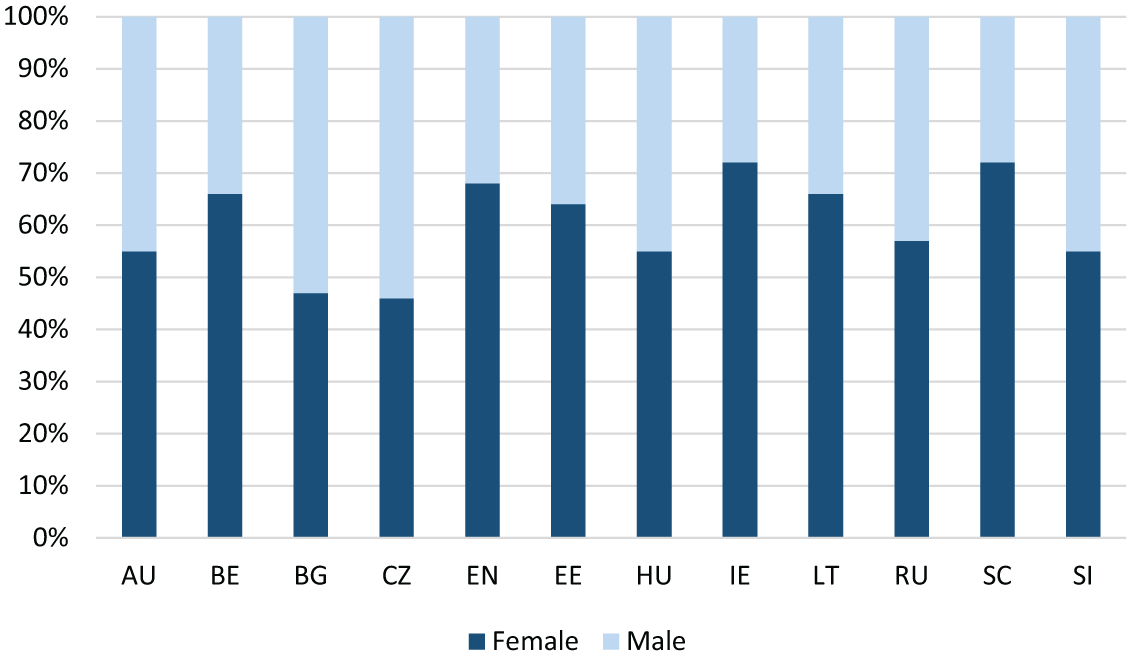
Sample gender distribution by country.
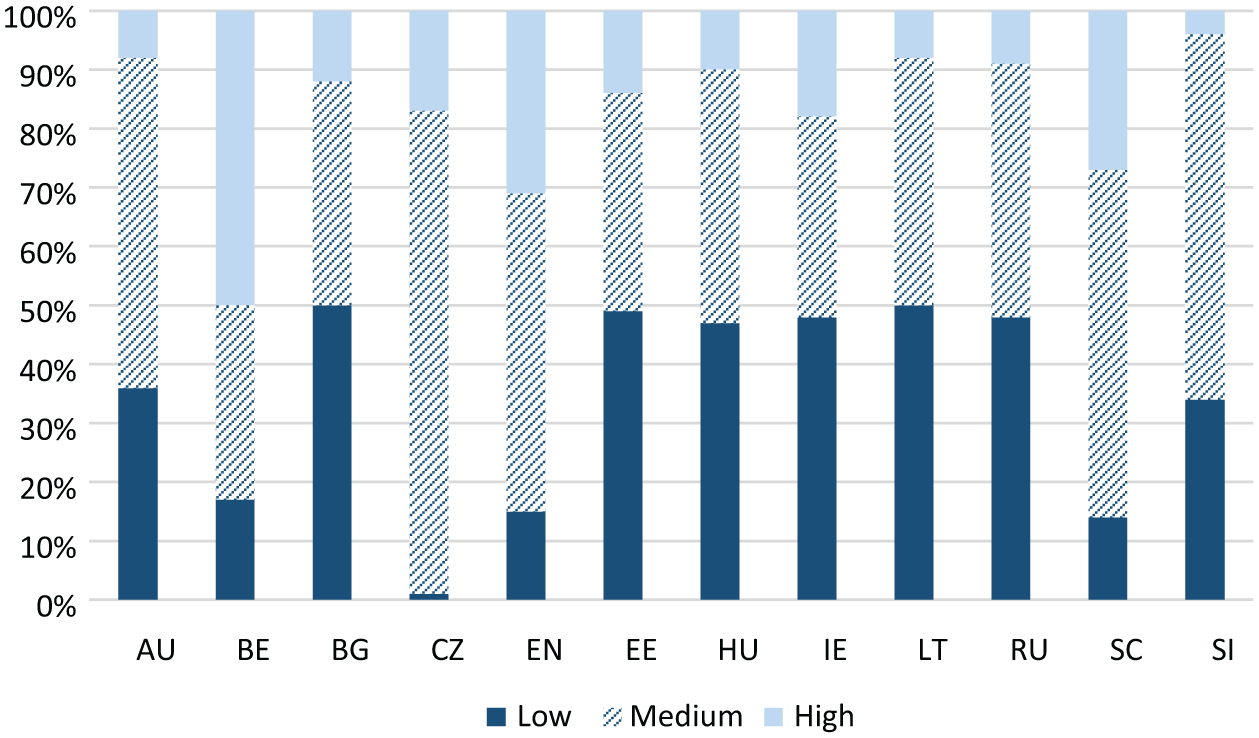
Sample educational attainment distribution by country.

Sample age distribution by country.

Sample labor market status distribution by country.
The article begins by outlining the main theoretical perspectives on socioeconomic, sociodemographic, and country-level aspects of lifelong learning. It then describes the research methodology, sets out the results, and discusses their significance.
Theoretical Background
Two main strands stand out in the literature on adult participation in lifelong learning: psychological and sociological. These dimensions were discussed in detail by Boeren, Nicaise, and Baert (2010); the bounded agency approach brings these together. In our analysis, “sociological” (socioeconomic and demographic) variables are “regressed” toward a psychological dependent variable: motivation. We therefore begin with a brief survey of the relevant literature on two levels: macro and micro. The macro level will help in understanding the different characteristics of countries.
Macro Level
The bounded agency model of participation in adult education was developed in light of empirical evidence which showed that different “welfare regimes” produce different barriers to participation (Rubenson & Desjardins, 2009). Countries’ structural features—institutions of various kinds—relate not only to whether adults participate in lifelong learning but also to how they participate. Boeren, Holford et al.’s (2012) analysis of motivational variation among adult learners in Eastern and Western Europe includes factors related to the labor market, the family, and the educational system. (Educational systems have often been omitted from research on welfare state regimes, yet they seem particularly salient for lifelong learning [Aiginger & Guger, 2006].)
Labor market
National labor markets differ. Eastern European countries, previously under Communist-led governments, have transformed—or are transforming—into market-oriented economies, comparable in many ways to those of the West. They sometimes said to be “catching up”—a process to which specific vocational training may well contribute (Cazes & Nesporova, 2004; European Bank for Reconstruction and Development, 2013). The extent of transformation differs (Schiff, Egoume-Bossogo, Ihara, Konuki, & Krajnyak, 2006). In Bulgaria and Lithuania, for instance, it has been less marked than in Estonia or Slovenia. Whereas Western Europe is now strongly service-oriented, a significant proportion of employment across Eastern European countries remains agricultural, particularly in Lithuania and Bulgaria (Holford et al., 2008). National systems of social security—welfare benefits, and job security—may also influence motivation to learn: For instance, social security benefits may be conditional on undertaking training. The continental “conservative–corporatist” countries (Austria and Belgium in our sample) are strongly stratified: Access to welfare and benefits (both pensions and unemployment benefit) depend largely on performance in the labor market (European Commission, 2012). As a result, their labor markets are relatively ineffective at generating social inclusion; those in work, however, are relatively well-off, and have more opportunities to participate in education and training.
Family structures and quality of life
Surveys of “life values” and “social aspects” reveal that quality of life is generally lower in Eastern European countries (Borooah, 2006). Families in Lithuania and Bulgaria tend to be larger, while their housing conditions are typically poorer than in Western Europe. Measured levels of happiness, and of trust in the political system, are quite low. Crime and violence tends to cause more concern than in Western countries. Scores on cognitive and social motivation are quite similar across Europe, but poorer living conditions in Eastern European countries may well contribute to stronger vocational motivation to participate in education and training.
Educational system
Labor market and employment structures also relate to educational structures (Holford et al., 2008). There appear to be links between countries’ compulsory schooling and adult education and training systems (Desmedt et al., 2006). Of the countries studied, Austria and Belgium have strongly stratified schooling systems: Children are split between “academic” and “vocational” tracks around the ages of 12 to 14 years. As Brunello (2001) argues, strong differentiation leads teenagers to receive more specialized education than those in comprehensive schooling systems; their need for specialized job-related training in adulthood may be lower.
The length of compulsory education also seems likely to affect adult participation in education (Eurydice, 2011). In some countries, the school leaving age is 18 years; in many it is 15 or 16 years. While there seems no particular association between vocational motivation and national school leaving age, this is complicated by variations in such factors as the age at which education becomes compulsory (ranging from 5 to 7 years), the total number of years spent at school, and the length of the school year. Shorter compulsory initial education presumably reduces how much can be studied, and may be associated with a need for more vocational training during adulthood.
Education systems in Eastern Europe have, of course, changed markedly over the past two decades, paralleling changes in the economy (Hantrais, 2002; Temple, 2010). Studies of pupil performance (such as the Progress in International Reading Literacy Study, the Trends in International Mathematics and Science Study [TIMSS] and the Programme for International Student Assessment) reveal that attainment levels in Eastern European countries are catching up with the West (Van Damme, 2008). Progress in International Reading Literacy Study, for instance, shows that the reading abilities of Bulgarian primary school children are the same as those in Flanders (547), while Lithuania’s children do significantly better than Scotland’s (537 vs. 527). TIMSS shows similar patterns (Van den Broeck, Van Damme, & Opdenakker, 2004). Comparisons over time are particularly revealing: TIMSS scores in mathematics and sciences decreased by 13 and 17 points, respectively, in Flanders, while the Lithuanian scores rose by 30 and 56 points over the period 2003 to 2007. Western European countries appear to have difficulties in maintaining standards, while younger Eastern Europeans seem to have improved their scores on these types of assessments. More research and data collection in the next few years will make it clearer whether the gap between Eastern and Western European education will narrow.
Adult education systems themselves also vary across countries. As Hefler and Markowitsch (2013) point out, the concept of formal adult education is fluid. In fact, they argue that different adult education systems can be characterized by two main components: variety in provision and in length and content of the programs. Exploring this analysis, an East–West division emerges. Eastern European countries have limited adult education provision, mostly concentrated around long courses (70% of courses take more than 200 hours). Western European countries, in contrast, have more variety in the number of different types of institutions offering adult education, but courses also vary in content and length, with considerably shorter courses and courses focusing on “leisure aspects.”
Micro Level
Motivation is of course a concept relating to the effort a person is willing to undertake (Deci & Ryan, 2002). In this article, we are concerned not only with a particular application (to education and training) of the broader concept but with a particular subset of this: Why does an adult learner participate in a specific type of program? (Keller, 1987). Houle (1961) distinguished three types of adult learner, based on their motivation: (a) those interested primarily in achieving a concrete goal, usually related to improving their status in the labor market, or obtaining a qualification; (b) those participating primarily because of the social interactions within the group of learners; and (c) those participating primarily because of a strong cognitive interest in the subject of the course. Houle’s theorization is still commonly used by researchers in the field: for example, Boeren, Holford et al. (2012), Boeren, Nicaise et al. (2012), and Robert (2012).
Age
Analyses of differential participation suggest age is one of most strongly determining characteristics (Boeren et al., 2010; Desjardins, Rubenson, & Milana, 2006). International bodies like the EU and the OECD (Organisation for Economic Co-operation and Development, 2006) define older workers as those aged 55 years and above; however, research shows there is already a sharp decline in participation after the age of 45 years (Desjardins et al., 2006). This may be associated with “stereotyping” of older adults: This appears to have a negative impact on their participation in learning activities as well as in the labor market (Chasteen, Schwarz, & Park, 2002; Gray & McGregor, 2003; Van Dalen, Henkens, & Schippers, 2010). Gaillard and Desmette (2010) found that people’s categorization of themselves as “older workers” lowers not only their aspirations at work but also their willingness to learn, develop and undertake training, and increases how likely they are to retire early. Such stereotyping reduces older adults’ productivity, adaptability, and loyalty (Greller & Stroh, 2004; Van Dalen, Henkens, & Schippers, 2009).
Age discrimination arises especially where employers do not have strong age management strategies (Bennington, 2004; Conlin & Emerson, 2006; Garstka, Hummert, & Branscombe, 2005; Macnicol, 2006; Snape & Redman, 2003; Wood, Wilkinson, & Harcourt, 2008). Kyndt, Michielsen, Van Nooten, Nijs, and Baert (2011) showed that younger employees (younger than 45 years) felt they received more encouragement from management to participate in training than those aged older than 45 years. Across most OECD countries, those older than age 55 years participate less both in education and training and in the labor force: As the workplace is one of the major providers of lifelong learning opportunities for adults, lower labor force participation explains (in part) older adults’ lower participation in training.
In addition to the literature relating to age in vocational education and training, psychological literature also suggests that some aspects of the capacity to learn decrease with age (Matzel, Grossman, Light, Townsend, & Kolata, 2008). Cognitive abilities, memory, and concentration decline, and may lead to learning processes being perceived as harder or less attractive. This may also (in part) explain older adults’ lower participation in education and training.
Employment and educational attainment
Analysis of Labour Force Survey data shows that adults with no formal qualifications are least likely to be in employment (Riddell & Weedon, 2012). Early school leavers are also vulnerable in the labor market, often becoming trapped in a cycle of low-paid work interspersed with periods of unemployment (Illeris, 2006, 2011). Individuals with no (or limited) formal qualifications tend to have more negative attitudes toward education (Tett & Maclachlan, 2008). In general, adults with no (or poor) formal qualifications are underrepresented in lifelong learning, even in countries with high participation rates (Desjardins et al., 2006; Nesbit, 2006; Robert, 2012). They are much more likely to be economically inactive, and are overrepresented among the long-term unemployed (Federighi & Torlone, 2012; Nicaise, 2010; Nixon, 2006). They are found disproportionately in lower paid and more monotonous jobs with limited autonomy or flexibility and fewer opportunities for training (Ashton, 2004). Schindler, Weiss, and Hubert (2011) argue that training needs are strongly related to job requirements, which generates a vicious spiral: The more highly qualified find work in higher quality skill-intensive occupations, which themselves offer more training opportunities. Poor qualifications make finding work more difficult; unemployment leads to poverty, social exclusion, and typically poorer health and well-being (Hoskins, Cartwright, & Schoof, 2010). Overall, there is a strong correlation between labor market participation and lifelong learning. The workplace itself generates many opportunities, so the proportion of adults engaged in lifelong learning is likely to be greater among the employed. While the unemployed participate less, those without work who do participate in education or training may do so for vocational reasons—for instance, to obtain paid work.
Gender
Although participation rates among men and women are quite similar, there are differences between their motivations, the types of courses in which they participate, and the barriers they have to overcome. Women participate more for leisure-oriented reasons, while men’s motives are much more job-related. Women are limited by a “glass ceiling” effect: Employers seem less prepared to invest in their development. Women also bear the main burden of family responsibilities (Koelet, 2005; Laurijssen, 2012). It is widely accepted that participation in education is strongly gendered (Leathwood & Francis, 2006).
Our research draws not only on this theoretical background but also on clusterings of countries and regions developed in previous work within the EU-funded project, “Towards a Lifelong Learning Society in Europe: The Contribution of the Education System” (LLL2010; Boeren, Holford et al., 2012; Boeren, Nicaise et al., 2012; Holford et al., 2008). Building on desk-based research, a country typology was constructed. Empirical data were then used to validate this typology. Empirical comparative research is time consuming and expensive (Hantrais, 2009). We therefore also sought to use the data to understand how the different levels of analysis relate to one other: in this case, how the country and individual levels relate. Through such exploration of countries and regions, we can throw light on how far generally accepted propositions (e.g., that the likelihood of participation in education decreased among older adults), are valid across a range of diverse contexts. This should increase our understanding of how generalizable and robust theories of participation are.
Data and Method
Having outlined the main theoretical perspectives on the determinants of adults’ participation in lifelong learning, we now seek to control these variables (gender, educational attainment, age, and labor market status)—across 12 European countries—to identify empirically which contribute most strongly to adults’ vocational motivation to learn.
Data Context
Our data are drawn from an international database of 12,000 participants in formal adult education during the year 2007. 1 Formal adult education was defined as officially recognized, credential-based education or training. Typically, this might involve recognition by a national ministry of education or in a national qualifications framework. What official recognition means in application, of course, varies according to national context, but in effect, these are the forms of adult education most similar to compulsory education. Informal workplace learning and in-company training outside the regular formal adult education system (e.g., in-company courses which do not lead to recognized qualifications) were excluded. The countries (or sometimes regions if they were part of a larger country, but had their own educational policies in place, e.g., for Belgium, only Flanders took part in the study) covered were Austria, Belgium (Flanders), Bulgaria, Czech Republic, England, Estonia, Hungary, Ireland, Lithuania, Russia, Scotland, and Slovenia.
Sampling
Stratified quota sampling was used: In every country, 1,000 participants were surveyed across four educational levels, based on the International Standard Classification of Education (ISCED): 250 at ISCED Levels 1 and 2 (comparable to primary and lower secondary education), 250 at ISCED Level 3 (comparable to higher secondary education), 250 at ISCED Level 4 (comparable to postsecondary but nontertiary education), and 250 at ISCED Level 5 (comparable to bachelors and masters courses in higher education). Within each ISCED block, sampling was random. In practice, the target of 250 participants at each level was not achieved in every country, and was exceeded in others. The sample was reweighted to the original sampling plan of 4 × 250 in 12 countries.
Questionnaire
Participants completed a questionnaire with closed questions. These focused mainly on motives to participate, experience of the classroom environment, barriers, and course characteristics such as teaching methods and enrolment requirements. Previous educational experience was also mapped, together with socioeconomic and sociodemographic characteristics. Adult learners at ISCED Levels 1 and 2 completed the questionnaire face to face with a trained interviewer; learners at higher levels generally completed the form on an individual basis, in the classroom or at home.
Quality Procedures
The use of a survey questionnaire in diverse cultural and institutional environments, and in a range of languages, presents particular problems. The LLL2010 research team, which included nationals of each of the countries in which it was used, adopted a number of quality assurance measures. A glossary of terms for the core variables in the questionnaire was created and discussed within the team: This ensured that as far as possible, all members shared understandings of the survey questions, and could translate and apply these in nationally meaningful and contextualized forms. Wherever possible, the questionnaire contained validated items from other international surveys: for example, sociodemographic variables were measured in exactly the same way as in the Eurostat Labour Force Survey and Adult Education Survey. Motivation scores were measured based on Boshier’s Education Participation Scale, which is widely validated in the adult education literature.
Results
The questionnaire contained 18 motivational statements, measuring their relevance for adult learners’ participation (see Boeren, Holford et al., 2012). Principal component analysis on the entire European data set revealed two main dimensions of motivation: A cognitive–social dimension and a vocational dimension, which means that items in the same dimension correlate to each other, while it is not impossible that specific individuals scored high on both cognitive–social and vocational items. The Cronbach alphas of both dimensions were above .700, suggesting these constructs provide reliable bases for further investigation (Mortelmans & Dehertogh, 2008). The results, including all factor loadings, are presented in Table 1.
Data Reduction for “Relevance”: Two Components.
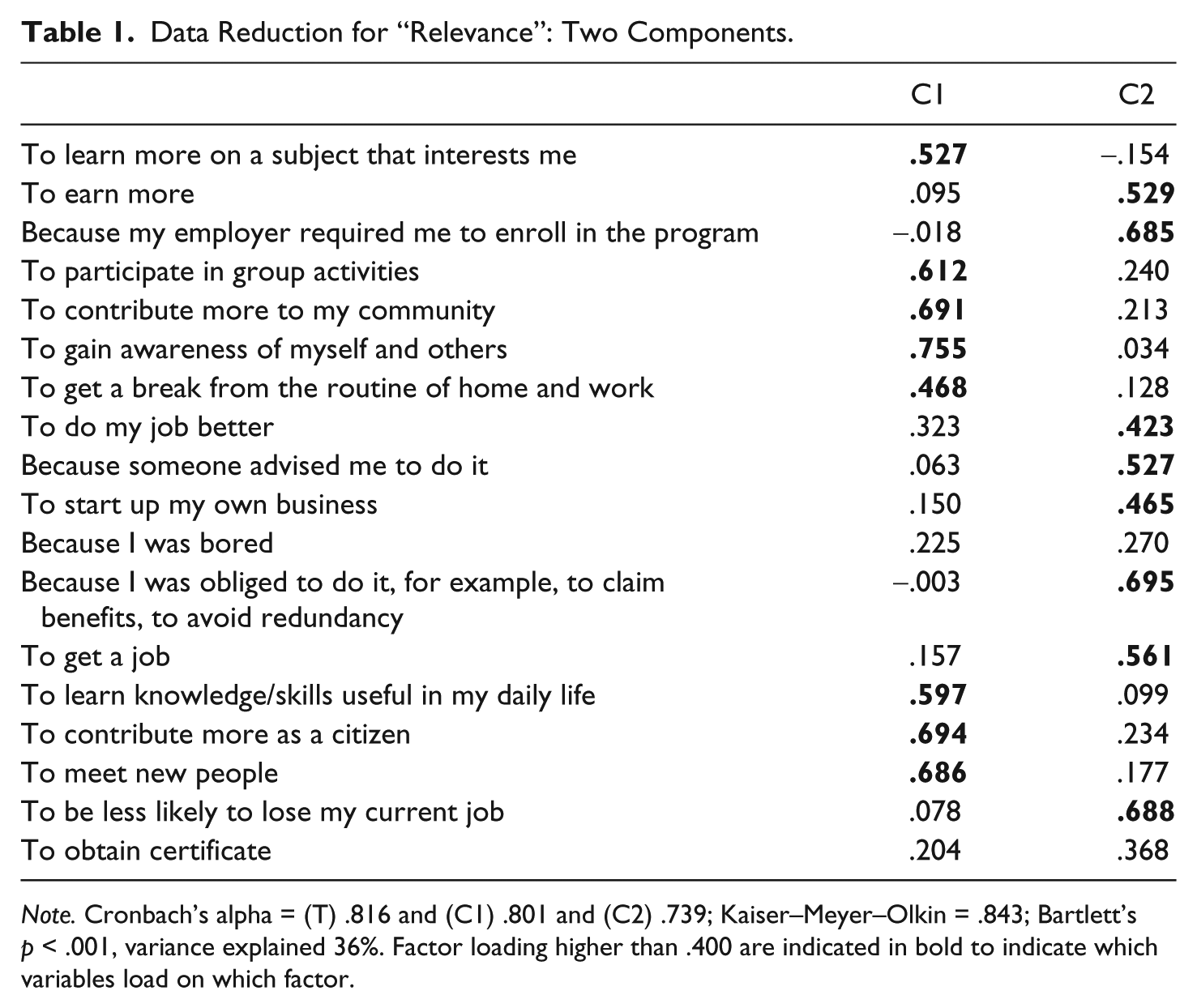
Note. Cronbach’s alpha = (T) .816 and (C1) .801 and (C2) .739; Kaiser–Meyer–Olkin = .843; Bartlett’s p < .001, variance explained 36%. Factor loading higher than .400 are indicated in bold to indicate which variables load on which factor.
The results of this principal component analysis were saved in a standardized form, resulting in a mean of 0 and a standard deviation of 1 for each component. Scores were compared across countries and analyzed by means of cluster analysis. As Boeren, Holford et al. (2012) show, four clusters emerged: (a) Belgium and Austria; (b) Scotland, England, and Ireland; (c) the Czech Republic, Estonia, Hungary, Russia, and Slovenia; and (d) Bulgaria and Lithuania. The variation in vocational motivation across countries was particularly strong, with Eastern European countries in general scoring higher than the Western European countries.
To clarify our understanding of vocational motivation, we sought to control whether other variables (i.e., other than the country level) contribute to the variation in vocational motivation. We controlled not only for sociodemographic and socioeconomic variables (age, job, gender, and educational attainment) but also for the country level. Figures 1 to 4 show how the sample was distributed by these four control variables in each country.
The adjusted R2 indicates how much of the variance is explained by the independent variables (A. Field, 2009). Age contributed less than 4%. The inclusion of the variable whether the adult learner had a job or not generated no major increase (+0.1%). The gender effect was also quite small (+0.5%). The adult learner’s educational attainment contributed rather more (+2.8%), but the strongest increase came with the inclusion of the country level (+20.8%; see Table 2).
Vocational Motivation: Controlling for Other Variables.
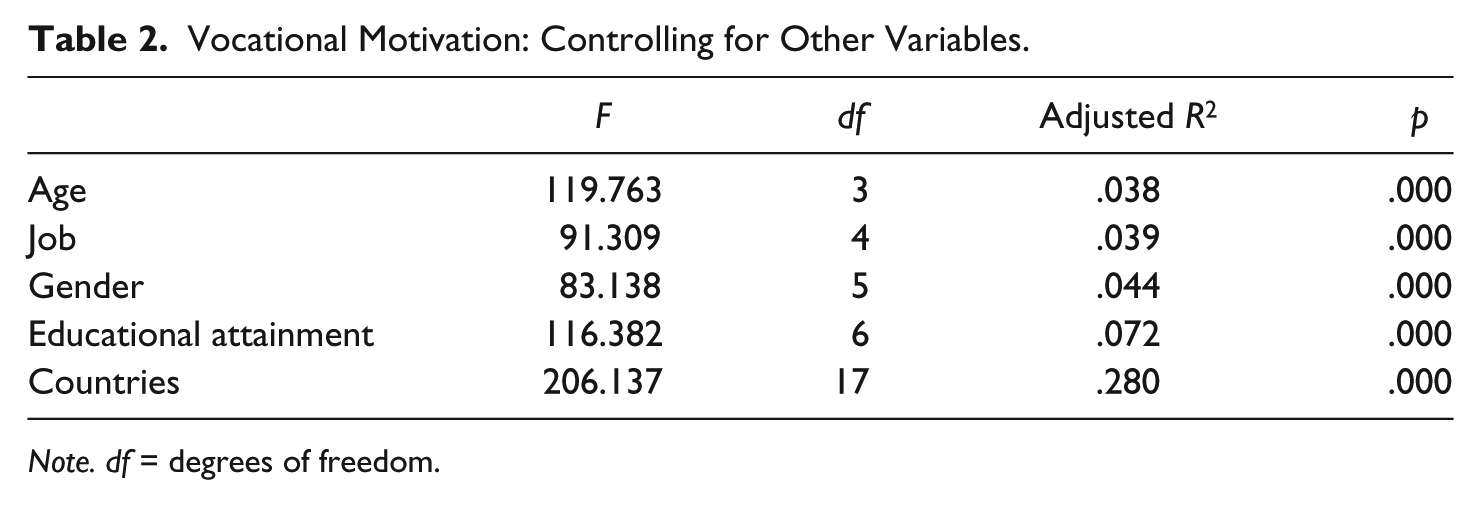
Note. df = degrees of freedom.
This shows that differences in motivation are most strongly explained by differences between countries, rather than by differences in individuals’ characteristics. In general, as noted by Boeren, Holford et al. (2012), motivational variance across countries shows similar patterns to welfare state typologies. Adult learners in Western European countries score lower on the vocational dimension than those in Eastern countries; scores in Bulgaria and Lithuania are especially high, where scores were higher than in the other Eastern European countries.
In order to demonstrate these differences, and to show that differences between countries go beyond the different age distributions in the country samples, we examined the mean for vocational motivation for each of the four clusters (see Figures 5-8).

Age and vocational motivation by clusters.
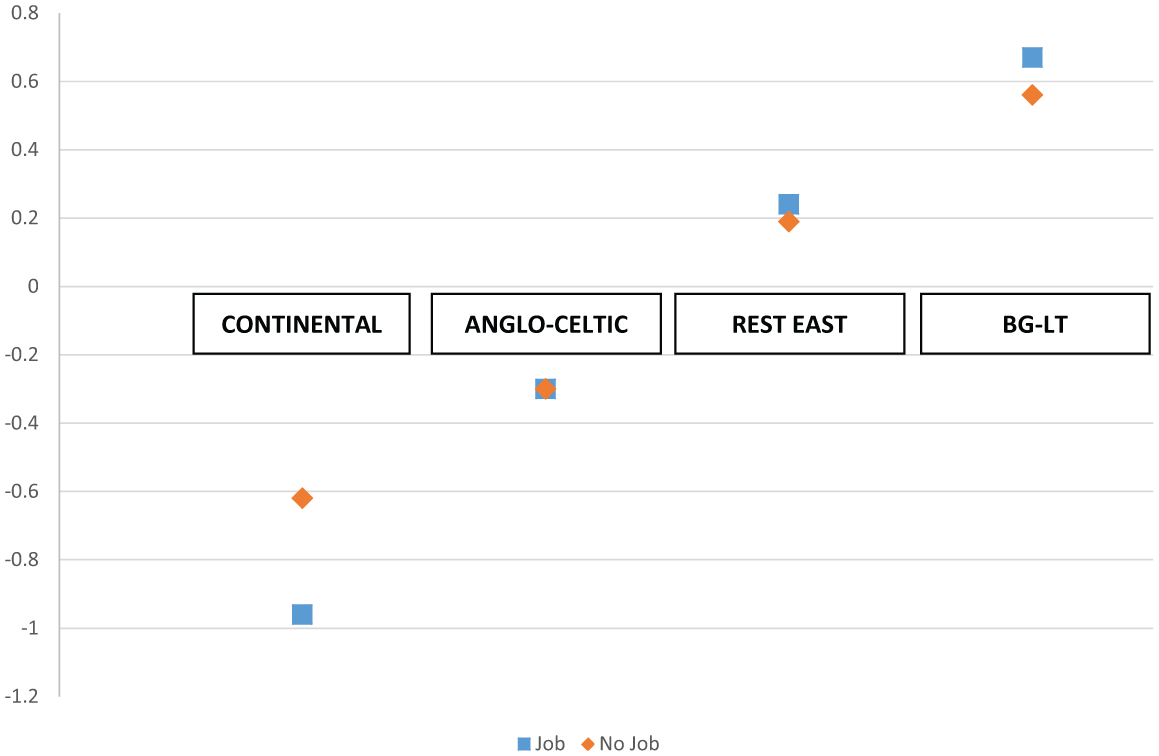
Labor market status and vocational motivation by clusters.
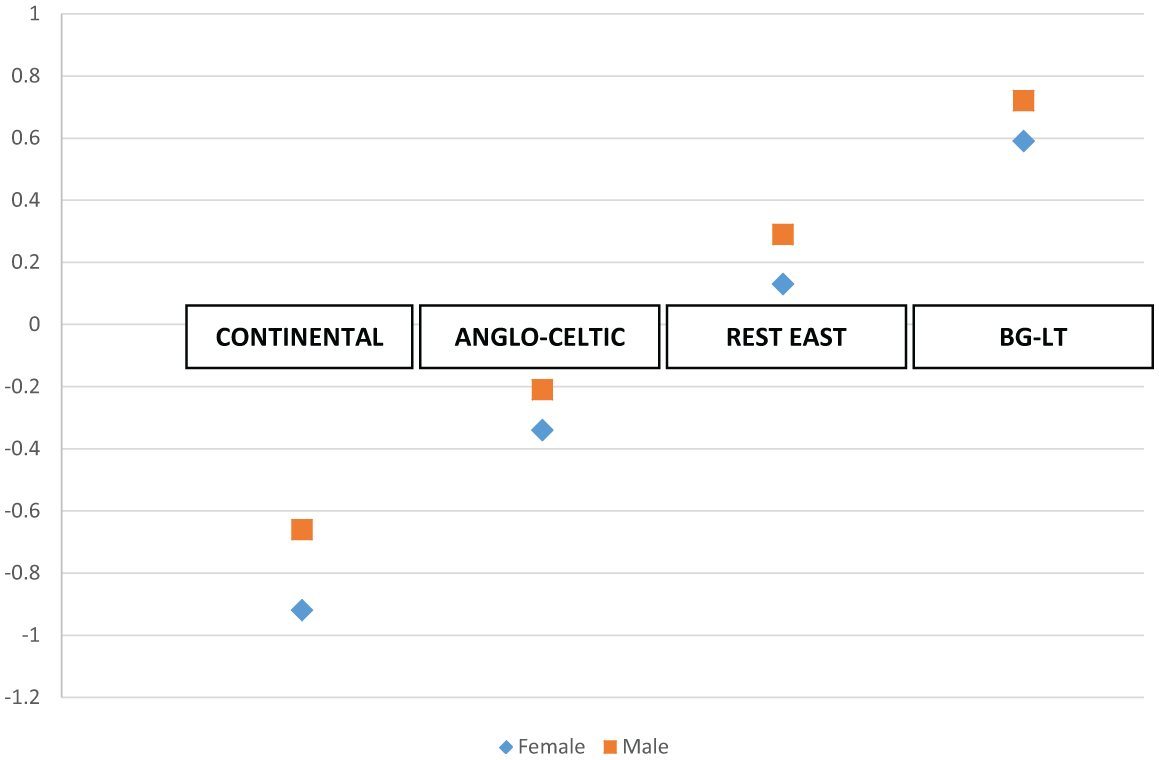
Gender and vocational motivation by clusters.
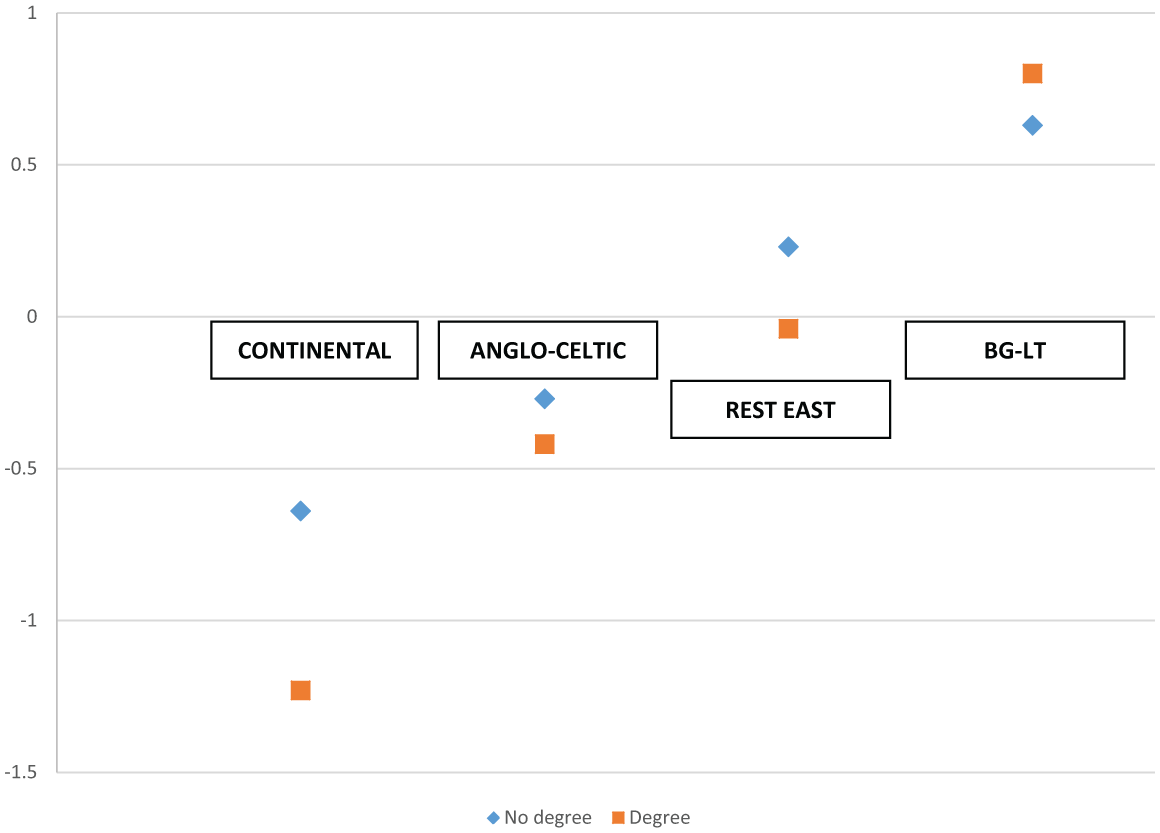
Educational attainment and vocational motivation by clusters.
Age (See Figure 5)
The literature suggests participation in formal education and training declines quite sharply after the age of 45 years (Desjardins et al., 2006); we therefore divided the samples by age, creating a “middle group” containing those aged between 38 and 42 years (those born between 1965 and 1969 in a survey conducted in 2007-2008). We included an older group, aged 42 to 67 years, and two younger groups: those born in the 1970s and those born in the 1980s (i.e., aged 28-37 years and 18-27 years at the time of the survey).
While adults’ vocational motivation to learn might be expected to decrease with age, differences in motivational scores between the various age groups were not significant in Eastern Europe. (In the Czech Republic, Estonia, Hungary, Russia, and Slovenia: F = 2.026; degrees of freedom (df) = 3; p = .108. In Bulgaria and Lithuania: F = 0.302; df = 3; p = .824.) In the Anglo-Celtic cluster, differences were also quite small: only the oldest group differed significantly from the youngest (F = 9.324; df = 3; p = .000). The “conservative–corporatist” cluster (Austria and Belgium) showed the largest differences between the youngest and oldest groups (F = 107.261; df = 3; p = .000).
While the differences between age groups within one cluster are interesting, comparing the scores for the same age groups across clusters is also revealing. While one would expect those born in the 1980s to have stronger vocational motivation (being at the earlier stages of their careers), we found that younger people in Austria and Belgium scored negatively compared with the overall mean of all adult learners in the pooled European data set. That is, the youngest adult learners in Austria and Belgium had lower levels of vocational motivation than the oldest learners in both clusters of Eastern European countries. The difference between the scores of those born in the 1980s across the four clusters is clearly significant (F = 242.381; df = 3; p = .000); the same applies in all age groups. This result clearly indicates that vocational motivation exists as an interplay between individual as well as country-level characteristics, and that motivation is thus more than simply an age-related concept.
Labor Market Status (See Figure 6)
To analyze labor market status, the sample was divided between those who were in paid work at the time of the survey, and those who were not. In general, in the entire sample, the unemployed had slightly higher vocational motivations than those in employment, suggesting participation in formal adult education may be seen as a stepping stone to future employment. However, comparing the unemployed across country clusters, clear differences again emerged (F = 334.922; df = 3; p = .000). Although the unemployed scored more highly than those with a job in the Austrian–Belgian cluster—those within the Eastern European clusters scored more highly than those in the Western European clusters. This result suggests—as with age—that the effect of the country level is stronger than the effect of labor market status.
Gender (See Figure 7)
Within each country cluster, men scored more highly on vocational motivation than women. However, if we compare men (F = 346.288; df = 3; p = .000) and women (F = 623.303; df = 3; p = .000) across country clusters, we notice—again—that the country level asserts itself. Men in Western European countries had lower vocational motivation than women in Eastern European countries: Country is more important than gender in explaining variation in vocational motivation across our 12 European countries. While one usually assumes that men participate because of job-related reasons, this assumption is only true if one explores the results within separate countries. Comparing Belgian men with Lithuanian women gives a completely different result.
Educational Attainment (See Figure 8)
To explore the influence of educational attainment, we distinguished those who had a degree (ISCED Level 5 qualification from a tertiary educational institution) from those who did not. In the Bulgarian–Lithuanian cluster, those with a degree had a somewhat stronger vocational motivation to participate; in the other three clusters, the opposite was found. Comparing degree holders (F = 286.643; df = 3; p = .000) and those without a degree (F = 611.201; df = 3; p = .000), it is again clear that the country-level variable is stronger.
Discussion and Conclusions
Our principal conclusion is that a clustering of countries according to respondents’ scores on motivational statements—particularly statements relating to vocational motivation—remains valid after controlling for individual sociodemographic and socioeconomic sampling characteristics. This supports literature—varieties of capitalism or welfare state regime theory, for instance—which suggests macro-structural factors—educational system and labor market—contribute to differences in motivational scores between countries. Differential patterns of motivation between countries in our study represent much more than mere sampling differences. This provides an empirical demonstration of the “bounded agency” approach (Rubenson & Desjardins, 2009). As Boeren, Holford et al. (2012) argued, participation in adult lifelong learning is too often analyzed in separate country contexts, with a focus on individual-level variables. Motivational theories are typically based on small-scale qualitative research in single countries. Houle’s (1961) study is both exemplary and representative: undertaken in the United States, it was based on 22 in-depth interviews. His theory has, of course, been tested using quantitative scales, but by allowing multicountry comparisons, our research adds substantial new insights to the knowledge base.
Having presented the results, what do these findings imply? First, they challenge sharply the widespread assumption that policies to encourage participation in adult lifelong learning should or can rely on the existence of broadly comparable levels of vocational motivation internationally. Patterns of adult motivation to learn or participate in education and training vary very significantly between countries. This points to the pervasiveness and power of national institutional structures and cultures.
Second, they show the very different challenges countries face in pursuing common goals such as building a “learning society.” Vocational motivation to learn is weaker in some countries than in others (Boeren, Holford et al., 2012). It therefore seems likely that vocationalism will have varying effectiveness as a policy lever. The motivational patterns revealed in this article suggest that countries will and must take varied policy paths, even when they agree on goals. How far a learning society should be based on vocational education alone is, of course, ultimately a normative matter: We believe our findings provide a basis for empirically informed questioning of today’s vocationalist policy “commonsense.”
Third, our findings raise questions about the use of indices (such as the EU’s lifelong learning participation index) as a foundation for policy design, particularly at the national level. The lifelong learning participation index is no more than a descriptive tool; it allows no multivariate exploration of other variables related to participation. Data are cross-sectional, not longitudinal, which limits researchers to explore changes over time. The index thus provides a very weak evidence base for policy purposes.
Finally, our findings suggest a need for deeper understanding of participation in adult lifelong learning based on studies which combine psychological and sociological approaches to participation with insights from social policy (Hudson, Lowe, & Kühner, 2008). Adult education and training systems are deeply embedded in national social and institutional structures, in how state, market, and family structures deliver social rights, and in patterns of social stratification. Research should take account of different elements of welfare (such as social security, employment, housing, education, and health systems, not only in the theoretical framework but it is also recommended that follow-up research includes specific variables measuring factors at the level of the education and labor market system). Fortunately, the country codes contained within cross-sectional micro-data sets such as the Eurostat Adult Education Survey and the Labour Force Survey should permit comparative micro–macro analysis.
Footnotes
Declaration of Conflicting Interests
The author(s) declared no potential conflicts of interest with respect to the research, authorship, and/or publication of this article.
Funding
The author(s) disclosed receipt of the following financial support for the research, authorship, and/or publication of this article: This research was funded by the EU’s 6th Framework research program.