



Abstract
Older people’s civic participation contributes to community development while at the same time providing opportunities for personal growth in later life. One important dimension of civic participation that has been largely underexplored is informal learning. The aim of this study is to explore the learnings experienced by Spanish older people through their participation in political organizations as one important type of participation that has received little attention in the literature to date. A total of 192 people aged 65 years and older and actively engaged in three kinds of political organizations participated in the study. Participants answered an open-ended question regarding learnings through political participation. Results show a range of informal learnings, relating to social, political, or instrumental domains. Both the type of organization and some sociodemographic and participatory characteristics are associated with the type of learnings experienced by participants. Implications for political organizations are discussed.
Introduction
Population ageing has led to increasing interest in older people’s engagement in productive activities (Gonzales, Matz-Costa, & Morrow-Howell, 2015). The potential of these activities to create benefits both for the individual and the community has received considerable attention from policy makers and gerontologists. In particular, activities such as civic participation contribute to community development while at the same time provide opportunities for personal growth in later life (e.g., Narushima, 2005).
Existing literature on civic participation tends to focus on the antecedents and outcomes of civic participation rather than the experience of participation itself (e.g., see the review on volunteering by Wilson, 2012). Thus, although there is a large amount of research on motivations, barriers, or factors affecting older people’s civic participation (e.g., Petriwskyj & Warburton, 2007), and a growing number of studies addressing the impact of this participation on their health and well-being (e.g., Anderson et al., 2014), much less is known about the actual experiences of older people engaged in civic activities. However, an understanding of these experiences is crucial as it affects commitment and ongoing motivations (e.g., Tang, Morrow-Howell, & Choi, 2010; Wilson, 2012).
There is a body of literature that suggests that one important dimension of the experience of civic participation is informal learning. Informal learning refers to the knowledge, skills, and attitudes that individuals acquire from their experiences, which go beyond organized and systematic educational opportunities offered either by state-approved educational institutions (formal learning) or by other social agencies (nonformal learning; Schugurensky & Myers, 2008). Informal learning may be self-directed (conscious and intentional), incidental (conscious and unintentional), or socialization learning (unconscious and unintentional; Duguid, Mündel, & Schugurensky, 2013). While learning through civic participation could include some systematic, nonformal learning, much of the actual learning that occurs is unplanned and spontaneous (Ilsley, 1990), frequently incidental learning (Ross-Gordon & Dowling, 1995).
Some studies have shown that the learnings associated with civic participation have important benefits for both individuals and organizations (Haski-Leventhal & Bargal, 2008; Ilsley, 1990; Piercy, Cheek, & Teemant, 2011). Thus, there is a learning dimension intrinsic to the experience of civic participation itself, and its understanding might be critical to both individuals and organizations (Schugurensky, 2002). This has been a common claim among theorists of participatory democracy (e.g., Pateman, 1970) and social movement organizations (e.g., Hall, 2006) that has nevertheless rarely been explored empirically (Duguid, Mündel, & Schugurensky, 2013). In view of the somewhat minimal literature in this area (Schugurensky, 2013), the intent of this article is to contribute to a deeper understanding of the relationship between learning and civic participation in later life.
Aging and Political Participation
Research into learning in this context is complicated by the multidimensional nature of civic participation, a concept for which there is no widely agreed-on meaning (Adler & Goggin, 2005). In an attempt to provide greater clarity, two main spheres have been identified (e.g., Adler & Goggin, 2005): social and political participation. While the former involves actions that primarily connect individuals to others, such as caregiving or volunteering, the latter refers to actions aimed at influencing political outcomes. With regard to older people’s civic participation, although there is a large amount of research on their social participation, particularly volunteering (Wilson, 2012), much less is known about their political participation (Nygard & Jakobsson, 2013). This knowledge is essential, however, to promote and improve inclusive and democratic participation, especially in the context of aging populations.
Furthermore, political participation is itself a multidimensional phenomenon, including high– and low–resource investment activities (Verba, Scholzman, & Brady, 1995) as well as institutionalized and noninstitutionalized forms of involvement (Kaase, 1999). Most research on older people’s political participation has focused on a single activity, such as voting (e.g., Binstock, 2000), or a combination of a few types of political participation, such as demonstrating, boycotting, signing petitions, or contacting politicians (e.g., Nygard & Jakobsson, 2013). However, research on other political activities, such as older people’s participation in political organizations, has been limited. This type of activity is particularly interesting because it requires a higher level of commitment and is more likely to be stable across time than other political behaviors (Goerres, 2009; Verba et al., 1995).
Existing research on older people’s political participation has mainly analyzed factors predicting participation (e.g., Nygard & Jakobsson, 2013; Serrat, Villar, & Celdrán, 2015) or compared elders’ participation to those of younger generations (e.g., Goerres, 2009). Some have looked at older people’s motivations (e.g., Petriwskyj, Warburton, Everingham, & Cuthill, 2014) and barriers (e.g., Serrat, Petriwskyj, Villar, & Warburton, 2015) to participation in political activities. However, learning through political participation has been far less often the focus of research. This article addresses this gap, focusing on the learnings associated with older people’s political participation. We begin, however, with a brief review of the literature associated with learning and the broader aspect of civic participation.
Civic Participation and Learning
There are a few studies that have found changes in participants’ attitudes, knowledge, and skills as a result of involvement in civic activities. Ilsley (1990) identified three categories of informal learning among volunteers: instrumental learning (acquisition of skills necessary for volunteer work), social learning (associated with issues such as communication, trust, respect, compassion, and openness), and critical learning (analysis of one’s own politics, values, and priorities, and those of society). Ross-Gordon and Dowling (1995) found that learning within volunteering organizations goes beyond the acquisition of new knowledge to include changes in skills and abilities related to working with others, and a changing sense of self, in terms of growing self-confidence or sense of connectedness to the community. In a recent case study on different types of civic activities, Duguid, Mündel, Schugurensky, and Haggerty (2013) found that participants experienced a wide range of learnings, including the development of instrumental, interpersonal, and communication skills; political efficacy; institutional and political knowledge about their organizations; and a broader understanding of social realities. These studies therefore suggest several dimensions to consider in analyzing informal learnings through civic participation. While establishing distinctions between types of informal learning may risk imposing artificial boundaries and neglecting the potential simultaneity of different kind of learnings, it also allows a better understanding of what people learn in different settings (Duguid, Mündel, & Schugurensky, 2013).
Research regarding older adults specifically has been limited, despite the burgeoning interest in their participation noted earlier. The few studies with this population have shown that older people experience a range of learnings through their participation in civic activities, from the acquisition of instrumental knowledge and skills to personal and spiritual growth (Narushima, 2005; Piercy et al., 2011; Schugurensky & Myers, 2008). However, there are some aspects that need further development.
First, the diversity and complexity of civic participation activities make it difficult to generalize about people’s learnings (Schugurensky & Mundel, 2005). Although there are some studies focused on older people’s volunteering (Narushima, 2005; Piercy et al., 2011), engagement in local governance initiatives (Schugurensky & Myers, 2008), or social movement organizations (Narushima, 2004), there is virtually no research on elders’ participation in political organizations. Taking into account the particular nature of this kind of political activity, learnings from either more general civic engagement activity or other political activity may not be generalizable.
Second, previous studies have found associations between the characteristics of learning and variables such as the profile of participants, their previous experiences of participation, or the type of civic activity or organization (Duguid, Mündel, & Schugurensky, 2013; Ilsley, 1990; Schugurensky & Mundel, 2005). Therefore the nature of the activity and the person undertaking it are both important dimensions in understanding the learning experience. To our knowledge, however, no study has systematically looked at the influence of variables such as the type of organization, sociodemographic variables, and participatory characteristics, on older people’s learnings through political participation. This knowledge is essential if older people’s experiences of participation are to be improved, increasing the benefits of productivity in later life.
Finally, most research on learnings through civic participation has been conducted in Anglo-Saxon countries, but little is known about other geographical contexts. Spain provides an interesting case study. Spanish elders have lived a great part of their lives during Franco’s dictatorship, a period marked by severe restrictions on civil liberties and rights. Although the transition to democracy in the mid-1970s allowed and legalized political activities and organizations, the over-65s remain the cohort with the lowest levels of political participation (Instituto de Mayores y Servicios Sociales, 2008). In Catalonia, where this study was conducted, the levels of political engagement among over-65s are similar to those in the rest of Spain; however, 9.1% of Catalan seniors are members of political organizations, compared with only 7% of elders in other regions of the country (Instituto de Mayores y Servicios Sociales, 2010). Spain therefore, and more specifically Catalonia, may differ to other sociopolitical contexts, such as the United States, Australia, Canada, or the United Kingdom, where most research on older people’s civic participation has been conducted.
Thus, the aims of this study are to explore the learnings experienced by Spanish older people through their participation in political organizations and to explore the possible association of these learnings with other variables such as the type of organization, sociodemographic variables, and participatory characteristics. In this way, the study seeks to identify not only what learnings are reported by those participating in political organizations but also what individual and organizational factors may influence these learnings. This will provide a more nuanced understanding of the learnings experienced by older people through their participation than that offered in the existing literature.
Method
Participants
The methods for this study are described in more detail elsewhere; a summary is provided here (Serrat, Petriwskyj et al., 2015). The researchers recruited respondents through political organizations, defined as formal groups that aim to influence the political agenda, political decision making, or the selection of government personnel (Morales, 2004). The study was conducted in Spain, in the autonomous region of Catalonia, with organizations selected from across this region. Participating organizations focused on both local and national issues, and on either single issues or a broader political agenda. In total, nine political parties or trade unions were included, with 56 respondents from these organizations, 28 neighborhood associations with 95 respondents and nine single-issue organizations focusing on older people’s rights, independence for Catalonia, the subprime mortgage crisis, human rights, and feminist issues, with 41 respondents. In all, 192 active members of the boards, committees and policy groups of these organization participated in the study. Respondents had been participating in their organizations for 1 to 66 years (M = 16.4, SD = 15.1) and devoted between 1 and 50 hours per week (M = 10.5, SD = 10.1). The final sample was aged between 65 and 86 years (M = 70.7, SD = 5.6), was close to half male and half female (54.8% male and 45.2% female), and close to a third with primary, secondary, or university education level (37.5% primary, 32.8% secondary, 29.7% university). Characteristics of the sample are shown in Table 1.
Comparative Profile of Older People Engaged With Political Organizations, by Type of Organization.

Note. p values are based on the chi-square statistic.
p < .05. **p < .01. ***p < .001.
Procedure
The organizations were approached by the first author to participate in the study and were asked to distribute the survey to members who met the inclusion criteria (aged 65 or older, a member of the board or a committee within the organization, having participated in the organization for at least 1 year, and devoting at least 1 hour per week to their involvement). Respondents completed the survey at home and returned it for collection by the research team. The study was approved by the Ethics Committee of the Faculty of Psychology of the University of Barcelona.
Instruments
The questionnaire used in the study was designed by the first and third authors, and pilot-tested with a sample of six older people participating in political organizations. The questionnaire included both closed-ended questions, incorporating some standardized scales, and open-ended questions to provide for a multidimensional analysis that allowed responses to be captured in respondents’ own words. First, sociodemographic details were collected relating to gender, age, marital status, education, income, and self-rated health, along with participatory characteristics in terms of number of years participating and average hours spent participating per week. Respondents were then asked how important their participation was for them on a 10-point scale, and whether they believed their participation would result in a change in policies (“Yes,” “No,” “I am not sure.”). The survey then asked if respondents had learnt anything valuable from their participation and if so asked them to describe this in a few words.
Data Analysis
Content analysis
Content analysis was conducted on the responses to the open-ended question regarding learning from participation, using a multistage process with the help of ATLAS.ti 7 qualitative analysis software. As the purpose of analysis was to both identify themes and explore the frequency with which they were raised by respondents, an inductive process of analysis was used in which themes were identified and categories formed and compared by two independent raters (Krippendorff, 2013), with confirmation of a random selection of responses by a third rater. Using this process, three categories of learnings were identified: social, political, and instrumental learnings. These are discussed in the following section. Frequency and chi-square analyses were then conducted on the themes and categories.
Logistic regression
To test the relationships between the learnings identified and the type of organization to which respondents belonged, as well as their sociodemographic and participatory characteristics and beliefs, a series of binary logistic regression analyses was conducted. These logistic regression analyses were conducted not to infer causality but rather to identify characteristics that were uniquely associated with the likelihood of reporting a particular kind of learning. The outcome variables were the three categories of social, political, and instrumental learnings identified in the content analysis (mention of a theme included in that category = 1, no mention of a theme included in that category = 0). The independent variables in the analysis were age, gender (male, female), income (≤1,000, 1,001-1,500, ≥1,501 euros per month, grouped according to the distribution of frequencies), marital status (married or de facto, widowed, single or divorced), education (primary education or less, secondary education, university education, grouped according to the distribution of frequencies), self-rated health (bad or average, good), type of organization (political party/ trade union [PP]; neighborhood association [NA]; single-issue [SI]), importance of participation, years participating, average hours participating per week, and internal political efficacy (Yes, No/Not sure).
Results
Content Analysis
Analysis of the learnings respondents reported from their participation in political organizations identified three overarching categories. These were categorized as social, political, and instrumental learnings. Within each of these categories, a number of themes were identified.
Social learnings
Five themes were identified relating to social learnings from participation. These reflected the ability to listen to and respect others’ opinions, a sense of solidarity with and awareness of others, recognition of the importance of social harmony, appreciation for the companionship of others, and integration into the community. Each of these represented different dimensions of learnings about the value of community and relationships.
Some participants reported that they had learned to listen to and respect others’ opinions: “To have more patience, and to listen and respect other people’s ideas” (woman, 74 years, NA). Respondents noted that they had developed a better ability to discuss and negotiate because they were now able to listen to others respectfully and calmly: “To listen to other people, to negotiate and respect other’s people criteria without feeling upset, and to argue better about problems” (man, 65 years, NA). This reflected a growing sense among respondents of the importance of deeper consideration of others’ views and acceptance and tolerance for those views and their expression.
One of the important things respondents had gained through their participation was a greater sense of awareness of others around them and of the importance of helping them. For one respondent, this was also a matter of being “a better citizen” (man, 71 years, NA). Another made note of the “satisfaction that comes from helping others” (man, 72 years, NA). One respondent summarized their learnings by saying: “Maybe the most important is to share and to help people in need, and to feel more unified with fellows and friends” (man, 80 years, PP). Therefore respondents had developed a greater appreciation of the importance of helping those around them, and the value this held for themselves and others.
In a related learning, participation had led some respondents to acknowledge the importance of social harmony and to recognize the potential for “better communal living” (man, 76 years, NA). As one respondent noted, they now saw this as possible even if conflict occasionally arose: “To live together with neighbors, even if sometimes we get mad” (woman, 69 years, NA). In this sense participation was described as developing respondents’ desire to build a cohesive and harmonious community, while acknowledging that conflict was a normal but surmountable challenge to cohesiveness.
This cohesiveness and harmony were, for some, expanded to a deeper companionship and friendship. Indeed, a number of respondents had come to appreciate the value of companionship through their participation. For one, this was also about “helping each other” (man, 71 years, NA). For another, this was about “companionship with people with the same ideas” (man, 65 years, PP). One also described the “friendship between fellows” (man, 83 years, PP). Therefore the developing sense of community included for some a growing appreciation of the value of deeper friendships with members of their community.
Furthermore, respondents described feeling more integrated into their communities as a result of participation. As one noted, he now felt, “. . . .more identified with my neighborhood, which is the place where I was born and I still live” (man, 81 years, NA). Therefore political participation had created the opportunity to develop a sense of belonging and “fit” with their community.
The social learnings respondents reported from participation in political organizations therefore varied but centered on a theme of greater appreciation for and commitment to developing constructive relationships, building community, helping and respecting each other.
Political learnings
Three themes were identified that related to political learnings from participation. These reflected an enhanced understanding of the social and political reality of their community, an appreciation of the value of collective action, and an enhanced ability to be assertive and defend their rights. These themes represented philosophical and practical development in relation to the political context of participation.
Respondents found they had a better understanding of social and political reality. For one, this was a matter of becoming savvier and better able to protect himself: “I’ve learnt how society works, to avoid being manipulated” (man, 70 years, PP). For others, this learning related to the issues facing the community: “To have a deeper understanding of the individual and collective problems of my community” (woman, 76 years, NA). Another respondent explained that they were able to look at these issues from “different points of view” (man, 71 years, NA). Therefore political participation provided an opportunity to develop a deeper and more nuanced understanding of the issues the community was facing and in some cases to recognize and manage risks to themselves.
Participation had helped respondents realize the value of collective action. As one respondent noted, they had learned, “That it is possible to change things if we act together. . . The importance of collaboration and team work” (woman, 67 years, PP). Another respondent saw this as “the strength of union” (man, 65 years, SI). For one respondent, working together was related to the goal of addressing injustice: “To become more sensitive to social, political, and cultural injustices, and to know that it is possible to achieve important goals through collaboration” (woman, 70 years, SI). Therefore, in response to a greater knowledge about the issues that needed to be addressed, respondents had also come to recognize that they could achieve the desired change by working together with others, rather than on their own.
Through their participation, respondents had learned to be assertive and defend their rights. For some, this was about becoming stronger in asserting their ideas. For example, as one woman reported, “I’ve learnt to be not submissive” (woman, 69 years, NA). Another similarly noted that she had learned, “To reassert my rights, never shut up, and stand up for my ideas” (woman, 68 years, PP). For others, this related to defending their rights “as a worker and citizen” (man, 70 years, PP). Therefore the growing sense of confidence among respondents related to both general assertiveness and more specifically asserting ideas.
As might be expected, a key benefit from political participation of this type therefore related to politically related knowledge and understanding. This was described in various ways by the respondents including a greater understanding of the political issues and injustices that needed to be addressed, the importance of collective action as a way of addressing these, and greater confidence and willingness to defend their own rights and views.
Instrumental learnings
Three themes were identified that related to instrumental learnings from participation. These related to an enhanced ability to work with other people, acquisition of practical and technical skills, and improved communication skills and confidence. These themes therefore represented the development of different types of skills and abilities through participation.
One of the important skills acquired through participation was the ability to work with others. This related to the earlier finding regarding an increased appreciation of collective action and community. For example, respondents reported that they had learned “to work with other people” (man, 72 years, SI) and “to work in teams” (man, 69 years, PP). Therefore respondents had developed not only a desire to be more connected with others and a recognition of the value of working with others but also stronger skills in actually doing so.
Participation had helped these individuals to acquire practical knowledge and technical skills. These included general as well as specialized computer skills: “Due to my position as treasurer of the organization, I had to learn how to work with a specific software” (woman, 65 years, SI). Another reported that she had acquired “administrative skills” (woman, 68 years, NA) through her participation. Therefore the skills respondents developed through participation included some of the practical knowledge needed to implement change in collaboration with others, and particularly in a structured organizational environment.
A number of respondents had also improved their public speaking skills and gained confidence in communication. Respondents had learned “. . . to speak in public” (woman, 66 years, PP) and to “express myself in front of lot of people” (man, 65 years, PP). For one man, participation helped him “to overcome my shyness” (man, 65 years, NA). This growing confidence resonates with the increasing assertiveness and savviness reported by respondents and reflects self-expression skills with important implications for an active role in creating political change.
Participation in these organizations therefore offered instrumental learnings. These related to both practical and professional skills as well as communication skills and confidence, offering practical development that complemented the increasing desire for community cohesion and community action.
These themes were analyzed for trends in the frequency with which they were mentioned. Of particular interest was the relationship between the type of organization to which participants belonged and the learnings they identified. Frequencies and chi-square values for the themes according to type of organization are presented in Table 2.
Frequency and Percentage of Responses (in Parentheses) to the Question “Could You Explain in a Few Words What You Have Learnt Through Your Participation?” by Type of Organization.

Note. p values are based on the chi-square statistic.
The sum of category values may sometimes be greater than 100% because some participants’ answers included more than one category. bApproaching significance.
p < .05. **p < .01. ***p < .001.
Frequencies and chi-square tests showed differences in the learnings reported by those in different types of organizations. The most frequently mentioned types of learnings were socially related, reported by close to 40% of respondents. These were particularly prominent among those in neighborhood associations and were also the most commonly reported learnings for those in this type of organization. In chi-square analysis, social learnings were significantly more likely to be reported by those in neighborhood associations than those in other organizations (χ2 = 6.725, p < .05). Within this category, appreciation for social harmony was also significantly more likely to be reported by those in neighborhood associations than those in other organizations (χ2 = 6.333, p < .05). Political learnings were the second most common type, reported by over 35% of respondents. One relationship approached significance in the chi-square analysis: Those in political parties or trade unions were more likely to report learning to defend their rights than those in other organizations (χ2 = 4.884, p = .087). Instrumental learnings were reported by over 21% of respondents. Learning to work with others in a team was significantly more likely to be reported by those in single-issue organizations than those in other organizations (χ2 = 7.105, p < .05).
Logistic Regression
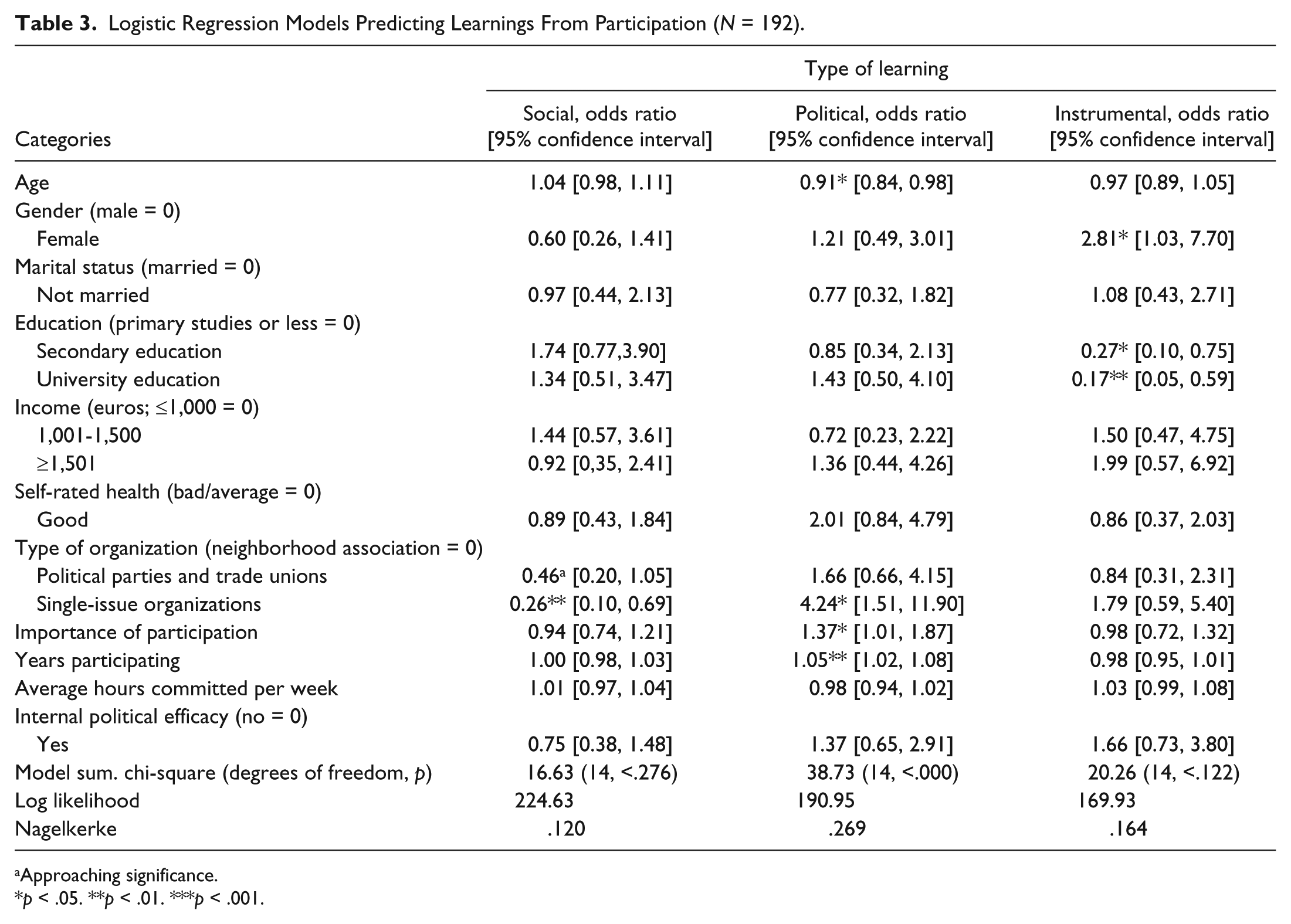
Following content analysis and analysis of frequency of responses, logistic regression analyses were conducted to test the association between the three categories identified in the content analysis and the type of organization and sociodemographic variables. The results of this analysis are presented in Table 3. Analysis revealed a number of significant relationships.
Logistic Regression Models Predicting Learnings From Participation (N = 192).
Approaching significance.
p < .05. **p < .01. ***p < .001.
Those belonging to single-issue organizations were significantly less likely than those in neighborhood associations to report social learnings from participation (odds ratio [OR] = 0.26, p < .01), and those in political organizations were also less likely to report these learnings, a relationship that approached significance (OR = 0.64, p < 0.1). Those belonging to single-issue organizations were significantly more likely to report political learnings (OR = 4.24, p < .05). These findings supported the patterns identified in chi-square analysis. Furthermore, the regression analysis revealed that those rating their participation as more important (OR = 1.37, p < .05), and those participating for a greater number of years (OR = 1.05, p < .01) were significantly more likely to report political learnings. Women were significantly more likely than men to report instrumental learnings, such as computer or public speaking skills (OR = 2.81, p < .05). Those with secondary (OR = 0.27, p < .05) and university education (OR = 0.17, p < .01) were also significantly less likely than those with primary education to report these instrumental learnings. Finally, increasing age was associated with a decreased likelihood of reporting political learnings (OR = 0.91, p < .05).
Discussion
The aims of this study were to explore the learnings experienced by Spanish older people through their involvement with political organizations and to explore the association of these learnings with variables such as the type of organization, sociodemographic variables, and participatory characteristics. The qualitative data suggested that political participation helped these older people develop their sense of community, connections and closeness with their neighbors, and understanding about the importance of growing and nurturing these relationships in the face of difference and conflict. Along with this greater sense of community, participation helped develop greater knowledge about what affected those around them and how working with others could address challenges. Complementing this connection to the community and desire for collaboration were a stronger sense of confidence and assertiveness, as well as relational and practical skills in implementing these new understandings.
These types of learnings match some of those identified by previous research on older adult’s involvement in broader civic activities. Social learnings, for instance, were common among senior volunteers (Narushima, 2005; Piercy et al., 2011); instrumental learnings were identified both for volunteers and seniors involved in local governance (Narushima, 2005; Schugurensky & Myers, 2008); and political learnings were also experienced by this last group (Schugurensky & Myers, 2008). Overall, our results show that political organizations offer wide opportunities for older adults’ informal learning that include but are not limited to knowledge and skills related to political action, and center on the importance of community and collective action.
Building on this understanding about the nature of the learnings from political participation, our second objective was the exploration of the possible association of these learnings with sociodemographic and organizational variables. While the qualitative findings suggest growing understanding and skills around community and collectivism, the quantitative findings indicated that there were trends in which dimensions of this understanding and skill set were more likely to develop among particular older people, or in specific types of organizations.
In chi-square analysis, social learnings broadly, and appreciation for social harmony specifically, were significantly more likely to be reported by those in neighborhood associations. Given the nature of neighborhood associations, these relationships are not unexpected. Involvement in community focused, local political organizations dealing with neighborhood issues therefore strengthens or builds a sense of solidarity, including working together and building respectful relationships within the community.
It is interesting to note not only that political learnings were the most common type for those in single-issue organizations but also that they were reported more frequently in these organizations than by those in either neighborhood associations or political parties and trade unions. While this relationship was not significant in chi-square analysis, it is an interesting trend. This may be explained by the nature of these groups; first, as nationally focused organizations, single-issue organizations may provide greater scope for learning about broader political issues than neighborhood associations. Second, being less centrally incorporated into political structures than political parties and trade unions, those who become involved may have less initial knowledge about broader political issues than those joining political parties and may therefore gain more such knowledge. One relationship did approach significance in the chi-square analysis: Those in political parties or trade unions were more likely to report learning to defend their rights than those in other organizations. While this did not reach statistical significance, it may indicate a trend that reflects the strongly politicized and embedded nature of these organizations within the political process, which may facilitate a culture of assertion of rights.
Instrumental learnings were also more common among those in single-issue organizations than other organization types. It is possible that the structured and formalized, but smaller nature of these organizations offers greater opportunities for administrative, functional and communicative roles, and therefore greater opportunity to develop these skills. Learning to work with others in a team was significantly more likely to be reported by those in single-issue organizations than other organizations. This suggests that this type of organization may particularly offer opportunities to develop team work in a structured environment.
These findings were largely supported by logistic regression analyses. Those belonging to single-issue organizations and political parties were significantly less likely than those in neighborhood associations to report social learnings from participation. Furthermore, those belonging to single-issue organizations were significantly more likely to report political learnings.
The consideration of sociodemographic and participatory characteristics provides additional insights into older people’s learnings through engagement with political organizations. Those rating their participation as more important and those participating for a greater number of years were significantly more likely to report political learnings from their participation. This suggests that those most committed philosophically and those who have been committed the longest are most likely to gain benefits in the form of political learnings, such as a commitment to defending their views and rights, knowledge about issues, and an appreciation for collective action.
Women were significantly more likely than men to report instrumental learnings, such as computer or public speaking skills. This may reflect gender differences, particularly in Spain, where older women have had fewer professional and other civic opportunities during their working lives, whereas older men are more likely to have been able to learn these skills earlier in life (Ministerio de Trabajo e Inmigración, 2007). Furthermore, those with secondary and university education were significantly less likely than those with primary education to report these instrumental learnings. Again, those with a higher level of education are more likely to have had the opportunity to develop these skills outside of their political participation.
Finally, increasing age was associated with a decreased likelihood of reporting political learnings. This is somewhat more difficult to explain; however, it is possible that in this sample older respondents had greater political knowledge and understanding prior to their participation, having already learnt this over their lifetime.
Limitations of the Study and Implications for Future Research
The design of this exploratory study has some implications for interpretation of results, and for future research directions. First, the sample was purposively selected, and restricted in terms of the types of organizations, types of political participation, and cultural and geographic context. The focus on data from the Spanish context is innovative and adds to a growing body of research on learnings. However, it should be acknowledged that the scope of the study is necessarily constrained, limiting the generalizablity of the findings. It would be useful for future research to provide comparative data from other national or cultural contexts and to explore additional forms of political participation. This sample grew up in Franco’s dictatorship, a context in which civil liberties and rights were severely restricted and access to educational opportunities was reserved to a minority of the population. It may be possible that, for those Spanish elders who have found a place in the political arena, participation may have a compensatory function, providing them with learning opportunities that they might not have previously accessed.
Conclusions and Implications for Political Organizations
This study adds significant understandings about learnings associated with political participation, an important dimension of civic participation and active ageing. The findings highlight different dimensions of learning, similar to studies looking at different forms of participation (Duguid, Mündel, Schugurensky, & Haggerty, 2013; Ilsley, 1990; Lucio-Villegas, 2009). Interestingly, although this study related to the political domain, many of the learnings were not political, but social or instrumental. Many of the forms of learning identified in this study are dimensions of participation that can present barriers to full involvement (e.g., Petriwskyj & Warburton, 2007), and their development is therefore important in overcoming these barriers and strengthening the democratic process. As Schugurensky (2002) reminds us, learning through democratic participation not only offers informal learning and growth but also strengthens and develops the quality of participation. This is an important dimension of members’ ongoing commitment and improved participation that is often overlooked by political organizations.
This study has further extended knowledge by demonstrating that the learnings that are more salient for older people depend on their own characteristics or those of the organization. As suggested for different forms of participation (Duguid, Mündel, Schugurensky, & Haggerty, 2013), this knowledge can help older people select the right organization for their own learning and help organizations better understand what they can offer in terms of spaces of learning.
Overall, this study has contributed to the literature relating to the potential for learning by older people through their political participation, an important aspect of civic engagement in later life. With a policy emphasis on active aging, there is renewed emphasis on the potential to learn and grow as individuals age. Findings from this study show that there are multidimensional opportunities for learning and that both organizations and older people have the capacity to maximize these opportunities to boost their mutual development.
Footnotes
Acknowledgements
The authors wish to thank the participants who generously offered their time during the course of this research.
Declaration of Conflicting Interests
The author(s) declared no potential conflicts of interest with respect to the research, authorship, and/or publication of this article.
Funding
The author(s) disclosed receipt of the following financial support for the research, authorship, and/or publication of this article: This work was supported by Spain’s Ministry of Economy and Competitiveness, Reference PSI2013-43706-P. The first author of this article was supported by an Endeavour Research Fellowship (Department of Education and Training, Australian Government, Reference No. 4329_2015).