




Abstract
In recent years, volunteering has received increasing attention as a unique form of learning, one which may complement lifelong learning programs for older adults. This study examined the underlying volunteer motivations as well as formal volunteer behaviors among older adult lifelong learners. Data from 277 members of the Osher Lifelong Learning Institute in an urban community in the western part of the United States were analyzed using exploratory factor analysis and binary logistic regression models. Results showed that generativity (i.e., a desire to help next generations or communities), personal development, and well-being are salient underlying volunteer motivators. However, only generativity was associated with actual volunteering among older lifelong learners (odds ratio = 1.55; standard error = .17; p < .05). These findings suggested that existing lifelong learning programs might consider incorporating volunteer-based service learning components into their curricula in order to further promote the benefits of lifelong learning among older adults.
This study examined older adults’ underlying motivations for volunteering, and their actual participation in formal volunteering among a sample of older adults who were members of a lifelong learning program in an urban community in the United States. Although participation in lifelong learning programs is known to be beneficial for one’s well-being in general (e.g., personal development), programs still face challenges and are always interested in improving. One of the strategies to further enhance the benefits and experiences of lifelong learning is to incorporate volunteer activities into existing programs. Volunteering is a specific type of indirect learning activity. Additionally, volunteering is beneficial for multiple aspects of well-being. Despite growing empirical evidence on the positive returns from lifelong learning and volunteering both separately and together, research on older lifelong learners’ motivations for volunteering is virtually nonexistent. Achieving a better understanding of older lifelong learners’ motivations for volunteering and their actual volunteering behaviors is a necessary initial step to facilitate lifelong learning programs that incorporate the benefits of service learning through volunteer activities, and ultimately to promote a better quality of life among older adults.
Theoretical Framework: Socioemotional Selectivity Theory
Socioemotional selectivity theory (SST; Carstensen, Isaacowitz, & Charles, 1999) was used to inform the design of this study. SST proposes that individuals become progressively more interested in emotionally meaningful activities in accordance with their realization of the remaining time in their later lives (Carstensen, 1992). For example, volunteering is an emotionally gratifying activity that tends to be more attractive to older adults (Carr, Fried, & Rowe, 2015). From an SST perspective, the emotional incentives from volunteering should be motivating for older adults to engage in volunteerism, whereas the instrumental incentives associated with volunteering (e.g., gaining job-related knowledge and skills) should motivate younger adults to volunteer (Flanagan & Levine, 2010).
Lifelong Learning
Lifelong learning generally includes any activities related to learning over the life span (Commission of the European Communities, 2001). The concept of lifelong learning covers formal (e.g., organized education programs, systematic job training) and informal learning (e.g., self-learning, use of the Internet for new information, and “accidental learning” such as information acquired through conversation with friends; Boulton-Lewis, 2010). However, lifelong learning is often considered in the context of labor force participation and career advancement, and, therefore, research on lifelong learning typically focuses on the working age population (Field, 2012). Accordingly, the older population in general, and retirees in particular, as well as the informal components of lifelong learning remain understudied (Jenkins, 2011).
Benefits of Lifelong Learning
Lifelong learning has benefits for numerous aspects of one’s life. Although the benefits of lifelong learning are yet to be confirmed with more empirical data, research has established that participation in lifelong learning programs improves one’s knowledge and competency (Peters, 2001), health and well-being (Panayotoff, 1993; Schuller, 2004; UNESCO Institute for Lifelong Learning, 2016), cognitive and intellectual stimulation (Lamb & Brady, 2005), and social capital (e.g., resources such as interpersonal trust, norms of reciprocity, and shared information gained from relationships with others; Boulton-Lewis, 2010; Coleman, 1988; Jones & Symon, 2001). Additionally, participation in lifelong learning programs offers an opportunity for time structure (e.g., daily routine) in older adults and retirees’ lives (Jones & Symon, 2001). Moreover, older adults are more likely to develop a new identity as a lifelong learner after retirement (i.e., after experiencing role loss as a worker; Golding, 2011). Finally, learning per se is often a joyful activity, which may enhance quality of later life (American Association of Retired Persons [AARP], 2000).
In spite of its numerous benefits and potentials, lifelong learning programs designed for older adults still need significant improvements to meet the demands not only from participants (e.g., intellectual curiosity, personal development) but also from aging societies (e.g., population aging). One of the most pressing matters is arguably the suitability of lifelong learning programs for growing and diverse older populations (Villar & Celdrán, 2012). From an SST perspective, older adults are more likely to consider helping next generations and their communities (i.e., generativity; Carstensen et al., 1999). Being concerned about the well-being of others is an important developmental goal in later life, and engaging in such generativity-related activities (e.g., volunteering) is often emotionally satisfying to older adults because it enhances their feelings of usefulness and productivity (Narushima, 2005; Okun & Schultz, 2003). However, existing programs and educational policies mainly focus on the potential economic gains associated with lifelong learning that comes through personal and career development both at the individual and societal levels (Jackson, 2011; Jenkins, 2011). As such, existing lifelong learning programs often may not be suitable to generative older adults who wish to be engaged in emotionally meaningful activities (e.g., volunteering, community service; Duguid, Mündel, & Schugurensky, 2013).
In this respect, two aspects of lifelong learning programs for older adults should receive more attention. First, the lack of systematic needs assessment of older adults’ demands (e.g., class subjects, learning styles) has been a concern in lifelong learning programs over the past several decades (Manheimer, Snodgrass, & Moskow-McKenzie, 1995; Ross-Gordon, 2011). Second, although previous studies documented the positive effects of learning activities outside of classroom settings (e.g., internships, service learning) among students and working age adults (Eyler, Giles, Stenson, & Gray, 2001; Matthews, Dorfman, & Wu, 2015; Yamashita, Kinney, & Lokon, 2013), older learners have been ignored in this context (Lewis, 2002). Also, the nonvocational benefits of lifelong learning have been studied much less often than its vocational/economic benefits (Jenkins, 2011; Jones & Symon, 2001). Taken together, to date, little is known about how lifelong learning programs may assess and address the needs of generative older learners.
Potential Role of Volunteering in Lifelong Learning Programs
As numerous scholars of adult education argue, one of the strategies to reform lifelong learning for older adults is to incorporate formal volunteering as a service learning component into the programs (Eaton & Salari, 2005; Manheimer et al., 1995). Formal volunteering (volunteering, hereafter) is defined as any individual activities intended to help nonprofit organization(s) with no direct financial gain (Reed, Carr, Rowe, & Carstensen, 2013). Volunteering is a socioemotionally gratifying activity and improves multiple aspects of individuals’ well-being (Carr et al., 2015; Carstensen et al., 1999). For example, volunteer activities enhance physical and mental health, social relationships, and social capital (Li & Ferraro, 2005, 2006; Pilkington, Windsor, & Crisp, 2012). As has been widely discussed, volunteering is also closely linked to a major component of successful aging—engagement with life (Rowe & Kahn, 1997).
Importantly, volunteer activities have been gradually recognized as learning opportunities in later life (Cook, 2011; Wilson, Harlow-Rosentraub, Manning, Simson, & Steele, 2006). Older adults learn either directly or indirectly from volunteerism. Cook (2011) explains that older volunteers may be engaged in self-directed learning (e.g., teaching oneself); volunteer training (e.g., computer use) and/or incidental learning (e.g., working with other volunteers and service recipients such as hospice patients and immigrants). Moreover, volunteer-related learning could take place not only in nonprofit organizations but also in broader community settings (Livingstone, 2010). Learning from volunteer activities is unique and complimentary to traditional lifelong learning programs in classroom settings, which often lack hands-on training and opportunities to use learning outcomes to contribute to communities/society (Duguid et al., 2013; Eyler, 2002). In a nutshell, volunteering has great potential as a service learning component of lifelong learning programs because of the beyond classroom learning experience, additional social networking, and the opportunity to be engaged in emotionally gratifying activities (Lightfoot & Brady, 2005; Wilson et al., 2006). In light of SST (Carstensen et al., 1999), volunteerism should complement one of the missing pieces (i.e., opportunities to fulfill generativity) of lifelong learning programs, and older lifelong learners should be encouraged to volunteer for these reasons.
Motivation and Predictors of Volunteering
In order to ultimately develop volunteer activity-based service learning in lifelong learning programs for generative older adults, the logical first step is to systematically assess motivations and interests for volunteering among older lifelong learners. However, as stated earlier, the noneconomic aspects of lifelong learning or volunteerism have been overlooked in previous research. Therefore, it should be noted that significantly less is known about the volunteer motivations of older lifelong learners compared with those of the general working age population. Interestingly, only one in four adults is engaged in formal volunteering in the United States, although a slightly greater percentage of older adults volunteers than younger generations (The Corporation for National and Community Service, 2014). Promoting volunteerism among older lifelong learners not only fulfills the socioemotional needs of individuals but also makes positive contributions (e.g., economic, instrumental) to our aging society (Wilson et al., 2006).
Previous research has identified three main motivators for volunteering—generativity, personal development, and well-being (Clary et al., 1998; Clary & Snyder, 1999). In keeping with SST, older adults place a greater emphasis on emotionally meaningful activities like volunteering to help the next generation and their communities (Carstensen, 1992; Carstensen et al., 1999). Additionally, younger, working age individuals tend to see volunteering as an instrumental means to develop their knowledge and skills, which are useful for their career advancement (Clary & Snyder, 1999; Flanagan & Levine, 2010; Okun & Schultz, 2003; Principi, Chiatti, Lamura, & Frerichs, 2012). Although it is well-known that younger adults are more interested in career development, the fact that the majority of older adults are interested in personal development is often overlooked (AARP, 2000). Moreover, given aging-related health declines, middle-age to older people are most likely be motivated to volunteer if such activities provide health benefits (Carr et al., 2015; Li & Ferraro, 2006). Yet, to date, underlying motivations and their association with actual volunteer participation among older adult learners have not been explicitly examined.
In addition to these motivators for volunteering, researchers report a number of factors relevant to volunteering behaviors. Rotolo and Wilson (2004) emphasize that research on volunteer motivations must include demographic and socioeconomic characteristics, which are powerful predictors of volunteering behaviors. To begin with, age is an indicator of life stage (e.g., retirement) as well as resource availability (e.g., time, money) and responsibility (e.g., caregiving, work), which jointly determine the feasibility of and opportunity for volunteer participation (Carr et al., 2015; Clary et al., 1998). Other well-known demographic characteristics including gender, race, and marital status are all relevant to the unique individual life course trajectories, values, and attitudes toward volunteerism (Li, 2007; Oesterle, Johnson, & Mortimer, 2004; Tang, Copeland, & Wexler, 2012). With regard to socioeconomic characteristics, greater educational attainment and higher income are positively associated with participation in volunteer activities (Adler, Schwartz, & Kuskowski, 2007; Oesterle et al., 2004). Interestingly, employment status, which is closely related to education and income, may be a barrier to volunteering due to the limited time and primary focus (i.e., career) of the life stage (Principi et al., 2012). Last, health problems may demoralize or discourage individuals from volunteering due to physical limitations and compromised capacity to carry out tasks in volunteer activities (Kart & Kinney, 2001; Li & Ferraro, 2006).
Research Questions and Hypotheses
Based on SST and previous research, this study addresses two research questions with the goal of contributing to the conversation about the design of lifelong learning programs (i.e., hybrid education model of service learning/volunteerism and traditional classroom) and, in turn, the quality of life among older adult learners.
This study addresses two primary research questions.
It is hypothesized that volunteer motivations will consist of three underlying domains: generativity, personal development, and well-being.
It is hypothesized that the identified motivations will be associated with individuals’ participation in volunteer activities. Simultaneously, it is expected that generativity- and well-being-related motivations are stronger predictors of volunteering behaviors than personal development-related motivations (e.g., acquiring specific sets of new skills and knowledge) among older lifelong learners in light of SST.
Method
Data
Data for this study were collected from middle-age to older adults who participated in the Osher Lifelong Learning Institute (OLLI) programs in the urban community of Las Vegas, Nevada. OLLI programs across the country collaborate with higher education institutions and offer various non-for-credit educational courses for local adults aged 50 years and older (The Bernard Osher Foundation, 2014). OLLI programs generally offer a wide range of courses, mainly taught by volunteer instructors, such as traditional academic disciplines (e.g., psychology, history), culture, arts, cooking, music, and light physical activities (e.g., yoga). More detailed descriptions about the OLLI program have been published elsewhere (e.g., Lightfoot & Brady, 2005), and note the wide variability in the types of learning opportunities available across local OLLI sites and programs. On approval from the institutional review board, OLLI program participants were asked to complete an online survey for this study (described below). To make initial contact, the OLLI program coordinators sent an e-mail on behalf of the researchers, which included a cover letter explaining the purpose of the study and a link to the online survey. Reminder e-mails to complete the survey were sent 1 week and again 1 day prior to the last day of data collection. In addition to e-mail communication, other recruitment strategies included announcements about the survey in OLLI monthly newsletters, a large poster in the lounge of the OLLI main campus, and a simple website with the information about the survey (https://unlvolli.wordpress.com/home/). The online survey was open for the last half of the spring semester between March 26th and May 15th in 2015.
Given the number of active members (N = 1,176) at the time of survey, approximately 27% of, or 321, OLLI members completed the survey. Of those, 44 participants did not answer to the volunteer participation question(s), and were excluded from the analysis. The final sample size was 277. The quality of responses in online surveys and paper-based surveys are often comparable (Query & Wright, 2003). However, it should be noted that online surveys are known to result in lower response rates than paper-based surveys (Shih & Fan, 2008). Considering that the vast majority of OLLI participants were known to regularly use e-mail (i.e., the main communication means within the OLLI program) and the Internet, in addition to the fact that they received no incentives to participate in this study, the response rate and sampling quality was assumed to be adequate for the purpose of this study.
Survey Instrument
The Qualtrics online survey system (Qualtrics, 2013) was used to implement data collection in this study. The survey items were designed to assess baseline information about their demographic and socioeconomic characteristics, as well as participants’ self-reported health. Also, a series of volunteer motivation questions adopted from the Santa Clara Volunteer Project Survey by the Stanford Center on Longevity (Reed et al., 2013) were included. The survey items on the baseline information have been previously pilot-tested with older lifelong learners and revised according to their feedback (Yamashita, López, Keene, & Kinney, 2015). None of the volunteer motivation items from the Santa Clara Volunteer Project Survey were modified. The participants provided consent after reading a detailed description of this study and their rights as participants at the beginning of the online survey.
Measures
Outcome variable
Formal volunteer participation was assessed by asking, “Have you done any formal volunteering in the past YEAR (helping a religious, educational, health-related, cultural, or other charitable organization but NOT for financial gain)?” The response was recorded as a dichotomous measure (yes vs. no).
Predictor variables
Three volunteer motivation indices including generativity, personal development, and well-being were created based on the results from exploratory factor analysis (EFA: reported in the following sections) with a set of 18 volunteer motivation items from the Santa Clara Volunteer Project Survey (Reed et al., 2013). For each item, the question started with “I would volunteer more if it . . . ” All volunteer motivation items are listed in Table 1. The three indices were created by computing the mean of a unique set of 18 volunteer motivation items that highly loaded onto each identified factor. Reliability was assessed using Cronbach’s alpha coefficient, α (generativity) = .87; α (personal development) = .87; α (well-being) = .92. All indices had a unique set of items that are conceptually consistent and had high-internal consistency (Kline, 1999). On a related note, Cronbach’s alpha coefficient has been criticized and could be biased particularly when each factor/index includes a large number of items (e.g., 12 and more; Cortina, 1993). Given the conceptual consistency, the small number of items in each index, and high reliability, as well as similar EFA findings with a previous study with large data (Reed et al., 2013), these indices were considered to be appropriate for the purpose of this study.
The List of Volunteer Motivation Survey Items and Estimated Rotated Factor Loadings From Exploratory Factor Analysis.

Note. The numbers are factor loadings except for the reliability indicator—Cronbach’s alpha. Blanks indicate factor loading less than 0.4. Maximum likelihood estimation with Promax rotation was used. The volunteer motivation items were adapted from the Santa Clara Volunteer project survey by the Stanford Center on Longevity.
Covariates
Age was measured in years. Gender (women vs. men), marital status (married vs. not married), race (White vs. non-White), and employment status (employed vs. not employed) were dichotomous measures. Years of education was recorded in total years of formal education. Household income was recorded in a 5-point Likert-type scale (1 = less than $25,000 to 5 = $100,000 or more by $25,000 increment). Health was also recorded in a 4-point Likert-type scale (1 = fair to 4 = excellent). No respondents reported poor health.
Statistical Analysis
Statistical analyses were performed using SAS version 9.4 (Copyright © 2002-2012 SAS Institute Inc.) and Mplus version 7 (Muthén & Muthén, 1998-2002). EFA was conducted to examine participants’ underlying motivations for volunteering. Given the data distributions and potential correlations between underlying factors (Brown, 2015), EFA with the maximum likelihood estimation and promax rotation for the 18 volunteer motivation items was run using the SAS PROC FACTOR function. Subsequently, based on the parallel test and visual examination of the scree plot in the preliminary analysis, three factor solutions were specified (Osborne & Costello, 2009). Any survey item with a factor loading less than 0.4 was excluded. As mentioned earlier, the internal consistency for all three motivation factors was greater than the conventionally accepted level (e.g., 0.7) in social science. Each identified motivation factor was given a representative name—generativity, personal development, and well-being—according to the conceptual examination of unique sets of highly loaded survey items.
Binary logistic regression with the full information maximum likelihood (Arbuckle, 1996) was estimated using Mplus. Full information maximum likelihood includes cases with missing values in parameter estimation. Model building was conducted in three steps. First, the unconditional model (Model 1) was constructed with only three volunteer motivation indices regressed on volunteer participation. Subsequently, the covariates were added to Model 1 to construct a fully conditional model (Model 2). Finally, a sensitivity analysis was conducted to assess the robustness of the models. Specifically, different estimators (e.g., robust maximum likelihood) and other potentially important covariates (e.g., teaching experience, number of courses taken in the OLLI program, etc.) were examined, but the results were consistent. Considering the parsimony of the statistical model, statistical insignificance, and theoretical propositions in relation to volunteer participation, these covariates were not included in the final model. For Model 1 and Model 2, the likelihood ratio test (vs. the null model) showed a significant improvement in fit (DeMaris, 2004). Statistical significance in all analyses was evaluated with an alpha level of .05.
Results
The descriptive statistics of the respondents by their volunteer participation status are presented in Table 2. Of those 277 OLLI participants who were included in the analysis, about 60% volunteered during the past year. The average age was about 70 years, and the majority of participants were women (over 71%), White (over 90%), and not employed (over 90%). The respondents were highly educated (the mean year of education was more than 16 years) and in good health (over 90% of them reported at least “good health”). OLLI participants who volunteered and those who did not volunteer were mostly comparable in terms of their demographic and socioeconomic characteristics. However, there were statistically significant differences (p < .05) in the generativity and well-being indices between these two groups. Specifically, volunteers had greater values in both the generativity and well-being indices than nonvolunteers.
Descriptive Statistics of Participants’ Characteristics by Formal Volunteer Participation Status.
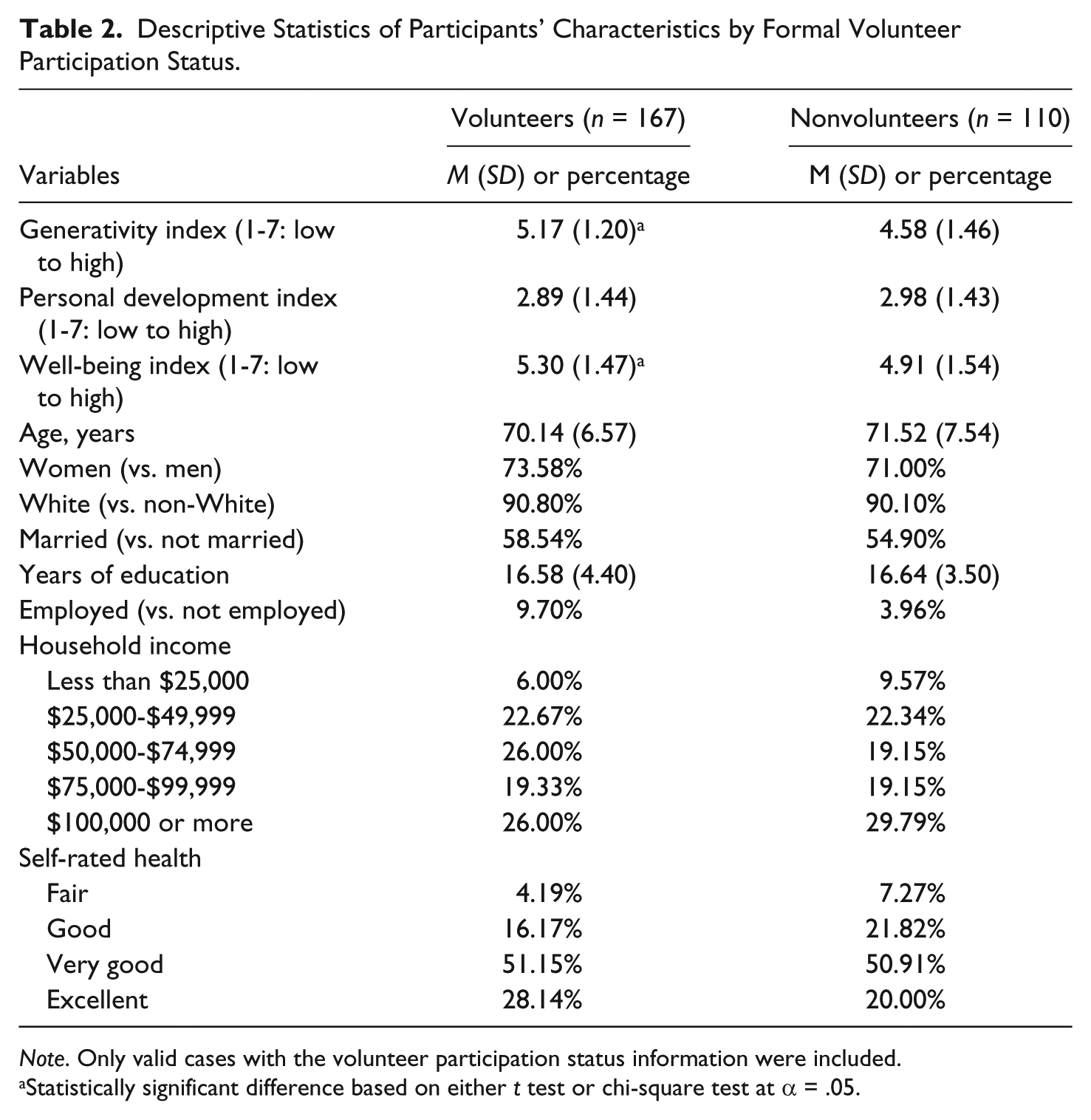
Note. Only valid cases with the volunteer participation status information were included.
Statistically significant difference based on either t test or chi-square test at α = .05.
Results from EFA identified three underlying volunteer motivation factors (see Table 1). To begin with, the first factor (five items) was named generativity because the survey items that loaded onto this factor were in alignment with the major component of SST (Carstensen et al., 1999), including perceived contribution to the community, and making use of work and life experience. The second factor (five items) is personal development as indicated by key concepts including advancement of one’s own, as well as colleagues’ career, and serving together with coworkers. Although the majority of the respondents in this study was not employed and the respondents’ interpretation of the meaning of career appears to be diverse, personal development was an important motivation for volunteering. Finally, well-being (three items) was also identified as a volunteer motivator. The respondents indicated that they would volunteer more if volunteering resulted in better health, longevity, and happiness. However, five of the volunteer motivation items which are related to serving oneself, volunteering fixed hours, cost, transportation issues, and social network did not highly load onto any of the identified factors (i.e., factor loadings < 0.4).
Table 3 shows the estimated odds ratios (ORs) from unconditional and conditional binary logistic regression models. The final model (Model 2) returned two significant predictors including the generativity index (OR = 1.55, standard error [SE] = 0.17, p < .05) and self-rated health (OR = 1.39, SE = 0.16, p < .05). On average, a 1-point increase in the generativity index was associated with 1.55 times greater odds of being engaged in volunteer activities. Also, better self-rated health was positively associated with greater odds of volunteering. Interestingly, the personal development and well-being indices were not predictive of volunteering activities in both the unconditional and conditional models.
Estimated ORs From Binary Logistic Regression Models on the Volunteer Participation Status.
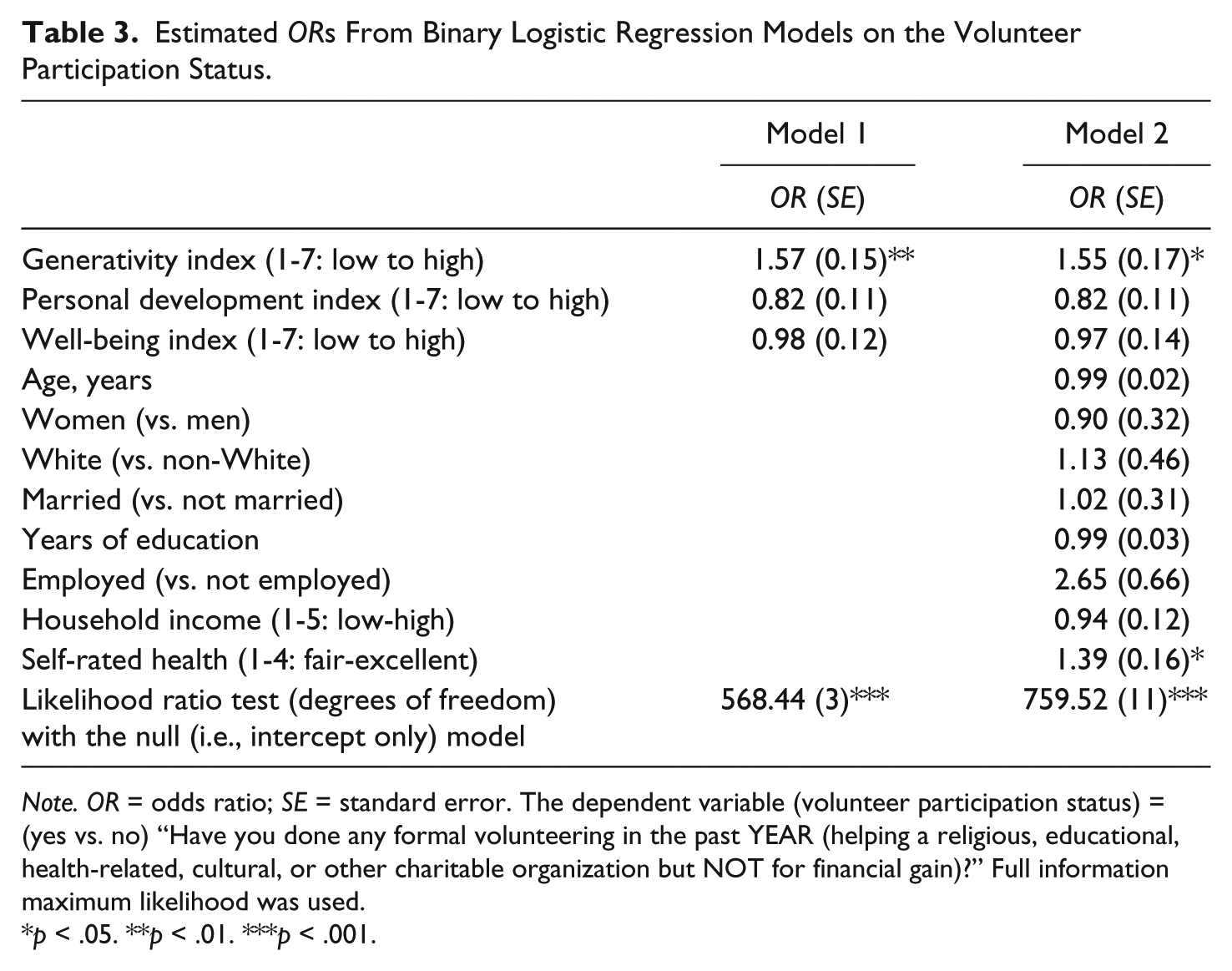
Note. OR = odds ratio; SE = standard error. The dependent variable (volunteer participation status) = (yes vs. no) “Have you done any formal volunteering in the past YEAR (helping a religious, educational, health-related, cultural, or other charitable organization but NOT for financial gain)?” Full information maximum likelihood was used.
p < .05. **p < .01. ***p < .001.
Discussion
Using data collected from older lifelong learners in urban communities in the United States, this study addressed two research questions—the underlying structure of individuals’ motivations for volunteering and predictors of volunteer behavior. Results revealed three underlying volunteer motivation factors: generativity, personal development, and well-being among this sample of older lifelong learners. As suggested by SST (Carstensen, 1992), generativity was identified as a motivation for volunteering. Also, personal development is a volunteer motivation, which is arguably driven by desire to learn and develop among older adults (AARP, 2000). Furthermore, given the tendency for age-related health declines, it is sensible that older adults may be motivated by the possible health benefits of volunteering. Overall, the findings are consistent with previous studies (Clary et al., 1998; Okun & Schultz, 2003; Reed et al., 2013). As Carr et al. (2015) indicate, empirical evidence suggests that emotional gratification, personal development, and well-being (e.g., physical and mental health) are benefits from volunteer activities and these may be applicable to the older adults in this study.
With regard to the predictors of volunteer participation among older lifelong learners, generativity and self-rated health were important. Generativity is often described as emotionally valued activities that help future generations and/or communities, and include activities such as volunteering (Adler et al., 2007; Carstensen, 1992; Kleiber, 1999). Despite the fact that only about one in four adults are engaged in formal volunteering in the United States (The Corporation for National and Community Service, 2014), about 60% of OLLI participants in this study volunteered for or through nonprofit organizations during the past year. Arguably, older lifelong learners may be a particularly generative subgroup. In this respect, lifelong learning programs should certainly consider opportunities for meeting the socioemotional needs of this subgroup. Nevertheless, generativity is not only an underlying motivation but also a significant predictor of actual volunteer participation among older lifelong learners.
Self-rated health was also predictive of actual volunteer participation among active OLLI members. The associations between health and volunteering are multifaceted. Individuals who are engaged in formal volunteering often appreciate its health benefits (Li & Ferraro, 2005; Pilkington et al., 2012). The creation and expansion of their social support network is one of the main mechanisms through which volunteerism promotes health (Li & Ferraro, 2006). As such, once one experiences the health and social benefits from volunteer activities, it is most likely to result in subsequent participation. At the same time, health problems could be major barriers to volunteer participation (Kart & Kinney, 2001). However, in this study, the vast majority of respondents reported good health. Therefore, the underlying mechanism of health and volunteering may be unique among older lifelong learners. One may argue that lifelong learners could be selectively healthier and more generatively inclined than the general older population, and therefore, health might have been an outcome rather than a facilitator of volunteerism in this study. Future research needs to clarify the pathways and directionality between health and volunteer behaviors among older lifelong learners in more detail.
Personal development and well-being, as well as the sociodemographic characteristics that were not associated with actual volunteer participation, merit a brief discussion. Although personal development and well-being were theoretically sound and empirically supported motivations for volunteering (Carr et al., 2015; Morrow-Howell, Hinterlong, Rozario, & Tang, 2003; Okun & Schultz, 2003), they were not predictive of actual volunteer behaviors among OLLI participants in this study. One possible explanation for these findings is that the general public may not be aware of such benefits from volunteering. Indeed, older lifelong learners in general, and those in this study in particular, are generative and motivated toward personal development (AARP, 2000). Therefore, their volunteer participation may be solely driven by generativity, and the actual benefits from volunteering (i.e., informal learning, well-being, social support) might have been taken for granted. Here, while more empirical research is needed to verify such a possible explanation, volunteer education seems to have great potential for promoting volunteerism in lifelong education programs.
Findings about respondents’ sociodemographic characteristics were not consistent with previous research (Clary et al., 1998; Rotolo & Wilson, 2004; Tang et al., 2012). However, it should be noted that the OLLI participants in this study appeared to be, for example, more generative, more educated, and healthier than the general older population. That is to say, older lifelong learners in urban communities may be a unique subpopulation. Additional research is needed to clarify the role of sociodemographic characteristics in terms of participants’ selection into lifelong learning programs and volunteer behaviors.
Based on the findings from this study, several implications can be drawn. To begin with, based on the identified underlying motivations, the systematic needs assessment revealed that older lifelong learners are interested in emotionally gratifying experiences such as volunteering. This is a justification for considering service learning (e.g., volunteerism) in lifelong learning programs (Eyler, 2002; Lewis, 2002; Wilson et al., 2006). Also, older lifelong learners in this study were particularly generative and actually engaged in formal volunteerism. Therefore, recruitment and retention of volunteers among older lifelong learners could be rather straightforward. Indeed, older adults are significantly more likely to volunteer if they are asked to do so (Independent Sector, 2000). Moreover, in view of these findings (i.e., generativity) and additional unique learning opportunities through volunteer activities (Cook, 2011; Eyler, 2002), volunteerism could function as a service learning component for participants in lifelong learning programs. A few successful examples of the hybrid model with lifelong learning and volunteerism for older adults already exist, such as the Legacy Leadership program (see Wilson et al., 2006; Wilson & Simson, 2003). Existing lifelong learning programs and education policies for older adults may consider these implications to meet the demands not only of generative older lifelong learners but also of aging communities/societies. However, service learning in lifelong learning programs for older adults is known to be resource- and labor-intensive and difficult to implement (Eyler, 2002). Future research should systematically analyze the challenges (e.g., logistics, funding) and solutions (e.g., collaborations with local nonprofit organizations and universities) of lifelong learning programs with service learning components.
Limitations
One of the limitations in this study is that despite the relatively large sample of older lifelong learners, the findings should not be extended to different populations. Future studies need to verify the findings in different and perhaps more diverse older populations (e.g., race and ethnic minorities, lower income) in order to improve the generalizability. By the same token, the potential effects of local community characteristics (e.g., urban vs. rural; wealthy vs. poor) as well as volunteer policy (e.g., local government volunteer program; corporate volunteer programs) should be taken into account. On a related note, the older lifelong learners who participated in this study completed the survey online. Given the prerequisite for adequate computer literacy, an online survey might have limited the respondents to those who are more familiar with technology. Also, the assessment tool (i.e., the Santa Clara Volunteer project survey by the Stanford Center on Longevity) adapted in this study has not yet been psychometrically validated or tested with older lifelong learners. EFA findings in this study can be the basis for more rigorous validation studies with larger samples. Additionally, the definition of volunteerism was limited to formal volunteering (i.e., for or through nonprofit organizations). Other types of volunteering such as informal or job-related volunteering were beyond the scope of this study.
Contributions
Despite these limitations, this study provided empirical evidence on the potential roles of volunteerism in lifelong learning programs for understudied older adults, and identified specific motivation factors that are linked to actual volunteer activities. Specifically, this study made three significant contributions to the volunteer-related literature. First, this study focused on volunteer motivations among the understudied population of older lifelong learners. To date, little research has been published about this learning context and its relationship to volunteerism. Second, identifying the underlying motivation factors for actual volunteer participation among older lifelong learners is useful not only for possible implementation of service learning opportunities but also for volunteer recruitment strategies by nonprofit organizations in general. Finally, this study reported high volunteer participation rates among older lifelong learners. Accordingly, lifelong learning programs and nonprofit volunteer organizations may collaborate to enhance learning opportunities for older adults as well as volunteer recruitment. Taken together, this study provides a basis for further research and suggests that service learning in lifelong learning programs for older adults may be beneficial.
Conclusion
This study of older lifelong learners in an urban community in the United States identified participants’ underlying volunteer motivations including generativity, personal development, and well-being. However, regression analysis showed that only generativity and self-rated health were associated with actual participation in volunteer activities. In our aging U.S. society, lifelong learning programs face several emerging challenges including a lack of systematic needs assessments and an understanding of their suitability for generative older adults. Although further research is warranted to extend the findings from this study to other U.S. communities with diverse populations of lifelong learning programs, our findings suggest that the incorporation of volunteerism into lifelong learning programs may enhance the breadth of learning opportunities (both inside and outside of classroom settings) and meet the socioemotional needs of generative older lifelong learners. This type of hybrid model for older adults has great potential for developing more comprehensive lifelong learning programs that enhance individuals’ quality of later life in a more holistic manner.
Footnotes
Declaration of Conflicting Interests
The author(s) declared no potential conflicts of interest with respect to the research, authorship, and/or publication of this article.
Funding
The author(s) received no financial support for the research, authorship, and/or publication of this article.