




Abstract
Translating theory to practice has been a historical concern of adult education. It remains unclear, though, if adult education’s theoretical and epistemological focus on meaning making transcends the academy. A manifest content analysis was conducted to determine if the frequency of meaning making language differed between the field’s U.S. scholarly journals, practitioner journals, and federal policy writings. This study found the field’s leading U.S. practitioner journal and its federal policy agencies used meaning making language less so than the field’s leading U.S. scholarly journals. Scholarly and practitioner journals, however, showed increased use since 2003. Implications for increasing meaning making language in practice and policy are discussed. Limitations for generalizing findings and interpreting authors’ intentions are addressed.
So much of the talk in adult education now centers on meaning making. Open any issue of the field’s most prominent U.S. journals and you will likely notice authors peppering their language with the phrase. So widespread is it that even the field’s differences are now framed in the language of meaning making. Consider Rose’s (2011) recent observation: “There seems to be an inherent distinction between research that examines meaning making and research that makes meaning” (p. 44). In the past, one may have simply described this as a difference in descriptive and explanatory research aims, but now it is a matter of what researchers do with meaning. Has this epistemological shift and accompanying language been similarly embraced by practitioners and policy makers, or has it emerged as an esoteric lexicon of sorts that serves to demarcate the field from practice and policy?
As ubiquitous as the language of meaning making has become, I often wonder how it aids the field. What does it do for learners and their learning? How does it assist educators in their practice? Is it useful for predicting and influencing adult learning? Does it strengthen the field’s influence on U.S. policy? I ask because admittedly I value the field’s historic aim of developing theory that translates to practice (Jarvis, 2004), I welcome works that seek to initiate newcomers into the field by illustrating ways of “linking theory and practice” (Merriam & Bierema, 2014), and I support long-standing symposia such as the Research-to-Practice Conference that expressly seek ways of affixing the two domains. Unabashedly, I see adult education as an applied discipline whose theory should inform policy and practice. I suspect this is also a concern voiced in over 7,000 manuscripts emerging from a cursory Google Scholar search of the phrases “adult education” and “theory to practice.” Of course, other normative positions should and do exist within the field. Those who see theory as descriptive rather than functional—in a sense professing a cultural anthropology of adult learning of sorts—are regularly applauded, and their works abound in the field’s leading journals. Might there be room for multiple views here?
From my perspective, if one sees practice as the education of adults, one bears a great responsibility to advance a body of knowledge that helps adults and educators attain their aims for learning. This requires a lexicon that adults and educators find helps them do things better. Has the field’s current language and understanding of meaning making done this? And have those we serve and work with adopted it for their work?
These questions emerge from my own leanings toward pragmatism and the ideas of early scholars such as William James (1928) and John Dewey (1938). From their perspectives, a theory’s value comes from how well it is applied and whether it works satisfactorily (McDermid, 2006). A pragmatist position sees little value in such things as a theory’s ontological validity or its tenets’ inherent meaning, preferring instead to view meaning as something created by the observer and closely related to the thing of concern’s function. To assess the accuracy of theoretical claims, then, pragmatists adopt a pragmatic truth criterion, which asserts that what is true is what works (Tӧrneke, 2010). What works is assessed by first declaring one’s goals and then empirically weighing how well those goals are realized by a certain belief or practice. If one aims for theoretical language that informs practice, one can assess whether it works by determining how well it has been adopted by practitioners.
In this article, I aim to determine if the language of meaning making has transcended the academy to U.S. practice and policy. To accomplish this, I conduct a manifest content analysis of the field’s use of meaning making terminology. To situate this analysis historically, I first discuss the origins of meaning making as a pedagogical focus and how adult education as a field has come to adopt this focus. In the subsequent analysis, I identify and quantify the field’s current use of the term (and related terms) in prominent U.S. research journals, practice journals, and federal policy writings. I then evaluate these data using inferential statistics to determine if the field’s scholars use these terms more than the field’s practitioners and policy makers. I conclude by discussing implications, limitations, and emergent questions. Throughout, I limit the scope of this analysis—including its literature review, data set, and discussion—to U.S. theory and practice in order to address a particular theoretical tradition and a similarly politicized body of practice.
Origins of Meaning Making as a Pedagogical Focus
The idea of meaning making as a pedagogical focus appears to have emerged alongside what is now called constructivism. In contrast to objectivist or positivist perspectives of learning that see knowledge as something that is acquired, constructivists see knowledge as something that is made by the learner (Erickson, 2007). Accordingly, knowledge always has idiosyncratic meaning developed through integrations between content and a learner’s personal experiences, assumptions, and behaviors (McCusker, 2013). The idea of acquiring immutable knowledge becomes nonsensical from this perspective because the meaning a person ascribes to content can never be perfectly duplicated, regardless of an educator’s best attempts. From this perspective, then, learning at its most basic is the act of making meaning.
One of the earliest champions of constructivism was the renowned developmental psychologist Jean Piaget. Piaget (1950) proposed that people advance through increasingly complex developmental stages characterized by different ways of organizing and understanding experience. The details of these stages—and their ontological validity—have been routinely challenged (see Merriam, Caffarella, & Baumgartner, 2007) and are mostly tangential to this discussion. Importantly, though, Piaget (1953) stressed that in each stage learners create meaning for their experience by integrating the salient details of those experiences with existing mental frameworks—constellations of images, symbols, and sensations he later called schemata. These schemata, he explained, are continuously changing with experience, as are the meanings they impart on experience. Meanwhile, the Piagetian David Ausubel (1963) coined the phrase meaningful learning to describe learning that asks learners to relate new content to their previous knowledge. Perry (1970) later extended these ideas, arguing that young adults create new meanings by simultaneously filtering their experience through various epistemological “positions”—that is, culturally derived ways of viewing the world. From these perspectives, the meanings ascribed to content may differ considerably depending on a learner’s developmental capacity and epistemological vantage.
The constructivist Robert Kegan (1994, 2000) later proposed a developmental theory of meaning making that profoundly influenced adult education and further entrenched the concept in its lexicon. Advancing what he called a constructive–developmental perspective, he described five hierarchical epistemologies—originally termed “meaning making systems” and “orders of consciousness”—that people may progress through over their life span. Each epistemology depicts a more advanced way of understanding experience through positioning one’s conceptualized self differently in relation to elements of experience. Kegan argued that for certain meanings to emerge, learners must first engage the world at higher levels of consciousness. For some, then, the meanings derived by others may be beyond their current abilities, or what Kegan calls “over their heads.” Kegan associated three orders of consciousness with adult development. These have particularly interested adult education researchers for their acknowledgement of the role of the self in learning—a focus aligned with the field’s concern for self-awareness and self-improvement (Michelson, 2011), as well as its humanist and andragogical assumptions (Tennant, 1998).
Around the same time, Jack Mezirow (1991) proposed what he saw as a uniquely constructivist theory of adult learning, transformative learning theory. From this perspective, adults interpret the meaning of their experiences through a lens of deeply held assumptions. Often tacit but sometimes explicit, these assumptions influence how adults understand and act in the world (Hoggan, 2014). When adults experience something that contradicts or challenges their way of negotiating the world—an event Mezirow (1995) called a disorienting dilemma—they may begin to examine their assumptions and develop new interpretive processes. Mezirow saw this as transformative because it irreversibly changed how one makes meaning. No longer does one attribute a previous meaning to a new experience; one now interprets an old or new experience from a revised set of assumptions and expectations (Mezirow, 1991). Mezirow’s theory has proved popular in the field, spawning numerous articles in the Journal of Transformative Education (JTED), and innumerable followers and theorists who have revised and extended the theory (Taylor & Cranton, 2012). At its core, though, it remains principally concerned with how adults make meaning of their experience (Mezirow, 1991).
Adult Education’s Focus on Meaning Making
The early constructivists and theorists who applied these ideas to adult education have inspired a zeitgeist in the field for meaning making. Sensing this trend, Adult Education Quarterly (AEQ) editors Elisbeth Hayes and Arthur Wilson christened 2003 with an editorial titled, “Making Meaning of Meaning Making.” Subsequent researchers have moved to substantiate the idea’s place in adult education by proposing that adults are better able to evaluate how meaning is made (Kumi-Yeboah & James, 2012). Others, inspired by Mezirow’s theory, have argued that fostering awareness to change how adults make meaning of their experience is now an objective of adult education (Dirkx, Mezirow, & Cranton, 2006). Some, attempting to establish a difference between meaning making and what has traditionally been called learning, have set the foundations of their research firmly in Mezirow’s theory, highlighting meaning making as “one of the most important tasks in adulthood” (Nitschke & Malvicini, 2013, p. 130) and “at the heart of adult learning” (Jones, 2009, p. 10). Further demonstrating its allure, Michael Newman (2014), a vocal critic of transformative learning theory, recently noted, “I am pleased to find myself ending these further thoughts in accord with [Mezirow]—learning is about meaning making” (p. 353).
It is not surprising, then, that as the field adopted the idea and language of meaning making so too did it embrace those of reflection. Mezirow (1991) simultaneously championed reflection and its variant critical reflection as defining characteristics of adult learning, processes for helping learners create new meaning. Numerous experiential learning theorists, too, have described reflection as a process of transforming meaning from personal experience (Fenwick, 2001; Jarvis, 2006; Kolb, 2015). Rodgers (2002), in a review of Dewey’s works, concluded that Dewey’s reflection was partly a meaning making process of relating new experiences with prior learning. It is now common to read scholars describe reflection as a producer or enabler of meaning making (Barg, 2009; Burns, 2015; Fetherston & Kelly, 2007; Grill, 2003; Jordi, 2011; Mälkki, 2012; Sealey-Ruiz, 2007; Smith, 2009), and its variant, critical reflection, as something similar (Baily, Stribling, & McGowan, 2014; Ntseane, 2011).
As adult education further embraced the idea of meaning making through reflection, it began to coalesce these ideas into a form of learning apart from those seemingly unconcerned with meaning making. This distinction became a normative one, with the latter drawing labels such as rote learning (Ausubel, 2010) and nonreflective learning (Jarvis, 2006). Perhaps the most widespread label was proposed by Mezirow (1991) who, borrowing from Habermas (1971), popularized the distinction between emancipatory, communicative, and instrumental learning. Instrumental learning he saw as stemming from environmental manipulation and hypothetical deductive reasoning. When describing its relationship with meaning, he shifted his language to note, “meaning is acquired” (Mezirow, 1991, p. 73) rather than made. Although not explicit, this highlights Mezirow’s view that instrumental learning involves imposed meaning rather than made meaning. And while not dismissive of the former, his writings illustrate a preference for the latter and its associated domain, communicative learning. “Most significant learning in adulthood” he argued, “falls into this category because it involves understanding, describing, and explaining intentions; values; ideals; moral issues; social, political, philosophical, psychological, or educational concepts; feelings and reasons” (Mezirow, 1991, p. 75).
Much of the field has followed suit and further promoted the normative distinction between learning that asks adults to acquire others’ meaning and learning that asks them to make their own. Some have further differentiated meaning making approaches from those that simply convey facts (Monk, 2013), transfer knowledge (Konopasky & Reybold, 2015), focus on information (Le Cornu, 2009), or help learners acquire the meanings of others (Feinstein, 2004). This distinction has noticeably influenced the types of learning some adult education researchers are willing to investigate. For instance, Dirkx et al. (2006), after acknowledging that meaning making occurs in nearly all forms of learning, argued that despite the widespread presence of content-focused, teacher-led learning, his focus “is on those aspects of our learning that we find personally meaningful,” experiences that “will serve to further elaborate and deepen our understanding of who we are and our relationship with others and the world” (p. 132). Such declarations have strong echoes of Mezirow’s (1991) normative distinction and appear indicative of the current ethos in the academic field. But has this shift in values and theory transcended the academy?
Method
There are numerous ways of addressing this question. One may examine, for instance, the types of learning outcomes used by practitioners, policy makers, and researchers, or the expressed theories-in-action of practitioners and policy makers. Both targets may be considered indicators of how well theory translates to practice. But both, like all indicators, have limitations. Assessing learning outcome types may illustrate a discrepancy but leave the researcher unaware of the reasons for this discrepancy. Furthermore, the data set from which the researcher draws her or his conclusions will undoubtedly be constrained by issues of access, introducing selection bias that threatens the study’s internal validity. Assessing the expressed theories-in-action of stakeholders is similarly limited. Issues related to cognitive biases, retrospective reporting, and socially desirable responses will likely prevent the researcher from extricating stakeholders’ actual practices from their self-reported practices.
Like these, language is an indicator with limitations. It may indicate innumerable factors, but likely one particularly germane to this issue: cultural influence (Stokhuijzen, 2009). The presence of language in one culture often indicates the adoption of cultural practices from another (Drake, 2008; Lib, 2010). If we see practitioners and policy makers as representing a culture distinct from researchers and theorists, we can assess the approximate transfer of practices across these cultures by the transfer of language associated with these practices. The cultural distinction between researchers/theorists and practitioners/policy makers—referred to as the dual culture thesis—has long been used to explain the theory to practice gap (Ginsburg & Gorostiaga, 2001). For this analysis, a failure of meaning making language to transfer to the language of practice and policy may indicate its theoretical basis and normative position have not been significantly adopted in these areas.
To explore this issue, a two-part manifest content analysis was undertaken. McBurney and White (2010) describe manifest content analysis as a method of analyzing text by counting the frequency of words or phrases. Coding schemes for target words and phrases are constructed a priori, and results are analyzed using inferential statistical procedures. The aim is to identify trends and differences in the frequency of usage rather than authors’ latent intention or meaning. Accordingly, it is an appropriate methodology for addressing this study’s research questions, which seek to determine if the frequency of meaning making language in U.S. scholarly, practitioner, and policy outlets differs. Manifest content analyses have recently helped identify changes in frequency of text discussing children and second-hand smoke (Patterson, Semple, Wood, Duffy, & Hilton, 2015), human papillomavirus vaccination programs (Hilton, Hunt, Langan, Bedford, & Petticrew, 2010), and male social workers (Giesler & Beadlescomb, 2015).
Manifest content analysis is a hyptothetico–deductive methodology rooted in scientific values, which seek to systematically and collectively advance knowledge about the world. It does not aim for objectivity or value neutrality—an aim now rejected by many social scientists (Long & Sanford, 2016)—rather it seeks to test claims and maximize rigor to improve the reliability and reproducibility of data. It takes what I consider an appropriately narrow scientific view, aiming to first determine if a language disconnect exists so that others can then investigate, on solid grounds, why it exists. Such values may seem discordant with those of constructivist epistemologies that promulgate meaning making language. But a scientific approach to categorizing knowledge does not require the target phenomena ascribe to scientific values; it only requires the phenomena are natural (as opposed to supernatural) and measurable. The question in our case is not whether the language of meaning making is morally good, aesthetically pleasing, uniformly representative, or ontologically true, but whether it is used in practice and policy. I see this as a scientific question.
It is also important to address how manifest content analysis accounts for the constructivist belief that meaning is contextual and that various words often address similar phenomena. Manifest content analysis is not dismissive of this obvious characteristic of language, rather it is focused on another equally important characteristic: shared meaning. Adult education researchers have concertedly worked to define the concept of “meaning making” for the field. In an entry on meaning making in the “Encyclopedia of Adult Education,” Hunt (2005) notes, “At its simplest, meaning making refers to a lifelong process of understanding the world and our relationship with it” (p. 391, italics added). When publically discussing this phenomenon, it is difficult to imagine a scenario whereby the field’s stakeholders encourage one another to substitute their preferred idiosyncratic synonym. Instead, the field depends on shared meaning to communicate effectively as a community of research and practice. To a reasonable extent, we assume a publically intelligible disciplinary language that eschews repeat explanation. Manifest content analysis seeks to uncover the degree to which this occurs by measuring the frequency of language usage across stakeholders.
Method 1: Practitioner Journal and Scholarly Journals
The following research question guided phase one of this analysis: “Do U.S. practitioner and scholarly adult education journals differ in how frequently they use meaning making terminology?” Its corresponding hypothesis was that practitioner journals use the terminology less so. The target sample was those journals sponsored by the American Association of Adult and Continuing Education: AEQ, JTED, and Adult Learning (AL). The former two (AEQ and JTED) are self-described scholarly journals targeting researchers (among others), whereas the latter (AL) is a self-described “practitioner-oriented” journal targeting explicitly those who design, manage, teach, and evaluate adult education programs. All peer-reviewed articles in these journals since 2003 (JTED’s inaugural year) were obtained from online archives. The average annual number of peer-reviewed articles were as follows: AEQ (M = 17.4, range: 14-20), JTED (M = 19.1, range: 13-25), and AL (M = 19.8, range: 12-32). Mean annual publications did not differ significantly, F(2, 36) = 1.05, p > .05. In all, 732 articles were retrieved.
Using the search function in Adobe Acrobat Reader DC, researchers electronically scanned articles for the phrases “meaning making,” “making meaning,” “make meaning,” or “made meaning.” Phrases were selected a priori from knowledge of the topic. An article containing a phrase in its abstract, main body, or footnotes was coded as having used meaning making language. All other articles, including those only containing a phrase in their reference sections, were coded as not having used meaning making language. To ensure interrater reliability—that is, the degree on which reviewers agreed that an article either contained meaning making language or did not—a randomly selected subset of article from each journal was rated by two coders. Articles from the years 2006 and 2011 (n = 144) were reviewed by a second trained coder using the above coding system and computer program. An interrater reliability analysis using Cohen’s kappa indicated almost perfect agreement, κ = 0.98, 95% confidence interval [0.94, 1], p < .001. Following coding, annual usage ratios were calculated for each journal for the years 2003 to 2015. Usage ratios were calculated by dividing the number of articles using meaning making language in a given year by the total articles published that year. Usage ratios allowed for parametric statistical analysis, between journal comparisons, and within journal trend visualization. Each journal produced 13 usage ratios.
Data were analyzed with SPSS 23. An analysis of covariance was conducted to determine if mean usage ratios differed between journals while adjusting for the covariant, time. Because sample sizes were equal, the test was robust against potential violations of normality and homogeneity of variance (Field, 2013). Simple planned contrasts using the Bonferroni correction were used if necessary to specify which groups differed.
Method 2: Federal Policy Writings and Scholarly Journals
The following research question guided phase two of this analysis: “Do U.S. federal adult education policy writings and scholarly adult education journals differ in how frequently they use meaning making terminology?” Its corresponding hypothesis was that federal policy writings use the terminology less so. The target sample was online resources from the Department of Education’s Office of Career, Technical and Adult Education (OCTAE). Within the United States, the OCTAE is the federal agency responsible for administering and coordinating programs related to adult education and literacy, career and technical education, and community colleges (U.S. Department of Education, 2016a). They also manage the Adult Education and Family Literacy Act (AEFLA), which contributes 25% of operating costs to state-run AEFLA-funded programs, the primary access point for adult basic education and literacy in the United States (Duke & Ganzglass, 2007). These programs serve over 1.8 million adults each year (U.S. Department of Education, 2014). Through the AEFLA, the OCTAE sponsors a national leadership initiative called Literacy Information and Communication System (LINCS) whose function is to expand evidence-based practice and improve the quality of adult education programs.
Each year the OCTAE produces numerous fact sheets, technical assistance sheets, and white papers outlining best practices and policies for career and technical education, adult education and literacy, and community colleges. All resources posted online during this writing (n = 52) were obtained from OCTAE’s online archives (see U.S. Department of Education, 2016b). Beginning 2011, OCTAE’s professional development branch LINCS has published reports covering such topics as guidelines for mathematics instruction, teaching excellence in adult literacy, evidence-based reading instruction, literacy programs for improved achievement, technology in corrections education, and meeting English language learner needs (see LINCS, 2016). All LINCS’s resources posted during this writing (n = 29) were obtained from LINCS’s online archive.
Resources from OCTAE and LINCS were scanned electronically using the described coding system. To ensure interrater reliability, a randomly selected subset of OCTAE resources (20% of sample) was rated by two trained coders. An interrater reliability analysis using Cohen’s kappa could not be calculated as coders agreed on all resources. Because numerous years saw a small number of published resources from each outlet, yearly usage ratios were not calculated. These were easily biased by a single reference to meaning making terminology. LINCS’s sole report from 2011, for instance, contained a reference to “make meaning,” creating a yearly usage ratio of 1.00. To overcome this limitation, data were recorded using 1 × 2 contingency tables for each outlet with columns indicating the frequency of resources that (a) referenced terminology or (b) did not reference terminology.
Data were analyzed with SPSS 23. Two chi-square tests of independence were performed to examine the relation between publication outlet and frequency of usage of meaning making terminology. The first compared the frequency of meaning making terminology usage in OCTAE resources and AEQ and JTED publications. The second compared frequencies in LINCS resources and AEQ and JTED publications. Post hoc tests using standardized residuals were used if necessary to specify which groups differed.
Results
Practitioner Journals and Scholarly Journals
The average usage ratio from 2003 to 2015 for AEQ was .327 (SD = .105), indicating 32.7% of its articles referenced target phrases. For the same years, JTED’s average usage ratio was .402 (SD = .127), and AL’s .089 (SD = .061). A closer look at Figure 1 indicates that, excluding AEQ’s anomalous decline in 2015, AEQ and JTED had higher ratios than AL every year by a factor of two to five. Usage ratios appeared to change as a function of time, F(1, 33) = 8.83, p = .005, η2 = .20, indicating that meaning making terminology was used increasingly by all outlets. When adjusted for time, usage ratios differed significantly between journals, F(2, 33) = 40.84, p = .000, η2 = .70. Planned contrasts using the Bonferroni correction revealed no difference in usage ratios between AEQ and JTED, t(33) = −2.08, p = .138, but significant differences between AL and AEQ, t(33) = 6.61, p = .000, and AL and JTED, t(33) = 8.67, p = .000. From this, we can conclude that AL uses these terms less so than AEQ and JTED. A second analysis of covariance examining the interaction of time and publication outlet was not significant, F(2, 33) = 1.33, p = .280, supporting the assumption of homogeneity of regression slopes. Additionally, time and journal were entered into a linear regression model to assess for violations of independence. A Durbin–Watson test indicated errors were uncorrelated (d = 2.34).
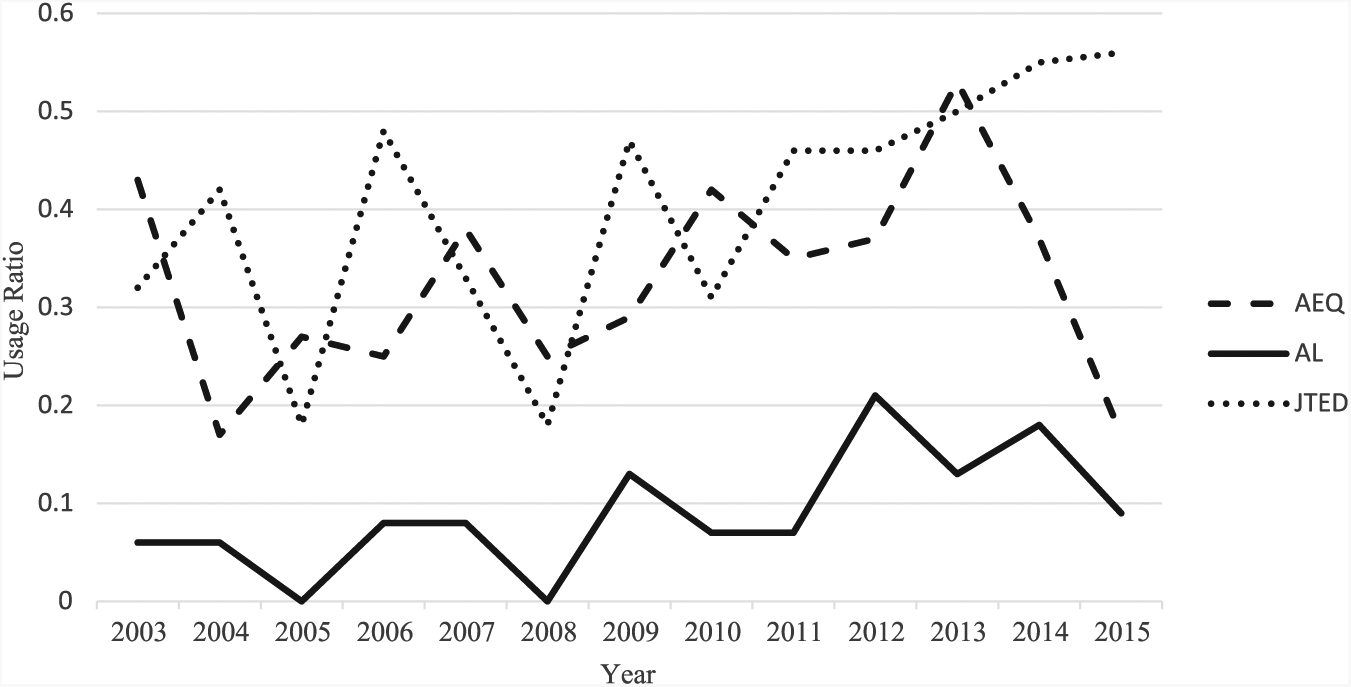
Phrase usage for AEQ, AL, and JTED from 2003 to 2015.
Federal Government Policy Resources and Scholarly Journals
No resources on OCTAE’s website (N = 52) referenced “meaning making,” “making meaning,” “make meaning,” or “made meaning.” Comparing frequencies with AEQ and JTED indicated a significant association between outlet and phrase usage, χ2(2) = 29.98, p < .0001. Post hoc analyses of standardized residuals revealed that the number of OCTAE resources containing meaning making terminology was lower than one would expect if outlets used the terminology similarly (z = −4.1).
Of the 29 online resources published by LINCS since 2011, three used meaning making terminology (10.3%). Comparing frequencies with AEQ and JTED revealed a significant association between outlet and phrase usage, χ2(2) = 15.17, p < .01. Post hoc analyses again revealed that the number of LINCS publications containing meaning making terminology was lower than one would expect if outlets used the terminology similarly (z = −2.4).
Discussion
These findings illustrate that U.S. practitioner and policy outlets in adult education use meaning making terminology less so than academic outlets. The field’s principal American practitioner journal, AL, uses meaning making language 3.7 times less often than its principal academic journal, AEQ, and 4.5 times less often than its principal specialty academic journal, JTED. The field’s sole U.S. federal agency disregards the language entirely, and its affiliate for expanding evidence-based practice, LINCS, uses it in 10.3% of its writings, paralleling AL’s 8.3% overall usage ratio but diverging from those of AEQ (32.7%) and JTED (39.1%). This suggests a language disconnect between theory and practice at odds with the field’s historically pragmatic aims. It appears that the promise of generalized meaning making models for practice (see Merriam & Heuer, 1996) has not yet materialized, although increasing use of meaning making language across journals suggests the possibility.
Distal Explanations
Some attempting to make sense of the disconnect between the language of research and practice have offered potential explanations. While none is directly applicable to these findings without follow-up research, each offers future researchers a narrative from which to guide research efforts. Importantly, these explanations suggest that the language disconnect observed here may be an outcome of larger, systemic issues or of the language itself.
In his notable work on curriculum theory titled, “Between Hope and Happening: Text and Context in Curriculum,” Lundgren (1983) explains how the gap between what educators intend to do (i.e., what they say) and what they actually do is always affected by power relations between and within arenas of formulation (policy), transformation (politics), and realization (teaching). Struggles for such things as resources, ideology, positioning, and professionalization shape the divide between the language and actions of research and practice. Usher and Bryant (2003) add that the language of adult education research often diverges from that of its practices because of its historic dependency on the fields of psychology and sociology, both of which have normalized a language of observation that distances the researcher from the learner. Although meaning making language attempts to overcome this, the authors note that researchers may be incapable of seeing this disconnect because they have been socialized into the language community promoting it.
Distal explanations such as these highlighting power and historical influence pertain to all issues within the field and undoubtedly warrant continued investigation. But so too do proximal explanations, which are often more accessible and, in their own way, useful in helping researchers attain goals. When I reflect on these findings, several seem worth considering. I introduce them here as impetuses for future research.
Proximal Explanations
Might the current language disconnect in meaning making terminology parallel a larger one between the foci of the field’s academic research and its practitioners’ work? In other words, has a language disconnect emerged because the language of researchers’ interests differs from the language of practitioners and policy makers’ interests? As transformative learning theory becomes the predominant research perspective of the field (Merriam & Bierema, 2014), have its researchers embraced a form and language of adult learning ignored by practitioners and policy makers alike? Some have voiced similar concerns. Past American Association of Adult and Continuing Education president Amy Rose (2011) observed, “Adult education has eschewed any attempt to bring its research into areas that have implications for the actual practice of the field” (p. 44). Academics, she argued, have bifurcated the field in a way that practitioners have not by focusing mostly on critical and emancipatory perspectives at the expense of how to do something differently or better. Unfortunately, this critique is not new. Twelve years earlier, Dean (1999) similarly bemoaned, “Our current research does not meet the needs of the field. It does not meet the needs of practitioners who desire research that has a direct relevance to their areas of practice” (p. 23).
Although in light of such critiques the results of this study could be seen as revealing discrepancies between research and practice, they alone communicate only discrepancies in language. It may be that practice is not radically different from researchers’ writings, but the way practitioners explain their practice is. This suggests practitioners are unaware of the language of meaning making. But a closer look suggests something different. Of the 309 authors contributing to AL articles, all either identify (in order of frequency) as professors, instructors, administrators, graduate students, professionals, consultants, or researchers. Most hold doctorate degrees and nearly all hold master’s degrees. It is unlikely that those sharing a similar professional socialization remain unaware of meaning making terminology.
An alternative view is that practitioners, or those writing for practitioners, do not find the language of meaning making useful for attaining their aims. Reviews of the meaning making literature in other fields have concluded it has conceptual and methodological limitations preventing empirical research from keeping pace with theoretical writings (Park, 2010). Its abstract nature may render it more amenable to hypothesis generation than hypothesis testing (Park, 2010). From an educational perspective, Panasuk and Lewis (2012) have similarly argued that meaning making language confuses rather than clarifies and contributes to the gap between rhetoric and practice: “The use of the encumbered terms, such as meaning making, negotiation of meaning, and making sense, provides very little help to understand what learning is and how learning outcomes can be revealed and assessed” (p. 8).
For practitioners seeking evidence-based practices this may be problematic. Might they avoid this language because they fail to see what it does and how it is applied? In their review of the research–practice gap in K-12, Hirschkorn and Geelan (2008) have concluded that for practitioners to value research, they must see how it applies to their teaching. To accomplish this, the authors suggest universities employ research translators “adept at speaking the language of both practitioners and researchers and . . . able to translate research findings into a form that is comprehensible, plausible, and . . . potentially fruitful to practitioners” (p. 11). Might similar efforts to translate how one applies the language of meaning making to practitioners’ aims be helpful to the field?
One might also consider a related argument that the language of meaning making is a tool for researchers to understand practice and, therefore, is inapplicable to practitioners’ efforts to do practice. This is an interesting claim because in a sense it highlights a divergence between researcher and practitioners’ aims. Practitioners and policy makers I suspect are often concerned with research that helps them, as Rose (2011) notes, “do something differently . . . and do it better” (p. 44). They may not necessarily seek to understand the putative forces shaping their practice. This is similar to Park’s (2010) earlier critique noting how meaning making language tends to work well at generating hypotheses (explanations of practice) but poorly at testing them (determinations of effectiveness).
A third explanation could be that the epistemology underlying this language is not valued in many practical arenas. As noted earlier, adult education’s positioning toward a unified meaning making epistemology has emerged from constructivist assumptions, which further a normative distinction between learning that asks adults to acquire others’ meaning and learning that asks them to make their own. Might some adult education practitioners and policy makers ignore meaning making language because their stakeholders (including learners) expect adults to acquire common meanings? Consider, for example, the important learning that occurs when novice welders or phlebotomists—to name two skilled occupations—acquire the foundational, and temporarily nonnegotiable, knowledge of their fields. Does the field’s epistemological preference and associated language exclude educators who facilitate such learning, including those who administer technical training, competency-based learning, and skills-based learning programs?
Similarly, outside the United States, one common research tradition that has embraced the language of meaning making is sociocultural theory. Sociocultural theory posits that adult learning is less an individual endeavor than a social process influenced by a person’s dominant culture and the contextual factors of which that culture is comprised (Alfred, 2002). These factors “[influence] the meaning that the learner makes of the learning process” (Alfred, 2002, p. 8). Although sociocultural theory shifts the focus from the individual to the community, it shares the same basic epistemological assumptions underlying most constructivist accounts, distinguishing itself only in its emphasis of the social and its adherence to social constructivism. This is, as Alfred (2002) notes, a departure from the Eurocentric worldviews that have dominated U.S. adult learning theory. But does this departure again magnify a values disconnect? Might the language of meaning making, when advanced from this perspective, again fail to pervade U.S. practice and policy because of deeply embedded cultural narratives promoting individualism (Imada, 2012) and self-reliance (Izaguirre, 2014)? Might practitioners and policy makers avoid the language of meaning making when advanced from this perspective because they disagree with its underlying epistemology?
Differing values form the core of the two-culture thesis used to explain the research to practice gap (Ginsburg & Gorostiaga, 2001). Theorists and researchers, the thesis argues, often see knowledge as a subjective political artifact, something serving particular interests within a particular sociocultural context. Although this view aligns well with the epistemology underlying meaning making language, it differs from how policy makers and practitioners see knowledge. From their perspective, knowledge is often something one arrives at objectively and uses in a systematic and technically rational manner. Ginsburg and Gorostiaga point to Schön’s (1995) work on professional learning as promoting this view. Although Ginsburg and Gorostiaga (2001) critique the two-culture thesis, arguing that groups are rarely homogenous, it can serve to further investigations of general cultural preferences for the epistemology underlying meaning making language.
There does indeed appear some shared epistemological leanings among researchers identifying with the field of adult education. In an earlier work, I noted the field’s general disregard for skills-based learning and suggested the practitioner working in these areas “look elsewhere for guidance” (Roessger, 2016). Interestingly, skills-based learning featured prominently in two influential OCTAE reports devoid of meaning making language. The 2014 presidential report “Making Skills Everyone’s Business: A Call to Transform Adult Learning in the United States” (U.S. Department of Education, 2015) described key strategies for improving teacher effectiveness, learner engagement, and diversity and equity in adult education. The 2012 presidential report “Investing in America’s Future: A Blueprint for Transforming Career and Technical Education” (U.S. Department of Education, 2012) described how educators and administrators could create more rigorous, relevant, and results-driven programs; effective teachers and faculty; and accessible and equitable programs. If such broad initiatives fail to use language common to the field’s academic publications, can its researchers still claim influence on U.S adult education policy?
Implications and Limitations
From these findings, several implications emerge with potential value to the field. Importantly, these implications are themselves normative, aiming to improve the reach of adult learning theory to practitioners and policy makers. First, consistent with Park’s (2010) suggestions to improve meaning making literature, adult education researchers should provide operational definitions to ensure meaning making terminology has shared meaning and avoids devolving into vague, abstract language. Researchers should continue to distinguish “meaning making” and its associated phrases from such closely related terms as “understanding,” “sense making,” “interpreting,” “thinking,” “knowing,” “comprehending,” and “perceiving.” What does meaning making describe that these other terms do not? What do learners do while making meaning that they do not do when doing these other things? Second, researchers should provide generalized empirical findings showing how practices utilizing meaning making terminology affect measurable learning outcomes, an aim of many adult education practitioners and policy makers interested in evidence-based practices. Last, after clarifying what meaning making is and what meaning making does, researchers should identify what areas or aims of adult learning are least applicable to meaning making language and in what ways the language can be reconceptualized to broaden its reach. For instance, how might meaning making apply to a situation in which an adult acquires, through formal learning, prescribed meaning of a new tool or procedure? Might we somehow still see this as a form of meaning making, in the same way we see the construction of a house from a blueprint—rather than from scratch—a form of house making?
The results of this study are limited in that they reveal the frequency of meaning making language in the field (i.e., the manifest content) rather than the latent content or meaning of that language. Future research should extend these findings using qualitative content analyses to explore subjective themes such as authors’ intention and meaning. The combination of manifest and latent content analysis has been termed summative content analysis (Hsieh & Shannon, 2005). When paired with this study, latent content analysis would allow for further interpretation of the language discrepancy between research and practice outlets. Currently, I and others are conducting extensive qualitative latent content analyses on these data to complement these findings. We see such a two-tiered approach as a way to balance the field’s “near total dominance of qualitative research methods within the top-cited . . . adult education journals in recent years” (Fejes & Nylander, 2015, p. 115). An interesting and relatively new methodological approach that may also shed light on these findings is multiple correspondence analysis. Combining the qualities of quantitative and qualitative content analysis, multiple correspondence analysis seeks to identify a data set’s underlying structures of categorical variables and represent them graphically. I see this as a particularly exciting opportunity to illuminate the speculative distal and proximal explanations offered here.
An additional limitation to this study is its generalizability. This study targeted only U.S. outlets. Because adult education is an international field, these results should not be considered indicative of the field as a whole. Researchers should consider replicating or extending this study with other countries’ outlets to determine if its findings generalize.
Conclusion
Translating theory to practice has been a historical concern of adult education. It remains unclear, though, if adult education’s theoretical and epistemological focus on meaning making transcends the academy. This study has identified a discrepancy between the frequency of meaning making language in U.S. scholarly, practitioner, and policy outlets. It appears the language of meaning making resides largely in the academy and has yet to equally permeate U.S. practice or policy writings. Increased usage in the field’s U.S. practitioner journal, however, indicates the language of meaning making may be making inroads.
Footnotes
Acknowledgements
I would like to thank the three anonymous reviewers for their valuable suggestions and Dr. Barbara Daley for her continuous support and mentorship.
Declaration of Conflicting Interests
The author(s) declared no potential conflicts of interest with respect to the research, authorship, and/or publication of this article.
Funding
The author(s) received no financial support for the research, authorship, and/or publication of this article.