



Abstract
Postsecondary transition programs have emerged to prepare adult learners to enter college with either limited or no remediation work needed in developmental education. This article examines the results of a pilot study, in which participants (ages 20 years and older who held GED® credentials or high school degrees) received accelerated instruction in reading, writing, mathematics, learning framework, and college knowledge. These transition programs, which took place at five sites in Texas, used a short-term (10 weeks or fewer) but intensive (at least 120 contact hours) cohort intervention model. Of the 20 pairs of pre- and postprogram assessments, which evaluated student achievement gains in reading, writing, and, mathematics, 18 resulted in statistically significant increases. However, many participants who realized achievement gains did not reach the college readiness benchmarks (as measured by the assessment instrument) in all three subject areas. However, evidence suggests that these students are better prepared academically than before the program.
Keywords
Introduction
In the 21st century, the U.S. economy has become inextricably linked to a global economy, dramatically increasing the demand for a more educated workforce. Anthony Carnevale (2007) is one of many economists who has documented the need for more citizens to earn postsecondary credentials. Although there is still a need for low-skilled workers, job demand for high-skilled occupations has greatly expanded over the past two decades (Autor, 2010). Furthermore, the U.S. Bureau of Labor Statistics (2016) projects that from 2014 to 2024, jobs requiring a postsecondary credential (from certificates to master’s degrees) will grow by as much as 14%. While most of the discussion about increasing college participation centers on current and recent high school graduates, adult learners are another important population that could potentially increase matriculation at higher education institutions.
According to the U.S. Census Bureau (2014), of the 210 million adults in the nation who are 25 years or older, approximately 62 million (nearly 30%) hold only a high school degree or credential. Another 35 million of this population (nearly 17%) have some postsecondary experience but do not possess a college degree. These 97 million individuals represent a potential pool to draw from in increasing the number of adults who hold a college credential. Postsecondary attainment for adult learners is not only critically important for meeting the needs of the workforce, but it is also the pathway that frequently determines entry into the middle class (and higher) for the degree earners. The U.S. Bureau of Labor Statistics (2015) reported that in 2014 adults earned an average of $20,730 without a high school degree, $35,540 with a high school degree, $49,470 with an associate degree, and $69,260 with a bachelor’s degree.
Despite the need for adult learners to matriculate in college, most of the focus in adult education and literacy has been on programs for lower skilled adults and on high school equivalency programs—especially prior to the Workforce Innovation and Opportunity Act of 2014 (Rutschow & Crary-Ross, 2014; Tamassia, Lennon, Yamamoto, & Kirsch, 2007). This focus is understandable, given that the first step for the nearly 25 million adults (25 years or older) without a high school degree is to obtain a certificate of high school equivalency by passing an approved assessment like the GED® exam. Activities such as GED classes remain critically important components of adult education programs. However, moving beyond these core services and supporting adult students in their desire to successfully transition into higher education is also an important role for adult education. As noted by Zhang (2010), the GED credential is no longer an educational endpoint; rather, it can become a bridge to postsecondary education.
However, many GED holders (particularly those who earned the credential prior to 2014, the year the test became more arduous) may not be well positioned for success in college. For example, Patterson, Zhang, Song, and Guison-Dowdy (2010) found that of the national 2003 cohort of “GED Passers” who entered college, only 11.8% earned a college credential by 2009. Furthermore, only 11.6% of the college-enrolled GED Passers in the 2004 cohort obtained a credential by 2010 (Zhang, Guison-Dowdy, Patterson, & Song, 2011). Although Reder (2007) recognized that there are several potential barriers to postsecondary success for GED-credentialed adults, he stated that many in this population lack the necessary academic skills to succeed in college-level coursework. Similarly situated are adults who graduated from high school but did not attend college immediately after graduation and now wish to continue their education; many of these adult learners also have academic deficiencies that may negatively affect their success in college (Tokpah & Padak, 2003). The high dropout rate for both of these populations is often linked to the number of developmental education courses these students take. Research studies indicate that the more time students spend in developmental education, the less likely they are to stay in school and earn a degree or certificate (Alliance for Excellent Education, 2006; Bailey, 2009).
Because of these dropout patterns, college readiness is particularly important for the adult learner seeking entry into postsecondary education. David Conley (2008) defines college readiness as the level of preparation a student needs to enroll and succeed—without remediation—in a credit-bearing, general education course at a postsecondary institution. The subjects most germane to college readiness are reading, writing, and mathematics because these disciplines serve as a foundation for a wide range of curricular offerings in college. However, Conley acknowledges that “preparation” goes beyond content knowledge since other factors such as students’ academic behaviors (e.g., study skills) also contribute to readiness. Many adult learners can lack the learning and study skills needed for college-level work. Furthermore, these leaners need to learn how to navigate the complicated college system itself, beginning with the processes of applying to college and for financial aid (Rutschow & Crary-Ross, 2014; Zafft, Kallenbach, & Spohn, 2006). Accordingly, many adult learners who desire to further their education beyond their high school credentials face these challenges in closing gaps in content, learning skills, and college knowledge.
Fortunately, some innovative postsecondary transition programs for adult learners have emerged to address the needs of this important population before they matriculate in college (Rutschow & Crary-Ross, 2014; Zafft et al., 2006). The primary purpose of these programs is to prepare program graduates to enter college with either limited or no additional remediation work needed in developmental education. Another purpose of transition programs is to provide participants with the learning and study skills associated with successful college students and with the knowledge of the full array of available college support resources. Perhaps equally important is that these students enter college with the confidence to succeed in meeting their postsecondary education goals. These programs hold promise in changing the academic landscape for adult learners.
Beginning in 2010, the Texas Higher Education Coordinating Board (THECB), which is the agency that oversees public higher education in the state, awarded grant funding to 12 adult education and literacy programs to establish accelerated transition programs for GED graduates and reentering adult learners with high school degrees. Program participants were intending to gain entrance into postsecondary education, but their academic skills in reading, writing, and mathematics were below college level. Although the THECB grant funding ended in 2014, many programs continue to operate using different funding sources. The intent of the programs—called Intensive College Readiness Programs for Adult Education Students (IP-AES)—is to provide participants with the necessary skills to enter and become successful in college.
This article will examine the results of the fourth and last year of the pilot, including the data analysis from preprogram to postprogram testing on two outcome measures for college readiness. More specifically, this study addressed the following research questions:
Literature Review
Postsecondary transition programs for adult learners, including the Texas IP-AES programs, typically have the following eight components and characteristics: (a) managed enrollment and accelerated instruction, (b) college readiness curricula, (c) student-directed pedagogy, (d) career guidance activities, (e) college knowledge instruction, (f) learning framework instruction, (g) enrichment activities (e.g., tutoring and academic advising), and (h) connections to higher education institutions. Below are brief descriptions of each component and any empirical evidence that supports their effectiveness.
Managed Enrollment and Accelerated Instruction
Unlike many adult education programs, which allow continuous open entry into classes, adult transition programs typically operate under a closed-enrollment system, whereby students must enter and exit the program during specified time periods (Rutschow & Crary-Ross, 2014). This policy allows instructors to present sequenced lessons of a set curriculum to students. It also promotes the formation of student cohort groups, which often leads to strong participant bonding, with students using each other as resources both inside and outside the classroom. Research from regular college environments shows increased student persistence and academic performance for such models (Tinto, 1997, 2003). Furthermore, Imel (2002) reports that cohort members engage in critical reflection and transformative learning in adult education settings.
Adult transition programs also tend to have an intensive (e.g., 120 contact hours) but accelerated (10 weeks or fewer) instructional schedule, unlike traditional adult education programs, which can occur in semester-based units. The accelerated timeframe of transition programs is intended to mitigate some of the barriers adult learners often face, including heavy work schedules and parental responsibilities (Rutschow & Crary-Ross, 2014; Zafft et al., 2006), thereby potentially increasing retention rates of participants. While acknowledging that attrition in adult education programs has complex causes, Comings, Parella, and Soricone (1999) report that there are high participant attrition rates for longer adult education programs (e.g., yearlong). However, little is known about the length of instructional time needed to affect specified gains in achievement in different disciplines for adult learners at varying skill levels (Rutschow & Crary-Ross, 2014). Therefore, more research is needed to determine the optimal number of student contact hours for each subject to both enhance program retention and promote achievement.
College Readiness Curricula
Unlike the K-12 standards-based curricula, the content in many adult education and literacy programs can be anomalous, varying from instructor to instructor (Rutschow & Crary-Ross, 2014). In addition, some programs have based their instruction on test preparation materials—an unsound educational practice (Beder & Medina, 2001; Martin & Broadus, 2013). Many adult college readiness transition programs, however, have recently based their curricula on a set of standards that identify the knowledge and skills graduates of the programs need to know to be successful in college or a career (Rutschow & Crary-Ross, 2014). For example, programs in states that have adopted the Common Core State Standards for college readiness often align their curricula to these standards (National Governors Association for Best Practices & Council of Chief State School Officers, 2010; Pimentel, 2013). However, since these standards are relatively new (released in 2010), the research on the use of the standards in adult transition programs is ongoing, with the results still forthcoming.
In 2008, Texas public school teachers and college faculty worked together to develop the state’s own College and Career Readiness Standards (Texas CCRS) that apply both to current high school graduates and to adult learners who wish to attend college (Texas Higher Education Coordinating Board & Texas Education Agency, 2009). The Texas IP-AES programs base their curricula on these standards, and faculty of the programs not only use the standards for English/language arts and mathematics, but they also refer to the cross-disciplinary components of the Texas CCRS. These standards include problem solving, reasoning, intellectual curiosity, and use of data and technology, as well as reading, writing, and researching across the curriculum (Texas Higher Education Coordinating Board & Texas Education Agency, 2009).
Student-Directed Pedagogy
One way to foster these kinds of cross-disciplinary skills is to use student-directed instruction. Although many adult education classes rely on traditional lecture-dominated pedagogy, instructors in adult transition programs are more likely to use a variety of instructional methods, including those that actively engage the student in the learning process. Examples of such instruction include group learning, peer review, project-based learning, research assignments, and portfolio development. Empirical evidence suggests that student-directed instruction better prepares students for postsecondary success than lecture-only teaching (Beder & Medina, 2001; Rutschow & Crary-Ross, 2014).
Career Guidance
Many postsecondary transition programs for adult learners provide guidance to students in developing possible career choices (Rutschow & Crary-Ross, 2014). Typical career training activities include group presentations, one-on-one career counseling, and student completion of career inventories. However, some adult transition programs use “contextualized curricula” in which instructional materials in reading, writing, and mathematics are presented within the context of specific careers in fields such as business or health care. Content-pertinent instruction has been a long-held tenet of adult education learning theory (Sticht, 1997), as this approach is thought to provide more curricular relevance for the learner. Furthermore, more recent research (Martin & Broadus, 2013) suggests that contextualized instruction produces greater student engagement in the learning process and results in increasing the rate of students entering and succeeding in college. Yet contextualized adult education transition programs often presuppose that students already have a strong desire to enter a particular career. The grant-funded Texas IP-AES programs chose not to use this approach.
College Knowledge and Learning Framework
Many adult transition programs provide information to their students about the various academic and other support resources available to students on their entry into college (Rutschow & Crary-Ross, 2014). These programs often deliver this information through either seminars or “college knowledge” or “college success” classes, sometimes supplemented by one-on-one sessions with an adviser or transition specialist. College knowledge seminars typically help students complete their college application and financial aid forms. In addition, college knowledge classes expose students to the support resources that will be available to them in college, such as tutoring, advising, financial aid services, library resources, computer labs, math and writing centers, psychological and social services, and career counseling. Research suggests that successful college students are more likely to take advantage of these resources during their college experience (Engle & Tinto, 2008).
Texas IP-AES adult transition programs also introduce students to learning framework models and study skills techniques. Learning framework teaches students learning theory and how models of learning translate into effective study strategies for college success (Weinstein, Acee, & Jung, 2011). Students learn about motivation, goal setting, time management, and other traditional study methods, such as note-taking, test preparation, and test-taking—all within the context of learning models and applying new information. Many of the cross-disciplinary skills noted above also are addressed in learning framework instruction, such as developing higher level cognitive skills (e.g., critical thinking). Like college knowledge information, learning framework is often delivered through seminars or classes (sometimes via combined college knowledge/learning framework classes) and through one-on-one sessions. In addition, instructors of content area courses in English and math often integrate study strategies in their classes as these skills become relevant. Empirical support for learning framework is prevalent for both stand-alone classes and by integration into regular course content, such as through Supplemental Instruction models (Kenney & Kallison, 1994; Weinstein et al., 2011).
Enrichment Activities
Activities such as tutoring (optional or mandatory), mentoring (informal or prearranged), and academic advising (group or individual) are common enrichment components of adult transition programs (Rutschow & Crary-Ross, 2014). Tutoring, which offers opportunities for students to address individual content difficulties, is sometimes provided by the instructors at designated times or provided by college students or community college staff. Administrators and instructors of an IP-AES program often perform mentoring on an ad hoc basis, but mentoring can be built into the program using college students or college faculty/staff assigned to specific students. Academic advisers from the college and/or IP-AES administrators conduct advising, often at the end of the program. Advisers can help students with college enrollment and with course selection based on student interest and test scores. While the literature on the efficacy of these activities in adult transition programs is limited mostly to anecdotal information, reports on these endeavors are positive (Engle & Tinto, 2008; Martin & Broadus, 2013; personal communications with site managers of the Texas IP-AES programs, 2014).
Connection to Postsecondary Education
Many adult transition programs are located on a community college campus, which exposes students to a postsecondary environment (Rutschow & Crary-Ross, 2014). This exposure can ease the students’ eventual transition to college by helping them become more familiar and comfortable in this setting. Furthermore, these students have many of the same privileges (e.g., access to libraries, computer labs) as regularly enrolled students. When held off-campus, transition programs can still help students make a connection to a postsecondary environment by having college tours and scheduled activities on the college campus. Again, the evidence for the value of this connection to the college campus is anecdotal but positive (Rutschow & Crary-Ross, 2014; personal communications with site managers of the Texas IP-AES programs, 2014).
Overall Success of Adult Transition Programs
Although determining how much any particular component of a postsecondary transition program for adult students contributes to participant success is difficult, a study at LaGuardia Community College examined holistically the benefits of its program (Martin & Broadus, 2013). The study used a random assignment design to compare the effectiveness of LaGuardia’s GED Bridge-to-Business and Health Careers program to its traditional GED courses for several outcome measures. Results of the study found that 53% of bridge students earned a GED certificate compared with 22% of the students in the traditional program. Furthermore, 24% of the bridge students matriculated into college versus 7% for those in the traditional program. Note this was a GED-to-college bridge program for students seeking both a GED and entrance into college, and it was a program using a specific contextualized curriculum; therefore, these results cannot be generalized to other types of adult transition programs. Furthermore, these types of controlled studies of transition programs are very limited.
Method
Participants
During the fourth and last year of the IP-AES pilot (2013-2014 academic year), the grant agency funded five programs, which are the focus of this study. At each location, a community college in Texas administered the program or partnered with a local adult education center (e.g., a literacy council) to administer the program. One community college in the study is in a large metropolitan area, two are in midsize cites, and two are in smaller communities.
The students at the five sites held a GED credential or a high school degree and were at least 20 years old. These participants were highly motivated (as evidenced in one-on-one interviews) and tested minimally at a sixth-grade level (and most often at a ninth-grade level) in reading, writing, and mathematics. More specifically, these five programs enrolled students in the top two levels (Level 5 and Level 6) of the six educational skill-level classification matrix of the National Reporting System of the U.S. Department of Education, Office of Vocational and Adult Education—now Office of Career and Technical and Adult Education (2013). These two levels are low adult secondary education (Skill Level Grades 9-10.9) and high adult secondary education (Grades 11-12). In addition, some IP-AES programs accepted highly motivated adult learners from the fourth National Reporting System classification level—high intermediate basic education (Grades 6-8.9). Students in the five programs tested below the college readiness standard in at least two of the three subject areas of reading, writing, and mathematics on the state-prescribed college readiness assessment, given prior to the program. (See Instruments for more information on this assessment.)
A total of 240 students enrolled in the five IP-AES sites, and 207 students (86%) completed the program. Program completion criteria varied by site but usually included attending class with no more than three absences, taking pre- and postprogram testing, and completing all major assignments. Of the students who initially enrolled in the five IP-AES programs, 60% of them were Hispanic. The remaining students by ethnicity by percentage were White (13%), African American (12%), and Other or Unknown (15%). Females outnumbered males by almost three to one, and more than 30% of the participants indicated that Spanish was the primary language spoken at home. Mean age of the students was 30 years. Finally, only 22% of the participants’ mothers and 20% of the fathers had any college experience. See Table 1 for participant characteristics for each of the IP-AES sites.
Participant Characteristics by Program Site.
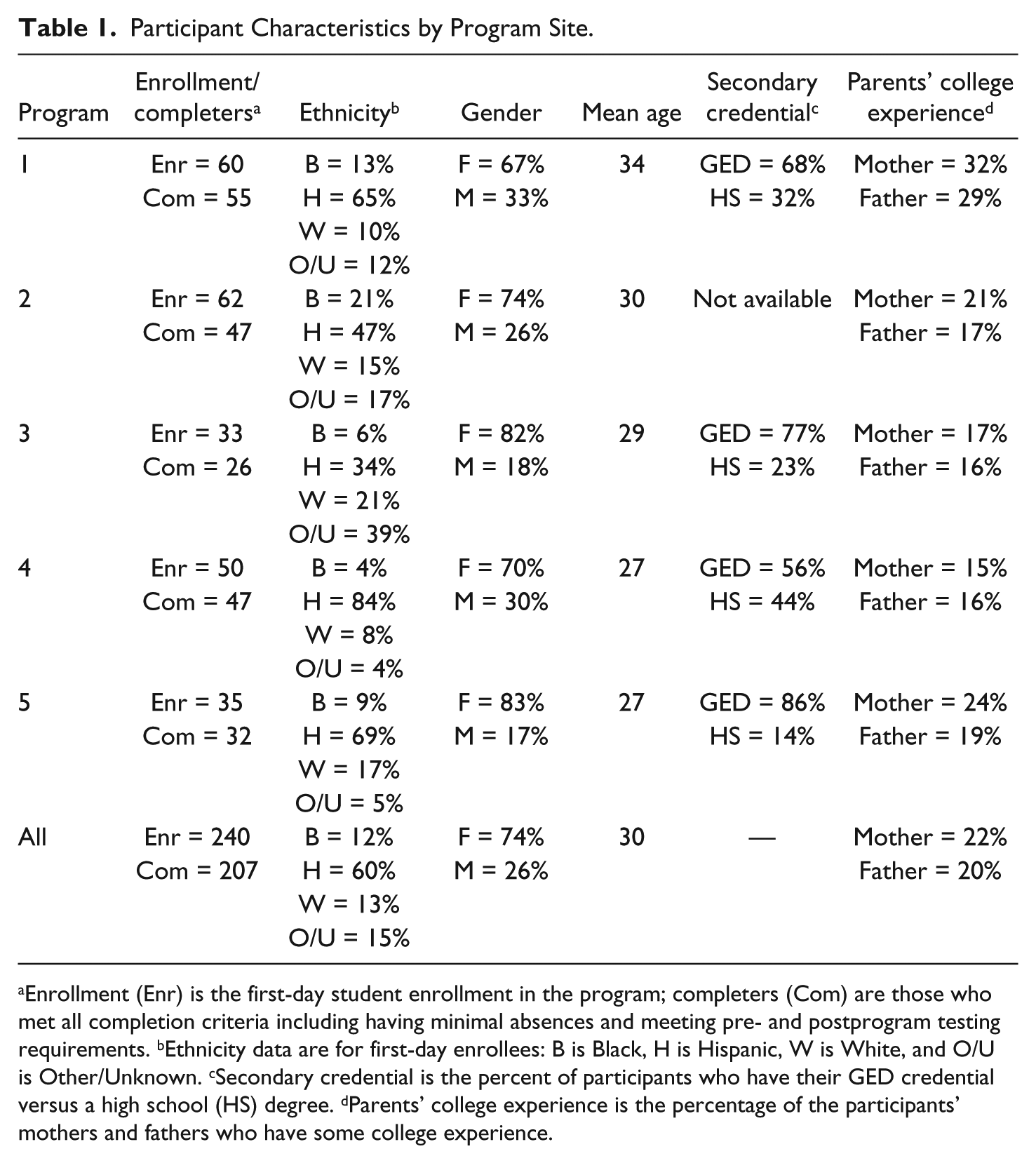
Enrollment (Enr) is the first-day student enrollment in the program; completers (Com) are those who met all completion criteria including having minimal absences and meeting pre- and postprogram testing requirements. bEthnicity data are for first-day enrollees: B is Black, H is Hispanic, W is White, and O/U is Other/Unknown. cSecondary credential is the percent of participants who have their GED credential versus a high school (HS) degree. dParents’ college experience is the percentage of the participants’ mothers and fathers who have some college experience.
Program Description
The five IP-AES programs provided their students with instruction in reading, writing, and mathematics via an English/Language Arts (E/LA) class that integrated reading and writing instruction and a separate math class. The curricula in these three subject areas were derived from the Texas College and Career Readiness Standards, which were developed by the Texas Higher Education Coordinating Board and Texas Education Agency (2009). In addition to content instruction, programs delivered information in college knowledge and learning framework through separate classes or seminars and by integrating the information into the regular content curriculum. The programs varied in length (for each site) from 6 to 10 weeks, 4 to 5 days a week, and 3 to 6 hours a day. Programs were required to have a minimum of 120 instructional student contact hours, and 20 of these hours were to address learning framework and college knowledge. Programs also provided orientation sessions, closing ceremonies, and enrichment activities such as tutoring, academic advising, career counseling, and mentoring. Each program operated between two to five cohorts for the academic year with no cohort exceeding 25 students. See Table 2 for specific characteristics of each of the five programs.
Program Characteristics.
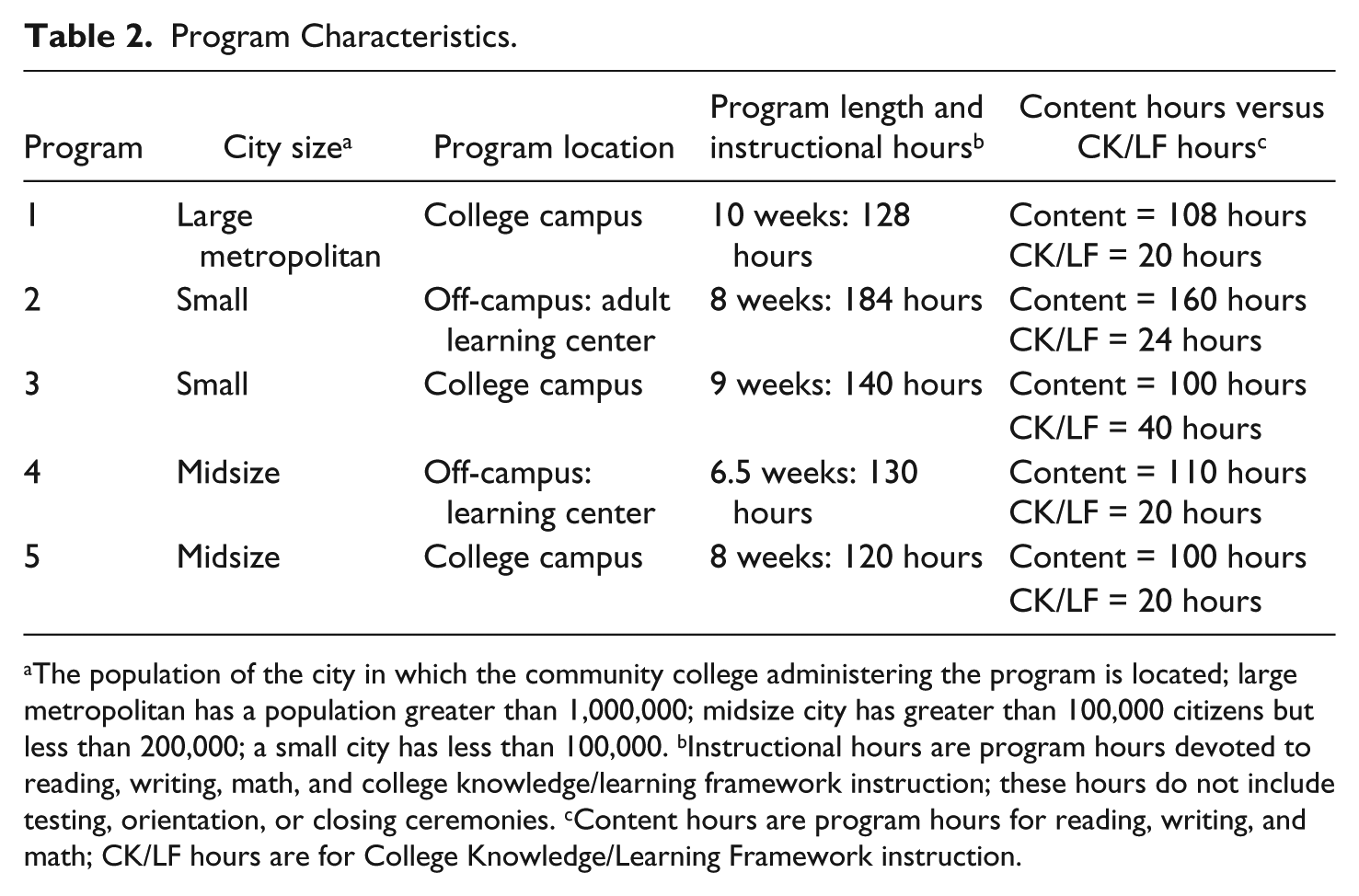
The population of the city in which the community college administering the program is located; large metropolitan has a population greater than 1,000,000; midsize city has greater than 100,000 citizens but less than 200,000; a small city has less than 100,000. bInstructional hours are program hours devoted to reading, writing, math, and college knowledge/learning framework instruction; these hours do not include testing, orientation, or closing ceremonies. cContent hours are program hours for reading, writing, and math; CK/LF hours are for College Knowledge/Learning Framework instruction.
For a comprehensive description of the IP-AES programs, refer to the manuscript, “Intensive College Readiness Programs for Adult Education Students (IP-AES): A Practitioner’s Guide to Program Implementation,” currently available on the Texas Higher Education Coordinating Board website at http://www.thecb.state.tx.us/reports/PDF/8479.PDF?CFID=53145008&CFTOKEN=45355758.
Outcome Measures and Instruments
All five programs conducted a pre- and postprogram student achievement assessment using the Texas Success Initiative Assessment (TSIA). The TSIA is a college readiness exam, developed by the College Board, that evaluates student achievement in reading, writing, and mathematics. Although other instruments measure college readiness skills, only the TSIA aligns specifically with the Texas College and Career Readiness Standards. The IP-AES curriculum is based on those standards for reading, writing, and mathematics, making the TSIA the appropriate instrument to measure achievement gains made by students over the course of the IP-AES program after instruction ended.
The TSIA has benchmark scores for college readiness in all three subjects, which were established using a modified bookmark method. The writing assessment consists of two parts—a multiple choice section and an essay section—and different combinations of these two scores qualify students for college readiness in writing.
All five programs also conducted a pre- and postprogram administration of the second edition of the Learning and Study Strategies Inventory (LASSI). This instrument is an 80-item assessment of student awareness and use of learning and study strategies necessary for success in college. Students responded on a 5-point Likert-type scale from “very much typical of me” to “not at all typical of me” to each of the 80 statements that relate to how the student studies. The LASSI instrument groups the statements into 10 separate categories, which are listed below:
Anxiety and worry about school performance
Attitude and interest
Concentration and attention to academic tasks
Information processing, acquiring knowledge and reasoning
Motivation, diligence, self-discipline, and willingness to work hard
Self-testing, reviewing, and preparing for classes
Selecting main ideas and recognizing important information
Use of support techniques and materials
Use of time management principles for academic tasks
Test strategies and preparing for tests
Note that the LASSI does not measure how effectively students are using learning skills; rather, it is a measure of students’ awareness and use of such strategies. Pretest and posttest means are given as a percentile against a national sample, with a score in the 75th percentile or above indicating an “area of relative strength” (according to the testing company).
Data Analysis
Two of the goals of the IP-AES programs (see Research Questions 1 and 2) were for students to (a) improve their skills in the areas of reading, writing, and mathematics and (b) achieve college readiness in these three disciplines. To determine whether the two goals were accomplished, the testing centers of the community colleges sponsoring each IP-AES program administered the TSIA to all students before the program began and then after all academic intervention was completed at the end of the program. There were no IP-AES staff members present during testing.
Researchers from the grant-funding agency compiled scores for students who took both the pretest and posttest TSIA for each of the three subject areas. Any student who failed to take either the pretest or posttest for a given subject area was not included in the analysis for that discipline. If some students failed to take one TSIA subject (either pretest and/or posttest) but took the other two subjects, those students were included only in the analyses for the two subject areas for which they had both pre-/postscores. Therefore, the sample sizes (or N) for the three subjects at an IP-AES program are often different for the three disciplines.
Research Question 1: Content Skills Improvement
Researchers ran a repeated-measures (within-subjects) analysis of variance (ANOVA) to determine if the posttest mean in a subject area represented a significant increase over the pretest mean. This analysis is appropriate because the same groups of subjects are being measured on the same outcome measure over a period of time—the length of the program. (Note that a paired t test could have also been used, as a comparable analysis.) Levels of significance, if they occurred, were designated at the .05 level or .01 level, meaning there was only a 5% or 1% chance, respectively, that the differences in mean scores occurred by chance. Note that the potential impact of “regression to the mean” can make it more difficult for higher pretest scores to increase on the posttest. Conversely, lower pretest scores can “tend” to be higher on the posttest because of this effect.
Then an “effect size” analysis was run for all three subject areas. The effect size is an indication of how different the mean pretest score is from the mean posttest score: that is, it is an indication of the magnitude of the difference. Different formulas measure effect sizes, but an “omega squared” method, used in this study, is commonly employed after an ANOVA analysis. An effect size of 0.15 or higher using omega squared indicates that a “large” or “meaningful” difference exists between the pretest mean and posttest mean.
Research Question 2: College Readiness Achievement
Researchers also examined the posttest means in all three subjects to determine if the means exceeded the respective benchmark scores for college readiness on the TSIA exam. Of course, posttest mean scores do not reveal the number of individual students who obtained college readiness benchmarks. Therefore, the researchers then calculated the number and percent increase of students who met the college readiness benchmark (in each subject area) on the posttest, having failed to have done so on the pretest.
Research Question 3: Increase in Learning Skills Awareness
The third goal of IP-AES programs was for students to increase their awareness and use of learning and study skills needed for college. The researchers used a pre-/postprogram administration of the second edition of the LASSI, which measures such awareness. Again, a repeated-measures ANOVA was used to determine if the posttest mean in each of the 10 learning categories represented a significant increase over the pretest mean. In addition, an effect size analysis was run for all 10 LASSI topics. Finally, researchers noted whether or not the posttest means (given as a percentile against a national sample) reached a threshold score of the 75th percentile, which can serve as a benchmark for an area of “relative strength.”
Results
Texas Success Initiative Assessment
Results of the TSIA testing are displayed in Table 3, which shows the pre- and posttest means for all five programs in reading, math, writing-multiple choice, and writing-essay.
Pre/Post Texas Success Initiative Assessment (TSIA) Mean Score Results.
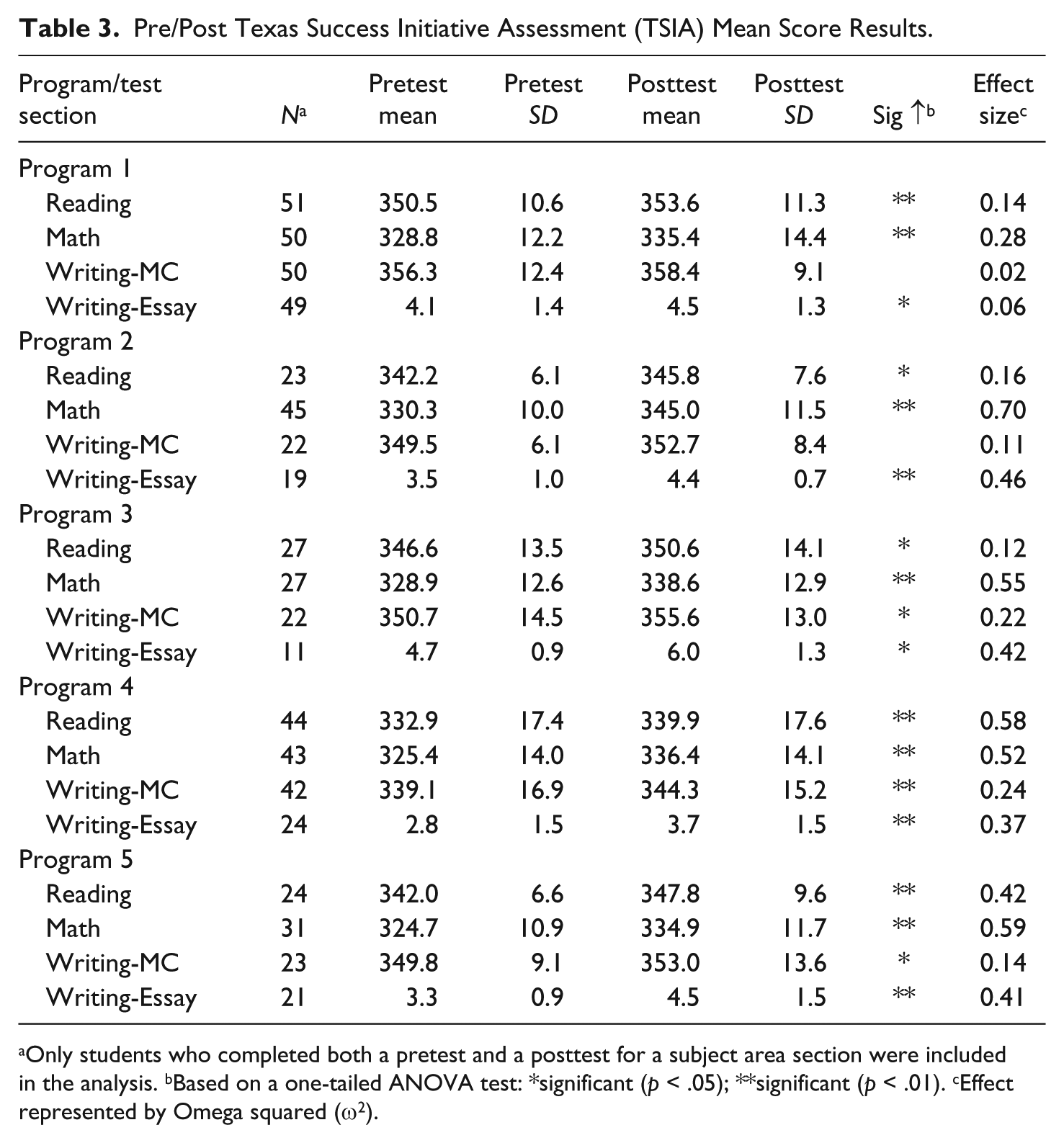
Only students who completed both a pretest and a posttest for a subject area section were included in the analysis. bBased on a one-tailed ANOVA test: *significant (p < .05); **significant (p < .01). cEffect represented by Omega squared (ω2).
Counting the two parts of writing assessment (multiple choice and essay) as separate tests, there were 20 pairs of pre- and posttests TSIA results (four tests at each of the five sites). The increases in mean scores from before content instruction began to the end of the program were statistically significant at either the .05 or .01 level of significance in 18 of the 20 pre/post pairs. And 14 of these increases had effect sizes of 0.16 or higher. Note that the two findings of “nonsignificance” from the 20 pairs of pre- and posttests were in the writing-multiple choice section of the TSIA at two of the five program sites.
These results indicate that IP-AES programs can and do affect student achievement in all three subject areas. However, it is also important to examine whether these achievement gains resulted in more students reaching the college readiness TSIA benchmarks in the three subject areas. Table 4 shows these data for all five programs.
Pre/Post Texas Success Initiative Assessment (TSIA) College Readiness Benchmark Results a .
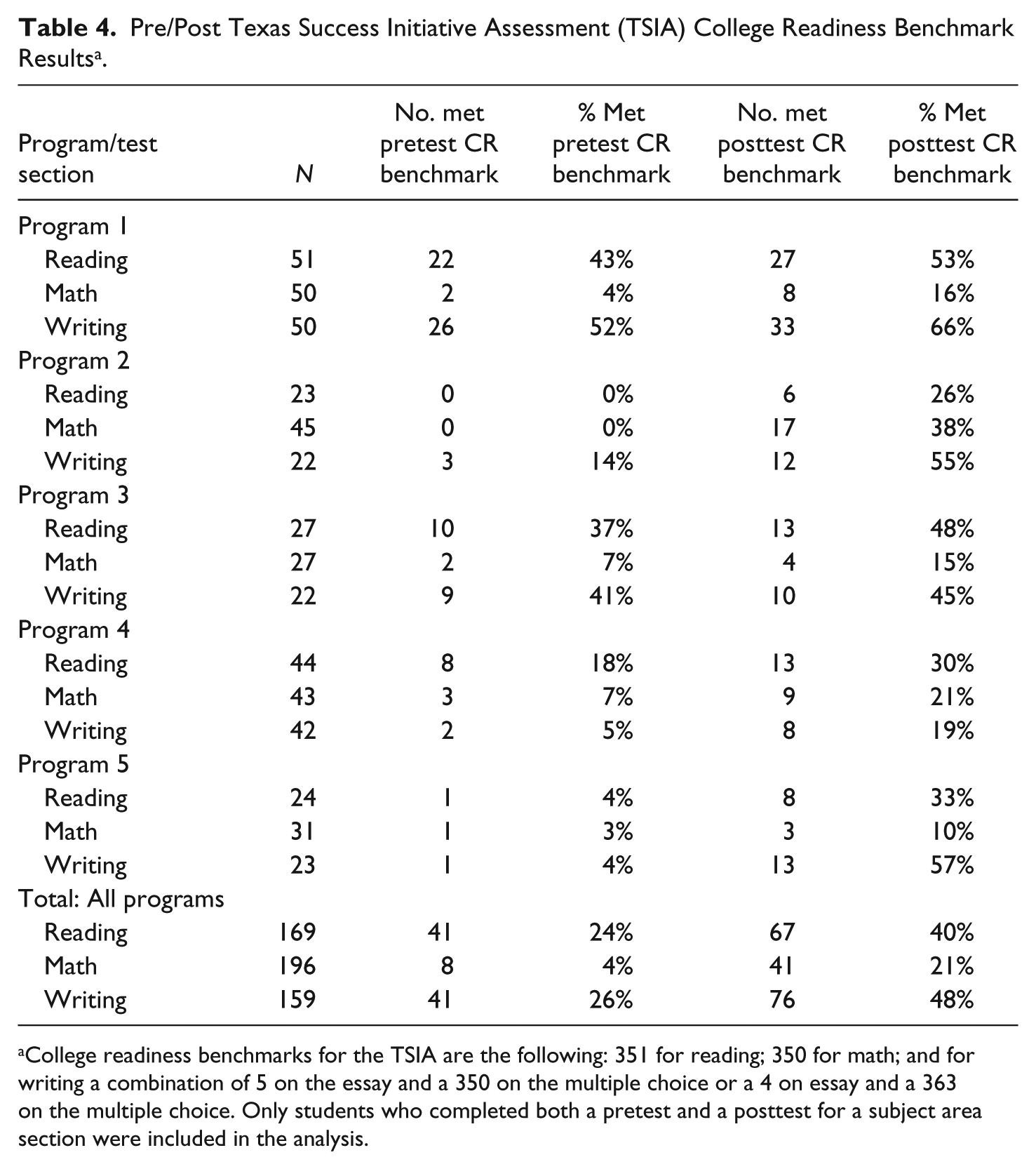
College readiness benchmarks for the TSIA are the following: 351 for reading; 350 for math; and for writing a combination of 5 on the essay and a 350 on the multiple choice or a 4 on essay and a 363 on the multiple choice. Only students who completed both a pretest and a posttest for a subject area section were included in the analysis.
Table 4 indicates that for all five programs a total of 169 students took both the TSIA reading pretest and posttest. Of those 169 completers, 41 students (24%) met the college readiness benchmark for reading (score of 351) on the pretest, while 67 students (40%) met the reading threshold on the posttest. Therefore, 26 more students obtained the benchmark on the posttest than on the pretest. In math, a total of 196 students took both the pre- and posttest, and only 8 (4%) met the math college readiness benchmark (score of 350) on the pretest, while 41 (21%) met the benchmark on the posttest—an increase of 33 students. Finally, 159 students attempted both the pretest and posttest in writing. As noted above, different combinations of multiple choice and essay scores can qualify students for college readiness in writing. Forty-one of the 159 students (26%) met the qualification for writing on the pretest, while 76 students (48%) met the standard on the posttest—an increase of 35 students. However, many IP-AES students in all programs failed to reach college readiness (as determined by the TSIA) in one or more subjects by the end of the program.
Learning and Study Strategies Inventory
Of the 50 pairs of pre- and posttests scores (10 learning categories across each of the 5 sites), 40 resulted in statistically significant increases at either the .05 or .01 level of significance. And 35 of these increases had effect sizes of 0.15 or higher. Furthermore, two programs had significant increases in all 10 LASSI categories, and another realized significant increases in 8 areas. The other two programs had 6 significant increases out of the 10 categories.
As noted above, LASSI results are given as a percentile against a national sample rather than a raw score. Therefore, the posttest percentile is an indication of whether students’ perceptions of their use of appropriate study skills favorably compared with those in the national sample. The LASSI instrument states that a benchmark at the 75th percentile or above indicates an area of relative strength. There were 11 mean posttest scores out of the 50 that reached this threshold.
Discussion of Results
TSIA Results
It is extremely promising that 18 of the 20 pairs of pre- and posttests TSIA exams across the three subject areas resulted in statistically significant achievement gains over the five IP-AES programs. Clearly, students made meaningful improvement in their reading, writing, and mathematics skills over the course of their IP-AES program. In addition, a number of individual students reached the college readiness benchmark in one or more subjects as measured by the postprogram TSIA, having failed to reach the threshold on the pretest. However, a lamentable number of participants did not reach the college readiness benchmarks in one or more of the subject areas of reading, writing, and mathematics. Of the 15 college readiness opportunities in the study (the 3 subject areas across the 5 programs), only 4 resulted in more than 50% of the students becoming college ready in a subject. It is possible that for this population of adult learners (GED holders and high school graduates with largely ninth-grade skill levels or above) more instructional contact hours are needed to make further academic advances toward college readiness.
Notwithstanding that many students in IP-AES programs were not able to reach college readiness by the end of the program, they are still more likely to be better prepared for college (because of increased skills) than if they had not participated in the program. IP-AES administrators noted that many of these students who significantly improved their content skills but who did not reach the college readiness benchmarks would be placed in a higher level of developmental education coursework (or have a possible non–course-based alternative) rather than start at the lowest level. For example, the sponsoring community colleges of the IP-AES programs use TSIA scores to place students in different levels of developmental education; therefore, a rise in TSIA scores could (and did) result in students “skipping” one or two levels (out of three) of developmental education courses in one or more of the three subject areas. Since studies show that dropout rates are higher for students who take more developmental coursework, this reduction in developmental education for these students enhances their chances of college success.
LASSI Results
It is encouraging that 40 of the 50 pairs of pre- and posttests LASSI scores resulted in statistically significant gains. However, LASSI is a measure of students’ awareness and use of learning and study skills. The instrument does not measure how effectively students are applying the learning skills. For example, a student may indicate that he or she reviews the text material before class, but the LASSI instrument does not capture how effective the student is in reviewing the material. And since each program had a college knowledge/learning framework component, one would expect these scores to go up; exposure to the material should certainly increase awareness of study skills. What remains unknown is the extent to which students are actually effective in their use of learning skills. Nevertheless, it is a positive result that so many LASSI scores increased at the end of the program.
Matriculation Information
Given that one of the ultimate purposes of college readiness adult transition programs is to help meet the needs of the workforce by producing program completers who go on to earn college credentials, it is important to track IP-AES graduates as they matriculate into higher education institutions. Most IP-AES graduates who matriculate at college after completing their IP-AES programs do so at the community college of the site of their IP-AES program, and three programs provided data on matriculation rates of program completers at their respective institutions—Programs 1, 4, and 5. Program 1 reported that of the program’s 168 students who completed its IP-AES program in the last 3 years, 65% matriculated at its community college after the program. Program 4 disclosed that 72% of the program’s 200 completers in the last 4 years enrolled at its college. And Program 5 reported that of the program’s 133 completers over the last 9 cohorts, 74% enrolled at its community college. These matriculation rates could be higher if some completers attended college at institutions other than the site of their IP-AES program. Regardless, these percentages compare favorably with the 57.5% of Texas public high school graduates (class of 2013-2014) who matriculated at Texas colleges and universities during the 2014-2015 academic year (Texas Education Agency, 2016). These figures also compare favorably to the 43% of both the 2003 and 2004 national cohorts of GED Passers who enrolled in postsecondary education by 2009 and 2010, respectively (Patterson et al., 2010; Zhang et al., 2011).
Success Criteria
The grant-funding agency allowed each of the five IP-AES programs the autonomy to establish specific success criteria for their programs prior to the beginning of the study (and before any data collection). Accordingly, the five programs had differing conceptions of success—some more ambitious than others. For example, one program set a goal of 80% of completers being college ready (via TSIA benchmarks) in at least one subject area and 50% in all three areas. In its rationale for establishing these criteria, this program stated that only 20% of its regular math developmental education students become college ready after 2 years of traditional developmental classes. This IP-AES program administrator wanted to more than double that percentage in only 10 weeks of instruction.
Another program set a goal of 50% of completers moving up at least one developmental level (or one level into college readiness) as determined by pre/post TSIA scores. (TSIA scores primarily determine placement into developmental education courses.) This program also set a goal of a 75% matriculation rate of program completers at its institution. Since the success criteria are different for each program, and data are not available for all programs, these results are not included in this article. Still, the overarching goal for IP-AES programs to increase participant skill levels and moving them as far as possible toward or to college readiness is the same for all programs.
Limitations
This research is subject to certain limitations that could potentially influence the results of the study. Because of financial constraints and methodological limits, this study did not employ a comparison group, in which a similar adult population would have taken the same pre/posttesting without receiving the IP-AES program intervention (or having an alternative treatment). Such a technique would have been useful in minimizing claims that other factors (besides the intervention) might have contributed to the study’s results. Although maturation is an unlikely threat to the study, given the relatively short time period of the program, a test–retest effect cannot be ruled out as a contributing factor of the gains realized on the outcome measures.
Conclusion
The purpose of the IP-AES programs is to promote successful transition into college for GED students and reentering adult learners with high school degrees. More specifically, successful IP-AES graduates should be able to matriculate in college with limited or no need for additional remediation work in developmental education. Evidence from this study supports the conclusion that students in these IP-AES programs made progress toward that goal. This research contributes to the limited number of studies on postsecondary transition programs for adult learners. Unlike other studies of transition program, this research reports on statistically significant content gains (in reading, writing, and math) on an assessment instrument (the TSIA) that is specifically aligned with college and career readiness standards (Texas College and Career Readiness Standards), which served as the curricular basis of the three subject areas. The study also reports on the percentages of participants who achieved college readiness in the three subject areas, having failed to have done so before the program began. However, it is important to continue to gather empirical evidence on the effectiveness of transition programs to enhance the college readiness skills of adult learners. Such research should track postprogram student success, including college matriculation rates, grades in entry-level college courses, overall college GPA, and retention and graduation rates. In addition, researchers should make efforts to determine which components of transition programs contribute most to participant success.
As the focus of adult education moves beyond core services, such as GED preparation, to include programs that help adult students matriculate at higher education institutions, then postsecondary transition programs can be part of this very important effort. Access to, and success in, postsecondary education and training often becomes the bright-line test that determines entry into the middle class. In addition, the workforce need for more individuals with higher level skills is not likely to diminish in coming years.
Footnotes
Acknowledgements
The author thanks Linda Muñoz of the Texas Higher Education Coordinating Board for her administration of this project. The author served as an independent evaluator of the program.
Declaration of Conflicting Interests
The author declared no potential conflicts of interest with respect to the research, authorship, and/or publication of this article.
Funding
The author disclosed receipt of the following financial support for the research, authorship, and/or publication of this article: This research was supported by a grant from the Texas Higher Education Coordinating Board.