



Abstract
Recognition of prior learning (RPL) is based on the principle that valuable learning, worthy of recognition, takes place outside formal education. In the context of higher education, legislation provides an enabling framework for the implementation of RPL. However, RPL will only gain its rightful position if it can ensure the RPL candidates’ success. Hence, the purpose of this study is to describe the significance of the learner profile of candidates. In this study, empirical research was conducted, which entailed the analysis of RPL candidates’ life stories as narratives. The findings illuminated specific characteristics of RPL candidates in terms of personal attributes, learning contexts, knowledge, and skills gained through a process of personal development. The conclusion is that this calls for an RPL approach that explicitly considers the significance of the profile at learner, practitioner, and institutional level.
Recognition of prior learning (RPL) candidates can be defined as students who are generally older, have working experience, and usually have family and other nonwork-related responsibilities. As stated by the National Center for Education Statistics (as cited in Hsu & Hamilton, n.d.), because of their age, knowledge, and experience they have different needs and responsibilities than students who have just completed high school. These candidates apply for recognition of their prior learning and are defined as “learners” (South African Qualifications Authority [SAQA], 2013) in an RPL process. The RPL policy of the higher education institution in which this study was conducted follows a learner-centered approach (University of South Africa, 2005a). It is therefore essential to know who these learners are, what their needs and experiences are, and what barriers to RPL assessment they may experience. The learner profile, context, and situation of RPL candidates in higher education are unique since every candidate is unique.
As a result of this uniqueness, an RPL candidate requires more comprehensive support and mentoring than the traditional student. The need for this support may arise from the gap between the context and knowledge gained through experience and the formal context of academic knowledge. Even though RPL is regarded as a learner-centered process, little is known about these learners’ prior learning. The profiling will assist in understanding these learners’ prior learning best and prepare them for success in formal educational settings. Despite numerous scholarly articles on RPL as well as research on learners’ experiences (Breier, 2001; J. Brown, 2015), there seems to be a lack of information on the learner profile.
RPL in South Africa gained prominence as a tool for access, equity and redress, and to address past unfair discrimination in education in the postapartheid context (Department of Higher Education and Training, 2016). As a result of racial-based apartheid policies and within the social context of township and rural schools, public schooling often was dysfunctional, and for different reasons, students left school without a formal school leaving certificate. An RPL policy for access to university provides opportunities to students with experience who are from previously disadvantaged backgrounds. However, a concern is that RPL has still not achieved its full potential (Letseka & Pitsoe, 2014) and draws strongly on international models with assumptions made about the candidate profile (Breier, 2011).
Central to an RPL strategy is the opportunity for extensive preparation for assessment. RPL entails the principles and processes through which the knowledge and the skills are made “visible, mediated and assessed” (SAQA, 2013, p. 5) for the purpose of recognition and access. Although the learner plays a central role in the process (Geyser, 2001) research on RPL in South Africa, reveals little reference to the learner profile. An interpretation of the profile will enable RPL practitioners to contribute to a learner-centered RPL approach where candidates are not only suitably prepared for the assessment but also for the demands of higher education.
Since the RPL approach is concerned with changing the lives of RPL candidates, it necessitates a description of the profile of candidates (Breier, 2011). The aim of this study is to describe the profile within a certain context, since the “student profile” in the South African higher education system has changed and is unique to every institution (Walters, 2015).
Theoretical Framework
Adult learning theories often seem to overlap and share common themes. Based on the work of several researchers (Freire, 1998; Knowles, 1990; Mezirow, 1991; Rogers, 2002; Vygotsky, 1978), themes include the role of previous experiences, active involvement of adults in their learning process, complex roles and responsibilities, and ability for critical reflection. Yang (2004a) summarizes the purpose of adult learning as providing an explanation of what, how, and why working adults learn. Since the focus is the working adult, the question of “who” can be added. Adult learning theories can be described from four interdependent perspectives, namely the learner-based, context-based, knowledge-based, and process-based approaches (Yang, 2004b). These perspectives will be discussed next.
Knowles’s (1990) andragogical principles and the humanist perspective draw attention to the personal attributes of adult learners, such as being needs and task oriented and motivated. What motivates adult learners to study is one of the most widely researched topics in adult education and researchers confirm that the reason for adults wishing to study at a higher education level is more complex than merely differentiating between internal and external motivation (Cantwell & Scevak, 2004; Rogers, 2002; Scanlon, 2008). A useful approach to motivation is the strengths approach to learner support, where learner motivation is enhanced by realizing the value of self-esteem and focusing on learner strengths rather than weaknesses (Simpson, 2008).
The personal profile does not function in isolation, but depends on factors such as social contexts, social interaction and relationships as proposed by the social learning theory (Merriam, 2001; Vygotsky, in Rogers, 2002), and situated learning (Lave & Wenger, 1991). Adult learners can develop their full potential because they thrive in a supportive and cooperative context of learning as described by social constructivism and communities of learning.
Context-based learning theories (Rogers, 2002) create an awareness of the value of sociocultural learning, collaborative learning, and dialogue in the learning context. According to Choules (2007, p. 159), RPL is associated with “social change education,” therefore context matters. Since valuable learning takes place in cultural contexts, a non-Western perspective should be included in the description of a learner profile (Merriam, 2008). Within the context of the diversity of the local student profile, learning and development are imbedded in cultural contexts, a concept which forms part of Vygotsky’s sociocultural theory. Vygotsky (1978) regards learning as a social process within a specific society or culture. Furthermore, critical theory (Brookfield, 2001; Freire, 1972) is committed to giving a voice to the learner through the power and dynamics of discourse and dialogue, which draws on the learners’ existing knowledge and experience. In developing their own voices, adults become aware of the wealth of their own experiences and potential to achieve their goals (Freire, 1972, 1998). In this regard, Boud and Walker (1998) refer to the uniqueness of every learner and his or her prior experience, learning context, and history.
Adult learners bring different types of knowledge to the learning context, such as cultural and practical knowledge, wisdom, formal learning, and situated knowledge (Wenger, 2002). Since RPL is about recognition of knowledge and skills (Breier, 2011), a description of the type of knowledge is required. A holistic approach toward knowledge can benefit an RPL approach. Yang (2004b) argues that most of the existing adult learning theories define knowledge and learning too narrowly, and therefore do not display the richness of adult learning. Central to adult learning is Mezirow’s (1996) transformative learning theory; as a process leading to changed perspectives, which is only possible through critical reflection on previous experiences. Transformative learning is regarded as the most significant type of learning in adulthood, since it provides the opportunity for a deep learning experience, resulting in a paradigm shift or change. The active learner is central to the reflection process in making new meaning of his or her own experiences. Relating to RPL, reflection is essential, since it is inherent in turning diverse learning experiences into relevant learning (Van Kleef, 2007).
The theoretical overview indicates that different adult learning theories complement and often support one another, as each one adds another dimension to a holistic learner profile. The eclectic and holistic approach (Yang, 2003) serves as the framework to ensure that all aspects and unique traits of a diverse learner profile are covered, since no single theory can capture the complexity of a learner profile. The eclectic approach (Vella, Berardinelli, & Burrow, 1998) allows for the combination of elements and concepts of adult learning theories most suitable to support the findings of this study. The framework of adult learning theories will help shape images of adult learners and learning by providing a lens through which to view the learner profile (Kang, 2007; Merriam, 2001).
Research Design and Data Collection and Analysis
In this qualitative interpretive constructivist research inquiry, a case study strategy was employed, since it allowed for investigation in a “real-life context” (Yin, 2009, p. 18). This helped capture the authentic experiences, descriptions, and personal reflections of RPL candidates as research participants. A qualitative research design gives the participants a voice (Braun & Clarke, 2006) and provides an in-depth enquiry and insider perspective of the learner profile of research participants (Henning, Van Rensburg, & Smit, 2004).
One of the assignments in the portfolio of evidence that candidates had to submit as part of the RPL assessment (University of South Africa, 2005b) was the prior learning paper. The prior learning paper as a narrative is a reflective life story in the format of a written and structured essay. Life stories are a suitable data collection tool (Savin-Baden & Van Niekerk, 2007) and most people are keen to share their stories. In the prior learning paper, the learners had the opportunity to make sense of their lived experiences (Burck, 2005). It provides an opportunity to express both professional and learner identities (Pokorny & Whittaker, 2014) by sharing information on personal learning and identity (Cameron, Travers, & Wihak, 2014), contexts and processes from their perspective. The value of a prior learning paper is the personal discovery of a learner’s own learning and competencies that people are often not aware of due to the nature of tacit knowledge (Bjornavald, 2001).
The writing of the paper was a result of a mediation process during a portfolio workshop as preparation for assessment. Every prior learning paper told a unique story of the way in which a learner had made meaning of life experiences. The paper therefore truly reflected characteristics of adult learners on a personal journey to university studies through an RPL process. It holds the possibility to provide new perspectives on learning, contexts, processes, and personal identity from students’ perspectives (Cameron et al., 2014).
Participation in this research was voluntary. Research participants were between 23 and 40 years of age and from multicultural backgrounds, which made this group unique and representative of a postapartheid educational context. Instead of selecting participants, all RPL candidates enrolled for the RPL process at the time were afforded the opportunity to participate in the research. Participants had the choice to make their prior learning papers available to the research. Based on the available prior learning papers, the researchers drew a purposive sample of 40 papers, which allowed the selection of information-rich cases for an in-depth study (McMillan & Schumacher, 2001). The text of the prior learning papers was analyzed as a document (Lieblich, Truval-Mashiach, & Zilber, 1998).
The steps proposed by Tesch (1992) and recommendations by McMillan and Schumacher (2001) served as a point of departure in a systematic and structured process to analyze the data. We used thematic analysis as an inductive and interpretive approach. To increase the reliability of the data analysis and ensure intercoder reliability, an expert in qualitative data analysis acted as the independent cocoder (Thomas, 2003).
In the next section, the four broad main themes and categories are discussed. The discussion of the findings is supported throughout by direct quotations from the data. Quotations were selected as being representative of a statement echoed by other participants to increase the quality and accuracy of themes and categories (Vaccaro & Lovell, 2010).
Findings
The prior learning papers revealed who the participants really were and how they saw the link between their experience, the current context and future studies. By sharing a broad spectrum of experience from childhood to the current context, participants showed evidence of the ability to collect information, analyze and evaluate it, and present it in such a way that it demonstrated their learner profile and ability to learn from experience. The individual nature of participants as learners was evident in the life stories. Within the life experiences as the point of reference, broad common themes and categories emerged. The experiences are entrenched in different contexts and learning processes, supported by personal attributes. The prior learning paper with a focus on learning through experience, showed the distinctive competency of adult learners to take a step back and reflect on learning as a journey of self-discovery.
The emotional aspect of taking a step back, thinking about one’s life and writing a life story is an intense experience, and helped make sense of their prior learning. One participant described this as follows: “I am writing this story from the bottom of my heart.” It is evident that participants saw the writing of a life story as a prior learning paper as a turning point in their lives since the experience was associated with emotions and personal discovery. Furthermore, the life stories are evident that the ability to reflect and to become aware of learning achievements empowers prospective students. Another participant confirmed that “the prior learning paper has initiated a beginning of a future” and a personal achievement as “I enjoyed writing my life story as I realized how I have conquered during my life journey regardless of not having Grade 12.” Most stories revealed a complicated life characterized by a prominent life-changing event or a turning point, emotional experiences such as retrenchment, exposure to past political injustices or unexpected changes resulting from the context or relationships. As a personal achievement, the realization that “in writing my life story I realized how I have conquered during my life journey regardless of not having matric.”
Against the background of the life journey, the main themes and categories capture the central aspects of a description of the learner profile. The research findings from the thematic data analysis emerged in four broad themes and will be discussed next. The broad themes are personal attributes and characteristics, multiple learning contexts in which learning was gained, knowledge and skills acquired through life and work experience, and a process of growth and development.
Personal Attributes and Characteristics
A distinctive characteristic is motivation consisting of intrinsic and extrinsic factors. The dual nature of motivation is related to a realization of self in relation to others, as reflected in the comment, “My motivation for completing my degree will not only be personal but will affect the lives of those around me.” Owing to adult learners’ focused motivation and the fact that they have encountered and managed obstacles, barriers are often perceived as challenges. Life experiences and lessons learnt from experiences had a self-mentoring role and served as personal motivation, as was mentioned by the following participants: “I have taken my own negative experiences as a child and turned them into a positive role,” and “ . . . self-encouragement is one of the values that pushes me forward.”
The commitment to learning was complemented by the personal attribute of being mature and having the wisdom and ability to change and grow. The characteristic of self-knowledge enhanced the motivation to achieve a goal: “I am motivated, diligent, energetic and persistent in everything I do . . . ” As a personal attribute, the participants explained perseverance and commitment as follows: “ . . . never lost hope in achieving my goals” and a realization that “one has to work hard and be committed . . . ”
The perseverance and persistence to achieve, despite negative life experiences and hardships, is evident in the fact that problems are regarded as challenges and that they are hardworking and dedicated. Perseverance amid challenges built on the strengths of the participants: “matured and grown mentally,” “my positive and persuasive manner . . . ” and “I don’t let anyone get in my way with my job.” A strong sense of religion appears to support persistence, for example, as shared by one participant: “I couldn’t have gotten there without God.” The personal learner profile is rooted in diverse and dichotomous life and work experiences gained in multiple learning contexts. These attributes could serve as useful transferable skills to develop an academic orientation toward experience in the academic context.
Multiple Learning Contexts
Contexts comprises family background, work context, and social involvement in the community and cultural contexts. The target group had extensive work and life experience with much learning taking place in these settings. Despite being exposed to the realities and demands of rural poor social contexts, such as “brought up from poor family in a very rural area” valuable learning took place. The community was valued and provided developmental opportunities, such as “assist community with financial skills,” despite a bleak political context.
The learning contexts often relate to roles and responsibilities. One participant reflected as follows on different roles and jobs in diverse contexts: Besides mother and spouse . . . started as a clerk. Part-time bookkeeper . . . student and teacher at a Bible college . . . receptionist . . . office manager . . . insurance industry . . . a part-time teacher at school.
The multiple learning contexts allowed for the acquisition of skills and knowledge. Relevant to this is that the value of culture as a context is considered since there is an openness to share cultural values and customs. Learners found that they were sometimes prevented from participating in various learning contexts, for example, within a “disadvantaged community . . . women [are] neglected in training . . . ” and “ . . . dreams shattered with school riots.” Barriers to educational opportunities due to apartheid’s schooling system were experienced, such as “it was in my Grade 12 year when violence broke out in the school.”
The involvement in diverse learning contexts acknowledges that RPL has value as lifelong learning and that learning takes place in different contexts of life.
Skills and Knowledge
Knowledge and skills acquired through life and work experience are divided into two main categories, namely work experience and life skills. However, in this wide array of learning, namely informal, formal, and nonformal learning (Duvekot & Schuur, 2014), the whole spectrum of learning and knowledge were found, such as communication skills (“to negotiate deals”) and life skills within the working environment (“solving problems under pressure”). Participants analyzed their lives and relevant experiences, with an awareness that “relatively every day of everyone’s life come[s] with an experience.”
An advantage of mature learners with experience is that they have already gained the skills required by the employment market. As one participant stated, “I developed through practical tasks throughout my career.” Learners gain knowledge through experiential learning (Kolb, 1984) in authentic learning contexts; they, therefore, bring lived experiences and practical knowledge to the academic context, such as “solving problems under pressure.” Besides common knowledge there is also evidence of academic-type knowledge (Breier, 2011) gained from work experience, described by a participant as “understanding of terminology.” Students’ competencies and attributes include practical skills such as leadership, problem solving, work-based experience of teamwork, an understanding of diversity, and a sense of self about the changing demands of the workplace. The commitment to learning and development is evident in a participant stating that “I am still gaining new experiences.” The background in industry-related experience can contribute to success in specific qualifications. Examples of the participants’ skills relating to the intended qualification were explained as “reconcile accounts, forensic auditing, signing off financial statements . . . ” and “involved in industry . . . ” Commitment to a career probably contributes to the achievement of extended learning and development of a self-directed learning approach. Participants identified a distinct individual learning curve in the community of practice.
As adult learners they had been exposed to different social learning systems such as engagement in teamwork in the workplace and various forms of knowledge (Walters, 2015). Participants realized that they had work experience, but that the lack of theoretical knowledge was a learning gap: “I want to do a degree so that I can combine it with my experience”—hence, their motivation to obtain a degree as a requirement for further career development. Work experience was often found to be the immediate link between the motivation to study and the passion for what they did: “The passion I have for law . . . ”
Process of Growth and Development
As adult learners, participants could reflect on characteristics developed through a life journey, as explained by a participant: “another value . . . to discover who you are . . . discovery of my potential . . . ”
Owing to a future orientation, adult learners plan proactively, can manage life and career developments, and are willing to start at the bottom of the career ladder. Future orientation is linked to career development as a dynamic process of growth. For example, one participant was “employed as [a] bus cleaner . . . currently an accountant . . . ”
Dramatic career progression with learning integrated in context was typical, such as “started as waitress and worked myself up . . . creditor’s department” and intense development such as from “being born into a very poor rural family . . . walking long distances to school . . . to being promoted as training manager due to exceptional performance.” Despite past political inequalities and practical challenges, the personal development resulted in success and an awareness of learning. During the professional preparation in the workplace, valuable knowledge was gained while performing daily duties, such as managing the office. This also reflects on the working student’s complex life with many responsibilities, as a participant confirms, “my roles and responsibilities increase.” Hence, as prospective students in higher education, RPL candidates make an informed decision on the qualification for which they want to register. The passion for what they do is evident. As one participant explained, “my career is close to my heart.”
Although candidates were aware of the personal and educational challenges of formal education, they regarded RPL as a gratifying experience and an opportunity for further growth and learning as a true reflection of the vision of RPL to redress past injustice and provide lifelong learning paths (SAQA, 2013). RPL is considered a valuable opportunity to help achieve success and to complete a degree: “RPL [is an] opportunity for a better life.” RPL is symbolic of newly achieved success and an opportunity for students without a formal matric certificate to access higher education. One participant felt “ . . . privileged to have the opportunity to obtain a degree through RPL . . . I never thought that I would get the opportunity to achieve what I always wanted to be . . . ”
Discussion
The findings revealed that the learner profile constitutes four main dimensions, namely, the personal attributes and characteristics; the multiple learning contexts; the knowledge, skills, and experiences gained though a journey of life and career development; and the process of growth and development as an adult learner. Despite past hardships and barriers, their personal and learning development are regarded as an empowering process.
The main themes, relating to the four broad approaches to adult learning theories (Rogers, 2002), interlink and are interdependent, for example, the personal attributes of perseverance and being motivated, contribute to a developmental path of growth and of acquiring learning. An example of interrelatedness between categories is that the characteristic of being motivated supports perseverance and the ability to deal with change and unforeseen circumstances. The empirical component of the study showed that the participants defined themselves in terms of their work experience and their multiple roles (Kegan, 2000). These components are interdependent and justify the holistic learner profile (Yang, 2003). The holistic approach maintains that the dynamic interaction between knowledge, individual, and social levels determines effective learning. This interdependence can be illustrated as follows.
The representation in Figure 1 reflects the interdependent nature of the four dimensions of the learner profile, which cannot function in isolation. Adult learners are characterized by distinctive personal attributes, knowledge, skills, and competencies they have gained in multiple learning contexts through a process of development and growth. The personal profile includes attributes and characteristics such as persistence, the ability to change and adapt, and maturity due to extensive and diverse life and work experiences that are anchored in both andragogical principles (Knowles, 1990) and the humanistic perspective of the learner-based approach (Rogers, 2002). Participants mentioned a variety of emotions because of dysfunctional relationships and contexts, reflecting negative experiences. These emotions highlight the emotional aspects associated with adult learning (Le Roux, 2010), and could be addressed in preparation for formal studies.
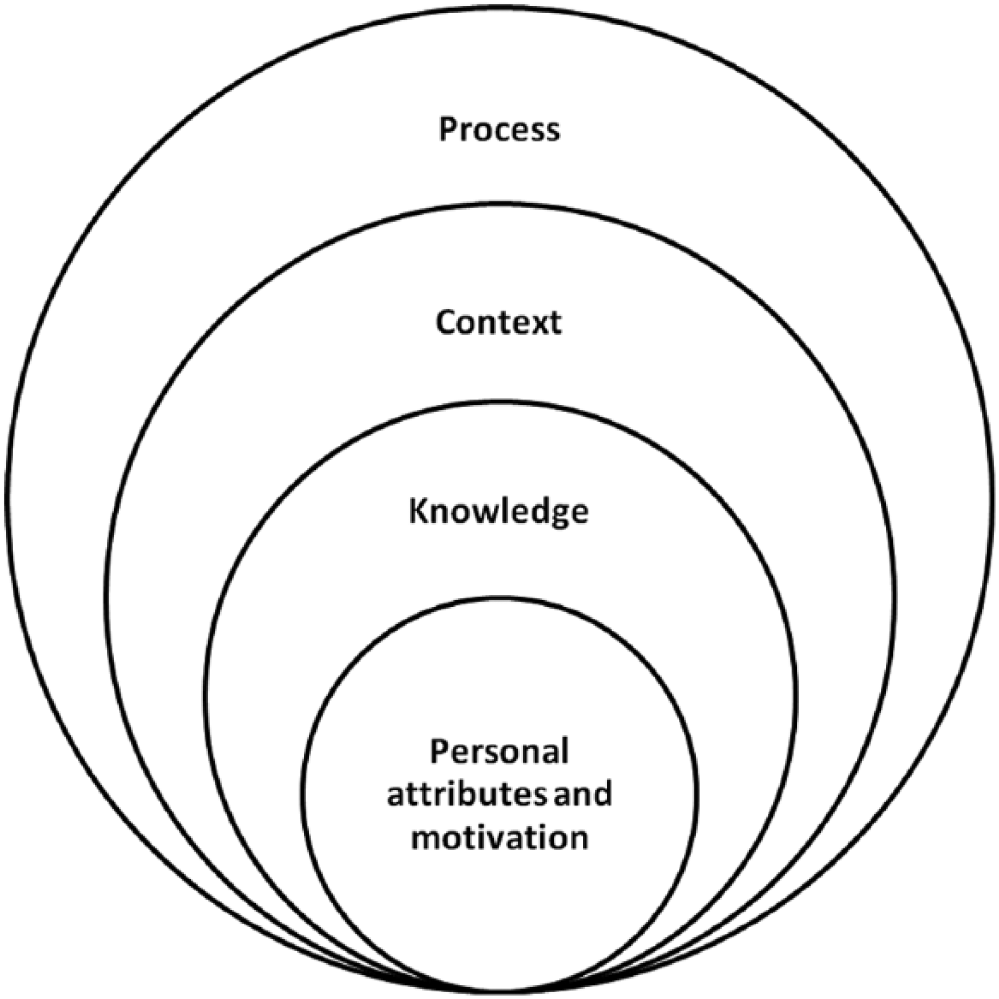
The learner profile of recognition of prior learning candidates.
The diverse nature of life and work experiences gained in different contexts motivates candidates to fulfil a dream of obtaining a degree. Both life and work experiences are linked to the motivation to study and to their preferred qualifications. However, to take responsibility as practitioners to assist the adult learner’s motivation, there is a need for support to be prepared for the demands of assessment in an academic context. The context of work experience differs from the context of higher education and, based on their learner profiles, a particular process is needed to take different learning contexts into consideration. Within the broad theme of common and academic knowledge, different boundary strengths may exist, which are often candidate-specific (Breier, 2011); a challenge that practitioners should considered in an RPL process.
An advantage of mature learners with experience is that they have gained knowledge through experiential learning in authentic learning contexts. For this reason, they bring lived experiences and practical knowledge to the academic context. There are different modes of acquiring knowledge, and the academic community should understand the worth of workplace-based learning since students bring with them “real-world” experiences in a “variety of occupational areas” (Whisemore, 2015, p. 15). Their competencies and attributes include practical skills such as leadership, problem-solving, work-based experience of teamwork, an understanding of diversity, and a sense of self in relation to the changing demands of the workplace, all of which are confirmed by the literature (Booysen, 2012; Druskat & Wheeler, in Clemens & Cord, 2013; Griesel & Parker, 2009). Owing to work experience, they have developed a sense of professionalism and community. The theme describing skills and knowledge acquired seems broad mainly as a result of exposure to a wide range of contexts, and possibly a less developed understanding of the complex structure of knowledge (Cantwell & Scevak, 2004).
The prior learning paper draws strongly on Kolb’s (1984) experiential learning framework (Pokorny & Whittaker, 2014), evident of the role of reflection as a mediation tool for writing a life history narrative. It served as an opportunity to extract and describe learning gained in different contexts and from diverse experiences, being an opportunity to “take stock of existing knowledge” (Duvekot & Schuur, 2014, p. 60). There is a realization of how experience has affected their development and commitment to register for formal studies. They have clear and focused goals, and are aware of their strengths and their ability to overcome hurdles. The writing served as a way of expressing personal and learner identities (Pokorny, 2013, in Pokorny & Whittaker, 2014). As Mullet, Akerson, and Turman (2013, p. 77) confirm, stories matter in adult learning and the adult learner’s past story “shapes the present and thus rules the future.” As mature learners, they are not only proud of their achievements and the realization of valuable knowledge already gained but can appreciate the link between prior learning, the current context, and the future.
To a large extent, themes on the learner profile correspond with those found in RPL-related studies such as those by Pasupathi, Mansour, and Brubaker (2007); J. O. Brown (2001); J. Brown (2015); Pearson (2000); Michelson and Mandell (2004); Lamoreaux (2005); Walters (2015); and Duvekot and Schuur (2014), which confirm the reliability of the findings. Although students within the South African context did not always have favorable conditions and were in many instances disadvantaged by an apartheid system, it is remarkable that themes correlate with those found in similar international studies. J. O. Brown (2001) confirms the value of workplace learning, the ability to reflect and the motivation of RPL candidates. Donoghue, Pelletier, Adams, and Duffield (2002) further agree that the characteristic of being highly motivated is influential in the success of RPL candidates. Both Lamoreaux (2005) and Van Kleef (2007) refer to the adult learner’s ability to reflect—hence, reflection is essential in the conceptual framework of RPL assessment. Since a characteristic of adult learners is to use experience as a learning resource, reflection enables them to reexamine their lives, resulting in increased confidence and self-esteem (Mahe, 2007).
The participants developed useful practical experience and wisdom as adult learners (Breier & Ralphs, 2009), graduate qualities (Griesel & Parker, 2009) through work experience and specific jobs, and through experiential learning contexts. The practical wisdom (Breier, 2011) enables RPL candidates to discern what is beneficial both on a personal and community level. Learners have developed personal characteristics, such as a willingness to learn, motivation, openness, a sense of identity, and self-confidence, that relate favorably to graduate attributes (Griesel & Parker, 2009) expected at university level. Personal qualities and the ability to apply knowledge could help learners to participate and interact in a new learning context. Taking cognizance of the learner profile will enable assessors to respect the prior learning context and identity of the learner as an experienced, skilled, and knowledgeable person (Pokorny & Whitaker, 2014). The very nature of the learner profile of RPL candidates can be perceived as a sound foundation for all learning, but the significance of the learner profile is that a learner-centered approach based on authentic description can improve the quality of the RPL process (Frick, Bitzer, & Leibowitz, 2007). It further allows RPL as a tool for transformation to realize its potential by making visible the human capital that adult learners with experience bring to the learning context (Duvekot, 2014).
The contribution of this empirical research is that it illuminates characteristics not described by the theoretical framework and also unique features not outlined by the studies mentioned. The learner profile in the South African context has distinctive characteristics; these are a strong sense of religion, a future orientation, and a willingness to start at the bottom of a career ladder. The political context and dichotomous past life experiences often cause a situation where adult learners need to enter further formal education without a formal school certificate, yet with a wealth of experience.
Conclusion
To be able to describe the learner profile, we conducted both theoretical and empirical research. From this study, it became apparent that the four perspectives, namely the learner-based, context-based, knowledge-based, and process-based approaches, do not function in isolation, but are interdependent and relate directly to one another, thus justifying a holistic and eclectic approach. The central concept of learning is based on the interaction between the learner, knowledge, the context of learning, and the process involved.
This research confirms that the holistic profile should be considered in an RPL strategy to contribute to a learner-centered approach that RPL sets out to be. These findings apply to the RPL context on different levels, since they have implications for the learner, the RPL practitioner and higher education. An implication at learner level is that learners should be aware of their profile to enable them to draw on their personal strengths, such as persistence, skills acquired, and the ability to learn from experience. These may include the development of personal attributes, their job-specific knowledge, and experiences from different career positions. An approach of confirmation of strengths, instead of weaknesses, may be suitable for this learner profile as they could draw on personal attributes and skills acquired through experience.
RPL practitioners are required to have in-depth knowledge of the learner profile. They should be aware of the specific needs of a learner profile and the profile should inform and influence the RPL strategy. The approach, as used in this research, of considering all four aspects of the holistic learner profile, could serve as a useful model to describe a learner profile. An implication for practice is that it is necessary to listen to the voice of adult learners with experience by acknowledging their wealth of experience. These learners wish to benefit and be empowered by the transformative power of RPL within a new political context. Practices responsive to the student profile will contribute to the main purpose of RPL, which is to empower those previously excluded from educational opportunities.
Considering the nature of unstructured prior learning and of learning acquired in diverse contexts, practitioners should realize that RPL candidates require a focused intervention as preparation for the demands of RPL assessment and the context after assessment. This intervention may act as a forum for bringing together and integrating the different areas of the adult learner’s life and learning experiences, multiple contexts, and development processes into a holistic whole. However, there is a need for further research on the type of support intervention which is most suitable for the learner profile and the demands of a particular assessment strategy. This implies a focused preparation process, leading to a well-prepared student with a better chance to succeed and by preparing them for integration into the formal learning context.
At an institutional level, there should be an awareness that adult learners enter higher education with relevant industry-related experience, wisdom, personal strengths, and a commitment to be successful. Although they begin formal studies at a much later stage in life, they feel ready and motivated to achieve academic success. In the context of higher education, adult learners who have not yet had previous contact with the formal academic context may require a sense of connection and belonging to the new academic community. The specific needs of adult learners should further be included in an institutional framework for student support and learning.
An RPL strategy based on in-depth knowledge of the learner profile in a particular context will contribute to RPL practices that go beyond policy and legislation, and will truly benefit and empower learners.
Footnotes
Acknowledgements
We thank Prof. G. Kamper for the critical review of the article.
Declaration of Conflicting Interests
The author(s) declared no potential conflicts of interest with respect to the research, authorship, and/or publication of this article.
Funding
The author(s) received no financial support for the research, authorship, and/or publication of this article.